Summary
Table of Content

Aerospace Titanium Market
Get a free sample of this report
Form submitted successfully!
Error submitting form. Please try again.
Thank you!
Your inquiry has been received. Our team will reach out to you with the required details via email. To ensure that you don't miss their response, kindly remember to check your spam folder as well!
Request Sectional Data
Thank you!
Your inquiry has been received. Our team will reach out to you with the required details via email. To ensure that you don't miss their response, kindly remember to check your spam folder as well!
Form submitted successfully!
Error submitting form. Please try again.
Aerospace Titanium Market Size
The aerospace titanium market is expanding owing to the increased global aircraft production rates, the adoption of titanium due to its high strength and light weight properties, and the development of military aviation programs around the world. The use of additive manufacturing in complex titanium components and the development of space exploration programs also contribute to the market growth.
Aerospace Titanium Market Key Takeaways
Market Size & Growth
- 2025 Market Size: USD 3.1 Billion
- 2026 Market Size: USD 3.4 Billion
- 2035 Forecast Market Size: USD 7.2 Billion
- CAGR (2026–2035): 8.6%
Regional Dominance
- Largest Market: North America
- Fastest Growing Region: Asia Pacific
Key Market Drivers
- Rising global aircraft production rates.
- Titanium’s superior strength?to?weight ratio.
- Growth in defense aviation programs.
- Adoption of additive manufacturing for complex parts.
- Expansion of space exploration missions.
Challenges
- Supply?chain volatility and dependency.
- Stringent aerospace certification hurdles.
Opportunity
- Hypersonic & reusable systems boost premium titanium use.
- High performance alloy innovation and recycling.
Key Players
- Market Leader: ATI (Allegheny Technologies Inc.) led with over 26.7% market share in 2025.
- Leading Players: Top 5 players in this market include ATI (Allegheny Technologies Inc.), VSMPO-AVISMA Corporation, TIMET (Titanium Metals Corporation), Howmet Aerospace, Kobe Steel, Ltd., which collectively held a market share of 78.4% in 2025.
Get Market Insights & Growth Opportunities
The increased global aircraft production rates are driving the aerospace titanium market as the commercial OEMs are increasing their production to meet the current delivery backlog. The International Air Transport Association (IATA) reported a global commercial aircraft order backlog of over 17,000 aircraft, which is more than ten years of production at current rates. This sustained backlog directly raises the demand for titanium in airframes, landing gear, and engine systems, providing long-term procurement assurance for suppliers of aerospace-grade titanium.
The development of military aviation programs drives the aerospace titanium market as governments are investing heavily in aircraft development. In the U.S. fiscal year 2025 budget, the Department of Defense requested USD 61.2 billion for procurement and research, development, test, and evaluation funding for aircraft and related systems. This significant investment will lead to an increase in the use of titanium in high-performance structural, propulsion, and airframe components, thus driving the market growth.
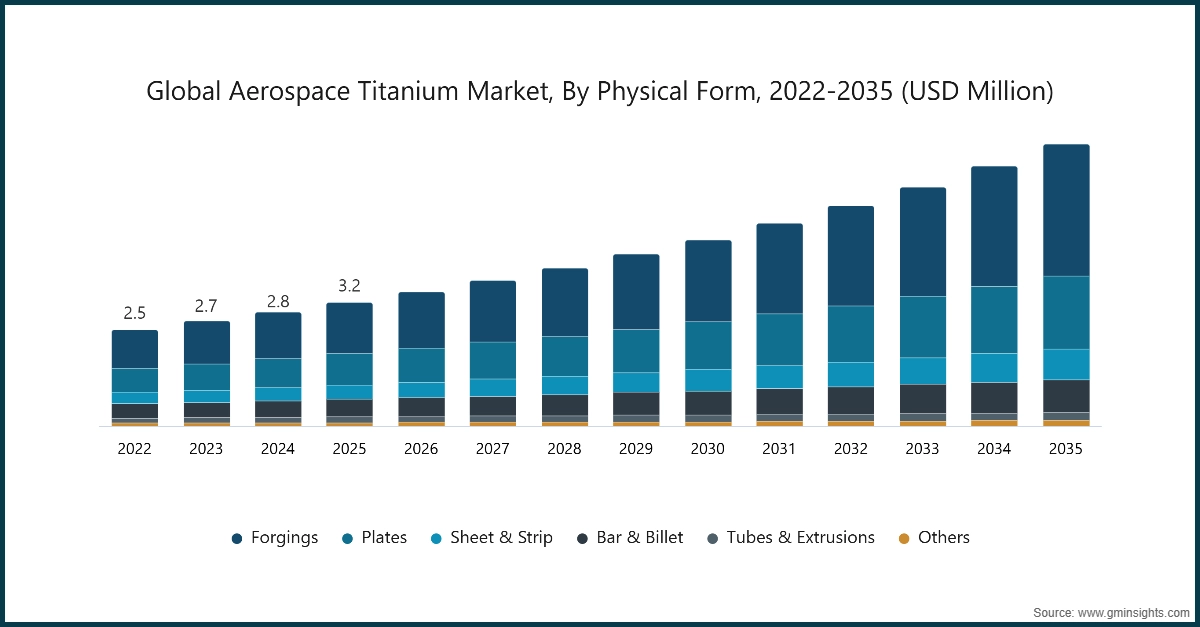
Between 2022 and 2024, the market witnessed considerable growth, increasing from USD 2.4 billion in 2022 to USD 2.9 billion in 2024. This was due to increased production of commercial aircraft, modernization of the defense sector, and consistent demand from engine and structural uses. Increased adoption of additive manufacturing, supply-chain localization efforts, and growing use of titanium in space and reusable launch systems further supported market penetration during this period. These factors collectively strengthened titanium’s role as a critical material across commercial, defense, and space aerospace segments.
The global aerospace titanium market was valued at USD 3.1 billion in 2025. The market is expected to grow from USD 3.4 billion in 2026 to USD 5.2 billion in 2031 & USD 7.2 billion in 2035, at a CAGR of 8.6% during the forecast period according to the latest report published by Global Market Insights Inc.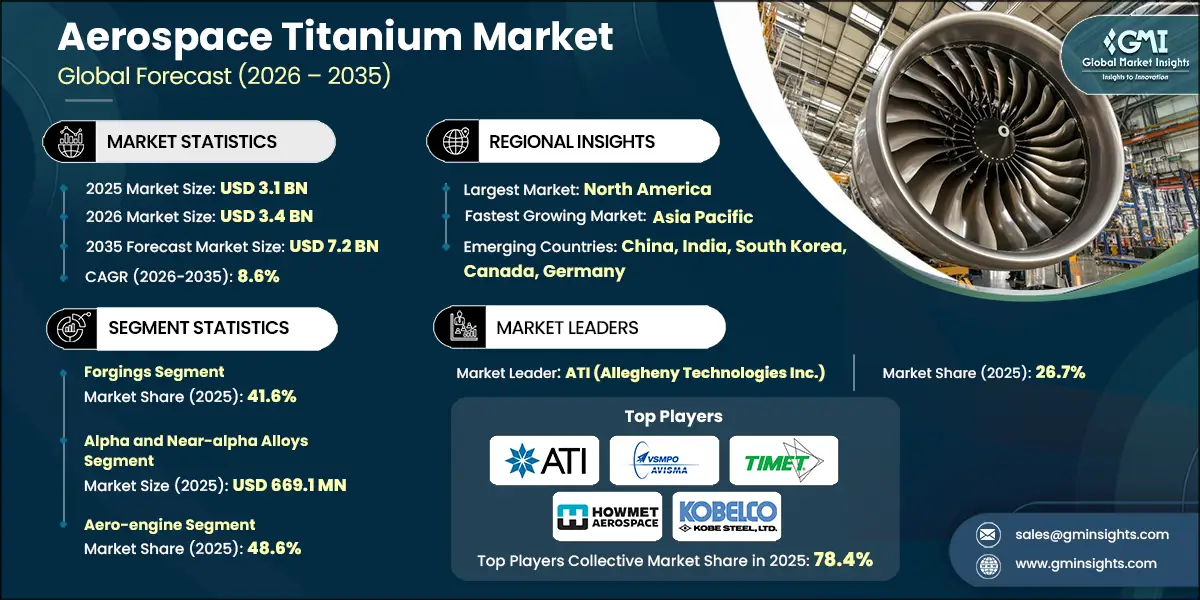
To get key market trends
Aerospace Titanium Market Trends
- The use of recycled titanium in certified aerospace applications is gradually rising as manufacturers seek cost-effectiveness and sustainable practices. Early adoption began around 2020 with OEMs setting goals for a circular economy and scrap recovery programs. This trend is projected to speed up through 2028 as better metallurgical controls are developed. The result will be lower raw material costs, decreased reliance on sponge, and improved environmental performance.
- Digital traceability and data-driven quality assurance are becoming essential in all stages of titanium production and processing. Adoption began around 2019 in response to stricter auditing, documentation, and compliance demands. This trend is likely to persist through 2030 as digital certification becomes the norm. The impact includes faster qualification cycles, fewer material rejections, and stronger regulatory confidence.
- Long-term supply agreements and premium pricing models are becoming more common in aerospace titanium procurement. This trend began after 2021 due to capacity limitations and increasing processing costs. It is likely to continue in the coming decade to ensure a stable supply chain. Improved capacity management, pricing certainty, and less vulnerability to market fluctuations are the expected gains.
Aerospace Titanium Market Analysis
Learn more about the key segments shaping this market
Based on the physical form, the market is divided into forgings, plate, sheet & strip, bar & billet, tubes & extrusions, and others.
- The forgings segment accounted for 41.6% of the market in 2025. Forgings lead the aerospace titanium market because they provide great mechanical strength, uniformity, and durability for critical components like landing gear, engine shafts, and high-stress structural parts. Their ability to withstand heavy loads, fatigue, and temperature changes makes them essential in aerospace applications. High demand from commercial aircraft, defense programs, and space systems ensures consistent use of titanium forgings across global supply chains.
- The plate segment is expected to grow at a rate of 8.9% over the forecast period. This growth comes from the increasing use of titanium plates in airframe structures, defense aircraft, and large aerospace components where flat, high-strength forms are needed. Titanium plates offer excellent corrosion resistance, machinability, and fatigue performance, which support lightweight design and structural integrity.
Based on the alloy type, the global aerospace titanium market is divided into commercially pure (CP) titanium, alpha & near-alpha alloys, beta & metastable beta alloys, and titanium aluminides.
- The alpha and near-alpha alloys segment dominated the market in 2025 with a value of USD 669.1 million. This is due to its wide applications in aero-engine components, airframe structures, and fasteners. These alloys provide great high-temperature performance, corrosion resistance, and fatigue strength, making them vital for critical aerospace components. Their reliability, machinability, and compatibility with modern manufacturing techniques help support their use in commercial and defense aviation programs.
- The beta & metastable beta alloys segment is expected to witness growth at a CAGR of 10.7% during the forecast period. This is due to their rising demand in landing gear, high-strength fasteners, structural parts, and space-related applications. These alloys possess improved strength-to-weight ratios, hardenability, and toughness. The rising demand for next-generation aircraft, reusable space vehicles, and advanced defense programs accelerates adoption of beta and metastable beta titanium alloys.
Learn more about the key segments shaping this market
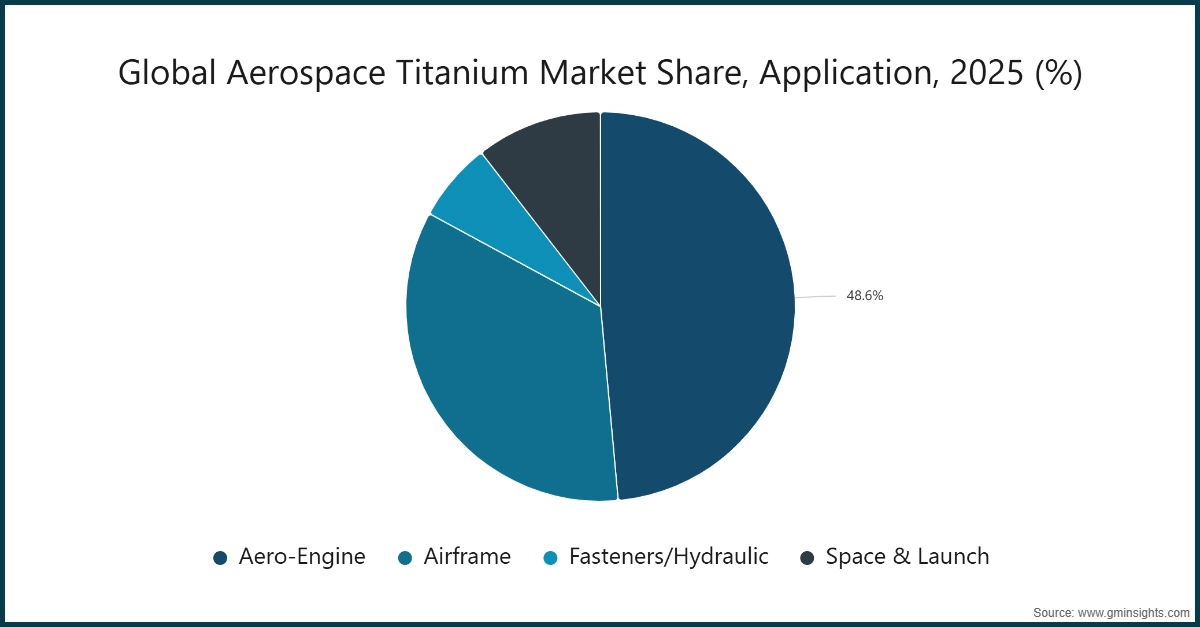
Based on the application, the global aerospace titanium market is divided into aero-engine, airframe, fasteners/hydraulic systems, and space & launch.
- The aero-engine segment led the market in 2025 with a market share of 48.6%. Titanium is widely used in compressor blades, fan cases, turbine disks, and other important engine parts. Commercial aircraft, defense programs, and maintenance, repair, and overhaul activities drive high demand due to titanium’s great strength-to-weight ratio, corrosion resistance, and ability to handle high temperatures. This strong use ensures that aero-engine applications stay the largest segment in the market.
- The space & launch segment is expected to grow at a rate of 10.2% during the forecast period. This growth comes from increasing global investments in reusable launch vehicles, satellites, and deep-space exploration programs. Titanium’s high strength, lightweight properties, and ability to resist extreme temperatures make it perfect for spacecraft structures and engine parts. Rising space exploration efforts and defense space programs are speeding up the use of titanium in this fast-growing segment.
Looking for region specific data?
North America Aerospace Titanium Market
The North America accounted for over 45% of aerospace titanium industry share in 2025.
- In North America, the aerospace titanium market is growing due to rising aircraft production, defense modernization programs, and increased demand for high-performance, lightweight materials in commercial and military aviation. There is broad use of advanced titanium alloys, forgings, and additive manufacturing among major OEMs and Tier-1 suppliers.
- Governments, defense agencies, and private aerospace companies are investing in advanced manufacturing facilities and supply chain expansion to meet production ramp-ups. The region is expected to remain a leader in titanium technology adoption, with commercial aircraft, defense aviation, and space programs driving steady market growth through 2035.
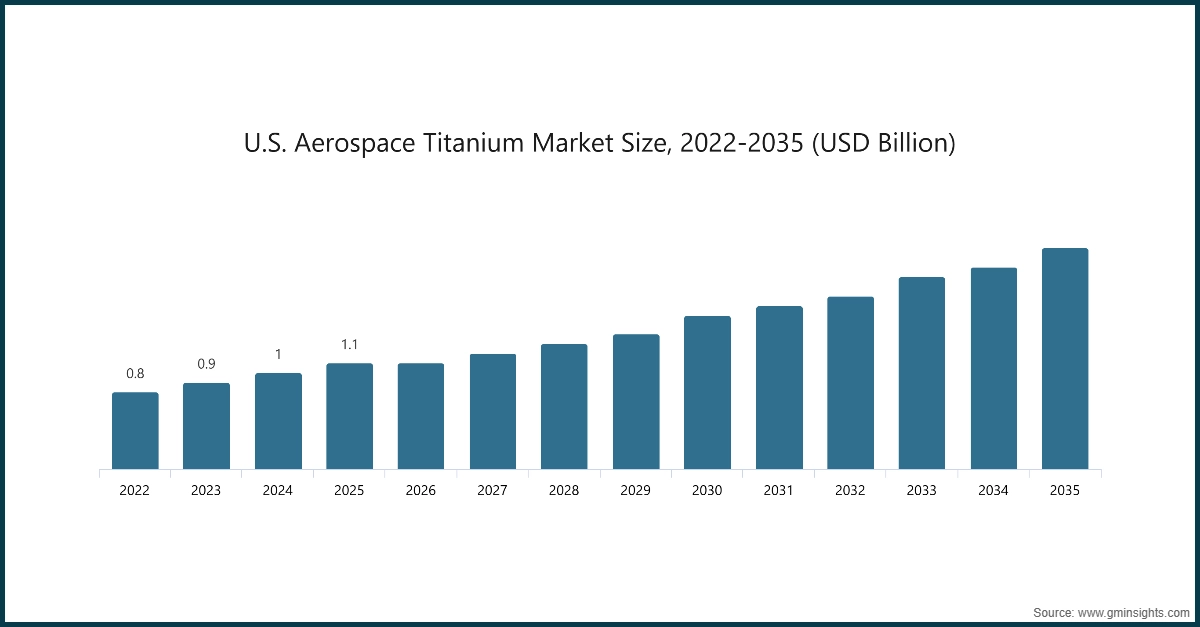
The U.S. market was valued at USD 841.6 million and USD 909.6 million in 2022 and 2023, respectively. The market size reached USD 1.1 billion in 2025, growing from USD 982.9 million in 2024.
- The growth of the aerospace titanium market in the U.S. is particularly strong due to the country’s advanced commercial aircraft production and extensive defense modernization efforts. The U.S. aerospace industry relies heavily on titanium alloys for critical components in jet engines, airframes, and landing gear because of their high strength‑to‑weight ratio and corrosion resistance, making them essential for performance and fuel efficiency in both commercial and military fleets
- The prominence of major OEMs such as Boeing, the U.S. Department of Defense’s focus on next‑generation platforms, and expanding capabilities in additive manufacturing and precision processing systems are driving sustained titanium demand, positioning the U.S. as the largest market in North America
Europe Aerospace Titanium Market
Europe aerospace titanium industry accounted for USD 857.7 million in 2025 and is anticipated to show lucrative growth over the forecast period.
- Europe’s aerospace titanium industry is expanding and this growth is fueled by a solid manufacturing base for commercial aircraft and coordinated defense initiatives that increase the demand for materials in high-performance applications. European aerospace manufacturers, particularly Airbus plants in France and Germany, rely on titanium alloys for engines, airframes, and structural components.
- European suppliers are also increasing adoption of advanced manufacturing technologies like additive manufacturing to reduce waste and lead times, supporting sustained titanium demand through the aerospace value chain.
France dominates the Europe aerospace titanium market, showcasing strong growth potential.
- France leads Europe in aerospace titanium demand as the country has a variety of civil and military aerospace programs that heavily use titanium alloys for structural airframes, engine parts, and components critical for durability. The growth of France’s aerospace industry is supported by major manufacturers and suppliers located in important regions such as Île-de-France and Rhône-Alpes, which focus on lightweight, high-performance materials to improve fuel efficiency and lower operational costs.
- Moreover, French aerospace manufacturers are increasingly integrating sustainable titanium alloy usage. This shift is driven by industry’s emphasis on reducing weight and extending the lifespan of aircraft structures. Government-supported research programs and partnerships with research institutions are speeding up the development of advanced alloys and precision manufacturing techniques. This further strengthens France's position in high-performance titanium production.
Asia Pacific Aerospace Titanium Market
The Asia Pacific market is anticipated to grow at the highest CAGR of 10.4% during the forecast period.
- The Asia‑Pacific aerospace titanium industry is growing rapidly due to expanding domestic aircraft assembly, increasing defense aviation procurements, and rising regional MRO activities. Countries like China, Japan, South Korea, and India are building stronger titanium supply chains by developing downstream processing and alloy fabrication capabilities to support local manufacturers.
- Strategic aerospace projects, including fleet modernization programs and public-private additive manufacturing partnerships, are encouraging the use of premium titanium alloys in engines and airframes. Investment in precision forging and machining centers further drives market growth during this forecast period.
China aerospace titanium market is estimated to grow with a significant CAGR, in the Asia-Pacific market.
- China is seeing a strong uptake of aerospace titanium, driven by national policies that emphasize self-sufficiency in high-performance materials and critical metal supply chains. The country’s push to increase domestic production of narrow‑body aircraft and indigenous defense platforms has elevated requirement for aerospace‑grade titanium alloys, encouraging investment in sponge production, rolling mills, and precision forgings within China.
- Collaboration between Chinese aerospace OEMs and research institutes is focusing on high-temperature titanium alloys and additive manufacturing qualifications. This collaboration is expanding material capabilities and reinforcing China’s status as the fastest-growing market in the Asia-Pacific area.
Middle East and Africa Aerospace Titanium Market
South Africa aerospace titanium industry to experience substantial growth in the Middle East and Africa.
- The UAE aerospace titanium market is expanding steadily as the country builds out advanced aerospace infrastructure and manufacturing capabilities. Major investments, like the new aircraft engine maintenance, repair, and overhaul facility in Al Ain, developed by the Tawazun Council and Mubadala in partnership with Pratt & Whitney, are improving local maintenance capacity. This increases the demand for titanium parts in engine and structure repairs.
- Moreover, partnerships established through events such as the Dubai Airshow 2025, like the partnership between Dassault Aviation, the Technology Innovation Institute, and ASPIRE, are expected to promote next-generation aerospace products. This further increases the use of high-performance titanium alloys in defense, aerospace, and space applications in the UAE.
Aerospace Titanium Market Share
The aerospace titanium industry is led by players such as ATI (Allegheny Technologies Inc.), VSMPO-AVISMA Corporation, TIMET (Titanium Metals Corporation), Howmet Aerospace, and Kobe Steel, Ltd. These five companies cumulatively accounted for 78.4% share of the market in 2025. They have strong business foundations with a diversified product portfolio in titanium, development of new and advanced alloys, and worldwide manufacturing and supply chain networks for the commercial aerospace, defense, and space industries. Their broad product portfolio, including sheets, plates, bars, forgings, and precision-engineered parts, enables them to be at the forefront in critical areas such as aero-engines, airframes, and space vehicles.
These companies maintain a competitive edge through investments in R&D, additive manufacturing, advanced alloy innovation, and strategic partnerships with OEMs. Their abilities to produce high-performance, lightweight titanium solutions enable them to capture a significant market share considering the growing global demand for aircraft production, defense upgrades, and space exploration efforts.
Aerospace Titanium Market Companies
Prominent players operating in the aerospace titanium industry are as mentioned below:
- Acnis International
- AEM Metal
- Allegheny Technologies Inc. (ATI)
- Aubert & Duval
- Carpenter Technology Corporation
- Dynamic Metals Ltd.
- Gould Alloys
- Howmet
- Kobe Steel, Ltd.
- Nippon Steel Corporation
- PJSC VSMPO-AVISMA Corporation
- Plymouth Tube Company USA
- Shaanxi Dongyu Titanium Industry Co., Ltd.
- Supra Alloys
- Titanium Metals Corporation (TIMET)
- ATI (Allegheny Technologies Inc.)
ATI supplies high-performance titanium mill products, including sheets, plates, bars, and forgings, to commercial and defense OEMs. Its wide product range, precise manufacturing, and strong presence in North America and global supply chains help it achieve high market penetration.
VSMPO-AVISMA offers broad production capabilities, integration across the value chain, and long-term deals with major OEMs ensure its leading market position. Ongoing research and development, creation of advanced alloys, and strategic growth strengthen its competitive position in high-performance aerospace titanium.
TIMET supplies titanium mill products and engineered titanium solutions for commercial and defense aerospace initiatives. Its product line includes sheets, plates, bars, and forgings designed for aero-engines, airframes, and structural components. TIMET’s advanced processing skills, quality certifications, and partnerships with aircraft makers ensure strong use of its titanium products.
Howmet Aerospace provides engineered titanium components and high-performance alloys for aerospace and defense uses. The company provides forgings, castings, and precision-milled titanium parts for aero-engines, airframes, and landing gear.
Kobe Steel is a Japanese titanium producer serving the aerospace, defense, and industrial markets. The company offers titanium ingots, mill products, and precision-engineered components for airframes, engines, and space vehicles.
Aerospace Titanium Market Report Attributes
| Key Takeaway | Details |
|---|---|
| Market Size & Growth | |
| Base Year | 2025 |
| Market Size in 2025 | USD 3.1 Billion |
| Market Size in 2026 | USD 3.4 Billion |
| Forecast Period 2026-2035 CAGR | 8.6% |
| Market Size in 2035 | USD 7.2 Billion |
| Key Market Trends | |
| Drivers | Impact |
| Rising global aircraft production rates | Drives 30% growth by increasing titanium demand as rising commercial aircraft production rates lead to higher fleet deliveries, directly boosting procurement of titanium for airframes, landing gear, and engine components. |
| Titanium’s superior strength-to-weight ratio | Supports 25% growth by allowing aircraft manufacturers to design lighter yet stronger structures, improving fuel efficiency, payload capacity, and operational range, while reducing overall maintenance costs and emissions. |
| Growth in defense aviation programs | Contributes 20% by driving increased procurement of titanium for fighter jets, transport aircraft, and unmanned aerial vehicles. |
| Adoption of additive manufacturing for complex parts | Adds 15% growth through enabling production of complex, near-net-shape titanium components with minimal waste and shorter lead times. |
| Expansion of space exploration missions | Accounts 10% growth as space exploration missions and launch vehicle programs specify high-temperature, lightweight, and durable titanium alloys for structural and propulsion systems. |
| Pitfalls & Challenges | Impact |
| Supply-chain volatility and dependency | Restrains market growth as aerospace titanium supply remains concentrated in a few countries. Fluctuations in raw material availability, export restrictions, and geopolitical tensions create uncertainty for OEMs, increasing procurement costs and causing production delays in both commercial and defense aviation programs. |
| Stringent aerospace certification hurdles | Limits adoption because lengthy approval processes from FAA, EASA, and other authorities slow entry of innovative titanium components, restricting large-scale deployment and reducing responsiveness to emerging aircraft design trends or defense program requirements. |
| Opportunities: | Impact |
| Hypersonic & reusable systems boost premium titanium use | Presents significant growth potential as hypersonic vehicles and reusable launch systems require titanium alloys that tolerate extreme heat, high stress, and repeated launch cycles. These applications drive demand for premium-grade titanium and specialized fabrication techniques, creating new high-margin opportunities for suppliers capable of meeting stringent material and performance specifications. |
| High performance alloy innovation and recycling | Offers opportunity by enabling circular supply chains and high-performance alloy solutions, meeting both environmental goals and rising demand for lightweight, durable components across commercial, defense, and space programs, while fostering technological differentiation for titanium suppliers. |
| Market Leaders (2025) | |
| Market Leader |
26.7% market share |
| Top Players |
Collective Market Share is 78.4% |
| Competitive Edge |
|
| Regional Insights | |
| Largest Market | North America |
| Fastest growing market | Asia Pacific |
| Emerging countries | China, India, South Korea, Canada, Germany |
| Future outlook |
|
What are the growth opportunities in this market?
Aerospace Titanium Industry News
- In December 2025, Howmet Aerospace announced a definitive agreement to acquire Consolidated Aerospace Manufacturing from Stanley Black & Decker for approximately USD 1.8 billion. The deal will expand Howmet’s aerospace components business, adding fasteners and engineered parts to its portfolio and strengthening its supply position for commercial and defense programs as aircraft production scales.
- In August 2025, VSMPO‑AVISMA Corporation produced its one‑millionth titanium ingot at its Verkhnyaya Salda facility, marking a major production milestone. This achievement reflects expanding capacity and operational scale, reinforcing VSMPO‑AVISMA’s ability to meet growing global aerospace demand for engineered titanium products used in airframes and engines.
- In July 2025, ATI extended and expanded its long‑term titanium supply agreement with Boeing, reinforcing its role as a key supplier of high‑performance titanium materials for multiple commercial aircraft programs. The agreement covers a broad portfolio of titanium products, including ingots, billets, and flat‑rolled sheet, and supports ramped production for future narrow‑ and wide‑body aircraft, strengthening ATI’s market position.
The aerospace titanium market research report includes in-depth coverage of the industry with estimates and forecast in terms of revenue (USD Million) from 2022 – 2035 for the following segments:
Market, By Physical Form
- Forgings
- Plate
- Sheet & strip
- Bar & billet
- Tubes & extrusions
- Others (wire, casting, flash-welded rings, specialty forms / extrusions)
Market, By Alloy Type
- Commercially pure (CP) titanium (Grades: 1-4, 7, 11, 16, 17, 26, 27)
- Alpha & near-alpha alloys
- Ti-5Al-2.5Sn
- Ti-6242 (Ti-6Al-2Sn-4Zr-2Mo)
- Alpha-beta alloys
- Ti-6Al-4V
- Ti-6Al-4V ELI
- Other alpha-beta alloys (Ti-3Al-2.5V, Ti-6Al-7Nb, Ti-6-22-22)
- Beta & metastable beta alloys (Ti-10V-2Fe-3Al, Ti-15V-3Al-3Cr-3Sn, Ti-17, Beta-21S)
- Titanium aluminides (gamma-TiAl)
Market, By Application
- Aero-engine applications
- Rotating components (fan blades, compressor blades, discs, rotors)
- Static engine components (casings, frames, vanes)
- Engine nacelles & thrust reversers
- Airframe structural applications
- Primary structures (wing forgings, bulkheads, frames)
- Attachment & interface components
- Landing systems (landing gear, struts, actuators)
- Fasteners, springs & hydraulic systems
- Space & launch vehicle applications
- Pressure vessels & COPV liners
- Cryogenic systems (LOX, LH2, LCH4 hardware)
- Rocket & satellite structures
Market, By End-use Industry
- Commercial
- Government and defense
The above information is provided for the following regions and countries:
- North America
- U.S.
- Canada
- Europe
- Germany
- UK
- France
- Spain
- Italy
- Russia
- Asia Pacific
- China
- India
- Japan
- Australia
- South Korea
- Latin America
- Brazil
- Mexico
- Argentina
- Middle East and Africa
- South Africa
- Saudi Arabia
- UAE
Frequently Asked Question(FAQ) :
What is the market size of the aerospace titanium in 2025?
The market size was USD 3.1 billion in 2025, with a CAGR of 8.6% expected through 2035, driven by increased global aircraft production rates, titanium's superior strength-to-weight properties, and growing military aviation programs worldwide.
What is the projected value of the aerospace titanium industry by 2035?
The aerospace titanium market is expected to reach USD 7.2 billion by 2035, propelled by rising commercial aircraft deliveries, expansion of space exploration missions, and advancements in additive manufacturing and high-temperature alloy development.
What is the current aerospace titanium industry size in 2026?
The market size is projected to reach USD 3.4 billion in 2026.
How much revenue did the forgings physical form segment generate in 2025?
The forgings segment dominated the physical form market with a 41.6% share in 2025, driven by its superior mechanical strength, uniformity, and durability for critical components like landing gear.
What was the market share of the aero-engine applications segment in 2025?
The aero-engine applications segment led the market with a 48.6% share in 2025, driven by widespread use of titanium in compressor blades, fan cases, and turbine disks across commercial aircraft.
What is the growth outlook for the beta & metastable beta alloys segment?
The beta & metastable beta alloys segment is the fastest-growing alloy type with a CAGR of 10.7% expected through 2035, driven by rising demand in landing gear.
Which region leads the aerospace titanium market?
North America leads the global aerospace titanium market, accounting for a 45% market share in 2025, supported by advanced commercial aircraft production.
What are the key trends shaping the aerospace titanium market?
Key trends include increased use of recycled titanium, adoption of digital traceability and quality systems, growth in long-term supply agreements, and rising use of additive manufacturing for complex titanium components.
Who are the key players in the aerospace titanium market?
Key players include Acnis International, AEM Metal, Allegheny Technologies Inc. (ATI), Aubert & Duval, Carpenter Technology Corporation, Dynamic Metals Ltd., Gould Alloys, Howmet, Kobe Steel Ltd., Nippon Steel Corporation, PJSC VSMPO-AVISMA Corporation, Plymouth Tube Company USA.
Aerospace Titanium Market Scope
Related Reports