Summary
Table of Content

Aerospace Sealants Market
Get a free sample of this report
Form submitted successfully!
Error submitting form. Please try again.
Thank you!
Your inquiry has been received. Our team will reach out to you with the required details via email. To ensure that you don't miss their response, kindly remember to check your spam folder as well!
Request Sectional Data
Thank you!
Your inquiry has been received. Our team will reach out to you with the required details via email. To ensure that you don't miss their response, kindly remember to check your spam folder as well!
Form submitted successfully!
Error submitting form. Please try again.
Aerospace Sealants Market Size
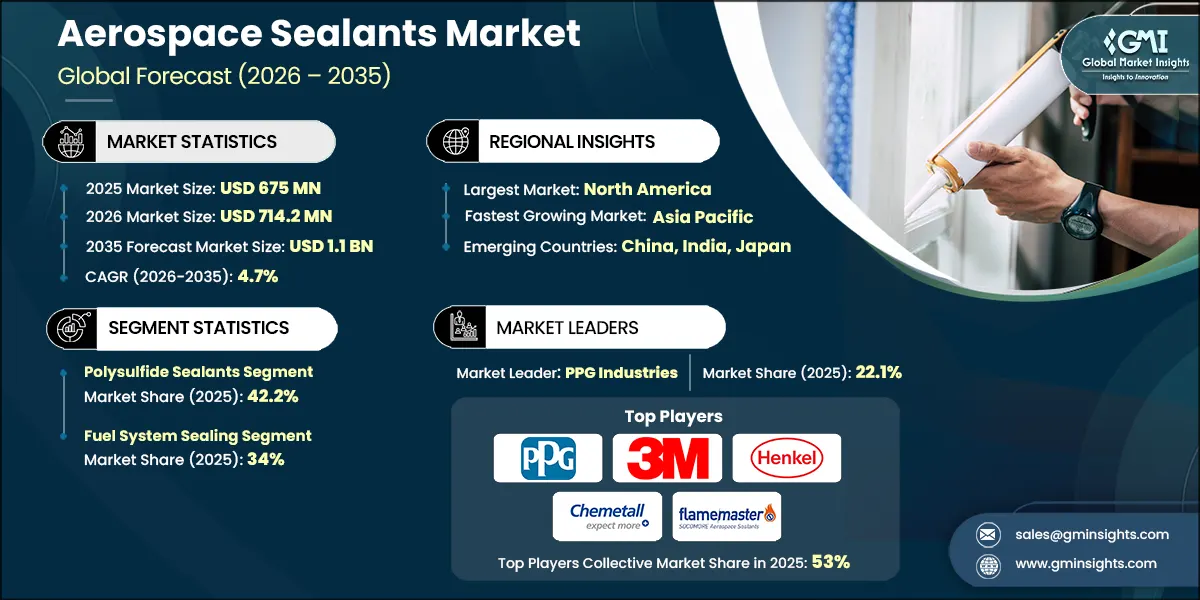
The global aerospace sealants market was valued at USD 675 million in 2025 and is projected to rise from USD 714.2 million in 2026 to USD 1.1 billion by 2035, expanding at a CAGR of 4.7% according to latest report published by Global Market Insights Inc.
Aerospace Sealants Market Key Takeaways
Market Size & Growth
- 2025 Market Size: USD 675 Million
- 2026 Market Size: USD 714.2 Million
- 2035 Forecast Market Size: USD 1.1 Billion
- CAGR (2026–2035): 4.7%
Regional Dominance
- Largest Market: North America
- Fastest Growing Region: Asia Pacific
Key Market Drivers
- Expansion of commercial fleets.
- Safety & quality regulations.
- Military & defense programs.
Challenges
- High development/certification costs.
Opportunity
- APAC fleet growth and MRO build-out expand regional consumption.
Key Players
- Leading Players: Top 5 players in this market include PPG Industries, 3M, Henkel, Chemetall, Flamemaster, which collectively held a market share of 53% in 2025.
Get Market Insights & Growth Opportunities
- Boeing’s CMO 2025–2044 projects 43,600 new aircraft over 20 years, and FAA projections show the U.S. commercial fleet expanding from 5,815 aircraft (2021) to 8,894 by 2042, each aircraft consumes ~200–300 lb of sealants over its lifecycle, with Asia Pacific representing 46% of global demand in Airbus’s GMF.
- FAA TSOs, EASA CS standards, and MIL specs (e.g., MIL PRF 81733; MIL S 8802) demand extensive testing, fuel resistance, thermal cycling, adhesion, and durability per AC 20 62E and related guidance. The Oct 2025 FAA EASA workshop underscored harmonized material standards across supply chains.
- The U.S. FY2025 DoD budget totals about USD 850 billion, backing procurement and modernization (e.g., F 35, B 21) that require sealants with stealth coating compatibility, supersonic tolerance, and long service life. Military specifications drive premium material usage and stable demand.
To get key market trends
Aerospace Sealants Market Trends
- Engine compartments and hot zones can exceed +400°F while cruise altitude airframes see lows near −65°F. Certification regimes target thousands of thermal cycles without adhesion loss or embrittlement, which pushes suppliers toward fluorosilicone and polyacrylate systems rated for elevated temperatures with strong fuel and hydraulic fluid resistance. The numbers tell us why to keep pace with hot section performance, sealants must deliver stability across ~465°F deltas while maintaining elasticity and bond strength.
- OEM weight reduction targets in the 20–25% range sharpen focus on lower density chemistries, thinner bond lines, and better wet out that can trim 30–100 lb of sealant weight depending on platform class. A 1% weight cut can improve fuel efficiency by roughly 0.75%, so material substitutions that save tens of pounds add up over multi year operating profiles .
- EASA’s environmental framework targets 50–70% VOC cuts by 2030 versus 2020 baselines, accelerating the move to water based, high solids, and solvent free systems. Industry data reveals tier one suppliers reworking portfolios to remove PFAS while preserving qualified performance envelopes. Expect adoption to pull through MRO as well, because airlines want faster cure, less odor, and safer handling on the line.
Aerospace Sealants Market Analysis
Learn more about the key segments shaping this market
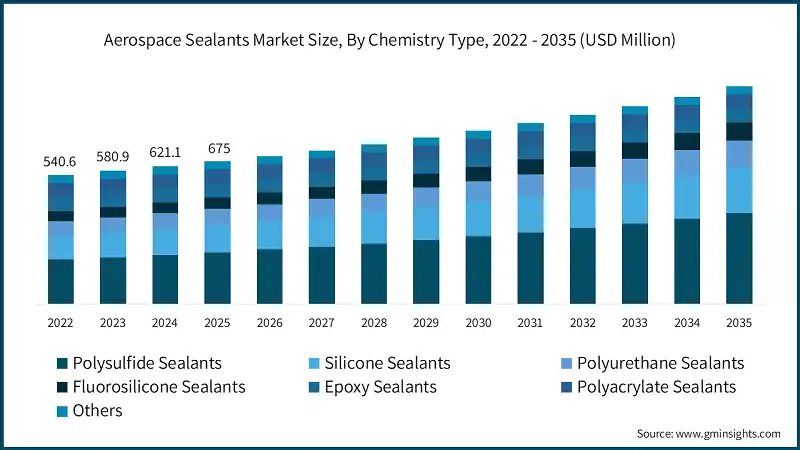
Based on chemistry type the market is segmented as polysulfide sealants, silicone sealants, polyurethane sealants, fluorosilicone sealants, epoxy sealants, polyacrylate sealants, and others.
- Polysulfide sealants held about 42.2% market share in 2025, led by integral fuel tank and fuel system sealing where long proven fuel resistance after extended immersion and thermal cycling remains the benchmark, qualification typically references MIL PRF 81733 and ASTM D1308 protocols. Silicone systems accounted for roughly 23.2% market share in 2025 owing to strength of temperature tolerance from about −85°F to +500°F, making them essential in engine spaces, ECS ducting, and windshield perimeters with low smoke/flammability requirements emphasized by EASA . Polyurethanes provide abrasion and impact resistance for structural and exterior applications, though shelf life and cold storage practices require careful adherence to AC 20 62E . Fluorosilicone materials blend silicone like temperature stability with upgraded resistance to fuels and hydraulic fluids. Epoxies address high strength bonding and potting in avionics and structures, while polyacrylates bridge performance gaps at a lower cost than fluorosilicones other chemistries and hybrids fill niche requirements.
- Looking at end use pull, commercial fleets dominate consumption due to higher build rates and frequent C /D checks, with military programs specifying premium grades for extreme environments and long service lives. The real driver here is qualification depth programs favor materials with broad QPL listings and long service records to minimize change risk and re qualification burden. As APAC platforms proliferate, qualification packages for polysulfide, silicone, and polyurethane families expand regionally, supporting the market across OEM and MRO channels.
Learn more about the key segments shaping this market
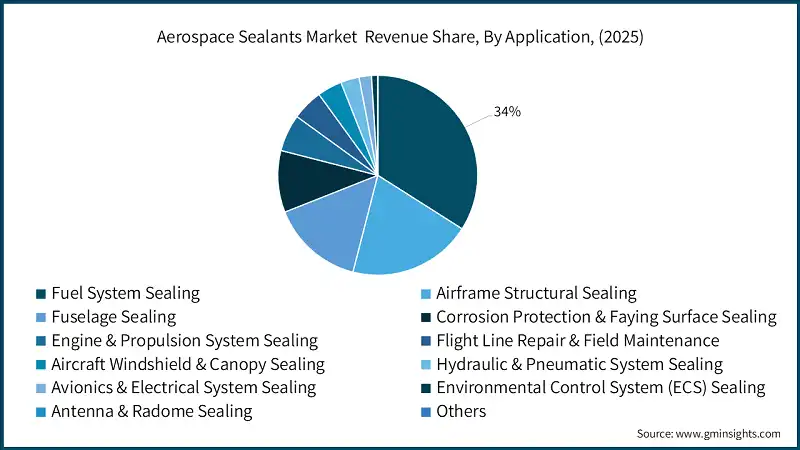
Based on application the aerospace sealants market is segmented as fuel system sealing, airframe structural sealing, fuselage sealing, corrosion protection & faying surface sealing, engine & propulsion system sealing, flight line repair & field maintenance, aircraft windshield & canopy sealing, hydraulic & pneumatic system sealing, avionics & electrical system sealing, environmental control system (ECS) sealing, antenna & radome sealing, others.
- Fuel system sealing represents the largest market share of 34% in 2025, spanning integral tanks, fuel cells, caps, and line fittings, qualification involves 168 hour immersions at elevated temperature followed by property retention checks, which is why polysulfides still anchor this category. Airframe structural sealing held 20% market share in 2025, where polyurethanes deliver mechanical strength in joints exposed to loads, fatigue, and weathering. Fuselage sealing relies on silicone and polyurethane to maintain pressure integrity and moisture defense through repeated pressurization cycles.
- Hot zone engine and propulsion sealing uses high temp silicone/fluorosilicone for nacelles, exhaust, and thrust reversers field repair and line maintenance prioritizes rapid cure chemistries for overnight turns. Windshield and canopy, hydraulic/pneumatic, avionics and electrical, ECS, antenna/radome, and other special duties round out the profile. Single aisles and wide bodies consume the most total material, but rotorcraft and UAVs create distinct requirements for vibration endurance and low weight chemistries—factors that keep innovation flowing in the market.
Looking for region specific data?
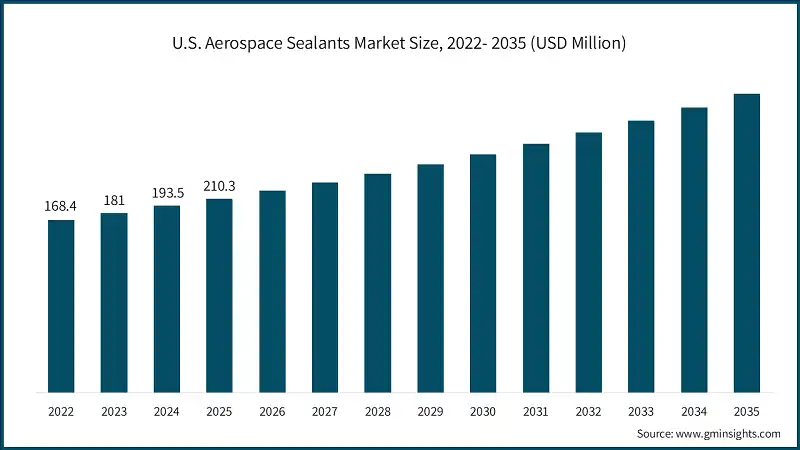
The U.S. aerospace sealants market valued at USD 210.3 million in 2025 and estimated to grow to almost USD 336.1 million by 2035. North America holds around 38% of the market share in 2025.
- North America’s aerospace sealants industry remains the largest on OEM presence, defense spending, and MRO density. The U.S. commercial fleet is projected to rise from 5,815 aircraft in 2021 to 8,894 by 2042, supporting recurring aftermarket demand. PPG’s USD 380 million Shelby, NC investment adds manufacturing capacity for coatings and sealants with H1 2027 completion plans. Add the FY2025 DoD budget of ~USD 850 billion.
- The Europe aerospace sealants market is underpinned by Airbus production in France, Germany, Spain, and the UK, plus a deep bench of MROs. EASA reported 8.3 million flights in 2023, which aligns with elevated maintenance workloads and steady sealant pull through. Environmental policy is shaping portfolios, stricter VOC and hazardous substance rules are accelerating low VOC, PFAS free adoption, and suppliers continue expanding regional application engineering and supply capabilities to support qualified alternatives.
- Asia Pacific is the fastest growing region for the aerospace sealants market, with Airbus projecting 19,560 new aircraft over 20 years about 46% of global demand. China and India are building domestic manufacturing and MRO capacity, and defense modernization in Japan and South Korea adds premium grade requirements. Accelerated adoption of international qualification standards and a pivot from price to performance as regional fleets scale and age.
Aerospace Sealants Market Share
The aerospace sealants industry shows moderate concentration: the top five players PPG Industries, 3M, Henkel, Chemetall, Flamemaster control roughly 53%, while the remaining ~47% is held by a long tail of regional and niche specialists. PPG is one of the main players in the market, leveraging decades of qualification data, a broad portfolio spanning polysulfide fuel tank sealants through high temp silicones, and a global service network. The firm committed USD 380 million to a new Shelby, NC facility to support expected growth across OEM and MRO channels, and continues to seed the pipeline with new products such as PR 2940 ESPA and PR 2936 launched in 2024.
- PPG Industries
- PPG Industries serves commercial, military, and general aviation customers with fuel tank polysulfides (e.g., PR 1422, PR 1440, PR 1776), polyurethane structural systems, and high temperature silicones; its $380 million Shelby, NC plant set for H1 2027 expands capacity and proximity to customers while its 2024 launches (PR 2940 ESPA and PR 2936) address rapid cure and processability requirements.
- PPG Industries serves commercial, military, and general aviation customers with fuel tank polysulfides (e.g., PR 1422, PR 1440, PR 1776), polyurethane structural systems, and high temperature silicones; its $380 million Shelby, NC plant set for H1 2027 expands capacity and proximity to customers while its 2024 launches (PR 2940 ESPA and PR 2936) address rapid cure and processability requirements.
- 3M
- 3M’s aerospace business spans fuel resistant sealants, structural adhesives, and specialty materials; the 2025 EC 9370 B/A FST extension supports interior sandwich panels, and the May 2024 portfolio refresh aligns with evolving regulatory and application needs, including PFAS reformulations under requalification programs .
- 3M’s aerospace business spans fuel resistant sealants, structural adhesives, and specialty materials; the 2025 EC 9370 B/A FST extension supports interior sandwich panels, and the May 2024 portfolio refresh aligns with evolving regulatory and application needs, including PFAS reformulations under requalification programs .
- Henkel
- Henkel, through Loctite, offers a wide range of aerospace sealants and adhesives and has executed a sequence of moves acquiring Seal for Life (Apr 2024), expanding India manufacturing (Jul 2024), partnering with Celanese on water based technologies (Nov 2024), and launching an Application Engineering Center in Chennai (Feb 2025) to deepen regional support and meet environmental goals.
- Henkel, through Loctite, offers a wide range of aerospace sealants and adhesives and has executed a sequence of moves acquiring Seal for Life (Apr 2024), expanding India manufacturing (Jul 2024), partnering with Celanese on water based technologies (Nov 2024), and launching an Application Engineering Center in Chennai (Feb 2025) to deepen regional support and meet environmental goals.
- Chemetall
- Chemetall provides sealants and surface treatment systems with emphasis on environmentally compliant chemistries and corrosion protection, while Dow Silicones delivers silicone and fluorosilicone options suited for extremes of temperature and fluid exposure.
- Chemetall provides sealants and surface treatment systems with emphasis on environmentally compliant chemistries and corrosion protection, while Dow Silicones delivers silicone and fluorosilicone options suited for extremes of temperature and fluid exposure.
- Flamemaster
- Flamemaster Sealants supply qualified polysulfide, polyurethane, and specialty lines with responsiveness valued by MRO and cost sensitive segments. Master Bond focuses on epoxy based systems for structural bonding, potting, and electronic protection in avionics where dielectric strength and thermal stability matter.
- Flamemaster Sealants supply qualified polysulfide, polyurethane, and specialty lines with responsiveness valued by MRO and cost sensitive segments. Master Bond focuses on epoxy based systems for structural bonding, potting, and electronic protection in avionics where dielectric strength and thermal stability matter.
Aerospace Sealants Market Companies
Major players operating in the aerospace sealants industry are:
- PPG Industries
- 3M
- Chemetall
- Cytec Industries
- Dow Corning
- Flamemaster
- Henkel
- Master Bond
- Permatex
- Royal Adhesives & Sealants
Aerospace Sealants Market Report Attributes
| Key Takeaway | Details |
|---|---|
| Market Size & Growth | |
| Base Year | 2025 |
| Market Size in 2025 | USD 675 Million |
| Market Size in 2026 | USD 714.2 Million |
| Forecast Period 2026 - 2035 CAGR | 4.7% |
| Market Size in 2035 | USD 1.1 Billion |
| Key Market Trends | |
| Drivers | Impact |
| Expansion of commercial fleets | Increases demand for reliable and durable aerospace sealants to support fleet growth. |
| Safety & quality regulations | Drive innovation and adoption of higher-standard sealants to ensure compliance and safety. |
| Military & defense programs | Boost demand for specialized, high-performance sealants suited for harsh environment applications. |
| Pitfalls & Challenges | Impact |
| High development/certification costs | Limit market entry and increase overall expenses for manufacturers, potentially slowing innovation. |
| Opportunities: | Impact |
| APAC fleet growth and MRO build-out expand regional consumption | Create significant opportunities for increased sales and market penetration in the Asia-Pacific region. |
| Market Leaders (2025) | |
| Market Leaders |
22.1 % market share |
| Top Players |
|
| Competitive Edge |
|
| Regional Insights | |
| Largest Market | North America |
| Fastest growing market | Asia Pacific |
| Emerging country | China, India, Japan |
| Future outlook |
|
What are the growth opportunities in this market?
Aerospace Sealants Industry News
- In May 2025, PPG announced that they will invest USD 380 million to build a new aerospace coatings and sealants facility in Shelby NC. This new facility will help company to meet growing demand in aerospace industry.
In August 2025, CDI products launched its new aerospace sealing system product line and digital catalogue. These products are designed with aerospace grade material compounds.
The aerospace sealants market research report includes in-depth coverage of the industry, with estimates & forecast in terms of revenue (USD Billion) and volume (Kilo Tons) from 2022 to 2035, for the following segments:
Market, By Chemistry Type
- Polysulfide sealants
- Cured polysulfide
- Non-cured (uncured) polysulfide
- Silicone sealants
- RTV silicone (non-corrosive)
- Low-outgassing silicone
- High-temperature silicone
- Fluorosilicone sealants
- Polyurethane sealants
- Polyether polyurethane
- Polyester polyurethane
- Polyacrylate sealants
- Epoxy sealants
- Others
Market, By Application
- Fuel system sealing
- Integral fuel tank sealing
- Fuel line & fitting sealing
- Airframe structural sealing
- Fuselage sealing
- Aircraft windshield & canopy sealing
- Flight line repair & field maintenance
- Engine & propulsion system sealing
- Hydraulic & pneumatic system sealing
- Avionics & electrical system sealing
- Environmental control system (ECS) sealing
- Antenna & radome sealing
- Corrosion protection & faying surface sealing
- Others
Market, By Aircraft Type
- Commercial aircraft
- Narrow-body aircraft
- Wide-body aircraft
- Regional aircraft
- Business & general aviation
- Military aircraft
- Fighter & combat aircraft
- Transport & tanker aircraft
- Rotorcraft (helicopters)
- Civil helicopters
- Military helicopters
- Unmanned aerial vehicles (UAVs) / drones
- Military UAVs
- Commercial UAVs
- Others
Market, By End Use Industry
- Commercial aviation
- Military & defense
- Space & satellite
- Others
The above information is provided for the following regions and countries:
- North America
- U.S.
- Canada
- Europe
- UK
- Germany
- France
- Italy
- Spain
- Rest of Europe
- Asia Pacific
- China
- India
- Japan
- South Korea
- Australia
- Rest of Asia Pacific
- Latin America
- Brazil
- Mexico
- Argentina
- Rest of Latin America
- Middle East & Africa
- UAE
- Saudi Arabia
- South Africa
- Rest of Middle East & Africa
Frequently Asked Question(FAQ) :
What is the aerospace sealants market size in 2025?
The global market size for aerospace sealants was valued at USD 675 million in 2025. Growing commercial aircraft production, expanding MRO activities, and stringent safety regulations are supporting market growth.
What is the market size of the aerospace sealants industry in 2026?
The market size for aerospace sealants is projected to reach USD 714.2 million in 2026, reflecting steady expansion driven by rising aircraft deliveries and aftermarket demand.
What is the projected value of the aerospace sealants market by 2035?
The market size for aerospace sealants is expected to reach USD 1.1 billion by 2035, growing at a CAGR of 4.7% from 2026 to 2035. This growth is fueled by fleet expansion, defense modernization programs, and increasing demand for high-performance sealing materials.
How much revenue did the polysulfide sealants segment generate in 2025?
Polysulfide sealants accounted for about 42.2% of the market share in 2025, making them the largest chemistry segment. Their dominance is driven by extensive use in fuel system sealing and proven resistance to fuels and thermal cycling.
What was the market share of the fuel system sealing application in 2025?
Fuel system sealing represented approximately 34% of the market share in 2025, supported by high qualification requirements and the continued reliance on polysulfide sealants for integral fuel tanks and fuel lines.
Which region leads the aerospace sealants market?
North America leads the global market, accounting for around 38% share in 2025. The region’s leadership is supported by strong OEM presence, high defense spending, and dense MRO infrastructure.
What are the key trends shaping the aerospace sealants industry?
Key trends include adoption of low-VOC and solvent-free formulations, increased use of fluorosilicone and high-temperature silicone sealants, weight-reduction initiatives, and growing emphasis on environmentally compliant chemistries.
Who are the key players in the aerospace sealants market?
Key players include PPG Industries, 3M, Henkel, Chemetall, Flamemaster, Dow Corning, Master Bond, Permatex, Cytec Industries, and Royal Adhesives & Sealants. These companies focus on product qualification, sustainability, and expanding global service capabilities.
Aerospace Sealants Market Scope
Related Reports