Summary
Table of Content

Aerogels Market
Get a free sample of this report
Form submitted successfully!
Error submitting form. Please try again.
Thank you!
Your inquiry has been received. Our team will reach out to you with the required details via email. To ensure that you don't miss their response, kindly remember to check your spam folder as well!
Request Sectional Data
Thank you!
Your inquiry has been received. Our team will reach out to you with the required details via email. To ensure that you don't miss their response, kindly remember to check your spam folder as well!
Form submitted successfully!
Error submitting form. Please try again.
Aerogels Market Size
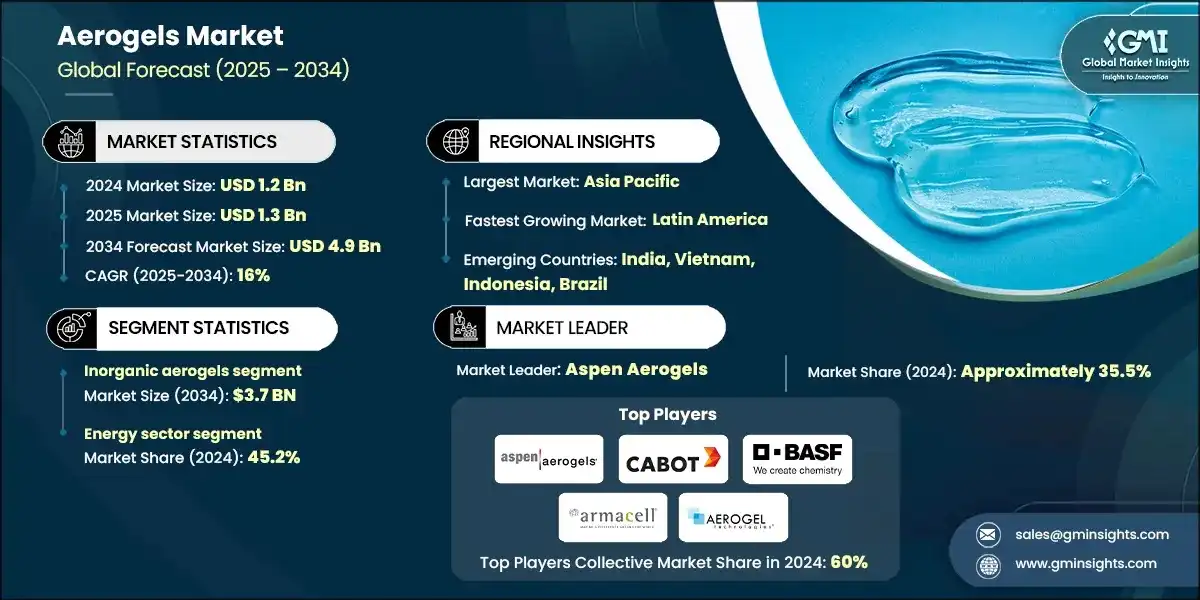
The global aerogels market was valued at USD 1.2 billion in 2024 and is set to grow from USD 1.3 billion in 2025 to USD 4.9 billion by 2034. The trajectory implies a 16% CAGR from 2025 to 2034, according to latest report published by Global Market Insights Inc. The aerogels industry is benefiting from rapid adoption in energy-intensive industries and EV battery safety systems, while manufacturing innovations are pushing costs lower and throughput higher.
Aerogels Market Key Takeaways
Market Size & Growth
- 2024 Market Size: USD 1.2 Billion
- 2025 Market Size: USD 1.3 Billion
- 2034 Forecast Market Size: USD 4.9 Billion
- CAGR (2025–2034): 16%
Key Market Drivers
- Industrial & Building Demand.
- Regulatory Push.
- EV Battery Safety.
Challenges
- High Production Cost.
- Material Fragility.
- Scalability Constraints.
Opportunity
- Cost-Effective Manufacturing.
- Hybrid & Composite Aerogels.
- Flexible Blanket Formats.
Key Players
- Market Leader: Aspen Aerogels led with over 35.5% market share in 2024.
- Leading Players: Top 5 players in this market include Aspen Aerogels, Cabot Corporation, BASF SE, Armacell International S.A., Aerogel Technologies LLC, which collectively held a market share of 60% in 2024.
Get Market Insights & Growth Opportunities
Additionally, ambient pressure drying (APD) and additive manufacturing are cutting time and equipment intensity, which is widening the addressable opportunity and accelerating transitions away from legacy insulation. And because performance advantages are held in both cryogenic and high-temperature regimes, end-users are standardizing flexible blanket formats for speed, rework ability, and lifetime ROI.
The aerogels market continues to scale on the back of proven performance advantages and steady cost compression, particularly where thermal efficiency and weight matter most. Energy industrial users standardized flexible aerogel blankets after field evidence showed 2–5× thickness reduction versus conventional high-temperature insulation, faster installs in adverse conditions, and superior moisture egress that limits corrosion under insulation details originally captured through NASA-linked development and subsequent commercial deployments in refinery, steam distribution, and LNG environments.
From a manufacturing perspective, APD is now a credible alternative to supercritical CO2 or freeze-drying, with studies documenting roughly 56% processing-time reductions on comparable structures and sub-0.03 W/m·K thermal conductivities in APD silica aerogels, enabling scale-up pathways that target 3–5× cost reductions in building-grade products. Federal projects in the U.S. have explicitly funded APD-based systems (e.g., pDCPD aerogels) aiming for R≥8 per inch and mass-producible, durable blankets suited to the building envelope an area where cost is the principal barrier to adoption.
On capacity and supply, leading manufacturers have balanced internal expansions with external manufacturing to serve both EV thermal barrier growth and energy industrial demand, contributing to improved availability and revenue scale in 2024–2025 while avoiding overbuild risks in a volatile macro environment. Because of this, the aerogels industry size has latitude to track near-term order cycles without falling victim to bottlenecks of specialized supercritical equipment, which used to be the hard limit.
To get key market trends
Aerogels Market Trends
- Ambient Pressure Drying (APD) scales with cost/time advantages APD eliminates expensive supercritical equipment and compresses process steps; recent studies report roughly a 56% reduction in processing time versus freeze drying, while maintaining low thermal conductivities compatible with superinsulation targets. In lab and pilot demonstrations, APD silica aerogels have achieved ~0.023–0.024 W/m·K with porosity >97%, putting them in range of still air and well ahead of conventional fibrous/foam options. Less capex, less batch risk, and more continuous flow, so scale is no longer hostage to autoclaves.
- Several programs funded by U.S. agencies aim for R≥8 per inch and 3–5× cost reductions relative to today’s aerogels (using APD and alternative chemistries like pDCPD), pointing to broader building envelope penetration within 2–4 years as prototypes hit production. In parallel, industry review work anticipates 20–40% cost reductions from atmospheric drying methods alone as processes mature across suppliers.
- Composite and hybrid aerogels overcome brittleness Pure silica aerogels break around modest strains, but reinforcement with cellulose, fiberglass, ceramic fibers, or polymers changes the equation. Composite systems have demonstrated compressive strengths around 7–11 MPa with Young’s modulus 13.5 MPa while preserving low k (0.025–0.03 W/m·K), supporting structural resilience for installation, vibration, and thermal cycling in the field.
- Breaking it down, that’s an order of magnitude gain versus monoliths and the difference between “handle with care” and “deploy at scale.” In the near term (≤2 years), expect hybrid formulations that combine inorganic aerogels with polymer matrices or CNT/graphene additives for targeted mechanical, electrical, or fire resistance properties, with EV batteries and aerospace components leading commercial uptake.
- Flexible blanket formats dominate industrial adoption Fiber reinforced aerogel blankets deliver up to 1,200°F service, are 2–5× thinner than legacy high temp alternatives and are water repellent yet breathable attributes that cut installation hours and suppress corrosion under insulation (CUI) in harsh service. Field evidence spans municipal steam networks, refineries, LNG terminals, and more than 550 miles of subsea pipelines using blanket solutions across 40+ locations.
- Compare this to rigid boards or cellular glass in tight spaces blankets improve fitness, reduce rework, and can be removed and reused, which improves life cycle ROI for operators. Timeline-wise, blanket dominance persists through the medium term (2–4 years) while composite panel and render systems scale for buildings.
- Additive manufacturing unlocks custom geometry and function Direct ink writing approaches can print complex aerogel structures with ultralow thermal conductivity (~15.9 mW/m·K) and high specific surface area (751 m²/g), enabling miniaturized, application specific designs that traditional casting cannot achieve.
Aerogels Market Analysis
Learn more about the key segments shaping this market
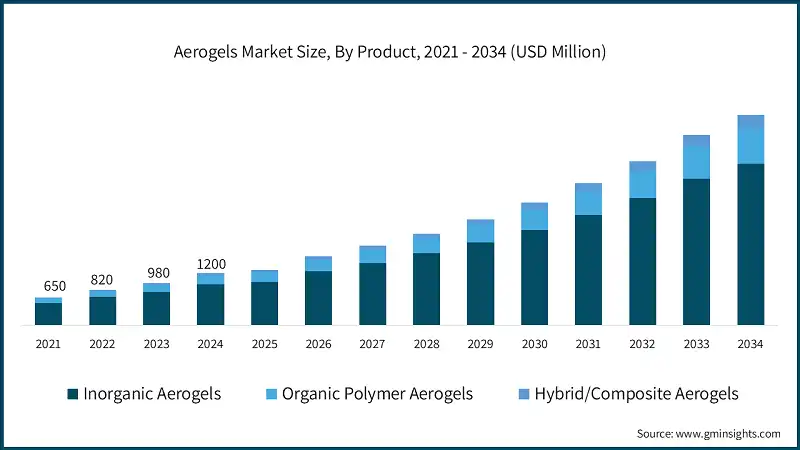
Based on product, the aerogels industry is divided into inorganic aerogels, organic polymer aerogels, and hybrid/composite aerogels. inorganic aerogels segment generated a revenue of USD 951.6 million in 2024 and is expected to reach USD 3.7 billion in 2034 at a CAGR of 15.6% in the forecasted period.
- Inorganic aerogels led the market with an estimated 79.3% market share in 2024 and are projected to expand near the mid-teens CAGR through 2034, propelled by silica’s ultra-low thermal conductivity (often 12–30 mW/m·K at room temperature) and >95% porosity that enable cryogenic through ~1,200°F service across refineries, LNG, and district energy systems, Processing advances also matter as ambient pressure drying and assisted foaming routes have achieved thermal conductivities near 18.9–24 mW/m·K. Reducing reliance on supercritical autoclaves and supporting cost down agendas. With broad qualification and field ROI evidence, inorganic formats remain the default for safety critical industrial assets where downtime risk outweighs initial price.
- Organic polymer aerogels accounted for roughly 16.2% market share in 2024 and are gaining share on mechanical resilience, weight savings, and application specific properties (electrical insulation, acoustic damping, sustainability). Composite designs using cellulose or fiberglass reinforcements have demonstrated compressive strengths around 11 MPa with Young’s modulus near 13.5 MPa while preserving ultralow k (~25–30 mW/m·K), widening use in vibration prone or thickness constrained installations.
Learn more about the key segments shaping this market
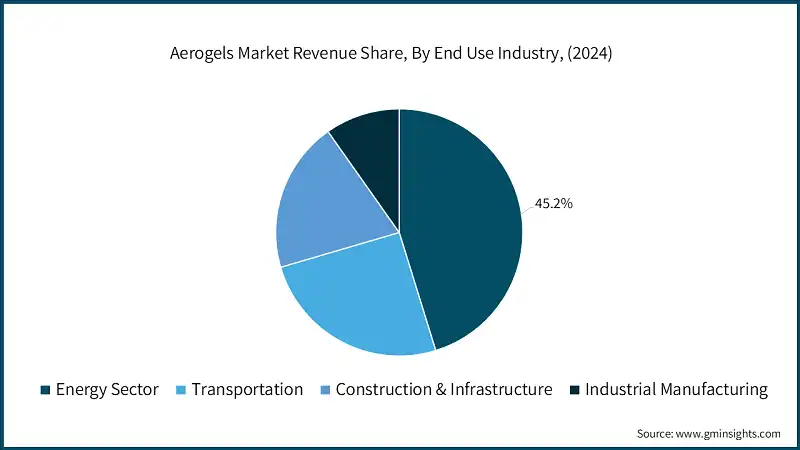
Based on end use industry, the market is divided into energy sector, transportation, construction & infrastructure, and industrial manufacturing. In 2024, energy sector segment held major market share, accounted for 45.2% share.
- Energy sector (oil & gas, power, LNG) holds the largest share and sets specifications that ripple across the aerogels market. In refineries and petrochemical sites, ultrathin blankets cut thickness by 2–5×, speed installation, and resist moisture benefits tied to measurable ROI like USD 25,000 labor savings per insulated line and USD 1.3 million annual energy savings in steam systems.
- LNG and subsea applications leverage cryogenic capability and acoustic/fire performance, with projects ranging from USD 35–40 million terminal scopes to 550+ miles of subsea pipelines insulated across 40+ locations. High temperature services operate to ~650°C/1,200°F while cryogenic service maintains flexibility at -196°C to sub ambient ranges, spanning the market’s full temperature segmentation.
- Transportation expands on two fronts EV battery safety and aerospace. In EVs, cell to cell aerogel barriers are now used by 18 of the top 20 OEMs and in 2.5+ million vehicles, designed to impede thermal runaway at up to ~1,000°C while minimizing mass and thickness; China’s move to a two hour non explosion standard from July 2026 will further raise adoption thresholds.
- Aerospace draws on NASA derived composites and multilayer systems for spacecraft thermal protection and cryogenic lines, with testing indicating meaningful weight reductions vs. conventional barriers important where every kilogram matters. Construction and infrastructure increasingly specify aerogel renders, boards, and cavity fills to achieve 50–60% U value reductions at 30–50 mm thickness, especially in heritage retrofits where façade preservation is mandatory.
Looking for region specific data?
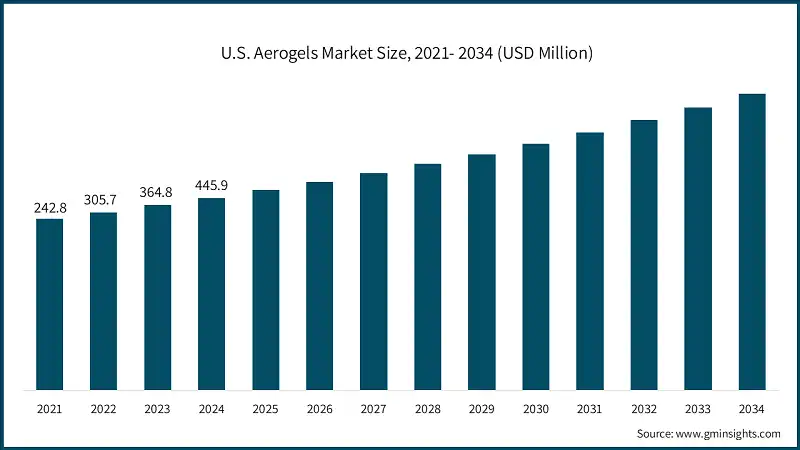
- The U.S. aerogels market generated a revenue of USD 445.9 million in 2024. The U.S. market is projected to grow at a CAGR of 15.8% reaching USD 1.7 billion by 2034. North America’s market remains the largest, underpinned by refinery, petrochemical, LNG, and district energy adoption of flexible blanket insulation, plus rapid EV thermal barrier ramp with U.S. and Canadian OEMs.
- The U.S. market benefits from NASA-derived technology transfer and DOE-backed innovation programs that target APD and high-R solutions, tightening the loop between R&D and commercialization.
- Canada’s industrial base adds cryogenic and high temperature projects where thickness and moisture management are decisive advantages for blankets. Because of this combination of industrial core plus EV safety the region sustains high utilization and supports modular capacity strategies among leading suppliers.
- Europe aerogels market generated a revenue of USD 354.3 Million in 2024. Europe market is projected to grow at a CAGR of 15.3% reaching USD 1.3 Billion by 2034. The Europe market operates with advanced building energy-efficiency standards and heritage retrofit programs where 30–50 mm aerogel renders and boards unlock 50–60% U value reductions, protecting facades that can’t tolerate thick build-ups.
- Germany, France, Italy, Spain, and the UK see steady demand for thin, non-combustible insulators in both envelopes and industrial upgrades, while EU research emphasizes APD cost down, bio based precursors, and recyclability consistent with circular economy goals.
- Asia Pacific aerogels market generated a revenue of USD 245.3 million in 2024. Asia Pacific market is projected to grow at a CAGR of 16.8% reaching USD 1.1 billion by 2034. The fastest-growing market is in the Asia Pacific region, driven by industrialization, infrastructure build out, and the EV supply chain scaling requirements for China, India, South Korea, and Japan. The China aerogels industry has an influence on battery safety regulations tightening from five minute warning to non-explosion in two hours in 2026 which implicates the thermal barrier standards changing behind the timeline.
- India and Southeast Asia are building additional LNG and Petrochemical capacity where cryogenic systems and high temp blanket systems reduce weight, space and schedule on modular builds, with supporting site evidence of 30–80% reduction in installation schedules and improved boil off control. Japan and South Korea, advance materials R&D and leads the premium application market for EVs and aerospace which facilitates and supports the adoption of composite aerogels and printed aerogels in the medium term.
Aerogels Market Share
Market concentration is moderate, with the top five accounting for roughly 60% of market share in 2024 and a clear leader is Aspen Aerogels based on installed base, product breadth, and OEM awards. The competitive picture splits between technology originators with strong IP in silica blankets and EV barriers, and cost-focused entrants betting on APD and alternative chemistries to widen access.
Leadership and share structure The leader holds an estimated 35.5% aerogels industry share, anchored in NASA-derived technology, deep industrial qualifications, and an expanding EV thermal barrier franchise that supplied multiple OEMs in 2024–2025.
The company reported USD 452.7 million revenue in 2024, a 90% YoY increase as thermal barrier revenues surged to USD 306.8 million and energy industrial revenues reached USD 145.9 million, alongside a 40% gross margin. Earlier NASA accounts documented industrial adoption at scale 24 of the world’s top 25 refineries, >550 miles of subsea pipelines, and project level ROI which helped entrench share in energy industrial segments before the EV inflection.
M&A and partnerships consolidation targets often include APD process know how, building materials integration, and EV specific barrier technologies. Partnerships with BASF and major OEMs illustrate dual paths building envelopes via A2 rated products and battery barriers for cell to pack strategies. Because of this, rivals emphasize cost-down and regional proximity to customers, especially in APAC where EV and industrial growth are fastest.
Market concentration outlook Given high qualification barriers, safety-critical specs, and demonstrated ROI, the market is unlikely to fragment rapidly. Yet, APD entrants and polymer/hybrid innovators can expand the pie, especially in buildings and EV batteries. Expect concentration to ease slightly if cost breakthroughs hit production, but the top cohort remains durable over the next cycle.
Aerogels Market Companies
Major players operating in the aerogels industry are:
- Active Aerogels
- Aerogel Technologies LLC
- Airglass AB
- Armacell International S.A.
- Aspen Aerogels Inc
- BASF SE
- Blueshift Materials Inc
- Cabot Corporation
- Enersens SAS
- Green Earth Aerogel Technologies
- Guangdong Alison Hi-Tech Co Ltd
- Jios Aerogel Corporation
- Nano High-Tech Co Ltd
- Svenska Aerogel AB
- Thermablok Aerogel
Aspen Aerogels Inc: Aspen Aerogels leads the way with a complete platform that includes high temperature, cryogenic, subsea, and EV thermal barriers. Their products, Pyrogel, Cryogel, Spaceloft subsea, and PyroThin, span from cryogenic temperatures to 650°C/1,200°F with documented deployments across refineries, LNG, municipal steam, and EV OEM programs. Recent filings underscore 2024 revenue figures of USD 452.7 million, a 90% year-over-year increase, mentioning PyroThin contracts with U.S. and European OEMs, and operational flexibility from external manufacturing to meet industrial energy demand.
Active Aerogels: Active Aerogels targets cost-effective production on a scale that preserves the critical performance for their industrial and building applications offerings based on APD processes. This is consistent with the market’s drive to reduce supercritical drying dependence and local supply for European projects with integrated sustainability targets.
Aerogel Technologies LLC: Aerogel Technologies LLC is also known for the robust high performance aerogel components and custom formats (e.g., Airloy strong aerogels) and superinsulating blankets that it provides. Their channel for distribution includes BuyAerogel.com, which includes data sheets and provides small amount of procurement for origination and niche applications.
Armacell International S.A.: Armacell International S.A. uses its wide distribution network to market aerogel blankets and offer advanced elastomeric foam combination ultra-thin and high performance focused on high temperature and cryogenic services.
BASF SE: BASF SE emphasizes combing building materials and A2 rated aerogel systems, and building strategic partnerships to include thin, non-combustible insulation in interior wall systems. Joint development and supply agreements brought building market aerogel solutions with high fire and thickness constraints.
Aerogels Market Report Attributes
| Key Takeaway | Details |
|---|---|
| Market Size & Growth | |
| Base Year | 2024 |
| Market Size in 2024 | USD 1.2 Billion |
| Market Size in 2025 | USD 1.3 Billion |
| Forecast Period 2025 - 2034 CAGR | 16% |
| Market Size in 2034 | USD 4.9 Billion |
| Key Market Trends | |
| Drivers | Impact |
| Industrial & Building Demand | Rising global demand for high-performance insulation in the oil & gas and construction sectors, driven by energy efficiency and safety standards. |
| Regulatory Push | Government regulations and policies promoting energy-efficient buildings and industrial processes, creating mandated markets. |
| EV Battery Safety | Growing adoption in electric vehicle (EV) batteries for thermal runaway prevention, representing a high-growth niche application. |
| Pitfalls & Challenges | Impact |
| High Production Cost | High initial product cost compared to conventional insulation materials like fiberglass and foam, limiting price-sensitive markets. |
| Material Fragility | Inherent fragility and low durability of pure silica aerogels, requiring composite structures and complicating handling. |
| Scalability Constraints | Limited global production capacity and complex supply chains, constraining the ability to scale for mass-market adoption. |
| Opportunities: | Impact |
| Cost-Effective Manufacturing | Shift towards cost-effective ambient pressure drying manufacturing to replace expensive supercritical drying. |
| Hybrid & Composite Aerogels | Development of hybrid and composite aerogels to enhance mechanical strength and functional properties for new applications. |
| Flexible Blanket Formats | Expansion of flexible aerogel blanket formats to replace traditional rigid and bulky insulation materials. |
| Market Leaders (2024) | |
| Market Leaders |
Approximately 35.5% market share in 2024 |
| Top Players |
Collectively 60% market share in 2024 |
| Competitive Edge |
|
| Regional Insights | |
| Largest Market | Asia Pacific |
| Fastest Growing Market | Latin America |
| Emerging Country | India, Vietnam, Indonesia, Brazil |
| Future Outlook |
|
What are the growth opportunities in this market?
Aerogels Industry News
- In December 2024, Aspen Aerogels announced an increase in effective production capacity through external manufacturing and expanded commercial vehicle EV thermal barrier contracts.
- In May 2024, the second manufacturing facility of Aspen Aerogels was initialized at a Georgia site in support of the high demand for its PyroThin thermal barriers for the electric vehicle industry.
- In February 2024, JIOS Aerogel announced this month the successful startup of its large-scale plant in Singapore, which has significantly increased production of silica aerogel materials for the electric vehicle market.
- In November 2023, Armacell announced the launch of ArmaGel HTL, a non-combustible aerogel insulation blanket for industrial applications that require both enhanced thermal protection and passive fire protection.
- In August 2023, Aspen Aerogels confirmed that it has ramped up production and delivery of aerogel thermal barriers to General Motors for the Ultium battery electric vehicle platform.
- In June 2023, BASF SE announced its expansion of the application of its SLENTEX polyurethane aerogel insulation panels in high-profile sustainable construction pilot projects across Europe.
The aerogels market research report includes in-depth coverage of the industry, with estimates & forecast in terms of revenue (USD Million) & volume (Tons) from 2021 to 2034, for the following segments:
Market, By Product
- Inorganic aerogels
- Silica aerogels
- Alumina aerogels
- Titania aerogels
- Carbon aerogels
- Crystalline aerogels
- Organic polymer aerogels
- Polyimide aerogels
- Polyurethane aerogels
- Polyurea aerogels
- Resorcinol-formaldehyde aerogels
- Hybrid/composite aerogels
- Fiber-reinforced aerogels
- Polymer-crosslinked aerogels
- Opacified aerogels
Market, By Form
- Flexible forms
- Aerogel blankets
- Aerogel tapes
- Aerogel wraps
- Rigid forms
- Aerogel panels
- Aerogel monoliths
- Aerogel boards
- Particulate forms
- Aerogel powders
- Aerogel beads
- Aerogel microspheres
Market, By Temperature Range
- -196°c to -50°c (Cryogenic applications)
- -50°c to 200°c (Ambient temperature applications)
- 200°c to 1200°c (High-temperature applications)
Market, By End Use Industry
- Energy sector
- Oil & gas
- Power generation
- Lng & gas processing
- Transportation
- Automotive
- Aerospace & defense
- Marine
- Rail transportation
- Construction & infrastructure
- Residential buildings
- Commercial buildings
- Industrial buildings
- Industrial manufacturing
- Chemical processing
- Food & beverage processing
- Pharmaceuticals
The above information is provided for the following regions and countries:
- North America
- U.S.
- Canada
- Europe
- Germany
- UK
- France
- Spain
- Italy
- Rest of Europe
- Asia Pacific
- China
- India
- Japan
- Australia
- South Korea
- Rest of Asia Pacific
- Latin America
- Brazil
- Mexico
- Argentina
- Rest of Latin America
- Middle East and Africa
- Saudi Arabia
- South Africa
- UAE
- Rest of Middle East and Africa
Frequently Asked Question(FAQ) :
What is the market size of the aerogels market in 2024?
The global aerogels market size was valued at USD 1.2 billion in 2024, driven by industrial and building demand for high-performance insulation materials.
What is the current aerogels market size in 2025?
The aerogels market is projected to reach USD 1.3 billion in 2025, supported by scaling demand in energy, EV, and construction sectors.
What is the projected value of the aerogels market by 2034?
The global aerogels market is expected to reach USD 4.9 billion by 2034, expanding at a 16% CAGR from 2025 to 2034, fueled by adoption in EV battery safety, industrial insulation, and energy-efficient building systems.
How much revenue did the inorganic aerogels segment generate in 2024?
The inorganic aerogels segment generated USD 951.6 million in 2024, accounting for about 79.3% market share. Its dominance is driven by silica-based aerogels’ ultra-low thermal conductivity and versatility across cryogenic to high-temperature applications.
What is the growth outlook for the inorganic aerogels segment through 2034?
The segment is projected to reach USD 3.7 billion by 2034, growing at a 15.6% CAGR, with growth anchored in refineries, LNG, and district energy systems requiring thin, efficient insulation.
Which end-use industry led the aerogels market in 2024?
The energy sector dominated with 45.2% market share in 2024, led by oil & gas, LNG, and power generation applications. This leadership is due to proven cost savings, moisture resistance, and ROI advantages in steam systems and refinery insulation.
What was the valuation of the U.S. aerogels market in 2024?
The U.S. aerogels market generated USD 445.9 million in 2024 and is projected to reach USD 1.7 billion by 2034 at a 15.8% CAGR. Growth is driven by DOE-backed innovation programs, EV thermal barrier adoption, and refinery insulation upgrades.
Which region leads the global aerogels industry?
Asia Pacific led the aerogels industry with USD 245.3 million in 2024, emerging as the fastest-growing regional market at a 16.8% CAGR. Industrialization, EV battery safety regulations, and large-scale LNG and construction projects across China, India, Japan, and South Korea are accelerating regional demand.
What are the key trends shaping the aerogels market?
Major trends include ambient pressure drying (APD) for cost-efficient manufacturing, hybrid and composite aerogels for enhanced durability, and flexible blanket formats gaining traction in industrial and building applications.
Who are the leading players in the aerogels industry?
Key players include Aspen Aerogels Inc., Cabot Corporation, BASF SE, Armacell International S.A., and Aerogel Technologies LLC, collectively holding around 60% market share in 2024.
Aerogels Market Scope
Related Reports