Summary
Table of Content

Advanced Transportation Pricing System Market
Get a free sample of this report
Form submitted successfully!
Error submitting form. Please try again.
Thank you!
Your inquiry has been received. Our team will reach out to you with the required details via email. To ensure that you don't miss their response, kindly remember to check your spam folder as well!
Request Sectional Data
Thank you!
Your inquiry has been received. Our team will reach out to you with the required details via email. To ensure that you don't miss their response, kindly remember to check your spam folder as well!
Form submitted successfully!
Error submitting form. Please try again.
Advanced Transportation Pricing System Market Size
Strong structural demand for advanced transportation pricing solutions is being created by the ongoing urban population increase in major countries as well as the worsening traffic congestion in quickly growing cities. Electronic toll collection, dynamic pricing, and vehicle miles traveled systems are gaining popularity as useful tools to lessen traffic, enhance revenue collection, and support larger smart mobility agendas as governments and business concessionaires want to manage road usage more effectively. The need for scalable, technology-driven pricing infrastructure for both highway and urban road networks is being strengthened by the faster rate of motorization in both developed and emerging markets.
Advanced Transportation Pricing System Market Key Takeaways
Market Size & Growth
- 2025 Market Size: USD 8 Billion
- 2026 Market Size: USD 8.8 Billion
- 2035 Forecast Market Size: USD 22.8 Billion
- CAGR (2026–2035): 11.2%
Regional Dominance
- Largest Market: North America
- Fastest Growing Region: Asia Pacific
Key Market Drivers
- Increasing adoption of smart city and mobility solutions.
- Expansion of public-private partnerships in transportation systems.
- Government initiatives promoting sustainable transport infrastructure and policies.
- Rising urban congestion demands efficient traffic management solutions.
Challenges
- High initial implementation and maintenance costs.
- Resistance from consumers to dynamic pricing models.
Opportunity
- Integration with smart city infrastructure.
- Rising demand for sustainable and eco-friendly transport.
- Advancements in IoT, AI, and big data analytics.
- Expansion of public-private partnerships (PPP) in transport projects.
Key Players
- Market Leader: Conduent led with over 3.9% market share in 2025.
- Leading Players: Top 5 players in this market include Conduent, Thales, Kapsch TrafficCom, TomTom, Cubic, which collectively held a market share of 14.5% in 2025.
Get Market Insights & Growth Opportunities
This global shift towards free-flow and barrier-free tolling is revolutionizing the deployment and operation of transportation pricing infrastructure. The move towards the use of completely automated, multi-lane free-flow tolling infrastructure is fueling the demand for the underlying pricing engines, software, and enforcement solutions that comprise the ATPS segment.
Technological advancements in on-road detection, data analysis, and payment processing are further improving the functionality and commercial attractiveness of transportation pricing solutions. Improvements to RFID, automatic license plate recognition, and vehicle classification solutions are providing more precise and accurate pricing determinations, while minimizing the cost of operation for the solution providers. These technological advancements are ensuring the ATPS segment continues to remain relevant and competitive in a variety of deployment scenarios, ranging from the open road corridors between cities to the increasingly congested urban centers that are embracing the use of emissions pricing.
Government initiatives supporting smart mobility and sustainable urban transport are creating a favorable regulatory and investment environment for ATPS adoption. Fiscal incentives, public-private partnership frameworks, and national digitalization agendas are encouraging transport authorities to modernize aging toll infrastructure and introduce new demand management mechanisms. Kapsch TrafficCom, a leading global ITS provider, had implemented transportation pricing projects across multiple countries and cities as of 2024, illustrating the broadening geographic appetite for sophisticated road pricing solutions and the growing role of established technology partners in accelerating deployment at scale.
The global advanced transportation pricing system market was valued at USD 8 billion in 2025. The market is expected to grow from USD 8.8 billion in 2026 to USD 22.8 billion in 2035 at a CAGR of 11.2%, according to latest report published by Global Market Insights Inc.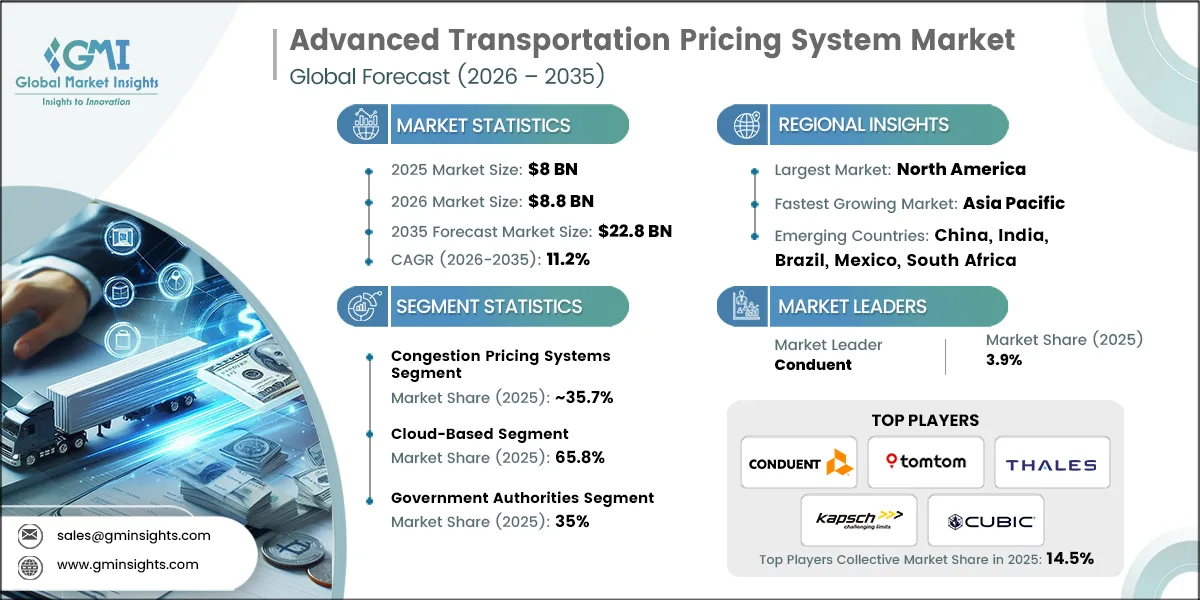
To get key market trends
Advanced Transportation Pricing System Market Trends
The creation of advanced transportation pricing systems (ATPS) is proceeding at an increasing pace because operators are choosing to abandon their traditional toll collection systems which require physical infrastructure and instead adopt modern pricing systems which utilize real-time data to adjust prices based on current traffic conditions. Contemporary systems are transitioning from their previous model which depended on fixed fees at toll plazas to a new system which enables drivers to travel without stopping while paying variable tolls that depend on distance traveled and current traffic conditions. The structural transformation enables governments and concession operators and fleet managers to utilize transportation pricing as a method for generating revenue which functions as a tool for controlling traffic demand and reducing emissions.
The ATPS field considers barrier-free tolling systems which operate between different systems as a major technological development because it has become a worldwide standard. Multi-lane free-flow (MLFF) deployments are replacing traditional toll booths in many markets which enables improved operational efficiency while reducing toll point congestion. Interoperability frameworks are experiencing increased development because they are particularly useful in areas where multiple jurisdictions control road systems. The European Electronic Toll Service (EETS) enables cross-border toll settlement through standardized architectures which allow a single onboard unit to function across participating national toll domains. The evolution of settlement systems creates a need for clearing platforms and standardized back-office systems and middleware that can handle settlement processes and enforcement activities for multiple operators.
Technological innovation continues to enhance the precision and flexibility of transportation pricing systems. Advances in RFID, automatic number plate recognition (ANPR), vehicle classification sensors, and digital payment processing have improved the accuracy and efficiency of electronic toll collection. Increasing integration of data analytics and connected vehicle information is enabling more responsive pricing strategies compared to legacy static toll schedules. These developments are supporting broader deployment across both highway corridors and dense urban networks where congestion pricing and low-emission zones are becoming more prominent policy instruments. On January 5, 2025, New York City officially launched its long-planned congestion pricing program, becoming the first city in the United States to implement a comprehensive urban road pricing system targeting vehicles entering Manhattan’s central business district.
The growing standardization of cloud-enabled and modular back-office platforms is further accelerating ATPS adoption. Vendors are increasingly offering scalable, API-driven architectures that can support multiple pricing use cases including highway free-flow tolling, urban congestion zones, low-emission charging, and vehicle miles traveled programs within a unified system framework. This modularity allows transport authorities to modernize incrementally, expanding pricing functionality without full infrastructure replacement. As a result, adoption barriers are lowering not only in advanced economies but also in emerging markets and mid-sized urban regions seeking cost-effective modernization pathways.
Advanced Transportation Pricing System Market Analysis
Learn more about the key segments shaping this market
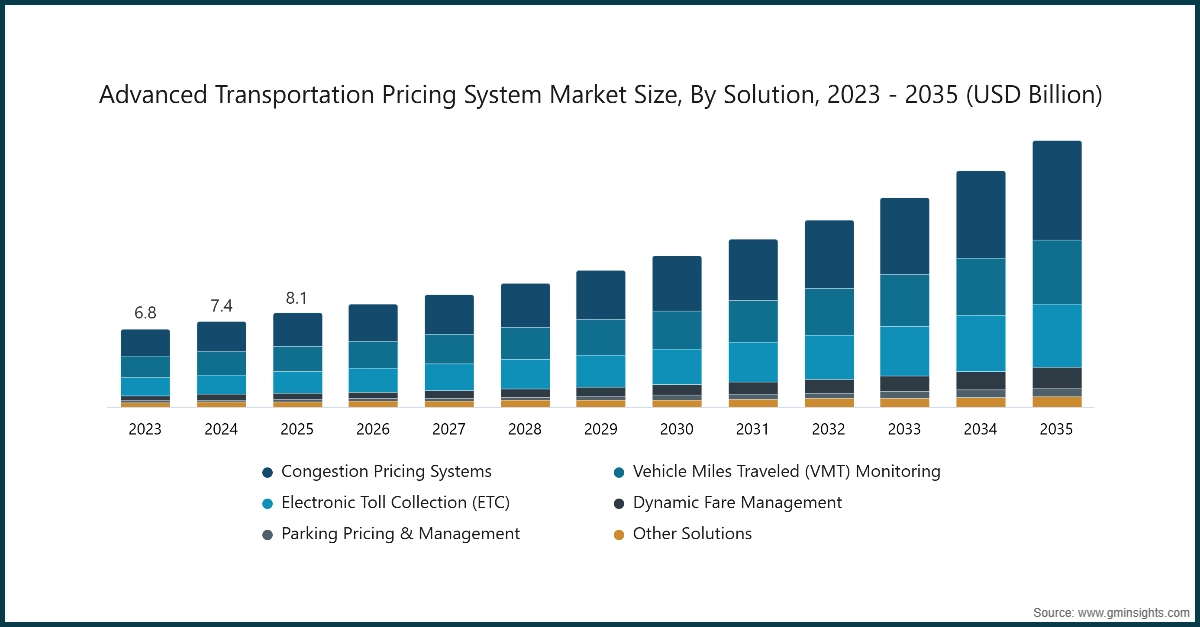
Based on solution, the market is divided into congestion pricing systems, vehicle miles traveled (VMT) monitoring, electronic toll collection (ETC), dynamic fare management, parking pricing & management, and other solutions. The congestion pricing systems dominated around 35.7% market share in 2025 and is expected to grow at a CAGR of 11.6% through 2026 to 2035.
- The ATPS market shows its greatest strategic value through its congestion pricing systems which serve as its primary market segment. The market maintains strong boundaries because citywide pricing programs and corridor-based pricing systems and zone-based pricing programs gain popularity in major global urban centers. Cities adopt congestion pricing because they need to manage increasing traffic while reducing emissions and they need to finance public transportation upgrades without raising taxes. The system enables governments to decrease road traffic and enhance air quality while simultaneously earning revenue. The segment will experience continuous growth until 2035 because congestion pricing helps organizations achieve their sustainability goals and net-zero targets and smart city projects.
- The second largest market segment of electronic toll collection (ETC) serves as the primary electronic toll collection solution for highway systems and intercity road networks throughout various regions. The system operates as the primary toll collection mechanism which generates revenue for highway systems and intercity road networks in most territories. Modern electronic toll collection systems have developed from traditional toll booths to advanced systems that use multiple lanes to enable vehicles to drive through without stopping. The worldwide transition toward barrier-free tolling creates benefits which include decreased congestion and decreased infrastructure expenses that motivate further financial support for electronic toll collection system enhancements and extensions. The electronic toll collection system has reached a more advanced technological level than congestion pricing yet users still want to use it because they need to upgrade outdated systems and use it in developing regions and to achieve tolling compatibility across various road systems.
- Vehicle miles traveled (VMT) monitoring is becoming increasingly important as governments explore alternatives to fuel taxes, which are declining due to the growth of electric vehicles. VMT systems measure how far a vehicle travels using GPS devices, onboard diagnostics (OBD-II), or mobile applications, and apply charges based on distance traveled. As electric vehicle adoption continues to grow and fuel tax revenue declines, VMT monitoring is expected to expand beyond pilot programs into broader implementation over the forecast period.
- Dynamic fare management and parking pricing and management complete the solution landscape. Dynamic fare management allows public transportation operators to adjust fares based on demand, time, or service type, improving efficiency and revenue collection. Parking pricing and management systems use real-time occupancy data, mobile payments, and data-driven pricing strategies to reduce traffic caused by drivers searching for parking and to improve space utilization. Both segments are benefiting from ongoing digitalization in urban mobility and smart city initiatives. While smaller than congestion pricing and ETC, these segments are expected to grow steadily as cities continue modernizing their transport infrastructure.
Learn more about the key segments shaping this market
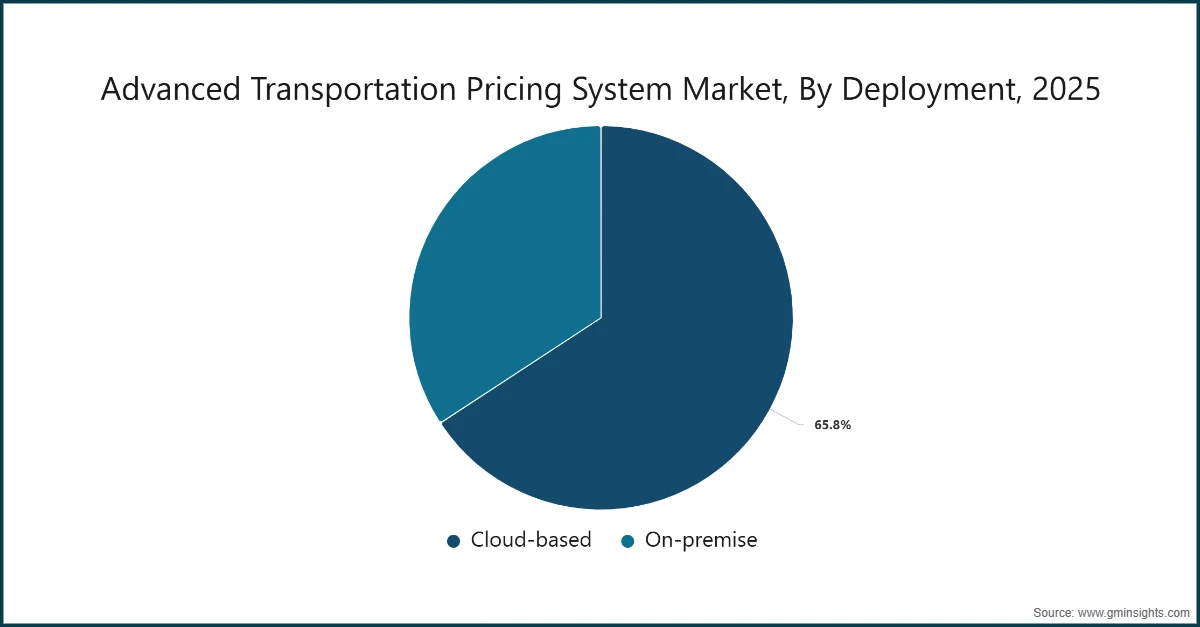
Based on deployment, the advanced transportation pricing system market is segmented into cloud-based and on-premise. Cloud-based segment dominates the market with 65.8% share in 2025 and is expected to grow at a CAGR of 11.4% from 2026 to 2035.
- The ATPS market currently experiences its most rapid growth through cloud-based deployment which operates as its primary market segment. The cloud platform advantages to businesses which include reduced operational costs and better system performance through instant updates and ability to grow their systems without limits. The ATPS solution which runs on cloud-based technology enables transport authorities and operators to handle tolling and congestion pricing operations through real-time management which older on-premise systems cannot handle because of their high costs and operational challenges.
- One major benefit of cloud platforms is their ability to scale transaction processing dynamically The system can process high volumes of toll and congestion data while connecting with external payment systems and enabling instant pricing algorithm updates without needing any equipment modifications at roadside locations or central back-office systems. The cloud-based systems provide exceptional value to contemporary multi-network ATPS systems because of their high adaptability.
- The availability of regional and sovereign cloud infrastructure from large providers is also helping governments overcome concerns about data security and local regulations. These solutions ensure that vehicle and payment data can remain in-country while still benefiting from cloud scalability and advanced software features. This is expanding the market for cloud-based ATPS globally.
- On-premise deployment still holds a significant and stable share, especially for national highway authorities, government agencies, and large transport networks with existing legacy systems. These organizations often need full control over their infrastructure and data for security, regulatory compliance, or historical system integration. While cloud adoption is expected to increase, on-premise systems will remain important for mission-critical national infrastructure where security, latency, and regulatory control cannot be compromised.
Based on application, the advanced transportation pricing system market is segmented into urban congestion management, smart city integration, freight & logistics pricing, parking management, and others. The urban congestion management segment dominates the market with 45.8% share in 2025 and is expected to grow at a CAGR of 11.7% from 2026 to 2035. - The ATPS market currently experiences its most significant growth through urban congestion management. Cities use this system to achieve three goals which are to decrease traffic congestion and enhance air quality and generate revenue through demand-based road pricing for their public transport systems. The system implements variable fee charges which apply to high-demand zones and active transportation routes and peak travel periods to motivate drivers to select different paths or traveling times or different modes of transportation. The cities that have implemented these systems observe two results which show their systems decrease congestion while their systems produce revenue thus encouraging more cities to adopt these programs which will maintain strong growth until 2035.
- Smart city integration is growing rapidly as authorities combine ATPS with broader urban infrastructure. The systems use traffic signals together with public transit systems and air quality monitoring and multimodal mobility platforms. The authorities use pricing data together with real-time traffic and transport information to improve their management of urban mobility. The combined development of connectivity and IoT sensors and AI analytics technology enables cities to implement ATPS systems through their smart city initiatives which create new revenue streams by changing travel patterns through dynamic pricing.
- Freight and logistics pricing is becoming increasingly important as cities and highway operators use targeted charges for commercial vehicles. These systems help manage delivery traffic, reduce road wear, and account for external costs of freight movement. Pricing mechanisms include time-of-day surcharges, emissions-based fees, and dynamic charges for loading zones. These tools optimize commercial vehicle flows while generating revenue for urban infrastructure and transport maintenance.
- Parking management uses real-time occupancy data, dynamic pricing, and mobile payment systems to make better use of urban parking spaces and reduce traffic caused by drivers searching for parking. These platforms often integrate with other ATPS systems, enabling unified accounts, combined billing, and coordinated pricing signals. The “others” category includes specialized applications such as low-emission zone access pricing, airport and port vehicle management, and event-based dynamic road pricing, which are emerging areas of deployment as cities adopt more flexible and data-driven pricing strategies.
Based on end use, the advanced transportation pricing system market is segmented into government authorities, private transport companies, logistics/fleet operators, and vehicle owners. The government authorities segment is expected to dominate the market with a share of 35% in 2025.
- The ATPS market shows its biggest customer base through government authorities who conduct public sector activities. The planning and purchasing and operational activities of transportation pricing systems for highways and urban roads and congestion zones are handled by public sector entities. National transport ministries and municipal authorities and highway agencies run major programs which include free-flow tolling and congestion pricing and vehicle miles traveled monitoring. The organization acts as the main customer base for ATPS vendors because it controls road access and pricing and enforcement regulations. The procurement process establishes requirements for long-lasting agreements together with public-private partnerships and technology updates spanning multiple years which create permanent requirements for hardware and software and services.
- Private transport companies are the second-largest segment. The group consists of toll road operators and transit network operators and ride-hailing companies and shared mobility platforms. Their assets generate dynamic pricing which enhances their fleet utilization and revenue collection and service delivery operations. Private concession operators make investments in advanced back-office systems and interoperability solutions and enforcement technologies to maximize their revenue while minimizing losses. The global growth of private investment in road infrastructure development has created a new market segment because modern tolling systems and dynamic pricing systems are essential requirements in modern concession agreements.
- Logistics and fleet operators are the fastest-growing end-use segment. Growth is driven by expanding commercial vehicle fleets, rising urban freight activity, and distance or emissions-based charging that affects fleet costs. Large logistics companies and last-mile delivery operators are adopting ATPS-compatible telematics and on-board units to track toll costs, optimize routes, and ensure regulatory compliance. The combination of fleet electrification, VMT monitoring, and urban access restrictions is creating more complex pricing environments, increasing demand for integrated ATPS solutions that simplify fleet cost management.
- Vehicle owners are a distinct and growing segment as more consumer-facing ATPS services become available. These include mobile toll accounts, pay-per-use insurance, in-app congestion payments, and smart parking platforms. While individual users contribute smaller revenue per transaction, they make up the largest volume of daily ATPS interactions. Customer account management, digital payment experience, and clear billing are therefore critical. Increasing awareness of congestion pricing, connected vehicle adoption, and mobility-as-a-service platforms is encouraging more active participation by private motorists in pricing and route optimization, ensuring this segment remains relevant over the long term.
Looking for region specific data?
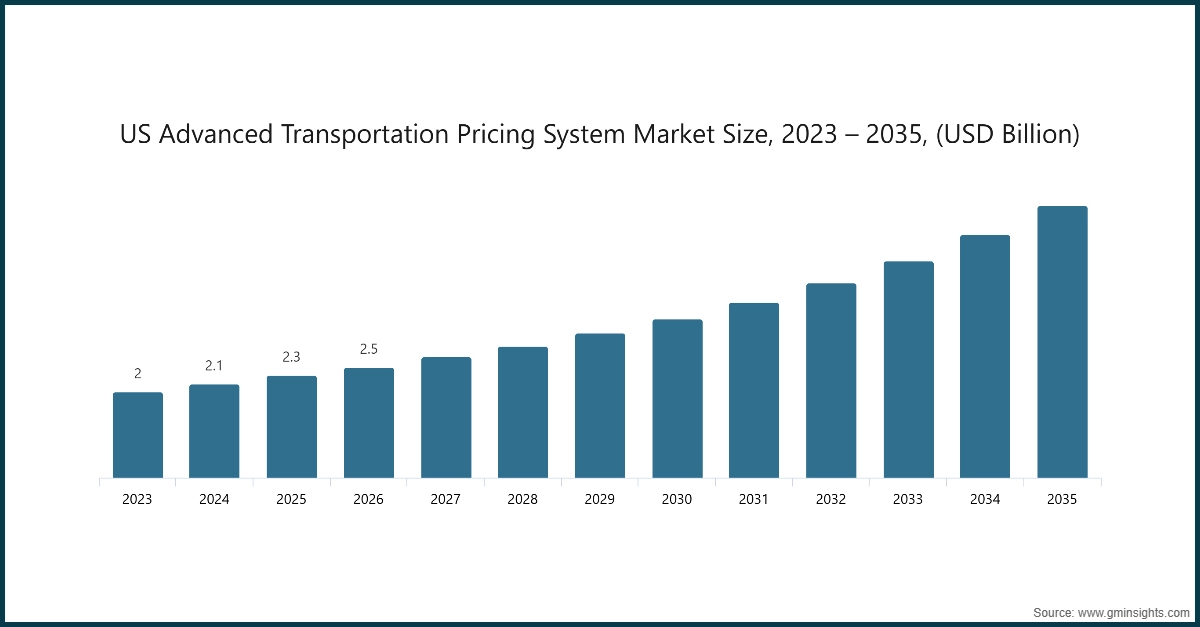
The U.S. advanced transportation pricing system market reached USD 2.3 billion in 2025.
- The U.S. advanced transportation pricing system (ATPS) market is expanding because federal agencies and state governments and municipal organizations together with private companies are implementing electronic toll collection and congestion pricing and vehicle miles traveled monitoring on their highways and urban roadways. Authorities need to find new highway funding solutions because electric vehicle adoption has decreased fuel tax revenues which create fiscal problems for highway funding. People need better ways to handle road demand because urban traffic congestion continues to rise which makes them more interested in using congestion pricing as a solution that provides dedicated funding for transportation projects.
- Federal and state agencies are modernizing tolling infrastructure and expanding program coverage to replace aging plaza-based systems with automated, free-flow electronic tolling. The upgrades through their implementation enable improved operational efficiency together with higher transaction capture rates and enhanced road network connectivity. The launch of urban congestion pricing programs in major U.S. cities has increased national attention on using road pricing as a mainstream tool for traffic management and transit funding.
- Vehicle miles traveled (VMT) monitoring is also expanding at the state level, with pilot programs providing insights on technology performance, user acceptance, and revenue potential. Transportation authorities are investing in GPS-based, onboard device-compatible, and mobile application platforms that preserve user privacy while providing accurate distance and location data for billing and compliance. Scalable, interoperable VMT systems are being developed to support multi-jurisdiction operations and potential long-term federal programs.
- Private sector investment in managed lanes, express toll corridors, and highway concessions is further supporting market growth. Dynamic pricing is being applied to maintain free-flow conditions and optimize revenue during periods of variable traffic demand. ATPS vendors are responding with cloud-based back-office systems, AI-driven pricing optimization tools, and multi-network interoperability solutions to meet the increasingly complex needs of U.S. transportation operators in both public and private sectors.
North America dominated the advanced transportation pricing system market with a market size of USD 2.8 billion in 2025.
- The market for advanced transportation pricing systems in North America experiences rapid growth because federal and state and provincial transportation agencies and municipal authorities and private highway operators implement electronic toll collection and congestion pricing and vehicle miles traveled monitoring across their entire road network system. The rising adoption of electric vehicles causes a decrease in fuel tax revenues which leads to funding shortages so governments now use mileage-based and demand-responsive pricing methods to finance highways sustainably. Political and public support for road pricing as a solution to handle traffic congestion in major urban areas has increased because it provides a way to fund both public transit and infrastructure projects.
- Transportation authorities together with private operators are upgrading their existing toll plazas while they implement free-flow electronic tolling systems on interstate highways and arterial roads and managed lanes. Urban congestion pricing programs attract interest from cities that seek to develop scalable methods for controlling road usage while improving mobility which leads to North American market expansion beyond federal and state highway operations.
- Vehicle miles traveled (VMT) monitoring is gaining traction as a long-term alternative to fuel taxes. State-level pilots are providing operational data and user insights that inform multi-jurisdiction frameworks. Technology vendors are developing GPS-enabled, privacy-preserving mileage reporting platforms that work with onboard vehicle devices and mobile applications, enabling interoperable systems across state lines.
- Private sector investment in managed lanes, express toll corridors, and highway concessions is further strengthening the market. Dynamic pricing is being used to maintain free-flow conditions and optimize revenue in high-demand corridors. Vendors and system integrators are deploying cloud-based back-office platforms, AI-driven pricing engines, multi-scheme interoperability tools, and advanced enforcement technologies to meet the growing complexity of public and private ATPS operations across North America.
Europe advanced transportation pricing system market accounted for a share of 29.9% and generated revenue of USD 2.4 billion in 2025.
- The European advanced transportation pricing system (ATPS) market holds a significant share of the global market because the region has implemented road user charging systems for many years and developed advanced electronic toll collection systems and built extensive urban congestion management programs. Europe has been a global leader in establishing interoperable tolling standards and emissions-based road pricing, with frameworks such as the European Electronic Toll Service providing cross-border interoperability and technical consistency. The region's transport emission reduction policies combined with decarbonization efforts for urban mobility and vehicle externalities internalization policies create an environment which supports ATPS adoption in both established markets and developing markets throughout the region.
- European transportation authorities together with highway operators are modernizing their existing toll systems by implementing automated barrier-free free-flow systems, which they use to develop new urban congestion pricing initiatives. Multiple nations have implemented distance- and emissions-based tolling systems, which now provide multiple countries with platforms to develop future passenger vehicle charging systems. The systems generate revenue while they help manage traffic demand and achieve environmental standards, and they provide operational frameworks which other European cities and national highway authorities can use to plan their own system implementations.
- Low-emission zone (LEZ) pricing is one of the fastest-growing ATPS applications in Europe, driven by EU air quality directives and municipal clean air policies. Cities are moving toward dynamic, technology-enabled access control, charging vehicles based on emissions, entry time, and duration rather than simple yes/no restrictions. This shift is increasing demand for ANPR enforcement systems, back-office account management platforms, and interoperability solutions that allow drivers to manage payments across multiple city schemes, supporting growth in the software and services components of the ATPS market.
- The broader European market is further supported by strong public investment in sustainable transport, including EU cohesion funds, national infrastructure programs, and green recovery initiatives. Manufacturers and system integrators are collaborating with transport authorities to standardize back-office systems, enforcement protocols, and cross-border interoperability, reducing fragmentation and improving scalability. Combined with a robust regulatory framework and policy focus on road pricing, Europe remains one of the most dynamic and resilient ATPS markets globally through 2035.
Germany dominates the advanced transportation pricing system market, showcasing strong growth potential, with a CAGR of 11.8% from 2026 to 2035.
- Germany leads Europe in advanced transportation pricing systems development because it has extensive highway networks and advanced digital systems and active programs for managing urban traffic congestion. The country operates one of Europe’s most comprehensive truck tolling systems, applying distance- and emissions-based charges across the Autobahn and major federal roads. The national ATPS system expansion resulted from tolling changes which implemented new toll requirements and introduced charges based on CO₂ emissions, which established Germany as a pioneer in road user charging methods that differ based on emissions levels.
- German cities face growing urban congestion problems because rising traffic delays force them to implement city-center access pricing and other demand management strategies. The government plans to implement congestion-based tolls as a solution which will decrease traffic congestion while enhancing mobility and providing specific funding for public transport development. The research institutes conducted quantitative analyses which demonstrated that pricing strategies effectively decreased urban traffic volume. The national truck toll system in Germany expanded on 1 July 2024 to include all vehicles weighing above 3.5 tonnes while the government introduced a CO₂-based surcharge which extended distance-based tolling and added emissions pricing to the national system.
- Germany’s strong digital transport infrastructure and public-private collaboration framework create favorable conditions for next-generation ATPS deployments. National initiatives, including investments in integrated mobility platforms, provide the technological foundation for advanced pricing and demand management systems to be deployed across highways and urban areas.
The Asia Pacific advanced transportation pricing system market is anticipated to grow at CAGR of 12% from 2026 to 2035 and generated revenue of USD 1.9 billion in 2025.
- The Asia-Pacific ATPS market undergoes rapid expansion because of urbanization growth and increasing vehicle counts and dedicated government efforts toward developing smart cities and sustainable transportation systems. The cities of China Japan South Korea India and Australia experience severe traffic congestion problems which lead to poor air quality and overwhelm public transportation systems. The region encompasses both emerging markets and developed markets through its implementation of greenfield projects in secondary cities and its development of national toll networks.
- China maintains regional leadership through its construction of 177000 kilometers of expressways and its implementation of an electronically charged tolling system that already achieves almost complete usage across the country. The governmental financing of smart highway systems together with traffic management technologies and vehicle-to-everything communication systems creates a requirement for hardware advancements and back-office operational systems and congestion pricing solutions in urban areas. Japan and South Korea operate the most sophisticated toll systems which feature multi-lane free-flow operations and distance-based charging methods and interoperable ETC networks that serve as models for other countries in the region.
- India represents a significant growth opportunity, expanding FASTag-based electronic toll collection and exploring GPS-based distance charging for the future. Southeast Asian countries like Malaysia, Thailand, Indonesia, and the Philippines are modernizing toll infrastructure with free-flow systems and interoperability upgrades, generating additional ATPS deployment activity across the region.
China advanced transportation pricing system market is estimated to grow with a CAGR of 11.7% from 2026 to 2035.
- China holds the position of the largest national ATPS market in the Asia-Pacific region while it stands as one of the most significant markets worldwide. The country benefits from its extensive expressway system which serves as the largest in the world, its active government initiatives for digital transport systems, and the increasing traffic problems that affect its major urban centers. The nationwide ETC interoperability program now covers all provincial expressways and processes hundreds of millions of transactions daily. This program establishes an advanced system which enables organizations to implement congestion pricing and emissions-based charging and distance-based road user fees. The centralized enforcement of national policies together with Chinas extensive domestic technology sector makes the country the leading ATPS market and a rising force in international transportation pricing methods.
- The government provides funding for smart highways and intelligent transport systems, which leads to ongoing acquisition of ATPS equipment and software, including new hardware and the development of back-office systems and urban road pricing software. Smart expressway initiatives use real-time traffic data to enable vehicle-to-infrastructure communication while providing dynamic pricing and autonomous vehicle support. Major cities such as Beijing, Shanghai, Guangzhou, and Shenzhen test congestion pricing and low-emission zone charges and time-of-day differentiated tolls to decrease urban traffic congestion while achieving air quality and carbon reduction objectives.
- China’s domestic ATPS industry has grown significantly, with companies like Genvict Technologies, Nationz Technologies, and Sunway Group providing ETC devices, roadside readers, and back-office software. These firms compete with international vendors and are expanding into Southeast Asia, Central Asia, the Middle East, and Africa. The rise of electric vehicles, which reduces fuel tax revenue, further supports the shift toward distance-based and usage-sensitive charging, creating long-term growth opportunities for China’s ATPS market through 2035 and beyond.
Latin America advanced transportation pricing system market shows lucrative growth over the forecast period.
- The Latin American market for advanced transportation pricing systems (ATPS) is experiencing stable growth because urban areas become more congested and vehicle numbers increase and governments work to upgrade their toll and road usage control systems. The cities in Brazil and Mexico and Argentina and Chile are using technology-based solutions which include electronic toll collection and congestion pricing and vehicle miles traveled monitoring to reduce traffic jams and lower emissions and create dedicated funding sources for public transportation and infrastructure development.
- The ATPS market in Brazil stands as the largest market for advanced transportation pricing systems in Latin America because the country operates major highway systems and urban road networks which are currently implementing electronic tolling together with demand-based pricing systems. The federal and state governments are upgrading toll systems through the implementation of free-flow ETC systems while they connect back-office systems and research dynamic road pricing systems to enhance their revenue collection methods and traffic control systems. The deployment of ATPS systems by other countries such as Argentina and Chile is expanding through their implementation of pilot programs and urban congestion management projects which they use to tackle their increasing transportation difficulties.
- The market growth in Latin America is supported by increasing public-private collaboration, regulatory encouragement for digital tolling, and the adoption of interoperable systems that can span multiple jurisdictions. As transportation authorities and private operators continue to upgrade legacy infrastructure and implement modern pricing technologies, the region is expected to see steady expansion of ATPS deployments, with opportunities across highway networks, urban centers, and managed lanes through 2035.
Brazil advanced transportation pricing system market is estimated to grow with a CAGR of 10.4% from 2026 to 2035 and reach USD 455 million in 2035.
- Brazil is the largest ATPS market in Latin America, supported by its extensive highway concession network and government efforts to modernize road pricing through electronic toll collection and distance-based charging. The country’s highways, spanning over 60,000 kilometers under private concession contracts, provide a technically advanced environment for ATPS deployment. Urban congestion in cities such as São Paulo, Rio de Janeiro, and Brasília further strengthens the demand for both highway and urban road pricing solutions.
- The market is being transformed by the shift from traditional toll plazas to fully automated, multi-lane free-flow tolling. Major highway operators are deploying ANPR enforcement systems, free-flow gantries, and cloud-based back-office platforms to enable real-time transaction processing. This transition is driving continuous demand for hardware, software, and services across both existing and newly awarded concession projects.
- Urban congestion pricing is emerging as a key growth area, with São Paulo exploring cordon-based and corridor-level pricing frameworks to complement existing traffic management and parking programs. The domestic ATPS ecosystem is also strengthening through a mix of international technology partnerships and local systems integration capabilities. Ongoing government infrastructure programs and private concession projects are expected to sustain strong market growth across highways and cities in Brazil through 2035.
The Middle East and Africa advanced transportation pricing system market accounted for USD 557.2 million in 2025 and is anticipated to show lucrative growth over the forecast period.
- The Middle East and Africa ATPS market is expanding at a constant rate because of three factors which include urbanization growth, rising traffic congestion, and government initiatives to develop smart transportation systems and environmentally friendly transit methods. Gulf countries, especially the UAE and Saudi Arabia, are investing heavily in electronic toll collection, congestion pricing, and advanced road user charging as part of their smart city projects. The highway concessions in Africa and the growth of urban populations in the region create a need for budget-friendly ATPS solutions which will support infrastructure development and traffic control on essential economic routes.
- Dubai Salik electronic toll system and Abu Dhabi Darb congestion management system together establish UAE as the region's most advanced technical system. The systems show how tolling systems that adjust to demand can control traffic flow while producing funds which dedicated infrastructure projects will use to maintain their operations. The Gulf states use this system as a prototype because they want to implement similar ATPS systems in their countries.
- Saudi Arabia’s Vision 2030 and new smart city projects like NEOM and the Red Sea Project are creating greenfield opportunities for ATPS, embedding advanced pricing systems into city planning from the start. Africa’s market is growing more gradually, with South Africa’s e-toll system as the most established example, and countries like Kenya, Nigeria, Ethiopia, Egypt, and Morocco expanding highway concessions with ETC and cloud-based tolling. These developments, supported by mobile payments and ANPR enforcement, are driving the region’s ATPS growth through 2035.
UAE advanced transportation pricing system market is expected to experience substantial growth in the Middle East and Africa transportation management system market, with a CAGR of 9.9% from 2026 to 2035.
- The United Arab Emirates is the most advanced ATPS market in the Middle East and Africa, driven by early adoption of electronic road pricing, smart city infrastructure goals, and supportive federal and emirate-level policies. Dubai’s Salik toll system has evolved from a basic highway revenue tool into a sophisticated urban traffic management system, while Abu Dhabi’s Darb congestion pricing framework provides complementary time-based pricing. Together, these systems serve as a dual-city laboratory, generating practical insights for the broader regional ATPS market.
- The UAE’s smart mobility initiatives, including Dubai’s Smart City program and Abu Dhabi’s Plan 2030, integrate ATPS with traffic signal management, public transit coordination, and multimodal journey planning. Investment in modern back-office platforms, ANPR enforcement, and mobile account management is enhancing both operational efficiency and the customer experience, creating steady demand across hardware, software, and services components. The country’s infrastructure readiness and connected transport ecosystem make it the region’s most commercially active ATPS market.
- Saudi Arabia and other Gulf Cooperation Council states are increasingly looking to the UAE as a reference for road pricing modernization. The UAE’s experience in digital toll payment, mobile accounts, and interoperable payment systems provides a scalable model for neighboring markets. Combined with its focus on reducing private vehicle dependence, integrating road pricing with multimodal transport, and maintaining strong financial and technological capacity, the UAE is positioned as a long-term driver of ATPS growth across the Middle East and Africa through 2035.
Advanced Transportation Pricing System Market Share
- The top 7 companies in the advanced transportation pricing system industry are Conduent, Thales Group, Kapsch TrafficCom, TomTom, Cubic, TransCore and IBM contributing 18.3% of the market in 2025.
- Conduent provides end-to-end advanced transportation pricing system solutions, offering back-office tolling platforms, payment processing systems, violation enforcement management, and customer account management infrastructure engineered for high-volume electronic toll collection operations. Its solutions support government highway authorities and private concession operators in deploying scalable, interoperable tolling ecosystems across urban and interurban road networks, making Conduent one of the most established ATPS platform providers across North America and international markets.
- Thales delivers advanced transportation pricing solutions that integrate secure transaction processing, multi-channel payment infrastructure, and real-time data analytics across national toll networks, urban congestion pricing schemes, and multimodal mobility platforms. Its deep expertise in cybersecurity, digital identity, and secure communications enables Thales to address the increasingly complex data protection and system integrity requirements of modern ATPS deployments, supporting transport authorities in building resilient, standards-compliant pricing infrastructure across both greenfield and legacy upgrade contexts.
- Kapsch TrafficCom specializes in the design, deployment, and long-term operation of electronic toll collection, free-flow tolling, and urban road pricing systems, offering roadside hardware, back-office software, and managed service solutions engineered for consistent transaction accuracy across diverse network environments. Its systems support highway operators and municipal authorities in implementing interoperable transportation pricing infrastructure, with continued investment in AI-driven enforcement, cloud-native platform architecture, and cross-border interoperability to meet evolving global ATPS operator requirements.
- TomTom leverages its mapping, real-time traffic intelligence, and location technology capabilities to deliver data-driven components that enhance the precision and responsiveness of advanced transportation pricing platforms. Its traffic flow datasets, routing APIs, and real-time congestion analytics support ATPS operators and software developers in building dynamic pricing engines that respond accurately to live road conditions, enabling more effective demand-responsive toll and congestion charge systems across urban and interurban networks globally.
- Cubic provides integrated advanced transportation pricing and urban mobility solutions, combining electronic fare collection, congestion pricing, and multimodal payment infrastructure within unified platform architectures serving city-scale transport networks. Its solutions assist transit authorities and highway operators in deploying account-based pricing systems that bridge road user charging and public transit payment within a single customer-facing mobility ecosystem, reinforcing Cubic's position as a leading integrator of transportation pricing and transit technology globally.
- TransCore specializes in radio frequency identification, free-flow tolling, and intelligent transportation system solutions, offering transponders, roadside readers, enforcement systems, and back-office transaction processing platforms engineered for high-throughput toll collection environments. Its solutions support state transportation departments and toll authorities in modernizing legacy infrastructure and deploying next-generation free-flow tolling architectures, with continued advancement in machine learning-based vehicle classification and AI-powered enforcement capabilities that improve transaction accuracy across large-scale deployments.
- IBM applies its expertise in cloud computing, artificial intelligence, and data analytics to deliver platform infrastructure and system integration capabilities that underpin the back-office intelligence and operational scalability of modern transportation pricing ecosystems. Its hybrid cloud architectures, AI-driven analytics platforms, and secure transaction processing capabilities support transport authorities in managing large-scale data environments, optimizing pricing algorithm performance, and integrating road user charging systems with broader smart city and mobility-as-a-service platforms globally.
Advanced Transportation Pricing System Market Companies
Major players operating in the advanced transportation pricing system industry are:
- Conduent
- Thales
- Kapsch TrafficCom
- TomTom
- Cubic
- TransCore
- IBM
- Siemens Mobility
- Q‑Free
- International Road Dynamics
The advanced transportation pricing system market is highly competitive, with global technology vendors, specialized tolling solution providers, systems integrators, and software platform developers offering comprehensive road pricing capabilities. Key companies focus on delivering accurate transaction processing, scalable back-office infrastructure, robust roadside enforcement hardware, and interoperable payment frameworks across highway, urban congestion, vehicle miles traveled, and dynamic fare management applications, providing end-to-end ATPS deployments and AI-driven pricing engines that ensure reliable revenue collection and demand management across diverse network environments.
Some companies specialize in specific segments of the ATPS value chain, such as free-flow gantry hardware, violation enforcement systems, satellite-based distance charging, and congestion pricing algorithm development. Additional capabilities including managed tolling services, OEM system integration, cross-border interoperability frameworks, and continuous platform optimization help transport authorities sustain high-quality pricing infrastructure across multiple jurisdictions. By combining advanced data analytics, performance-based service contracts, and ongoing technology investment, leading ATPS vendors are enhancing revenue integrity, operational efficiency, and regulatory compliance for road pricing operators globally.
Advanced Transportation Pricing System Market Report Attributes
| Key Takeaway | Details |
|---|---|
| Market Size & Growth | |
| Base Year | 2025 |
| Market Size in 2025 | USD 8 Billion |
| Market Size in 2026 | USD 8.8 Billion |
| Forecast Period 2026-2035 CAGR | 11.2% |
| Market Size in 2035 | USD 22.8 Billion |
| Key Market Trends | |
| Drivers | Impact |
| Increasing adoption of smart city and mobility solutions | Expands global demand for ATPS technologies, encouraging solution providers to scale deployment of congestion pricing, VMT, and ETC systems. |
| Expansion of public-private partnerships in transportation systems | Facilitates ATPS implementation as cities adopt innovative tolling and fare management models, driving investments in integrated, technology-enabled pricing solutions. |
| Government initiatives promoting sustainable transport infrastructure and policies | Accelerates ATPS adoption by supporting policies for congestion mitigation, carbon reduction, and efficient traffic management, enhancing system performance and efficiency. |
| Rising urban congestion demands efficient traffic management solutions | Boosts demand for dynamic pricing, electronic tolling, and vehicle tracking solutions to optimize traffic flow and incentivize off-peak travel. |
| Pitfalls & Challenges | Impact |
| High initial implementation and maintenance costs | Can limit ATPS adoption, as cities and operators face significant capital expenditure and technology upkeep expenses. |
| Resistance from consumers to dynamic pricing models | May slow adoption of congestion pricing, VMT, and other ATPS solutions due to public pushback against changing tolls and fare structures. |
| Opportunities: | Impact |
| Integration with smart city infrastructure | Enables cities to implement real-time traffic management, dynamic tolling, and multimodal fare systems, boosting efficiency and system adoption. |
| Rising demand for sustainable and eco-friendly transport | Encourages adoption of congestion pricing and VMT-based models to reduce emissions, increasing investment in ATPS technologies. |
| Advancements in IoT, AI, and big data analytics | Improves predictive pricing, traffic forecasting, and revenue management, enhancing system performance and reliability. |
| Expansion of public-private partnerships (PPP) in transport projects | Facilitates funding and deployment of large-scale ATPS initiatives, accelerating market growth and infrastructure modernization. |
| Market Leaders (2025) | |
| Market Leader |
3.9% market share |
| Top Players |
Collective market share in 2025 is 14.5% |
| Competitive Edge |
|
| Regional Insights | |
| Largest Market | North America |
| Fastest growing market | Asia Pacific |
| Emerging countries | China, India, Brazil, Mexico, South Africa |
| Future outlook |
|
What are the growth opportunities in this market?
Advanced Transportation Pricing System Industry News
In November 2025, Kapsch TrafficCom received a €4.9 million contract from Barcelona City Council to upgrade traffic infrastructure in four city districts over two and a half years. The work includes traffic controller integration, pedestrian safety systems, vehicle detection, and bus priority systems serving over 500,000 residents and 10 million tourists annually.
In June 2025, Kapsch TrafficCom won contracts to operate two Traffic Management Centers in Rochester and Hornell, New York, for three years with two optional one-year extensions, increasing its U.S. TMC operations to seven centers across New York, Missouri, California, and Texas.
- In May 2025, Kapsch TrafficCom secured a contract for five tunnels in Sharjah, UAE, covering three years of implementation and two years of maintenance, with an option to add AI-driven traffic management systems later.
- In January 2025, TransCore launched the Central Business District Tolling Program in New York City, the first operational congestion pricing scheme in the U.S. The system uses over 100 detection points and TransCore’s Infinity Digital Lane System with machine learning to identify vehicles and charge tolls in real time.
The advanced transportation pricing system market research report includes in-depth coverage of the industry with estimates & forecasts in terms of revenue ($ Mn) and volume (Units) from 2022 to 2035, for the following segments:
Market, By Solution
- Congestion Pricing Systems
- Vehicle Miles Traveled (VMT) Monitoring
- Electronic Toll Collection (ETC)
- Dynamic Fare Management
- Parking Pricing & Management
- Other Solutions
Market, By Deployment
- Cloud-based
- On-premise
Market, By Application
- Urban Congestion Management
- Smart City Integration
- Freight & Logistics Pricing
- Parking Management
- Others
Market, By Component
- Hardware
- Transponders / OBUs
- ANPR / ALPR Cameras
- RFID Readers
- Communication Equipment
- Others
- Software
- Back-Office Tolling Platform
- Payment & Settlement Software
- Congestion Pricing Software
- Others
- Services
- Professional Services
- Managed Services
Market, By End Use
- Government Authorities
- Private Transport Companies
- Logistics / Fleet Operators
- Vehicle Owners
The above information is provided for the following regions and countries:
- North America
- US
- Canada
- Europe
- Germany
- UK
- France
- Italy
- Spain
- Russia
- Nordics
- Norway
- Denmark
- Netherlands
- Belgium
- Asia Pacific
- China
- India
- Japan
- South Korea
- ANZ
- Vietnam
- Indonesia
- Singapore
- Malaysia
- Thailand
- Latin America
- Brazil
- Mexico
- Argentina
- MEA
- South Africa
- Saudi Arabia
- UAE
Frequently Asked Question(FAQ) :
What is the market size of the advanced transportation pricing system in 2025?
The market size was USD 8 billion in 2025, with a CAGR of 11.2% expected through 2035 driven by rising urban congestion, smart city initiatives, and increasing adoption of electronic toll collection and dynamic pricing systems worldwide.
What is the projected value of the advanced transportation pricing system market by 2035?
The ATPS market is expected to reach USD 22.8 billion by 2035, propelled by barrier-free tolling adoption, government sustainability mandates, advancements in IoT and AI, and expanding public-private partnerships in transport infrastructure.
What is the advanced transportation pricing system industry size in 2026?
The market size is projected to reach USD 8.8 billion in 2026, supported by accelerating deployment of free-flow tolling, congestion pricing frameworks, and smart mobility programs globally.
Which solution segment dominated the advanced transportation pricing system industry in 2025?
Congestion pricing systems dominated the ATPS market with approximately 35.7% market share in 2025, driven by urban traffic management needs and emission reduction policy goals.
What was the market share of cloud-based deployment in 2025?
Cloud-based deployment held a dominant 65.8% share of the ATPS market in 2025 and is projected to grow at a CAGR of 11.4% from 2026 to 2035.
Which application segment leads the advanced transportation pricing system market?
Urban congestion management led the ATPS market with a 45.8% share in 2025 and is expected to grow at a CAGR of 11.7% through 2035, as cities globally adopt demand-based road pricing to reduce traffic, improve air quality, and fund public transit.
Which region dominates the advanced transportation pricing system market?
North America dominated the ATPS market with a size of USD 2.8 billion in 2025, driven by federal and state modernization of toll infrastructure, expanding urban congestion pricing programs, and growing vehicle miles traveled (VMT) monitoring initiatives.
What are the upcoming trends the advanced transportation pricing system market?
Key trends include the multi-lane free-flow tolling, growing adoption of cloud-enabled and modular back-office platforms, integration of AI and real-time data analytics for dynamic pricing, and expansion of emissions-differentiated road user charging and low-emission zone pricing across urban centers.
Who are the key players in the advanced transportation pricing system?
Key players include Conduent, Thales Group, Kapsch TrafficCom, TomTom, Cubic, TransCore, IBM, Siemens Mobility, Q-Free, and International Road Dynamics.
Advanced Transportation Pricing System Market Scope
Related Reports