Summary
Table of Content

Advanced Distribution Management System Market
Get a free sample of this report
Form submitted successfully!
Error submitting form. Please try again.
Thank you!
Your inquiry has been received. Our team will reach out to you with the required details via email. To ensure that you don't miss their response, kindly remember to check your spam folder as well!
Request Sectional Data
Thank you!
Your inquiry has been received. Our team will reach out to you with the required details via email. To ensure that you don't miss their response, kindly remember to check your spam folder as well!
Form submitted successfully!
Error submitting form. Please try again.
Advanced Distribution Management System Market Size
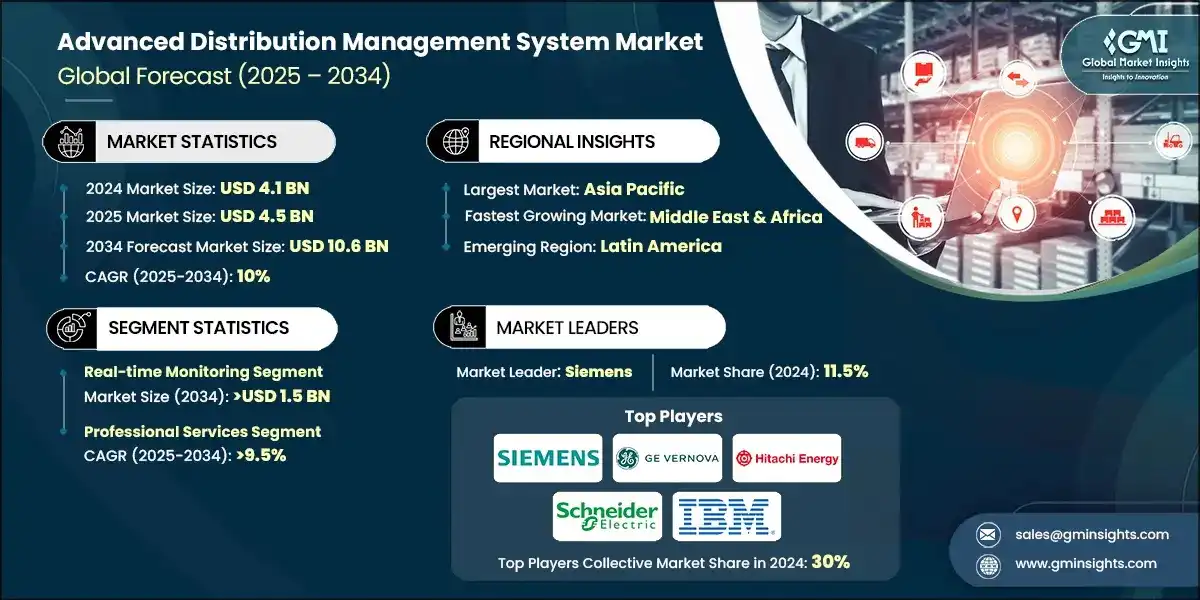
The global advanced distribution management system market size was valued at USD 4.1 billion in 2024. The market is expected to grow from USD 4.5 billion in 2025 to USD 10.6 billion in 2034, at a CAGR of 10%, according to Global Market Insights Inc.
Advanced Distribution Management System Market Key Takeaways
Market Size & Growth
- 2024 Market Size: USD 4.1 Billion
- 2025 Market Size: USD 4.5 Billion
- 2034 Forecast Market Size: USD 10.6 Billion
- CAGR (2025–2034): 10%
Regional Dominance
- Largest Market: Asia Pacific
- Fastest Growing Region: Middle East & Africa
Key Market Drivers
- Rising Integration of Distributed Energy Resources (DERs).
- Increasing Grid Reliability and Resilience Needs.
Challenges
- High Implementation Costs and Complexity.
Opportunity
- Smart Grid Expansion and Urban Electrification.
Key Players
- Market Leader: Siemens led with over 11.5% market share in 2024.
- Leading Players: Top 5 players in this market include Siemens, GE Vernova, Hitachi Energy, Schneider Electric, IBM Corporation, which collectively held a market share of 30% in 2024.
Get Market Insights & Growth Opportunities
- The widespread adoption of smart grids is a major contributor, with over 58% of smart grid investments now incorporating ADMS technologies. Additionally, the integration of renewable energy sources like solar and wind into the grid has created a need for advanced systems that can handle distributed energy resources (DERs), manage bi-directional power flows, and maintain grid stability.
- Innovations in technology are enhancing the capabilities of ADMS platforms. Modern systems now include AI-powered analytics, cloud-native architecture, and edge computing, which allow for faster decision-making and improved scalability. Around 52% of new ADMS products feature AI integration, enabling predictive maintenance, automated fault detection, and optimized energy distribution. These advancements are making ADMS solutions more attractive to utilities worldwide.
- Geographically, North America and Europe are leading in ADMS adoption due to strong regulatory frameworks and sustainability goals. Governments in these regions are pushing for carbon neutrality and grid modernization, which aligns with the capabilities of ADMS. Meanwhile, the Asia-Pacific region is experiencing rapid growth, driven by urbanization, rising energy demand, and infrastructure development in countries like India and China.
- As ADMS becomes more interconnected and data-driven, cybersecurity has emerged as a critical concern. Utilities are prioritizing secure communication protocols, data encryption, and compliance with regulatory standards to protect infrastructure from cyber threats. The U.S. GAO reports that 57% of cybersecurity recommendations for critical infrastructure remain unimplemented, underscoring the urgency for action. DOE’s Cybersecurity Implementation Plan outlines goals to embed cybersecurity into energy modernization, including proactive risk assessments and secure software development.
- Despite its promising growth, the ADMS market faces challenges such as high implementation costs and integration issues with legacy systems. However, ongoing innovation and increasing investments by utilities are expected to mitigate these barriers. As the energy landscape continues to evolve, ADMS will play a crucial role in enabling resilient, efficient, and sustainable power distribution networks globally.
To get key market trends
Advanced Distribution Management System Market Trends
- One of the most significant trends is the integration of artificial intelligence (AI) and machine learning (ML) into ADMS platforms. These technologies enable predictive analytics for grid optimization, fault detection, and proactive maintenance. According to the U.S. Department of Energy, over 64 gigawatts (GW) of grid capacity could be unlocked by prioritizing AI-enhanced interconnection projects by 2030. Additionally, initiatives like TAIGR (Testing AI Grid Resilience) by the Idaho National Laboratory are actively evaluating AI’s role in grid reliability and risk mitigation.
- The market is witnessing a growing emphasis on distributed energy storage systems, including battery storage and microgrids. ADMS platforms are evolving to manage these decentralized assets efficiently, ensuring grid stability and resilience. The integration of solar, wind, and other renewables requires sophisticated control systems, and ADMS is central to balancing supply and demand in real time. This trend aligns with global decarbonization goals and supports the transition to cleaner energy sources.
- As ADMS becomes more interconnected and data-driven, cybersecurity has emerged as a critical concern. Utilities are prioritizing secure communication protocols, data encryption, and compliance with regulatory standards to protect infrastructure from cyber threats. Regulatory mandates around reliability reporting and outage management are also shaping the development of ADMS functionalities, ensuring transparency and accountability in grid operations.
- A growing trend in the ADMS market is the shift toward modular and cloud-native architecture. These systems offer scalability, flexibility, and faster deployment, making them ideal for utilities of varying sizes and needs. Cloud-based ADMS platforms reduce infrastructure costs and enable remote access, which is particularly valuable for utilities operating in geographically dispersed regions. This approach supports incremental upgrades and future-proofing, aligning with the evolving needs of modern power grids.
- Despite the promising growth, integration with legacy infrastructure remains a significant challenge. Many utilities operate outdated systems that are not compatible with modern ADMS platforms, leading to high deployment costs and technical complexities. However, this challenge also presents opportunities for vendors offering interoperable solutions and migration support.
Advanced Distribution Management System Market Analysis
Learn more about the key segments shaping this market
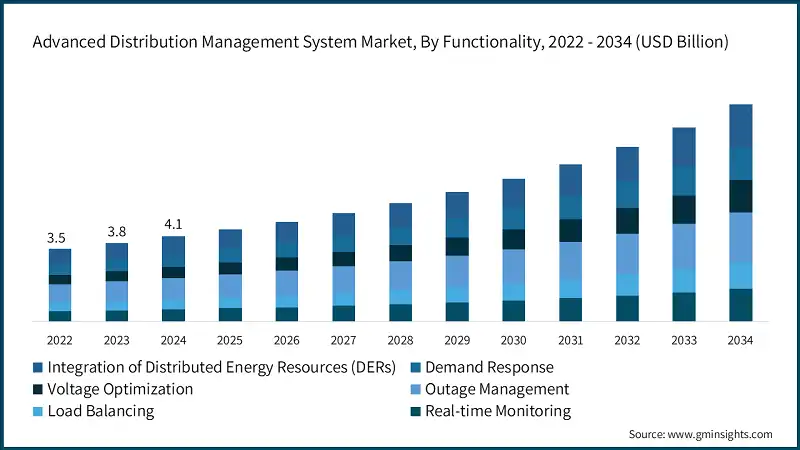
- The advanced distribution management system market was valued at USD 3.5 billion, USD 3.8 billion and USD 4.1 billion in 2022, 2023 and 2024 respectively. Utilities worldwide are under pressure to improve grid reliability, reduce outages, and integrate renewable energy sources. ADMS platforms offer a unified solution that combines outage management, distribution automation, and real-time analytics, making them indispensable for modern grid operations.
- Another major factor contributing to this growth is the rapid integration of distributed energy resources (DERs) such as solar panels, wind turbines, and battery storage systems. These decentralized assets require sophisticated control and coordination, which ADMS platforms are uniquely equipped to handle. The rise in electric vehicle (EV) adoption has further complicated grid dynamics, necessitating advanced load forecasting and demand response capabilities both of which are core features of ADMS solutions.
- According to the U.S. Department of Energy, over 6.7 million plug-in electric vehicles have been sold in the U.S. since 2010, and in Q3 2024, battery electric vehicles accounted for 8.9% of all light-duty vehicle sales, rising to 21% when including hybrids. This surge in EVs is expected to add between 100 TWh and 185 TWh to national electricity demand by 2030, representing 2.5% to 4.6% of total U.S. consumption. Such growth underscores the need for intelligent grid management systems like ADMS to ensure stability and V2G integration.
- Based on functionality, real-time monitoring segment is anticipated to grow more USD 1.5 billion by 2034 due to increasing need for grid reliability, operational efficiency, and outage reduction. Utilities are under pressure to manage complex, decentralized energy networks that include renewable sources, electric vehicles, and distributed energy resources (DERs). Real-time monitoring enables utilities to detect faults instantly, respond to grid disturbances proactively, and maintain service continuity capabilities.
- Load balancing is also an important segment that refers to the even distribution of electrical load across all phases and feeders in a power distribution network. In ADMS, this functionality is vital for preventing overloading of transformers, feeders, and conductors. When loads are unevenly distributed, it can lead to voltage fluctuations, overheating, and equipment damage. ADMS platforms equipped with load balancing capabilities continuously monitor and adjust loads in real time.
- With the increasing integration of renewable energy sources like solar and wind, and the rise of electric vehicles (EVs), load patterns have become more unpredictable. ADMS systems use load balancing to manage these fluctuations effectively. By dynamically redistributing loads, utilities can accommodate intermittent generation and variable demand without compromising grid performance. This is especially important in regions experiencing rapid urbanization and electrification, where demand spikes can strain infrastructure.
- Government incentives and funding programs have accelerated ADMS adoption, particularly in regions like North America, Europe, and Asia-Pacific. For instance, smart city initiatives and energy transition policies in countries like India and China have led to substantial investments in grid infrastructure. These programs often include subsidies or mandates for utilities to adopt advanced management systems, further fueling market growth.
Learn more about the key segments shaping this market
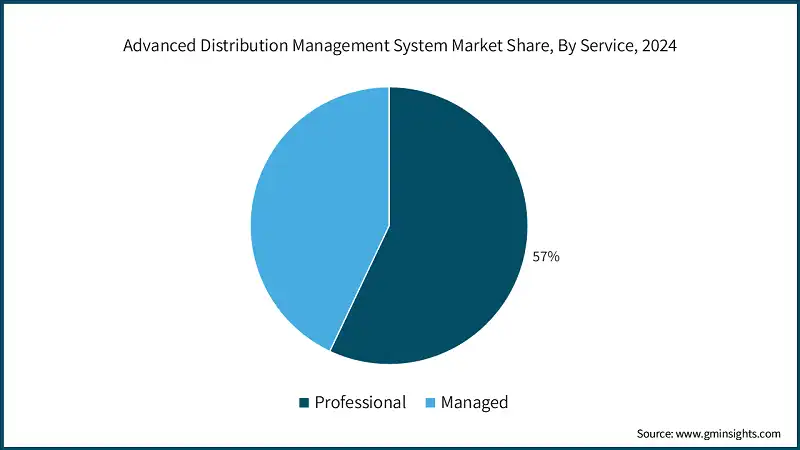
- Based on services, in the advanced distribution management system market, professional services segment is expected to grow up to more than 9.5% CAGR. These services include system integration, consulting, training, and post-deployment support. As ADMS solutions become more complex integrating AI, IoT, and cloud technologies utilities increasingly rely on expert service providers to ensure seamless implementation.
- Managed services go beyond initial deployment, offering ongoing monitoring, maintenance, and optimization of ADMS systems. Utilities benefit from 24/7 support, proactive issue resolution, and performance tuning, which are critical for maintaining grid reliability. These services are especially valuable for utilities with limited in-house IT capabilities. By outsourcing ADMS management, utilities can focus on core operations while ensuring their systems remain secure, updated, and compliant with evolving standards.
- One of the key drivers of growth in the managed services segment is its cost-effectiveness and scalability. Utilities can avoid large upfront investments in infrastructure and personnel by adopting subscription-based service models. Managed service providers offer flexible packages that scale with the utility’s needs, making it easier to adapt to changing grid demands, regulatory requirements, and technological advancements. This model is particularly attractive to small and mid-sized utilities seeking to modernize without overextending resources.
- With increasing cyber threats targeting critical infrastructure, managed services play a vital role in cybersecurity and regulatory compliance. Providers offer advanced threat detection, incident response, and compliance reporting as part of their service offerings. This ensures that ADMS platforms are protected against breaches and aligned with industry standards such as NERC CIP and ISO 27001. Utilities benefit from expert guidance and tools that would be costly and complex to manage internally.
- Professional and managed services also contribute to continuous innovation in the ADMS market. Service providers bring cross-industry expertise, best practices, and access to emerging technologies. Through strategic partnerships, utilities can pilot new features, integrate distributed energy resources (DERs), and enhance grid automation. These services enable utilities to evolve with the market, ensuring their ADMS platforms remain future-ready and competitive.
Looking for region specific data?
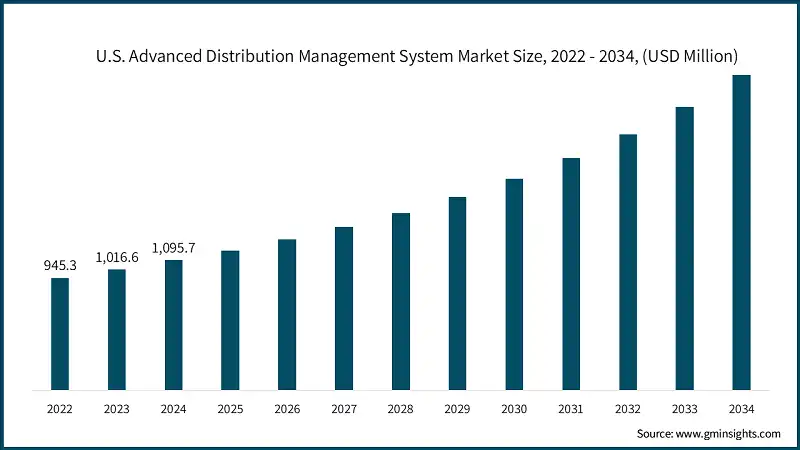
- The U.S. advanced distribution management system market in 2022, 2023 and 2024 was valued at USD 945.3 million, USD 1.01 billion and USD 1.09 billion respectively. U.S. is investing on a large scale in the power transmission as well distribution, growing the demand for ADMS across the world. In 2023, investor-owned utilities spent about USD 170 billion to expand the electricity grid, indicating the promising future for the market across the U.S.
- The U.S. plays a pivotal role in the global ADMS market, contributing over 28% of total market share in 2024. This dominance is driven by aggressive utility digitization programs and federal initiatives like the Grid Modernization Initiative. More than 72% of U.S.-based utilities have adopted ADMS-enabled smart grid systems, reflecting a strong commitment to enhancing grid reliability, operational efficiency, and outage management. The country’s advanced infrastructure and regulatory support have positioned it as a hub for innovation and deployment of ADMS technologies.
- The U.S., the second largest economy in the world, accounts for 15% of global clean energy investment, and remains a major investor in oil and gas. Clean energy investment in the U.S. more than tripled from 2018 to 2023, when annual clean investment totaled nearly USD 248 billion. These figures shows that the demand for ADMS will be increasing in coming decades.
- The APAC region is also experiencing a noteworthy rise in industrialization, thus increasing the need for ADMS. In 2023, the Asia Pacific’s real GDP amounted to USD 56.6 trillion, constituting 61% of the globe's total. In this year Asia Pacific region exported USD 11.7 trillion worth of merchandise goods, and USD 2.7 trillion worth of commercial services.
- China is a key growth engine for the ADMS market in the Asia-Pacific region. With rapid urbanization, rising energy demand, and a national push for smart grid development, China is accelerating its adoption of ADMS technologies. The country’s utilities are investing heavily in digital platforms to manage distributed energy resources (DERs), integrate renewables, and improve grid resilience. China’s role is especially critical as Asia-Pacific is projected to exhibit the steepest growth curve in ADMS adoption globally.
- Japan continues to play a significant role in the ADMS industry, largely due to its strong progress in the end-use sectors of the ADMS market. The country’s advancements in smart infrastructure, industrial automation, and energy distribution are driving demand for ADMS technologies. According to World Economics, Japan’s GDP is estimated at USD 6.31 trillion in PP terms for 2024, with an initial projection of USD 6.38 trillion for 2025. This economic growth is expected to contribute to a substantial rise in ADMS demand across the Asia-Pacific region in the coming years.
Advanced Distribution Management System Market Share
Top 5 companies including Siemens, GE Vernova, IBM, Hitachi Energy, Schneider Electric hold more than 30% market around the world. The major companies consistently work on new products and solutions which makes them a crucial part of the industry globally. These companies place a high focus on investment, especially on research and development. Besides, these companies apply different methods of market development in order to obtain considerable shares in the industry.
Advanced Distribution Management System Market Companies
- Siemens is advancing ADMS innovation through its Xcelerator platform, which merges digital and physical infrastructure to enable intelligent grid operations. Its Spectrum Power ADMS integrates AI, DERMS, and real-time analytics to enhance grid resilience and sustainability. With digital twins, Zero Trust cybersecurity, and circularity initiatives, Siemens positions ADMS as a cornerstone of decarbonization and adaptive grid modernization across global markets.
- GE Vernova’s GridOS ADMS platform is central to its mission to electrify and decarbonize the world. The company’s sustainability strategy includes deploying 31 GW of new power capacity and integrating 310,000 automation units in 2024 alone. ADMS innovations support real-time fault detection, DER integration, and grid flexibility, especially in underserved regions.
- Schneider Electric’s EcoStruxure ADMS is redefining grid resilience through AI-native ecosystems and modular digital platforms. Its ADMS supports fault prediction, DER orchestration, and wildfire risk mitigation using satellite data and AI. Utilities like PG&E and Unareti leverage Schneider’s solutions to enhance urban grid visibility and reduce outage durations. The company’s multi-year initiative in agentic AI and its stepwise deployment model enable scalable, sustainable grid modernization.
Major players operating in the advanced distribution management system market are:
- Aspen Technology: AspenTech OSI ADMS is a comprehensive suite for real-time grid management, integrating SCADA, DMS, OMS, and DERMS. It supports outage management, switch order simulation, and operator training for resilient and efficient distribution operations.
- Cyient: Cyient’s iDMS enhances ADMS readiness by improving data accuracy and governance across GIS, metering, and asset systems. It automates network data validation using smart meter data, boosting reliability and operational efficiency.
- DNV: DNV offers vendor-neutral ADMS advisory services, helping utilities select, implement, and optimize control room technologies. Their expertise spans SCADA, OMS, cybersecurity, and change management for tailored grid modernization.
- Eaton: Eaton’s ADPS (Advanced Distribution Planning System) combines CYME modeling with analytics for long-term grid planning. It supports DER integration, regulatory compliance, and scenario-based investment decisions across utility operations.
- Elipse Power ADMS is a modular platform for managing generation, transmission, and distribution networks. It offers real-time control, substation automation, and renewable integration, with flexible deployment options and advanced analytics.
- Energy Hub: EnergyHub’s platform focuses on DERMS, offering dynamic load shaping, EV charging optimization, and virtual power plant orchestration. It uses advanced algorithms for real-time flexibility and predictive analytics across distributed assets.
- ETAP: ETAP ADMS unifies SCADA, DMS, and OMS into a modular solution for smart grid operations. It features fault location, load shedding, volt/VAR optimization, and real-time microgrid control on a geospatial platform.
- GE Vernova: GE Vernova’s GridOS ADMS offers integrated outage management, DER orchestration, and predictive analytics. It improves grid reliability, restoration speed, and operational efficiency with AI-driven insights and centralized fault resolution.
- HCL Technologies: HCLTech does not offer a dedicated ADMS platform but provides automation and AI-driven solutions through its DRYiCE suite. These tools support operational transformation and data integration across enterprise systems.
- Hitachi Energy: Hitachi’s Network Manager ADMS delivers real-time monitoring, outage management, and DER optimization via a scalable SCADA platform. It includes operator training simulators and grid-aware DERMS for resilient and efficient grid operations.
- IBM Corporation: IBM’s ADMS integrates AI, IoT, and cloud technologies to deliver predictive grid analytics, outage management, and real-time control. It supports DER integration and enhances grid reliability through cognitive automation and scalable architecture.
- Itron Inc: Itron’s IntelliFLEX is a grid-edge DERMS platform that complements ADMS by enabling real-time DER coordination, AI-driven forecasting, and load balancing. It integrates with AMI and SCADA systems to optimize grid performance and reduce peak loads.
- Minsait: Minsait’s Onesait ADMS combines SCADA, DMS, and OMS into a unified platform with distributed intelligence. It supports FLISR, DER orchestration, and advanced analytics, offering scalable, autonomous grid operations for utilities of all sizes.
- Oracle: Oracle Utilities Network Management System (NMS) delivers real-time grid monitoring, FLISR, Volt/VAR optimization, and DERMS integration. It supports scalable deployment and predictive analytics, helping utilities modernize and manage complex distribution networks.
- Schneider Electric: Schneider’s EcoStruxure ADMS integrates SCADA, DMS, and OMS with over 50 advanced functions. It enables real-time control, outage management, and DER integration, supporting grid reliability, planning, and optimization on a unified platform.
- Siemens: Siemens Spectrum Power ADMS offers integrated SCADA, OMS, and advanced fault analysis. It supports DER integration, grid automation, and real-time decision-making, helping utilities manage dynamic distribution networks efficiently.
- Survalent Technology Corporation: SurvalentONE ADMS is a modular platform combining SCADA, OMS, and DMS. It features FLISR, Volt/VAR optimization, load forecasting, and DERMS, enabling utilities to enhance reliability, reduce outages, and optimize grid operations.
- Wipro Ltd. Wipro’s DeltaVerge platform focuses on digital distribution management, offering real-time visibility, mobility, and analytics. While not a traditional ADMS, it supports sales and inventory operations across distribution ecosystems with IoT and AI integration.
Advanced Distribution Management System Market Report Attributes
| Key Takeaway | Details |
|---|---|
| Market Size & Growth | |
| Base Year | 2024 |
| Market Size in 2024 | USD 4.1 Billion |
| Market Size in 2025 | USD 4.5 Billion |
| Forecast Period 2025 - 2034 CAGR | 10% |
| Market Size in 2034 | USD 10.6 Billion |
| Key Market Trends | |
| Drivers | Impact |
| Rising Integration of Distributed Energy Resources (DERs) | The growing adoption of solar, wind, and battery storage systems requires utilities to manage complex, decentralized energy flows. ADMS enables real-time visibility, control, and optimization of DERs, helping utilities balance supply and demand, reduce outages, and support grid stability amid increasing renewable penetration. |
| Increasing Grid Reliability and Resilience Needs | Frequent extreme weather events and aging infrastructure are pushing utilities to modernize grid operations. ADMS provides predictive analytics, fault location, and automated restoration capabilities, allowing faster response to disruptions and proactive maintenance. This enhances grid reliability, reduces downtime, and improves customer satisfaction. |
| Pitfalls & Challenges | Impact |
| High Implementation Costs and Complexity | Deploying ADMS requires significant investment in infrastructure, software, and skilled personnel. Integration with legacy systems and real-time data sources adds complexity, often leading to delays and budget overruns. Smaller utilities may struggle to justify the cost, limiting widespread adoption despite long-term operational benefits. |
| Opportunities: | Impact |
| Smart Grid Expansion and Urban Electrification | As cities modernize and electrify transportation, ADMS offers utilities a chance to manage complex, high-demand networks efficiently. With smart grid expansion, ADMS can optimize load distribution, integrate EV charging, and support real-time decision-making, positioning utilities as leaders in sustainable urban infrastructure. |
| Market Leaders (2024) | |
| Market Leaders |
Market Share 11.5% |
| Top Players |
Collective market share in 2024 is Market Share 30% |
| Competitive Edge |
|
| Regional Insights | |
| Largest Market | Asia Pacific |
| Fastest Growing Market | Middle East & Africa |
| Emerging Region | Latin America |
| Future outlook |
|
What are the growth opportunities in this market?
Advanced Distribution Management System Industry News
- In March 2025, Oracle unveiled new features for its Oracle Utilities Network Management System (NMS) at DISTRIBUTECH in Dallas, aimed at enhancing distributed energy resource (DER) lifecycle management. These ADMS upgrades empower control room operators and program managers to optimize grid performance using both front-of-the-meter and behind-the-meter data. The enhancements improve demand response, DER orchestration, and forecasting, while supporting rapid restoration during extreme weather events.
- In October 2024, Schneider Electric announced a strategic partnership with Noida International Airport to deploy advanced building and energy management solutions, including an Advanced Distribution Management System (ADMS). The ADMS will enable real-time monitoring and control of critical airport systems, enhancing operational efficiency and sustainability. Integrated with Electrical SCADA and smart dashboards, the system will optimize energy usage, support renewable integration, and ensure uninterrupted power supply.
The advanced distribution management system market research report includes in-depth coverage of the industry with estimates & forecast in terms of “USD Million” from 2021 to 2034, for the following segments:
Market, By Functionality
- Real-time Monitoring
- Load Balancing
- Outage Management
- Voltage Optimization
- Demand Response
- Integration of Distributed Energy Resources (DERs)
Market, By Service
- Professional
- Managed
Market, By Deployment
- Cloud Based
- On Premise
Market, By End Use
- Energy and Utilities
- IT and Telecommunications
- Manufacturing
- Defense and Government
- Infrastructure
- Healthcare
- Transportation and Logistics
- Others
The above information has been provided for the following regions and countries:
- North America
- U.S.
- Canada
- Mexico
- Europe
- UK
- France
- Netherlands
- Italy
- Spain
- Sweden
- Denmark
- Germany
- Russia
- Asia Pacific
- China
- India
- Japan
- South Korea
- Australia
- Middle East & Africa
- Saudi Arabia
- UAE
- Qatar
- Egypt
- South Africa
- Latin America
- Brazil
- Argentina
- Peru
Frequently Asked Question(FAQ) :
What is the market size of the advanced distribution management system in 2024?
The market size was valued at USD 4.1 billion in 2024, with a CAGR of 10% expected through 2034. The adoption of smart grids and the integration of renewable energy sources are driving market growth.
What is the projected value of the advanced distribution management system market by 2034?
The market is poised to reach USD 10.6 billion by 2034, driven by the need for grid modernization, renewable energy integration, and advanced system functionalities.
What is the expected size of the advanced distribution management system industry in 2025?
The market size is projected to reach USD 4.5 billion in 2025.
How much revenue is the real-time monitoring segment expected to generate by 2034?
The real-time monitoring segment is anticipated to grow to USD 1.5 billion by 2034, led by the increasing need for grid reliability, operational efficiency, and outage reduction.
What was the valuation of the professional services segment in 2024?
The professional services segment is expected to grow at a CAGR of over 9.5% till 2034, propelled by the increasing complexity of ADMS solutions and the need for expert integration, consulting, and support services.
Which region leads the advanced distribution management system sector?
The U.S. leads the market, contributing over 28% of the global market share in 2024. This dominance is attributed to aggressive utility digitization programs and federal initiatives like the Grid Modernization Initiative.
What are the upcoming trends in the advanced distribution management system market?
Trends include AI- and ML-driven analytics, modular cloud-native systems, stronger cybersecurity, and expanding distributed energy storage.
Who are the key players in the advanced distribution management system industry?
Key players include Aspen Technology, Cyient, DNV, Eaton, Elipse Software, Energyhub, ETAP, GE Vernova, HCL Tech, Hitachi Energy, IBM Corporation, Itron Inc., Minsait ACS, and Oracle.
Advanced Distribution Management System Market Scope
Related Reports