Summary
Table of Content

5G Telematics Control Unit Market
Get a free sample of this report
Form submitted successfully!
Error submitting form. Please try again.
Thank you!
Your inquiry has been received. Our team will reach out to you with the required details via email. To ensure that you don't miss their response, kindly remember to check your spam folder as well!
Request Sectional Data
Thank you!
Your inquiry has been received. Our team will reach out to you with the required details via email. To ensure that you don't miss their response, kindly remember to check your spam folder as well!
Form submitted successfully!
Error submitting form. Please try again.
5G Telematics Control Unit Market Size
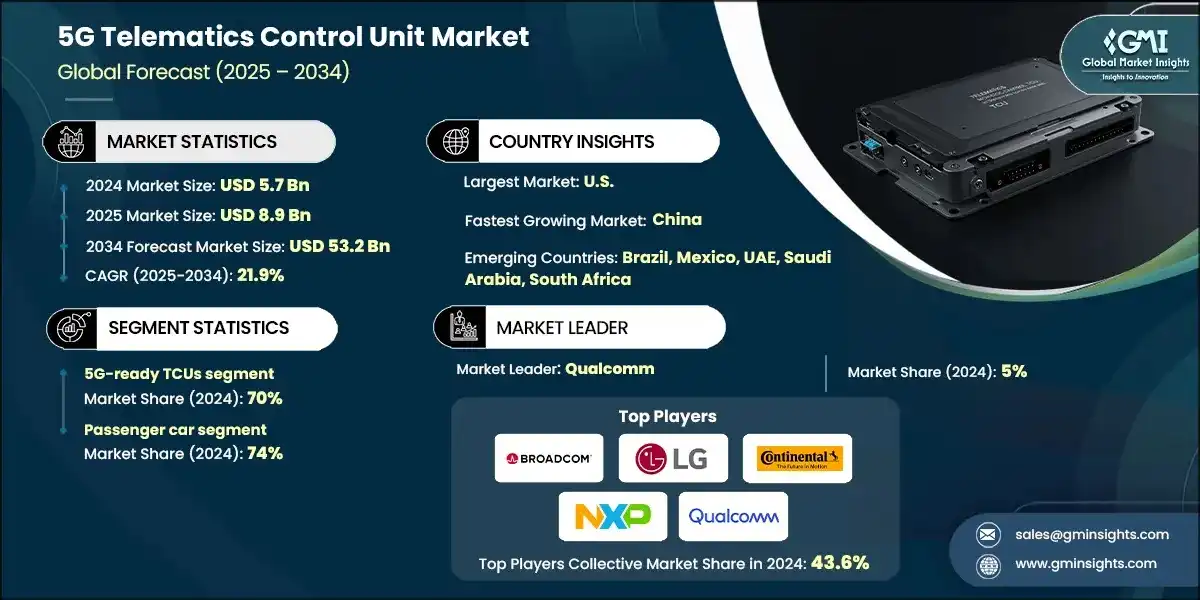
The global 5G telematics control unit market size was estimated at USD 5.7 billion in 2024. The market is expected to grow from USD 8.9 billion in 2025 to USD 53.2 billion in 2034, at a CAGR of 21.9% according to latest report published by Global Market Insights Inc.
To get key market trends
OEMs increasingly put 5G telematics control units right into cars while making them, because they need faster connections, instant data process, and smooth fit with car systems. The auto industry now moves toward self-driving and connected cars, and in-built TCUs works better than aftermarket ones for safe, strong, and reliable performance.
When 5G meets edge computing, TCUs can handle data on the spot, which cut down delays and make reaction times faster for important functions. This also lets vehicles get over-the-air software updates easily, do remote checks, and manage fleets in real-time. Companies like Tesla show how it works, fixing more than 35% of recall issues via OTA updates, says the 5G Automotive Association.
Car makers push out dual band 5G TCUs that mix mmWave with Sub-6 GHz tech faster now, because vehicles need super low delays for V2X communications. Sub-6 GHz gives wide coverage and keeps connection steady, but mmWave brings very low latency and high data speed needed for safety and self-driving features.
The car industry fast moving toward connected vehicles, and this push to make demand for advanced telematics spikes. Drivers today want smooth connectivity for infotainment, while ADAS need instant data swaps to work right. According to 5G Automotive Association, around 20% of cars worldwide are already on cellular networks, and this number is likely to grow fast as 5G networks spread.
EVs and hybrid cars rely on 5G TCUs to manage energy-smart connected services and improve cabin experience. Connecting infotainment, smart navigation, and remote diagnostics need strong 5G units that handle big data fast and with low delay. Worldwide growth of EV production pushing 5G TCU demand higher. Telematics and AI systems in cars use 5G TCUs to process lots of sensor info, help predictive maintenance, and support AI-driven autonomous features. Real-time monitoring, multi-sensor fusion, and edge computing all need solid 5G connection, which also increases semiconductor use in these units.
IoT services in connected vehicles like remote diagnostics, cloud updates, and media streaming depend on 5G TCUs for constant high-speed connection. Investments in smart fleet management, ridesharing, and V2X ecosystems keep driving market growth. Luxury car makers and fleet operators now adopt advanced 5G TCUs to power premium telematics, smart cockpits, and autonomous driving. High-end cars need low-latency, high-bandwidth modules to ensure smooth connection and secure data, pushing adoption of top-tier 5G TCUs.
APAC is seeing big growth due to high vehicle production in China, Japan, South Korea. Fast adoption of connected car tech, strong local manufacturing, and partnerships with global semiconductor and telematics firms help push 5G TCU penetration up.
Europe’s expansion comes from regulations supporting electric mobility, intelligent transport, and connected vehicles. Germany, France, and Italy using advanced telematics and smart fleet solutions in both passenger and commercial vehicles. Rising consumer interest in connected, high-tech, autonomous features also lifting 5G TCU demand in the region.
5G Telematics Control Unit Market Report Attributes
| Key Takeaway | Details |
|---|---|
| Market Size & Growth | |
| Base Year | 2024 |
| Market Size in 2024 | USD 5.7 Billion |
| Market Size in 2025 | USD 8.9 Billion |
| Forecast Period 2025 - 2034 CAGR | 21.9% |
| Market Size in 2034 | USD 53.2 Billion |
| Key Market Trends | |
| Drivers | Impact |
| Integration of 5G connectivity | Automakers are incorporating 5G TCUs to enable high-speed data transfer, supporting advanced infotainment systems, real-time navigation, and over-the-air (OTA) updates |
| Adoption in electric vehicles (EVs) | EV manufacturers are integrating 5G TCUs to enhance connectivity for smart charging, battery management, and vehicle-to-grid (V2G) communication |
| Demand for enhanced connectivity | Consumers seek seamless in-car experiences with high-speed internet access, driving the need for advanced TCUs |
| Government regulations | Policies mandating connected vehicle technologies and safety features propel TCU adoption |
| Advancements in autonomous driving | The progression towards self-driving vehicles necessitates robust communication systems, boosting TCU demand |
| Pitfalls & Challenges | Impact |
| High development costs | The complexity of 5G technology increases R&D and manufacturing expenses |
| Infrastructure limitations | Inadequate 5G network coverage in certain regions hampers the full utilization of TCUs |
| Cybersecurity concerns | The integration of advanced connectivity features raises the risk of cyber threats, necessitating stringent security measures |
| Opportunities: | Impact |
| Expansion in emerging markets | Growing automotive markets in regions like Asia-Pacific and Latin America present new avenues for TCU adoption. |
| Collaboration with telecom providers | Partnerships between automakers and telecom companies can enhance 5G infrastructure and service offerings. |
| Development of v2x ecosystems | Building comprehensive vehicle-to-everything networks can create demand for advanced TCUs. |
| Market Leaders (2024) | |
| Market Leaders |
5% market share |
| Top Players |
Collective market share in 2024 is Collective Market Share is 43.6% |
| Competitive Edge |
|
| Regional Insights | |
| Largest Market | US |
| Fastest growing market | China |
| Emerging countries | Brazil, Mexico, UAE, Saudi Arabia, South Africa |
| Future outlook |
|
What are the growth opportunities in this market?
5G Telematics Control Unit Market Trends
Connected vehicles, including EVs and hybrids, are being adopted fast, pushing up the need for 5G TCUs. These units let cars, infrastructure, and cloud platforms talk smoothly, supporting telematics, infotainment, and safety apps. As OEMs add smart navigation, remote diagnostics, and V2X features, 5G TCUs become key for fast, high-bandwidth data transfer. This growth in connected mobility is driving global 5G TCU deployments and market expansion.
EV makers rely a lot on advanced TCUs to improve battery use, energy efficiency, and cabin experiences. 5G TCUs make over-the-air updates, predictive maintenance, and real-time monitoring easier, boosting efficiency and customer satisfaction. With EV production rising worldwide, demand for dependable high-speed 5G telematics units is climbing. Automakers pushing 5G integration to stand out create a clear growth path for the 5G TCU market.
Drivers now expect rich in-car media, voice assistants, and smooth streaming. 5G TCUs support fast, low-latency data needed for advanced infotainment and multi-device connectivity. OEMs put in 5G TCUs to give real-time media updates, navigation, and cloud apps. AI-driven infotainment makes TCUs even more important, opening new opportunities for suppliers and pushing constant tech upgrades in automotive telematics.
Advanced Driver Assistance Systems (ADAS) need real-time sensor data for collision alerts, lane-keeping, and adaptive cruise control. 5G TCUs enable ultra-low-latency communication between vehicles and infrastructure, supporting better safety and V2X features. Rules around vehicle safety and insurance perks for equipped cars encourage automakers to adopt 5G telematics, making TCUs vital for future autonomous or semi-autonomous vehicles.
Commercial fleets and logistics depend more on connected solutions for route planning, fuel use, predictive maintenance, and monitoring. 5G TCUs send data in real-time, helping operators track vehicles, analyze performance, and cut downtime. Growing demand for digital fleet management, especially in e-commerce and last-mile delivery, 5G drives TCU use, offering big market opportunities in commercial vehicles.
The automotive sector is moving to V2X networks where vehicles communicate with each other, infrastructure, and pedestrians. 5G TCUs are needed for reliable, fast, high-bandwidth data exchange, enabling smart traffic control, less congestion, and accident prevention. Government initiatives and smart city projects worldwide boost V2X adoption, increasing 5G TCU deployment. Integrating vehicles into these connected ecosystems is a major driver for the 5G telematics market.
5G Telematics Control Unit Market Analysis
Learn more about the key segments shaping this market
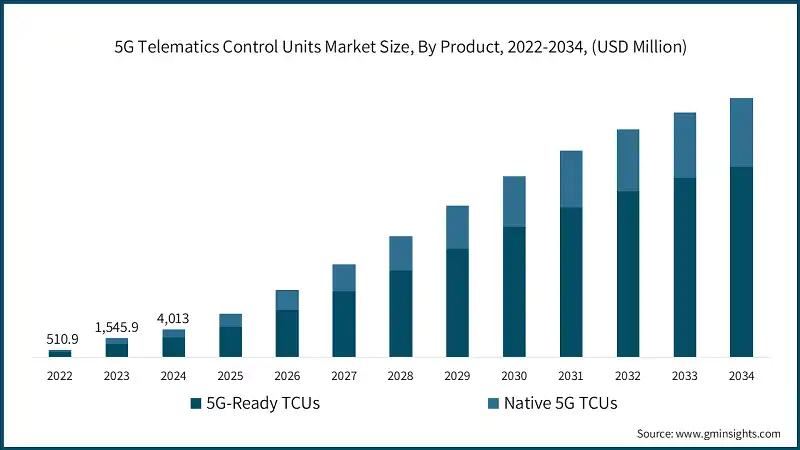
Based on product, the 5G telematics control unit market is divided into 5G-ready TCUs, and native 5G TCUs. The 5G-ready TCUs segment dominated the market accounting for around 70% in 2024 and is expected to grow at a CAGR of over 22% from 2025 to 2034.
- Connected vehicles, including EVs and hybrids, are being adopted fast, pushing up need for 5G-ready TCUs. These units let cars, infrastructure, and cloud systems talk smoothly, supporting telematics, entertainment, and remote diagnostics. Low-latency and high-bandwidth connections help OEMs add advanced features, improve vehicle intelligence, and make passenger experience better.
- Rising EV and autonomous vehicle production makes high-speed telematics more necessary. 5G-ready TCUs allow over-the-air updates, predictive maintenance, and real-time monitoring, helping efficiency. Automakers using these units can offer smarter, safer cars while standing out in competitive markets, creating big growth opportunities for 5G TCU adoption worldwide.
- Drivers now expect advanced infotainment, streaming, and multi-device connectivity. 5G-ready TCUs support fast, low-latency data for AI-driven infotainment and cloud apps. By giving seamless media, real-time navigation, and updates, these units keep passengers engaged and push OEMs to adopt 5G telematics to meet rising expectations.
- Fleet operators also rely on connected tech for route planning, vehicle tracking, and operational efficiency. 5G-ready TCUs send data in real-time, enable predictive maintenance, track performance, and cut downtime. Growing demand for smart fleet management, e-commerce delivery, and last-mile logistics fuels advanced telematics adoption, expanding the 5G TCU market across commercial sectors.
- V2X communication is becoming core to smart transportation networks. 5G-ready TCUs allow ultra-low-latency connections between vehicles, infrastructure, and pedestrians, improving safety, traffic flow, and congestion control. Global government initiatives and smart city projects accelerate V2X adoption, boosting demand for 5G telematics units and supporting connected mobility growth.
Learn more about the key segments shaping this market
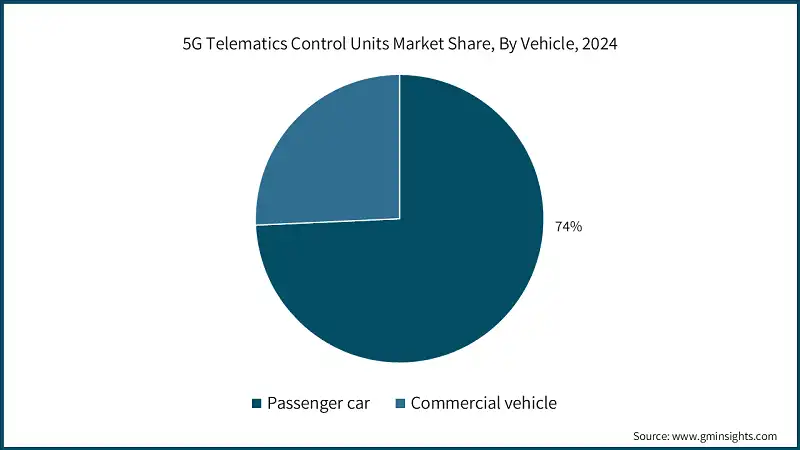
Based on vehicle, the 5G telematics control unit market is segmented into passenger car and commercial vehicle. The passenger car dominates the market with 74% share in 2024, and the segment is expected to grow at a CAGR of over 22% from 2025 to 2034.
- Growing demand for connected passenger vehicles is pushing automakers to add TCUs that let cars talk in real-time with the cloud, roads, and each other. These units handle navigation, infotainment, telematics, and safety tasks, making driving smoother overall. As buyers expect smarter mobility, automakers focus more on putting TCUs inside to boost connectivity and intelligence.
- Manufacturers keep adding TCUs to support ADAS and improve vehicle safety. Cars with these units can share data instantly, helping with collision alerts, remote checks, and quick emergency help. Strong safety rules and growing V2X systems are speeding up TCU use in passenger vehicles, giving the market solid growth.
- Drivers want rich in-car entertainment like seamless streaming, navigation, and voice control. TCUs make this possible by keeping fast, stable connections and linking with AI-powered infotainment platforms. Automakers use it to give better user experience and stand apart in a market full of competition.
- Over-the-air updates becoming common in passenger cars also push TCU demand up. These units let OEMs send software updates, fix bugs, or add features without visits to service centers. It saves cost, improves maintenance cycles, and helps brands keep customers longer through steady improvements even after purchase.
- Shared mobility and ride-hailing trends also add to this rise. TCUs let operators track cars live, check performance, and offer services based on usage. As city transport systems grow, connected cars with TCUs are key for efficiency, safety, and custom services, driving steady demand worldwide.
Based on fuel, the 5G telematics control unit market is segmented into gasoline, diesel, all-electric, HEV, PHEV, and FCEV. A big chunk of the car market still runs on gasoline, and that’s pushing the first big wave of 5G TCU rollouts. OEMs want to boost connectivity without jumping fully to EV platforms. Putting 5G TCUs inside lets them modernize old powertrains with smart features like real-time navigation, telematics, and infotainment. It helps keep these vehicles relevant and supports digital shift.
- In many developing countries, gasoline vehicles has high market share while EV adoption moves slower. That creates a big chance to fit 5G TCUs into mass-market cars, bringing connected features at scale. Automakers use telematics to give regular engines smart mobility options, which keeps TCU demand steady in gasoline segments worldwide.
- More drivers now want the same smart connectivity no matter what they drive. Even without electric power, they expect infotainment, maps, and telematics that just work. 5G TCUs help OEMs meet that, giving fast, stable connection and modern features inside traditional cars, making products more competitive and improving loyalty.
- Many OEMs follow a hybrid game plan, adding 5G TCUs into gasoline vehicles to keep connectivity across all models. This lowers development costs, makes platforms easier to scale, and smooths their move toward EVs later. With smart connectivity inside gas models, brands get stronger value and new revenue from telematics services.
Based on installation, the 5G telematics control unit market is segmented into OEMs, and aftermarket.
- OEMs planning on integrating 5G-ready TCUs in their new cars. These boxes help very fast, low-delay communication, which lets advanced telematics and AI in infotainment run smoother, also helps predict maintenance needs. Doing this early can make brands look better, showing they lead in connected mobility.
- The move towards self-driving and semi-self-driving cars makes OEMs spend on 5G TCUs. With these, cars can mix sensor data fast, talk to everything around (V2X), and process info quick, all needed for safe autonomous rides. Using 5G now helps fleets stay future-proof and fit into smart city transport later.
- 5G TCUs also lets OEMs give high-end in-car services. Things like cloud games, AR navigation, and heavy streaming work because the connection is reliable and wide-band. This can catch tech-minded buyers and open new money streams with subscriptions, making the vehicle more than just a car.
- Fleet management and MaaS solutions getting more complex is pushing OEMs to add 5G telematics. Real-time info sharing, predicting problems, and remote fixes are easier with 5G. Cars with these units can work more reliably, cut downtime, and attract commercial clients, letting OEMs tap new connected mobility business.
- Smart city programs and government rules make OEMs adopt 5G-ready units faster. Cars talking instantly with traffic systems can avoid crashes, optimize flow, and connect with V2X networks. OEMs putting in these TCUs can follow future rules, join city transport systems, and improve their stance in the connected vehicle market.
Looking for region specific data?
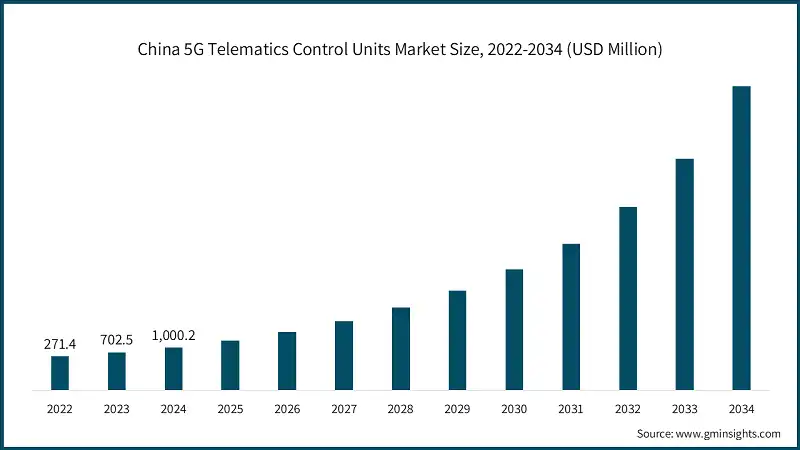
China dominated the 5G telematics control unit market in North America with around 40% share in 2024 and generated USD 1 billion in revenue.
- China’s connected car is propelling, due to which consumer demand for tech in-car such as infotainment, navigation and remote diagnostics keep driving TCU adoption. These units is critical for linking cars with cloud, and as more vehicles adopt connected services, OEMs increase 5G TCU fitment, boosting market growth in both passenger and commercial segments.
- Government support for intelligent transport is propelling market opportunities, with rules on emergency call, tracking, and safety standards make TCU adoption faster. Incentives and smart city programs encourage OEMs and suppliers to invest 5G-ready telematics, which strengthen China’s position as leader in automotive connectivity.
- Rapid 5G rollout increases TCU demand by giving low-latency, high speed data network. Real-time exchange for telematics, infotainment, and V2X applications are possible now, and as coverage spreads nationwide, more vehicles equip 5G-enabled TCUs, helping intelligent transport and better car experiences, thus driving market growth across segments.
- Autonomous and semi-autonomous cars growth is generating demand for advanced TCUs that enable vehicle-to-vehicle and vehicle-to-infrastructure communication. Real-time data transfer, sensor integration, predictive analytics make TCUs essential for self-driving features. More investment in self-driving in China directly increasing 5G telematics adoption among OEMs.
- Local TCU makers like Huawei, Neusoft, Valeo are supporting market growth by raising production, improving local supply chains and working with OEMs. In 2024, number of vehicles with 5G connectivity rise sharply, showing adoption trends strong, and local manufacturers become key drivers in China telematics ecosystem.
- Customer expectations for improved in-car experience drives 5G TCU market. Drivers wants seamless connectivity, navigation in real-time, personalized infotainment, and advanced telematics. TCUs provide high-speed internet, cloud link and vehicle-smartphone connections. Rising preference for connected mobility solution motivates OEMs fit 5G TCUs, supporting growth trajectory in China.
Asia Pacific 5G telematics control unit market dominated with a market share of 41% in 2024.
- Rapid adoption of 5G across APAC is increasing vehicle data sharing, which help telematics and safety systems work better while traffic efficiency improves. Rising sales of electric and autonomous vehicles create growing demand for TCUs that manage batteries, charging, and navigation while keeping cars connected to infrastructure.
- Supportive government rules pushing safety and tracking features are driving market growth, automakers now integrate TCUs more to meet standards and enhance overall vehicle safety. Consumer expectations for connected features, including infotainment, remote diagnostics, and navigation, are rising, forcing manufacturers to adopt 5G TCUs for better user experience.
- Artificial intelligence and machine learning integration in TCUs allow predictive maintenance, smarter routing, and personalized services, leveraging 5G’s low-latency high-speed transfer. Smart city and V2X initiatives increasing market opportunities as vehicles need to talk to infrastructure, other cars, and pedestrians, helping congestion and improving mobility.
- Automotive OEMs and tech companies investing more in connected platforms is expanding TCU capabilities, supporting fleet management, telematics, and over-the-air updates. Growing use of data-driven services like usage-based insurance and real-time diagnostics is fueling market demand for advanced 5G TCUs across APAC regions.
Europe 5G telematics control unit accounted for USD 1.3 billion in 2024 and is anticipated to show lucrative growth over the forecast period.
- Increasing EU spending in 5G infrastructure will provide significant market opportunities for 5G TCU market. Telecom operators expanding coverage to support high-speed low-latency data transfer. This network backbone make real-time data exchange possible and supports advanced telematics in vehicles. As 5G networks spread across countries, more automakers adopt 5G TCUs, driving growth in connected vehicle applications and next-gen mobility solutions.
- EU regulations push connected and autonomous vehicle tech, with mandates like emergency call systems and vehicle tracking making automakers integrate advanced telematics. These rules accelerate TCU adoption and encourage innovation, strengthening Europe leadership in intelligent transport and connected mobility.
- Consumer demand for better in-car experience is rising in Europe, drivers want seamless connectivity, navigation in real-time, and personalized infotainment. 5G TCUs allow high-speed internet, cloud link, and connection with different applications, improving convenience and entertainment. OEMs respond by fitting vehicles with 5G-ready TCUs, boosting market expansion and adoption of connected automotive tech.
- The growth of electric vehicles in Europe is driving demand for advanced telematics. 5G TCUs support V2X communication, letting EVs interact with roads, other vehicles, and pedestrians. This is important for safe, efficient EV use and smart energy management, making 5G TCUs essential for Europe’s electric mobility ecosystem.
- Europe leads in autonomous driving development, vehicles relying more on real-time communication and sensor integration. 5G TCUs enable this, helping vehicles talk to infrastructure while supporting autonomous navigation and safety. As self-driving tech grow, demand for high-performance TCUs rises, boosting European 5G telematics market and encouraging more innovation.
The 5G telematics control unit market of Germany is steadily growing
- Germany strong automotive sector, with big OEMs like Volkswagen, BMW, Mercedes-Benz, drives TCU adoption heavily. These carmakers are embedding 5G-connected TCUs more in new models, boosting both regional market growth and export potential. Connectivity features improve vehicle performance and satisfy growing consumer demand for smarter and more connected mobility solutions.
- German government actively backing connected vehicle tech with supportive policies and regulations. Mandates on emergency call systems, vehicle tracking, and safety compliance push TCU integration faster across new cars. These programs encourage automotive telematics innovation, rising adoption of 5G systems, and help position Germany as a leader in intelligent transportation and connected mobility in Europe and worldwide.
- Germany rapid 5G investment expanding network coverage to support high-speed, low-latency communication. This network backbone make real-time data exchange possible and supports advanced telematics in vehicles. As deployment grow nationwide, automakers increasingly fit 5G TCUs in cars, driving adoption in passenger and commercial segments while enabling next-gen connected and autonomous mobility solutions.
- Consumer demand for better in-car experience is rising in Germany, drivers seeking seamless connectivity, navigation in real-time, and personalized infotainment. 5G TCUs allow high-speed internet, cloud integration, and link with multiple applications, improving convenience and entertainment. OEMs responding by embedding 5G-ready TCUs, enhancing overall driving experience and supporting market growth in connected automotive tech.
The North America 5G telematics control unit market is anticipated to grow at the highest CAGR of over 13.5% during the analysis timeframe.
- North America automotive industry is adopting connected vehicle tech, with big OEMs such as Ford, General Motors, and Tesla embedding 5G TCUs into new cars. This adoption supports advanced infotainment, navigation, and telematics services. As consumer demand for smarter, more connected vehicles rises, 5G TCU integration drives strong market growth across passenger and commercial segments.
- Government initiatives and regulations in North America promote connected mobility and vehicle safety. Mandates such as eCall systems, tracking, and compliance standards push automakers to integrate advanced 5G TCUs. Federal and state-level programs, along with smart transport projects, accelerate adoption, encourage innovation, and strengthen the region leadership in intelligent transportation and next-gen telematics technologies.
- The growing integration of smart city projects in North America is boosting TCU adoption. Cities deploy connected traffic lights, intelligent road sensors, and V2X networks, so vehicles need to communicate smoothly with urban systems. 5G-enabled TCUs let cars interact in real-time with these networks, improving traffic efficiency, safety, and the overall smart mobility ecosystem.
- Rising demand for fleet management and logistics efficiency is driving TCU adoption across North America. Commercial fleets depend more on telematics for real-time tracking, predictive maintenance, and route optimization. 5G TCUs provide low-latency, high-speed connectivity, helping fleet operators monitor vehicles better, cut costs, and improve delivery reliability, accelerating market growth.
The 5G telematics control unit market in US is projected to witness strong and sustained growth throughout the forecast period from 2025 to 2034.
- The fast adoption of vehicle-to-infrastructure V2I and vehicle-to-pedestrian V2P safety systems in US. is driving 5G TCU demand. These systems depend on real-time connection with traffic lights, crosswalks and roadside units. 5G TCUs enables ultra-low latency communication, helping accident prevention, improving traffic safety and supporting nationwide intelligent transportation initiatives.
- Growth of connected fleet services fueling US TCU market. Commercial logistics, ride-sharing and last mile delivery companies more often leveraging telematics for route optimization, predictive maintenance and driver monitoring. 5G TCUs provide high speed, real-time data transfer, reduce operational costs, improve efficiency and enable scalable fleet management solutions creating strong market demand across commercial vehicles.
- The US rise of digital insurance and usage-based insurance UBI programs is pushing TCU adoption faster. Insurers need continuous vehicle data to assess risk, set premiums, and monitor driver behavior. 5G TCUs allow high-speed data transfer for real-time telematics insights, enabling personalized insurance models, reduces claim costs, and expand opportunities for connected vehicle monetization.
- Growing demand for in-car digital ecosystems, like streaming entertainment, interactive infotainment and AI-driven personal assistants, is increasing 5G TCU adoption. Drivers expect multi-device connectivity and low-latency experiences more often. 5G-enabled TCUs provide enough bandwidth for smooth operation of multiple apps at same time, transforming cars into mobile digital hubs and enhancing passenger experiences across U.S. market.
Latin America 5G telematics control unit accounted for over USD 350 million in 2034 and is anticipated to show lucrative growth over the forecast period.
- Rapid urbanization in Latin America is driving demand for connected vehicle tech. Cities expand smart traffic management systems and intelligent road infrastructure, so vehicles need to communicate in real time. 5G TCUs allows smooth integration with these urban networks, improving traffic efficiency, reducing congestion and supporting safer, smarter mobility in densely populated LATAM cities.
- The rise of shared mobility services, like ride-hailing and micro-transit, is pushing 5G TCU adoption. Service providers require real-time tracking, fleet management, and predictive maintenance. 5G-enabled TCUs provide high-speed connectivity and low-latency, letting vehicles operate efficiently and reliably, reduce operational costs, and allow LATAM mobility companies to scale services faster across urban and regional markets.
- Rising demand for connected insurance and telematics-based risk management is pushing LATAM TCU market growth. Usage-based insurance programs relies on constant driving and vehicle data for premium calculation. 5G-enabled TCUs allow reliable, real-time data transfer, helping insurers offer personalized policies, monitor driver behavior, reduce claims, and increase adoption of connected vehicle solutions across Latin America.
- New partnerships between regional automakers, tech providers, and telecom operators are boosting TCU innovation in LATAM. Collaborations focus on AI-powered predictive maintenance, fleet optimization, infotainment, and vehicle connectivity. 5G TCUs developed through these partnerships improves safety, operational efficiency, and customer experience, strengthening the region connected mobility ecosystem and driving rapid adoption across passenger and commercial vehicles.
The 5G telematics control unit market in Brazil is projected to witness a notable increase in market share from 2025 to 2034.
- The rise of smart tolling and road usage monitoring systems in Brazil driving 5G TCU adoption. Vehicles with 5G TCUs can communicate with toll stations, pay electronically, and report traffic conditions in real time. This integration help traffic flow, reduces congestion at toll points, and support nationwide intelligent transportation initiatives.
- Brazil increasing cross-border trade and logistics activity creating demand for connected telematics in long-haul trucks. 5G TCUs enable real-time fleet tracking, route optimization and cargo monitoring, cutting operational costs and delays. By improving supply chain efficiency, these solutions helps Brazil transport and logistics sector meet growing e-commerce and industrial transport needs.
- The entertainment and in-car digital services in Brazil is growing fastly. Passengers now wanting streaming, gaming and real-time infotainment more during trips. 5G TCUs give bandwidth and low latency required for smooth digital experience, turning vehicles into mobile entertainment hubs, and creating new market for connected automotive services.
- Advanced driver-assistance systems ADAS integration in mid-range cars is pushing TCU adoption. 5G TCUs supports real-time sensor data for lane keeping, collision avoidance and adaptive cruise control. As Brazilian consumers increasingly want safety features that used to be only in premium models, automakers adopt 5G TCUs more to enable ADAS across wider range of vehicles.
MEA 5G telematics control unit accounted for over USD 200 million in 2024 and is anticipated to show lucrative growth over the forecast period.
- The smart city projects expand fast across MEA countries, driving adoption of 5G TCUs. Vehicles fitted with TCUs can talk to traffic lights, road sensors and emergency services, allowing real-time traffic management, cutting congestion, and improving urban mobility. These systems help safer and more efficient transport networks, encouraging adoption of connected vehicles in regions with rapid urban growth.
- Logistics and e-commerce fleet growth in MEA is boosting TCU demand. 5G TCUs provides real-time tracking, predictive maintenance, and route optimization, helping operators reduce cost and deliver on time. With rising trade and expanding urban distribution, telematics solutions become key for efficient operations and growth of commercial mobility services.
- MEA governments investing in connected public transport systems. 5G TCUs let buses, taxis and trams communicate with central control centers for route optimization, passenger info, and vehicle health check. This integration improve operational efficiency, reduces delays, and ensures safer public transport networks, increasing adoption of advanced telematics in region.
- High-end infotainment and passenger experience solutions adoption is rising in luxury and premium cars across MEA. 5G TCUs allows smooth streaming, navigation, and AR-based features. Passengers get immersive digital experiences while traveling, encouraging automakers to fit advanced TCUs, differentiate vehicles, and drive growth in connected car segment.
The 5G telematics control unit market in Saudi Arabia is anticipated to capture a growing share of the regional market between 2025 and 2034.
- Saudi Arabia Vision 2030 urban plans are pushing 5G TCU adoption fast. Smart highways and intelligent traffic networks need cars to communicate in real-time, helping optimize traffic flow and safety overall. 5G TCUs lets connected vehicles interact with these systems, supporting kingdom goal of futuristic and sustainable cities while modernizing mobility networks.
- Luxury tourism and premium transport growth in Saudi Arabia is rising TCU demand. High-end vehicles with 5G TCUs provides connected infotainment, AR-guided tours and real-time navigation for tourists. This enhances passenger experience and push automakers to integrate advanced telematics, creating small but growing market for connected vehicles in tourism sector.
- Saudi Arabia is expanding electric vehicle EV infrastructure, driving the adoption for 5G TCUs. 5G TCUs lets vehicle-to-grid V2G communication function, smart charging control and energy optimization work at same time. As kingdom push EVs for cutting carbon, telematics becomes critical for energy use, vehicle safety, and connectivity in EV ecosystem is still developing.
- Logistics and last-mile delivery sector in Saudi Arabia now adopting connected vehicle solutions faster than before. 5G TCUs provide real-time fleet tracking, route optimization, and predictive maintenance too. With trade and e-commerce grows rapidly, telematics adoption helps improve operational efficiency, reduce cost, and supports companies meet delivery goals across both urban and regional routes.
5G Telematics Control Unit Market Share
- The top 7 companies in the 5G telematics control unit industry are NXP, Texas Instruments, STMicroelectronics, Infineon Technologies, Toshiba Electronic Devices, Analog Devices, and Renesas Electronics, contributing around 55% of the market in 2024.
- Qualcomm plays a crucial role in the market through its semiconductor and connectivity solutions that enable 5G functionality in telematics control units. Qualcomm's chipsets and modem technologies are fundamental components in many 5G TCU implementations. The company's leadership in 5G technology development and its automotive-specific solutions, including the Snapdragon Automotive platforms, position it as an essential enabler of 5G telematics capabilities across the industry.
- NXP is strengthening its presence in 5G TCU market by providing wide portfolio of automotive-grade semiconductors. The company focus on making integrated solutions that combine connectivity, security, and processing power, meeting growing demand for connected and autonomous vehicles. NXP works closely with automotive manufacturers to adapt products for specific market needs, ensure scalability and reliability in 5G telematics systems.
- LG is strengthening its presence in 5G Telematics Control Unit TCU market by making integrated antenna solutions that works as connectivity hubs, connecting in-vehicle data to outside cellular and wireless networks. The company advancing next-gen vehicle communication solutions like smart antennas and connectivity hubs, reinforcing position as trusted partner to leading OEMs worldwide.
- Broadcom is enhancing its competitive position in the 5G and automotive telematics business by emphasizing high-speed, secure vehicle connectivity solutions. Broadcom has launched next-generation automotive Ethernet switches with 50G and multigigabit PHYs to support zonal and cross-domain designs. It's also growing its wireless portfolio with 5G, Wi-Fi, and Bluetooth combo chips that comply with automotive-grade requirements such as AEC-Q100 and PPAP. By integrating high-bandwidth backbone technology with wireless edge solutions, Broadcom is poised as a strategic enabler of next-generation, software-defined vehicles that require ultra-low latency, scalability, and greater network security.
- Continental continues to lead the automotive connectivity space by building on deep competence in telematics and E/E architectures. The company is concentrated on modular, scalable telematics control units (TCUs) that accommodate 4.5G/5G, hybrid cellular-V2X, and region-dependent communication protocols such as DSRC and C-V2X. Continental is also investing in high-performance computers (HPCs) and zone control units (ZCUs) to facilitate software-defined vehicles with over-the-air updating. With these advancements, Continental provides flexibility to changing connectivity standards and strengthens its position as a core technology provider to global OEMs.
5G Telematics Control Unit Market Companies
Major players operating in the 5G telematics control unit industry are:
- Broadcom
- Continental
- Ericsson
- Huawei Technologies
- LG Electronics
- Marvell Technology Group
- Nokia
- NXP
- Qualcomm Technologies
- Samsung Electronics
- The 5G TCU market is very competitive, with semiconductor and tech companies competing to provide advanced connectivity solutions to automotive OEMs and Tier 1 suppliers. Key players Qulacom, NXP, and LG Electronics focus on high-performance, low-latency platforms that support V2X communication, autonomous driving, and real-time telematics.
- Companies differentiate through proprietary chipsets, integrated antenna modules, and AI-enabled processing. Partnerships with car makers, R&D investment, and early 5G adoption are important for keeping market leadership, as customers expect seamless connectivity, reliability, and scalable solutions across vehicle platforms.
- LG uses its semiconductor expertise to deliver advanced computing and connectivity solutions, targeting ultra-low latency and high-speed 5G TCU applications. NXP emphasizes automotive-grade security, efficient processing, and integrated connectivity, offering solutions tailored to OEM requirements.
- LG Electronics focuses on in-vehicle connectivity hubs and smart antenna systems to improve data communication between cars and external networks. These strategies show the market focus on collaboration, innovation, and integration, with players prioritizing OEM partnerships, cybersecurity, and modular platforms to meet growing demand for connected, autonomous, and electric vehicles globally.
5G Telematics Control Unit Industry News
- In January 2025, Continental AG announce it expanding 5G telematics manufacturing with new facility in Mexico, targeting North American automotive market. The plant focus on producing next-gen 5G TCUs with integrated edge computing, supporting OEMs growing demand for advanced connectivity solutions. This expansion represent $150 million investment and expect to create 800 new jobs, while improving Continental ability to serve fast-growing connected vehicle market in region.
- In December 2024, Qualcomm Technologies reveal next-gen Snapdragon Automotive 5G Platform, designed for telematics control units with improved AI processing and dual-band mmWave and Sub-6 GHz connectivity. Platform promises about 40% better power efficiency and 60% faster processing than previous versions, enabling more complex edge computing and real-time data analytics inside vehicles.
- In November 2024, LG Electronics secure major contract with leading European automaker to supply 5G TCUs for electric vehicle platforms. Multi-year agreement worth around $2.3 billion, includes advanced TCUs with integrated battery management system connectivity and over-the-air update capability. Deal is among biggest 5G TCU contracts announced so far and show growing integration of telematics into EV systems.
- In October 2024, Harman International launch new CloudCar platform, combining 5G telematics with cloud-based services for car manufacturers. Platform allows seamless OTA updates, remote diagnostics and personalized user experience, while giving OEMs flexible deployment options and scalable service architecture.
The 5G telematics control unit market research report includes in-depth coverage of the industry with estimates & forecasts in terms of revenue ($ Mn/Bn) and volume (vehicle installation) from 2021 to 2034, for the following segments:
Market, By Product
- 5G-Ready TCUs
- Native 5G TCUs
Market, By Propulsion
- Gasoline
- Diesel
- All-electric
- HEV
- PHEV
- FCEV
Market, By Technology
- Sub-6 GHz 5G TCUs
- Wave 5G TCUs
Market, By Vehicle
- Passenger car
- Hatchback
- Sedan
- SUV
- Commercial Vehicle
- Light duty
- Medium duty
- Heavy-duty
Market, By Installation
- OEMs
- Aftermarket
The above information is provided for the following regions and countries:
- North America
- US
- Canada
- Europe
- UK
- Germany
- France
- Italy
- Spain
- Russia
- Nordics
- Asia Pacific
- China
- India
- Japan
- South Korea
- ANZ
- Southeast Asia
- Latin America
- Brazil
- Mexico
- Argentina
- MEA
- South Africa
- Saudi Arabia
- UAE
Frequently Asked Question(FAQ) :
What are the key trends in the 5G telematics control unit market?
Trends include connected vehicles, V2X integration, ADAS advancements, AI-powered infotainment, and growing digital fleet management demand.
Who are the major players in the 5G telematics control unit industry?
Major players include Broadcom, Continental, Ericsson, Huawei Technologies, LG Electronics, Marvell Technology Group, Nokia, NXP, Qualcomm Technologies, and Samsung Electronics.
Which region dominated the 5G telematics control unit sector?
China led the market in North America with a 40% share in 2024, generating USD 1 billion in revenue. The growing demand for connected car technologies, such as infotainment and remote diagnostics, is driving TCU adoption in the region.
What was the market share of the passenger car segment in 2024?
The passenger car segment dominated the market with a 74% share in 2024 and is set to expand at a CAGR of over 22% up to 2034.
How much revenue did the 5G-ready TCU segment generate in 2024?
The 5G-ready TCU segment accounted for approximately 70% of the market in 2024 and is expected to witness over 22% CAGR till 2034.
What is the expected size of the 5G telematics control unit industry in 2025?
The market size is projected to reach USD 8.9 billion in 2025.
What is the projected value of the 5G telematics control unit market by 2034?
The market is poised to reach USD 53.2 billion by 2034, driven by advancements in connected mobility, V2X networks, and the rising adoption of autonomous vehicles.
What is the market size of the 5G telematics control unit in 2024?
The market size was estimated at USD 5.7 billion in 2024, with a CAGR of 21.9% expected through 2034. The increasing integration of 5G TCUs by OEMs to meet the demand for faster connections and seamless vehicle systems is driving market growth.
5G Telematics Control Unit Market Scope
Related Reports