Summary
Table of Content

3D Food Printing Commercial Equipment Market
Get a free sample of this report
Form submitted successfully!
Error submitting form. Please try again.
Thank you!
Your inquiry has been received. Our team will reach out to you with the required details via email. To ensure that you don't miss their response, kindly remember to check your spam folder as well!
Request Sectional Data
Thank you!
Your inquiry has been received. Our team will reach out to you with the required details via email. To ensure that you don't miss their response, kindly remember to check your spam folder as well!
Form submitted successfully!
Error submitting form. Please try again.
3D Food Printing Commercial Equipment Market Size
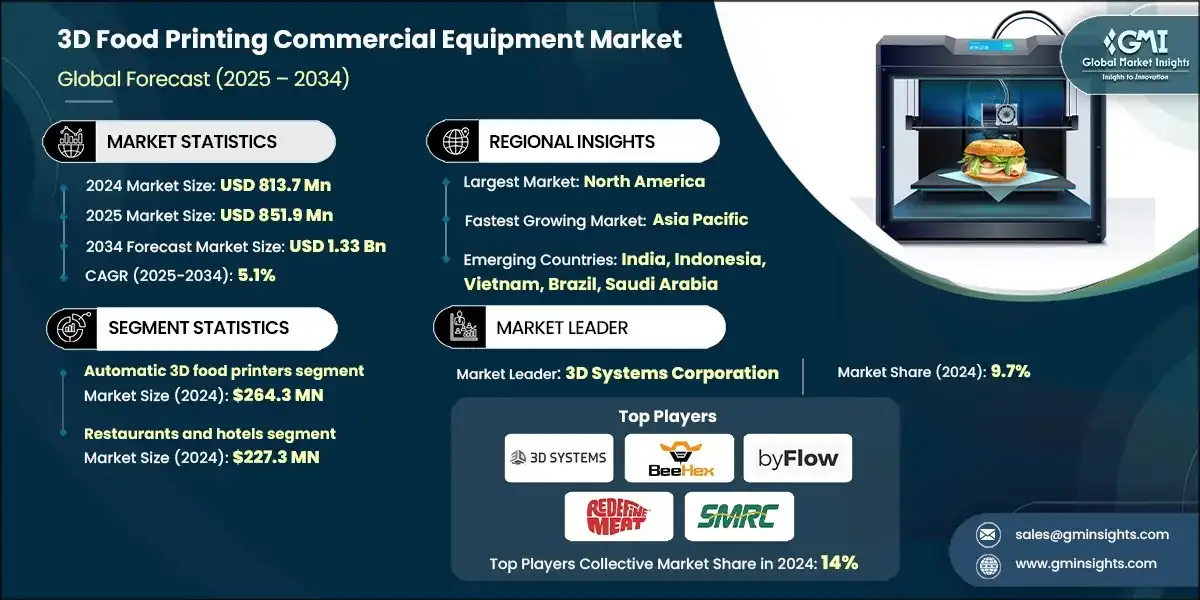
According to a recent study by Global Market Insights Inc., the global 3D food printing commercial equipment market was estimated at USD 813.7 million in 2024. The market is expected to grow from USD 851.9 million in 2025 to USD 1.33 billion by 2034, growing at a CAGR of 5.1%.
3D Food Printing Commercial Equipment Market Key Takeaways
Market Size & Growth
- 2024 Market Size: USD 813.7 Million
- 2025 Market Size: USD 851.9 Million
- 2034 Forecast Market Size: USD 1.33 Billion
- CAGR (2025–2034): 5.1%
Key Market Drivers
- Nutritional personalization and public health integration.
- Sustainability and decentralized food production.
- Innovation in food design and consumer experience.
Challenges
- Regulatory complexity and approval delays.
- Inflexibility of existing regulatory frameworks.
Opportunity
- Precision nutrition integration with AI and biomedical research.
- Culinary innovation for specialized and remote environments.
Key Players
- Market Leader: 3D Systems Corporation led with over 9.7% market share in 2024.
- Leading Players: Top 5 players in this market include 3D Systems Corporation, BeeHex, Byflow B.V., Redefine Meat, Systems and Materials Research Corporation (SMRC), which collectively held a market share of 14% in 2024.
Get Market Insights & Growth Opportunities
- The market has grown 56% since 2019, driven by strategic government interventions aimed at fostering innovation, sustainability, and food security.
- In the U.S., the government partnered with major corporations like GE Aviation and Raytheon, the program supports small and medium-sized enterprises (SMEs) by offering financing, technical assistance, and workforce development for additive manufacturing technologies, including food printing.
- The U.S. Department of Agriculture, Department of Energy, and Department of Commerce have all contributed resources to make 3D printing more accessible and standardized. These efforts are not only reshaping supply chains but also enabling the development of customized food solutions, which are critical in addressing dietary needs and emergency food production scenarios.
- Moreover, India has also taken an initiative-taking stance with its National Strategy on Additive Manufacturing, launched by the Ministry of Electronics and Information Technology (MeitY). The policy aims to establish India as a global hub for additive manufacturing by 2025, with specific goals such as creating 100 startups, developing 500 products, and generating 1 lakh skilled jobs
- The strategy includes incentives like subsidies, tax benefits, and integration with existing schemes such as the Production Linked Incentive (PLI) and Lean Manufacturing Competitiveness Scheme.
- Additionally, the U.S. Department of Agriculture has funded a project at the University of Connecticut to develop 3D-printed pulse-based food products tailored for nutrition and shelf-life, with collaboration from the U.S. Army Combat Capabilities Development Command.
- The IUFoST Scientific Information Bulletin highlights how 3D food printing enables precise dosing of macro and micronutrients tailored to individual dietary needs, including the elderly and hospitalized patients.
- For instance, pyramid-shaped snacks printed from fruit and vegetable blends have been developed to address swallowing difficulties in children and seniors, while probiotic-enriched mashed potatoes have shown potential in improving gut health and immune function.
- These innovations align with broader public health goals, such as reducing chronic disease risk and enhancing dietary compliance, especially in institutional settings like hospitals and care homes.
- The ability to integrate medical data into food design represents a convergence of healthcare and food technology, positioning 3D food printing as a strategic tool in preventive nutrition.
- 3D food printing supports a decentralized, consumer-centric model of food manufacturing that can significantly reduce environmental impact. By enabling on-demand production close to the point of consumption, this technology minimizes food waste, lowers transportation emissions, and reduces reliance on complex supply chains.
- The extrusion-based printing systems, which dominate current applications, allow for the use of diverse food pastes including those derived from surplus or underutilized ingredients, thus contributing to circular economy principles.
- Moreover, the ability to create visually appealing and structurally optimized food products enhances consumer acceptance of sustainable ingredients that might otherwise be discarded. This shift toward localized, low-waste production models is increasingly aligned with global sustainability frameworks and government climate action plans.
To get key market trends
3D Food Printing Commercial Equipment Market Trends
- The integration of digital technologies into food manufacturing is transforming how food is produced, tracked, and delivered. 3D food printing supports this shift by enabling agile, on-demand production that can be digitally monitored and customized. As noted by EDHEC Business School, this technology allows food supply chains to become location-independent, linking manufacturing and delivery systems in real time. For example, digital platforms can now track ingredient sourcing, nutritional composition, and consumer preferences, enabling manufacturers to respond dynamically to market demands. This trend is particularly impactful in e-commerce and direct-to-consumer models, where transparency and traceability are becoming non-negotiable.
- 3D food printing is revolutionizing culinary design by enabling chefs and manufacturers to create intricate, customized food products that cater to individual dietary needs and aesthetic preferences. According to the Florida Education Institute, this includes artistic plating, experimental textures, and nutrient-specific formulations. Startups like Novameat are producing plant-based steaks with precise texture and flavor profiles, while the EU’s PERFORMANCE project has developed “smoothfood” for care homes, texturized meals that preserve taste and dignity. This trend is driving growth in both luxury dining and healthcare nutrition, where personalization is a key value proposition.
- The adoption of robotics, AI, and sensor-based automation is accelerating across the food industry, and 3D food printing is at the forefront of this transformation. As highlighted by the National Institute of Standards and Technology (NIST), autonomous systems enabling predictive analytics, real-time quality control, and 24/7 production capabilities. In the context of 3D food printing, this means faster prototyping, reduced labor dependency, and enhanced consistency in output. Companies investing in Industry 4.0 capabilities are better positioned to scale operations, reduce costs, and meet the growing demand for customized food products.
- Environmental concerns are driving innovation in food manufacturing, and 3D food printing offers a sustainable alternative by minimizing waste and optimizing resource use. The technology allows for the repurposing of surplus ingredients into edible pastes, reducing food loss across the supply chain. Additionally, precise portioning and localized production reduce packaging and transportation emissions. NIST emphasizes that companies conducting resource-use audits and integrating recycled materials into their processes are achieving measurable reductions in carbon footprint. This trend aligns with global sustainability goals and is increasingly influencing procurement and investment decisions.
- Modern consumers are demanding greater control over their food choices, including transparency in sourcing, nutritional content, and environmental impact. 3D food printing enables brands to meet these expectations by offering customizable meals and interactive product experiences. For instance, QR codes on packaging can reveal ingredient origins, water usage, or carbon footprint, enhancing consumer trust and engagement. This trend is reshaping marketing strategies and product development, pushing companies to adopt more transparent and responsive business models that reflect consumer values.
3D Food Printing Commercial Equipment Market Analysis
Learn more about the key segments shaping this market
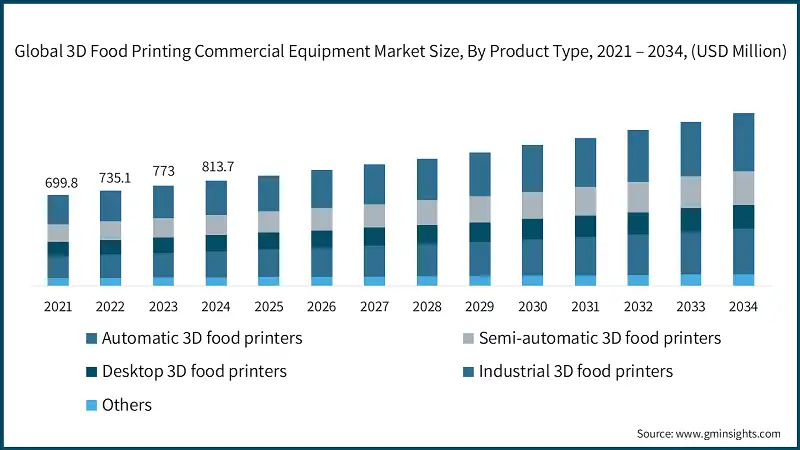
Based on product type, the market is segmented into automatic 3D food printers, semi-automatic 3D food printers, desktop 3D food printers, industrial 3D food printers, others. In 2024, the automatic 3D food printers segment generated a revenue of USD 264.3 million and is expected to grow at CAGR of around 5.4% during 2025 to 2034.
- Automatic 3D food printers significantly reduce manual intervention, enabling faster production cycles and consistent output ideal for commercial kitchens, food service providers, and institutional settings where volume and reliability are critical.
- With rising global labor costs and shortages in skilled food preparation staff, automatic systems offer a cost-effective alternative by minimizing human dependency, especially in high-throughput environments like hospitals, airlines, and catering services.
- These printers often come equipped with IoT and AI capabilities, allowing for real-time monitoring, predictive maintenance, and adaptive recipe adjustments, features that align with Industry 4.0 standards and digital transformation goals in food manufacturing.
- Automatic systems are designed to meet stringent food safety and hygiene regulations, with enclosed environments and minimal human contact, making them preferable in regulated sectors such as healthcare and defense food supply chains.
- Their ability to manage diverse ingredients and produce complex designs at scale makes automatic printers more commercially viable for large enterprises and food tech startups aiming to expand across geographies and product lines.
Learn more about the key segments shaping this market
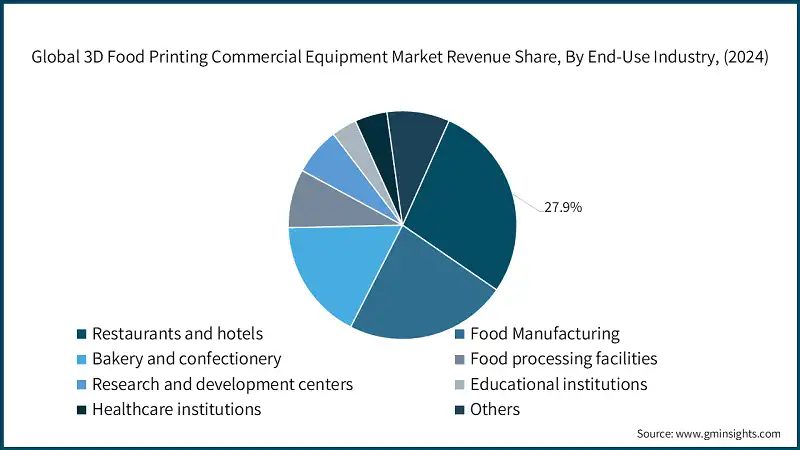
The 3D food printing commercial equipment market by end user industry is segmented into restaurants and hotels, food manufacturing, bakery and confectionery, food processing facilities, research and development centers, educational institutions, healthcare institutions, and others. The restaurants and hotels segment leading with a revenue of USD 227.3 million and has a market share of around 27.9% in 2024.
- Restaurants and hotels increasingly adopted 3D food printers to create visually striking and customized dishes, enhancing guest experience and brand differentiation in a competitive hospitality landscape.
- Automated food printing allowed chefs to streamline repetitive tasks such as plating and decoration, improving kitchen throughput and consistency during peak service hours.
- The rise of experiential dining, where presentation and storytelling are central, made 3D food printing a valuable tool for crafting unique textures, shapes, and edible art that elevate the dining narrative.
- Hotels and restaurants leveraged 3D printers to cater to diverse dietary needs (e.g., vegan, gluten-free, low-sodium) with precision, aligning with global trends in personalized nutrition and wellness tourism.
- Early adoption of 3D food printing positioned hospitality brands as tech-forward and innovative, attracting media attention and tech-savvy clientele, especially in luxury and boutique segments.
Looking for region specific data?
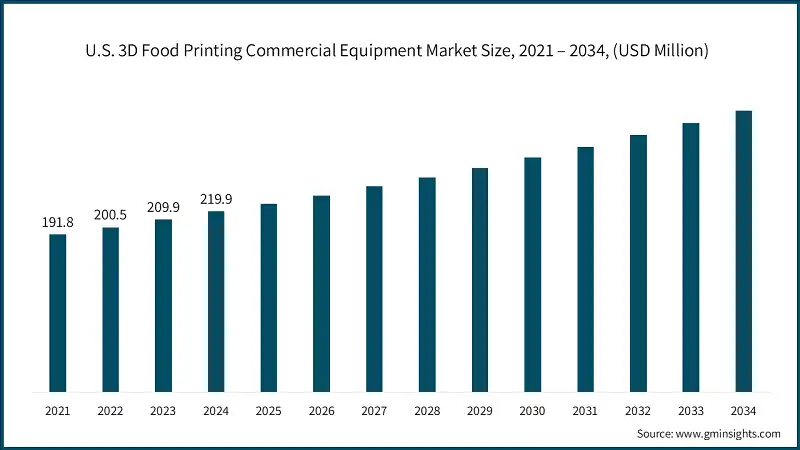
The U.S. 3D food printing commercial equipment market was valued at around USD 219.9 million in 2024 and is anticipated to register a CAGR of 4.6% between 2025 and 2034.
- The U.S. is demonstrating strong demand in the 3D food printing commercial equipment due to a combination of federal support, technological innovation, and evolving consumer preferences.
- The U.S. National Science Foundation (NSF) has actively funded research into 3D food printing, particularly through its AI Institute for Dynamical Systems, which has supported projects like Columbia University's development of multi-ingredient vegan cheesecakes using additive manufacturing.
- This reflects a broader national interest in healthy eating, personalized nutrition, and food innovation. Additionally, the NSF emphasizes the need for an ecosystem of supporting industries, such as food cartridge manufacturers and downloadable recipe platforms which is accelerating commercialization and adoption.
- The U.S. Department of Defense and USDA have also backed additive manufacturing initiatives, recognizing its potential for producing nutrient-dense, shelf-stable foods for military and institutional use.
- From a consumer standpoint, the Center for Food Demand Analysis and Sustainability at Purdue University reports that U.S. households are increasingly prioritizing health-conscious food choices, with 77% of surveyed consumers preferring “healthy” labeled products when priced equally.
- This shift in dietary awareness is creating fertile ground for 3D food printing, which enables precise control over nutritional content and ingredient customization.
- Moreover, the U.S. market benefits from a robust infrastructure for digital transformation and smart manufacturing, allowing restaurants, healthcare institutions, and food service providers to integrate 3D printing into their operations.
- As the technology matures and becomes more affordable, its alignment with national health, sustainability, and innovation goals is expected to further strengthen demand across both consumer and institutional segments.
Europe witnessed promising demand in the 3D food printing commercial equipment market with a share of around 26.1% in 2024 and is expected to grow at a robust CAGR of 5.2% through 2034.
- Europe is demonstrating strong demand in the 3D food printing commercial equipment due to its strategic alignment with innovation-driven policy frameworks and sustainability goals.
- The European Commission’s New European Innovation Agenda explicitly supports deep-tech innovation including additive manufacturing to modernize public services and address food security challenges.
- Through instruments like Horizon Europe and innovation procurement mechanisms, the EU is channeling billions of euros into regional innovation valleys and experimental regulatory environments such as sandboxes and living labs.
- These initiatives are designed to accelerate commercialization of technologies like 3D food printing, particularly in sectors where personalized nutrition, resource efficiency, and digital transformation intersect. The EU’s emphasis on decentralizing food production and reducing greenhouse gas emissions further reinforces the relevance of 3D food printing in meeting climate and health objectives.
Asia Pacific 3D food printing commercial equipment market is expected to grow at 6.9% during the forecast period.
- Asia-Pacific (APAC) is demonstrating strong demand in the 3D food printing commercial equipment due to its strategic focus on innovation-led food security and digital transformation.
- At the 2025 APEC Food Security Ministerial Meeting, agriculture ministers from 21 member economies including South Korea, Japan, China, and ASEAN nations emphasized the need for smart agriculture and data-driven food systems to combat climate shocks and supply chain disruptions.
- South Korea, for instance, has prioritized expanding smart farming and AI-powered agri-business models, recognizing the role of technologies like 3D food printing in enhancing resilience and sustainability. These policy directions are not isolated; they reflect a region-wide commitment to integrating advanced manufacturing into food systems to address nutritional gaps, reduce waste, and decentralize production.
- The convergence of climate action, innovation, and regional cooperation is creating fertile ground for the adoption of 3D food printing across institutional and commercial sectors.
- Moreover, APAC’s economic and technological landscape is rapidly evolving to support high-growth industries like additive manufacturing. According to the World Economic Forum, APAC accounts for over 75% of the global manufacturing labor force and is transitioning from cost-based competition to innovation leadership.
- Countries like China, Japan, and South Korea are outpacing Europe in R&D spending as a share of GDP, while India and Vietnam are leveraging cost efficiencies to scale emerging technologies. This innovation momentum is reflected in the food sector, where 3D food printing is being used to create personalized, nutrient-rich meals for healthcare, hospitality, and education.
3D Food Printing Commercial Equipment Market Share
- The top 5 companies in the 3D food printing commercial equipment industry, such as 3D Systems Corporation, BeeHex, Byflow B.V., Redefine Meat, and Systems and Materials Research Corporation (SMRC), hold a market share of 14%.
- 3D Systems Corporation has maintained its leadership through a dual strategy of technological specialization and operational restructuring. The company has focused on high-growth verticals such as medical technology and aerospace, while also investing in regenerative medicine applications like human lung printing. To withstand competitive pressures, 3D Systems initiated a multi-phase cost reduction program, achieving over USD 20 million in savings in Q2 2025 alone. This includes consolidating its operational footprint, insourcing manufacturing, and streamlining its workforce. These moves have allowed the company to preserve R&D momentum while improving profitability, positioning it to scale its food printing capabilities in tandem with its broader additive manufacturing portfolio.
- BeeHex has differentiated itself by focusing on automated bakery decoration systems, leveraging its NASA-origin technology to solve labor and consistency challenges in commercial baking. Its strategy centers on modular, vision-enabled robotic systems that replicate human decorators with precision, offering scalable solutions for both industrial and retail clients. BeeHex’s emphasis on customization and AI integration allows it to adapt to diverse customer needs while maintaining high throughput. By aligning its offerings with long-term trends in food automation and personalization, BeeHex has built a defensible niche that insulates it from broader competition in the additive manufacturing space.
- ByFlow B.V. has positioned itself as a pioneer in compact, user-friendly 3D food printers tailored for restaurants, educational institutions, and culinary innovators. Its flagship product, the “Focus 3D Food Printer,” is designed for portability and ease of use, enabling chefs to experiment with textures, shapes, and flavors without industrial-scale infrastructure. ByFlow’s strategy includes building a digital ecosystem around its hardware offering downloadable recipes, ingredient cartridges, and training modules. This consumer-centric approach has allowed the company to penetrate niche markets and maintain relevance amid growing competition from larger industrial players.
3D Food Printing Commercial Equipment Market Companies
Major players operating in the 3D food printing commercial equipment industry are:
- 3D Systems Corporation
- BeeHex
- Byflow B.V.
- CocoaPress
- Desktop Metal
- Inkedibles
- Katjes
- Natural Machines
- Print2Taste
- Procusini
- Redefine Meat
- SavorEat
- Steakholder Foods
- Systems and Materials Research Corporation (SMRC)
- Wiiboox
Redefine Meat has adopted an aggressive product and distribution expansion strategy, launching a diverse portfolio of plant-based “New-Meat” products endorsed by Michelin-star chefs. The company has expanded from foodservice into retail, partnering with premium e-commerce platforms like Ocado (UK) and Albert Heijn (Netherlands) to reach consumers directly. Its ability to replicate the taste, texture, and aroma of animal meat using additive manufacturing has positioned it as a disruptor in both the plant-based and 3D food printing sectors. By combining culinary excellence with scalable logistics, Redefine Meat is rapidly building brand equity and market share across Europe and beyond.
SMRC has focused on space-grade food printing technologies, supported by U.S. government contracts and research grants. Its work with NASA on developing 3D-printed meals for long-duration space missions exemplifies its strategy of targeting high-stakes, innovation-driven environments. SMRC’s emphasis on nutrient density, shelf stability, and programmable texture aligns with the needs of defense, healthcare, and disaster relief sectors. By operating at the intersection of aerospace, biotechnology, and food science, SMRC has carved out a strategic position that is less vulnerable to commercial market fluctuations and more reliant on institutional partnerships.
3D Food Printing Commercial Equipment Market Report Attributes
| Key Takeaway | Details |
|---|---|
| Market Size & Growth | |
| Base Year | 2024 |
| Market Size in 2024 | USD 813.7 Million |
| Market Size in 2025 | USD 851.9 Million |
| Forecast Period 2025 - 2034 CAGR | 5.1% |
| Market Size in 2034 | USD 1.33 Billion |
| Key Market Trends | |
| Drivers | Impact |
| Nutritional personalization and public health integration | Globally, this driver is enabling healthcare systems and food service providers to deliver customized nutrition solutions, improving dietary outcomes for aging populations and patients with chronic conditions. |
| Sustainability and decentralized food production | It is fostering a shift toward localized, low-waste food manufacturing models that align with climate action goals and reduce dependency on traditional supply chains. |
| Innovation in food design and consumer experience | This driver is transforming consumer engagement by allowing brands to offer visually and texturally unique food products, enhancing premiumization and personalization in global food markets. |
| Pitfalls & Challenges | Impact |
| Regulatory complexity and approval delays | Globally, this challenge is prolonging product launch cycles and increasing compliance costs, deterring innovation and market entry for emerging players. |
| Inflexibility of existing regulatory frameworks | It is creating misalignment between technological capabilities and legal standards, restricting scalability and cross-border adoption of 3D food printing solutions. |
| Opportunities: | Impact |
| Precision nutrition integration with AI and biomedical research | Capitalizing on this opportunity could revolutionize dietary management by enabling real-time customization of meals based on genetic, metabolic, and behavioral data. |
| Culinary innovation for specialized and remote environments | This opportunity could redefine food logistics in remote or high-demand settings by enabling on-site production of customized meals with minimal waste and storage requirements. |
| Market Leaders (2024) | |
| Market Leaders |
9.7% market share |
| Top Players |
The collective market share in 2024 is 14% |
| Competitive Edge |
|
| Regional Insights | |
| Largest Market | North America |
| Fastest Growing Market | Asia Pacific |
| Emerging Country | India, Indonesia, Vietnam, Brazil, Saudi Arabia |
| Future Outlook |
|
What are the growth opportunities in this market?
3D Food Printing Commercial Equipment Market News
- In April 2025, Revo Foods launched El Blanco, the world’s first 3D-printed black cod filet made entirely from fungi protein, marking a breakthrough in sustainable seafood innovation. Developed using the company’s proprietary Food Fabricator X2 printer, El Blanco replicates the texture and flavor of traditional black cod while offering a high-protein, low-impact alternative to overfished marine species. This launch reflects Revo Foods’ strategic focus on scaling alternative proteins through additive manufacturing, positioning the company at the forefront of culinary-grade food tech in both retail and foodservice markets.
- In June 2024, India launched its first National Additive Manufacturing Symposium in New Delhi, marking a strategic milestone in advancing 3D printing technologies, including applications in food manufacturing. Organized by the Ministry of Electronics and Information Technology (MeitY) under the National Strategy on Additive Manufacturing, the symposium brought together industry leaders, researchers, and policymakers to accelerate innovation, foster public-private partnerships, and promote India’s vision of becoming a global hub for additive manufacturing by 2025. This initiative is expected to catalyze demand for 3D food printing commercial equipment by integrating it into broader industrial and digital transformation agendas.
- In January 2024, Revo Foods unveiled its industrial-scale 3D food printer, named Food Fabricator X2, marking a significant advancement in additive manufacturing for food production. Designed to meet the growing demand for sustainable and scalable food solutions, the X2 enables high-volume printing of complex plant-based products, including Revo’s signature salmon alternatives. This launch reflects the company’s strategic shift from artisanal innovation to commercial-scale deployment, positioning Revo Foods as a key player in transforming food manufacturing through precision, automation, and sustainability.
- In June 2022, Wiiboox introduced LuckyBot, a food 3D printer extruder designed to transform conventional FDM 3D printers into multifunctional food creation devices. This innovation allows users to print with edible materials such as chocolate, mashed potatoes, and cheese, expanding the accessibility of food 3D printing to hobbyists, culinary professionals, and educational institutions. By bridging the gap between desktop 3D printing and culinary experimentation, Wiiboox is strategically positioning LuckyBot to democratize food innovation and tap into the growing demand for personalized, creative, and tech-enabled food experiences.
The 3D food printing commercial equipment market research report includes in-depth coverage of the industry, with estimates & forecasts in terms of revenue (USD Million) (Thousand Units) from 2021 to 2034, for the following segments:
Market, By Product Type
- Automatic 3D food printers
- Semi-automatic 3D food printers
- Desktop 3D food printers
- Industrial 3D food printers
- Others
Market, By Technology
- Fused deposition modeling (FDM)
- Hot air sintering
- Binder jetting
- Selective laser sintering
Market, By Food Material
- Chocolate and confectionery
- Bakery products
- Meat and seafood
- Dairy alternatives
- Nutritional products
- Others
Market, By End Use Industry
- Restaurants and hotels
- Food Manufacturing
- Bakery and confectionery
- Food processing facilities
- Research and development centers
- Educational institutions
- Healthcare institutions
- Others
Market, By Distribution Channel
- Direct sales
- Indirect sales
The above information is provided for the following regions and countries:
- North America
- U.S.
- Canada
- Europe
- Germany
- U.K.
- France
- Italy
- Spain
- Netherlands
- Asia Pacific
- China
- Japan
- India
- South Korea
- Australia
- Latin America
- Brazil
- Mexico
- Argentina
- MEA
- UAE
- Saudi Arabia
- South Africa
Frequently Asked Question(FAQ) :
What is the market size of the 3D food printing commercial equipment in 2024?
The market size was USD 813.7 million in 2024, with a CAGR of 5.1% expected through 2034 driven by nutritional personalization, sustainability goals, and government innovation support.
What is the projected value of the 3D food printing commercial equipment market by 2034? The 3D
food printing commercial equipment market is expected to reach USD 1.33 billion by 2034, propelled by AI integration, precision nutrition, and decentralized food production models.
What is the current 3D food printing commercial equipment market size in 2025?
The market size is projected to reach USD 851.9 million in 2025.
How much revenue did the automatic 3D food printers segment generate in 2024? Automatic 3D food
printers generated USD 264.3 million in 2024, leading the market due to reduced manual intervention and IoT capabilities.
What was the valuation of restaurants and hotels segment in 2024?
The restaurants and hotels segment held 27.9% market share and generated USD 227.3 million in 2024, driven by demand for visually striking customized dishes and experiential dining.
What is the growth outlook for Asia Pacific 3D food printing commercial equipment market from 2025 to 2034?
Asia Pacific market for 3D food printing commercial equipment is projected to grow at a 6.9% CAGR till 2034, due to innovation-led food security initiatives, smart agriculture adoption, and regional cooperation in advanced manufacturing.
Which region leads the 3D food printing commercial equipment market?
The U.S. market size exceeded USD 219.9 million in 2024, with a CAGR of 4.6% expected through 2034. Federal support, NSF funding, and consumer preference for health-conscious products fuel the region's dominance.
What are the upcoming trends in the 3D food printing commercial equipment market?
Key trends include convergence of AI and IoT technologies, development of alternative proteins and functional foods, and integration of machine learning for hyper-personalized meal creation.
Who are the key players in the 3D food printing commercial equipment market?
Key players include 3D Systems Corporation, BeeHex, Byflow B.V., CocoaPress, Desktop Metal, Inkedibles, Katjes, Natural Machines, Print2Taste, Procusini, Redefine Meat, SavorEat, Steakholder Foods, Systems and Materials Research Corporation (SMRC), and Wiiboox.
3D Food Printing Commercial Equipment Market Scope
Related Reports