
Convenience, Innovation, and Changing Lifestyles Driving Global Frozen Bakery Demand.
Published Date: April 27, 2026
The global frozen bakery market has evolved into a highly dynamic segment within the broader food processing industry, driven by shifting consumer lifestyles, increasing urbanization, and rising demand for convenient yet high-quality baked products. Over the past decade, frozen bakery products have transitioned from being niche offerings in retail freezers to becoming mainstream staples across households, foodservice outlets, quick-service restaurants, and institutional catering channels.
This transformation has been supported by advancements in cold chain logistics, rapid expansion of modern retail infrastructure, and continuous innovation in product formulation and preservation techniques. Frozen bakery products, including bread, pastries, cakes, pizza crusts, and dough-based items, offer extended shelf life without compromising taste or texture, making them highly attractive to both consumers and commercial buyers.
The market is also benefiting from evolving dietary preferences, particularly the rising inclination toward ready-to-bake and ready-to-eat solutions that reduce preparation time while ensuring consistent quality. In addition, manufacturers are increasingly focusing on clean-label formulations, improved nutritional profiles, and premium product offerings to align with health-conscious consumer behavior.
Despite strong growth momentum, the industry continues to face challenges such as fluctuating raw material costs, supply chain disruptions, and stringent food safety regulations. However, innovation-led expansion and increasing global penetration of frozen food products are expected to sustain long-term growth.
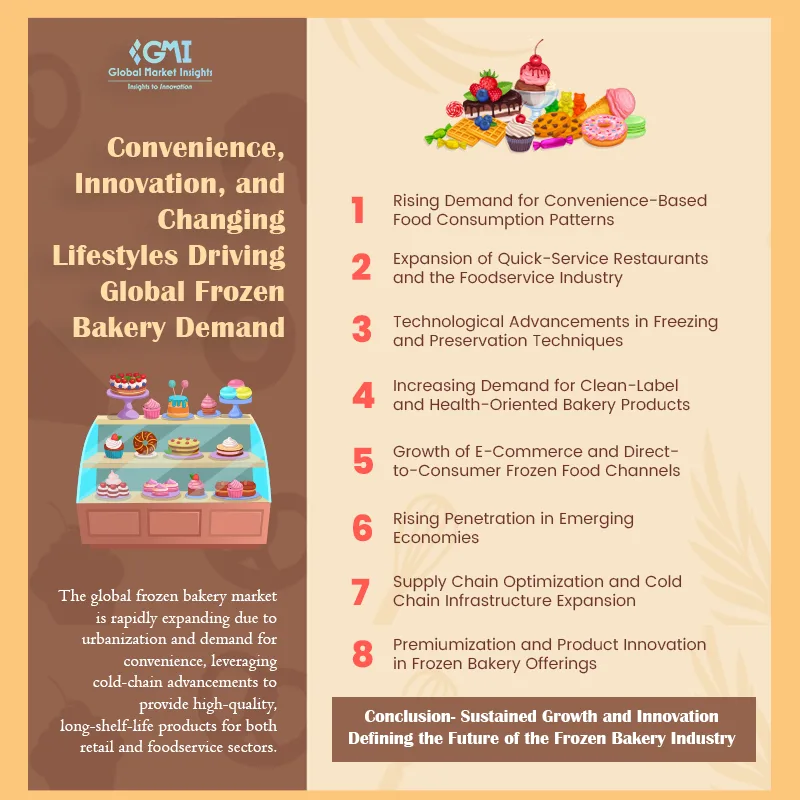
Rising Demand for Convenience-Based Food Consumption Patterns
One of the most influential trends driving the frozen bakery market is the growing consumer preference for convenience-oriented food products. Urban lifestyles, longer working hours, and increasing participation of the workforce in professional sectors have significantly reduced the time available for traditional baking or meal preparation.
Frozen bakery products provide a practical solution by offering ready-to-bake and partially prepared formats that minimize preparation time while maintaining bakery-fresh quality. Retail chains across Europe and North America have reported consistent growth in frozen bread and pastry sales, particularly in urban households where convenience is a primary purchase driver.
A notable example is the widespread adoption of frozen croissants and bread dough in supermarkets, which allows consumers to enjoy bakery-style products at home with minimal effort. The opportunity lies in expanding product portfolios to include healthier and more customized options, while the challenge remains in maintaining product freshness perception and overcoming consumer bias toward freshly baked goods.
Expansion of Quick-Service Restaurants and the Foodservice Industry
The rapid expansion of quick-service restaurants (QSRs), cafés, and institutional foodservice providers is significantly contributing to the growth of frozen bakery demand. These establishments rely heavily on standardized, cost-efficient, and scalable food solutions to maintain consistency across multiple locations.
Frozen bakery products enable foodservice operators to streamline operations, reduce labor dependency, and ensure uniform product quality. For instance, global QSR chains increasingly use frozen dough systems for burger buns, pizza bases, and breakfast pastries to maintain consistency across outlets.
The opportunity in this segment lies in long-term supply contracts and customized product development tailored to brand-specific requirements. However, challenges include maintaining strict quality control standards and managing cold chain logistics efficiently across large distribution networks.
Technological Advancements in Freezing and Preservation Techniques
Technological innovation in freezing methods has played a crucial role in enhancing product quality, texture retention, and shelf stability in the frozen bakery market. Advanced techniques such as flash freezing and cryogenic freezing have significantly improved the ability to preserve bakery products without compromising sensory attributes.
Modern processing technologies also enable better control over dough fermentation, moisture retention, and crust formation, ensuring that baked products maintain freshness after thawing or baking. Several leading manufacturers have invested in automated production lines integrated with precision freezing systems to optimize output efficiency.
The opportunity lies in leveraging these technologies to expand premium frozen bakery offerings. However, high capital investment requirements and energy consumption costs remain key challenges for small and mid-sized manufacturers.
Increasing Demand for Clean-Label and Health-Oriented Bakery Products
Consumer awareness regarding health and nutrition has significantly influenced the frozen bakery market, leading to rising demand for clean-label, organic, and fortified bakery products. Manufacturers are increasingly reformulating products to reduce artificial additives, preservatives, and trans fats.
Products enriched with whole grains, seeds, high-fiber ingredients, and plant-based alternatives are gaining strong traction among health-conscious consumers. Retailers in North America and Europe have reported increased shelf space allocation for gluten-free frozen bakery items, reflecting shifting dietary preferences.
A key opportunity in this segment is product differentiation through nutritional enhancement and transparency in ingredient sourcing. The challenge lies in balancing health-focused formulations with taste, texture, and affordability expectations.
Growth of E-Commerce and Direct-to-Consumer Frozen Food Channels
The rise of e-commerce platforms and direct-to-consumer (DTC) food delivery models has reshaped distribution dynamics in the frozen bakery market. Online grocery platforms have made it easier for consumers to access a wide range of frozen bakery products without visiting physical stores.
Digital retail channels have also enabled smaller brands to reach wider audiences and compete with established players. Subscription-based frozen food delivery services are gaining popularity in urban markets, offering curated bakery assortments delivered directly to consumers’ homes.
The opportunity in this segment lies in expanding digital visibility and improving cold chain-enabled last-mile delivery systems. However, challenges include maintaining product integrity during transit and managing logistics costs associated with frozen distribution.
Rising Penetration in Emerging Economies
Emerging economies across Asia-Pacific, Latin America, and the Middle East are witnessing increasing adoption of frozen bakery products due to urbanization, rising disposable incomes, and the expansion of modern retail infrastructure.
Consumers in these regions are gradually shifting from traditional bakery consumption patterns to packaged and frozen alternatives that offer longer shelf life and convenience. Supermarket expansion and the growing presence of international bakery brands are further accelerating market penetration.
For example, urban centers in countries such as India and China are experiencing rapid growth in frozen pizza bases and frozen bread consumption through organized retail chains.
The opportunity lies in untapped market potential and localized product innovation. However, challenges include limited cold chain infrastructure and price sensitivity among consumers.
Supply Chain Optimization and Cold Chain Infrastructure Expansion
Efficient cold chain logistics remain a critical factor in the success of the frozen bakery market. Manufacturers and distributors are increasingly investing in refrigerated storage, transportation systems, and real-time monitoring technologies to maintain product quality across the supply chain.
Improvements in supply chain visibility and temperature-controlled logistics have significantly reduced spoilage rates and improved distribution efficiency. Large food conglomerates are also integrating digital tracking systems to ensure compliance with safety standards.
The opportunity lies in enhancing operational efficiency and reducing wastage. However, challenges include high infrastructure costs and dependency on energy-intensive refrigeration systems.
Premiumization and Product Innovation in Frozen Bakery Offerings
The frozen bakery market is experiencing a strong shift toward premiumization, with manufacturers focusing on gourmet-style products and artisanal formulations. Consumers are increasingly willing to pay higher prices for high-quality frozen bakery items that replicate bakery-fresh experiences.
Innovations in fillings, flavor profiles, and texture enhancement have enabled companies to expand product portfolios into premium segments. For instance, specialty frozen pastries and multi-grain artisan breads are gaining popularity in premium retail stores and hospitality channels.
The opportunity lies in capturing high-value consumer segments and expanding brand differentiation. However, challenges include maintaining consistency in premium quality while scaling production.
Conclusion- Sustained Growth and Innovation Defining the Future of the Frozen Bakery Industry
The frozen bakery market continues to evolve as a key segment within the global packaged food industry, supported by convenience-driven consumption patterns, technological innovation, and expanding retail infrastructure. While opportunities remain strong across both developed and emerging markets, the industry must navigate challenges related to logistics, cost pressures, and evolving consumer expectations. Continuous innovation and strategic expansion are expected to define the next phase of market development.
The market is also expected to maintain steady expansion as food manufacturers continue to adapt to changing consumption habits and evolving retail ecosystems. Increasing investment in advanced freezing technologies, combined with stronger distribution networks, is improving product availability and consistent quality across global markets. At the same time, rising demand for premium, healthier, and more diversified bakery options is encouraging companies to innovate across product lines.
Moving forward, competitive advantage is likely to depend on operational efficiency, product differentiation, and the ability to respond quickly to regional taste preferences and regulatory standards, ensuring sustained relevance in a highly dynamic food industry landscape.