
Digital Health Revolution: Key Trends, Opportunities, and Challenges Reshaping the Future of Healthcare
Published Date: April 30, 2026
The digital health market has entered a phase of accelerated transformation, driven by the convergence of healthcare delivery and advanced technologies. Increasing demand for accessible, efficient, and personalized care has pushed healthcare systems, technology providers, and policymakers to adopt digital-first strategies. From telemedicine expansion to artificial intelligence-driven diagnostics, the sector is redefining how care is delivered, managed, and experienced. The integration of digital tools into traditional healthcare frameworks has not only improved patient outcomes but also enhanced operational efficiencies across the value chain.
Recent years have witnessed a shift from reactive care models toward preventive and data-driven healthcare ecosystems. This transition is supported by growing investments, favorable regulatory environments, and rising consumer acceptance of digital solutions. As healthcare systems continue to face challenges such as aging populations, workforce shortages, and rising costs, digital health technologies are emerging as critical enablers of sustainable and scalable care delivery.
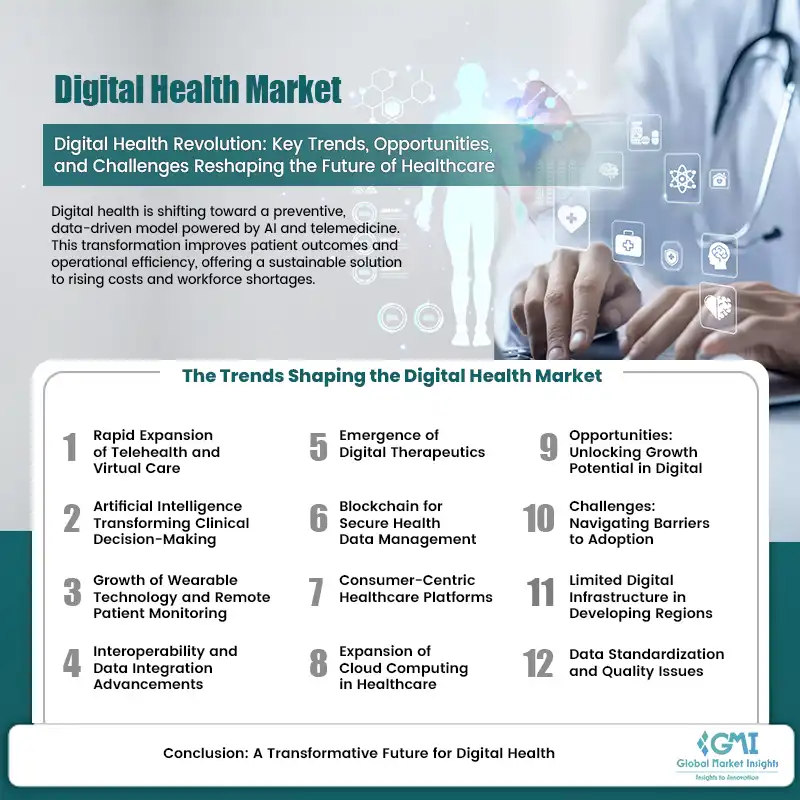
The Trends Shaping the Digital Health Market:
Rapid Expansion of Telehealth and Virtual Care:
- Telehealth has evolved from a complementary service to a central pillar of modern healthcare delivery. The widespread adoption of virtual consultations, remote diagnostics, and digital triage systems has significantly improved access to care, particularly in underserved regions.
- Healthcare providers are increasingly leveraging telehealth platforms to reduce patient wait times, optimize resource allocation, and ensure continuity of care. A notable development is the integration of telehealth into primary care workflows, enabling hybrid care models that combine in-person and virtual interactions. For instance, large hospital networks have reported improved patient satisfaction scores and reduced no-show rates following the adoption of virtual care platforms.
- Telehealth is playing a crucial role in managing chronic conditions, where regular monitoring and consultations are essential. As reimbursement frameworks and regulatory policies continue to evolve, telehealth is expected to remain a dominant force within the digital health ecosystem.
Artificial Intelligence Transforming Clinical Decision-Making:
- Artificial intelligence (AI) is rapidly reshaping the clinical landscape by enhancing diagnostic accuracy, streamlining workflows, and enabling predictive analytics. AI-powered tools are being deployed across various applications, including medical imaging, pathology, and clinical decision support systems.
- Healthcare organizations are increasingly utilizing AI algorithms to analyze large datasets and identify patterns that may not be immediately visible to clinicians. For example, AI-driven imaging solutions have demonstrated the ability to detect abnormalities with high precision, reducing diagnostic errors and improving early intervention rates.
- Furthermore, AI enables personalized treatment plans by analyzing patient-specific data, including genetic information, lifestyle factors, and medical history. This shift toward precision medicine is expected to drive better patient outcomes while optimizing resource utilization.
Growth of Wearable Technology and Remote Patient Monitoring:
- Wearable devices and remote patient monitoring (RPM) solutions are transforming how health data is collected and utilized. These technologies enable continuous tracking of vital signs, providing healthcare professionals with real-time insights into patient health.
- The adoption of wearables has been particularly significant in managing chronic diseases such as cardiovascular conditions and diabetes. By facilitating early detection of potential health issues, RPM systems help reduce hospital admissions and improve long-term patient outcomes.
- In addition, employers and insurance providers are increasingly incorporating wearable technology into wellness programs, incentivizing individuals to adopt healthier lifestyles. This trend underscores the growing importance of preventive care in the digital health landscape.
Interoperability and Data Integration Advancements:
- Interoperability remains a critical focus area as healthcare systems strive to create seamless data exchange across platforms and providers. The ability to integrate data from electronic health records (EHRs), wearable devices, and other digital tools is essential for delivering coordinated and efficient care.
- Recent advancements in data standards and cloud-based platforms have improved interoperability, enabling healthcare organizations to access and share patient information more effectively. This has led to better care coordination, reduced duplication of tests, and enhanced clinical decision-making.
- However, achieving full interoperability requires ongoing collaboration among stakeholders, including technology providers, healthcare institutions, and regulatory bodies.
Emergence of Digital Therapeutics:
- Digital therapeutics (DTx) are gaining traction as evidence-based interventions that leverage software to prevent, manage, or treat medical conditions. These solutions are often used in conjunction with traditional therapies, providing patients with personalized and scalable treatment options.
- Clinical studies have demonstrated the effectiveness of digital therapeutics in managing conditions such as mental health disorders, chronic pain, and metabolic diseases. As regulatory frameworks evolve, the adoption of DTx is expected to increase, offering new opportunities for innovation within the digital health market.
- Pharmaceutical companies are also exploring partnerships with digital health firms to integrate therapeutics with digital platforms, creating comprehensive treatment ecosystems.
Blockchain for Secure Health Data Management:
- Blockchain technology is emerging as a promising solution for addressing data security and privacy concerns in healthcare. By enabling decentralized and tamper-proof data storage, blockchain enhances the integrity and transparency of health records.
- Healthcare organizations are exploring blockchain applications for secure data sharing, supply chain management, and clinical trial tracking. For example, blockchain-based systems can ensure the authenticity of pharmaceutical products, reducing the risk of counterfeit drugs.
- While adoption is still in its early stages, the potential of blockchain to transform data management practices in healthcare is significant.
Consumer-Centric Healthcare Platforms
- The shift toward consumer-centric healthcare is driving the development of digital platforms that empower patients to take control of their health. Mobile health applications, patient portals, and digital engagement tools are enabling individuals to access medical information, schedule appointments, and communicate with healthcare providers.
- This trend is supported by increasing digital literacy and the growing expectation for convenient and personalized healthcare experiences. Healthcare providers are investing in user-friendly platforms that enhance patient engagement and satisfaction.
- Moreover, the integration of AI and data analytics into these platforms enable more tailored health recommendations, further improving patient outcomes.
Expansion of Cloud Computing in Healthcare:
- Cloud computing plays a pivotal role in enabling scalability, flexibility, and cost efficiency within the digital health market. Healthcare organizations are increasingly migrating their IT infrastructure to cloud-based platforms to support data storage, analytics, and application development.
- Cloud solutions facilitate real-time data access and collaboration, enabling healthcare providers to deliver timely and informed care. Additionally, cloud-based systems support advanced analytics and machine learning applications, driving innovation across the sector.
- As cybersecurity measures continue to improve, the adoption of cloud computing in healthcare is expected to accelerate further.
Opportunities: Unlocking Growth Potential in Digital Health
- The digital health market presents significant opportunities for stakeholders across the value chain. Increasing investments from venture capital firms and private equity investors are fueling innovation and supporting the growth of startups and established companies alike.
- Emerging markets offer substantial growth potential, driven by rising healthcare demand and improving digital infrastructure. Governments in these regions are implementing initiatives to promote digital health adoption, creating favorable conditions for market expansion.
- Additionally, the integration of advanced technologies such as AI, IoT, and big data analytics is opening new avenues for innovation. Companies that can effectively leverage these technologies to deliver value-driven solutions are well-positioned to capitalize on market opportunities.
Challenges: Navigating Barriers to Adoption
Despite its growth potential, the digital health market faces several challenges that may hinder widespread adoption. Data privacy and security concerns remain a significant barrier, particularly as healthcare data becomes increasingly digitized.
Regulatory complexities also pose challenges, as varying standards across regions can complicate product development and market entry. Healthcare providers must navigate these regulations while ensuring compliance with data protection laws.
Additionally, the integration of digital solutions into existing healthcare systems can be complex and resource-intensive. Resistance to change among healthcare professionals and patients may further slow adoption rates.
Limited Digital Infrastructure in Developing Regions
- Inadequate internet connectivity and lack of advanced digital infrastructure restrict adoption.
- Rural and remote areas face difficulties accessing telehealth and digital platforms.
- Limited availability of reliable hardware and technical support slows implementation.
- These gaps create unequal access to digital healthcare solutions globally.
Data Standardization and Quality Issues
- Inconsistent data formats across platforms hinder seamless integration.
- Poor data quality can affect accuracy in analytics and clinical decision-making.
- Lack of universal standards complicates interoperability efforts.
- Ensuring reliable, standardized data remains critical for effective digital health deployment.
Conclusion: A Transformative Future for Digital Health
The digital health market is undergoing a profound transformation, driven by technological innovation and evolving healthcare needs. The trends outlined in this report highlight the sector’s dynamic nature and its potential to redefine healthcare delivery on a global scale.
As stakeholders continue to invest in digital solutions, the focus will increasingly shift toward creating integrated, patient-centric ecosystems that deliver measurable value. Addressing challenges related to data security, interoperability, and regulatory compliance will be critical to sustaining growth and ensuring long-term success.
Ultimately, the market is poised to play a central role in shaping the future of healthcare, offering innovative solutions that enhance accessibility, efficiency, and patient outcomes.