
AI in 2026: Agentic AI, Record Investment, and the Trends Transforming Enterprise
Published Date: May 18, 2026
Artificial intelligence entered a defining phase in 2026 as enterprises, governments, and investors shifted focus from experimentation to large-scale implementation. What began as a wave of generative AI adoption in previous years has now evolved into a broad transformation of enterprise operations, industrial automation, software infrastructure, healthcare systems, cybersecurity frameworks, and digital commerce. Organizations are no longer evaluating whether AI should be integrated into business models. Instead, the emphasis has moved toward scalability, measurable returns, infrastructure readiness, and long-term strategic positioning.
Global investment activity has accelerated sharply across the AI ecosystem. According to Gartner, worldwide AI spending is projected to reach USD 2.52 trillion in 2026, reflecting a 44% year-over-year increase. AI infrastructure alone is expected to account for more than USD 1.3 trillion in spending as enterprises and technology firms continue expanding compute capacity, cloud infrastructure, and specialized AI systems.
The market is also witnessing a structural shift in capital allocation. Investors are increasingly prioritizing commercially viable AI applications, enterprise-grade automation tools, vertical AI platforms, and infrastructure providers capable of supporting real-world deployment. At the same time, governments across North America, Europe, and Asia are strengthening funding initiatives for semiconductor manufacturing, AI research, cybersecurity resilience, and digital sovereignty programs.
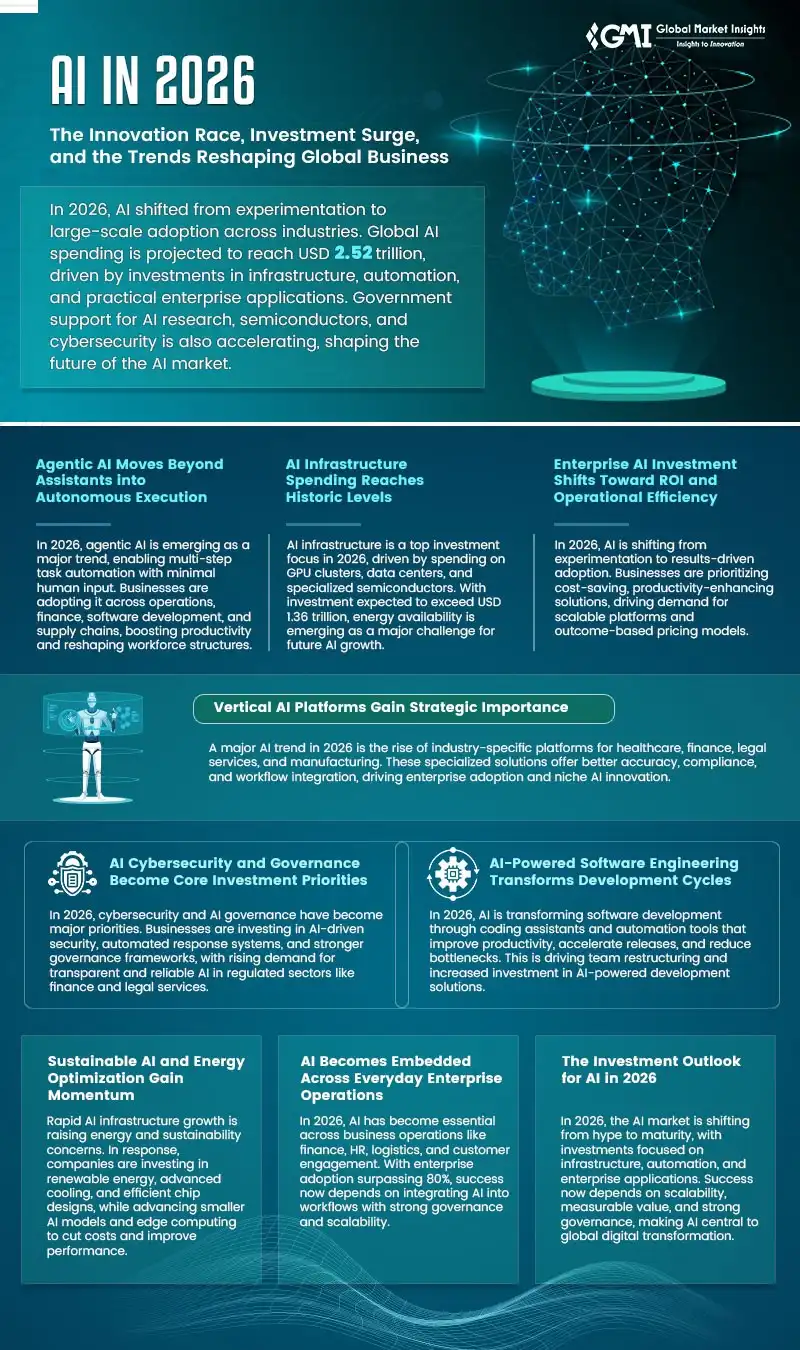
Some trends represent the most significant developments shaping the AI landscape in 2026.
1) What Is Agentic AI Doing in 2026? Autonomous Execution at Enterprise Scale
One of the most transformative developments in 2026 is the rapid rise of agentic AI systems. Unlike earlier AI models designed primarily for content generation or conversational support, agentic AI platforms are now capable of executing multi-step workflows with minimal human intervention.
Enterprises are deploying AI agents for procurement management, customer operations, software development, financial reporting, legal research, and supply chain optimization. These systems can analyze context, retrieve information, make operational decisions, and complete tasks autonomously across multiple software environments.
Industry analysts report that organizations are increasingly moving agentic AI from pilot programs into production-scale environments. Enterprise demand is now centered on workflow automation rather than isolated chatbot functionality.
This transition is redefining enterprise productivity models and reshaping workforce structures, particularly across administrative and process-driven functions.
2) AI Infrastructure Spending Reaches Historic Levels
AI infrastructure investment has become one of the largest capital allocation priorities across the technology sector in 2026. Cloud providers, hyperscalers, semiconductor companies, and data center operators are collectively committing hundreds of billions of dollars toward AI-ready infrastructure.
Large-scale GPU clusters, high-density computing campuses, advanced cooling systems, and energy-efficient server architectures are now critical competitive assets.
The market is also experiencing substantial growth in AI-optimized servers, inference hardware, and specialized semiconductor technologies. Gartner estimates that AI infrastructure spending alone will exceed USD 1.36 trillion in 2026.
Energy supply has emerged as a strategic concern for the industry, with several analysts identifying electricity availability as a major limiting factor for future AI data center expansion.
3) Enterprise AI Investment Shifts Toward ROI and Operational Efficiency
The AI market in 2026 is no longer driven solely by innovation narratives or speculative experimentation. Enterprises are increasingly demanding measurable returns on investment before expanding deployments.
Organizations are prioritizing AI systems capable of reducing operational costs, improving productivity, accelerating decision-making, and streamlining workflows. This shift has created strong demand for enterprise AI platforms integrated directly into finance, legal, cybersecurity, customer service, and operational systems.
Industry data indicates that enterprise buyers are becoming more selective regarding vendor partnerships and AI procurement decisions. Instead of maintaining fragmented AI ecosystems, businesses are consolidating spending around fewer enterprise-grade platforms capable of delivering scalability, governance, and interoperability.
This trend is also changing enterprise software economics, with many providers transitioning from subscription-based pricing models toward usage-based and outcome-driven commercial structures.
4) Vertical AI Platforms Gain Strategic Importance
Another major trend shaping the AI market in 2026 is the emergence of industry-specific AI platforms. Generic large language models are increasingly facing commoditization pressures, prompting investors and enterprises to prioritize specialized AI solutions tailored for healthcare, legal services, finance, manufacturing, and cybersecurity.
Vertical AI systems are proving more effective because they integrate domain-specific knowledge, compliance requirements, industry workflows, and proprietary datasets.
This trend is accelerating mergers, acquisitions, and strategic partnerships across niche AI segments. Enterprises are increasingly selecting AI vendors capable of solving highly targeted operational challenges rather than relying exclusively on generalized AI tools. The rise of vertical AI is also improving adoption confidence among regulated industries where accuracy, accountability, and compliance remain critical concerns.
5) AI Cybersecurity and Governance Become Core Investment Priorities
As AI adoption expands across critical business operations, cybersecurity and governance have become central areas of investment in 2026. Enterprises are increasing spending on AI-powered threat detection, automated incident response systems, and advanced identity management solutions.
At the same time, governments and regulators are intensifying scrutiny around data governance, AI transparency, intellectual property protection, and model accountability. Organizations are responding by implementing stronger governance frameworks designed to ensure compliance, reliability, and auditability.
The demand for “fiduciary-grade AI” has increased significantly in sectors such as legal services, accounting, and financial advisory, where accuracy and traceability are essential. Companies that can demonstrate strong governance capabilities are increasingly gaining competitive advantages in enterprise procurement decisions.
6) AI-Powered Software Engineering Transforms Development Cycles
Software development is undergoing major transformation as AI coding assistants and automated engineering systems become integrated into enterprise workflows. AI platforms are now assisting with debugging, testing, code generation, software documentation, infrastructure management, and application optimization.
Development teams are using AI systems to shorten release cycles, reduce engineering bottlenecks, and improve productivity. AI-assisted coding platforms have also become a major area of venture capital investment due to their direct commercial applicability and measurable efficiency gains.
This shift is influencing hiring models across the technology industry. Several organizations are restructuring software teams around smaller, highly skilled engineering groups supported by AI-driven development environments.
Industry analysts increasingly view AI-enhanced software engineering as one of the highest-return enterprise use cases currently available.
7) Sustainable AI and Energy Optimization Gain Momentum
The rapid expansion of AI infrastructure has intensified discussions around sustainability, energy consumption, and environmental impact. Data centers supporting AI workloads require significant electricity, water resources, and cooling capacity, creating pressure for more efficient infrastructure strategies.
Technology companies are now investing heavily in renewable energy integration, advanced cooling technologies, modular data center design, and energy-efficient semiconductor architectures. Several hyperscalers are also entering into long-term energy agreements to secure stable power supplies for future AI expansion.
This trend is also accelerating innovation in smaller AI models, edge computing systems, and inference optimization techniques aimed at reducing computational costs while maintaining performance quality.
8) AI Becomes Embedded Across Everyday Enterprise Operations
Perhaps the most significant development of 2026 is the normalization of AI across routine business operations. AI is no longer confined to experimental labs or isolated digital transformation initiatives. Instead, it is becoming deeply integrated into procurement, finance, customer engagement, logistics, HR management, healthcare administration, and enterprise knowledge systems.
Businesses are increasingly treating AI as operational infrastructure rather than a standalone technology initiative. This shift reflects a broader transition from AI experimentation toward institutional adoption.
Research firms estimate that more than 80% of enterprises have now deployed or tested generative AI-enabled applications in at least one business function. The competitive landscape is increasingly favoring organizations capable of embedding AI directly into workflows while maintaining governance, scalability, and operational efficiency.
9) The Investment Outlook for AI in 2026
The AI market in 2026 reflects a transition from hype-driven growth toward operational maturity. Capital continues flowing aggressively into infrastructure, enterprise automation, vertical AI applications, semiconductors, and cloud ecosystems. However, investors are now placing greater emphasis on sustainable economics, commercialization potential, and measurable enterprise value.
Infrastructure providers, semiconductor manufacturers, enterprise AI vendors, cybersecurity firms, and workflow automation platforms are emerging as some of the strongest beneficiaries of this shift. Meanwhile, organizations unable to demonstrate practical utility or scalable business models are facing growing market pressure.
As enterprises integrate AI more deeply into core operations, the industry is entering a phase where long-term competitiveness will depend not only on technical innovation but also on execution capability, infrastructure resilience, governance standards, and operational scalability.
Artificial intelligence in 2026 is no longer defined by experimental ambition alone. It has become a foundational layer of modern enterprise strategy, global investment activity, and digital economic transformation.