Market Size by Product, by Range (< 100 mm, 101 mm, 1, 000 mm, 1, 001 mm to 10, 000 mm, >10, 000 mm), by Source (Laser Beam, Infrared (IR), LED).
Report ID: GMI3353
|
Published Date: February 2026
|
Report Format: PDF
Download Free PDF
Photoelectric Sensor Market Size
The global photoelectric sensor market was valued at USD 2.4 billion in 2025. The market is expected to grow from USD 2.5 billion in 2026 to USD 5.1 billion in 2035, at a CAGR of 8.1% during the forecast period according to the latest report published by Global Market Insights Inc. The growth of the Photoelectric Sensors industry is being fueled by the increasing prevalence of process automation and smart manufacturing across all businesses. From manufacturing plants and their assembly lines to the manufacturing of packaging, photoelectric sensors are being utilized more frequently than ever before to detect, count, and inspect products accurately. Therefore, manufacturers have been able to lower their error rates and increase the number of finished products they produce. For instance, according to research published in Institute of Electrical and Electronics Engineers, it is estimated that in 2024 over 54 % of automotive assembly lines worldwide utilized photoelectric sensors for position verification and defect detection, underscoring their importance in advanced production environments.
Another key growth driver is the integration of IoT and Industry 4.0 technologies, with intelligent sensor systems enabling real‑time monitoring, predictive maintenance, and data analytics in smart factories. Installation of IoT‑enabled photoelectric sensors to rise sharply between 2023 and 2024, allowing manufacturers to reduce operational errors and downtime while improving asset tracking and remote diagnostics.
Furthermore, with the increased demand for automated logistics and e-commerce, distribution centers are utilizing sensors for faster sorting/tracking & managing inventories. This is further emphasized by the increase in automated systems for online retail & will drive sensor usage making photoelectric solutions an essential part of the supply chain and solidifying their long-term market trend.
Photoelectric Sensor Market Trends
The global photoelectric sensor industtry is experiencing significant transformation driven by the integration of IoT and Industry 4.0 technologies, enabling real-time monitoring, predictive maintenance, and seamless connectivity within smart factory ecosystems.
The connected sensors allow manufacturers to collect actionable data, optimize production processes, and reduce downtime, accelerating adoption across automotive, electronics, and packaging sectors.
Additionally, miniaturization and compact designs are becoming increasingly important, with smaller, space-efficient sensors being integrated into automated robots, PCB-mounted equipment, and other confined applications. These compact sensors deliver high-precision detection while minimizing installation complexity and energy consumption, making them ideal for electronics manufacturing, medical devices, and smart infrastructure projects.
Furthermore, advancements in detection technologies, including laser-based, fiber-optic, and AI-assisted sensing, are enhancing accuracy, detection range, and operational reliability in challenging environments such as dusty, humid, or high-speed production lines. These innovations are expanding the applicability of photoelectric sensors in high-precision sectors such as semiconductors, pharmaceuticals, and automotive assembly.
Moreover, emerging applications in logistics automation, smart buildings, and agri-tech are creating new growth opportunities, driven by the rise of e-commerce, automated warehouses, and energy-efficient infrastructure. Together, these trends are expected to sustain market growth while enabling broader adoption across traditional and non-traditional industries worldwide.
Photoelectric Sensor Market Analysis
Basec on the light source, the market is segmented into LED-Based, Laser-Based, and Fiber-Optic.
The laser-based segment is anticipated to reach USD 1.8 billion by 2035. The segment is driven by increasing demand for high‑precision, long‑range detection in automated industrial environments. Laser photoelectric sensors offer exceptionally focused light spots that enable reliable detection of small objects and detailed positioning, which is critical in automotive assembly lines and semiconductor production where precision and consistency are paramount.
Additionally, the adoption of new laser sensor technology has accelerated as a result of manufacturers creating new products that include IO-Link capable laser units with real-time diagnostic capabilities and detection of contamination events which results in improved uptime and predictive maintenance efficiency for production lines. In addition, the reduced pricing of high-powered laser diode components has also contributed to the proliferation of advanced laser sensors from the automotive industry to other markets such as smart logistics and robotics for inspection applications.
The LED-Based segment was valued at USD 831.8 million in 2025 and is anticipated to grow at a CAGR of 9.4% over the forecast years. The growth is being driven by its energy efficiency, long operational lifespan, and versatility across industries. LED technology is increasingly integrated in sensors for automotive automation, consumer electronics assembly, and industrial robotics, where reliable, low‑power detection is critical. Recent innovations include compact, IoT‑ready LED sensor modules that support real‑time diagnostics and remote monitoring for smart manufacturing systems.
On the basis of optical configuration, the photoelectric sensor market is divided into through-beam, retro-reflective, and diffuse.
The retro-reflective segment held a market share of 42.7% in 2025, driven by expanding safety and infrastructure demand, such as high‑visibility road signage and reflective safety gear. Market players are innovating with high‑intensity microprismatic films and lightweight EV body tapes, while stringent regulations and smart highway projects continue to boost adoption in transportation and industrial applications.
The through-beam segment is anticipated to grow at a CAGR of 9.5% during the forecast period 2026 – 2035. The growing demand for high-precision, long-range detection equipment is driving growth in the long-range, high-precision detection equipment (e.g., photoelectric sensors). Recent product innovations include new sensing and control technologies enabled by the Internet of Things (IoT), as well as advanced photoelectric designs that enhance product reliability. Equipment manufacturers are deploying through-beam solutions to support the development of smart factories and high-speed package handling applications, contributing to global adoption.
On the basis of end-user industry, the photoelectric sensor market is segmented into industrial manufacturing, automotive & transportation, food & beverage processing, pharmaceuticals & medical devices, building automation & smart infrastructure, electronics & semiconductor manufacturing, energy, utilities & infrastructure, aerospace & defense, and others.
The pharmaceuticals & medical devices segment held a market share of 25.3% in 2025, is driven primarily by the continued demand for health care around the world from an increasing number of older individuals as well as from ongoing development of new treatments for diseases (new drugs) and the use of state-of-the-art technology (AI enabled diagnostic devices, wearable medical devices). The development of biologics, precision medicine, and minimally invasive surgical technologies has allowed many more ways to treat and monitor conditions, and, through the integration of digital health, has made these types of technologies also widely accepted by hospitals, outpatient treatment centers and physicians.
The automotive & transportation segment is anticipated to grow at a CAGR of 19.2% during the forecast period 2026 – 2035, due to continued growth in demand for automobile technology innovations to provide new levels of safety (advanced driving assistance systems including radar, LiDAR, and camera-based systems as well as those to allow vehicles to perform autonomously). AI enabled sensors, connected vehicles and smart mobility systems are accelerating the use of sensor technology in the transition to using electric and/or autonomously powered vehicles, improving the potential to prevent collisions, achieving adaptive cruise control, and providing improved telematics.
North America Photoelectric Sensor Market
The North America photoelectric sensor market holds a significant share of the 28.2% in 2025.
North America’s growth is driven by by rapid adoption of industrial automation across manufacturing, packaging, and logistics sectors, where sensors enable precise object detection and workflow efficiency. Strong integration of IIoT and smart factory solutions, alongside stringent safety and quality regulations, has accelerated deployment in automotive plants and warehousing systems, while established sensor makers continuously innovate to meet advanced industrial requirements.
The U.S. photoelectric sensor market was valued at USD 486.8 million and USD 503.2 million in 2022 and 2023, respectively. The market size reached USD 546.3 million in 2025, growing from USD 522.9 million in 2024.
The U.S. market is expanding due to surging automation in manufacturing and logistics, increased integration of smart and IoT‑enabled sensor technologies for real‑time monitoring, and rising demand for energy‑efficient, high‑precision detection solutions. Growth is further supported by strong emphasis on workplace safety compliance, expansions in e‑commerce fulfillment centers, and ongoing R&D investments that drive product sophistication and broad industrial adoption.
Europe Photoelectric Sensor Market
Europe photoelectric sensor industry accounted for USD 557.8 million in 2025 and is anticipated to show lucrative growth over the forecast period.
Europe’s photoelectric sensor industry growth continues to be influenced by expanding industrial automation investments and the widespread use of photoelectric sensors in automotive, packaging and manufacturing. Efficient use of photoelectric sensors can lead to improved efficiency and more effective methods of quality control via precise measurement capabilities. The rapidly increasing regulatory requirements for energy efficiency and environmental sustainability will continue to increase the use of advanced photoelectric sensors. Emerging developments in business sectors related to automation include smart factory concepts and new IO-Link and digital filtering technologies, which support increases of reliability and automation of photoelectric sensors throughout Europe.
Germany dominates the Europe photoelectric sensor market, due to the country's existing automotive industry and advanced manufacturing activities that utilize photoelectric sensors for automation, robotics, and precision production. The ongoing R&D activities by manufacturers, both in Germany and worldwide, in conjunction with the strength of the industry 4.0 ecosystem in Germany, enable innovation and sustained market leadership for the use of photoelectric sensors. The rapid growth of logistics, warehousing and quality control segments will also support greater use of photoelectric sensors across the country.
Asia Pacific Photoelectric Sensor Market
The Asia Pacific market is anticipated to hold significant share of 42.8% in 2025 and is expected to grow at the highest CAGR of 8.8 % during the forecast period.
The Asia-Pacific market is experiencing rapid growth, driven by accelerated industrialization, expanding manufacturing bases, and widespread automation adoption across automotive, electronics, and packaging sectors. Integration of IIoT and smart factory technologies boosts demand for precise, non‑contact sensing solutions, while supportive government policies and infrastructure investments in China, India, and Southeast Asia further enhance regional uptake and technological innovation.
China photoelectric sensor market is estimated to grow with a CAGR of 9.9%, The country remains a key growth engine within Asia-Pacific, driven by robust manufacturing modernization, surging automation investments, and strategic initiatives like “Made in China 2025” that prioritize smart production systems. This fuels heavy deployment of sensors in automotive assembly, consumer electronics, and logistics automation, supported by innovation in high‑performance sensing technologies.
Latin American Photoelectric Sensor Market
The Latin America particulate matter monitoring market, valued at USD 47 million in 2025, driven by increasing is driven by rising regulatory pressure to enforce stricter air quality standards and growing public concern over urban pollution health impacts. Investment in fixed and portable PM monitors is increasing as governments and industries adopt advanced optical and sensor technologies to track PM2.5/PM10 levels, while awareness and environmental initiatives strengthen regional monitoring networks.
Middle East and Africa Photoelectric Sensor Market
Saudi Arabia photoelectric sensor industry to experience substantial growth in the Middle East and Africa.
The Saudi Arabia market is expected to experience substantial growth during the forecast period due to the expanding adoption of automation and smart infrastructure technologies across manufacturing, logistics, and industrial sectors, aligned with Vision 2030 diversification and smart city initiatives. Increased deployment of sensors in process automation, safety systems, and industrial IoT networks is accelerating demand for advanced photoelectric sensing solutions.
Photoelectric Sensor Market Share
The global photoelectric sensor industry is moderately consolidated, with key players such as OMRON Corporation, Panasonic Industry Co., Ltd., SICK AG, KEYENCE CORPORATION, and Rockwell Automation collectively accounting for approximately 39% of the market. These companies capitalize on extensive expertise in industrial automation, sensing technologies, and factory integration, delivering high-precision, reliable sensors for applications across manufacturing, logistics, automotive, and robotics.
While these leading vendors dominate, the market remains partially fragmented, with numerous regional and specialized suppliers catering to niche segments such as smart factories, AI-driven production lines, and harsh-environment automation. Smaller players differentiate through tailored solutions, cost-efficient models, AI-enabled detection, and rapid deployment support. These competitive dynamic drives innovation in multi-mode sensing, long-range detection, compact designs, and seamless integration with industrial IoT and automated control systems, underpinning steady growth in the global market.
Photoelectric Sensor Market Companies
Prominent players operating in the photoelectric sensor indusyry are as mentioned below:
OMRON Corporation
Panasonic Industry Co., Ltd.
SICK AG
KEYENCE CORPORATION
Rockwell Automation
Balluff Inc
OPTEX FA CO., LTD.
Baumer
Pepperl+Fuchs SE
TAKEX EUROPE LTD.
Wenglor
Schneider Electric
Banner Engineering Corp.
Hans Turck GmbH & Co. KG
Leuze electronic Pvt. Ltd.
OMRON Corporation
OMRON Corporation is a global leader in industrial automation and sensing solutions, leveraging its core “Sensing & Control + Think” technology to deliver advanced photoelectric sensors (including diffuse‑reflective, through‑beam, and retro‑reflective types) integrated with automation and IoT platforms. Its broad portfolio supports packaging, assembly, and material handling applications, with continuous R&D investments driving innovations in high‑precision detection and smart factory connectivity.
Panasonic Industry Co., Ltd.
Panasonic Industry Co., Ltd. offers a comprehensive range of photoelectric and laser sensors as part of its factory automation portfolio, including compact, thru‑beam, retro‑reflective, and IO‑Link‑enabled models designed for object detection, positioning, and measurement tasks. By combining robust optical sensing with electronic control expertise, Panasonic’s sensors optimize production processes across automotive, packaging, and electronics industries while supporting integration with broader automation systems.
SICK AG
SICK AG is a leading German manufacturer of intelligent sensors and sensor solutions, with a strong footprint in industrial automation, logistics, and factory applications. Its photoelectric sensor portfolio delivers reliable object detection and advanced diagnostics under challenging conditions, supported by modular design and integration with sensor intelligence features. SICK’s global R&D and broad product range have reinforced its position as a preferred provider of precision sensing technologies.
Photoelectric Sensor Industry News
In December 2025, SICK AG launched the W12 NextGen series of photoelectric sensors, expanding its industrial automation portfolio with high-performance, precision detection solutions. The new range enhances the capabilities of the established W12 series, offering improved reliability, versatility, and repeatability even under challenging operating conditions. With advanced sensing features and intelligent usability, the W12 NextGen supports complex manufacturing processes, reinforcing SICK’s position as a leader in industrial sensor innovation.
In January 2024, Panasonic Industrial Automation partnered with Mouser Electronics through a new distribution agreement to expand access to its industrial automation solutions. The collaboration enables Mouser to offer Panasonic’s portfolio, including EX-10 ultra-slim photoelectric sensors and FP0R programmable controllers, that are supporting automotive, semiconductor, packaging, and biomedical applications, while enhancing availability and support for design engineers in the IIoT and automation markets.
The Photoelectric Sensor market research report includes in-depth coverage of the industry with estimates and forecast in terms of revenue in USD Billion from 2022 – 2035 for the following segments:
Market, By Light Source
LED-Based
Laser-Based
Fiber-Optic
Market, By Optical Configuration
Through-Beam
Retro-Reflective
Diffuse
Market, By Sensing Range
Short Range: ≤ 100 mm
Medium Range: >100 mm – ≤1,000 mm
Long Range: >1,000 mm – ≤10,000 mm
Ultra-Long / Extended Range: >10,000 mm
Market, By Housing Geometry
Cylindrical
Rectangular / Box
Slot / Fork
Market, By End-User Industry
Industrial Manufacturing
Automotive & Transportation
Food & Beverage Processing
Pharmaceuticals & Medical Devices
Building Automation & Smart Infrastructure
Electronics & Semiconductor Manufacturing
Energy, Utilities & Infrastructure
Aerospace & Defense
Others
The above information is provided for the following regions and countries:
North America
U.S.
Canada
Europe
Germany
UK
France
Spain
Italy
Netherlands
Asia Pacific
China
India
Japan
Australia
South Korea
Latin America
Brazil
Mexico
Argentina
Middle East and Africa
South Africa
Saudi Arabia
UAE
Authors: Suraj Gujar, Sandeep Ugale
Photoelectric Sensor Market Scope
Photoelectric Sensor Market Size
Photoelectric Sensor Market Trends
Photoelectric Sensor Market Analysis
Photoelectric Sensor Market Share
Report Content
Chapter 1 Methodology and Scope
1.1 Market scope and definition
1.2 Research design
1.2.1 Research approach
1.2.2 Data collection methods
1.3 Data mining sources
1.3.1 Global
1.3.2 Regional/Country
1.4 Base estimates and calculations
1.4.1 Base year calculation
1.4.2 Key trends for market estimation
1.5 Primary research and validation
1.5.1 Primary sources
1.6 Forecast model
1.7 Research assumptions and limitations
Chapter 2 Executive Summary
2.1 Industry 360° synopsis, 2022 – 2035
2.2 Key market trends
2.2.1 System type trends
2.2.2 Deployment model trends
2.2.3 End-user industry trends
2.2.4 Regional trends
2.3 TAM analysis, 2025-2035
2.4 CXO perspectives: Strategic imperatives
2.4.1 Executive decision points
2.4.2 Critical success factors
2.5 Future outlook and strategic recommendations
Chapter 3 Industry Insights
3.1 Industry ecosystem analysis
3.1.1 Supplier landscape
3.1.2 Profit margin analysis
3.1.3 Cost structure
3.1.4 Value addition at each stage
3.1.5 Factor affecting the value chain
3.1.6 Disruptions
3.2 Industry impact forces
3.2.1 Growth drivers
3.2.1.1 Widespread adoption of industrial automation
3.2.1.2 Industry 4.0 & Smart factory initiatives
3.2.1.3 Growing demand in packaging & logistics
3.2.1.4 Rising Demand for high precision sensing in sectors
3.2.1.5 Growing focus towards energy efficiency sensors
3.2.2 Industry pitfalls and challenges
3.2.2.1 Significant capital and operational expenditure
3.2.2.2 Integration challenges with legacy systems
3.2.3 Market opportunities
3.2.3.1 Growing regions with rising industrialization and automation
3.2.3.2 Expanding adoption in smart buildings
3.3 Regulatory landscape
3.3.1 North America
3.3.2 Europe
3.3.3 Asia Pacific
3.3.4 Latin America
3.3.5 Middle East & Africa
3.4 Porter’s analysis
3.5 PESTEL analysis
3.6 Technology and innovation landscape
3.6.1 Current technological trends
3.6.2 Emerging technologies
3.7 Emerging business models
3.8 Compliance requirements
3.9 Patent and IP analysis
3.10 Geopolitical and trade dynamics
Chapter 4 Competitive Landscape, 2025
4.1 Introduction
4.2 Company market share analysis
4.2.1 By region
4.2.1.1 North America
4.2.1.2 Europe
4.2.1.3 Asia Pacific
4.2.1.4 Latin America
4.2.1.5 Middle East & Africa
4.3 Competitive benchmarking of key players
4.3.1 Financial performance comparison
4.3.1.1 Revenue
4.3.1.2 Profit margin
4.3.1.3 R&D
4.3.2 Product portfolio comparison
4.3.2.1 Product range breadth
4.3.2.2 Technology
4.3.2.3 Innovation
4.3.3 Geographic presence comparison
4.3.3.1 Global footprint analysis
4.3.3.2 Service network coverage
4.3.3.3 Market penetration by region
4.3.4 Competitive positioning matrix
4.3.4.1 Leaders
4.3.4.2 Challengers
4.3.4.3 Followers
4.3.4.4 Niche players
4.3.5 Strategic outlook matrix
4.4 Key developments, 2022-2025
4.4.1 Mergers and acquisitions
4.4.2 Partnerships and collaborations
4.4.3 Technological advancements
4.4.4 Expansion and investment strategies
4.4.5 Digital transformation initiatives
4.5 Emerging/ startup competitors’ landscape
Chapter 5 Market Estimates and Forecast, By Light Source, 2022 – 2035 (USD Billion, Units)
5.1 Key trends
5.2 LED-Based
5.3 Laser-Based
5.4 Fiber-Optic
Chapter 6 Market Estimates and Forecast, By Optical Configuration, 2022 – 2035 (USD Billion, Units)
6.1 Key trends
6.2 Through-Beam
6.3 Retro-Reflective
6.4 Diffuse
Chapter 7 Market Estimates and Forecast, By Sensing Range, 2022 – 2035 (USD Billion, Units)
7.1 Key trends
7.2 Short Range: ≤ 100 mm
7.3 Medium Range: >100 mm – ≤ 1,000 mm
7.4 Long Range: >1,000 mm – ≤ 10,000 mm
7.5 Ultra-Long / Extended Range: >10,000 mm
Chapter 8 Market Estimates and Forecast, By Housing Geometry, 2022 – 2035 (USD Billion, Units)
8.1 Key trends
8.2 Cylindrical
8.3 Rectangular / Box
8.4 Slot / Fork
Chapter 9 Market Estimates and Forecast, By End-User Industry, 2022 – 2035 (USD Billion, Units)
9.1 Key trends
9.2 Industrial Manufacturing
9.3 Automotive & Transportation
9.4 Food & Beverage Processing
9.5 Pharmaceuticals & Medical Devices
9.6 Building Automation & Smart Infrastructure
9.7 Electronics & Semiconductor Manufacturing
9.8 Energy, Utilities & Infrastructure
9.9 Aerospace & Defense
9.10 Others
Chapter 10 Market Estimates and Forecast, By Region, 2022 – 2035 (USD Mn)
10.1 Key trends
10.2 North America
10.2.1 U.S.
10.2.2 Canada
10.3 Europe
10.3.1 Germany
10.3.2 UK
10.3.3 France
10.3.4 Spain
10.3.5 Italy
10.3.6 Netherlands
10.4 Asia Pacific
10.4.1 China
10.4.2 India
10.4.3 Japan
10.4.4 Australia
10.4.5 South Korea
10.5 Latin America
10.5.1 Brazil
10.5.2 Mexico
10.5.3 Argentina
10.6 Middle East and Africa
10.6.1 South Africa
10.6.2 Saudi Arabia
10.6.3 UAE
Chapter 11 Company Profiles
11.1 OMRON Corporation
11.2 Panasonic Industry Co., Ltd.
11.3 SICK AG
11.4 KEYENCE CORPORATION
11.5 Rockwell Automation
11.6 Balluff Inc
11.7 OPTEX FA CO., LTD.
11.8 Baumer
11.9 Pepperl+Fuchs SE
11.10 TAKEX EUROPE LTD.
11.11 Wenglor
11.12 Schneider Electric
11.13 Banner Engineering Corp.
11.14 Hans Turck GmbH & Co. KG
11.15 Leuze Electronic Pvt. Ltd.
Don't see your key competitors?
The companies listed in this report are a curated selection - not the full competitive universe.
Our market revenue calculations use a bottom-up methodology that accounts for all players across all regions - including manufacturers, distributors, and specialists not individually profiled. The profiles section spotlights strategically significant players; it does not define the scope of our market sizing.
Your competitive landscape may also include
Regional or domestic-only leaders not in the global top tier
Distributors and channel partners who control market access
Emerging disruptors, startups, or adjacent-industry entrants
Niche players focused on a specific application or end-use
Free customization - up to 20% of report value
Need specific data? Request customization and get the insights tailored to your exact requirements.
Authors: Suraj Gujar, Sandeep Ugale
For inquiries regarding discounts, bulk purchases, or customization requests, please contact us at[email protected]
Explore our licensing options:
Starting at: $2,450
Immediate Delivery Available
Premium Report Details
Base Year: 2025
Companies Profiled: 15
Tables and Figures: 594
Countries covered: 19
Pages: 190
Download Free PDF
Premium Report Details
Base Year: 2025
Companies Profiled: 15
Tables and Figures: 594
Countries covered: 19
Pages: 190
Download Free PDF
Share Content
Add Citations
Suraj Gujar. 2026, February. Photoelectric Sensor Market Size – By Light Source, Optical Configuration, Sensing Range, Housing Geometry, End-User Industry - Global Forecast, 2026-2035 (Report ID: GMI3353). Global Market Insights Inc. Retrieved August 14, 2026, from https://www.gminsights.com/toc/details/photoelectric-sensor-market
Photoelectric Sensor Market
Get a free sample of this report
Get a free sample of this report Photoelectric Sensor Market
Is your requirement urgent? Please give us your business email for a speedy delivery!



Photoelectric Sensor Market Size
The global photoelectric sensor market was valued at USD 2.4 billion in 2025. The market is expected to grow from USD 2.5 billion in 2026 to USD 5.1 billion in 2035, at a CAGR of 8.1% during the forecast period according to the latest report published by Global Market Insights Inc. The growth of the Photoelectric Sensors industry is being fueled by the increasing prevalence of process automation and smart manufacturing across all businesses. From manufacturing plants and their assembly lines to the manufacturing of packaging, photoelectric sensors are being utilized more frequently than ever before to detect, count, and inspect products accurately. Therefore, manufacturers have been able to lower their error rates and increase the number of finished products they produce. For instance, according to research published in Institute of Electrical and Electronics Engineers, it is estimated that in 2024 over 54 % of automotive assembly lines worldwide utilized photoelectric sensors for position verification and defect detection, underscoring their importance in advanced production environments.
Another key growth driver is the integration of IoT and Industry 4.0 technologies, with intelligent sensor systems enabling real‑time monitoring, predictive maintenance, and data analytics in smart factories. Installation of IoT‑enabled photoelectric sensors to rise sharply between 2023 and 2024, allowing manufacturers to reduce operational errors and downtime while improving asset tracking and remote diagnostics.
Furthermore, with the increased demand for automated logistics and e-commerce, distribution centers are utilizing sensors for faster sorting/tracking & managing inventories. This is further emphasized by the increase in automated systems for online retail & will drive sensor usage making photoelectric solutions an essential part of the supply chain and solidifying their long-term market trend.
Photoelectric Sensor Market Trends
Photoelectric Sensor Market Analysis
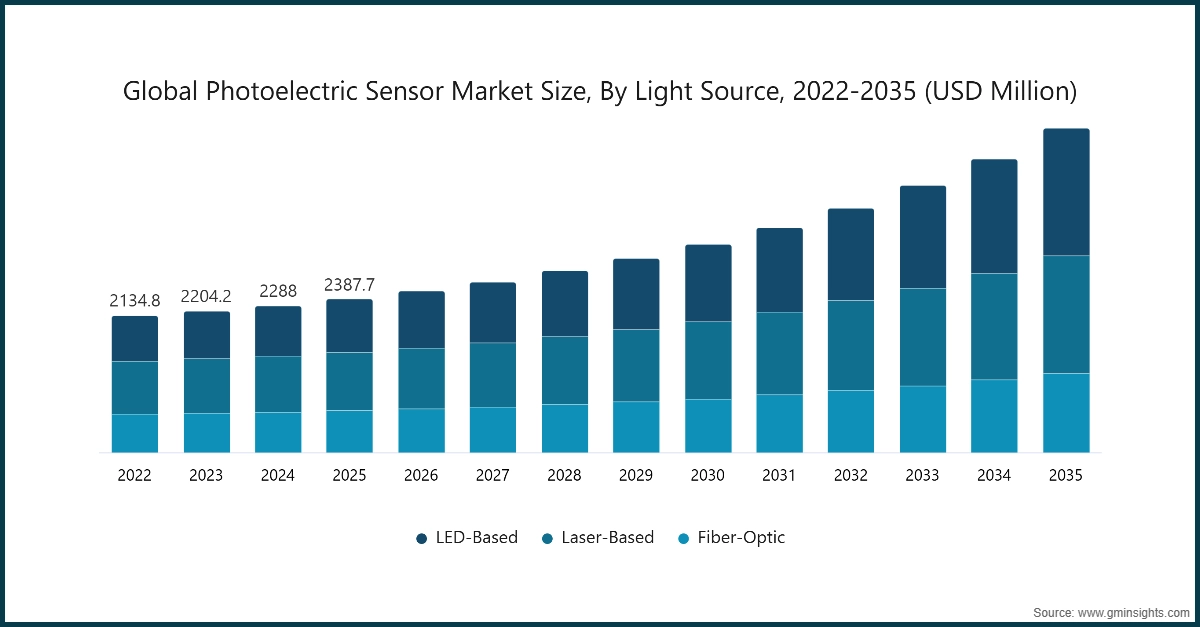
Basec on the light source, the market is segmented into LED-Based, Laser-Based, and Fiber-Optic.
On the basis of optical configuration, the photoelectric sensor market is divided into through-beam, retro-reflective, and diffuse.
On the basis of end-user industry, the photoelectric sensor market is segmented into industrial manufacturing, automotive & transportation, food & beverage processing, pharmaceuticals & medical devices, building automation & smart infrastructure, electronics & semiconductor manufacturing, energy, utilities & infrastructure, aerospace & defense, and others.
North America Photoelectric Sensor Market
The North America photoelectric sensor market holds a significant share of the 28.2% in 2025.
The U.S. photoelectric sensor market was valued at USD 486.8 million and USD 503.2 million in 2022 and 2023, respectively. The market size reached USD 546.3 million in 2025, growing from USD 522.9 million in 2024.
Europe Photoelectric Sensor Market
Europe photoelectric sensor industry accounted for USD 557.8 million in 2025 and is anticipated to show lucrative growth over the forecast period.
Asia Pacific Photoelectric Sensor Market
The Asia Pacific market is anticipated to hold significant share of 42.8% in 2025 and is expected to grow at the highest CAGR of 8.8 % during the forecast period.
Latin American Photoelectric Sensor Market
Middle East and Africa Photoelectric Sensor Market
Saudi Arabia photoelectric sensor industry to experience substantial growth in the Middle East and Africa.
Photoelectric Sensor Market Share
The global photoelectric sensor industry is moderately consolidated, with key players such as OMRON Corporation, Panasonic Industry Co., Ltd., SICK AG, KEYENCE CORPORATION, and Rockwell Automation collectively accounting for approximately 39% of the market. These companies capitalize on extensive expertise in industrial automation, sensing technologies, and factory integration, delivering high-precision, reliable sensors for applications across manufacturing, logistics, automotive, and robotics.
While these leading vendors dominate, the market remains partially fragmented, with numerous regional and specialized suppliers catering to niche segments such as smart factories, AI-driven production lines, and harsh-environment automation. Smaller players differentiate through tailored solutions, cost-efficient models, AI-enabled detection, and rapid deployment support. These competitive dynamic drives innovation in multi-mode sensing, long-range detection, compact designs, and seamless integration with industrial IoT and automated control systems, underpinning steady growth in the global market.
Photoelectric Sensor Market Companies
Prominent players operating in the photoelectric sensor indusyry are as mentioned below:
OMRON Corporation is a global leader in industrial automation and sensing solutions, leveraging its core “Sensing & Control + Think” technology to deliver advanced photoelectric sensors (including diffuse‑reflective, through‑beam, and retro‑reflective types) integrated with automation and IoT platforms. Its broad portfolio supports packaging, assembly, and material handling applications, with continuous R&D investments driving innovations in high‑precision detection and smart factory connectivity.
Panasonic Industry Co., Ltd. offers a comprehensive range of photoelectric and laser sensors as part of its factory automation portfolio, including compact, thru‑beam, retro‑reflective, and IO‑Link‑enabled models designed for object detection, positioning, and measurement tasks. By combining robust optical sensing with electronic control expertise, Panasonic’s sensors optimize production processes across automotive, packaging, and electronics industries while supporting integration with broader automation systems.
SICK AG is a leading German manufacturer of intelligent sensors and sensor solutions, with a strong footprint in industrial automation, logistics, and factory applications. Its photoelectric sensor portfolio delivers reliable object detection and advanced diagnostics under challenging conditions, supported by modular design and integration with sensor intelligence features. SICK’s global R&D and broad product range have reinforced its position as a preferred provider of precision sensing technologies.
Photoelectric Sensor Industry News
In December 2025, SICK AG launched the W12 NextGen series of photoelectric sensors, expanding its industrial automation portfolio with high-performance, precision detection solutions. The new range enhances the capabilities of the established W12 series, offering improved reliability, versatility, and repeatability even under challenging operating conditions. With advanced sensing features and intelligent usability, the W12 NextGen supports complex manufacturing processes, reinforcing SICK’s position as a leader in industrial sensor innovation.
In January 2024, Panasonic Industrial Automation partnered with Mouser Electronics through a new distribution agreement to expand access to its industrial automation solutions. The collaboration enables Mouser to offer Panasonic’s portfolio, including EX-10 ultra-slim photoelectric sensors and FP0R programmable controllers, that are supporting automotive, semiconductor, packaging, and biomedical applications, while enhancing availability and support for design engineers in the IIoT and automation markets.
The Photoelectric Sensor market research report includes in-depth coverage of the industry with estimates and forecast in terms of revenue in USD Billion from 2022 – 2035 for the following segments:
Market, By Light Source
Market, By Optical Configuration
Market, By Sensing Range
Market, By Housing Geometry
Market, By End-User Industry
The above information is provided for the following regions and countries: