
Peracetic Acid Market Size & Share 2026-2035
Download Free PDF
Report Content
Chapter 1. Research Methodology
1.1 Research Approach
1.2 Quality Commitments
1.2.1 GMI AI Policy Data Integrity Commitment
1.2.1.1 Source Consistency Protocol
1.3 Research Trail Confidence Scoring
1.3.1 Research Trail Components
1.3.2 Scoring Components
1.4 Data Collection
1.4.1 Partial List of Primary Sources
1.5 Data Mining Sources
1.5.1 Paid Sources
1.5.1.1 Sources, By Region
1.6 Base Estimates Calculations
1.6.1 Base Year Calculation
1.7 Forecast Model
1.7.1 Quantified Market Impact Analysis
1.7.1.1 Mathematical Impact of Growth Parameters on Forecast
1.8 Research Transparency Addendum
1.8.1 Source Attribution Framework
1.8.2 Quality Assurance Metrics
1.8.3 Our Commitment to Trust
Chapter 2. Executive Summary
2.1 Industry 360° Synopsis
2.2 Key Market Trends
2.2.1 Grade Trends
2.2.2 Application Trends
2.2.3 End Use Industry Trends
2.2.4 Regional Trends
2.3 TAM Analysis, 2027–2035
2.4 CXO Perspectives: Strategic Imperatives
Chapter 3. Industry Insights
3.1 Industry Ecosystem Analysis
3.1.1 Supplier Landscape
3.1.2 Profit Margin
3.1.3 Cost Structure
3.1.4 Value Addition at Each Stage
3.1.5 Factors Affecting the Value Chain
3.1.6 Disruptions
3.2 Industry Impact Forces
3.2.1 Growth Drivers
3.2.2 Industry Pitfalls Challenges
3.2.3 Market Opportunities
3.3 Growth Potential Analysis
3.4 Pricing Analysis (Driven by Primary Research)
3.4.1 Historical Price Trend Analysis (Driven by Primary Research)
3.4.2 Pricing Strategy by Player Type (Premium / Value / Cost-plus) (Driven by Primary Research)
3.5 Regulatory Landscape
3.5.1 North America
3.5.2 Europe
3.5.3 Asia Pacific
3.5.4 Latin America
3.5.5 Middle East Africa
3.6 Porter's Analysis
3.7 PESTEL Analysis
3.8 Trade Data Analysis (Based on Paid Database)
3.8.1 Import/Export Volume Value Trends (Based on Paid Database)
3.8.2 Key Trade Corridors Tariff Impact (Based on Paid Database)
3.9 Impact of AI Generative AI on the Market (Driven by Primary Research)
3.9.1 AI-Driven Disruption of Existing Business Models
3.9.2 GenAI Use Cases Adoption Roadmap by Segment
3.9.3 Risks, Limitations Regulatory Considerations
3.10 Capacity Production Landscape (Driven by Primary Research)
3.10.1 Production Capacity by Region Key Producer (Driven by Primary Research)
3.10.2 Capacity Utilization Rates Expansion Pipelines (Driven by Primary Research)
Chapter 4. Competitive Landscape, 2025
4.1 Introduction
4.2 Company Market Share Analysis
4.2.1 By Region
4.2.1.1 North America
4.2.1.2 Europe
4.2.1.3 Asia Pacific
4.2.1.4 Latin America
4.2.1.5 Middle East Africa
4.2.2 Market Concentration Analysis
4.3 Competitive Analysis of Major Market Players
4.4 Competitive Positioning Matrix
4.5 Key Developments
4.5.1 Mergers Acquisitions
4.5.2 Partnerships Collaborations
4.5.3 New Product Launches
4.5.4 Expansion Plans Funding
4.6 Company Tier Benchmarking
4.6.1 Tier Classification Criteria Qualifying Thresholds
4.6.2 Tier Positioning Matrix by Revenue, Geography Innovation
Chapter 5. Peracetic Acid Market Estimates and Forecast, by Grade, (USD Million Kilotons, 2022–2035)
5.1 Key Trends by Grade
5.2 Solution Grade
5.2.1 5–15% PAA Solution (Standard / Mid-Strength)
5.2.2 15–35% PAA Solution (High-Strength Industrial)
5.2.3 >35% PAA Solution (Concentrated Specialty)
5.3 Distilled Grade
5.3.1 High Purity Distilled PAA
5.3.2 Analytical/Reagent Grade PAA
Chapter 6. Peracetic Acid Market Estimates and Forecast, by Application (USD Million Kilotons, 2022–2035)
6.1 Key Trends by Application
6.2 Disinfectant
6.2.1 Surface Disinfection (Non-Food Contact)
6.2.2 Equipment Facility Disinfection (CIP/COP Systems)
6.3 Sterilant
6.3.1 High-Level Sterilization (Medical Instruments Endoscopes)
6.3.2 Pharmaceutical Grade Sterilization
6.4 Sanitizer
6.4.1 Food Contact Surface Sanitization
6.4.2 Beverage Line Sanitization (Breweries, Wineries, Dairies)
6.5 Oxidizer/Bleaching Agent
6.5.1 Pulp Paper Bleaching (ECF Process)
6.5.2 Industrial Effluent Wastewater Oxidation
6.6 Others
6.6.1 Chemical Synthesis Reagent
6.6.2 Aquaculture Agricultural Disinfection
Chapter 7. Peracetic Acid Market Estimates and Forecast, by End-Use Industry, (USD Million Kilotons, 2022–2035)
7.1 Key Trends by End-Use Industry
7.2 Food Beverage
7.2.1 Poultry Meat Processing
7.2.2 Fruit Vegetable Processing
7.2.3 Dairy Processing
7.2.4 Beverage Production (Breweries, Wineries, Soft Drinks)
7.2.5 Food Packaging Disinfection
7.3 Healthcare
7.3.1 Hospitals Clinical Settings
7.3.2 Medical Device Instrument Sterilization
7.3.3 Pharmaceutical Manufacturing Facilities
7.4 Water Treatment
7.4.1 Municipal Drinking Water Treatment
7.4.2 Industrial Wastewater Treatment
7.4.3 Cooling Towers Recirculating Water Systems
7.5 Pulp Paper
7.5.1 Chemical Pulp Bleaching (ECF TCF Processes)
7.5.2 Paper Mill Effluent Treatment
7.6 Agriculture
7.6.1 Aquaculture Disinfection
7.6.2 Seed Treatment Crop Protection
7.6.3 Greenhouse Horticultural Disinfection
7.7 Others
7.7.1 Oil Gas (Produced Water Treatment Pipeline Disinfection)
7.7.2 Laundry Textile Processing
7.7.3 Institutional Cleaning (Commercial Industrial)
Chapter 8. Peracetic Acid Market Estimates and Forecast, by Regional(USD Million Kilotons, 2022–2035)
8.1 Key Trends
8.2 North America
8.2.1 U.S.
8.2.2 Canada
8.3 Europe
8.3.1 Germany
8.3.2 UK
8.3.3 France
8.3.4 Rest of Europe
8.4 Asia Pacific
8.4.1 China
8.4.2 Japan
8.4.3 South Korea
8.4.4 India
8.4.5 Rest of Asia Pacific
8.5 Latin America
8.5.1 Brazil
8.5.2 Mexico
8.5.3 Rest of Latin America
8.6 Middle East Africa
8.6.1 South Africa
8.6.2 Saudi Arabia
8.6.3 UAE
8.6.4 Rest of Middle East & Africa
Chapter 9. Company Profiles (Driven by Primary Research)
Don't see your key competitors?
The companies listed in this report are a curated selection - not the full competitive universe.
Our market revenue calculations use a bottom-up methodology that accounts for all players across all regions - including manufacturers, distributors, and specialists not individually profiled. The profiles section spotlights strategically significant players; it does not define the scope of our market sizing.
Your competitive landscape may also include
Free customization - up to 20% of report value
Need specific data? Request customization and get the insights tailored to your exact requirements.
For inquiries regarding discounts, bulk purchases, or customization requests, please contact us at [email protected]
Share Content
Add Citations
Kiran Pulidindi. 2026, September. Peracetic Acid Market Size - By Product Type, By Purity, By End Use Industry Analysis, Share, Growth Forecast 2026 - 2035 (Report ID: GMI1524). Global Market Insights Inc. Retrieved October 30, 2026, from https://www.gminsights.com/toc/details/peracetic-acid-market

Peracetic Acid Market
Get a free sample of this report
Peracetic Acid (PAA) Market Size
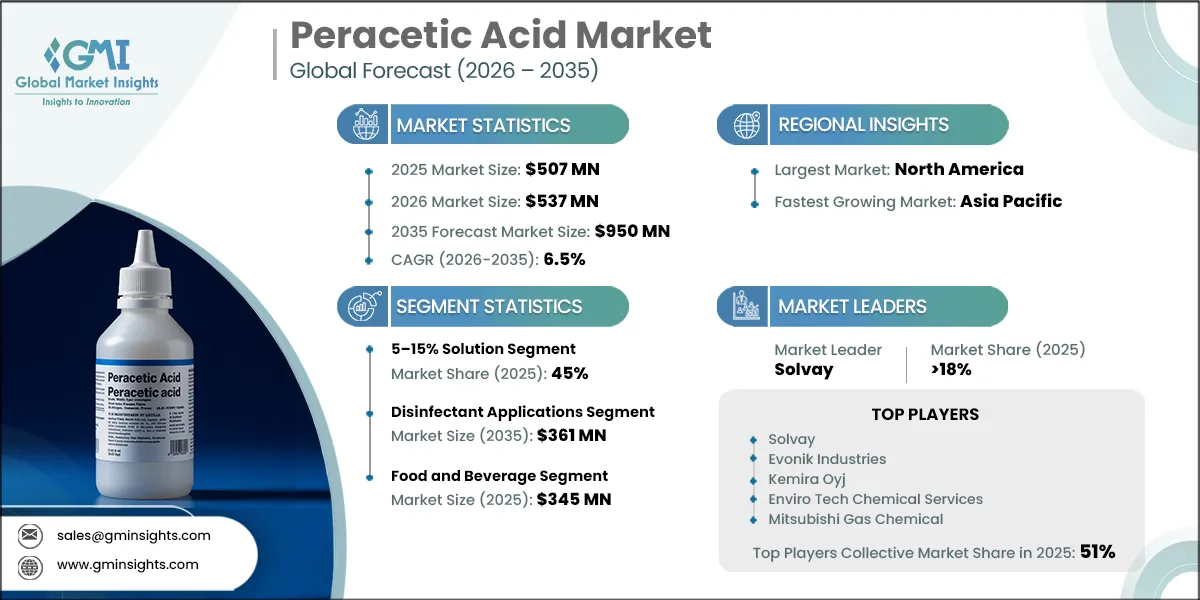
The Peracetic Acid (PAA) market was valued at USD 507 million in 2025, is projected to reach USD 537 million in 2026, expanding at a ~6.5% CAGR (2026–2035), and is expected to reach USD 950 million by 2035.
The Peracetic Acid (PAA) market is expected to reach 651 KT by 2035. Its expansion is underpinned by compliance-led food sanitation demand, a gradual move toward non-chlorine water disinfection, and a richer sales mix of concentrated and high-purity formulations. That mix matters because premium applications can support revenue growth even where solution-volume consumption remains tied to processing throughput and utility replacement cycles.
GMI Analyst View
Our primary research conversations with procurement leaders at food processing facilities and water utilities indicate that the global Peracetic Acid (PAA) market reached a total commercial solution volume of 366 KT in 2025 — a level that reflects regulatory-mandated demand depth in protein processing and the expanding footprint of PAA in industrial water treatment, characteristics that together insulate baseline demand from short-term macroeconomic cycles and purchasing budget pressure.
Peracetic Acid (PAA) Market Trends, Growth Drivers & GMI Forecast Outlook
Regulated food sanitation gives the market a durable consumption floor, while water-treatment conversion and sterility-critical manufacturing broaden the addressable premium mix. Forecast performance depends on whether regulatory pressure, utility capital cycles, feedstock availability, and safe handling infrastructure advance in step rather than independently.
Key Drivers
Evidence anchors use cited external data; demand implications and forecast conditions represent GMI analysis.
Food processing demand is structurally different from discretionary industrial chemical demand. In meat, poultry, beverage, dairy, and produce operations, sanitation chemistry is tied to throughput, auditability, and customer acceptance rather than optional plant spending. PAA's decomposition profile and effectiveness in cold-process environments make it particularly relevant where processors must maintain cleaning performance without leaving persistent residues.
Water treatment is the principal conversion opportunity, but its commercial timing is uneven. Utility operators generally evaluate new disinfectants during permit renewals, equipment upgrades, or when byproduct-management costs expose weaknesses in the installed chlorine system. PAA therefore competes not only on disinfection performance, but also on the avoidance of downstream dechlorination and on the operating implications of a changed chemical program.
Sterility-sensitive manufacturing is shifting attention toward higher-purity formulations. Pharmaceutical production, aseptic filling, and specialized packaging environments place a premium on validated chemistry, documentation, and reliable dosing. These applications favor suppliers able to pair formulation consistency with technical service and regulatory support.
Key Restraints
Evidence anchors use cited external data; demand implications and forecast conditions represent GMI analysis.
PAA producers remain exposed to hydrogen peroxide availability and pricing because peroxide is both a core input and a higher-value feedstock for adjacent specialty applications. Integrated producers can better manage supply continuity and pricing volatility, whereas merchant buyers are more exposed to sudden shifts in feedstock allocation. This difference is particularly consequential in lower-concentration products, where customers can more readily compare delivered chemical costs against incumbent alternatives.
Chlorine's installed base remains a practical barrier even where PAA offers environmental or process advantages. Utilities must weigh process redesign, operating familiarity, permitting, operator training, and chemical logistics against the potential benefit of a new disinfection chemistry. As a result, conversion is likely to be concentrated in facilities facing a discrete compliance challenge or a coincident capital-replacement decision.
Handling requirements also shape product selection. Large processors and utilities can absorb the engineering, training, and containment measures associated with concentrated chemistry; smaller sites often cannot do so economically. This favors delivered dilute solutions, local technical support, and on-site generation models in applications where transportation and storage risk outweigh freight-efficiency benefits.
Evidence anchors use cited external data; demand implications and forecast conditions represent GMI analysis.
GMI Analyst View
We view the forecast as resilient but conditional. Food sanitation creates a stable regulatory demand base, while water treatment and sterility-critical uses provide upside that depends on approval calendars, capital replacement decisions, and feedstock economics. The principal risk is delayed conversion rather than a broad collapse in underlying consumption.
Peracetic Acid (PAA) Market Segment Analysis
By Grade / Concentration
The Peracetic Acid (PAA) market's grade structure reflects two simultaneous purchasing priorities: dependable sanitation at scale and increasingly specialized performance in sterility-critical settings.
The 5–15% solution segment accounted for 45.0% of revenue in 2025 and is projected to generate USD 372 million by 2035. This concentration remains the operating standard for broad food-contact sanitation and general water-treatment use because it balances handling practicality with dosing flexibility. Its scale makes it central to supplier volume utilization, although its relative strategic value is challenged by specialty grades that command more technical differentiation.
The 15–35% solution segment generated USD 177 million in 2025 and is projected to grow at a 7.1% CAGR (2026–2035). This grade serves facilities that require stronger delivered concentration without assuming the full handling burden of highly concentrated product. Its role is expanding in modernizing processing and utility assets where operators seek to reduce transport intensity and improve on-site dilution control.
The more than 35% concentrated segment is projected to reach USD 110 million by 2035 and grow at an 8.0% CAGR (2026–2035). High-concentration supply is most attractive to large users with established containment, dosing, and chemical-safety infrastructure. Freight efficiency and inventory flexibility can be material advantages, but these benefits are available only where plant engineering and operator capability are sufficient.
Distilled/high-purity PAA is projected to account for 9.9% of revenue in 2035, compared with 6.9% in 2025. The grade's increasing contribution reflects the pull of pharmaceutical sterilization, aseptic packaging, and other applications that place a premium on controlled impurity profiles and validation. It is a key source of mix-led value creation for producers with high-specification manufacturing capability.
Analytical/reagent-grade PAA generated USD 15 million in 2025 and is projected to grow at a 4.8% CAGR (2026–2035). This remains a specialized market serving laboratory, quality-control, and process-development settings where documentation and consistency outweigh volume economics. Demand is comparatively steady, but its limited addressable base constrains its influence on total market expansion.
By Application
The Peracetic Acid (PAA) market application mix is still led by everyday disinfection and sanitation, but the faster strategic shift is toward applications where validated sterility, controlled residues, or process-specific oxidation performance is required.
Disinfectant applications generated USD 203 million in 2025 and are projected to reach USD 361 million by 2035. This application benefits from its broad relevance across food processing, industrial cleaning, and water systems. Its underlying demand is anchored in routine operating protocols, which gives the category a more stable profile than applications exposed primarily to project-based capital spending.
Sanitizer applications are projected to generate USD 285 million by 2035 and accounted for 30.0% of revenue in 2025. Sanitization demand is reinforced by the expansion of certified food and beverage production, particularly where export customers require consistent hygiene documentation. Suppliers that combine chemistry with dosing, monitoring, and compliance support can be better positioned than providers competing on chemical price alone.
Sterilant applications accounted for 12.0% of revenue in 2025 and are projected to grow at a 7.9% CAGR (2026–2035). Sterilant demand is linked to pharmaceutical, medical, and aseptic operating environments where failures carry outsized quality and compliance consequences. These customers generally place greater value on qualification support, process reliability, and supply assurance than on lowest-cost procurement.
Oxidizer/bleaching applications are projected to generate USD 128 million by 2035 and represented 13.0% of revenue in 2025. Pulp processing and selected industrial cleaning uses provide a durable base for this category, although its growth profile is less favorable than that of specialty sterilization. Demand is shaped by the operating health of downstream paper and industrial production rather than solely by food-safety regulation.
By End Use
The Peracetic Acid (PAA) market is led by food and beverage processing, but water treatment and healthcare-related uses are increasingly important to revenue quality and supplier differentiation.
Food and beverage generated USD 345 million in 2025 and is projected to account for 65.8% of market revenue in 2035. The segment's breadth across poultry, meat, dairy, beverage, produce, and packaged foods reduces dependence on a single processing chain. Regulatory sanitation requirements and export-market expectations make PAA procurement an embedded production requirement rather than a discretionary consumable decision.
Water treatment is projected to generate USD 108 million by 2035 and grow at a 7.8% CAGR (2026–2035). Utility adoption is strongest where conventional chlorination faces regulatory, byproduct, or operating-cost pressure. The addressable opportunity is sizable, but commercialization depends on site-specific approvals and the practical ability of operators to incorporate a new chemistry into established treatment systems.
Healthcare/pharma accounted for 8.1% of revenue in 2025 and is projected to generate USD 100 million by 2035. Demand in this end use is supported by sterile manufacturing, hospital disinfection, and high-level equipment reprocessing. Its importance lies less in absolute volume than in the premium-grade requirements and qualification barriers that favor technically capable suppliers.
Pulp and paper is projected to account for 4.8% of revenue in 2035 and generated USD 35 million in 2025. The end use remains relevant for bleaching and process-water needs, particularly in regions with active pulp capacity. However, it faces a more restrained long-term demand environment than food safety and sterility-focused applications.
Agriculture generated USD 15 million in 2025 and is projected to grow at an 8.2% CAGR (2026–2035). Crop washing, post-harvest treatment, and aquaculture applications are expanding where export standards require stronger microbial control. The segment is still small, but it offers a route into food-safety modernization beyond conventional processing plants.
GMI Analyst View
We see the mix shift as more consequential than the headline growth rate. Dilute formulations will continue to carry the largest volume base, but high-purity and concentrated grades are moving the market toward customers with more demanding qualification requirements, greater service needs, and longer supplier relationships. That favors producers with integrated production and application expertise.
Peracetic Acid (PAA) Market Regional Analysis
North America Peracetic Acid (PAA) Market Analysis
The Peracetic Acid (PAA) market in North America accounted for 35.1% of global revenue in 2025 and is projected to reach USD 290 million by 2035. The region combines a deeply established food-processing base with a developing water-treatment conversion opportunity. Demand is supported by mature sanitation practices, but further expansion will increasingly depend on the pace at which utilities and industrial sites revise disinfection programs.
U.S.
The U.S. generated USD 152 million in 2025 and is projected to reach USD 253 million by 2035. Poultry and protein processing remain the country's principal demand anchor, while wastewater treatment and pharmaceutical manufacturing provide important premium and conversion-led opportunities. The scale of federally inspected processing supports recurring chemical demand across a wide network of plants.
Canada
Canada accounted for 5.1% of global revenue in 2025 and is projected to grow at a 3.6% CAGR (2026–2035). The Canadian market is comparatively mature, particularly in food processing and wastewater disinfection. Its stable operating base supports recurring demand, although fewer greenfield industrial projects limit the scope for rapid incremental expansion.
Europe Peracetic Acid (PAA) Market Analysis
The Peracetic Acid (PAA) market in Europe is projected to reach USD 220 million by 2035 and grow at a 4.4% CAGR (2026–2035). Europe remains strategically important because its food, pharmaceutical, and water-treatment users often demand high documentation standards and established process validation. Market growth is moderated by maturity in many core applications, but the region continues to influence specialty-grade requirements and sustainability expectations.
Germany
Germany accounted for 7.1% of global revenue in 2025 and is projected to reach USD 61 million by 2035. Its manufacturing depth across food, chemical, and pharmaceutical industries supports demand for both standard and high-purity grades. Integrated cleaning-in-place systems and exacting process standards make technical service and formulation reliability particularly important.
UK
The UK generated USD 30 million in 2025 and is projected to grow at a 4.6% CAGR (2026–2035). Food manufacturing, dairy, beverage production, and water treatment underpin demand. The market values regulatory continuity, supplier responsiveness, and operational support as processors and utilities weigh cost, residue management, and sanitation performance.
France
France accounted for 5.1% of global revenue in 2025 and is projected to reach USD 37 million by 2035. Food and beverage applications, including wine and spirits production, support a distinctive sanitation base. PAA's residue profile is relevant in fermentation and bottling environments where processors seek hygiene control without compromising product characteristics.
Rest of Europe
Rest of Europe encompasses a varied demand base across Benelux, Scandinavia, Eastern Europe, and the Iberian Peninsula. Modernization of export-oriented food processing supports adoption in Eastern Europe, while environmental policy and established municipal-treatment practices sustain interest in northern and western markets. Regional suppliers compete through local service coverage and application knowledge.
Asia Pacific Peracetic Acid (PAA) Market Analysis
The Peracetic Acid (PAA) market in Asia Pacific generated USD 122 million in 2025 and is projected to reach USD 310 million by 2035. The region's growth is broad-based rather than reliant on a single end use. Food safety upgrades, sterile pharmaceutical manufacturing, and investment in water infrastructure are progressing at different speeds across major economies, creating demand for both commodity and specialty formulations.
China
China generated USD 62 million in 2025 and is projected to reach USD 165 million by 2035. Food-processing modernization and export-compliance requirements remain central to demand, while pharmaceutical capacity growth raises the need for higher-purity products. Local production access and peroxide integration will be important differentiators as the market becomes more technically segmented.
Japan
Japan accounted for 4.9% of global revenue in 2025 and is projected to grow at a 3.4% CAGR (2026–2035). The market is defined by established sanitation practices, high traceability expectations, and limited greenfield expansion. Incremental demand is likely to come from healthcare and specialty manufacturing rather than large increases in commodity processing volumes.
South Korea
South Korea accounted for 3.0% of global revenue in 2025 and is projected to grow at a 5.7% CAGR (2026–2035). Its modern food-processing and export-oriented pharmaceutical industries create demand for internationally aligned sanitation and sterilization chemistry. Producers able to meet quality, documentation, and local-service requirements are positioned to benefit.
India
India generated USD 10 million in 2025 and is projected to grow at a ~17.5% CAGR (2026–2035). The pace reflects a small base alongside accelerating food-safety compliance and pharmaceutical manufacturing activity. Expansion will depend on the ability of processors to adopt safer handling practices and of suppliers to provide dependable domestic technical support.
Rest of Asia Pacific
Rest of Asia Pacific includes Southeast Asia, Australia, New Zealand, and smaller Pacific markets. Export-oriented food production and water-infrastructure development are expanding the use of recognized sanitation chemistries. Demand conditions vary widely, making distribution reach, local approvals, and customer training critical to market development.
Latin America Peracetic Acid (PAA) Market Analysis
The Peracetic Acid (PAA) market in Latin America is projected to account for 8.2% of global revenue in 2035 and grow at a 6.9% CAGR (2026–2035). Food-processing exports remain the region's principal demand engine, particularly where customers must meet North American and European sanitation expectations. Water-treatment modernization offers a secondary growth avenue, though purchasing conditions remain sensitive to operating cost and local chemical availability.
Brazil
Brazil accounted for 4.9% of global revenue in 2025 and is projected to reach USD 52 million by 2035. Large poultry and beef processing operations create a durable sanitation base, and export certification reinforces the use of validated chemistries. Domestic supply capability can reduce logistics exposure and improve supplier competitiveness in a geographically large market.
Mexico
Mexico generated USD 10 million in 2025 and is projected to grow at a 6.1% CAGR (2026–2035). Export-oriented food manufacturing supports demand, especially in facilities linked to North American retail and foodservice supply chains. The market also benefits from the gradual formalization of hygiene practices among processors serving cross-border customers.
Rest of Latin America
Rest of Latin America includes markets such as Colombia, Argentina, Peru, Chile, and Central America. Adoption is advancing through food-safety upgrades, agricultural processing, and customer requirements associated with export markets. Supply reliability and affordable delivery models will determine the pace at which smaller processors adopt PAA-based programs.
Middle East & Africa Peracetic Acid (PAA) Market Analysis
The Peracetic Acid (PAA) market in Middle East & Africa accounted for 4.9% of global revenue in 2025 and is projected to reach USD 52 million by 2035. The region's demand profile combines Gulf investment in localized food production and healthcare capacity with longer-horizon water-treatment needs across African urban centers. Market development is constrained by logistics, handling capability, and uneven regulatory enforcement, but high-growth pockets are emerging.
Saudi Arabia
Saudi Arabia is projected to grow at an 8.4% CAGR (2026–2035) and reach USD 18 million by 2035. Food-security initiatives and new poultry, dairy, and processed-food capacity are strengthening demand for sanitation chemistry that meets international standards. Healthcare expansion also supports specialty sterilization use, particularly where newer facilities adopt formalized chemical-management programs.
UAE
The UAE accounted for 1.0% of global revenue in 2025 and is projected to grow at a 9.1% CAGR (2026–2035). The country's position as a specialty-chemical distribution hub supports regional access to PAA products. Demand is linked to high-standard food handling, hospitality-related supply chains, and developing pharmaceutical manufacturing activity.
South Africa
South Africa presents a developing opportunity in food processing, water treatment, and industrial hygiene. Adoption is likely to favor suppliers that can pair chemical supply with technical training and dependable logistics, particularly where users have limited prior experience with concentrated oxidizing chemistries.
Rest of MEA
Rest of MEA comprises diverse markets across Sub-Saharan Africa, North Africa, and the Levant. Urban water infrastructure, food-processing formalization, and healthcare investment are expanding the addressable opportunity, but country-specific rules and distribution constraints will continue to produce uneven adoption patterns.
GMI Analyst View
We believe Asia Pacific is becoming the pivotal source of incremental demand because food safety modernization, pharmaceutical investment, and water infrastructure development are occurring concurrently across several large economies. North America and Europe will remain strategically valuable, however, because their established premium applications and demanding customer standards support market value beyond volume alone.
Peracetic Acid (PAA) Market Share & Competitive Landscape
The Peracetic Acid (PAA) market share structure is moderately concentrated, with the top five producers accounting for approximately 51% of revenue in 2025. Competition is shaped by hydrogen peroxide integration, application engineering, regional manufacturing reach, regulatory qualification, and the ability to supply customers with safe dosing, monitoring, and compliance support rather than chemistry alone.
Solvay held approximately 18% of market revenue in 2025.
Its competitive position is reinforced by peroxide integration, global manufacturing reach, and the ability to serve large industrial customers requiring reliable supply. The company's on-site peroxide and specialty-chemicals capabilities are particularly relevant where customers seek to reduce logistics risk and strengthen supply assurance.
Evonik held approximately 12% of market revenue in 2025.
The company's Active Oxygens portfolio is positioned across food processing, water treatment, and healthcare-related applications. Its strategy emphasizes upstream capability, access to premium specialty markets, and lower-carbon product development, which can strengthen its relevance as procurement teams place greater emphasis on traceability and supply-chain emissions.
Kemira held approximately 8% of market revenue in 2025.
Kemira's water-treatment and pulp-and-paper relationships give it a differentiated route to market in applications where chemical performance is closely tied to process expertise. Its acquisition of Water Engineering, Inc. expanded its U.S. industrial water-treatment service footprint, adding service capacity across food and beverage, healthcare, and manufacturing customers [4].
Other suppliers, including Mitsubishi Gas Chemical, Ecolab, Enviro Tech Chemical Services, Airedale Chemical, Christeyns, Diversey, SEITZ, Acuro Organics, Jubilant Ingrevia, Promox, and Hydrite, compete through combinations of regional production, specialty-grade formulation, channel strength, food-hygiene expertise, and application service. On-site generation and delivered-solution models are strategically important where concentrated-product handling creates a barrier for smaller processors and decentralized utility customers.
Recent Industry Developments
June 2026 - Evonik Industries launches low-carbon-footprint peracetic acid for the European market. Evonik introduced a low-carbon-footprint PAA portfolio for Europe using bio-based acetic acid, low-carbon hydrogen peroxide, and a certified mass-balance approach. The offering is intended to help food, beverage, and water-treatment customers address supply-chain emissions without changing approved formulations or operating procedures [6].
August 24, 2026 - RPC acquires the Peracidin® product line from Angelini Pharma. RPC acquired the Peracidin® brand and portfolio, expanding its PAA sterilant offering across dialysis reprocessing, water treatment, and life sciences. The transaction strengthens RPC's access to healthcare-adjacent applications where validated high-level disinfection is a key purchasing requirement [7].
Need a specific section of this report?
Purchase regional analysis, country-level analysis, company profiles, or any other segment-level insights separately
based on your research needs.