
Oil-free Air Compressor Market Size & Share 2026-2035
Download Free PDF
Report Content
Chapter 1. Research Methodology
1.1 Research Approach
1.2 Quality Commitments
1.2.1 GMI AI Policy & Data Integrity Commitment
1.2.1.1 Source Consistency Protocol
1.3 Research Trail & Confidence Scoring
1.3.1 Research Trail Components
1.3.2 Scoring Components
1.4 Data Collection
1.4.1 Partial List of Primary Sources
1.5 Data Mining Sources
1.5.1 Paid Sources
1.5.1.1 Sources, By Region
1.6 Base Estimates & Calculations
1.6.1 Base Year Calculation
1.7 Forecast Model
1.7.1 Quantified Market Impact Analysis
1.7.1.1 Mathematical Impact of Growth Parameters on Forecast
1.8 Research Transparency Addendum
1.8.1 Source Attribution Framework
1.8.2 Quality Assurance Metrics
1.8.3 Our Commitment to Trust
Chapter 2. Executive Summary
2.1 Industry 360° Synopsis
2.2 Key Market Trends
2.2.1 Product Type Trends
2.2.2 Power Rating Trends
2.2.3 Application Trends
2.2.4 Product Configuration
2.2.5 Regional Trends
2.3 TAM Analysis, 2027–2035 (USD Billion)
2.4 CXO Perspectives: Strategic Imperatives
Chapter 3. Industry Insights
3.1 Industry Ecosystem Analysis
3.1.1 Supplier Landscape
3.1.2 Profit Margin
3.1.3 Cost Structure
3.1.4 Value Addition at Each Stage
3.1.5 Factors Affecting the Value Chain
3.1.6 Disruptions
3.2 Industry Impact Forces
3.2.1 Growth Drivers
3.2.2 Industry Pitfalls & Challenges
3.2.3 Market Opportunities
3.3 Growth Potential Analysis
3.4 Pricing Analysis (Driven by Primary Research)
3.4.1 Historical Price Trend Analysis (Driven by Primary Research)
3.4.2 Pricing Strategy by Player Type (Premium / Value / Cost-plus) (Driven by Primary Research)
3.5 Regulatory Landscape
3.5.1 North America
3.5.2 Europe
3.5.3 Asia Pacific
3.5.4 Latin America
3.5.5 Middle East & Africa
3.6 Porter's Analysis
3.7 PESTEL Analysis
3.8 Trade Data Analysis (Based on Paid Database)
3.8.1 Import/Export Volume & Value Trends (Based on Paid Database)
3.8.2 Key Trade Corridors Tariff Impact (Based on Paid Database)
3.9 Impact of AI & Generative AI on the Market (Driven by Primary Research)
3.9.1 AI-Driven Disruption of Existing Business Models
3.9.2 GenAI Use Cases Adoption Roadmap by Segment
3.9.3 Risks, Limitations Regulatory Considerations
3.10 Capacity Production Landscape (Driven by Primary Research)
3.10.1 Production Capacity by Region Key Producer (Driven by Primary Research)
3.10.2 Capacity Utilization Rates Expansion Pipelines (Driven by Primary Research)
Chapter 4. Competitive Landscape, 2025
4.1 Introduction
4.2 Company Market Share Analysis
4.2.1 By Region
4.2.1.1 North America
4.2.1.2 Europe
4.2.1.3 Asia Pacific
4.2.1.4 Latin America
4.2.1.5 Middle East & Africa
4.2.2 Market Concentration Analysis
4.3 Competitive Analysis of Major Market Players
4.4 Competitive Positioning Matrix
4.5 Key Developments
4.5.1 Mergers & Acquisitions
4.5.2 Partnerships Collaborations
4.5.3 New Product Launches
4.5.4 Expansion Plans Funding
4.6 Company Tier Benchmarking
4.6.1 Tier Classification Criteria Qualifying Thresholds
4.6.2 Tier Positioning Matrix by Revenue, Geography Innovation
Chapter 5. Oil-free Air Compressor Market Estimates Forecast, by Product Type (USD Million, 2022–2035)
5.1 Rotary Screw
5.1.1 Water-Injected Rotary Screw
5.1.2 Dry-Running Rotary Screw
5.2 Reciprocating (Piston)
5.2.1 Single-Stage Reciprocating
5.2.2 Multi-Stage Reciprocating
5.3 Centrifugal
5.3.1 Single-Stage Centrifugal
5.3.2 Multi-Stage Centrifugal
5.4 Scroll
5.5 Diaphragm
Chapter 6. Oil-free Air Compressor Market Estimates Forecast, by Application (USD Million, 2022–2035)
6.1 Food Beverage
6.1.1 Food Processing Packaging
6.1.2 Beverage Bottling Carbonation
6.2 Pharmaceutical & Biotechnology
6.2.1 Drug Manufacturing Tablet Pressing
6.2.2 Cleanroom Sterile Packaging Environments
6.3 Semiconductor Electronics
6.3.1 Wafer Fabrication Lithography
6.3.2 PCB Assembly Precision Component Manufacturing
6.4 Chemical Petrochemical
6.4.1 Process Air Instrument Air Supply
6.4.2 Pneumatic Conveying Systems
6.5 Oil Gas
6.5.1 Upstream Operations (Drilling, Wellhead Control Systems)
6.5.2 Downstream Refinery Operations
6.6 Automotive
6.6.1 Paint Coating Booths
6.6.2 Assembly Line Tooling Robotic Systems
6.7 Healthcare Medical
6.7.1 Hospital Medical Air Pipeline Systems
6.7.2 Dental Equipment Clinics
6.7.3 Surgical Tools Respiratory Devices
6.8 Others (Textiles, Laboratories, Construction, Emerging Applications)
Chapter 7. Oil-free Air Compressor Market Estimates Forecast, by Power Rating (USD Million, 2022–2035)
7.1 Below 15 kW
7.2 15–55 kW
7.3 55–160 kW
7.4 Above 160 kW
Chapter 8. Oil-free Air Compressor Market Estimates Forecast, by Product Configuration (USD Million, 2022–2035)
8.1 Stationary
8.2 Portable
Chapter 9. Oil-free Air Compressor Market Estimates Forecast, by Region (USD Million, 2022–2035)
9.1 North America
9.1.1 U.S.
9.1.2 Canada
9.1.3 Mexico
9.2 Europe
9.2.1 Germany
9.2.2 U.K.
9.2.3 France
9.2.4 Italy
9.2.5 Rest of Europe
9.3 Asia Pacific
9.3.1 China
9.3.2 Japan
9.3.3 South Korea
9.3.4 India
9.3.5 Australia
9.3.6 Rest of Asia Pacific
9.4 Latin America
9.4.1 Brazil
9.4.2 Argentina
9.4.3 Rest of Latin America
9.5 Middle East & Africa
9.5.1 South Africa
9.5.2 Saudi Arabia
9.5.3 UAE
9.5.4 Rest of Middle East Africa
Chapter 10. Company Profiles (Driven by Primary Research)
Don't see your key competitors?
The companies listed in this report are a curated selection - not the full competitive universe.
Our market revenue calculations use a bottom-up methodology that accounts for all players across all regions - including manufacturers, distributors, and specialists not individually profiled. The profiles section spotlights strategically significant players; it does not define the scope of our market sizing.
Your competitive landscape may also include
Free customization - up to 20% of report value
Need specific data? Request customization and get the insights tailored to your exact requirements.
For inquiries regarding discounts, bulk purchases, or customization requests, please contact us at [email protected]
Share Content
Add Citations
Kiran Pulidindi. 2026, September. Oil-free Air Compressor Market Size By Product (Portable, Stationary), By Technology (Rotary, Reciprocating, Centrifugal), By Application (Home Appliances, Food & Beverage, Semiconductors & Electronics, Manufacturing, Healthcare), Power, 2026 - 2035 (Report ID: GMI460). Global Market Insights Inc. Retrieved November 13, 2026, from https://www.gminsights.com/toc/details/oil-free-air-compressor-market

Oil-free Air Compressor Market
Get a free sample of this report
Oil-free Air Compressor Market Size
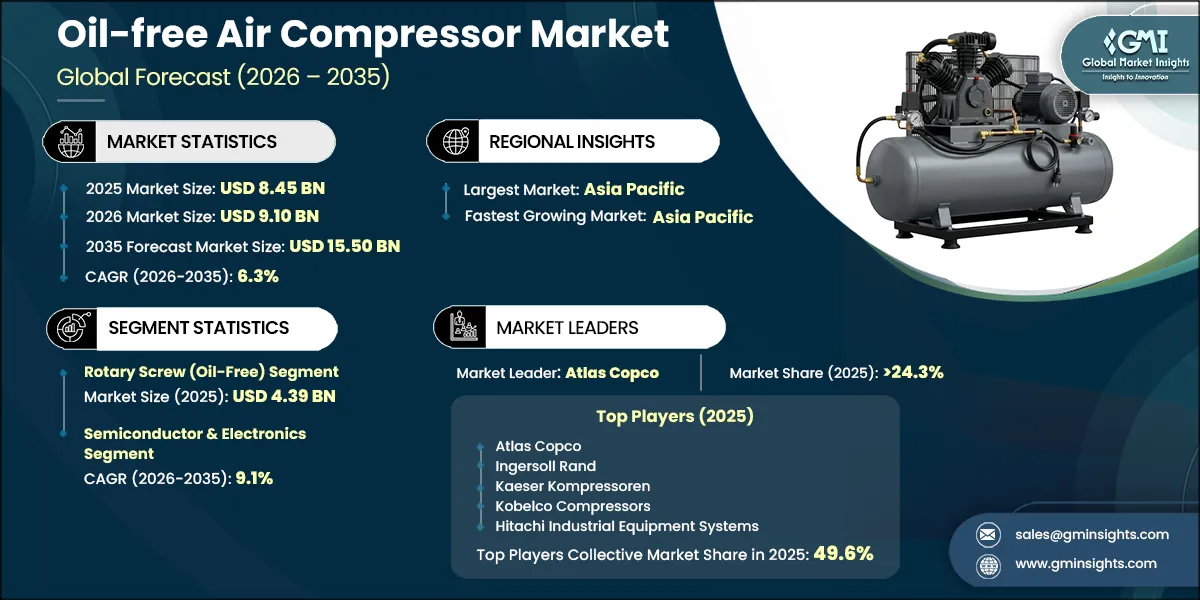
The oil-free air compressor market was valued at USD 8.45 billion in 2025, is projected to reach USD 9.10 billion in 2026, is expected to grow at a 6.3% CAGR (2026–2035), and is forecast to reach USD 15.50 billion by 2035.
The market is moving toward larger-capacity, technically advanced systems as contamination-critical manufacturing and utility applications gain weight in the demand mix. A 2025 average selling price of USD 51,800 per unit reflects the increasing penetration of variable-speed drive (VSD) and high-pressure centrifugal equipment, which lifts revenue intensity relative to unit shipments.
GMI Analyst View
Based on direct input from industry experts engaged in our primary research, the global oil-free air compressor market shipped approximately 163,100 units in 2025. We view this relationship between shipment volume and revenue as evidence of a technology-led market in which validated, high-purity systems command a meaningful premium over general industrial compressor categories.
Oil-free Air Compressor Market Trends, Growth Drivers & GMI Forecast Outlook
The oil-free air compressor market is being reshaped by new semiconductor and biologics capacity, energy-management obligations, and buyers' increasing preference for validated compressed-air systems. Growth remains concentrated in applications where air purity, uptime, energy performance, and documentation requirements influence equipment selection more directly than initial purchase price.
Key Drivers
Evidence anchors use cited external data; demand implications and forecast conditions represent GMI analysis.
Semiconductor capacity projects require compressed-air infrastructure that can maintain purity and flow stability across fabrication, packaging, and supporting cleanroom processes. This favors centrifugal and high-capacity oil-free rotary screw configurations, particularly where continuous-duty requirements make downtime, particulate risk, or oil carryover commercially unacceptable.
Biologics investment is widening the addressable base for qualified oil-free systems beyond conventional solid-dose production. Sterile filling, lyophilization, active pharmaceutical ingredient processing, and cleanroom pressurization each create distinct equipment and service opportunities, with documentation requirements reinforcing the value of established suppliers and certified product platforms.
The Energy Efficiency Directive is also changing replacement decisions in Europe by bringing compressed-air performance into broader industrial energy-management programs. Audit-led capital planning should favor equipment with controllable operating profiles, measurable efficiency gains, and service support capable of translating plant-level findings into investable replacement projects [2].
Key Restraints
Evidence anchors use cited external data; demand implications and forecast conditions represent GMI analysis.
For smaller and cost-sensitive operators, the investment case for oil-free equipment depends on confidence that energy savings and avoided contamination risk will justify the capital premium. Buyers in textile, light manufacturing, and smaller food-processing operations may therefore retain existing lubricated systems longer when electricity pricing or production visibility is unstable.
Regulatory pressure does not automatically convert into immediate compressor orders. Industrial operators must often allocate the same capital pool across HVAC, heating, lighting, motor systems, insulation, and process upgrades, creating sequencing risk for fleet renewal even when compressed air is identified as an efficiency priority.
Qualification requirements present a different constraint: they lengthen the interval between equipment selection and productive operation. In pharmaceutical, semiconductor, and medical environments, commissioning, documentation, verification, and process integration can delay installation decisions despite approved project budgets.
GMI Analyst View
We see the market dividing between contamination-critical applications, where oil-free specification is integral to operational risk control, and conventional industrial uses, where capital discipline remains decisive. Suppliers that connect equipment performance with validation support, energy-management outcomes, and dependable aftermarket execution should gain the strongest position in the higher-value demand pool.
Oil-free Air Compressor Market Segment Analysis
By Product Type
The oil-free air compressor market product mix reflects a widening divide between broad-use compressor platforms and specialized technologies designed around purity, capacity, noise, or maintenance constraints.
Rotary Screw (Oil-Free)
Rotary Screw (Oil-Free) generated USD 4.39 billion in 2025 and is expected to grow at a 6.2% CAGR (2026–2035). The category retains its leadership through operating flexibility across a wide flow and pressure range. VSD-equipped systems are particularly relevant to plants with fluctuating load profiles, while their serviceability and familiar installation footprint support replacement activity in food, pharmaceutical, electronics, and general high-purity manufacturing.
Centrifugal
Centrifugal compressors are forecast to generate USD 4.50 billion by 2035 and expand at a 6.7% CAGR (2026–2035). Continuous, high-volume applications increasingly favor centrifugal designs because their oil-free architecture and stable output align with the requirements of fabrication plants, large pharmaceutical facilities, and process-intensive operations. Their higher acquisition cost is more readily absorbed where lifecycle performance and uninterrupted air supply govern procurement.
Scroll
Scroll compressors generated USD 1.01 billion in 2025 and are projected to generate USD 1.75 billion by 2035. Compact form factors, low noise, and clean point-of-use performance support scroll adoption in laboratories, dental clinics, hospital systems, and small-format pharmaceutical facilities. The technology has a narrower power envelope than screw or centrifugal products, but this limitation reinforces its position in specialized, quality-sensitive niches.
Reciprocating (Oil-Free)
Reciprocating (Oil-Free) compressors are forecast to generate USD 498 million by 2035 and grow at a 1.7% CAGR (2026–2035). This category continues to lose relative relevance as buyers prioritize lower vibration, lower noise, and reduced maintenance intensity. Residual demand remains in portable systems, low-volume applications, and installations where initial cost carries more weight than lifecycle operating performance.
Others (Turbo, Diaphragm, Linear)
Others (Turbo, Diaphragm, Linear) generated USD 253 million in 2025 and are expected to advance at an 11.6% CAGR (2026–2035). Magnetic-bearing turbo, diaphragm, and linear technologies are gaining attention where the elimination of lubrication-related risk is central to the investment case. Their adoption remains selective, but semiconductor, pharmaceutical, and advanced industrial buyers are increasingly willing to evaluate these systems where reduced maintenance intervention and ultra-high purity can offset a premium price point.
By Application
Semiconductor & Electronics
Semiconductor & Electronics generated USD 1.52 billion in 2025 and is expected to grow at a 9.1% CAGR (2026–2035). The application's demand profile is defined by persistent purity requirements across wafer fabrication, photolithography, chemical mechanical planarization, packaging, and cleanroom support. New fab capacity favors equipment suppliers that can offer validated performance, large-flow capability, and responsive field service during construction and production-ramp phases.
Food & Beverage
Food & Beverage generated USD 1.43 billion in 2025 and is forecast to generate USD 2.36 billion by 2035. Compressed air that contacts food, packaging, or production surfaces is increasingly managed as a critical control point. Replacement demand is therefore supported by audit readiness, contamination prevention, and the need to modernize aging fixed-speed installations without disrupting tightly scheduled production environments.
Pharmaceutical & Biotech
Pharmaceutical & Biotech is forecast to generate USD 2.80 billion by 2035 and grow at a 7.6% CAGR (2026–2035). Biologics, peptide, sterile injectable, and fill-and-finish capacity additions are expanding the need for documented process utilities. Eli Lilly's USD 9 billion investment in an Indiana active pharmaceutical ingredient manufacturing site for tirzepatide illustrates the scale of pharmaceutical capacity investment supporting qualified utility infrastructure [4]. Demand extends beyond greenfield projects as contract manufacturers and established producers modernize validated systems.
Chemical & Petrochemical
Chemical & Petrochemical generated USD 1.09 billion in 2025 and is expected to grow at a 4.6% CAGR (2026–2035). Oil-free compressors serve instrument-air, pneumatic conveying, and process-air requirements where contamination can compromise catalyst performance or product quality. Demand remains tied to selective modernization and greenfield projects, rather than a broad-based replacement cycle, because alternative gas and process-compression solutions serve portions of the same operating base.
Automotive
Automotive generated USD 761 million in 2025 and is projected to generate USD 1.30 billion by 2035. Paint-shop operations and automated assembly systems create a clear need for clean compressed air, particularly where surface quality and robotic-tool reliability affect production yield. New electric-vehicle manufacturing programs and increasingly automated body-in-white lines provide an incremental demand layer, especially in Asia Pacific manufacturing clusters.
Healthcare
Healthcare is forecast to generate USD 1.27 billion by 2035 and expand at a 6.6% CAGR (2026–2035). Medical air pipelines, surgical tools, dental systems, respiratory-device testing, and laboratory utilities sustain demand for verified oil-free air. Growth is supported by hospital construction in emerging markets and modernization of aging medical infrastructure in established healthcare systems.
Oil & Gas
Oil & Gas generated USD 507 million in 2025 and is expected to grow at a 4.1% CAGR (2026–2035). The segment relies on clean instrument air for control systems in upstream, midstream, refinery, and petrochemical assets. Its demand is relatively durable because equipment reliability and process safety are critical, although expansion is linked more closely to industrial project activity than to broad commodity-market movements.
Textile
Textile is forecast to generate USD 601 million by 2035 and grow at a 3.6% CAGR (2026–2035). Air-jet weaving and yarn texturing remain the principal demand sources, but the application faces structural constraints from production migration, limited capital investment in mature manufacturing locations, and technology substitution in selected weaving processes. Suppliers must therefore compete on operating efficiency and service economics rather than volume growth alone.
Others
Others generated USD 674 million in 2025 and are projected to generate USD 1.05 billion by 2035. This category encompasses laboratory gas delivery, construction, field medical systems, environmental monitoring, and emerging industrial uses. Its diversity provides access to niche opportunities, though procurement patterns remain fragmented and more dependent on application-specific performance requirements than on a common investment cycle.
GMI Analyst View
We believe product selection is becoming increasingly application-led rather than technology-led. Centrifugal and premium rotary screw equipment are well placed in high-throughput specification markets, while scroll systems retain defensible niches where footprint and acoustic performance matter. Emerging turbo platforms signal a longer-term shift toward designs that reduce mechanical contamination pathways and maintenance exposure.
Oil-free Air Compressor Market Regional Analysis
North America Oil-free Air Compressor Market Analysis
The oil-free air compressor market in North America is forecast to generate USD 4.14 billion by 2035 and grow at a 5.8% CAGR (2026–2035). The region combines semiconductor fabrication investment, biologics manufacturing expansion, and a sizeable installed base approaching replacement age. FDA, food-safety, and medical-device compliance requirements support premium specification, while an established service ecosystem reinforces lifecycle revenue opportunities for global OEMs.
U.S.
The U.S. generated USD 1.77 billion in 2025 and is expected to grow at a 6.0% CAGR (2026–2035). Semiconductor and pharmaceutical capacity projects are creating concentrated demand for large oil-free systems, particularly in manufacturing clusters where fab construction and sterile-drug production are progressing simultaneously. Deep aftermarket coverage improves customer confidence in complex installations requiring fast response and validated service processes.
Canada
Canada is forecast to generate USD 551 million by 2035 and grow at a 4.5% CAGR (2026–2035). Food processing, dairy, meat, grain handling, and pharmaceutical manufacturing provide the core demand base. The market's more measured trajectory reflects a smaller advanced-manufacturing footprint and capital expenditure patterns that are influenced by resource-sector cycles.
Mexico
Mexico generated USD 237 million in 2025 and is projected to generate USD 424 million by 2035. Nearshoring of automotive, electronics, and light industrial production is increasing the use of quality-certified manufacturing systems. Export-oriented food and beverage facilities add a second layer of demand because compliance with North American customer and food-safety standards increasingly favors oil-free air specification.
Europe Oil-free Air Compressor Market Analysis
Europe generated USD 1.85 billion in 2025 and is expected to grow at a 4.8% CAGR (2026–2035). The region's mature installed base and existing penetration in regulated industries moderate expansion, but energy audits and replacement programs provide a durable source of demand. EU energy-efficiency obligations are encouraging manufacturers to assess compressed-air losses as part of wider capital planning, creating opportunities for VSD-led upgrades .
Germany
Germany generated USD 651 million in 2025 and is forecast to generate USD 1.06 billion by 2035. Precision engineering, chemical processing, pharmaceutical manufacturing, food production, and automotive operations create a technically demanding customer base. Germany's concentration of compressor manufacturers also supports product development, testing, application engineering, and a deeply established service infrastructure.
U.K.
The U.K. is forecast to generate USD 512 million by 2035 and grow at a 4.3% CAGR (2026–2035). Pharmaceutical manufacturing, medical-device production, and healthcare infrastructure sustain demand for high-specification systems. Procurement cycles for imported equipment can be extended, but the need for validated clean-air utilities continues to support replacement and project-based purchasing.
France
France generated USD 279 million in 2025 and is expected to grow at a 4.3% CAGR (2026–2035). Aerospace, pharmaceutical, food-processing, industrial-gas, and maintenance-intensive operations support a diversified demand base. Buyers are likely to emphasize reliability and lifecycle efficiency where equipment supports controlled production or high-consequence industrial processes.
Italy
Italy is forecast to generate USD 350 million by 2035, compared with USD 223 million in 2025. Northern Italy's concentration of food processing, precision engineering, and pharmaceutical contract manufacturing supports steady equipment demand. Cost sensitivity remains influential, making a documented operating-cost and compliance case central to accelerating replacement decisions.
Rest of Europe
Rest of Europe generated USD 371 million in 2025 and is projected to generate USD 609 million by 2035. Industrial modernization across Central and Eastern Europe, alongside food-export, automotive, and pharmaceutical investment in markets such as Poland, the Netherlands, Sweden, and Spain, broadens the regional opportunity. First-time oil-free installations are particularly relevant where manufacturers are upgrading facilities to meet higher export and process-quality standards.
Asia Pacific Oil-free Air Compressor Market Analysis
Asia Pacific generated USD 3.21 billion in 2025 and is forecast to generate USD 6.48 billion by 2035. The region contains an exceptional concentration of semiconductor capacity, pharmaceutical manufacturing, food processing, electronics assembly, and healthcare infrastructure investment. This combination makes Asia Pacific the most consequential market for suppliers balancing premium high-purity offerings with competitively positioned systems for expanding industrial customers.
China
China generated USD 1.44 billion in 2025 and is expected to grow at a 7.1% CAGR (2026–2035). Semiconductor investment, biosimilar manufacturing, export-oriented pharmaceutical production, and electronics manufacturing underpin demand. International suppliers remain relevant in premium Class 0 applications, while domestic manufacturers exert pricing pressure in less demanding industrial segments.
Japan
Japan is forecast to generate USD 719 million by 2035 and grow at a 4.1% CAGR (2026–2035). A mature installed base and slower domestic industrial expansion constrain volume growth, but semiconductor equipment, precision manufacturing, and local technology leadership sustain demand for sophisticated systems. The presence of major domestic suppliers also supports continued application engineering and product development activity.
India
India is expected to grow at an 11.1% CAGR (2026–2035) and generate USD 1.10 billion by 2035. Domestic manufacturing initiatives, expanding hospital infrastructure, pharmaceutical investment, electronics assembly, and food-processing modernization are widening the customer base. The market is attractive not only because of project growth, but because new facilities are more likely to specify quality-certified compressed-air systems at the outset.
South Korea
South Korea is forecast to generate USD 699 million by 2035, compared with USD 353 million in 2025. Its semiconductor industry creates ongoing demand for large-format centrifugal and rotary screw systems that can support stringent fabrication environments. AI-memory and advanced semiconductor capacity additions strengthen the opportunity for suppliers with proven cleanroom references and reliable project-execution capability.
Australia
Australia generated USD 161 million in 2025 and is expected to grow at a 5.1% CAGR (2026–2035). Food and beverage processing, pharmaceutical manufacturing, mining-related operations, and healthcare construction underpin demand. Regulation and quality assurance support oil-free adoption in controlled manufacturing environments, while the dispersed industrial footprint elevates the importance of service availability.
Rest of Asia Pacific
Rest of Asia Pacific generated USD 385 million in 2025 and is expected to grow at an 8.1% CAGR (2026–2035). Southeast Asian electronics assembly, pharmaceutical manufacturing, food-processing expansion, and industrial investment are supporting a diversified growth profile. Singapore and Malaysia offer high-purity pharmaceutical opportunities, while Vietnam, Thailand, and Indonesia broaden demand for electronics and export-oriented production systems.
Latin America Oil-free Air Compressor Market Analysis
Latin America is forecast to generate USD 931 million by 2035, compared with USD 507 million in 2025. Food processing, pharmaceutical production, mining, and petrochemical industries are the principal demand anchors. Imported equipment exposure and currency volatility remain meaningful purchase barriers, which makes localized support, financing structures, and lifecycle-cost justification important competitive differentiators.
Brazil
Brazil generated USD 279 million in 2025 and is projected to generate USD 546 million by 2035. Pharmaceutical generics production and large-scale food and beverage processing provide two durable demand streams. Export-oriented facilities have stronger incentives to maintain documented air quality and predictable production uptime, supporting investment in premium oil-free systems.
Argentina
Argentina is forecast to generate USD 148 million by 2035 and grow at a 3.9% CAGR (2026–2035). Macroeconomic volatility and constrained capital availability limit equipment investment cycles. Pharmaceutical manufacturing offers the most resilient demand source, although buyers are likely to prioritize financing flexibility and long service life when making replacement decisions.
Rest of Latin America
Rest of Latin America generated USD 127 million in 2025 and is expected to grow at a 6.4% CAGR (2026–2035). Mining, food exports, pharmaceutical manufacturing, and industrial modernization across Chile, Colombia, Peru, and other markets support growth. Demand remains fragmented, favoring suppliers that can combine regional channel coverage with application support in sectors subject to production-quality requirements.
Middle East & Africa Oil-free Air Compressor Market Analysis
Middle East & Africa generated USD 507 million in 2025 and is forecast to generate USD 977 million by 2035. Hydrocarbon downstream operations, petrochemical investment, hospital construction, food processing, and pharmaceutical manufacturing are diversifying regional demand. The market's growth potential is increasingly linked to industrial-development strategies that broaden requirements beyond conventional instrument-air applications.
Saudi Arabia
Saudi Arabia is expected to grow at a 7.6% CAGR (2026–2035) and generate USD 263 million by 2035. Industrial diversification is increasing demand from pharmaceutical, food-processing, aerospace, and advanced-manufacturing projects alongside established downstream energy activity. This shift favors suppliers able to support specification-driven customers with engineered solutions and local service capacity.
UAE
The UAE generated USD 101 million in 2025 and is forecast to generate USD 200 million by 2035. Pharmaceutical free-zone manufacturing, logistics-linked food operations, and industrial diversification in Abu Dhabi and Dubai are supporting demand. Buyers increasingly require documented performance and service responsiveness to support regulated manufacturing and regional distribution operations.
South Africa
South Africa generated USD 76 million in 2025 and is expected to grow at a 5.6% CAGR (2026–2035). Pharmaceutical production, food and beverage processing, mining, and established industrial operations form the market's core. Equipment reliability and aftermarket support are particularly relevant where plant availability is constrained by infrastructure and operating-cost pressures.
Rest of Middle East & Africa
Rest of Middle East & Africa generated USD 203 million in 2025 and is expected to grow at a 6.5% CAGR (2026–2035). Pharmaceutical and food-processing investment in Egypt, healthcare expansion in Nigeria, and industrial development in Morocco and other markets contribute to a broad but uneven opportunity set. Channel strength and the ability to tailor offerings to varying project-finance and service conditions will influence supplier performance.
GMI Analyst View
We consider Asia Pacific the central strategic battleground because its demand combines scale, advanced manufacturing, and uneven national development paths. India's expansion and Southeast Asia's industrial investment contrast with Japan's replacement-led profile, while Middle Eastern diversification is creating a more sophisticated base of non-hydrocarbon applications for oil-free systems.
Oil-free Air Compressor Market Share & Competitive Landscape
The Oil-free Air Compressor Market share structure is moderately concentrated at the premium end, where the top five suppliers collectively held approximately 49.6% of global revenue in 2025. Competitive advantage depends on technology breadth, certification capability, installed-base service coverage, application engineering, and the ability to support qualification-intensive customers through the full equipment lifecycle.
Atlas Copco AB
Atlas Copco held a 24.3% market share in 2025 and generated USD 2.05 billion in oil-free air compressor revenue.
Its broad Class 0 portfolio across rotary screw, centrifugal, scroll, and low-pressure systems positions the company strongly in premium applications. Global service coverage and established food, pharmaceutical, and electronics references reinforce its ability to capture both new equipment and aftermarket value.
Ingersoll Rand Inc.
Ingersoll Rand held a 15.4% market share in 2025 and generated USD 1.30 billion in oil-free air compressor revenue.
The company competes through its oil-free screw platform, lifecycle service capabilities, connected monitoring, and acquisitions in adjacent flow technologies. Its positioning is strengthened where customers seek integrated air-treatment, gas-generation, and compressor solutions rather than stand-alone equipment.
Kaeser Kompressoren SE
Kaeser Kompressoren held a 5.7% market share in 2025 and generated USD 481 million in oil-free air compressor revenue.
The company's engineering reputation, European service presence, and compressed-air audit capabilities align with demand from industrial customers undertaking energy-efficiency upgrades. Its in-house component expertise also supports positioning in quality-sensitive pharmaceutical, food, and industrial applications.
Kobelco Compressors Corporation
Kobelco specializes in oil-free scroll and centrifugal technologies for semiconductor, pharmaceutical, food-processing, and other high-purity environments. Its long-standing relationships in Japanese semiconductor manufacturing and process expertise support a focused position in applications where equipment reliability and contamination control are central to qualification.
Hitachi Industrial Equipment Systems Co. Ltd
Hitachi Industrial Equipment Systems offers oil-free scroll, screw, and centrifugal systems supported by broader industrial automation and energy-management capabilities within the Hitachi Group. This integration can strengthen its proposition where predictive maintenance, connected operations, and equipment coordination influence buying decisions.
ELGi Equipments Ltd
ELGi has expanded its oil-free portfolio into international markets through product investment and distribution development. Its competitive approach emphasizes value-conscious customers in pharmaceutical, food, textile, and industrial applications that seek credible lifecycle performance without the pricing structure of the largest premium suppliers.
BOGE Kompressoren GmbH & Co. KG
BOGE competes in European mid-market oil-free screw and scroll applications with close-integration service and application support. Its position is relevant among SMEs that must reconcile energy-efficiency investment requirements with constrained capital budgets.
Aerzener Maschinenfabrik GmbH (Aerzen)
Aerzen's product base in blowers, screw compressors, wastewater aeration, pneumatic conveying, and process applications gives it access to industrial customers with complex air-handling needs. Its DS series expansion broadens the company's oil-free offering for regulated and energy-sensitive manufacturing settings.
Anest Iwata Corporation
Anest Iwata is established in oil-free reciprocating, scroll, and rotary screw systems for medical, dental, pharmaceutical, food, and electronics applications. Its specialization in medical and dental compressed air supports a defensible role in smaller, quality-critical installations that may be less central to broad-line industrial suppliers.
FS-Elliott Co. LLC
FS-Elliott focuses on oil-free centrifugal compressor packages for large-volume industrial process air. Its affiliation with Mitsubishi Heavy Industries provides engineering depth and supports participation in petrochemical, power, steel, and process-industry projects requiring high-capacity systems.
Mitsubishi Heavy Industries Compressor International Corp.
Mitsubishi Heavy Industries Compressor International provides centrifugal and screw solutions for large utility and process applications. Its project-execution capabilities and experience in energy, infrastructure, and petrochemical markets support participation in complex installations where technical integration is a core procurement consideration.
Denair Energy Saving Technology
Denair serves price-sensitive industrial customers in Asia Pacific and emerging markets with oil-free screw and centrifugal systems. The company's competitive relevance is strongest in applications where adequate technical performance and accessible pricing outweigh the service-network advantages of international premium brands.
Mitsui Seiki Kogyo Co. Ltd
Mitsui Seiki serves semiconductor and precision-manufacturing customers with high-precision compressor and vacuum technologies. Its supply-chain relationships and focus on specification-driven applications provide insulation from purely price-led competition.
Tamturbo Oy
Tamturbo develops magnetic-bearing turbo-compressors designed to eliminate oil contact and reduce maintenance demands. The company represents an emerging technology-oriented competitive force in applications where contamination-risk reduction, partial-load efficiency, and extended service intervals justify a specialized equipment proposition.
Recent Industry Developments
Aerzener Maschinenfabrik GmbH introduced its DS series of double-stage oil-free screw compressors in March 2025. The product line is certified to ISO 8573-1 Class 0 across its operating range and is intended for food and beverage, chemical, pharmaceutical, and medical applications; the company states that the design can provide energy savings of up to 12% compared with best-performing existing models in the same class [6].
In July 2025, Ingersoll Rand announced the acquisition of Termomeccanica Industrial Compressors S.p.A. and its subsidiary Adicomp S.p.A. for approximately €160 million. The transaction expands its engineered compressor and renewable natural gas capabilities while adding manufacturing and commercial reach in Europe, the Americas, and India [7].
Need a specific section of this report?
Purchase regional analysis, country-level analysis, company profiles, or any other segment-level insights separately
based on your research needs.