Report Content
Chapter 1. Methodology and Scope
1.1 Market Scope and Definitions
1.2 Research Design
1.2.1 Research Approach
1.2.2 Data Collection Methods
1.3 Data Mining Sources
1.3.1 Global
1.3.2 Regional/Country
1.4 Base Estimates and Calculations
1.4.1 Base Year Calculation
1.4.2 Key Trends for Market Estimation
1.5 Primary Research and Validation
1.5.1 Primary Sources
1.6 Forecast Model
1.7 Research Assumption and Limitations
Chapter 2. Executive Summary
2.1 Industry 360° Synopsis
Chapter 3. Industry Insights
3.1 Industry Ecosystem Analysis
3.2 Industry Impact Forces
3.2.1 Growth Drivers
3.2.1.1 Rising Demand for Lyophilized Products
3.2.1.2 Technological Advancements in Lyophilization Technique
3.2.1.3 Rapid Expansion of Pharmaceutical and Food Industry
3.2.1.4 Growing Demand for Superior Products with Longer Shelf Life and Stability
3.2.2 Industry Pitfalls and Challenges
3.2.2.1 High Setup and Maintenance Cost of Freeze-Drying Equipment
3.2.2.2 Lack of Skilled Workforce
3.3 Growth Potential Analysis
3.4 Regulatory Landscape
3.5 Trump Administration Tariffs
3.5.1 Impact on Trade
3.5.1.1 Trade Volume Disruptions
3.5.1.2 Country-Wise Response
3.5.2 Impact on the Industry
3.5.2.1 Supply-Side Impact (Cost of Manufacturing)
3.5.2.1.1 Price Volatility in Key Materials
3.5.2.1.2 Supply Chain Restructuring
3.5.2.1.3 Production Cost Implications
3.5.2.2 Demand-Side Impact (Cost to Consumers)
3.5.2.2.1 Price Transmission to End Markets
3.5.2.2.2 Market Share Dynamics
3.5.2.2.3 Consumer Response Patterns
3.5.3 Key Companies Impacted
3.5.4 Strategic Industry Responses
3.5.4.1 Supply Chain Reconfiguration
3.5.4.2 Pricing and Product Strategies
3.5.4.3 Policy Engagement
3.5.5 Outlook and Future Considerations
3.6 Technological Landscape
3.7 Future Market Trends
3.8 Gap Analysis
3.9 Porter's Analysis
3.10 PESTEL Analysis
Chapter 4. Competitive Landscape, 2024
4.1 Introduction
4.2 Company Market Share Analysis
4.3 Company Matrix Analysis
4.4 Competitive Analysis of Major Market Players
4.5 Competitive Positioning Matrix
4.6 Strategy Dashboard
Chapter 5. Market Estimates and Forecast, By Product, 2021–2034 ($ Mn)
5.1 Key Trends
5.2 Devices
5.2.1 Tray-Style Freeze Dryers
5.2.2 Manifold Freeze Dryers
5.2.3 Rotary Freeze Dryers
5.3 Consumables
5.3.1 Lyoguard Trays
5.3.2 Manifolds and Vial Holders/Adapters
5.3.3 Vacuum Pumps
5.3.4 Product Sensors and Temperature Probes
5.3.5 Pouches
5.3.5.1 Polyethylene Terephthalate (PET)
5.3.5.2 Polyethylene (PE)
5.3.5.3 Foil
5.3.6 Other Consumables
Chapter 6. Market Estimates and Forecast, By Scale of Operation, 2021–2034 ($ Mn)
6.1 Key Trends
6.2 Bench-Top Lyophilization Equipment
6.3 Pilot-Scale Lyophilization Equipment
6.4 Industrial-Scale Lyophilization Equipment
Chapter 7. Market Estimates and Forecast, By Application, 2021–2034 ($ Mn)
7.1 Key Trends
7.2 Autoimmune Diseases
7.3 Respiratory Diseases
7.4 Gastrointestinal Disorders
7.5 Oncology
7.6 Cardiovascular Diseases
7.7 Infectious Diseases
7.8 Metabolic Disorders
7.9 Other Applications
Chapter 8. Market Estimates and Forecast, By Industry, 2021–2034 ($ Mn)
8.1 Key Trends
8.2 Pharmaceutical
8.3 Biotechnology
8.4 Biomedical
8.5 Food Processing
8.6 Other Industries
Chapter 9. Market Estimates and Forecast, By Region, 2021–2034 ($ Mn)
9.1 Key Trends
9.2 North America
9.2.1 U.S.
9.2.2 Canada
9.3 Europe
9.3.1 Germany
9.3.2 UK
9.3.3 France
9.3.4 Spain
9.3.5 Italy
9.3.6 Netherlands
9.4 Asia Pacific
9.4.1 China
9.4.2 Japan
9.4.3 India
9.4.4 Australia
9.5 Latin America
9.5.1 Brazil
9.5.2 Mexico
9.5.3 Argentina
9.6 Middle East and Africa
9.6.1 South Africa
9.6.2 Saudi Arabia
9.6.3 UAE
Chapter 10. Companies Profiled
10.1 ATS
10.2 Azbil
10.3 Buchi
10.4 Cuddon
10.5 GEA Group Aktiengesellschaft
10.6 HOF Sonderanlagenbau
10.7 IlShin BioBase
10.8 Labconco
10.9 MechaTech Systems
10.10 Millrock Technology
10.11 Optima
10.12 W. L. Gore & Associates
10.13 ZIRBUS Technology



Lyophilization Equipment Market Size
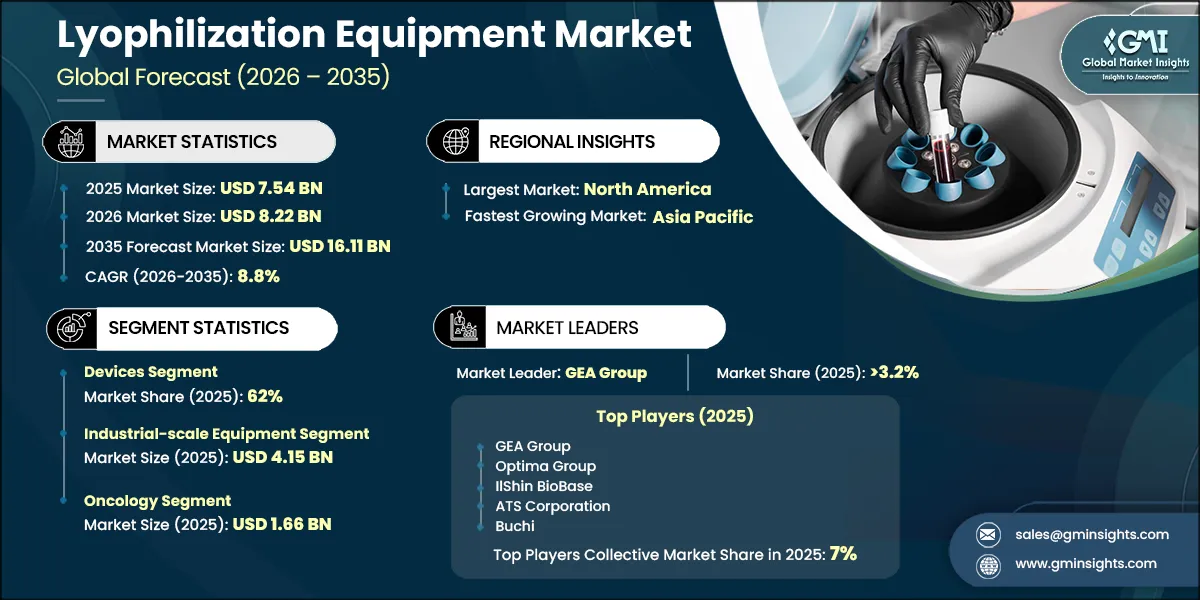
The lyophilization equipment market was valued at USD 7.54 billion in 2025, with revenue projected to reach USD 8.22 billion in 2026, expanding at an 8.8% CAGR over 2026–2035 to USD 16.11 billion by 2035.
The lyophilization equipment market combines capital systems and recurring consumables purchased by pharmaceutical, biotechnology, biomedical, and food-processing end users. Its evolution is increasingly shaped by biologic pipeline commercialization, sterile-manufacturing compliance upgrades, and the need to protect product stability from development through commercial fill-finish operations.
GMI Analyst View
Our interactions with equipment procurement managers and biologics manufacturing teams indicate that the global lyophilization equipment market reached approximately USD 7.0 billion in 2024 a milestone that reflects how consistently pharmaceutical and biotech capital budgets have prioritized freeze-drying infrastructure even through periods of broader industry cost pressure. The pace at which manufacturers have continued to commit to lyophilization capacity signals a conviction that this technology is non-negotiable for the next generation of biologic, biosimilar, and sensitive injectable pipelines.
Lyophilization Equipment Market Trends, Growth Drivers & GMI Forecast Outlook
Biosimilar commercialization, outsourced sterile manufacturing, and regulatory expectations are raising the value of validated freeze-drying capacity. Demand is strongest where operators require reliable process transfer, automated aseptic handling, and reproducible performance, while energy use, facility cost, and specialist capability constrain the addressable buyer base.
Key Drivers
Biosimilar approvals translate into equipment demand because commercial launch readiness depends on validated sterile capacity, not simply on product authorization. Suppliers that can shorten qualification cycles, maintain repeatable thermal profiles, and support transfer from development to commercial operations are therefore positioned to benefit as programs move from approval into sustained production. The approval environment also supports replacement decisions when existing lines cannot meet new throughput or containment expectations.
CDMO investment is particularly consequential because new sterile fill-finish installations bring a defined set of equipment requirements before contracted production can begin. Freeze-dryers, isolators, loading systems, controls, and consumables are purchased as an integrated operating capability rather than as discretionary stand-alone assets. GEA's expansion of pharmaceutical technology capability illustrates how suppliers are preparing to serve this more demanding project pipeline.[4]
Annex 1 has changed the commercial logic of installed equipment. Older systems may remain mechanically serviceable but become less attractive when they require extensive intervention, monitoring, or containment upgrades to sustain a defensible compliance posture. This favors equipment platforms that combine automation, documentation integrity, and compatibility with validated aseptic workflows.
Key Restraints
Freeze-drying imposes a difficult operating-cost profile because refrigeration, vacuum generation, and cycle control must remain stable throughout lengthy production runs. Efficiency features can improve the economics of established operators, but smaller facilities must still weigh the cost of optimized systems and their supporting infrastructure against the alternative of outsourced manufacturing [5].
The capital hurdle extends beyond the freeze-dryer itself. Commercial deployment requires suitable cleanrooms, utilities, automation, containment, validation, and a quality system capable of maintaining inspection readiness. That requirement directs procurement toward larger pharmaceutical manufacturers and well-capitalized CDMOs, while limiting the number of organizations that can justify an in-house line [6].
Process expertise is an additional constraint because formulation behavior, primary drying, secondary drying, and control strategy must be developed together. A platform with sophisticated automation still requires qualified personnel who can establish robust recipes and transfer them across scales. This makes process-development support and service capability important purchasing criteria, especially for new entrants.
*Evidence anchors use cited external data; demand implications and forecast conditions represent GMI analysis.*
GMI Analyst View
We see the market increasingly rewarding suppliers that reduce qualification risk rather than merely offering lower initial equipment prices. As outsourced sterile manufacturing expands, buyers are prioritizing platforms that can accommodate multiple client programs, preserve process knowledge through transfer, and support an audit-ready operating model without repeated reconfiguration.
Lyophilization Equipment Market Segment Analysis
By Product
Devices represented 62.0% of the market in 2025, while consumables accounted for 38.0%. The lyophilization equipment market's product mix reflects two complementary buying cycles: equipment purchases tied to capacity projects and replacement programs, and consumable demand tied to operating throughput, contamination control, and routine maintenance.
Tray-style lyophilizers generated USD 2.64 billion in 2025 and are projected to reach USD 5.64 billion by 2035. Their role in commercial pharmaceutical and biotechnology production derives from high usable shelf area, compatibility with automated loading and unloading, and a well-established regulatory reference base. These attributes make tray systems the preferred configuration where batch scale, repeatability, and aseptic integration are central to the investment case.
Manifold lyophilizers held a 15.0% share in 2025 and are projected to reach USD 2.42 billion by 2035. Manifold systems remain important in laboratories, early-stage development, diagnostics, and specialty applications where vessel flexibility and smaller batch formats outweigh the throughput advantages of tray configurations. Their demand is closely linked to research intensity and the number of programs requiring formulation screening or small-volume processing.
Rotary lyophilizers generated USD 905.2 million in 2025 and are projected to account for 12.0% of the market by 2035. Their application is more specialized, including food, nutraceutical, botanical, and particulate-material processing where tumbling can promote uniform drying behavior. The segment's positioning is shaped by product format and material-handling requirements rather than direct substitution with high-volume sterile tray systems.
Lyoguard trays generated USD 905.2 million in 2025 and are projected to reach USD 1.93 billion by 2035. Single-use containment formats are commercially important because they can reduce direct product contact, simplify transfer handling, and support cleaning-validation strategies. Their revenue is tied to batch activity and therefore provides a recurring demand stream that is less dependent on the timing of large equipment purchases.
Manifolds and vial holders held an 8.0% share in 2025 and are projected to reach USD 1.29 billion by 2035. These components support pilot, bench-top, academic, and development-scale use cases, where frequent configuration changes and replacement needs are common. Their demand profile benefits from the breadth of clinical-development and diagnostic workflows rather than from a narrow set of large capital projects.
Vacuum pumps generated USD 528.0 million in 2025 and are projected to hold a 7.0% share by 2035. Pumps are essential to cycle performance and operate under sustained mechanical demands, creating service, replacement, and upgrade opportunities across the installed base. The shift toward lower-contamination and more tightly controlled pharmaceutical environments further supports demand for systems aligned with stringent operating requirements.
Sensors held a 4.0% share in 2025 and are projected to reach USD 644.3 million by 2035. As operators place greater emphasis on endpoint determination, shelf uniformity, and process documentation, measurement hardware becomes more integral to platform differentiation. Sensor demand consequently rises with the sophistication of process analytical technology and the need to substantiate control of critical process conditions.
Pouches made of PET, PE, or foil generated USD 377.2 million in 2025 and are projected to hold a 5.0% share by 2035. These formats support specialized containment and packaging needs in food, nutraceutical, diagnostic, and selected pharmaceutical applications. Their commercial relevance depends on material compatibility, barrier performance, and the operational convenience they provide in lower-volume or nontraditional freeze-drying workflows.
Other consumables held a 2.0% share in 2025 and are projected to reach USD 322.1 million by 2035. This category captures accessories whose value is dispersed across the installed base but remains necessary for routine operation, validation, and maintenance. Its demand follows overall utilization, reinforcing the consumables contribution even when new-system orders are uneven.
By Scale
Industrial-scale equipment generated USD 4.15 billion in 2025 and is projected to hold a 55.0% share by 2035. Commercial sterile manufacturing is the decisive demand center at this scale. Investments typically require integrated loading, cleaning, sterilization, automation, and documentation capabilities, making the procurement decision closely connected to facility design, regulatory qualification, and long-term capacity planning.
Pilot-scale systems held a 25.0% share in 2025 and are projected to reach USD 4.03 billion by 2035. Pilot units provide the operational bridge between formulation development and commercial manufacturing. They are particularly valuable to CDMOs and emerging biotechnology companies because robust scale-up knowledge can reduce costly redevelopment and transfer risk before a product reaches larger production assets.
Bench-top systems generated USD 1.51 billion in 2025 and are projected to reach USD 3.22 billion by 2035. Demand is anchored in academic laboratories, hospital pharmacies, diagnostic development, and early-stage biotechnology settings. These systems serve as accessible entry points for feasibility work, cycle development, and small-batch requirements before programs progress into more capital-intensive scales.
By Application
Oncology generated USD 1.66 billion in 2025 and is projected to expand at a 9.4% CAGR (2026–2035). Complex oncology biologics, including sensitive injectable products, support demand for reliable freeze-drying and reconstitution performance. The application's commercial urgency can compress manufacturing qualification schedules as developers move therapies from clinical programs into broader availability.
Autoimmune applications are projected to reach USD 3.06 billion by 2035 and held an 18.0% share in 2025. The installed commercial base for inflammatory and immune-mediated therapies provides a durable demand foundation. Biosimilar competition also broadens the number of manufacturers requiring qualified sterile capacity for products that must meet comparable stability and quality expectations.
Infectious diseases held a 15.0% share in 2025 and are projected to account for 14.0% by 2035. The relative mix change reflects normalization after elevated pandemic-era investment rather than a disappearance of need. Vaccines, antibiotics, antivirals, and diagnostic materials continue to require stable formulations, but the segment is moving toward a more routine procurement pattern.
Cardiovascular applications are projected to reach USD 1.77 billion by 2035 and are expected to grow at a 7.7% CAGR (2026–2035). This segment is supported by established product categories where long shelf life and reconstitution remain important. Its comparatively measured pace reflects mature treatment portfolios and investment that is more dependent on volume expansion and replacement demand than on the creation of entirely new modalities.
Respiratory applications generated USD 754.4 million in 2025 and are projected to hold a 10.0% share by 2035. Demand is supported by biologic therapies and diagnostic products that require stable delivery formats. Broader access to specialty respiratory treatment and the operational need for reliable reconstitution sustain equipment and consumable requirements in this application.
Metabolic applications are projected to reach USD 1.29 billion by 2035 and held an 8.0% share in 2025. The segment is influenced by peptide, enzyme, and other sensitive therapies for which stability requirements can favor lyophilized presentations. Development pipelines, rather than current liquid-formulation preferences alone, will determine the extent to which new products convert into freeze-drying demand.
GI disorder applications held a 7.0% share in 2025 and are projected to reach USD 1.13 billion by 2035. Inflammatory bowel disease and related biologic therapies provide the principal commercial foundation. The value of lyophilization lies in enabling stable, sterile product formats that can support distribution and administration needs across a growing specialty-care population.
Other applications accounted for USD 603.5 million in 2025 and are projected to hold an 8.0% share by 2035. Veterinary biologics, diagnostics, nutraceuticals, and emerging advanced-therapy workflows widen the market beyond major therapeutic categories. These uses diversify demand but often involve different batch scales, qualification expectations, and purchasing behavior from commercial pharmaceutical manufacturing.
By Industry
Pharmaceutical end users generated USD 3.39 billion in 2025 and are projected to account for 43.0% of the market by 2035. Sterile injectable portfolios, branded generics, and established manufacturing networks keep pharmaceutical companies central to large-system demand. The change in mix reflects faster investment elsewhere, not a withdrawal of pharmaceutical capital expenditure from lyophilization capability.
Biotechnology is projected to reach USD 5.32 billion by 2035 and held a 30.0% share in 2025. Biotechnology demand is shaped by the commercialization of biologics, outsourcing by capital-constrained developers, and the need to establish scalable manufacturing strategies early in a program's life. This makes development-to-commercial transfer capability a material differentiator for equipment suppliers.
Biomedical applications generated USD 905.2 million in 2025 and are projected to hold a 12.0% share by 2035. Diagnostic reagents, clinical laboratory materials, and hospital compounding create demand for smaller and more flexible freeze-drying formats. Procurement is influenced by product stability and workflow reliability rather than by the large-capacity requirements of commercial drug manufacturing.
Food processing is projected to reach USD 1.29 billion by 2035 and held an 8.0% share in 2025. Premium food ingredients, instant beverages, specialty nutrition, and nutraceutical products support industrial food freeze-drying investment. Buyers in this sector emphasize throughput, product quality, energy efficiency, and format differentiation, resulting in a demand profile distinct from regulated sterile pharmaceutical operations.
Other industries held a 5.0% share in 2025 and are projected to expand at a 5.5% CAGR (2026–2035). Agricultural, specialty-research, and industrial applications provide incremental demand but have fewer of the regulatory and biologics-pipeline catalysts supporting pharmaceutical-oriented categories. Their purchasing patterns are consequently more exposed to project economics and specialized end-market conditions.
GMI Analyst View
We expect the most resilient segment opportunities to arise where equipment selection and recurring operating consumption reinforce one another. Industrial systems remain essential to commercial capacity, but pilot platforms increasingly influence supplier choice earlier in the customer lifecycle, while single-use containment and process-monitoring consumables benefit as utilization of validated lines rises.
Lyophilization Equipment Market Regional Analysis
North America Lyophilization Equipment Market Analysis
North America generated USD 2.64 billion in lyophilization equipment revenue in 2025 and is projected to represent 30.0% of the global market by 2035. The lyophilization equipment market in North America is supported by a dense network of pharmaceutical manufacturers, biotechnology companies, and CDMOs. Demand centers on sterile injectables, biologics, and capacity modernization, with project decisions increasingly influenced by supply-chain resilience and qualification readiness.
U.S.
The U.S. generated USD 2.41 billion in 2025 and is projected to account for 91.3% of North American revenue by 2035. The U.S. market benefits from domestic CDMO expansion, a substantial innovator and biosimilar pipeline, and a deep base of regulated sterile manufacturing. Reshoring priorities strengthen the commercial case for new and upgraded domestic capacity, while established sites create an ongoing service and replacement opportunity.
Canada
Canada held an 8.6% share of North American revenue in 2025 and is projected to reach USD 417.2 million by 2035. Canadian demand is concentrated around biologics manufacturing activity and development-stage capacity, particularly in established life-sciences corridors. Public support for domestic biomanufacturing can improve the investment environment, although the market remains more project-driven than the United States.
Europe Lyophilization Equipment Market Analysis
Europe is projected to reach USD 4.19 billion by 2035 and held a 28.0% share in 2025. Europe's market is strongly shaped by the installed base of sterile manufacturing assets and the compliance demands associated with Annex 1. This creates simultaneous demand for new platforms, automation upgrades, retrofit assessment, and validation support, especially where legacy operations require a more robust contamination-control strategy.
Germany
Germany generated USD 527.0 million in 2025 and is projected to hold a 24.9% share of European revenue by 2035. Germany occupies both a demand-side and supply-side position, with pharmaceutical manufacturing operations alongside specialist equipment providers. Its market benefits from engineering capability, a sizable regulated production base, and investment in systems that combine containment, automation, and process-control sophistication.
UK
The UK is projected to reach USD 747.5 million by 2035 and held a 17.9% share in 2025. Contract manufacturing, innovator production, and closely aligned GMP expectations sustain UK demand. Buyers place value on platforms that facilitate reliable process transfer and can support both domestic operations and internationally supplied products.
France
France generated USD 301.7 million in 2025 and is projected to account for 14.3% of European revenue by 2035. The French market is supported by biologics and vaccine manufacturing, where lyophilized formats require dependable sterile fill-finish operations. Recurring consumable and service needs complement periodic replacement demand from large installed production facilities.
Italy
Italy is projected to reach USD 597.8 million by 2035 and held a 14.3% share in 2025. Italy's pharmaceutical sector includes generic, specialty, and export-oriented producers that increasingly require flexible sterile manufacturing infrastructure. Customized equipment configurations can be particularly relevant where manufacturers serve specialized product portfolios or smaller commercial batches.
Spain
Spain generated USD 226.3 million in 2025 and is projected to hold a 10.7% share of European revenue by 2035. Domestic pharmaceutical manufacturing and export-oriented production underpin Spanish demand. Growing CDMO activity can expand the need for validated capacity as providers seek to serve biotechnology clients that require reliable European sterile-manufacturing access.
Netherlands
The Netherlands is projected to reach USD 298.9 million by 2035 and held a 7.1% share in 2025. The country's logistics role and position within the European pharmaceutical ecosystem support demand for commercial fill-finish operations. Equipment investment is tied to distribution-oriented manufacturing, international supply-chain coordination, and a continued focus on compliant production capacity.
Rest of Europe
Rest of Europe held a 10.7% share in 2025 and is projected to reach USD 454.5 million by 2035. This group includes markets with meaningful pharmaceutical production and specialty biologics activity. Demand varies by national manufacturing footprint, but compliance upgrades and the need for internationally acceptable GMP standards provide a common investment rationale.
Asia Pacific Lyophilization Equipment Market Analysis
Asia Pacific held a 26.0% share in 2025 and is projected to represent 32.0% by 2035. The lyophilization equipment market in Asia Pacific is being reshaped by domestic biologics manufacturing, export-oriented CDMO development, and broader alignment with international quality expectations. The region's share gain reflects a structural expansion of qualified production capacity rather than a purely cyclical increase in equipment buying.
China
China generated USD 905.2 million in 2025 and is projected to account for 46.2% of Asia Pacific revenue by 2035. China's demand is propelled by domestic biologics commercialization, expanding contract manufacturing capability, and efforts to strengthen local pharmaceutical supply. Greater alignment with internationally recognized quality practices raises the value of automated, documented, and GMP-compatible lyophilization systems.
Japan
Japan is projected to reach USD 1.19 billion by 2035 and held a 23.1% share in 2025. Japan's established pharmaceutical base supports continuing investment in biologics, plasma-derived therapies, and vaccine manufacturing. Mature quality standards and a preference for dependable process performance favor suppliers with strong validation, service, and process-development credentials.
India
India held a 15.4% share of Asia Pacific revenue in 2025 and is projected to reach USD 793.8 million by 2035. India's position in generics and biosimilars creates a clear need for equipment capable of supporting regulated-market supply. CDMOs and integrated manufacturers can benefit from systems that satisfy international customer expectations while maintaining viable project economics.
Australia
Australia generated USD 150.9 million in 2025 and is projected to represent 7.6% of Asia Pacific revenue by 2035. Australia combines a smaller manufacturing base with strong regulatory alignment and a growing biotechnology ecosystem. Demand is concentrated in specialized production, development activity, and efforts to strengthen sovereign pharmaceutical capability.
Rest of Asia Pacific
Rest of Asia Pacific held a 7.7% share in 2025 and is projected to reach USD 394.3 million by 2035. South Korea and emerging Southeast Asian manufacturing hubs are key sources of opportunity. Their growth depends on the expansion of biologics capacity, the maturation of local CDMOs, and investment in facilities that can meet the quality expectations of international pharmaceutical customers.
Latin America Lyophilization Equipment Market Analysis
Latin America is projected to reach USD 805.4 million by 2035 and held a 5.0% share in 2025. Regional demand is linked to domestic biopharmaceutical development, GMP modernization, and selective food-processing investment. Capital decisions remain sensitive to funding conditions and policy support, but sterile manufacturing requirements provide a durable foundation for pharmaceutical equipment demand.
Brazil
Brazil generated USD 226.3 million in 2025 and is projected to account for 60.0% of Latin American revenue by 2035. Brazil's scale, public-health manufacturing requirements, and domestic pharmaceutical capabilities make it the region's principal demand center. Equipment investment is supported by biologics and vaccine production needs, alongside broader efforts to align local manufacturing with international quality expectations.
Mexico
Mexico held a 25.0% share of Latin American revenue in 2025 and is projected to reach USD 201.4 million by 2035. Proximity to the United States and integration into North American supply chains create a meaningful opportunity for pharmaceutical manufacturing expansion. CDMO investment can benefit where producers seek a nearshore base for regulated-market supply.
Argentina
Argentina generated USD 56.6 million in 2025 and is projected to hold a 15.0% share of Latin American revenue by 2035. The market has an established domestic pharmaceutical foundation and continuing need for essential-medicine production. However, capital deployment is likely to remain selective, with equipment projects closely tied to financing conditions and the strategic importance of local manufacturing capacity.
Middle East & Africa (MEA) Lyophilization Equipment Market Analysis
MEA generated USD 452.6 million in 2025 and is projected to reach USD 1.13 billion by 2035. The lyophilization equipment market in MEA is supported by pharmaceutical localization programs, healthcare infrastructure investment, and the gradual development of GMP-compliant sterile manufacturing. Growth is uneven across the region, with Gulf markets leading larger-scale capacity projects and African markets building foundational production capability.
Saudi Arabia
Saudi Arabia generated USD 150.9 million in 2025 and is projected to account for 33.3% of MEA revenue by 2035. Localization initiatives are strengthening the case for domestic sterile injectable and vaccine production. Government-backed manufacturing investment can support demand for industrial systems, particularly where the objective is to reduce dependence on imported medicines and build qualified regional supply.
UAE
The UAE is projected to reach USD 375.5 million by 2035 and held a 33.3% share in 2025. Free-zone manufacturing strategies and the country's role as a regional logistics hub support investment in export-capable pharmaceutical production. Equipment demand benefits from facilities seeking internationally credible quality systems and the ability to serve a broader Middle East and Africa market.
South Africa
South Africa held a 16.7% share of MEA revenue in 2025 and is projected to reach USD 188.3 million by 2035. As the most industrialized pharmaceutical market in sub-Saharan Africa, South Africa has an established base for sterile manufacturing. Local vaccine and biologics initiatives can support additional lyophilization demand, though project execution will depend on sustained investment and technical capacity.
Rest of MEA
Rest of MEA generated USD 75.4 million in 2025 and is projected to hold a 16.7% share by 2035. Egypt, Morocco, and selected Gulf markets contribute to an emerging demand base. Modernization programs are increasing the relevance of GMP-compliant equipment, but procurement remains tied to the pace of domestic manufacturing development and the availability of qualified operating talent.
GMI Analyst View
We view Asia Pacific's increasing importance as a consequence of manufacturing-network redesign and regulatory maturation. The region's opportunity is strongest where local capacity can serve both domestic demand and export markets, while North America and Europe retain substantial value through replacement, automation, service, and high-complexity sterile-production requirements.
Lyophilization Equipment Market Share & Competitive Landscape
The lyophilization equipment market share structure remains fragmented: the five leading suppliers collectively accounted for approximately 7.0% of global revenue in 2025. Competition is therefore defined less by concentration than by technical specialization, application fit, installed-base service, and the ability to deliver qualified systems for distinct production environments.
GEA Group held a 3.2% share in 2025. GEA competes through a broad freeze-drying platform offering, including systems designed for large-scale pharmaceutical environments. Its position is reinforced by energy-management features, automation capability, and the ability to support customers that require stringent process and compliance performance.
Optima held a 1.8% share in 2025. Optima's differentiation is rooted in integrated aseptic fill-finish and lyophilization line design. For customers seeking a coordinated qualification path across filling, isolation, and freeze-drying operations, its system-integration model can reduce vendor-management complexity and support turnkey project execution.
IlShin BioBase held a 0.8% share in 2025. IlShin BioBase serves pharmaceutical and food-processing applications through industrial, pilot, and bench-top systems. Its relevance is increasing as Asian manufacturers seek automated, GMP-aligned equipment with the technical capability to serve both domestic and export-oriented production.
ATS participates through automation and line-integration capabilities for life-sciences manufacturing. Its competitive role is strongest where buyers need lyophilization equipment to operate as part of a broader aseptic manufacturing system. Integration, qualification support, and established access to North American pharmaceutical customers are more material to its positioning than stand-alone equipment competition.
Buchi addresses laboratory and pilot-scale buyers with systems used in formulation development, research, and diagnostic workflows. Its commercial advantage lies in its scientific-instrument distribution base and relevance at the early stages of process development. These relationships can make Buchi a familiar platform choice before programs move to larger manufacturing scales.
Azbil participates through process-control, monitoring, and automation components used within pharmaceutical manufacturing environments. Its position reflects the growing importance of validated control architecture, environmental monitoring, and data integrity in modern lyophilization operations, particularly in Japanese and broader Asian manufacturing settings.
Cuddon serves commercial freeze-drying requirements across food, agricultural, and selected pharmaceutical uses. The company competes where application-specific engineering, food-grade throughput, and export-market support matter more than the highly integrated aseptic requirements of major pharmaceutical fill-finish installations.
HOF Sonderanlagenbau focuses on custom-engineered systems for pharmaceutical customers with specialized containment, product-handling, or process requirements. This bespoke positioning is valuable when standard platforms cannot adequately address high-potency products, unusual loading arrangements, or technically demanding production conditions.
Labconco is active in bench-top freeze-drying through its FreeZone range. Its market role is concentrated in laboratories, hospitals, academic institutions, and small biotechnology operations, where accessibility, established distribution, and dependable development-scale performance are central purchase criteria.
MechaTech Systems focuses on GMP-compliant pilot and industrial equipment for pharmaceutical applications. The company's engineering flexibility can be attractive for clinical manufacturing and smaller commercial-batch requirements, especially where customers need close technical collaboration during design, validation, and commissioning.
Millrock Technology specializes in pharmaceutical freeze-dryers for clinical and commercial production. Its process analytical technology positioning addresses customers seeking improved cycle understanding, more precise endpoint control, and reduced dependence on conservative operating margins. This capability is particularly relevant to developers and CDMOs working to improve throughput without compromising product quality.
W. L. Gore & Associates participates principally through its Lyoguard tray system and related advanced-materials applications. Its consumables position is strategically distinct from that of equipment suppliers because demand is linked to operational batches and product handling. The company benefits when manufacturers prioritize single-use containment, reduced cross-contamination exposure, and simplified transfer workflows.
ZIRBUS technology supplies industrial and pilot-scale systems for pharmaceutical and food applications. Its German engineering base and configurable GMP-oriented platforms position it as an alternative for customers that require compliant systems with practical flexibility in configuration, capacity, or project delivery.
Recent Industry Developments
GEA received independent TÜV Rheinland certification for its LYOVAC ECO Mode energy-optimization feature in November 2025. The certification covered a 21.1% reduction in electrical power consumption per production-scale freeze-drying cycle, supporting buyers' assessment of operating-cost improvements without changes to product formulation or drying protocols [5].
IlShin BioBase disclosed a contract with Donggwang JeYak for a sterile automated freeze-dryer, valued at approximately USD 3.0 million, with delivery scheduled through February 2027. The project demonstrates continuing demand for automated, GMP-aligned lyophilization capacity among South Korean pharmaceutical manufacturers [7].
Need a specific section of this report?
Purchase regional analysis, country-level analysis, company profiles, or any other segment-level insights separately
based on your research needs.