Market Size By – Intercept Phase (Terminal Phase Interceptors, Midcourse Phase Interceptors, Boost Phase Interceptors), By Threat Type (Ballistic Missile Interceptors, Cruise Missile Interceptors, Hypersonic Threat Interceptors, Aircraft/Aerial Threat Interceptors), By Launch Platform (Land-Based, Naval/Ship-Based, Airborne, Space-Based), By Range (Short Range <50 km, Medium Range 50–100 km, Long Range 100–1,000 km, Extended Range >1,000 km), By Guidance System (Radar-Guided Systems, Infrared/Heat-Seeking Systems, Command-Guided Systems, GPS-Guided Systems, Multi-Sensor/Hybrid Guidance Systems), Growth Forecast. The market forecasts are provided in terms of revenue (USD).
Report ID: GMI2401
|
Published Date: March 2026
|
Report Format: PDF
Download Free PDF
Interceptor Missiles Market Size
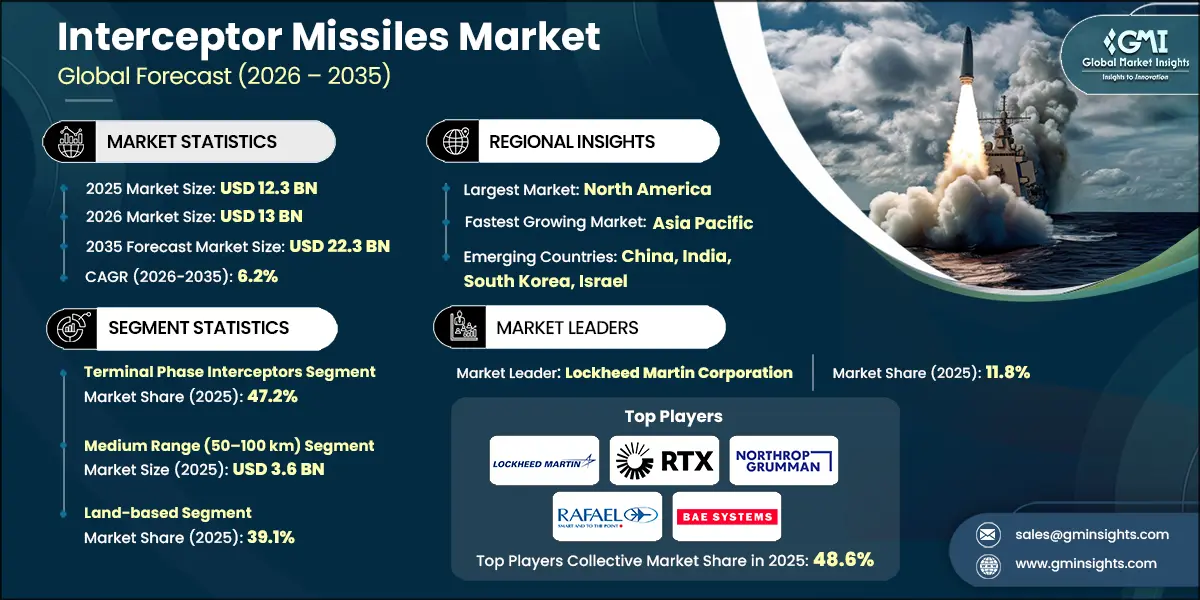
The global interceptor missiles market was valued at USD 12.3 billion in 2025. The market is expected to grow from USD 13 billion in 2026 to USD 17.4 billion in 2031 & USD 22.3 billion in 2035, at a CAGR of 6.2% during the forecast period according to the latest report published by Global Market Insights Inc.
The growth of the interceptor missiles market is attributed to increasing global defense spending on missile defense systems, rising ballistic and hypersonic missile threats, advancements in interceptor missile technologies and guidance systems, growing adoption of multi-layered missile defense architectures, and expansion of foreign military sales and allied defense programs.
Rising global defense expenditure focused on air and missile defense modernization is significantly driving interceptor missile demand. Increasing geopolitical tensions and evolving missile threats are compelling governments to strengthen layered defense architectures. According to the Center for Strategic and International Studies, U.S. Department of Defense spending on air and missile defense modernization has averaged over USD 22 billion annually since 2022. Sustained funding supports procurement of advanced interceptor systems, upgrades to existing defense networks, and accelerated deployment of next-generation interception technologies worldwide.
Expansion of foreign military sales and allied defense cooperation programs is accelerating interceptor missile adoption across partner nations. Governments are increasingly procuring interoperable missile defense systems to strengthen collective security frameworks and regional deterrence capabilities. In October 2024, South Korea’s Defense Acquisition Program Administration approved a project valued at approximately USD 1.45 billion through 2031 to procure additional PAC-3 interceptors and upgrade launcher systems, reflecting rising threat perceptions and expanding multinational missile defense integration initiatives.
The interceptor missiles market increased steadily from USD 10.4 billion in 2022 and reached USD 12.3 billion in 2025 due to rising geopolitical tensions, increasing ballistic and hypersonic missile threats, and sustained defense modernization programs across major economies. Governments accelerated procurement of integrated air and missile defense systems, while allied defense collaborations and foreign military sales supported deployment expansion, driving consistent funding and program continuity.
Interceptor Missiles Market Trends
Expansion of multi-layered missile defense architectures is reshaping market dynamics. Countries are deploying integrated terminal, midcourse, and boost-phase interceptors to counter diverse missile threats. This trend accelerated around 2022 amid rising ballistic and hypersonic threats and is expected to continue through 2035, enhancing national security, strengthening allied defense frameworks, and improving strategic deterrence capabilities.
Advancements in AI-enabled guidance and multi-sensor fusion systems are gaining prominence. Modern interceptor missiles increasingly incorporate AI-assisted targeting, radar and infrared sensors, and predictive algorithms for real-time threat tracking and engagement. Emerging around 2023, this trend is expected to expand through 2032, improving interception accuracy, response time, and operational reliability against complex aerial threats.
Integration of space- and airborne-based early warning systems is influencing defense strategies. Governments are leveraging satellites, airborne sensors, and networked command centers to enhance missile detection and interception coordination. This trend began around 2024 and is projected to continue through 2035, enabling rapid engagement of threats, improved situational awareness, and optimized deployment of advanced interceptor missile systems.
Interceptor Missiles Market Analysis
Based on intercept phase, the global interceptor missiles market is segmented into terminal phase interceptors, midcourse phase interceptors, and boost phase interceptors.
The terminal phase interceptors segment led the market in 2025, holding a 47.2% share due to its critical role in countering short- and medium-range ballistic missiles. Their rapid response capability, proven effectiveness in layered defense architectures, and widespread deployment across allied and homeland missile defense programs contributed to dominant adoption globally.
Midcourse phase interceptors’ segment is anticipated to grow at a CAGR of 7.4% over the forecast period as nations increasingly invest in exo-atmospheric interception systems. Rising ballistic missile threats, strategic emphasis on early threat neutralization, and advancements in sensor and guidance technologies are driving demand for midcourse interceptors in multi-layered defense networks.
Based on range, the global interceptor missiles market is divided into Short Range (<50 km), Medium Range (50–100 km), Long Range (100–1,000 km), Extended Range (>1,000 km).
Medium range (50–100 km) dominated the market in 2025 and valued at USD 3.6 billion, due to high operational flexibility for regional missile threats. These systems balance cost and coverage, supporting both homeland defense and allied protection missions, and are increasingly preferred for layered defense programs integrating terminal and midcourse interceptors.
The extended range (>1,000 km) segment is expected to witness growth at a CAGR of 7.7% during the forecast period, driven by rising strategic missile threats, development of advanced propulsion and guidance technologies, and growing adoption by countries seeking long-range interception capabilities for comprehensive national and regional security.
Based on launch platforms, the global interceptor missiles market is divided into land-based, naval / ship-based, airborne, and space-based.
Land-based segment led the market in 2025 with a market share of 39.1% owing to cost-effective deployment, mobility of ground launchers, and compatibility with multi-layered air and missile defense systems. Strong domestic and allied procurement programs, coupled with integration into networked command structures, reinforced its leading position globally.
The airborne segment is expected to grow at a CAGR of 7.6% during the forecast period due to its ability to provide rapid, flexible, and mobile missile interception coverage. Advancements in air-launched interceptors, integration with radar and sensor networks, and increasing adoption for regional threat mitigation drive market growth.
North America Interceptor Missiles Market
North America held around 41.7% of interceptor missiles industry share in 2025.
Rising geopolitical tensions drive North America to adopt multi-layered air and missile defense systems. Large defense budgets support procurement of terminal, midcourse, and boost-phase interceptors, modernizing networks and strengthening homeland and allied security. Advanced R&D continues to maintain technological leadership in missile detection and interception capabilities.
AI-guided targeting and multi-sensor fusion enhance operational readiness. Expansion of foreign military sales and allied defense programs boosts demand. Space- and network-integrated systems improve rapid response, situational awareness, and coordinated deployment, reinforcing the region’s strategic advantage in global missile defense operations.
The U.S. interceptor missiles market was valued at USD 3.9 billion and USD 4.1 billion in 2022 and 2023, respectively. The market size reached USD 4.6 billion in 2025, growing from USD 4.3 billion in 2024.
The U.S. leads in defense spending on missile defense modernization through THAAD, PAC-3, and GBI programs. Funding supports interceptor development, testing, and deployment, ensuring multi-layered protection against ballistic, cruise, and hypersonic threats while maintaining technological superiority globally.
Allied partnerships drive foreign military sales and interoperability initiatives. AI-enabled guidance, sensor integration, and predictive targeting improve interception accuracy. Modernization of deployed assets strengthens national security and ensures readiness against evolving aerial and missile threats worldwide.
Europe Interceptor Missiles Market
Europe market accounted for USD 612.3 billion in 2025 and is anticipated to show lucrative growth over the forecast period.
European nations expand missile defense capabilities to counter regional threats. Investments focus on integrated air and missile defense systems, modernizing legacy interceptors, and building multi-layered networks to protect critical infrastructure and allied forces across NATO territories.
Adoption of AI-assisted guidance, modular interceptors, and interoperable systems increases operational efficiency. Collaborative programs among member states enhance coordination, response speed, and long-term capability development, strengthening Europe’s defense posture against emerging missile threats.
Germany dominates the Europe interceptor missiles market, showcasing strong growth potential.
Germany prioritizes modernization of missile defense systems to address regional threats. Investments target multi-layered interception networks, NATO integration, and advanced radar-guided interceptors for enhanced protection.
Legacy interceptors are upgraded with improved guidance and propulsion technologies. Participation in joint NATO projects and foreign military sales strengthens operational readiness, industrial partnerships, and the country’s ability to respond effectively to evolving missile threats.
Asia Pacific Interceptor Missiles Market
The Asia Pacific market is anticipated to grow at a highest CAGR of 6.4% during the forecast period.
Regional tensions and expanding missile capabilities drive Asia-Pacific nations to invest in interceptors. Governments procure short-, medium-, and long-range systems, integrating AI targeting, multi-sensor detection, and networked command structures for comprehensive defense.
Modernization of armed forces and adoption of layered defense enhance homeland and maritime security. Foreign military sales, joint programs, and local production accelerate deployment, ensuring readiness against ballistic, cruise, and hypersonic threats across the region.
China interceptor missiles market is estimated to grow with a significant CAGR, in the Asia Pacific market.
China is modernizing its missile defense to address regional threats and high-speed missile proliferation. Investments include terminal, midcourse, and boost-phase interceptors, AI-guided targeting, radar, and space-based surveillance systems.
Indigenous development of long-range and hypersonic interceptors, combined with multi-layered deployments, strengthens national coverage. Domestic R&D, large-scale procurement, and production capabilities ensure operational readiness and enhance deterrence, positioning China as a leading missile defense power.
Middle East and Africa Interceptor Missiles Market
UAE market to experience substantial growth in the Middle East and Africa interceptor missiles market.
The UAE expands interceptor missile capabilities to protect infrastructure amid regional threats. Investments focus on short-, medium-, and long-range interceptors and multi-layered air defense with advanced radar and sensor systems.
Partnerships with global defense contractors and joint development programs accelerate acquisition and adoption. Emphasis on training, maintenance, and readiness strengthens national security and positions the UAE as a regional missile defense leader.
Interceptor Missiles Market Share
The interceptor missiles industry is led by players such as Lockheed Martin Corporation, RTX Corporation, Northrop Grumman Corporation, Rafael Advanced Defense Systems Ltd., and BAE Systems plc, which together account for 48.6% share of the global market. These companies hold strong competitive positions with their extensive portfolios in terminal, midcourse, and boost-phase interceptor missiles across land, naval, and allied defense segments.
Their broad global manufacturing and service presence, long-standing government and defense relationships, and focus on advanced guidance technologies and certified systems have helped these companies achieve market leadership. Additionally, ongoing investment in AI-enabled targeting, multi-sensor fusion, hypersonic interception, and modernization programs supports sustained growth and increasing demand across key regions worldwide.
Interceptor Missiles Market Companies
Prominent players operating in the interceptor missiles industry are as mentioned below:
RTX Corporation
Lockheed Martin Corporation
Northrop Grumman Corporation
Boeing Defense, Space & Security
BAE Systems plc
MBDA
Thales Group
Rafael Advanced Defense Systems Ltd.
Israel Aerospace Industries
Aselsan A.Ş.
Saab AB
Mitsubishi Heavy Industries
Hanwha Aerospace
Anduril Industries
BlueHalo
Dynetics
Lockheed Martin Corporation: Lockheed Martin provides a comprehensive range of interceptor missiles, including PAC-3, THAAD, and SM-3 systems. The company focuses on multi-layered missile defense solutions, offering full lifecycle support, system integration, and deployment services across land, naval, and allied defense programs worldwide.
RTX Corporation: RTX delivers advanced interceptor missile systems such as SM-3, SM-6, and ESSM. Emphasizing precision guidance, operational reliability, and integrated air and missile defense capabilities, the company supports both homeland and allied defense programs globally.
Northrop Grumman Corporation: Northrop Grumman specializes in strategic interceptor systems, including Ground-Based Interceptors and Next Generation Interceptors. The company provides advanced propulsion, sensor integration, and command-and-control solutions for layered missile defense architectures across national and allied programs.
Rafael Advanced Defense Systems Ltd.: Rafael develops interceptor missiles including Iron Dome Tamir, David’s Sling Stunner, and Arrow-3. The company emphasizes high-precision targeting, rapid-response air defense solutions, and multi-layered protection for regional and allied defense operations worldwide.
BAE Systems plc:BAE Systems delivers interceptor missile technologies and integrated defense solutions, including Aster 30 interceptors. The company focuses on advanced guidance subsystems, systems integration, and operational support to enhance interception effectiveness across European and allied missile defense programs.
Interceptor Missiles Industry News
In February 2026, Frankenburg Technologies, a Tallinn‑based defense company that has moved to mass‑produce low‑cost interceptor missiles tailored for countering drones and loitering munitions. Frankenburg plans multi‑site production across the EU, with initial capacity targets of around 100 missiles per day per site, using modular, container‑style manufacturing.
In February 2026, Rafael Advanced Defense Systems has joined Lockheed Martin and the Boeing–Anduril team in Phase I of the U.S. Army’s second Indirect Fire Protection Capability Increment 2 (IFPC Inc 2) “Second Interceptor” competition.
In January 2026, Lockheed Martin signed a framework agreement with the U.S. Department of War, to quadruple THAAD interceptor production from 96 to 400 units per year over the next seven years.
The interceptor missiles market research report includes in-depth coverage of the industry with estimates and forecast in terms of revenue (USD Billion) from 2022 – 2035 for the following segments:
Market, By Intercept Phase
Terminal phase interceptors
Midcourse phase interceptors
Boost phase interceptors
Market, By Threat Type
Ballistic missile interceptors
Cruise missile interceptors
Hypersonic threat interceptors
Aircraft / aerial threat interceptors
Market, By Launch Platform
Land-based
Naval / ship-based
Airborne
Space-based
Market, By Range
Short range (<50 km)
Medium range (50–100 km)
Long range (100–1,000 km)
Extended range (>1,000 km)
Market, By Guidance System
Radar-guided systems
Infrared / heat-seeking systems
Command-guided systems
Gps-guided systems
Multi-sensor / hybrid guidance systems
The above information is provided for the following regions and countries:
North America
U.S.
Canada
Europe
Germany
UK
France
Spain
Italy
Netherlands
Asia Pacific
China
India
Japan
Australia
South Korea
Latin America
Brazil
Mexico
Argentina
Middle East and Africa
South Africa
Saudi Arabia
UAE
Authors: Suraj Gujar, Ankita Chavan
Interceptor Missiles Market Scope
Interceptor Missiles Market Size
Interceptor Missiles Market Trends
Interceptor Missiles Market Analysis
Interceptor Missiles Market Share
Report Content
Chapter 1 Methodology and Scope
1.1 Market scope and definition
1.2 Research design
1.2.1 Research approach
1.2.2 Data collection methods
1.3 Data mining sources
1.3.1 Global
1.3.2 Regional/Country
1.4 Base estimates and calculations
1.4.1 Base year calculation
1.4.2 Key trends for market estimation
1.5 Primary research and validation
1.5.1 Primary sources
1.6 Forecast model
1.7 Research assumptions and limitations
Chapter 2 Executive Summary
2.1 Industry 360° synopsis, 2022 – 2035
2.2 Key market trends
2.2.1 Intercept phase trends
2.2.2 Threat type trends
2.2.3 Launch platform trends
2.2.4 Range trends
2.2.5 Guidance system trends
2.2.6 Region trends
2.3 TAM Analysis, 2026-2035
2.4 CXO perspectives: Strategic imperatives
Chapter 3 Industry Insights
3.1 Industry ecosystem analysis
3.1.1 Supplier Landscape
3.1.2 Profit Margin
3.1.3 Cost structure
3.1.4 Value addition at each stage
3.1.5 Factor affecting the value chain
3.1.6 Disruptions
3.2 Industry impact forces
3.2.1 Growth drivers
3.2.1.1 Increasing global defense spending on missile defense systems
3.2.1.2 Rising ballistic and hypersonic missile threats
3.2.1.3 Advancements in interceptor missile technologies and guidance systems
3.2.1.4 Growing adoption of multi-layered missile defense architectures
3.2.1.5 Expansion of foreign military sales and allied defense programs
3.2.2 Industry pitfalls and challenges
3.2.2.1 High development and procurement costs of interceptor missile systems
3.2.2.2 Strict regulatory and export control restrictions on missile technologies
3.2.3 Market opportunities
3.2.3.1 Integration of interceptor missiles with space-based and early warning systems
3.2.3.2 Modernization and replacement of legacy air and missile defense systems
3.3 Growth potential analysis
3.4 Regulatory landscape
3.4.1 North America
3.4.2 Europe
3.4.3 Asia Pacific
3.4.4 Latin America
3.4.5 Middle East & Africa
3.5 Porter’s analysis
3.6 PESTEL analysis
3.7 Technology and Innovation landscape
3.7.1 Current technological trends
3.7.2 Emerging technologies
3.8 Emerging business models
3.9 Compliance requirements
3.10 Patent and IP analysis
3.11 Pricing analysis (Driven by Primary Research)
3.11.1 Historical price trend analysis
3.11.2 Pricing strategy by player type
3.12 Trade Data Analysis (Based on Paid Databases)
3.12.1 Import/export volume & value trends
3.12.2 Key trade corridors & tariff impact
3.13 Impact of AI & generative AI on the market (Driven by Primary Research)
3.13.1 AI-driven disruption of existing business models
3.13.2 GenAI use cases & adoption roadmap by segment
3.19.3.4 Research, development, test and evaluation
3.19.3.5 Infrastructure and construction
3.19.3.6 Technology and innovation
3.20 Supply chain resilience
3.21 Geopolitical analysis
3.22 Workforce analysis
3.23 Digital transformation
3.24 Mergers, acquisitions, and strategic partnerships landscape
3.25 Risk assessment and management
3.26 Major contract awards (2021–2024)
Chapter 4 Competitive Landscape, 2025
4.1 Introduction
4.2 Company market share analysis
4.2.1 By region
4.2.1.1 North America
4.2.1.2 Europe
4.2.1.3 Asia Pacific
4.2.1.4 Latin America
4.2.1.5 Middle East & Africa
4.2.2 Market concentration analysis
4.3 Competitive benchmarking of key players
4.3.1 Financial performance comparison
4.3.1.1 Revenue
4.3.1.2 Profit margin
4.3.1.3 R&D
4.3.2 Product portfolio comparison
4.3.2.1 Product range breadth
4.3.2.2 Technology
4.3.2.3 Innovation
4.3.3 Geographic presence comparison
4.3.3.1 Global footprint analysis
4.3.3.2 Service network coverage
4.3.3.3 Market penetration by region
4.3.4 Competitive positioning matrix
4.3.4.1 Leaders
4.3.4.2 Challengers
4.3.4.3 Followers
4.3.4.4 Niche players
4.4 Key developments
4.4.1 Mergers and acquisitions
4.4.2 Partnerships and collaborations
4.4.3 Technological advancements
4.4.4 Expansion and investment strategies
4.4.5 Digital transformation initiatives
4.5 Emerging/ startup competitors landscape
Chapter 5 Market Estimates and Forecast, By Intercept Phase, 2022 – 2035 (USD Billion)
5.1 Key trends
5.2 Terminal phase interceptors
5.3 Midcourse phase interceptors
5.4 Boost phase interceptors
Chapter 6 Market Estimates and Forecast, By Threat Type, 2022 – 2035 (USD Billion)
6.1 Key trends
6.2 Ballistic missile interceptors
6.3 Cruise missile interceptors
6.4 Hypersonic threat interceptors
6.5 Aircraft / aerial threat interceptors
Chapter 7 Market Estimates and Forecast, By Launch Platform, 2022 – 2035 (USD Billion)
7.1 Key trends
7.2 Land-based
7.3 Naval / ship-based
7.4 Airborne
7.5 Space-based
Chapter 8 Market Estimates and Forecast, By Range, 2022 – 2035 (USD Billion)
8.1 Key trends
8.2 Short range (<50 km)
8.3 Medium range (50–100 km)
8.4 Long range (100–1,000 km)
8.5 Extended range (>1,000 km)
Chapter 9 Market Estimates and Forecast, By Guidance System, 2022 – 2035 (USD Billion)
9.1 Key trends
9.2 Radar-guided systems
9.3 Infrared / heat-seeking systems
9.4 Command-guided systems
9.5 Gps-guided systems
9.6 Multi-sensor / hybrid guidance systems
Chapter 10 Market Estimates and Forecast, By Region, 2022 – 2035 (USD Billion)
10.1 Key trends
10.2 North America
10.2.1 U.S.
10.2.2 Canada
10.3 Europe
10.3.1 Germany
10.3.2 UK
10.3.3 France
10.3.4 Spain
10.3.5 Italy
10.3.6 Netherlands
10.4 Asia Pacific
10.4.1 China
10.4.2 India
10.4.3 Japan
10.4.4 Australia
10.4.5 South Korea
10.5 Latin America
10.5.1 Brazil
10.5.2 Mexico
10.5.3 Argentina
10.6 Middle East and Africa
10.6.1 South Africa
10.6.2 Saudi Arabia
10.6.3 UAE
Chapter 11 Company Profiles
11.1 Global Key Players
11.1.1 RTX Corporation
11.1.2 Lockheed Martin Corporation
11.1.3 Northrop Grumman Corporation
11.1.4 Boeing Defense, Space & Security
11.1.5 BAE Systems plc
11.1.6 MBDA
11.1.7 Thales Group
11.2 Regional Players
11.2.1 Rafael Advanced Defense Systems Ltd.
11.2.2 Israel Aerospace Industries
11.2.3 Aselsan A.
11.2.4 Saab AB
11.2.5 Mitsubishi Heavy Industries
11.2.6 Hanwha Aerospace
11.3 Niche Players
11.3.1 Anduril Industries
11.3.2 BlueHalo
11.3.3 Dynetics
11.3.4 Bharat Dynamics Limited
Don't see your key competitors?
The companies listed in this report are a curated selection - not the full competitive universe.
Our market revenue calculations use a bottom-up methodology that accounts for all players across all regions - including manufacturers, distributors, and specialists not individually profiled. The profiles section spotlights strategically significant players; it does not define the scope of our market sizing.
Your competitive landscape may also include
Regional or domestic-only leaders not in the global top tier
Distributors and channel partners who control market access
Emerging disruptors, startups, or adjacent-industry entrants
Niche players focused on a specific application or end-use
Free customization - up to 20% of report value
Need specific data? Request customization and get the insights tailored to your exact requirements.
Authors: Suraj Gujar, Ankita Chavan
For inquiries regarding discounts, bulk purchases, or customization requests, please contact us at[email protected]
Explore our licensing options:
Starting at: $2,450
Premium Report Details
Base Year: 2025
Companies Profiled: 17
Tables and Figures: 260
Countries covered: 18
Pages: 165
Download Free PDF
Premium Report Details
Base Year: 2025
Companies Profiled: 17
Tables and Figures: 260
Countries covered: 18
Pages: 165
Download Free PDF
Share Content
Add Citations
Suraj Gujar. 2026, March. Interceptor Missiles Market- By Intercept Phase, By Threat Type, By Launch Platform, By Range, By Guidance System - Global Forecast, 2026-2035 (Report ID: GMI2401). Global Market Insights Inc. Retrieved August 25, 2026, from https://www.gminsights.com/toc/details/interceptor-missiles-market
Interceptor Missiles Market
Get a free sample of this report
Get a free sample of this report Interceptor Missiles Market
Is your requirement urgent? Please give us your business email for a speedy delivery!



Interceptor Missiles Market Size
The global interceptor missiles market was valued at USD 12.3 billion in 2025. The market is expected to grow from USD 13 billion in 2026 to USD 17.4 billion in 2031 & USD 22.3 billion in 2035, at a CAGR of 6.2% during the forecast period according to the latest report published by Global Market Insights Inc.
The growth of the interceptor missiles market is attributed to increasing global defense spending on missile defense systems, rising ballistic and hypersonic missile threats, advancements in interceptor missile technologies and guidance systems, growing adoption of multi-layered missile defense architectures, and expansion of foreign military sales and allied defense programs.
Rising global defense expenditure focused on air and missile defense modernization is significantly driving interceptor missile demand. Increasing geopolitical tensions and evolving missile threats are compelling governments to strengthen layered defense architectures. According to the Center for Strategic and International Studies, U.S. Department of Defense spending on air and missile defense modernization has averaged over USD 22 billion annually since 2022. Sustained funding supports procurement of advanced interceptor systems, upgrades to existing defense networks, and accelerated deployment of next-generation interception technologies worldwide.
Expansion of foreign military sales and allied defense cooperation programs is accelerating interceptor missile adoption across partner nations. Governments are increasingly procuring interoperable missile defense systems to strengthen collective security frameworks and regional deterrence capabilities. In October 2024, South Korea’s Defense Acquisition Program Administration approved a project valued at approximately USD 1.45 billion through 2031 to procure additional PAC-3 interceptors and upgrade launcher systems, reflecting rising threat perceptions and expanding multinational missile defense integration initiatives.
The interceptor missiles market increased steadily from USD 10.4 billion in 2022 and reached USD 12.3 billion in 2025 due to rising geopolitical tensions, increasing ballistic and hypersonic missile threats, and sustained defense modernization programs across major economies. Governments accelerated procurement of integrated air and missile defense systems, while allied defense collaborations and foreign military sales supported deployment expansion, driving consistent funding and program continuity.
Interceptor Missiles Market Trends
Interceptor Missiles Market Analysis
Based on intercept phase, the global interceptor missiles market is segmented into terminal phase interceptors, midcourse phase interceptors, and boost phase interceptors.
Based on range, the global interceptor missiles market is divided into Short Range (<50 km), Medium Range (50–100 km), Long Range (100–1,000 km), Extended Range (>1,000 km).
Based on launch platforms, the global interceptor missiles market is divided into land-based, naval / ship-based, airborne, and space-based.
North America Interceptor Missiles Market
North America held around 41.7% of interceptor missiles industry share in 2025.
The U.S. interceptor missiles market was valued at USD 3.9 billion and USD 4.1 billion in 2022 and 2023, respectively. The market size reached USD 4.6 billion in 2025, growing from USD 4.3 billion in 2024.
Europe Interceptor Missiles Market
Europe market accounted for USD 612.3 billion in 2025 and is anticipated to show lucrative growth over the forecast period.
Germany dominates the Europe interceptor missiles market, showcasing strong growth potential.
Asia Pacific Interceptor Missiles Market
The Asia Pacific market is anticipated to grow at a highest CAGR of 6.4% during the forecast period.
China interceptor missiles market is estimated to grow with a significant CAGR, in the Asia Pacific market.
Middle East and Africa Interceptor Missiles Market
UAE market to experience substantial growth in the Middle East and Africa interceptor missiles market.
Interceptor Missiles Market Share
The interceptor missiles industry is led by players such as Lockheed Martin Corporation, RTX Corporation, Northrop Grumman Corporation, Rafael Advanced Defense Systems Ltd., and BAE Systems plc, which together account for 48.6% share of the global market. These companies hold strong competitive positions with their extensive portfolios in terminal, midcourse, and boost-phase interceptor missiles across land, naval, and allied defense segments.
Their broad global manufacturing and service presence, long-standing government and defense relationships, and focus on advanced guidance technologies and certified systems have helped these companies achieve market leadership. Additionally, ongoing investment in AI-enabled targeting, multi-sensor fusion, hypersonic interception, and modernization programs supports sustained growth and increasing demand across key regions worldwide.
Interceptor Missiles Market Companies
Prominent players operating in the interceptor missiles industry are as mentioned below:
Interceptor Missiles Industry News
The interceptor missiles market research report includes in-depth coverage of the industry with estimates and forecast in terms of revenue (USD Billion) from 2022 – 2035 for the following segments:
Market, By Intercept Phase
Market, By Threat Type
Market, By Launch Platform
Market, By Range
Market, By Guidance System
The above information is provided for the following regions and countries: