
Hollow Fiber Membrane Market Size & Share 2026-2035
Download Free PDF
Report Content
Chapter 1. Research Methodology
1.1 Research Approach
1.2 Quality Commitments
1.2.1 GMI AI Policy & Data Integrity Commitment
1.2.1.1 Source Consistency Protocol
1.3 Research Trail & Confidence Scoring
1.3.1 Research Trail Components
1.3.2 Scoring Components
1.4 Data Collection
1.4.1 Partial List of Primary Sources
1.5 Data Mining Sources
1.5.1 Paid Sources
1.5.1.1 Sources, By Region
1.6 Base Estimates & Calculations
1.6.1 Base Year Calculation
1.7 Forecast Model
1.7.1 Quantified Market Impact Analysis
1.7.1.1 Mathematical Impact of Growth Parameters on Forecast
1.8 Research Transparency Addendum
1.8.1 Source Attribution Framework
1.8.2 Quality Assurance Metrics
1.8.3 Our Commitment to Trust
Chapter 2. Executive Summary
2.1 Industry 360° Synopsis
2.2 Key Market Trends
2.2.1 Membrane Material Trends
2.2.2 Filtration Technology Trends
2.2.3 Application Trends
2.2.4 Regional Trends
2.3 TAM Analysis, 2026–2035 (USD Billion)
2.4 CXO Perspectives: Strategic Imperatives
Chapter 3. Industry Insights
3.1 Industry Ecosystem Analysis
3.1.1 Supplier Landscape
3.1.2 Profit Margin
3.1.3 Cost Structure
3.1.4 Value Addition at Each Stage
3.1.5 Factors Affecting the Value Chain
3.1.6 Disruptions
3.2 Industry Impact Forces
3.2.1 Growth Drivers
3.2.2 Industry Pitfalls & Challenges
3.2.3 Market Opportunities
3.3 Growth Potential Analysis
3.4 Pricing Analysis (Driven by Primary Research)
3.4.1 Historical Price Trend Analysis (Driven by Primary Research)
3.4.2 Pricing Strategy by Player Type (Premium / Value / Cost-plus) (Driven by Primary Research)
3.5 Regulatory Landscape
3.5.1 North America
3.5.2 Europe
3.5.3 Asia Pacific
3.5.4 Latin America
3.5.5 Middle East & Africa
3.6 Porter's Analysis
3.7 PESTEL Analysis
3.8 Trade Data Analysis (Based on Paid Database)
3.8.1 Import/Export Volume & Value Trends (Based on Paid Database)
3.8.2 Key Trade Corridors & Tariff Impact (Based on Paid Database)
3.9 Impact of AI & Generative AI on the Market (Driven by Primary Research)
3.9.1 AI-Driven Disruption of Existing Business Models
3.9.2 GenAI Use Cases & Adoption Roadmap by Segment
3.9.3 Risks, Limitations & Regulatory Considerations
3.10 Capacity & Production Landscape (Driven by Primary Research)
3.10.1 Production Capacity by Region & Key Producer (Driven by Primary Research)
3.10.2 Capacity Utilization Rates & Expansion Pipelines (Driven by Primary Research)
Chapter 4. Competitive Landscape, 2025
4.1 Introduction
4.2 Company Market Share Analysis
4.2.1 By Region
4.2.1.1 North America
4.2.1.2 Europe
4.2.1.3 Asia Pacific
4.2.1.4 Latin America
4.2.1.5 Middle East & Africa
4.2.2 Market Concentration Analysis
4.3 Competitive Analysis of Major Market Players
4.4 Competitive Positioning Matrix
4.5 Key Developments
4.5.1 Mergers & Acquisitions
4.5.2 Partnerships & Collaborations
4.5.3 New Product Launches
4.5.4 Expansion Plans & Funding
4.6 Company Tier Benchmarking
4.6.1 Tier Classification Criteria & Qualifying Thresholds
4.6.2 Tier Positioning Matrix by Revenue, Geography & Innovation
Chapter 5. Hollow Fiber Membrane Market Estimates & Forecast, By Membrane Material (USD Million, 2022–2035)
5.1 Polymeric
5.1.1 Polyvinylidene Fluoride (PVDF)
5.1.2 Polysulfone (PSF) / Polyethersulfone (PES)
5.1.3 Polyacrylonitrile (PAN)
5.1.4 Polyethylene (PE) / Polypropylene (PP)
5.1.5 Others (Cellulose Acetate & Emerging Polymer Blends)
5.2 Ceramic
5.2.1 Alumina-Based
5.2.2 Zirconia-Based
5.2.3 Titania-Based & Others
5.3 Forecast Assumptions & Scenario Analysis (Driven by Primary Research)
5.3.1 Base Case — Key Macro & Industry Variables Driving CAGR
5.3.2 Bull Scenario — Upside Assumptions & Trigger Conditions
5.3.3 Bear Scenario — Downside Assumptions & Risk Factors
5.3.4 Sensitivity Analysis — Variables the Forecast is Most Sensitive To
Chapter 6. Hollow Fiber Membrane Market Estimates & Forecast, By Filtration Technology (USD Million, 2022–2035)
6.1 Microfiltration (MF)
6.1.1 Low-Pressure MF
6.1.2 Cross-Flow MF
6.1.3 Dead-End MF
6.2 Ultrafiltration (UF)
6.2.1 Low-Pressure UF
6.2.2 High-Pressure UF
6.2.3 Cross-Flow UF
6.3 Nanofiltration (NF)
6.3.1 Standard NF
6.3.2 Tight NF (Near-RO Performance)
6.4 Reverse Osmosis (RO)
6.5 Gas Separation
6.5.1 Nitrogen / Oxygen Separation
6.5.2 Hydrogen Purification
6.5.3 Carbon Capture (CO₂ Separation)
6.6 Others (Pervaporation, Membrane Distillation, Forward Osmosis)
Chapter 7. Hollow Fiber Membrane Market Estimates & Forecast, By Application (USD Million, 2022–2035)
7.1 Water & Wastewater Treatment
7.1.1 Municipal Drinking Water Treatment
7.1.2 Industrial Wastewater Treatment & Reuse
7.1.3 Desalination Pre-Treatment
7.1.4 Zero Liquid Discharge (ZLD) Systems
7.2 Pharmaceutical & Biotechnology
7.2.1 Cell Harvesting & Clarification
7.2.2 Protein Concentration & Diafiltration
7.2.3 Virus Filtration & Sterile Filtration
7.2.4 Continuous Bioprocessing (Perfusion Systems)
7.3 Food & Beverage Processing
7.3.1 Dairy Processing (Milk Concentration & Whey Protein Recovery)
7.3.2 Juice & Wine Clarification
7.3.3 Beverage Microfiltration & Cold Sterilization
7.4 Medical / Hemodialysis
7.4.1 Hemodialysis Membranes
7.4.2 Plasmapheresis & Therapeutic Apheresis
7.4.3 Extracorporeal Membrane Oxygenation (ECMO)
7.5 Chemical & Industrial Processing
7.5.1 Solvent Recovery & Purification
7.5.2 Oil & Gas (Produced Water Treatment & Gas Dehydration)
7.5.3 Pulp & Paper Effluent Treatment
7.6 Gas Separation & Industrial
7.6.1 Air Separation (Nitrogen / Oxygen Enrichment)
7.6.2 Natural Gas Sweetening (CO₂ & H₂S Removal)
7.6.3 Hydrogen Purification for Fuel Cell Applications
7.7 Others (Research & Academic Institutions, Aquaculture, Specialty Applications)
Chapter 8. Hollow Fiber Membrane Market Estimates & Forecast, By Region (USD Million, 2022–2035)
8.1 North America
8.1.1 U.S.
8.1.2 Canada
8.2 Europe
8.2.1 Germany
8.2.2 UK
8.2.3 France
8.2.4 Italy
8.2.5 Spain
8.2.6 Rest of Europe
8.3 Asia Pacific
8.3.1 China
8.3.2 Japan
8.3.3 India
8.3.4 South Korea
8.3.5 Australia
8.3.6 Rest of Asia Pacific
8.4 Latin America
8.4.1 Brazil
8.4.2 Argentina
8.4.3 Mexico
8.4.4 Rest of Latin America
8.5 Middle East & Africa
8.5.1 South Africa
8.5.2 Saudi Arabia
8.5.3 UAE
8.5.4 Rest of Middle East Africa
Chapter 9. Company Profiles (Driven by Primary Research)
Don't see your key competitors?
The companies listed in this report are a curated selection - not the full competitive universe.
Our market revenue calculations use a bottom-up methodology that accounts for all players across all regions - including manufacturers, distributors, and specialists not individually profiled. The profiles section spotlights strategically significant players; it does not define the scope of our market sizing.
Your competitive landscape may also include
Free customization - up to 20% of report value
Need specific data? Request customization and get the insights tailored to your exact requirements.
For inquiries regarding discounts, bulk purchases, or customization requests, please contact us at [email protected]
Share Content
Add Citations
Kiran Pulidindi. 2026, September. Hollow Fiber Membrane Market Size - By Material Type, Filtration Type, Technology Configuration, Application, End Use, Industry Analysis, Share, Growth Forecast 2025 - 2034 (Report ID: GMI3118). Global Market Insights Inc. Retrieved October 26, 2026, from https://www.gminsights.com/toc/details/hollow-fiber-membranes-market

Hollow Fiber Membrane Market
Get a free sample of this report
Hollow Fiber Membrane Market Size
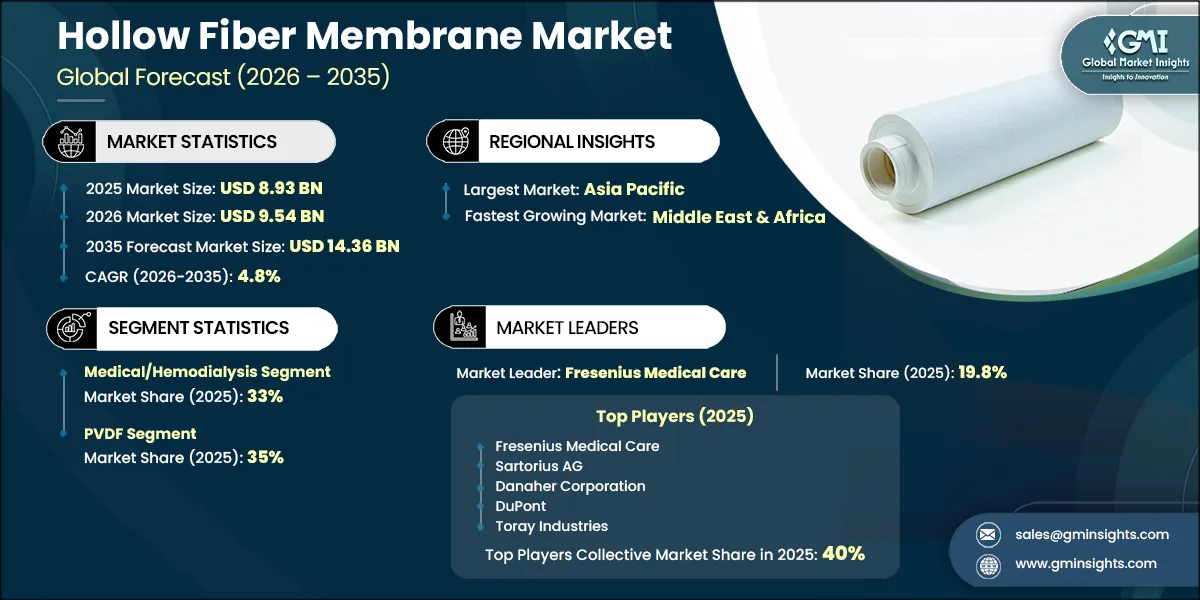
The hollow fiber membrane market was valued at USD 8.93 billion in 2025, is projected to reach USD 9.54 billion in 2026, and is expected to grow at a 4.8% CAGR (2026–2035) to reach USD 14.36 billion by 2035.
The hollow fiber membrane market is supported by a diversified demand base spanning life-sustaining dialysis, municipal and industrial water reuse, biopharmaceutical processing, and selective industrial separations. Its revenue profile reflects the balance between high-volume standardized modules and differentiated products that command value through validated performance, material resilience, and application-specific qualification.
GMI Analyst View
Our analysis of manufacturer-level production capacity and industry engagement indicates that approximately 785 million square meters of active membrane surface area were deployed globally in 2025. We view the gap between surface-area demand and realized revenue as a defining industry feature: price competition is most acute in standard UF and MF formats, while bioprocessing, high-performance dialysis, and emerging NF applications retain a stronger value proposition.
Hollow Fiber Membrane Market Trends, Growth Drivers & GMI Forecast Outlook
Key Drivers
Water stress is changing membrane procurement from an incremental treatment upgrade into a core infrastructure decision. Municipal operators increasingly require systems that can improve effluent quality, support reuse, and fit constrained plant footprints. Hollow fiber formats are well suited to these requirements because their high packing density supports modular deployment in MBR, polishing, and pre-treatment configurations.
Dialysis provides a separate and durable demand foundation. Clinical treatment requirements make dialyzer consumption less exposed to discretionary industrial spending, while the move toward more demanding treatment modalities increases the importance of membrane flux, biocompatibility, and reliable supply. This stable medical base helps moderate the volatility inherent in project-led water and bioprocessing demand.
Direct nanofiltration is expanding the addressable water-reuse opportunity by enabling a more compact treatment pathway for contaminants that conventional systems often address through multiple membrane stages. NX Filtration's repeat order for León's potable-reuse project illustrates the commercial transition of hollow fiber NF from specialist deployments to utility-scale engineering specifications [4].
Key Restraints
The biopharmaceutical channel remains the highest-value demand pool, but its purchasing pattern is governed by customer inventory, manufacturing campaigns, clinical pipeline progression, and capacity commissioning. That creates a meaningful timing risk for suppliers of TFF cartridges and single-use filtration assemblies even when underlying biologics output remains constructive.
Standardized municipal modules face a different constraint: price erosion. Producers with lower-cost manufacturing bases can compete effectively in conventional UF and MF tenders, shifting established suppliers toward applications where qualification records, membrane consistency, service capability, and technical support are more decisive than initial module cost.
Fouling compounds the economic challenge for users. Cleaning protocols, process validation, downtime, and replacement planning affect the total cost of ownership in both wastewater and regulated bioprocess environments. Suppliers that extend service intervals without sacrificing flux or selectivity will be better positioned in cost-sensitive applications.
*Evidence anchors use cited external data; demand implications and forecast conditions represent GMI analysis.*
GMI Analyst View*
We view the market as a combination of stable recurring demand and episodic high-value procurement. Dialysis and water treatment provide an operating floor because they are linked to essential clinical and infrastructure needs, whereas life-sciences demand can move sharply with inventory behavior. Suppliers with exposure across both demand types are better insulated than specialists concentrated in a single procurement cycle.
Hollow Fiber Membrane Market Segment Analysis
By Application
Medical/hemodialysis accounted for 33.0% of hollow fiber membrane market revenue in 2025 and is expected to represent 30.0% by 2035. The application remains the industry's principal recurring-use channel because each treatment cycle depends on clinically qualified dialyzer modules. Its relative weight moderates as water and life-sciences applications expand, but demand remains anchored by chronic kidney disease treatment volumes and the need for consistently available, validated membrane products.
Water & wastewater treatment is expected to reach USD 3.88 billion by 2035 and expand at a 5.7% CAGR (2026–2035). Municipal reuse, industrial effluent upgrading, and desalination pre-treatment are widening the addressable project base. MBR systems and modular UF installations are especially relevant where operators need greater recovery, tighter discharge performance, or staged upgrades to legacy treatment assets.
Pharmaceutical & biotechnology generated USD 1.97 billion in 2025 and is projected to grow at a 5.8% CAGR (2026–2035). TFF hollow fiber cartridges support concentration, clarification, and diafiltration steps that are integral to biologics production. Demand recovery depends on manufacturing utilization and customer restocking, while virus-removal and high-purity workflows preserve a premium for qualification, consistency, and supply assurance.
Food & beverage is projected to reach USD 1.01 billion by 2035 and held a 7.0% revenue share in 2025. Dairy protein processing remains the principal demand source, supplemented by beverage clarification, fermentation processing, and plant-protein concentration. These applications reward membranes that can maintain throughput under demanding feed conditions while protecting product quality and reducing thermal processing requirements.
Chemical & industrial processing is expected to reach USD 718 million by 2035 and accounted for 5.0% of revenue in 2025. Demand is tied to solvent recovery, produced-water treatment, and separation of difficult industrial streams. Adoption is selective because conventional process technologies retain installed-base advantages, but chemically resistant polymeric and ceramic fibers can create value where harsh operating conditions limit alternatives.
Gas separation & industrial gas generated USD 447 million in 2025 and is expected to reach USD 718 million by 2035. Nitrogen generation, gas dehydration, hydrogen purification, and natural gas treatment underpin demand for this application. The segment benefits from membrane systems' compact footprint and operating simplicity, particularly where on-site gas generation reduces the need for centralized supply or cryogenic separation.
By Material
PVDF represented 35.0% of material revenue in 2025 and is projected to account for 38.0% by 2035. PVDF combines chemical resistance, mechanical durability, and suitability for surface modification, giving it broad relevance in MBR, reuse, and industrial water applications. Its growing position reflects continued investment in water infrastructure as well as the material's ability to withstand rigorous cleaning regimes.
PSF/PES generated USD 2.23 billion in 2025 and is expected to expand at a 4.0% CAGR (2026–2035). PSF and PES retain an established role in dialysis and bioprocessing because their performance history is deeply embedded in clinical and regulated manufacturing workflows. Their competitive challenge is strongest in newer water-treatment installations where PVDF's chemical resilience can be more advantageous.
PE/PP is projected to account for 10.0% of revenue by 2035 and grow at a 3.0% CAGR (2026–2035). These materials remain relevant in cost-sensitive microfiltration and selected industrial applications. Their narrower premium-use opportunity limits growth relative to materials that offer greater chemical resistance, higher permeability, or a more established regulatory position in specialized applications.
PAN held an 8.0% revenue share in 2025 and is projected to generate USD 1.01 billion by 2035. PAN's hydrophilicity and low-fouling characteristics support its use in municipal UF and selected dialysis formats. It occupies a cost-performance position between commodity alternatives and higher-value materials, but competition from PVDF and PSF/PES constrains its expansion in premium applications.
Other polymeric materials are projected to represent 7.0% of revenue by 2035, compared with 8.0% in 2025. Cellulose-based and specialist polymer fibers retain relevance where pore structure, compatibility, or legacy qualification creates meaningful switching barriers. Their overall position is moderated by the broader shift toward PVDF and other polymers that serve expanding water-reuse and industrial treatment requirements.
Ceramic hollow fiber membranes are expected to reach USD 2.15 billion by 2035 and grow at a 7.2% CAGR (2026–2035). Ceramic fibers address applications where high temperatures, aggressive chemicals, steam sterilization, or challenging feed streams exceed the practical range of many polymeric membranes. Their higher initial cost narrows adoption to applications with a clear lifecycle benefit, but that differentiation supports their position in demanding industrial and food-processing environments.
By Technology / Pore Size
Ultrafiltration represented 32.0% of technology revenue in 2025 and is expected to account for 34.0% by 2035. UF is the workhorse technology for MBR systems, water pre-treatment, and numerous biopharmaceutical separation steps. Its gain reflects the need for robust particulate and macromolecule removal in compact treatment trains, particularly where water-reuse investment requires scalable and repeatable module configurations.
Hemodialysis/specialty membranes are projected to grow at a 3.9% CAGR (2026–2035). This technology category shares its underlying revenue pool with the medical/hemodialysis application analysis. Its growth is shaped by clinical qualification, treatment-modal evolution, and the high importance of membrane consistency, with innovation focused on flux performance and patient-specific treatment requirements.
Microfiltration is expected to represent 10.0% of revenue by 2035 and grow at a 3.0% CAGR (2026–2035). MF remains important in lower-cost water treatment, industrial filtration, and pre-treatment stages. Its growth is constrained by competition from non-membrane treatment methods and by substitution toward tighter membrane barriers where regulatory requirements demand more comprehensive contaminant control.
Gas separation technology held an 8.0% revenue share in 2025 and is projected to account for 9.0% by 2035. Membrane-based nitrogen generation and gas-conditioning applications are expanding as industrial users value decentralized operation and a compact equipment footprint. Emerging hydrogen and carbon-management uses could create further opportunity, although adoption depends on economics and process-specific purity requirements.
Nanofiltration is projected to represent 6.0% of revenue by 2035 and grow at a 9.2% CAGR (2026–2035). NF is gaining strategic relevance in potable reuse and micropollutant removal because it can address a tighter contaminant spectrum than conventional UF without necessarily requiring a full reverse-osmosis train. Its commercial opportunity depends on utility acceptance, project references, and the ability to demonstrate favorable lifecycle economics.
Other technologies, including RO-HF and pervaporation, held an 11.0% revenue share in 2025 and are projected to grow at a 4.9% CAGR (2026–2035). These formats serve specialized separation needs that can be technically attractive but remain less standardized than mainstream water, dialysis, and bioprocessing applications. Their development is likely to be shaped by niche process innovation rather than broad-based replacement cycles.
GMI Analyst View
We see materials and technology competition converging around performance differentiation. Commodity-grade formats will remain exposed to cost competition, while applications requiring chemical durability, fouling resistance, precise selectivity, or established validation support more defensible positioning. The central strategic question is not simply which membrane grows fastest, but which formats can convert technical capability into durable realized value.
Hollow Fiber Membrane Market Regional Analysis
North America Hollow Fiber Membrane Market Analysis
North America represented 28.0% of hollow fiber membrane market revenue in 2025 and is expected to reach USD 3.73 billion by 2035. The region combines a mature dialysis installed base with high-value biopharmaceutical manufacturing and an emerging water-reuse opportunity in water-constrained jurisdictions. Demand favors suppliers able to meet exacting clinical and regulated-process requirements while supporting utilities seeking modular upgrades to existing treatment capacity.
U.S.
The U.S. generated USD 2.25 billion in 2025 and is projected to grow at a 4.1% CAGR (2026–2035). The market is supported by large dialysis networks, established biopharmaceutical production clusters, and a developing pipeline of potable-reuse projects. Adoption of advanced dialysis formats and increasing demand for high-performance water treatment create opportunities for suppliers with strong regulatory and service capabilities.
Canada
Canada held a 2.8% global revenue share in 2025 and is expected to reach USD 373 million by 2035. A stable healthcare base and established municipal treatment infrastructure support consistent demand. Market development is likely to be gradual, with replacement needs and targeted infrastructure modernization more important than large-scale capacity build-outs.
Europe Hollow Fiber Membrane Market Analysis
Europe generated USD 2.14 billion in 2025 and is expected to grow at a 4.0% CAGR (2026–2035). Europe combines established dialyzer and life-sciences manufacturing with a strong regulatory basis for water reuse and advanced wastewater treatment. This mix supports demand for both high-value qualified membranes and water-oriented UF and NF modules, although capital deployment will vary across national utility systems.
Germany
Germany accounted for 7.2% of global revenue in 2025 and is expected to reach USD 948 million by 2035. Its role in dialysis, industrial chemicals, and biopharmaceutical manufacturing creates a diversified demand base. Domestic technical capability also makes the country important to the region's supply chain for specialist products and high-performance separation solutions.
UK
The UK is projected to account for 4.4% of global revenue by 2035 and grow at a 4.0% CAGR (2026–2035). Water-quality obligations and the need to manage difficult contaminants strengthen the case for advanced membrane treatment. Procurement will depend on regulatory implementation, utility investment priorities, and the commercial demonstration of NF and related polishing technologies.
France
France held a 4.3% global revenue share in 2025 and is expected to reach USD 569 million by 2035. Dialysis demand, water-treatment expertise, and a substantial pharmaceutical base create a balanced application profile. This diversity reduces dependence on any individual end market and supports demand for both medical and industrially oriented membrane formats.
Italy
Italy is projected to account for 3.3% of global revenue by 2035 and generated USD 322 million in 2025. Food and beverage processing provides a distinctive demand stream alongside healthcare. Wine, dairy, and specialty food production support filtration requirements that complement the country's more conventional dialysis and municipal-water needs.
Spain
Spain represented 2.4% of global revenue in 2025 and is expected to account for 2.2% by 2035. Water scarcity and a large agri-food industry make reuse and effluent treatment particularly relevant. The modest relative-share movement reflects faster expansion in emerging markets rather than a weakening need for advanced water-treatment infrastructure.
Asia Pacific Hollow Fiber Membrane Market Analysis
Asia Pacific is projected to represent 38.0% of global hollow fiber membrane market revenue by 2035 and grow at a 5.7% CAGR (2026–2035). The region's demand rests on municipal water investment, manufacturing scale, expanding dialysis access, and a broad industrial customer base. It is also a decisive production center, making the region central to both demand growth and the competitive economics of standard membrane modules.
China
China held a 15.7% global revenue share in 2025 and is expected to reach USD 2.46 billion by 2035. Municipal wastewater reuse, dialysis expansion, and domestic life-sciences manufacturing underpin demand. Local suppliers are increasingly influential in standard water-treatment formats, while premium applications continue to reward technology depth, operating references, and validated quality performance.
Japan
Japan is projected to represent 7.6% of global revenue by 2035 and grow at a 4.7% CAGR (2026–2035). The country combines a substantial dialysis market with a globally relevant manufacturing base. Japanese producers are positioned across medical, water, gas-separation, and specialty applications, allowing them to leverage materials science and process engineering across multiple end uses.
India
India held a 4.2% global revenue share in 2025 and is expected to grow at a 8.1% CAGR (2026–2035). Healthcare access, municipal water infrastructure, and pharmaceutical manufacturing are expanding in parallel. Domestic membrane production is beginning to develop, but imported technologies remain important in higher-specification applications and in projects requiring long operating reference histories.
South Korea
South Korea is expected to reach USD 655 million by 2035 and grow at a 5.7% CAGR (2026–2035). Its advanced semiconductor, display, and food-processing industries create demand for high-purity water and carefully controlled process separations. That industrial mix supports a stronger requirement for differentiated UF and NF performance than in markets dominated solely by municipal deployment.
Australia
Australia held a 1.4% global revenue share in 2025 and is projected to reach USD 164 million by 2035. Water scarcity supports continued use of UF and MBR systems in municipal and industrial settings, including mining-water management. The market's growth is constrained by population scale and relatively mature membrane infrastructure in major urban centers.
Latin America Hollow Fiber Membrane Market Analysis
Latin America held a 7.0% revenue share in 2025 and is expected to reach USD 1.01 billion by 2035. Water-quality investment, dialysis needs, and expanding pharmaceutical activity support regional demand. Execution risk remains relevant because project timelines depend on public funding, utility finances, and the ability to translate regulatory ambition into operating treatment capacity.
Brazil
Brazil generated USD 281 million in 2025 and is expected to grow at a 4.9% CAGR (2026–2035). The country combines a significant dialysis base with industrial water-treatment and pharmaceutical-processing needs. Its broad industrial footprint supports a more diversified demand profile than many regional peers, though infrastructure investment conditions remain variable.
Mexico
Mexico generated USD 188 million in 2025 and is expected to reach USD 302 million by 2035. Nearshoring-related manufacturing investment and water-security concerns are creating new application pathways. The León project using direct hollow fiber nanofiltration demonstrates a notable utility-scale reference for advanced potable-reuse treatment in the country.
Argentina
Argentina held a 0.8% global revenue share in 2025 and is expected to grow at a 3.0% CAGR (2026–2035). Demand is present across healthcare and water treatment, but fiscal and investment constraints can defer infrastructure programs. Suppliers therefore face a market where technical need does not always translate quickly into installed membrane capacity.
Middle East & Africa Hollow Fiber Membrane Market Analysis
Middle East & Africa is projected to account for 7.0% of global revenue by 2035 and grow at a 6.5% CAGR (2026–2035). Acute water stress and rising healthcare needs create a strong structural rationale for membrane adoption. The region's opportunity is concentrated in reuse, desalination pre-treatment, and dialysis, but project conversion remains dependent on funding execution, procurement structures, and operating-service capability.
Saudi Arabia
Saudi Arabia is expected to reach USD 382 million by 2035 and grow at a 7.3% CAGR (2026–2035). Water-security programs are supporting large-scale wastewater reuse and treatment investment, while dialysis demand adds a recurring clinical consumption base. Suppliers that can support major projects with reliable module supply and local service will be best positioned.
UAE
The UAE generated USD 161 million in 2025 and is projected to grow at a 7.2% CAGR (2026–2035). Desalination pre-treatment and treated-sewage-effluent reuse create complementary demand channels. The market favors proven performance in hot, saline, and operationally intensive water-treatment environments.
South Africa
South Africa is expected to reach USD 151 million by 2035 and held a 1.2% global revenue share in 2025. Infrastructure stress, water scarcity, and industrial effluent management create a need for membrane-based treatment solutions. Adoption is likely to be shaped by municipal investment capacity, industrial compliance requirements, and the economics of rehabilitating aging treatment systems.
GMI Analyst View*
We expect Asia Pacific to remain the principal center of demand expansion and competitive capacity development. The region's importance extends beyond consumption: its manufacturing scale is changing the cost structure of standard modules worldwide. We also view the Middle East & Africa as strategically significant because water security is becoming a non-discretionary infrastructure priority rather than a technology preference.
Hollow Fiber Membrane Market Share & Competitive Landscape
The hollow fiber membrane market share structure is moderately concentrated, with the top five participants accounting for approximately 40.0% of global revenue in 2025. Competition is highly application-specific: dialysis rewards clinical validation and vertical integration, bioprocessing rewards qualification and supply assurance, while municipal water treatment increasingly differentiates suppliers through module economics, operating performance, and project execution support.
Fresenius Medical Care held a 19.8% share of the global market in 2025. Its leading position is rooted in vertical integration across dialyzer manufacturing and clinical distribution. This structure provides procurement scale, quality-system depth, and direct insight into treatment requirements, creating barriers for competitors attempting to replicate its reach in the dialysis value chain.
Sartorius held approximately a 7.1% share of the global market in 2025. The company is concentrated in high-value bioprocessing filtration, where customer switching is constrained by process validation and manufacturing continuity. Its strategic challenge is to manage life-sciences cyclicality while extending its single-use and intensified-processing capabilities across an evolving biologics production base.
Danaher, through Pall, held approximately a 5.8% share of the global market in 2025. Pall's position in biopharmaceutical filtration is strengthened by a broad systems portfolio and a long-established presence in regulated manufacturing environments. Integrated disposable assemblies, process support, and qualification familiarity reinforce customer retention where filtration performance is closely tied to validated production workflows.
DuPont competes in industrial water and municipal reuse through its PVDF hollow fiber UF portfolio. Its focus is on module productivity, operating economics, and treatment reliability, areas that remain central as customers evaluate both greenfield projects and replacement cycles in water infrastructure.
Toray has a strong position in Asia Pacific water-treatment and industrial membrane applications. Its regional manufacturing experience and materials expertise support participation in MBR, municipal reuse, and broader separation markets, where long operating histories remain valuable in major infrastructure tenders.
Asahi Kasei's Planova™ platform occupies a specialist virus-removal position in biopharmaceutical and plasma-derived therapeutics. The company's planned additional spinning capacity indicates continued emphasis on supply assurance in a segment where technical qualification and manufacturing consistency are essential [5].
Mitsubishi Chemical Group, Kovalus Separation Solutions, Veolia Water Technologies & Solutions, Sumitomo Electric, Parker Hannifin, Pentair, Repligen, NX Filtration, Mann+Hummel, Beijing OriginWater Technology, and Polymem contribute to a competitive landscape spanning MBR, industrial water, gas separation, bioprocessing, and emerging NF applications. Their competitive positions depend on the fit between membrane chemistry, channel access, regional service capability, and the technical demands of the end-use application.
LG Chem participates in the broader membrane filtration industry, but its primary portfolio of polyamide composite thin-film flat-sheet membranes for spiral-wound RO and NF elements falls outside the hollow fiber membrane scope used in this report.
Recent Industry Developments
Thermo Fisher Scientific completed its acquisition of Solventum's Purification & Filtration business in September 2025, bringing a broader filtration and separation portfolio into its Life Sciences Solutions segment. The transaction strengthens the strategic importance of filtration capabilities within a major life-sciences supplier and may influence competitive positioning across bioprocessing applications.
DuPont launched the IntegraTec™ XTP 100 IG PVDF hollow fiber UF module globally in October 2025. The product is targeted at industrial utility, wastewater treatment, and reuse applications, reflecting continued supplier investment in higher-productivity module platforms.
NX Filtration received a repeat order in July 2025 to expand the León, Mexico, hollow fiber nanofiltration facility. The development provides an important commercial reference for direct NF in municipal indirect potable-reuse treatment.
Asahi Kasei announced plans in July 2025 for a fourth Planova™ spinning plant in Nobeoka, Japan, to expand virus-removal filter capacity. The investment highlights continued attention to supply reliability for biopharmaceutical filtration applications.
Need a specific section of this report?
Purchase regional analysis, country-level analysis, company profiles, or any other segment-level insights separately
based on your research needs.