
Electric Household Appliances Market Size & Share 2026-2035
Market Size By – Product Type (Large Appliances, Small Appliances), By Price (Low, Medium, High), By End Use (Residential, Commercial), By Distribution Channel (Online, Offline), Growth Forecast. The market forecasts are provided in terms of revenue (USD).Download Free PDF
Report Content
Chapter 1 Methodology & Scope
1.1 Market scope & definitions
1.2 Research design
1.2.1 Research approach
1.2.2 Data collection methods
1.3 Base estimates and calculations
1.3.1 Base year calculation
1.3.2 Market estimates & forecasts parameters
1.4 Forecast Model
1.4.1 Key trends for market estimates
1.4.2 Quantified market impact analysis
1.4.2.1 Mathematical impact of growth parameters on forecast
1.4.3 Scenario analysis framework
1.5 Primary research and validation
1.5.1 Some of the primary sources (but not limited to)
1.6 Data mining sources
1.6.1 Paid Sources
1.7 Primary research and validation
1.7.1 Primary sources
1.8 Research Trail & confidence scoring
1.8.1 Research trail components
1.8.2 Scoring components
1.9 Research transparency addendum
1.9.1 Source attribution framework
1.9.2 Quality assurance metrics
1.9.3 Our commitment to trust
1.10 Market Definitions
Chapter 2 Executive Summary
2.1 Industry 360° synopsis
2.2 Key market trends
2.2.1 Regional
2.2.2 Product type
2.2.3 Price
2.2.4 End Use
2.2.5 Distribution Channel
Chapter 3 Industry Insights
3.1 Industry ecosystem analysis
3.1.1 Raw material suppliers
3.1.2 Manufacturing footprint by region
3.1.3 Distribution network structure
3.1.4 Profit margin analysis by value chain stage
3.1.5 Value addition at each stage
3.1.6 Factor affecting the value chain
3.2 Industry impact forces
3.2.1 Growth drivers
3.2.1.1 Technological advancements
3.2.1.2 Urbanization & changing lifestyles
3.2.1.3 Rising disposable income
3.2.2 Pitfalls & challenges
3.2.2.1 High initial costs
3.2.2.2 Regulatory complexity
3.2.3 Opportunities
3.2.3.1 Smart & connected appliances
3.2.3.2 Energy-efficient & sustainable solutions
3.3 Growth potential analysis
3.4 Future market trends
3.5 Technology and innovation landscape
3.5.1 Current technological trends
3.5.2 Emerging technologies
3.6 Price trends
3.6.1 By region
3.6.2 By product
3.6.3 Historical price trend analysis
3.6.4 Pricing strategy by player type
3.7 Regulatory landscape
3.7.1 Global energy efficiency standards landscape
3.7.2 Regional regulatory frameworks
3.7.2.1 North America
3.7.2.2 Europe
3.7.2.3 Asia Pacific
3.7.2.4 Latin America
3.7.2.5 Middle East & Africa
3.7.3 Safety & product standards
3.7.4 Environmental & recycling regulations
3.7.5 Trade policies & tariff landscape
3.7.6 Emerging regulations
3.8 Trade data analysis (driven by primary research) – (HS Code – 8509.90)
3.8.1 Global import/export volume & value trends
3.8.2 Key trade corridors & partners
3.8.3 Tariff structure & impact by region
3.8.4 Trade balance analysis by country & product category
3.8.5 Impact of trade agreements
3.9 Impact of AI & Generative AI on the Market
3.9.1 GenAI use cases & adoption roadmap by segment
3.9.2 AI in product development & personalization
3.9.3 AI in manufacturing & supply chain optimization
3.9.4 Risks, limitations & regulatory considerations
3.10 Supply chain analysis
3.10.1 Global component sourcing dynamics
3.10.2 Key component suppliers by region
3.10.3 Manufacturing & Assembly locations
3.10.4 Logistics & distribution infrastructure
3.10.5 Supply chain disruption risks & resilience
3.10.6 Nearshoring & reshoring trends
3.10.7 Critical material dependencies
3.11 Distribution infrastructure & channel penetration landscape
3.11.1 Channel coverage by region & format (modern vs traditional trade)
3.11.2 Last-mile infrastructure & delivery models
3.11.3 Installation & after-sales service network density
3.11.4 E-commerce fulfillment infrastructure by region
3.12 Porter’s analysis
3.13 PESTEL analysis
Chapter 4 Competitive Landscape, 2025
4.1 Introduction
4.2 Company market share analysis
4.2.1 By Region
4.2.1.1 North America
4.2.1.2 Europe
4.2.1.3 Asia Pacific
4.2.1.4 Latin America
4.2.1.5 Middle East & Africa
4.3 Company matrix analysis
4.4 Competitive analysis of major market players
4.5 Competitive positioning matrix
4.6 Key developments
4.6.1 Mergers & acquisitions
4.6.2 Partnerships & collaborations
4.6.3 New product launches
4.6.4 Expansion plans
Chapter 5 Market Estimates & Forecast, By Type, 2022 – 2035, (USD Billion) (Million Units)
5.1 Key trends
5.2 Large appliances
5.2.1 Refrigerators
5.2.1.1 French door
5.2.1.2 Side-by-side
5.2.1.3 Top-mount
5.2.1.4 Mini/compact refrigerators
5.2.2 Cooking appliances
5.2.2.1 Electric ranges
5.2.2.2 Built-in ovens
5.2.2.3 Induction cooktops
5.2.2.4 Microwave ovens
5.2.2.5 Combination ovens
5.2.3 Laundry appliances
5.2.3.1 Front-load washers
5.2.3.2 Top-load washers
5.2.3.3 Washer-dryer combos
5.2.3.4 Dryers
5.2.3.5 Styler/garment care systems
5.2.4 Cleaning appliances
5.2.4.1 Robot vacuum cleaners
5.2.4.2 Cordless stick vacuums
5.2.4.3 Canister vacuums
5.2.4.4 Steam cleaners/mops
5.2.5 Climate control appliances
5.2.5.1 Air conditioners
5.2.5.2 Air purifiers
5.2.5.3 Dehumidifiers
5.2.5.4 Electric heaters
5.2.5.5 Air quality management systems
5.3 Small appliances
5.3.1 Food preparation appliances
5.3.1.1 Electric rice cookers
5.3.1.2 Coffee makers & espresso machines
5.3.1.3 Blenders & mixers
5.3.1.4 Toasters & sandwich makers
5.3.1.5 Electric kettles
5.3.1.6 Multi-cookers & pressure cookers
5.3.1.7 Food steamers
5.3.1.8 Others
5.3.2 Personal care appliances
5.3.2.1 Hair dryers
5.3.2.2 Hair straighteners & curling irons
5.3.2.3 Electric shavers
5.3.2.4 Others
5.3.3 Water treatment appliances
5.3.3.1 Water purifiers
5.3.3.2 Water dispensers (hot & cold)
5.3.3.3 Others
5.3.3.4 Other small appliances
Chapter 6 Market Estimates & Forecast, By Price, 2022 – 2035, (USD Billion) (Million Units)
6.1 Key trends
6.2 Low
6.3 Medium
6.4 High
Chapter 7 Market Estimates & Forecast, By End Use, 2022 – 2035, (USD Billion) (Million Units)
7.1 Key trends
7.2 Residential
7.2.1 Single-person households
7.2.2 Nuclear families
7.2.3 Multi-generational households
7.2.4 Affluent/high-net-worth households
7.3 Commercial
7.3.1 Hospitality (hotels, resorts)
7.3.2 Food service (restaurants, cafes)
7.3.3 Office buildings
7.3.4 Healthcare facilities
7.3.5 Educational institutions
7.3.6 Government/public buildings
Chapter 8 Market Estimates & Forecast, By Distribution Channel, 2022 – 2035, (USD Billion) (Million Units)
8.1 Key trends
8.2 Online
8.2.1 E-commerce
8.2.2 Company website
8.3 Offline
8.3.1 Mega retail stores
8.3.2 Supermarket/hypermarket stores
8.3.3 Others
Chapter 9 Market Estimates & Forecast, By Region, 2022 – 2035, (USD Billion) (Million Units)
9.1 Key trends
9.2 North America
9.2.1 U.S.
9.2.2 Canada
9.3 Europe
9.3.1 Germany
9.3.2 UK
9.3.3 France
9.3.4 Italy
9.3.5 Spain
9.4 Asia Pacific
9.4.1 China
9.4.2 India
9.4.3 Japan
9.4.4 South Korea
9.4.5 Australia
9.5 Latin America
9.5.1 Brazil
9.5.2 Mexico
9.5.3 Argentina
9.6 MEA
9.6.1 Saudi Arabia
9.6.2 UAE
9.6.3 South Africa
Chapter 10 Company Profiles
10.1 BSH Hausgeräte
10.2 Electrolux
10.3 Gree Electric Appliances
10.4 Haier Group
10.5 Hitachi
10.6 LG Electronics
10.7 Midea Group
10.8 Miele
10.9 Panasonic
10.10 Robert Bosch
10.11 Samsung Electronics
10.12 Sharp
10.13 Siemens
10.14 Walton Group
10.15 Whirlpool
Don't see your key competitors?
The companies listed in this report are a curated selection - not the full competitive universe.
Our market revenue calculations use a bottom-up methodology that accounts for all players across all regions - including manufacturers, distributors, and specialists not individually profiled. The profiles section spotlights strategically significant players; it does not define the scope of our market sizing.
Your competitive landscape may also include
Free customization - up to 20% of report value
Need specific data? Request customization and get the insights tailored to your exact requirements.
For inquiries regarding discounts, bulk purchases, or customization requests, please contact us at [email protected]
Starting at: $2,450
Base Year: 2025
Companies Profiled: 15
Tables and Figures: 168
Countries covered: 18
Pages: 231
Download Free PDF
Base Year: 2025
Companies Profiled: 15
Tables and Figures: 168
Countries covered: 18
Pages: 231
Download Free PDF
Share Content
Add Citations
Avinash Singh. 2026, April. Electric Household Appliances Market Size- By Product Type, By Price, By End Use, By Distribution Channel, 2026 – 2035 (Report ID: GMI214). Global Market Insights Inc. Retrieved June 14, 2026, from https://www.gminsights.com/toc/details/electric-household-appliances-market

Electric Household Appliances Market
Get a free sample of this report
Electric Household Appliances Market Size
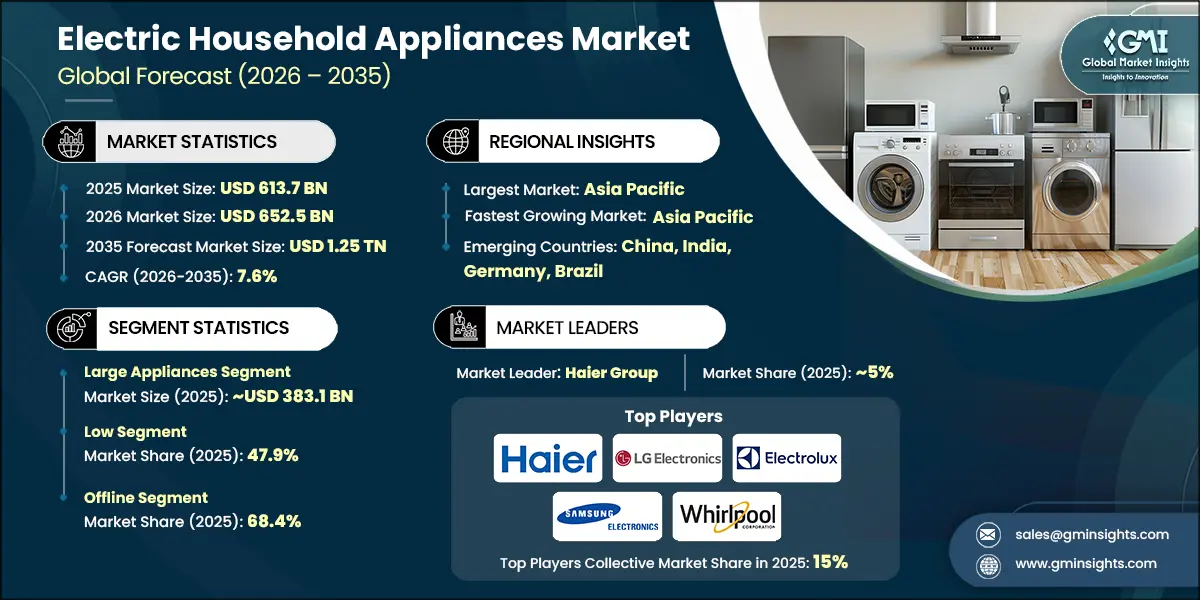
The electric household appliances market was estimated at USD 613.7 billion in 2025. The market is expected to grow from USD 652.5 billion in 2026 to USD 1.25 trillion in 2035, at a CAGR of 7.6% according to latest report published by Global Market Insights Inc.
Electric Household Appliances Market Trends
Electric Household Appliances Market Analysis
Based on product type, the market is categorized into large appliances and small appliances. The large appliances segment accounted for revenue of around USD 383.1 billion in 2025 and is anticipated to grow at a CAGR of 7.4% from 2026 to 2035.
Based on price, the electric household appliances market consists of low, medium and high. The low segment emerged as leader and held 47.9% of the total market share in 2025.
Based on distribution channel, the electric household appliances market consists of online and offline. The offline segment emerged as leader and held 68.4% of the total market share in 2025 and is anticipated to grow at a CAGR of 3.9% from 2026 to 2035.
North America Electric Household Appliances Market
The U.S. dominates an overall North America market and valued at USD 91 billion in 2025 and is estimated to grow at a CAGR of 7.4% from 2026 to 2035.
Europe Electric Household Appliances Market
In the European market, Germany is expected to experience significant and promising growth from 2026 to 2035.
Asia Pacific Electric Household Appliances Market
In the Asia Pacific market, the China held 36.1% market share in 2025 and is anticipated to grow at a CAGR of 8.2% from 2026 to 2035.
Middle East and Africa Electric Household Appliances Market
In the Middle East and Africa market, Saudi Arabia is expected to experience significant and promising growth from 2026 to 2035.
Electric Household Appliances Market Share
Electric Household Appliances Market Companies
Major players operating in the market include:
Electrolux AB holds a competitive edge through its strong consumer‑centric innovation, well‑established global distribution network, and leading market positions in Europe, the Nordics, Switzerland, and Latin America. The company emphasizes design, sustainability, and premium built‑in kitchen and laundry segments, helping differentiate its offerings in a fragmented and price‑pressured market.
Samsung Electronics is a specialized company that operates in consumer electronics including home appliances. The company’s portfolio boasts refrigerators, washing machines, ovens, and vacuum cleaners all with smart connectivity enabled through the SmartThings system. Samsung aims to innovate by using AI-enabled features, efficiency in energy and performance, and even customization that is evident in the Bespoke line, adapting to the needs of consumers based on lifestyle.
Whirlpool Corporation maintains a competitive edge through its historically strong manufacturing scale, extensive multi‑brand portfolio including Whirlpool, Maytag, KitchenAid, JennAir, and Amana, and deep-rooted distribution dominance across the Americas. Its long‑established brand equity and diversified product range give Whirlpool a resilient market presence, particularly in kitchen and laundry appliances.
Electric Household Appliances Industry News
The electric household appliances market research report includes in-depth coverage of the industry, with estimates & forecast in terms of revenue (USD Billion) (Million Units) from 2022 to 2035, for the following segments:
Market, By Product Type
Market, By Price
Market, By End Use
Market, By Distribution Channel
The above information is provided for the following regions and countries: