District Heating & Cooling Market Size & Share 2026-2035
Report ID: GMI2877
|
Published Date: October 2026
|
Report Format: PDF/Excel/Dashboard/Platform
Download Free PDF
Explore our licensing options:
District Heating & Cooling Market Size
The district heating & cooling market was valued at USD 429.9 billion in 2025, is projected to reach USD 449.3 billion in 2026, and is expected to grow at a 4.6% CAGR (2026-2035) to reach USD 675.1 billion by 2035.
The district heating & cooling market is being reshaped by the need to decarbonize dense urban thermal demand without sacrificing reliability or affordability. Network economics increasingly depend on an operator's ability to combine renewable heat, industrial waste heat, thermal storage, and digital controls while managing the conversion of high-temperature legacy assets.
GMI Analyst View
Based on input from industry leaders and network operators, the market handled 14,783.2 PJ in 2025. We view this installed demand base as a source of revenue durability for network owners, but also as evidence that fuel conversion and network modernization will unfold through long capital cycles rather than through rapid asset replacement.
District Heating & Cooling Market Trends, Growth Drivers & GMI Forecast Outlook
Decarbonization mandates, urban heat planning, and the economics of centralized thermal supply are reinforcing investment in new connections and lower-carbon supply systems. The market's trajectory will depend on how effectively operators align infrastructure renewal with financing structures, municipal planning, and increasingly stringent efficiency requirements.
Key Drivers
Driver
Evidence signal
Market-demand implication
GMI forecast condition
Accelerating renewable and waste heat integration
Renewable and waste heat accounted for 46.2% of EU district energy supply in 2024, surpassing fossil fuels for the first time [1]Euroheat & Power (via ccme.news). "Renewables and waste heat lead EU district energy supply for first time." ccme.news
Structural movement toward lower-cost renewable supply reduces operator fuel exposure and broadens economically viable service areas, supporting new-connection activity
Sustained policy support for power-to-heat technologies and waste-heat recovery frameworks underpins forecast baseline demand growth through 2035
Global network expansion driven by urban heat planning
Under existing policies, district heating consumers are projected to reach about 650 million worldwide by 2030 [2]IEA. "Executive summary - Renewables in District Energy." iea.org
Rising consumer connections extend operators' revenue bases and direct capital toward new distribution infrastructure in Asia Pacific and North America
Continued urban heat-planning mandates and municipal concession frameworks sustain connection growth sufficient to maintain the forecast-period CAGR
EU EED mandating DHC decarbonization
EU Energy Efficiency Directive 2023/1791 establishes progressive efficient district heating and cooling thresholds and requires systems built or substantially refurbished after 2030 to use no additional fossil fuels, with full decarbonization by 2050 [3]European Commission. "Energy Efficiency Directive." energy.ec.europa.eu
Compliance obligations compel investment in low-temperature upgrades, renewable heat sourcing, and digital controls, directing procurement toward advanced district energy infrastructure
Regulatory certainty over long planning horizons and blended-finance mechanisms support sustained infrastructure capital expenditure across European markets
Evidence anchors use cited external data; demand implications and forecast conditions represent GMI analysis.
Large heat pumps, electric boilers, thermal storage, and waste-heat recovery are changing the investment logic of established networks. Their value lies not only in lowering direct exposure to fuel-price volatility, but also in making a system more flexible: operators can absorb intermittent renewable electricity, recover surplus industrial heat, and optimize supply across multiple heat sources. That flexibility improves the commercial case for network extensions where building-level systems would otherwise compete for the same load.
Urban expansion provides a distinct demand mechanism. In established networks, investment is concentrated on replacing supply assets and upgrading distribution performance. In developing urban districts, however, district energy can be incorporated into land-use, utility, and building approvals before individual heating or cooling systems are installed. This combination of retrofit demand and greenfield connection growth gives operators several routes to expand their customer base.
The revised European policy framework adds greater predictability to long-cycle investment decisions. By connecting efficient network status to planning, financing, and public-support structures, regulation shifts decarbonization from a discretionary objective into a commercial requirement. Operators that can demonstrate a credible pathway to lower-carbon supply are better positioned to secure capital, maintain tariff legitimacy, and compete for municipal concessions.
Key Restraints
Restraint
Evidence signal
Market-demand implication
GMI forecast condition
Fossil fuel lock-in and legacy infrastructure conversion costs
About 90% of global district-heating supply is currently produced from fossil fuels, with coal accounting for approximately half of production [4]IEA. "Opportunities for district heating in the changing energy landscape." iea.org
Legacy high-temperature combined heat and power plants and heat-only boiler assets create stranded-asset risk and lengthen modernization timelines, particularly in China and Eastern Europe
The pace of coal and gas displacement directly determines whether physical volumes and revenues grow at or above the central forecast track through 2035
Below-target renewable adoption rate in EU heating and cooling
The EU renewable energy share in heating and cooling reached 26.7% in 2024 [5]Eurostat. "Small increase in renewable heating & cooling in 2024." ec.europa.eu
A persistent compliance gap can constrain eligibility for subsidized financing and favorable regulatory treatment, creating a cost-of-capital premium that moderates near-term investment in transition markets
Sustained policy enforcement, reformed electricity-to-gas price ratios, and Member State transposition progress are prerequisites for demand growth to reach the upper end of the forecast range
Tightening EU EED efficiency classification thresholds
EU Energy Efficiency Directive 2023/1791 introduced a carbon-intensity efficiency criterion for district energy systems, with an alternative threshold tightening from 200 g CO2/kWh to 150 g CO2/kWh from 2026 onward [3]European Commission. "Energy Efficiency Directive." energy.ec.europa.eu
Operators that do not meet updated criteria may face reduced access to regulated-return frameworks and structural funding, raising the financing cost of network investment
Operator compliance progress and the degree to which national regulators enforce reclassification are key swing variables in the European regional demand forecast
Evidence anchors use cited external data; demand implications and forecast conditions represent GMI analysis.
Legacy infrastructure is the most consequential constraint because supply conversion is inseparable from distribution-system modernization. High-temperature networks often require pipe, substation, and building-interface upgrades before they can efficiently accommodate heat pumps, geothermal heat, or low-grade recovered heat. Municipal owners and regulated operators must therefore sequence asset retirement, customer-service continuity, and capital recovery carefully, which can defer otherwise attractive projects.
The financing challenge is especially pronounced where renewable heat deployment has not yet kept pace with regulatory expectations. A project may have a technically sound decarbonization pathway but still face elevated financing costs if its compliance status, power-price exposure, or eligibility for public support remains uncertain. The result is a market in which the availability of concessional funding and workable tariff design can be as important as heat demand itself.
GMI Analyst View
We believe the central determinant of growth will be the financial architecture available to operators undertaking both legacy conversion and network expansion. Markets that combine stable regulated returns with public support and credible electricity-price signals should advance more quickly than those where compliance obligations arrive before investable project structures.
District Heating & Cooling Market Segment Analysis
By Energy Source
The district heating & cooling market's district heating segment generated USD 296.4 billion in 2025 and is projected to account for a 70.3% share of market revenue by 2035. Its position reflects the density of heat demand in cold-climate urban areas and the extensive installed base of centralized networks. As operators integrate renewable heat, waste heat, and storage, district heating is shifting from a fuel-delivery model toward a multi-source thermal platform that can preserve connection value while reducing supply risk.
District cooling is projected to generate USD 200.2 billion by 2035 and accounted for a 31.0% share of market revenue in 2025. Growth is concentrated in high-density warm-climate developments where centralized chilled-water systems can reduce peak electricity demand and simplify cooling provision for large mixed-use sites. The segment's economics are strongest where master-planned development, high cooling loads, and long-term service contracts allow operators to build networks around predictable utilization.
By Application
The residential segment generated USD 136.3 billion in 2025 and is projected to account for a 31.9% share of market revenue by 2035. Residential demand gives networks a broad and durable load base, particularly in dense apartment districts where centralized supply can be coordinated with building renovation programs. Connection growth depends on affordability, building-interface upgrades, and the ability of municipalities to align heat planning with housing policy.
The commercial segment accounted for a 45.6% share of market revenue in 2025 and is projected to generate USD 302.5 billion by 2035. Offices, retail centers, hospitals, hotels, and public facilities provide concentrated, relatively predictable thermal loads that can improve network utilization across the year. Their growing focus on energy-performance compliance and operational carbon management also strengthens district energy's appeal as an outsourced infrastructure solution.
The industrial segment generated USD 97.7 billion in 2025 and is projected to grow at a 4.9% CAGR (2026-2035). Process industries can use district energy to reduce exposure to dedicated boiler investment and improve the predictability of thermal supply. The segment also offers operators an opportunity to recover excess industrial heat and feed it back into nearby networks, creating a two-way thermal relationship that can improve overall system efficiency.
GMI Analyst View
We see commercial demand as especially attractive because its density, contractual visibility, and year-round load characteristics improve the economics of network expansion. Industrial demand represents a separate strategic opportunity where operators can move beyond heat supply and develop local thermal ecosystems built around waste-heat recovery and process-energy integration.
District Heating & Cooling Market Regional Analysis
North America District Heating & Cooling Market Analysis
The district heating & cooling market in North America generated USD 89.0 billion in 2025 and is projected to reach USD 137.6 billion by 2035. The region combines mature campus and downtown systems with newer municipal decarbonization projects that use geothermal energy, heat pumps, biomass, and recovered heat. Resilience planning and building-electrification policy are increasing the strategic value of district-scale infrastructure where building-level solutions may be constrained by space, cost, or grid capacity.
U.S.
The U.S. generated USD 71.2 billion in 2025 and is projected to account for a 16.3% share of global market revenue by 2035. Legacy steam systems in northeastern cities, campus networks, and large institutional districts create a foundation for conversion to more efficient hot-water configurations. Investment is increasingly directed toward reducing distribution losses, adding lower-carbon supply, and integrating district-scale geothermal and waste-heat resources.
Canada
Canada is projected to generate USD 27.5 billion by 2035 and accounted for a 4.1% share of global market revenue in 2025. Municipal energy planning, clean-energy incentives, and major urban redevelopment are supporting district heating projects across several provinces. The strongest opportunities are likely to emerge where local authorities can combine land-use control, low-carbon heat resources, and anchor-load customers within a single development strategy.
Europe District Heating & Cooling Market Analysis
Europe generated USD 238.1 billion in 2025 and is projected to reach USD 351.9 billion by 2035. The region's scale reflects decades of investment in urban district heating, especially across Nordic, Baltic, Central European, and Eastern European markets. Regulatory modernization is now driving a new investment cycle centered on renewable supply, lower-temperature distribution, digital optimization, and the conversion of coal- and gas-dependent assets.
Germany
Germany generated USD 30.9 billion in 2025 and is projected to account for a 6.8% share of global market revenue by 2035. Municipal heat-planning requirements are creating a clearer pipeline for network modernization and expansion. Large heat pumps, industrial waste heat, river and groundwater sources, and seasonal storage are increasingly relevant to urban networks seeking to reduce fossil-fuel dependence while preserving system reliability.
Poland
Poland is projected to generate USD 24.6 billion by 2035 and accounted for a 3.9% share of global market revenue in 2025. Its transition challenge is shaped by the scale of coal-based district heating infrastructure and the need to protect affordability during fuel conversion. Modernization funding and fuel-switching projects can support near-term progress, but the longer-term opportunity depends on integrating lower-carbon heat sources into networks designed around legacy thermal generation.
Sweden
Sweden generated USD 11.9 billion in 2025 and is projected to grow at a 4.0% CAGR (2026-2035). The country's mature networks have already established a comparatively low-carbon supply base, shifting investment emphasis toward efficiency improvements, low-temperature operation, seasonal storage, and recovered heat. Continued data-center and industrial development creates additional potential for integrating excess heat into urban systems.
Finland
Finland generated USD 9.5 billion in 2025 and is projected to account for a 2.1% share of global market revenue by 2035. The market is notable for its established urban networks and its practical use of industrial and data-center waste heat. Operators are using these resources to reduce dependence on conventional fuels while maintaining the high supply reliability required by dense northern-city load profiles.
Austria
Austria is projected to generate USD 10.6 billion by 2035 and accounted for a 1.7% share of global market revenue in 2025. The country combines biomass-based systems in smaller communities with larger urban networks supplied through combined heat and power and emerging renewable sources. Geothermal development and large heat pumps could become more important as operators seek to improve the flexibility and carbon performance of established city networks.
Italy
Italy is projected to generate USD 14.1 billion by 2035 and accounted for a 2.2% share of global market revenue in 2025. Northern Italian urban areas provide the most favorable conditions for district heating because population density, seasonal heating demand, and industrial activity support concentrated loads. Waste-heat recovery and industrial-site redevelopment may expand connection opportunities, although climate conditions limit the model's reach outside the country's northern regions.
France
France generated USD 9.5 billion in 2025 and is projected to account for a 2.1% share of global market revenue by 2035. Long-term concession models and a substantial public-sector network base provide a stable platform for renewable heat integration. Biomass, geothermal energy, and recovered heat are central to the modernization of city networks, particularly where public authorities are using concessional structures to balance decarbonization goals with consumer affordability.
The Rest of Europe generated USD 143.0 billion in 2025 and is projected to reach USD 211.1 billion by 2035. This aggregate includes a diverse mix of mature and transition-stage markets, many of which have significant legacy district heating assets. Investment momentum will be shaped by the capacity of public and private operators to convert fuel-dependent systems while maintaining service continuity and access to modernization capital.
Asia Pacific District Heating & Cooling Market Analysis
The district heating & cooling market in Asia Pacific generated USD 91.2 billion in 2025 and is projected to reach USD 168.0 billion by 2035. The region combines large-scale urban heating expansion in Northeast Asia with a growing district cooling opportunity in warmer, rapidly urbanizing cities. Its demand profile is differentiated by government-led network programs, rising connection density, and master-planned development that can incorporate centralized thermal infrastructure from the outset.
China
China generated USD 63.8 billion in 2025 and is projected to reach USD 117.6 billion by 2035. It remains the region's principal district heating market because of the scale of northern-city heating demand and the extensive role of centralized supply. The market's long-term development depends on converting coal-based capacity, increasing the use of cleaner combined heat and power, and expanding geothermal, biomass, and recovered-heat alternatives where local resources permit.
Japan
Japan accounted for a 2.5% share of global market revenue in 2025 and is projected to generate USD 20.2 billion by 2035. District energy is concentrated in high-density redevelopment zones, particularly around major transportation, commercial, and mixed-use districts. Its growth is closely tied to the continued approval of large projects where cooling and heating systems can be planned as part of the site's foundational infrastructure rather than retrofitted later.
South Korea
South Korea generated USD 9.1 billion in 2025 and is projected to grow at a 6.3% CAGR (2026-2035). Centralized networks in major metropolitan areas provide a substantial installed base for continued connection growth and supply modernization. The integration of industrial waste heat and geothermal resources can improve the carbon profile of these systems while helping operators manage the cost and resilience requirements of dense urban demand.
Middle East District Heating & Cooling Market Analysis
The district heating & cooling market in the Middle East generated USD 5.1 billion in 2025 and is projected to reach USD 7.8 billion by 2035. The region is primarily a district cooling market, where centralized chilled-water production serves dense residential, commercial, hospitality, and government developments. Long-horizon urban development programs make district cooling a core utility consideration rather than an optional efficiency measure.
UAE
The UAE generated USD 1.8 billion in 2025 and is projected to account for a 0.4% share of global market revenue by 2035. Large-scale developments in Dubai and Abu Dhabi continue to support centralized cooling infrastructure, with established operators serving commercial, residential, and hospitality districts. Expansion prospects are tied to the pace of master-planned development, customer connections, and the continued integration of district cooling into urban infrastructure plans.
Saudi Arabia
Saudi Arabia is projected to generate USD 2.0 billion by 2035 and is expected to grow at a 4.4% CAGR (2026-2035). New city and mixed-use projects provide an opportunity to embed centralized cooling systems before conventional building-level equipment is installed. The commercial case is supported by high cooling loads, but execution will depend on development sequencing, water and electricity management, and the timely delivery of anchor demand.
Qatar
Qatar generated USD 1.0 billion in 2025 and is projected to grow at a 4.1% CAGR (2026-2035). Existing cooling assets in Doha's commercial and hospitality districts provide a base for further utilization, while major urban development continues to support connection opportunities. Network growth will be influenced by occupancy patterns in newer districts and the ability of operators to sustain high utilization beyond initial development cycles.
Rest of World District Heating & Cooling Market Analysis
The district heating & cooling market in the Rest of World generated USD 6.5 billion in 2025 and is projected to grow at a 3.8% CAGR (2026-2035). Lower urban density, fragmented utility regulation, and constrained municipal financing limit the immediate scale of centralized thermal infrastructure in many of these markets. Select cities with concentrated industrial activity, high cooling demand, or accessible waste heat could nevertheless develop viable long-term district energy opportunities.
GMI Analyst View
We view Asia Pacific's expansion as structurally durable because it is supported by urban growth, connection-density gains, and public network programs rather than by fuel substitution alone. Europe remains strategically important because its modernization cycle can unlock greater value from mature assets, while the Middle East provides a distinct cooling-led growth profile.
District Heating & Cooling Market Share & Competitive Landscape
The district heating & cooling market share landscape is highly fragmented, with the top five participants including Veolia, ENGIE, Fortum, Vattenfall AB, Tabreed collectively holding 4.25% of global revenue in 2025. This structure reflects the local nature of district energy networks: operators often hold geographically defined concessions, and competitive intensity is strongest at the development, procurement, and contract-award stages rather than within an operating service area. Scale, access to capital, decarbonization expertise, and control of municipal relationships are therefore key differentiators.
Veolia held a 1.95% share of global market revenue in 2025. Its position is supported by a multi-utility operating model that links thermal energy networks with water, waste, and resource-recovery capabilities. This integration can strengthen its competitiveness in municipal concessions where customers seek a coordinated approach to infrastructure renewal and renewable heat sourcing.
ENGIE held a 1.26% share of global market revenue in 2025. Its network operations benefit from broader capabilities in energy infrastructure, renewables, and storage, allowing the company to support progressive supply decarbonization across district heating and cooling systems. Its strategic challenge is to translate this broad platform into economically scalable network conversions across varied regulatory environments.
Fortum held a 0.58% share of global market revenue in 2025. Its Nordic district heating operations provide experience in waste-heat recovery, lower-carbon supply systems, and urban network management. This operating history positions the company as a relevant reference point for other operators pursuing low-temperature conversion and the integration of recovered heat into established networks.
Vattenfall AB is positioned through district heating assets in Sweden and Germany, where its focus on fossil-free heat production aligns with the wider European modernization cycle. Its portfolio illustrates the importance of combining local network knowledge with access to renewable supply options, especially in markets where legacy coal and gas assets are under increasing regulatory pressure.
Tabreed holds a specialist position in Gulf district cooling, where centralized chilled-water systems are integral to large commercial, residential, and government developments. Its regional footprint demonstrates how operators in warm-climate markets can build scale through development partnerships, long-term customer connections, and operational expertise in managing high cooling loads.
Beyond these operators, Danfoss and Siemens are relevant through network controls, digital optimization, automation, and system components rather than concession ownership alone. Keppel Corporation Limited has developed a presence in Singapore and Southeast Asia, while Goteborg Energi, Helen Oy, Korea District Heating Corporation, and STEAG GmbH retain important national and regional positions. Development-oriented and specialist participants, including Emicool, Emirates Central Cooling Systems Corporation (Empower), and Ramboll Group A/S, add competitive pressure through project delivery, engineering, and market-specific service models.
Recent Industry Developments
PATRIZIA SE agreed to acquire Statkraft Varme, Statkraft AS's district heating business in Norway and Sweden, in September 2025. The transaction covers production and distribution assets serving households, municipalities, and businesses in the Nordic region and highlights continued institutional interest in district heating as a long-duration infrastructure asset class [6]PATRIZIA SE. "PATRIZIA acquires Statkraft's district heating business." patrizia.ag. The deal also signals a growing role for specialized infrastructure investors in acquiring and modernizing utility assets as incumbent energy groups prioritize capital allocation toward other renewable generation platforms.
Need a specific section of this report?
Purchase regional analysis, country-level analysis, company profiles, or any other segment-level insights separately
based on your research needs.
Authors: Ankit Gupta, Abhishek Chopra
District Heating & Cooling Market Scope
District Heating & Cooling Market Size
District Heating & Cooling Market Trends
District Heating & Cooling Market Analysis
District Heating & Cooling Market Share
Report Content
Chapter 1. Research Methodology
1.1 Research approach
1.2 Quality Commitments
1.2.1 GMI AI policy & data integrity commitment
1.2.1.1 Source consistency protocol
1.3 Research Trail & Confidence Scoring
1.3.1 Research Trail Components
1.3.2 Scoring Components
1.4 Data Collection
1.4.1 Partial list of primary sources
1.5 Data mining sources
1.5.1 Paid sources
1.5.1.1 Sources, by region
1.6 Base estimates and calculations
1.6.1 Base year calculation
1.7 Forecast model
1.7.1 Quantified market impact analysis
1.7.1.1 Mathematical impact of growth parameters on forecast
1.8 Research transparency addendum
1.8.1 Source attribution framework
1.8.2 Quality assurance metrics
1.8.3 Our commitment to trust
Chapter 2. Executive Summary
2.1 Industry 360° synopsis
2.2 Key market trends
2.2.1 Business trends
2.2.2 Energy source trends
2.2.3 Application trends
2.2.4 Regional trends
Chapter 3. Industry Insights
3.1 Industry ecosystem analysis
3.1.1 Supplier Landscape
3.1.2 Profit Margin
3.1.3 Cost structure
3.1.4 Value addition at each stage
3.1.5 Factors affecting the value chain
3.1.6 Disruptions
3.2 Industry impact forces
3.2.1 Growth drivers
3.2.2 Industry pitfalls & challenges
3.2.3 Market opportunities
3.3 Growth potential analysis
3.4 Pricing Analysis (Driven by Primary Research)
3.4.1 Historical Price Trend Analysis
3.4.2 Pricing Strategy by Player Type
3.5 Regulatory landscape
3.5.1 North America
3.5.2 Europe
3.5.3 Asia-Pacific
3.5.4 Middle East & Africa
3.6 Porter's analysis
3.7 PESTEL analysis
3.8 Impact of AI & Generative AI on the Market (Driven by Primary Research)
3.8.1 AI-Driven Disruption of Existing Business Models
3.8.2 GenAI Use Cases & Adoption Roadmap by Segment
The companies listed in this report are a curated selection - not the full competitive universe.
Our market revenue calculations use a bottom-up methodology that accounts for all players across all regions - including manufacturers, distributors, and specialists not individually profiled. The profiles section spotlights strategically significant players; it does not define the scope of our market sizing.
Your competitive landscape may also include
Regional or domestic-only leaders not in the global top tier
Distributors and channel partners who control market access
Emerging disruptors, startups, or adjacent-industry entrants
Niche players focused on a specific application or end-use
Free customization - up to 20% of report value
Need specific data? Request customization and get the insights tailored to your exact requirements.
For inquiries regarding discounts, bulk purchases, or customization requests, please contact us at[email protected]
Over 70% of our clients customize reports to fit their needs. Please tell us how you would like to customize yours below



District Heating & Cooling Market Size
The district heating & cooling market was valued at USD 429.9 billion in 2025, is projected to reach USD 449.3 billion in 2026, and is expected to grow at a 4.6% CAGR (2026-2035) to reach USD 675.1 billion by 2035.
The district heating & cooling market is being reshaped by the need to decarbonize dense urban thermal demand without sacrificing reliability or affordability. Network economics increasingly depend on an operator's ability to combine renewable heat, industrial waste heat, thermal storage, and digital controls while managing the conversion of high-temperature legacy assets.
GMI Analyst View
Based on input from industry leaders and network operators, the market handled 14,783.2 PJ in 2025. We view this installed demand base as a source of revenue durability for network owners, but also as evidence that fuel conversion and network modernization will unfold through long capital cycles rather than through rapid asset replacement.
District Heating & Cooling Market Trends, Growth Drivers & GMI Forecast Outlook
Decarbonization mandates, urban heat planning, and the economics of centralized thermal supply are reinforcing investment in new connections and lower-carbon supply systems. The market's trajectory will depend on how effectively operators align infrastructure renewal with financing structures, municipal planning, and increasingly stringent efficiency requirements.
Key Drivers
Evidence anchors use cited external data; demand implications and forecast conditions represent GMI analysis.
Large heat pumps, electric boilers, thermal storage, and waste-heat recovery are changing the investment logic of established networks. Their value lies not only in lowering direct exposure to fuel-price volatility, but also in making a system more flexible: operators can absorb intermittent renewable electricity, recover surplus industrial heat, and optimize supply across multiple heat sources. That flexibility improves the commercial case for network extensions where building-level systems would otherwise compete for the same load.
Urban expansion provides a distinct demand mechanism. In established networks, investment is concentrated on replacing supply assets and upgrading distribution performance. In developing urban districts, however, district energy can be incorporated into land-use, utility, and building approvals before individual heating or cooling systems are installed. This combination of retrofit demand and greenfield connection growth gives operators several routes to expand their customer base.
The revised European policy framework adds greater predictability to long-cycle investment decisions. By connecting efficient network status to planning, financing, and public-support structures, regulation shifts decarbonization from a discretionary objective into a commercial requirement. Operators that can demonstrate a credible pathway to lower-carbon supply are better positioned to secure capital, maintain tariff legitimacy, and compete for municipal concessions.
Key Restraints
Evidence anchors use cited external data; demand implications and forecast conditions represent GMI analysis.
Legacy infrastructure is the most consequential constraint because supply conversion is inseparable from distribution-system modernization. High-temperature networks often require pipe, substation, and building-interface upgrades before they can efficiently accommodate heat pumps, geothermal heat, or low-grade recovered heat. Municipal owners and regulated operators must therefore sequence asset retirement, customer-service continuity, and capital recovery carefully, which can defer otherwise attractive projects.
The financing challenge is especially pronounced where renewable heat deployment has not yet kept pace with regulatory expectations. A project may have a technically sound decarbonization pathway but still face elevated financing costs if its compliance status, power-price exposure, or eligibility for public support remains uncertain. The result is a market in which the availability of concessional funding and workable tariff design can be as important as heat demand itself.
GMI Analyst View
We believe the central determinant of growth will be the financial architecture available to operators undertaking both legacy conversion and network expansion. Markets that combine stable regulated returns with public support and credible electricity-price signals should advance more quickly than those where compliance obligations arrive before investable project structures.
District Heating & Cooling Market Segment Analysis
By Energy Source
The district heating & cooling market's district heating segment generated USD 296.4 billion in 2025 and is projected to account for a 70.3% share of market revenue by 2035. Its position reflects the density of heat demand in cold-climate urban areas and the extensive installed base of centralized networks. As operators integrate renewable heat, waste heat, and storage, district heating is shifting from a fuel-delivery model toward a multi-source thermal platform that can preserve connection value while reducing supply risk.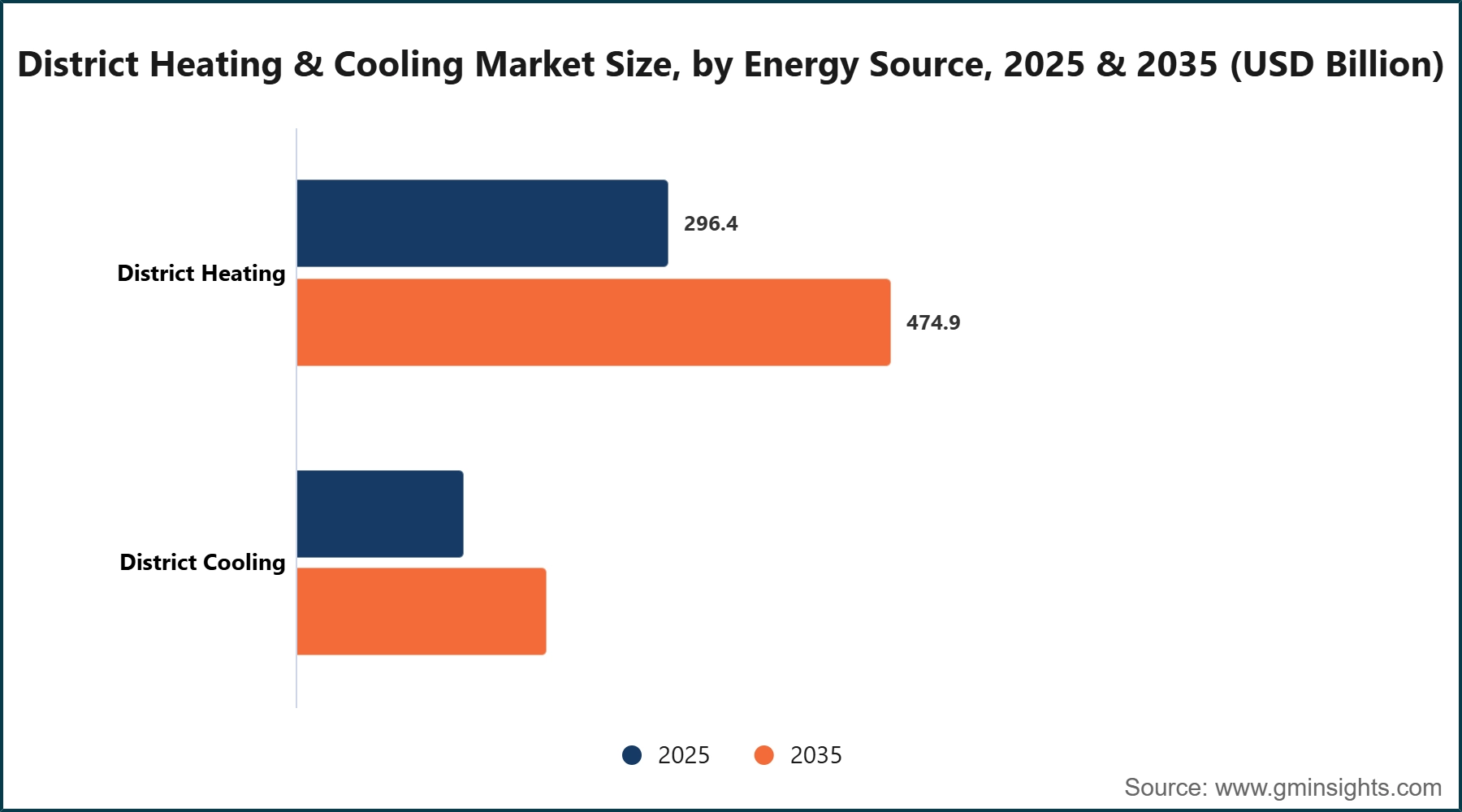
District cooling is projected to generate USD 200.2 billion by 2035 and accounted for a 31.0% share of market revenue in 2025. Growth is concentrated in high-density warm-climate developments where centralized chilled-water systems can reduce peak electricity demand and simplify cooling provision for large mixed-use sites. The segment's economics are strongest where master-planned development, high cooling loads, and long-term service contracts allow operators to build networks around predictable utilization.
By Application
The residential segment generated USD 136.3 billion in 2025 and is projected to account for a 31.9% share of market revenue by 2035. Residential demand gives networks a broad and durable load base, particularly in dense apartment districts where centralized supply can be coordinated with building renovation programs. Connection growth depends on affordability, building-interface upgrades, and the ability of municipalities to align heat planning with housing policy.
The commercial segment accounted for a 45.6% share of market revenue in 2025 and is projected to generate USD 302.5 billion by 2035. Offices, retail centers, hospitals, hotels, and public facilities provide concentrated, relatively predictable thermal loads that can improve network utilization across the year. Their growing focus on energy-performance compliance and operational carbon management also strengthens district energy's appeal as an outsourced infrastructure solution.
The industrial segment generated USD 97.7 billion in 2025 and is projected to grow at a 4.9% CAGR (2026-2035). Process industries can use district energy to reduce exposure to dedicated boiler investment and improve the predictability of thermal supply. The segment also offers operators an opportunity to recover excess industrial heat and feed it back into nearby networks, creating a two-way thermal relationship that can improve overall system efficiency.
GMI Analyst View
We see commercial demand as especially attractive because its density, contractual visibility, and year-round load characteristics improve the economics of network expansion. Industrial demand represents a separate strategic opportunity where operators can move beyond heat supply and develop local thermal ecosystems built around waste-heat recovery and process-energy integration.
District Heating & Cooling Market Regional Analysis
North America District Heating & Cooling Market Analysis
The district heating & cooling market in North America generated USD 89.0 billion in 2025 and is projected to reach USD 137.6 billion by 2035. The region combines mature campus and downtown systems with newer municipal decarbonization projects that use geothermal energy, heat pumps, biomass, and recovered heat. Resilience planning and building-electrification policy are increasing the strategic value of district-scale infrastructure where building-level solutions may be constrained by space, cost, or grid capacity.
U.S.
The U.S. generated USD 71.2 billion in 2025 and is projected to account for a 16.3% share of global market revenue by 2035. Legacy steam systems in northeastern cities, campus networks, and large institutional districts create a foundation for conversion to more efficient hot-water configurations. Investment is increasingly directed toward reducing distribution losses, adding lower-carbon supply, and integrating district-scale geothermal and waste-heat resources.
Canada
Canada is projected to generate USD 27.5 billion by 2035 and accounted for a 4.1% share of global market revenue in 2025. Municipal energy planning, clean-energy incentives, and major urban redevelopment are supporting district heating projects across several provinces. The strongest opportunities are likely to emerge where local authorities can combine land-use control, low-carbon heat resources, and anchor-load customers within a single development strategy.
Europe District Heating & Cooling Market Analysis
Europe generated USD 238.1 billion in 2025 and is projected to reach USD 351.9 billion by 2035. The region's scale reflects decades of investment in urban district heating, especially across Nordic, Baltic, Central European, and Eastern European markets. Regulatory modernization is now driving a new investment cycle centered on renewable supply, lower-temperature distribution, digital optimization, and the conversion of coal- and gas-dependent assets.
Germany
Germany generated USD 30.9 billion in 2025 and is projected to account for a 6.8% share of global market revenue by 2035. Municipal heat-planning requirements are creating a clearer pipeline for network modernization and expansion. Large heat pumps, industrial waste heat, river and groundwater sources, and seasonal storage are increasingly relevant to urban networks seeking to reduce fossil-fuel dependence while preserving system reliability.
Poland
Poland is projected to generate USD 24.6 billion by 2035 and accounted for a 3.9% share of global market revenue in 2025. Its transition challenge is shaped by the scale of coal-based district heating infrastructure and the need to protect affordability during fuel conversion. Modernization funding and fuel-switching projects can support near-term progress, but the longer-term opportunity depends on integrating lower-carbon heat sources into networks designed around legacy thermal generation.
Sweden
Sweden generated USD 11.9 billion in 2025 and is projected to grow at a 4.0% CAGR (2026-2035). The country's mature networks have already established a comparatively low-carbon supply base, shifting investment emphasis toward efficiency improvements, low-temperature operation, seasonal storage, and recovered heat. Continued data-center and industrial development creates additional potential for integrating excess heat into urban systems.
Finland
Finland generated USD 9.5 billion in 2025 and is projected to account for a 2.1% share of global market revenue by 2035. The market is notable for its established urban networks and its practical use of industrial and data-center waste heat. Operators are using these resources to reduce dependence on conventional fuels while maintaining the high supply reliability required by dense northern-city load profiles.
Austria
Austria is projected to generate USD 10.6 billion by 2035 and accounted for a 1.7% share of global market revenue in 2025. The country combines biomass-based systems in smaller communities with larger urban networks supplied through combined heat and power and emerging renewable sources. Geothermal development and large heat pumps could become more important as operators seek to improve the flexibility and carbon performance of established city networks.
Italy
Italy is projected to generate USD 14.1 billion by 2035 and accounted for a 2.2% share of global market revenue in 2025. Northern Italian urban areas provide the most favorable conditions for district heating because population density, seasonal heating demand, and industrial activity support concentrated loads. Waste-heat recovery and industrial-site redevelopment may expand connection opportunities, although climate conditions limit the model's reach outside the country's northern regions.
France
France generated USD 9.5 billion in 2025 and is projected to account for a 2.1% share of global market revenue by 2035. Long-term concession models and a substantial public-sector network base provide a stable platform for renewable heat integration. Biomass, geothermal energy, and recovered heat are central to the modernization of city networks, particularly where public authorities are using concessional structures to balance decarbonization goals with consumer affordability.
The Rest of Europe generated USD 143.0 billion in 2025 and is projected to reach USD 211.1 billion by 2035. This aggregate includes a diverse mix of mature and transition-stage markets, many of which have significant legacy district heating assets. Investment momentum will be shaped by the capacity of public and private operators to convert fuel-dependent systems while maintaining service continuity and access to modernization capital.
Asia Pacific District Heating & Cooling Market Analysis
The district heating & cooling market in Asia Pacific generated USD 91.2 billion in 2025 and is projected to reach USD 168.0 billion by 2035. The region combines large-scale urban heating expansion in Northeast Asia with a growing district cooling opportunity in warmer, rapidly urbanizing cities. Its demand profile is differentiated by government-led network programs, rising connection density, and master-planned development that can incorporate centralized thermal infrastructure from the outset.
China
China generated USD 63.8 billion in 2025 and is projected to reach USD 117.6 billion by 2035. It remains the region's principal district heating market because of the scale of northern-city heating demand and the extensive role of centralized supply. The market's long-term development depends on converting coal-based capacity, increasing the use of cleaner combined heat and power, and expanding geothermal, biomass, and recovered-heat alternatives where local resources permit.
Japan
Japan accounted for a 2.5% share of global market revenue in 2025 and is projected to generate USD 20.2 billion by 2035. District energy is concentrated in high-density redevelopment zones, particularly around major transportation, commercial, and mixed-use districts. Its growth is closely tied to the continued approval of large projects where cooling and heating systems can be planned as part of the site's foundational infrastructure rather than retrofitted later.
South Korea
South Korea generated USD 9.1 billion in 2025 and is projected to grow at a 6.3% CAGR (2026-2035). Centralized networks in major metropolitan areas provide a substantial installed base for continued connection growth and supply modernization. The integration of industrial waste heat and geothermal resources can improve the carbon profile of these systems while helping operators manage the cost and resilience requirements of dense urban demand.
Middle East District Heating & Cooling Market Analysis
The district heating & cooling market in the Middle East generated USD 5.1 billion in 2025 and is projected to reach USD 7.8 billion by 2035. The region is primarily a district cooling market, where centralized chilled-water production serves dense residential, commercial, hospitality, and government developments. Long-horizon urban development programs make district cooling a core utility consideration rather than an optional efficiency measure.
UAE
The UAE generated USD 1.8 billion in 2025 and is projected to account for a 0.4% share of global market revenue by 2035. Large-scale developments in Dubai and Abu Dhabi continue to support centralized cooling infrastructure, with established operators serving commercial, residential, and hospitality districts. Expansion prospects are tied to the pace of master-planned development, customer connections, and the continued integration of district cooling into urban infrastructure plans.
Saudi Arabia
Saudi Arabia is projected to generate USD 2.0 billion by 2035 and is expected to grow at a 4.4% CAGR (2026-2035). New city and mixed-use projects provide an opportunity to embed centralized cooling systems before conventional building-level equipment is installed. The commercial case is supported by high cooling loads, but execution will depend on development sequencing, water and electricity management, and the timely delivery of anchor demand.
Qatar
Qatar generated USD 1.0 billion in 2025 and is projected to grow at a 4.1% CAGR (2026-2035). Existing cooling assets in Doha's commercial and hospitality districts provide a base for further utilization, while major urban development continues to support connection opportunities. Network growth will be influenced by occupancy patterns in newer districts and the ability of operators to sustain high utilization beyond initial development cycles.
Rest of World District Heating & Cooling Market Analysis
The district heating & cooling market in the Rest of World generated USD 6.5 billion in 2025 and is projected to grow at a 3.8% CAGR (2026-2035). Lower urban density, fragmented utility regulation, and constrained municipal financing limit the immediate scale of centralized thermal infrastructure in many of these markets. Select cities with concentrated industrial activity, high cooling demand, or accessible waste heat could nevertheless develop viable long-term district energy opportunities.
GMI Analyst View
We view Asia Pacific's expansion as structurally durable because it is supported by urban growth, connection-density gains, and public network programs rather than by fuel substitution alone. Europe remains strategically important because its modernization cycle can unlock greater value from mature assets, while the Middle East provides a distinct cooling-led growth profile.
District Heating & Cooling Market Share & Competitive Landscape
The district heating & cooling market share landscape is highly fragmented, with the top five participants including Veolia, ENGIE, Fortum, Vattenfall AB, Tabreed collectively holding 4.25% of global revenue in 2025. This structure reflects the local nature of district energy networks: operators often hold geographically defined concessions, and competitive intensity is strongest at the development, procurement, and contract-award stages rather than within an operating service area. Scale, access to capital, decarbonization expertise, and control of municipal relationships are therefore key differentiators.
Veolia held a 1.95% share of global market revenue in 2025. Its position is supported by a multi-utility operating model that links thermal energy networks with water, waste, and resource-recovery capabilities. This integration can strengthen its competitiveness in municipal concessions where customers seek a coordinated approach to infrastructure renewal and renewable heat sourcing.
ENGIE held a 1.26% share of global market revenue in 2025. Its network operations benefit from broader capabilities in energy infrastructure, renewables, and storage, allowing the company to support progressive supply decarbonization across district heating and cooling systems. Its strategic challenge is to translate this broad platform into economically scalable network conversions across varied regulatory environments.
Fortum held a 0.58% share of global market revenue in 2025. Its Nordic district heating operations provide experience in waste-heat recovery, lower-carbon supply systems, and urban network management. This operating history positions the company as a relevant reference point for other operators pursuing low-temperature conversion and the integration of recovered heat into established networks.
Vattenfall AB is positioned through district heating assets in Sweden and Germany, where its focus on fossil-free heat production aligns with the wider European modernization cycle. Its portfolio illustrates the importance of combining local network knowledge with access to renewable supply options, especially in markets where legacy coal and gas assets are under increasing regulatory pressure.
Tabreed holds a specialist position in Gulf district cooling, where centralized chilled-water systems are integral to large commercial, residential, and government developments. Its regional footprint demonstrates how operators in warm-climate markets can build scale through development partnerships, long-term customer connections, and operational expertise in managing high cooling loads.
Beyond these operators, Danfoss and Siemens are relevant through network controls, digital optimization, automation, and system components rather than concession ownership alone. Keppel Corporation Limited has developed a presence in Singapore and Southeast Asia, while Goteborg Energi, Helen Oy, Korea District Heating Corporation, and STEAG GmbH retain important national and regional positions. Development-oriented and specialist participants, including Emicool, Emirates Central Cooling Systems Corporation (Empower), and Ramboll Group A/S, add competitive pressure through project delivery, engineering, and market-specific service models.
Recent Industry Developments
PATRIZIA SE agreed to acquire Statkraft Varme, Statkraft AS's district heating business in Norway and Sweden, in September 2025. The transaction covers production and distribution assets serving households, municipalities, and businesses in the Nordic region and highlights continued institutional interest in district heating as a long-duration infrastructure asset class [6]PATRIZIA SE. "PATRIZIA acquires Statkraft's district heating business." patrizia.ag. The deal also signals a growing role for specialized infrastructure investors in acquiring and modernizing utility assets as incumbent energy groups prioritize capital allocation toward other renewable generation platforms.
Need a specific section of this report?
Purchase regional analysis, country-level analysis, company profiles, or any other segment-level insights separately
based on your research needs.