Disposable Thermometer Market Size & Share 2026-2035

Market Size - By Type (Digital Thermometers, Strip Thermometers); By Target Area (Oral, Axilla, Rectal, Other Target Areas); By End Use (Hospitals, Diagnostic Centers, Homecare, Other End Users), Growth Forecast. The market forecasts are provided in terms of value (USD).
Report ID: GMI4622
   |
Published Date: March 2026
 | 
Report Format: PDF

Download Free PDF

Disposable Thermometer Market Size

The global disposable thermometer market was valued at USD 291.3 million in 2025. The market is expected to grow from USD 312.5 million in 2026 to USD 679.8 million in 2035, at a CAGR of 9% during the forecast period, according to the latest report published by Global Market Insights Inc.
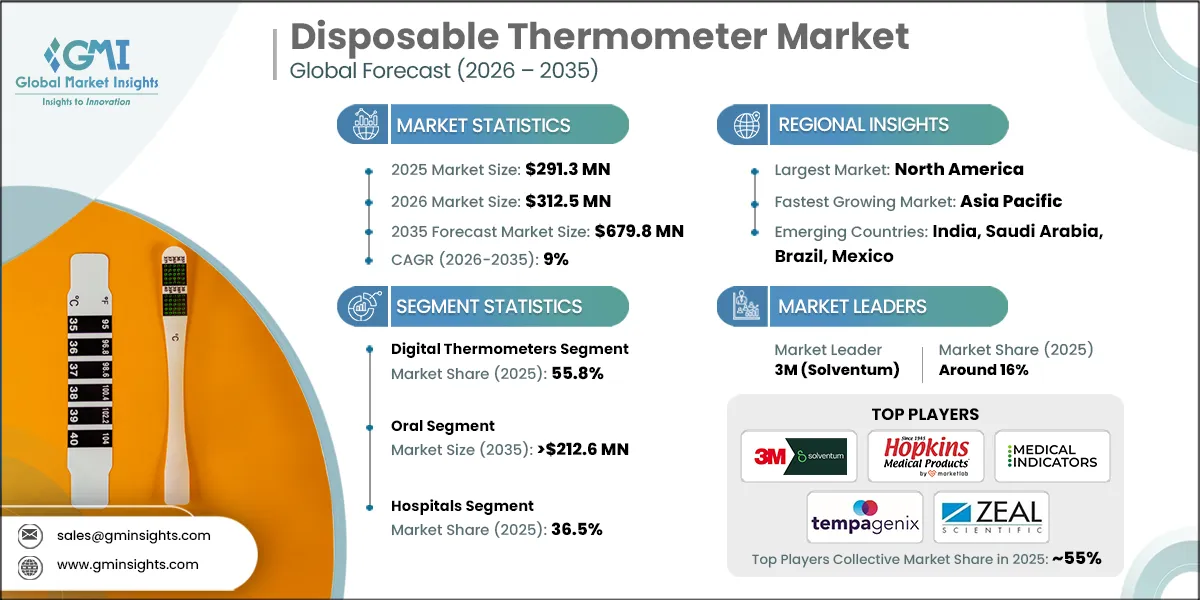
Disposable Thermometer Market Research Report
Growing emphasis on infection prevention and control, technological advancements, increasing demand for home-based care services and rising hospital acquired infections (HAIs), among other factors, are driving the market growth.

Innovation in more accurate disposable temperature strips and expansion of telehealth and remote temperature monitoring practices are expected to propel the industry demand. 3M, Hopkins Medical Products, MEDICAL INDICATORS, tempagenix, and Zeal are among the leading players operating in the market. These players mainly focus on product innovation, geographic expansion, adoption of the latest technologies in devices, and collaboration with local or regional healthcare providers, among others.
 

The market has increased from USD 240 million in 2022 and reached USD 271.9 million in 2024, with the historic growth rate of 6.5%. Hospitals and clinics are choosing single-use thermometers more often to keep patients safe from hospital-acquired infections (HAIs). When COVID-19 started, the need for clean, touch-free temperature checks became even more important to protect both patients and healthcare workers. As people live longer and more individuals manage chronic conditions, families and caregivers are relying more on disposable thermometers for daily health monitoring.
 

Recent improvements in technology are making disposable thermometers more reliable than ever. These devices are now more accurate and easier to use, whether in hospitals or at home. As more people receive medical treatment at home, particularly in wealthy countries, disposable thermometers have become indispensable instruments. People managing their health at home prefer these thermometers because they're simple to use, safe, and affordable. More people are also adding these convenient thermometers to their travel health kits and emergency medical supplies.
 

Further, disposable income is an important indicator to determine an individual’s ability to consume goods and services. The disposable thermometers market is poised to grow exponentially due to an rise in disposable income. Increasing disposable income is closely associated with healthcare spending, and is anticipated to affect healthcare spending in the coming years.
 

A disposable thermometer is a device used for evaluating the body heat of a human or other animals. The tip of the device is inserted into the mouth under the tongue (oral or sublingual temperature), under the armpit (axillary temperature), or on the forehead. After each use, the thermometer is discarded, which helps prevent the spread of serious infections like Clostridium difficile, MRSA, norovirus, and rotavirus.

Disposable Thermometer Market Trends

The medical device industry has one of the highest R&D expenses measured globally. Thus, technological advancements remain at the core of innovation. A significant decline in the performance of disposable thermometers was observed in the last decade, but recent advances in disposable thermometers have ultimately reversed that trend. This was possible due to the progress of novel products for monitoring the body temperature.
 

  • Additionally, new product approvals might increase due to the growing number of potential novel products that have entered the development phase in recent years. Also, major industry players are adopting various strategies to remain flexible and competitive in advancing technologies.
     
  • Further, disposable income is also an important indicator to determine the individual’s ability to consume goods and services. The disposable thermometers market is poised to grow exponentially owing to an increase in disposable income.
     
  • Increasing disposable income is highly associated with healthcare spending, and recent growth in disposable income is anticipated to affect healthcare spending over the coming years.
     
  • For instance, as per the Centers for Medicare & Medicaid Services, in 2024, the U.S. health care spending grew 7.5% in 2023, reaching USD 4.9 trillion, or USD 14,570 per person. Furthermore, adoption of non-mercury disposable thermometers in developed and developing economies has increased. This will further trigger the market growth.
     

Disposable Thermometer Market Analysis

Disposable Thermometer Market, By Type, 2022-2035 (USD Million)

Based on type, the disposable thermometer market is segmented into digital thermometers and strip thermometers. The digital thermometers segment accounted for a leading share of 55.8% in 2025. Expansion in emerging markets with growing healthcare and growing elderly population requiring frequent monitoring and rising adoption in emergency and field medical settings are among the key variables contributing to industry growth. The segment is expected to reach USD 372 million by 2035, growing at a CAGR of 8.8% during the forecast period.
 

  • With advancements in technology, people have gradually shifted from traditional thermometers to digital thermometers. As technology improves, health awareness grows, and the need for accurate temperature readings becomes more important. These modern thermometers are becoming the preferred choice because they give faster and more accurate readings while being easy to use. Hospitals, clinics, and nursing homes are switching to single-use digital thermometers to prevent infections and reduce the risk of spreading germs between patients.
     
  • Additionally, more healthcare facilities are opening, and the COVID-19 pandemic has made digital thermometers essential for checking temperatures in places like offices and schools. Better sensor technology means these devices now provide more accurate and quicker readings, making them reliable tools for both healthcare professionals and families at home.
     
  • Further, companies making these thermometers now include features that let users connect to their phones through Bluetooth and use apps to keep track of temperature readings. As healthcare systems get better and people in developing countries can afford more, we're seeing more investment in creating new, better, and affordable temperature-measuring technology.
     
  • The strip thermometers segment was valued at USD 128.7 million in 2025. Strip thermometers are relatively low-cost, lightweight, flexible thermometer options to help accurately assess body temperature using a color change from heat sensitive liquid crystal to show current body temperature.
     
  • Their simplicity of design allows for various applications for rapid temperature screening in healthcare and non-healthcare environments, including schools, workplaces, travel, and basic home monitoring, therefore they're often better suited for population-based mass screening than for precise measurements (clinical grade).
     
  • Furthermore, with an ongoing focus on being hygienic and convenient, the use of strip thermometers may continue to be a reliable fast and low complexity option for assessing body temperature.
     

Based on target area, the disposable thermometer market is segmented into oral, axilla, rectal, and other target areas. The oral segment is expected to drive business growth and expand at a CAGR of 9.1%, reaching over USD 212.6 million by 2035.
 

  • There is a comparatively higher preference towards oral thermometers especially in homecare settings and clinics citing benefits such as easy to use and consistent results. These thermometers are gentle and user-friendly, making them comfortable for everyone to use. Families and even healthcare facilities are prefering them owing to higher accuracy for temperature readings, and overall lower cost.
     
  • Hospitals and clinics have now changed their preference to more disposable oral thermometers to take better care of patients. These disposable devices help keep items clean and restrict the spread of microorganisms, especially in sensitive areas in the hospitals such as intensive care units, operation theaters, and children's wards.
     
  • More people are using oral thermometers because of the rise in long-term health conditions that need regular temperature checks and because doctors are focusing more on preventing illness before it happens.
     
  • The Axilla segment is expected to record higher growth with a CAGR of 9.7% over the forecast period. Taking the axilla temperature is an internal and less invasive process for measuring temperatures compared to taking a temperature orally (or rectally). It can be done by placing a probe or thermometer in a person's armpit.
     
  • The axilla temperature method allows for easy access to the thermometer for young children, elderly people, and adults who have a difficult time with taking their temperature orally or rectally.
     
  • Using disposable axillary probes helps reduce the need to clean them and prevent the spread of germs or cross-contamination from one patient to another, particularly in settings where there is a high volume of patients.
     
  • The rectal segment was valued at USD 68.3 million in 2025. Rectal temperature measurement offers high precision and accuracy when determining true core body temperature. Thus, rectal temperature measurement is particularly useful in infants, those who are critically ill and require high accuracy in diagnosing temperature abnormalities.
     
  • By utilizing disposable rectal thermometers, the potential for cross-infection is mitigated, and therefore hygiene is promoted. This is especially important for neonatal units and during an emergency, where reliable temperature measurements are critical for the accurate assessment of patients.

Disposable Thermometer Market, By End Use (2025)

Based on end use, the disposable thermometer market is segmented into hospitals, diagnostic centers, homecare and other end users. The hospitals segment accounted for the leading market share of 36.5% in 2025.
 

  • With a rise in new patients seeking help for chronic and infectious illnesses, there is now a greater need for hospital admissions. This has resulted in increased use of these 'single-use' thermometers in emergency departments, intensive care units, and neonatal units.
     
  • These thermometers allow a medical practitioner to provide a more efficient level of care by allowing them to take temperatures in a quicker and more reliable manner. Hospitals seem to appreciate these devices since they do not require cleaning or sterilization between each use, which saves time and money.
     
  • The introduction of new technologies has resulted in making disposable thermometers more attractive to hospitals. There is better adoption of digital features into these products, allowing them to produce better results at a much faster rate.
     
  • Hospitals primarily buy these devices in bulk due to cheaper rates from certain insurance companies, which makes them highly appealing. These factors worsen the dependency of the hospital segment on these products and imply the market is set for use in the future. 
     
  • The diagnostic centers segment was valued at USD 71.4 million in 2025. To enhance patient examination workflow while also adhering to strict hygiene requirements, diagnostic centers utilize disposable thermometers. As they are intended to be used only once, there is no requirement to sterilize these devices between patients and therefore no additional time, labor, or risk of cross-infection associated with this process.
     
  • Due to their relatively low cost and proven reliability, disposable thermometers are a viable option for both routine vital sign measurements and specialized diagnostic procedures. As diagnostic facilities expand their service offerings and patient volume increases, the use of disposable thermometers may help support operational efficiency, compliance with safety regulations, and ease of patient throughput.
     
  • The homecare segment was valued at USD 59.5 million in 2025. Home healthcare providers are using disposable thermometers because they are easy to clean, can be used on different patients, and are simple to read.
     
  • Disposable thermometers are ideal for home care of elderly patients and chronic disease patients due to their low weight and maintenance. As the trend toward home-based healthcare grows due to an aging population, the use of disposable thermometers as an effective, low-effort tool for safe and accessible management of patients’ health may also increase.

U.S. Disposable Thermometer Market, 2022 – 2035 (USD Million)

North America Disposable Thermometer Market

North America disposable thermometer industry accounted for leading share of 38.2% in 2025.
 

  • The U.S. disposable thermometer market was valued at USD 85 million and USD 89.8 million in 2022 and 2023, respectively. In 2025 the market size was valued at USD 101.3 million from USD 95.2 million in 2024. Favorable regulatory guidelines for disposable medical devices in the country is projected to fuel market growth.
     
  • Healthcare facilities are now placing a stronger emphasis on infection control practices. As hospitals, clinics, and nursing homes strive to maintain contamination-free environments, single-use thermometers have become essential tools that completely prevent cross-contamination. The COVID-19 pandemic has made healthcare providers more vigilant about infection control, leading to higher demand for single-use medical devices like disposable thermometers.
     
  • Additionally, temperature monitoring devices are becoming more important as the U.S. sees an increase in infectious diseases, seasonal flu, and chronic conditions. Many Americans live with disabilities or age-related chronic illnesses, and there are particularly high rates of diabetes along with all other conditions that need regular temperature monitoring.
     
  • Furthermore, as more elderly patients require hospital care, healthcare providers need easier and cleaner ways to check body temperature, making disposable thermometers the natural choice.
     

Europe Disposable Thermometer Market

Europe accounted for a significant share of the disposable thermometer industry and was valued at USD 82.7 million in 2025.
 

  • The market in Europe is growing steadily as healthcare systems emphasize rigorous hygiene standards and infection‑control protocols.
     
  • Using a thermometer that can only be used once limits the risk of cross-contamination between patients, and hence they are used by different settings, including hospitals, long‑term care facilities, and emergency departments, among others.
     
  • In addition, as the population of Europe ages, the need for these types of products may continue to rise due to the growing number of physician visits being made in both inpatient and outpatient settings.
     
  • Furthermore, private clinics see a benefit to these types of thermometers for their practice because they provide savings along with better efficiencies in their operation.
     

Asia Pacific Disposable Thermometer Market

The Asia Pacific disposable thermometer industry accounted for a substantial share of the market and was valued at USD 58.8 million in 2025.
 

  • Due to the growing medical facilities in the Asia Pacific region, such as healthcare clinics, hospitals, supportive medical programs within the community, and awareness of the impact of disease transmission on society, the market growth is being driven.
     
  • In addition, The demand for disposable thermometers, which are inexpensive and easy-to-use diagnostic instruments, are expected to continue to surge throughout the region over the forecast timeframe.
     
  • Similarly, due to increased public health preparedness, many Asia Pacific countries are using single-use thermometers and increasing the frequency at which they are used for screening patients during seasonal outbreaks. The demand for at-home care is also growing at a steady rate, as patients and their families are trying to find affordable and easy to use options for monitoring their fever-levels.
     
  • Further, as digital health initiatives continue to expand, the use of disposable thermometers will play an important role in the monitoring, triage, and remote-care kits used by patients throughout the Asia-Pacific region.
     
  • Moreover, the region’s strong manufacturing capabilities support localized production, improving affordability and supply reliability.
     

Latin America Disposable Thermometer Market

The Latin American disposable thermometer industry is anticipated to exhibit remarkable growth during the analysis period.
 

  • In Latin America, the market is growing as hospitals and healthcare providers look for cost-effective methods of diagnosing patients while keeping hygiene in mind, due to rising levels of awareness about infection control standards.
     
  • Hospitals and other healthcare facilities are increasingly using single-use devices (SUDs) to reduce the burden of sterilization and reduce the spread of communicable diseases in high-traffic areas.
     
  • The growth of home care has created more opportunities, as more and more patients want to manage chronic disease outside the hospital, which may create a new demand for simple, low-maintenance temperature monitoring solutions.
     
  • In addition, improved supply chains and an increase in imports of low-cost consumables may lead to a broader use of disposable thermometers. Although there are variations in healthcare infrastructure among the different countries, the overall volume of disposable thermometers being used continues to increase as both governments and private providers continue to improve their emphasis on preventative health.   
     

Middle East and Africa Disposable Thermometer Market

The Middle East and Africa disposable thermometer industry is expected to experience substantial growth over the analysis timeframe.
 

  • The MEA region is witnessing gradual but notable growth in disposable thermometer usage as healthcare systems modernize and place greater emphasis on infection‑prevention measures.
     
  • Hospitals and clinics, particularly in urban centers, increasingly adopt single‑use thermometers to enhance patient safety and streamline workflows. Many countries are expanding primary healthcare networks, creating demand for easy‑to‑use, hygienic diagnostic tools suitable for varied clinical settings.
     
  • Additionally, in more developed markets within the Gulf states, higher healthcare investment and adoption of global hygiene standards further boost usage.
     

Disposable Thermometer Market Share

The disposable thermometer industry is moderately competitive, shaped by a mix of large medical manufacturers and specialized companies focused on single‑use temperature‑monitoring solutions. Top 5 players including 3M, Hopkins Medical Products, MEDICAL INDICATORS, tempagenix, and Zeal, accounted for around 65% share of the global market in 2025. These players with broad healthcare portfolios compete alongside niche producers that emphasize precision, hygiene, and ease of use. Companies operating in this space differentiate through product accuracy, material innovation, ease of interpretation, and compliance with infection‑control standards.
 

Smaller and specialized companies focus on targeted innovations such as color‑change technologies, improved readability, environmentally friendly materials, and customizable formats for clinical workflows. These companies have strong partnerships with hospitals, diagnostic centers, and home healthcare providers, which help them maintain their significant market position.
 

Furthermore, competitive pressure as a result of the growth of private label firms and domestic competitors has intensified in the cost-sensitive regions of APAC and Latin America. Companies focusing on improving the accuracy of their products and digitizing them are gaining a foothold. Expansion of the market share in this segment will be a result of increased product development as well as strategic alliances and international diversification.
 

Disposable Thermometer Market Companies

A few of the prominent players operating in the global disposable thermometer industry include:

  • 3M (Solventum)
  • Acme United Corporation
  • Advanced Meditech Internationals (AMI)
  • American Diagnostics Corporation
  • FIRST AID ONLY
  • graham field
  • H-B Instrument
  • Hopkins Medical Products
  • LCRHallcrest
  • MEDICAL INDICATORS
  • MEDLINE
  • microlife corporation
  • Protontek
  • tempagenix
  • Zeal
     
  • 3M (Solventum)

Focuses on expanding its medical consumables portfolio through scalable manufacturing, global distribution strength, and innovation in safer, hygienic temperature‑monitoring solutions while leveraging strong brand trust to penetrate clinical and home‑care segments.
 

Centers on precision‑engineered, single‑use thermometers with strict quality control, strengthening partnerships with hospitals and emergency care providers, and investing in design improvements for accuracy, infection prevention, and clinician convenience.
 

Advances user‑friendly temperature‑strip technologies, emphasizes retail and home‑use channels, enhances visual‑indicator formats, and strategically expands into travel, school, and workplace wellness markets through accessible, low‑cost disposable solutions.
 

Disposable Thermometer Industry News:

  • In January 2026, NexTemp, a subsidiary of Medical Indicators, announced the release of its new NexTemp App, a digital companion designed to simplify temperature tracking for everyday health monitoring, and personal insights. It is paired with the brand’s single-use NexTemp Ultra thermometers, for improved accuracy, hygiene, and seamless experience. This development has expanded company's product range, enabling it to improve its market presence.
     

The disposable thermometer market research report includes an in-depth coverage of the industry with estimates and forecasts in terms of revenue in (USD Million) from 2022 - 2035 for the following segments:

Market, By Type

  • Digital thermometers
  • Strip thermometers

Market, By Target Area

  • Oral
  • Axilla 
  • Rectal
  • Other target areas

Market, By End Use

  • Hospitals
  • Diagnostic centers
  • Homecare
  • Other end users
     

The above information is provided for the following regions and countries:

  • North America
    • U.S.
    • Canada
  • Europe
    • Germany
    • UK
    • France
    • Spain
    • Italy
    • Netherlands
  • Asia Pacific
    • China
    • Japan
    • India
    • Australia
    • South Korea
  • Latin America
    • Brazil
    • Mexico
    • Argentina
  • MEA
    • South Africa
    • Saudi Arabia
    • UAE
AuthorsMonali Tayade, Shishanka Wangnoo
Disposable Thermometer Market Scope
  • Disposable Thermometer Market Size
  • Disposable Thermometer Market Trends
  • Disposable Thermometer Market Analysis
  • Disposable Thermometer Market Share

Report Content

Chapter 1   Research Methodology

1.1    Research approach

1.2    Quality commitments

1.2.1    GMI AI policy & data integrity commitment

1.2.1.1    Source consistency protocol

1.3    Research trail & confidence scoring

1.3.1    Research trail components

1.3.2    Scoring components

1.4    Data collection

1.4.1    Partial list of primary sources

1.5    Data mining sources

1.5.1    Paid sources

1.5.1.1    Sources, by region

1.6    Base estimates and calculations

1.6.1    Base year calculation

1.7    Forecast model

1.7.1    Quantified market impact analysis

1.7.1.1    Mathematical impact of growth parameters on forecast

1.8    Research transparency addendum

1.8.1    Source attribution framework

1.8.2    Quality assurance metrics

1.8.3    Our commitment to trust

Chapter 2   Executive Summary

2.1    Industry 360° synopsis

2.2    Key market trends

2.2.1    Regional trends

2.2.2    Type trends

2.2.3    Target area trends

2.2.4    End use trends

2.3    CXO perspectives: Strategic imperatives

Chapter 3   Industry Insights

3.1    Industry ecosystem analysis

3.2    Industry impact forces

3.2.1    Growth drivers

3.2.1.1    Growing emphasis on infection prevention and control

3.2.1.2    Rising hospital acquired infections (HAIs)

3.2.1.3    Increasing demand for home-based care services

3.2.1.4    Technological advancements

3.2.2    Industry pitfalls and challenges

3.2.2.1    Availability of substitutes

3.2.2.2    Environmental concerns due to single-use plastic waste

3.2.3    Opportunities

3.2.3.1    Development of eco-friendly biodegradable disposable thermometers

3.3    Growth potential analysis

3.4    Regulatory landscape (Driven by primary research)

3.4.1    North America

3.4.2    Europe

3.4.3    Asia Pacific

3.5    Technology and innovation landscape

3.5.1    Current technological trends

3.5.2    Emerging technologies (Driven by primary research)

3.6    Consumer insights

3.7    Investment landscape

3.8    Impact of AI & generative AI on the market (Driven by primary research)

3.8.1    AI-driven disruption of existing business models

3.8.2    GenAI use cases & adoption roadmap by segment

3.8.3    Risks, limitations & regulatory considerations

3.9    Porter's analysis

3.10    PESTEL analysis

3.11    Gap analysis

3.12    Future market trends (Driven by primary research)

3.13    Overview on disposable oral thermometer in clinical use

3.14    Outlook on the accuracy and function of different thermometry techniques for measuring body temperature

Chapter 4   Competitive Landscape, 2025

4.1    Introduction

4.2    Company matrix analysis

4.3    Company market share analysis

4.3.1    Global

4.3.2    North America

4.3.3    Europe

4.4    Competitive analysis of major market players

4.5    Competitive positioning matrix

4.6    Key developments

4.6.1    Mergers & acquisitions

4.6.2    Partnerships & collaborations

4.6.3    New product launches

4.6.4    Expansion plans

Chapter 5   Market Estimates and Forecast, By Type, 2022 - 2035 ($ Mn)

5.1    Key trends

5.2    Digital thermometers

5.3    Strip thermometers

Chapter 6   Market Estimates and Forecast, By Target Area, 2022 - 2035 ($ Mn)

6.1    Key trends

6.2    Oral

6.3    Axilla

6.4    Rectal

6.5    Other target areas

Chapter 7   Market Estimates and Forecast, By End Use, 2022 - 2035 ($ Mn)

7.1    Key trends

7.2    Hospitals

7.3    Diagnostic centers

7.4    Homecare

7.5    Other end users

Chapter 8   Market Estimates and Forecast, By Region, 2022 - 2035 ($ Mn)

8.1    Key trends

8.2    North America

8.2.1    U.S.

8.2.2    Canada

8.3    Europe

8.3.1    Germany

8.3.2    UK

8.3.3    France

8.3.4    Spain

8.3.5    Italy

8.3.6    Netherlands

8.4    Asia Pacific

8.4.1    China

8.4.2    Japan

8.4.3    India

8.4.4    Australia

8.4.5    South Korea

8.5    Latin America

8.5.1    Brazil

8.5.2    Mexico

8.5.3    Argentina

8.6    MEA

8.6.1    South Africa

8.6.2    Saudi Arabia

8.6.3    UAE

Chapter 9   Company Profiles

9.1    3M (Solventum)

9.2    Acme United Corporation

9.3    Advanced Meditech Internationals (AMI)

9.4    American Diagnostics Corporation

9.5    FIRST AID ONLY

9.6    graham field

9.7    H-B Instrument

9.8    Hopkins Medical Products

9.9    LCR Hallcrest

9.10    MEDICAL INDICATORS

9.11    MEDLINE

9.12    microlife corporation

9.13    Protontek

9.14    tempagenix

9.15    Zeal

Don't see your key competitors?

The companies listed in this report are a curated selection - not the full competitive universe.

Our market revenue calculations use a bottom-up methodology that accounts for all players across all regions - including manufacturers, distributors, and specialists not individually profiled. The profiles section spotlights strategically significant players; it does not define the scope of our market sizing.

Your competitive landscape may also include

Regional or domestic-only leaders not in the global top tier
Distributors and channel partners who control market access
Emerging disruptors, startups, or adjacent-industry entrants
Niche players focused on a specific application or end-use

Free customization - up to 20% of report value

Need specific data? Request customization and get the insights tailored to your exact requirements.

AuthorsMonali Tayade, Shishanka Wangnoo

For inquiries regarding discounts, bulk purchases, or customization requests, please contact us at [email protected]

Explore our licensing options:

Starting at: $2,450

Premium Report Details

Base Year: 2025

Companies Profiled: 15

Tables and Figures: 120

Countries covered: 19

Pages: 135

Download Free PDF
