
Data Center Rack and Enclosure Market Size & Share 2026-2035
Download Free PDF
Report Content
Chapter 1. Methodology
1.1 Research approach
1.2 Quality commitments
1.2.1 GMI AI policy & data integrity commitment
1.3 Research trail & confidence scoring
1.3.1 Research trail components
1.3.2 Scoring components
1.4 Data collection
1.5 Data mining sources
1.5.1 Paid sources
1.6 Base estimates and calculations
1.6.1 Base year calculation
1.7 Forecast model
1.7.1 Quantified market impact analysis
1.8 Research transparency addendum
1.8.1 Source attribution framework
1.8.2 Quality assurance metrics
1.8.3 Our commitment to trust
Chapter 2. Executive Summary
2.1 Industry 360° synopsis, 2022 - 2035
2.2 Key market trends
2.2.1 Regional trends
2.2.2 Component trends
2.2.3 Data Center Type trends
2.2.4 Application trends
2.3 TAM Analysis, 2027–2035
2.4 CXO perspectives: Strategic imperatives
Chapter 3. Industry Insights
3.1 Industry ecosystem analysis
3.1.1 Supplier landscape
3.1.2 Profit margin analysis
3.1.3 Cost structure
3.1.4 Value addition at each stage
3.1.5 Factor affecting the value chain
3.1.6 Disruptions
3.2 Industry impact forces
3.2.1 Growth drivers
3.2.1.1 Hyperscale & Colocation Data Center Expansion
3.2.1.2 Rising AI & High-Density Computing Deployments
3.2.1.3 Increasing Rack Power Density
3.2.1.4 Data Center Modernization & Retrofitting
3.2.1.5 Growth of Edge Computing Infrastructure
3.2.2 Industry pitfalls and challenges
3.2.2.1 High Upfront Infrastructure Costs
3.2.2.2 Space, Power & Cooling Constraints.
3.2.3 Market opportunities
3.2.3.1 Liquid-Cooling-Ready High-Density Racks
3.2.3.2 Modular & Prefabricated Data Center Infrastructure
3.2.3.3 Smart & IoT-Enabled Racks
3.2.3.4 Data Center Expansion in Emerging Markets
3.2.3.5 Customized AI & HPC Rack Solutions.
3.3 Growth potential analysis
3.4 Pricing Analysis (Driven by Primary Research)
3.4.1 Historical Price Trend Analysis
3.4.2 Pricing Strategy by Player Type (Premium / Value / Cost-plus)
3.5 Regulatory landscape
3.5.1 North America
3.5.2 Europe
3.5.3 Asia-Pacific
3.5.4 Latin America
3.5.5 Middle East and Africa
3.6 Porter’s analysis
3.7 PESTEL analysis
3.8 Trade Data Analysis (Based on Paid Database)
3.8.1 Import/Export Volume & Value Trends
3.8.2 Key Trade Corridors & Tariff Impact
3.9 Impact of AI & Generative AI on the Market (Driven by Primary Research)
3.9.1 AI-Driven Disruption of Existing Business Models
3.9.2 GenAI Use Cases & Adoption Roadmap by Segment
3.9.3 Risks, Limitations & Regulatory Considerations
3.10 Capacity & Production Landscape (Driven by Primary Research)
3.10.1 Production Capacity by Region & Key Producer
3.10.2 Capacity Utilization Rates & Expansion Pipelines
3.11 Patent Analysis
3.12 Technology & Innovation Landscape
3.12.1 Current Technology Trends
3.12.2 Emerging Technology Trends
3.13 Cost Breakdown Analysis, 2025
Chapter 4. Competitive Landscape,2025
4.1 Introduction
4.2 Company market share analysis
4.2.1 By Region
4.2.1.1 North America
4.2.1.2 Europe
4.2.1.3 Asia-Pacific
4.2.1.4 Latin America
4.2.1.5 Middle East and Africa
4.2.2 Market Concentration Analysis
4.3 Competitive analysis of major market players
4.4 Competitive positioning matrix
4.5 Key developments
4.5.1 Mergers & acquisitions
4.5.2 Partnerships & collaborations
4.5.3 New product launches
4.5.4 Expansion plans and funding
4.6 Company tier benchmarking
4.6.1 Tier classification criteria & qualifying thresholds
4.6.2 Tier positioning matrix by revenue, geography & innovation
Chapter 5. Market Estimates & Forecast, By Component, 2022 - 2035 ($Bn)
5.1 Key trends
5.2 Solution
5.2.1 Frame size
5.2.1.1 19-inch rack
5.2.1.2 Other racks
5.2.2 Frame design
5.2.2.1 Open frame rack
5.2.2.2 Enclosed rack
5.2.2.3 Customized rack
5.2.3 Rack unit
5.2.3.1 36u rack
5.2.3.2 42u rack
5.2.3.3 45u & 48u rack
5.2.3.4 Other rack units
5.3 Service
5.3.1 Professional
5.3.2 Managed
Chapter 6. Market Estimates & Forecast, By Data Center Type, 2022 - 2035 ($Bn)
6.1 Key trends
6.2 Hyperscale & Cloud Data Centers
6.3 Colocation Data Centers
6.4 Enterprise Data Centers
6.5 Edge Data Centers
Chapter 7. Market Estimates & Forecast, By Application, 2022 - 2035 ($Bn)
7.1 Key trends
7.2 BFSI
7.3 Colocation
7.4 Energy
7.5 Government
7.6 Healthcare
7.7 Manufacturing
7.8 IT & telecom
7.9 Others
Chapter 8. Market Estimates & Forecast, By Region, 2022 - 2035 ($Bn)
8.1 Key trends
8.2 North America
8.2.1 US
8.2.2 Canada
8.3 Europe
8.3.1 UK
8.3.2 Germany
8.3.3 France
8.3.4 Italy
8.3.5 Spain
8.3.6 Belgium
8.3.7 Netherlands
8.3.8 Sweden
8.4 Asia Pacific
8.4.1 China
8.4.2 India
8.4.3 Japan
8.4.4 Australia
8.4.5 Singapore
8.4.6 South Korea
8.4.7 Vietnam
8.4.8 Indonesia
8.5 Latin America
8.5.1 Brazil
8.5.2 Mexico
8.5.3 Argentina
8.6 MEA
8.6.1 South Africa
8.6.2 Saudi Arabia
8.6.3 UAE
Chapter 9. Company Profiles
Don't see your key competitors?
The companies listed in this report are a curated selection - not the full competitive universe.
Our market revenue calculations use a bottom-up methodology that accounts for all players across all regions - including manufacturers, distributors, and specialists not individually profiled. The profiles section spotlights strategically significant players; it does not define the scope of our market sizing.
Your competitive landscape may also include
Free customization - up to 20% of report value
Need specific data? Request customization and get the insights tailored to your exact requirements.
For inquiries regarding discounts, bulk purchases, or customization requests, please contact us at [email protected]
Share Content
Add Citations
Preeti Wadhwani. 2026, September. Data Center Rack and Enclosure Market (Report ID: GMI2599). Global Market Insights Inc. Retrieved October 22, 2026, from https://www.gminsights.com/toc/details/data-center-rack-and-enclosure-market

Data Center Rack and Enclosure Market
Get a free sample of this report
Data Center Rack & Enclosure Market Size
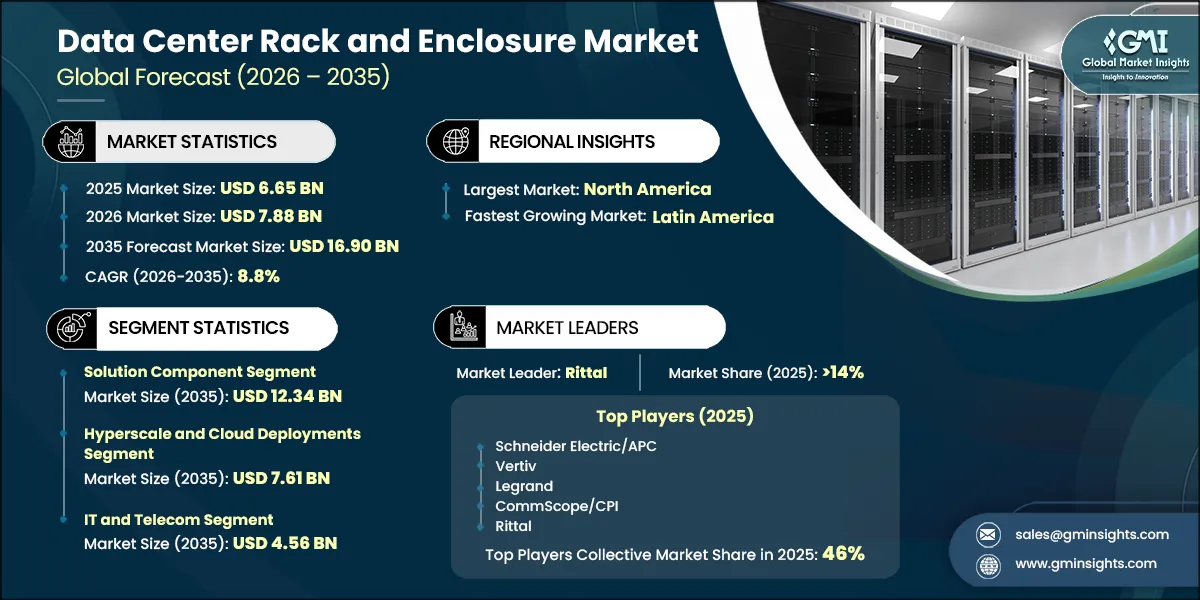
The data center rack & enclosure market was valued at USD 6.65 billion in 2025, is projected to reach USD 7.88 billion in 2026, and is expected to grow at an 8.8% CAGR (2026-2035) to reach USD 16.90 billion by 2035. The market covers physical rack structures, enclosed cabinets, customized AI/HPC enclosures, integration, installation, and lifecycle services used across hyperscale, colocation, enterprise, and edge environments.
Growth is increasingly shaped by the interaction of new capacity construction and a richer equipment mix. GPU-dense deployments require enclosures that accommodate greater electrical loads, thermal interfaces, cable management, and structural requirements, shifting purchasing decisions from standard hardware specifications toward qualified, application-specific rack systems and associated services.
GMI Analyst View
Based on our primary industry engagement and ongoing discussions with data center infrastructure stakeholders, the global data center rack & enclosure market reached USD 5.51 billion in 2024. We view that level as evidence that AI infrastructure programs compressed conventional procurement and installation cycles before the base year, establishing a demand environment structurally different from traditional refresh-led purchasing.
Data Center Rack & Enclosure Market Trends, Growth Drivers & GMI Forecast Outlook
AI-oriented construction is changing rack procurement from a largely standardized infrastructure purchase into a systems-integration decision. Demand is supported by cloud-campus expansion and liquid-cooling readiness, while grid access, facility retrofits, and enterprise workload migration determine when identified demand converts into installed capacity.
Key Drivers
*Evidence anchors use cited external data; demand implications and forecast conditions represent GMI analysis.*
Hyperscale construction creates demand not only for cabinet volumes but also for racks integrated with power distribution, containment, and thermal-management interfaces. Buyers are increasingly qualifying suppliers earlier in the design cycle, particularly where server architecture, cooling method, and busbar configuration must be aligned before a data hall is commissioned.
The customized AI/HPC opportunity reflects a product-mix shift rather than a conventional replacement cycle. Open-rack standards and modular GPU architectures are making compatibility, manufacturing repeatability, and field integration central competitive variables. Suppliers able to deliver factory-configured systems can reduce deployment complexity for operators while improving their position in high-density project pipelines.
Key Restraints
*Evidence anchors use cited external data; demand implications and forecast conditions represent GMI analysis.*
Power availability and cooling retrofits place an important timing constraint on rack demand. Uptime Institute identifies power and cooling constraints, alongside escalating infrastructure costs, as major operational concerns for data center managers, while efficiency progress in legacy estates has slowed [3]. In practice, a rack specification can be approved before the underlying electrical and mechanical work is ready, delaying revenue recognition and concentrating near-term high-density deployment in purpose-built facilities.
Enterprise cloud migration produces a separate constraint. Organizations retaining private infrastructure are more likely to prioritize targeted resilience, security, and hybrid-cloud upgrades than broad fleet replacement. This preserves demand for specialized deployments but reduces the predictability of conventional enterprise refresh volumes.
GMI Analyst View
We see the central transition as a move from volume-led expansion toward value-led procurement. The strongest opportunities lie where enclosure design, power delivery, cooling integration, and commissioning are purchased as an interdependent system. Grid and retrofit limitations can defer projects, but they also favor suppliers capable of supporting modular, factory-integrated deployment models.
Data Center Rack & Enclosure Market Segment Analysis
By Component
The data center rack & enclosure market solution component generated USD 5.05 billion (76.0%) in 2025 and is projected to reach USD 12.34 billion (73.0%) by 2035. Services generated USD 1.60 billion (24.0%) in 2025 and are forecast to reach USD 4.56 billion (27.0%) by 2035.
Hardware remains the commercial anchor because every new facility requires a physical enclosure platform. However, integration complexity is widening the service opportunity, particularly for operators managing mixed-density estates and repeatable multi-site deployments.
Enclosed racks generated USD 2.22 billion (44.0%) in 2025 and are projected to reach USD 4.94 billion by 2035. Open-frame racks generated USD 1.42 billion (28.0%) in 2025 and are expected to account for 22.0% in 2035. Customized formats are projected to advance at an 11.1% CAGR (2026-2035).
Enclosed cabinets retain relevance where containment, access control, and cable organization are material operating requirements. Customized designs benefit where liquid cooling, higher-current power distribution, and structural support must be engineered around a defined compute architecture.
The 19-inch format generated USD 3.13 billion (62.0%) in 2025 and is projected to reach USD 7.90 billion (64.0%) by 2035. Other frame sizes generated USD 1.92 billion (38.0%) in 2025 and are forecast to grow at a 7.2% CAGR (2026-2035).
Compatibility with established IT equipment sustains 19-inch racks across enterprise, colocation, and retrofit programs. Alternative widths remain strategically significant in hyperscale settings, where open-rack designs and custom server architectures can outweigh interoperability with installed infrastructure.
The 42U format generated USD 2.43 billion (48.0%) in 2025 and is projected to reach USD 4.94 billion (40.0%) by 2035. The 45U and 48U category generated USD 1.11 billion (22.0%) in 2025 and is forecast to grow at a 10.3% CAGR (2026-2035). The 36U format generated USD 758 million (15.0%) in 2025 and is projected to grow at a 6.4% CAGR (2026-2035).
Taller configurations are gaining importance where floor-space productivity and cabinet-level compute density are prioritized. Smaller formats continue to serve edge, retrofit, and distributed use cases, where transportability and space constraints can matter more than maximum server density.
Professional services generated USD 958 million (60.0%) in 2025 and are projected to reach USD 2.37 billion by 2035. Managed services generated USD 638 million (40.0%) in 2025 and are expected to expand at a 12.5% CAGR (2026-2035).
Professional services capture design, installation, and commissioning work at the point of deployment. Managed offerings are increasingly valuable to customers seeking continuous monitoring, maintenance coordination, and operational consistency across geographically distributed rack estates.
By Data Center Type
Hyperscale and cloud deployments generated USD 2.79 billion (42.0%) in 2025 and are projected to reach USD 7.61 billion by 2035. Colocation generated USD 1.80 billion (27.0%) in 2025 and is forecast to grow at an 8.8% CAGR (2026-2035). Hyperscale operators are shaping the premium end of procurement through their demand for custom, qualified, high-density systems. Colocation providers create a complementary demand base because they must support tenants with varied power, connectivity, security, and equipment requirements within a common physical facility.
Enterprise data centers generated USD 1.46 billion (22.0%) in 2025. Edge data centers generated USD 599 million (9.0%) in 2025 and are projected to reach USD 1.52 billion by 2035. Enterprise demand is increasingly selective, concentrated in security-sensitive, regulated, and hybrid operating models. Edge deployments require a different value proposition, emphasizing compact configurations, ruggedization, manageable installation, and repeatable deployment across distributed locations.
By Application
IT and telecom generated USD 1.86 billion (28.0%) in 2025 and is projected to reach USD 4.56 billion by 2035. BFSI generated USD 1.13 billion in 2025 and is projected to reach USD 3.04 billion by 2035. Telecommunications and cloud communications workloads sustain demand for scalable network and compute infrastructure. In BFSI, security, resilience, latency control, and regulatory obligations make infrastructure design more exacting, supporting demand for controlled and serviceable rack environments.
Colocation applications generated USD 931 million (14.0%) in 2025 and are forecast to expand at a 9.7% CAGR (2026-2035). Healthcare generated USD 532 million (8.0%) in 2025 and is projected to reach USD 1.52 billion by 2035. Colocation growth reflects the migration of enterprise workloads into third-party facilities, where standardized operating procedures coexist with customer-specific infrastructure needs. Healthcare adoption is tied to digitized clinical operations, data-intensive diagnostics, and the need to secure sensitive information in dependable physical infrastructure.
Government and public-sector applications generated USD 599 million (9.0%) in 2025 and are projected to reach USD 1.52 billion by 2035. Public-sector modernization creates demand across sovereign cloud, citizen-services platforms, and agency data consolidation. Procurement often places weight on lifecycle support, certification, domestic service capacity, and the ability to integrate rack systems into broader critical-infrastructure programs.
GMI Analyst View
We believe segment performance will increasingly depend on the degree of integration delivered at the rack level. Commodity hardware remains necessary, but the revenue pool is shifting toward systems that resolve deployment risk for high-density computing. Suppliers that connect enclosure design with thermal, power, and service capabilities should be better positioned than vendors competing only on cabinet price.
Data Center Rack & Enclosure Market Regional Analysis
North America Data Center Rack & Enclosure Market Analysis
North America generated USD 2.39 billion (36.0%) in 2025 and is projected to reach USD 5.41 billion (32.0%) by 2035. The data center rack & enclosure market has a deep North American installed base, supported by hyperscale campuses, mature colocation ecosystems, and ongoing AI infrastructure investment. The region's share moderation reflects faster expansion elsewhere rather than a loss of its importance in advanced, high-value deployments.
U.S.
The U.S. generated USD 2.00 billion in 2025 and is projected to reach USD 4.41 billion by 2035. The U.S. combines large hyperscale procurement programs with a broad base of colocation, government, financial-services, and enterprise demand. Its diversity of facility types creates opportunities for both standardized infrastructure and purpose-built AI-ready configurations.
Canada
Canada generated USD 397.3 million in 2025 and is forecast to grow at an 8.4% CAGR (2026-2035). Canadian demand is supported by campus development in major connectivity and power markets. The country's value proposition for operators depends on the availability of suitable power, reliable connectivity, and the capacity to serve North American workloads with resilient infrastructure.
Europe Data Center Rack & Enclosure Market Analysis
Europe generated USD 1.46 billion (22.0%) in 2025 and is forecast to grow at a 7.7% CAGR (2026-2035). European procurement is influenced by established interconnection hubs, data-sovereignty requirements, and the need to modernize legacy estates. Power constraints in mature markets can redirect new construction, creating a more geographically distributed investment pattern.
U.K.
The U.K. generated USD 354.3 million in 2025 and is projected to reach USD 711.1 million by 2035. London's role in financial services and connectivity sustains infrastructure demand, while cloud and colocation investment broadens the purchasing base. Buyers place particular emphasis on availability, security, and efficient use of constrained metropolitan capacity.
Germany
Germany generated USD 315 million in 2025 and is projected to reach USD 659 million by 2035. Germany's market is anchored by Frankfurt's interconnection role and by demand for infrastructure that supports data sovereignty and private-cloud strategies. These conditions support a mix of colocation build-outs and carefully specified enterprise deployments.
France
France is projected to reach USD 310 million by 2035, from USD 231.3 million in 2025. Sovereign-cloud initiatives and domestic digital-infrastructure programs support demand for racks deployed in European-jurisdiction facilities. The market favors suppliers that can meet security, integration, and service expectations in institutional and cloud environments.
Netherlands
The Netherlands generated USD 177.6 million in 2025 and is projected to reach USD 456.3 million by 2035. The Amsterdam connectivity ecosystem maintains the country's strategic importance, although power availability affects where incremental capacity can be developed. This dynamic supports demand for efficient configurations and can shift procurement toward secondary locations.
Sweden
Sweden generated USD 128.2 million in 2025 and is forecast to grow at an 8.7% CAGR (2026-2035). Access to lower-carbon power and a favorable climate supports greenfield data center interest. Rack demand is therefore linked to large-scale campus construction and the technical requirements of energy-intensive compute environments.
Asia Pacific Data Center Rack & Enclosure Market Analysis
Asia Pacific generated USD 2.00 billion (30.0%) in 2025 and is projected to reach USD 5.75 billion (34.0%) by 2035. Asia Pacific combines large domestic digital markets with expanding hyperscale, colocation, and government infrastructure programs. Its growth broadens the market beyond mature hubs, increasing demand for suppliers that can adapt products, service models, and manufacturing support to local deployment conditions.
China
China is projected to reach USD 2.57 billion by 2035, from USD 1.02 billion in 2025. National computing infrastructure initiatives and domestic cloud development underpin China's scale. High-density deployments create demand for rack suppliers able to support customized power, cooling, and form-factor requirements at volume.
India
India generated USD 217.6 million in 2025 and is projected to reach USD 1.08 billion by 2035. India's expansion is supported by new hyperscale campuses, accelerating cloud adoption, and rising digital-service consumption. The market rewards vendors that can support rapid construction schedules while addressing local service and supply-chain needs.
Japan
Japan generated USD 254.2 million in 2025 and is forecast to grow at an 8.0% CAGR (2026-2035). Japan retains demand from global cloud expansion alongside sophisticated manufacturing and financial-services infrastructure. The market requires solutions that can address both new colocation capacity and modernization of established computing estates.
Singapore
Singapore is projected to reach USD 451.8 million by 2035, from USD 181.2 million in 2025. Singapore remains an important regional interconnection and financial-services hub despite constraints on power-intensive development. Demand is likely to favor highly efficient, carefully specified systems and continue to influence infrastructure investment across the broader Southeast Asian corridor.
Australia
Australia generated USD 145.2 million in 2025 and is forecast to grow at a 10.0% CAGR (2026-2035). Cloud adoption, government modernization, and the expansion of regional connectivity support demand in Australian metropolitan markets. Edge and distributed infrastructure also matter as operators serve a geographically dispersed customer base.
South Korea
South Korea is projected to reach USD 315.3 million by 2035, from USD 109.3 million in 2025. The country's technology-intensive economy and concentrated metropolitan demand support advanced infrastructure procurement. AI applications and cloud expansion are increasing the relevance of high-density rack systems in new facilities.
Vietnam
Vietnam generated USD 34.7 million in 2025 and is forecast to grow at a 16.0% CAGR (2026-2035). Vietnam is emerging as an additional location for regional cloud and data center investment. Early-stage capacity development can favor suppliers that offer modular systems and practical local delivery support as operators establish new facilities.
Indonesia
Indonesia generated USD 36.1 million in 2025 and is forecast to grow at a 15.0% CAGR (2026-2035). Indonesia's large digital consumer base and rising cloud adoption are building a foundation for domestic infrastructure investment. Demand is likely to develop across hyperscale, colocation, and distributed digital-service deployments.
Latin America Data Center Rack & Enclosure Market Analysis
Latin America generated USD 332.3 million in 2025 and is projected to reach USD 1.01 billion by 2035. The region's opportunity is tied to cloud localization, enterprise digitization, and the expansion of third-party data center capacity. Suppliers must account for uneven power infrastructure, project financing, and varying local service requirements across markets.
Brazil
Brazil generated USD 198.4 million in 2025 and is forecast to grow at an 11.0% CAGR (2026-2035). Brazil is the region's principal data center market, with Sao Paulo providing a major hub for cloud, colocation, financial-services, and enterprise infrastructure. Its scale supports demand for both high-volume standardized products and more complex integrated solutions.
Mexico
Mexico generated USD 96.1 million in 2025 and is projected to reach USD 304 million by 2035. Nearshoring, proximity to U.S. demand centers, and industrial digitalization are strengthening Mexico's infrastructure case. Rack procurement is likely to grow alongside new capacity serving manufacturing, logistics, and regional cloud workloads.
Argentina
Argentina generated USD 38.2 million in 2025 and is forecast to grow at a 10.1% CAGR (2026-2035). Argentina remains an earlier-stage opportunity, where investment conditions and enterprise modernization shape project timing. Suppliers that can align offerings with local channel partners and phased capacity expansion may be better placed to capture demand.
Middle East & Africa Data Center Rack & Enclosure Market Analysis
Middle East & Africa generated USD 464.7 million in 2025 and is projected to reach USD 1.35 billion by 2035. Government-backed digital strategies, sovereign AI ambitions, and expanding cloud footprints are reshaping demand in leading Gulf markets. Across Africa, procurement remains more concentrated in major commercial hubs, where reliable power, connectivity, and colocation investment determine capacity growth.
Saudi Arabia
Saudi Arabia generated USD 254.2 million in 2025 and is forecast to grow at a 9.6% CAGR (2026-2035). National digital infrastructure initiatives support demand for purpose-built facilities and advanced computing environments. Large projects can favor suppliers able to coordinate rack, power, thermal, and service elements within a broader deployment program.
UAE
The UAE is projected to reach USD 540.6 million by 2035, growing at an 11.9% CAGR (2026-2035). The UAE's role as a regional financial, logistics, and digital-services hub supports sustained infrastructure investment. Its AI and cloud programs create an addressable market for high-density, integrated rack configurations.
South Africa
South Africa generated USD 41.9 million in 2025 and is forecast to grow at a 9.4% CAGR (2026-2035). Johannesburg remains a key commercial center for regional digital infrastructure. Growth depends on continuing colocation investment and the ability of operators to support enterprise and financial-services workloads with dependable facility infrastructure.
GMI Analyst View
We expect regional leadership to become less concentrated even as North America remains essential to premium infrastructure demand. Asia Pacific's breadth, Latin America's cloud-localization opportunity, and Gulf investment programs create multiple growth centers. The strongest suppliers will need scalable manufacturing and channel capabilities rather than a single-hub approach to market coverage.
Data Center Rack & Enclosure Market Share & Competitive Landscape
The data center rack & enclosure market share landscape is moderately concentrated, with the five largest vendors such as Rittal, Schneider Electric / APC, Vertiv, Legrand, and CommScope / CPI accounting for approximately 46% of 2025 revenue. Competition is increasingly determined by high-density engineering, liquid-cooling compatibility, standards alignment, geographic fulfillment capability, and the ability to integrate enclosures with power, thermal, and monitoring infrastructure.
Rittal held approximately 14% market share in 2025. Its broad enclosure portfolio and international manufacturing presence support participation across hyperscale, colocation, industrial, and distributed-edge projects.
Schneider Electric/APC held approximately 12% market share in 2025. Its installed base, NetShelter portfolio, and EcoStruxure platform position the company to address customers seeking coordination between rack infrastructure and data center management systems.
Vertiv held approximately 8% market share in 2025. The company's strength in power and cooling gives its rack offering relevance where customers seek a coordinated white-space infrastructure platform.
Legrand is strengthening its data center position through rack, power, and connectivity assets, including expanded OCP-oriented solutions. Its activity illustrates the strategic importance of combining physical infrastructure with critical-power capability and regional market access.
nVent/SCHROFF participates through enclosure and infrastructure offerings that serve data center and industrial requirements. Its strategy emphasizes the commercial value of extending rack capability into adjacent power and thermal infrastructure categories.
CommScope/CPI, Panduit, Eaton, Belden/CPI, Wiwynn, Austin Hughes, Canovate, Conteg, Hammond Manufacturing, Penn Elcom, ZPAS, Sanmina, and Supermicro contribute to a competitive field that spans standardized racks, cable-management-led systems, OCP-compatible integration, and regional specialist supply. Their positions depend on customer qualification, channel depth, design flexibility, and the ability to serve distinctive application requirements without compromising deployment speed.
Recent Industry Developments
Vertiv launched its Rack Extreme platform for AI and high-density IT deployments in June 2026 [4]. The introduction reflects increased demand for rack designs that can support deeper, heavier equipment while connecting with integrated power and cooling architectures.
Legrand announced the acquisitions of Keydak in China and TES in the U.K. in March 2026, expanding its rack and critical-power capabilities across two important data center markets [5]. The transaction underscores the strategic value of local manufacturing, power infrastructure expertise, and proximity to high-growth capacity markets.
nVent's Hoffman Schroff subsidiary agreed in August 2026 to acquire Maverick Power, expanding its data center power-infrastructure position [6]. The proposed transaction signals continued convergence between rack enclosures, power distribution, and broader facility infrastructure.
Need a specific section of this report?
Purchase regional analysis, country-level analysis, company profiles, or any other segment-level insights separately
based on your research needs.