Market Size - By Product Type (Apparel, Footwear, Accessories); By Usage (Running, Outdoor Sports, Yoga & Pilates, Gym & Fitness Training, Recreational Activities, Others); By Price (Low, Medium, High); By Consumer Group (Kids, Men, Women); By Distribution Channel (Online, Offline), Growth Forecast. The market forecasts are provided in terms of value (USD) & volume (Million Units).
Report ID: GMI7357
|
Published Date: April 2026
|
Report Format: PDF
Download Free PDF
Activewear Market Size
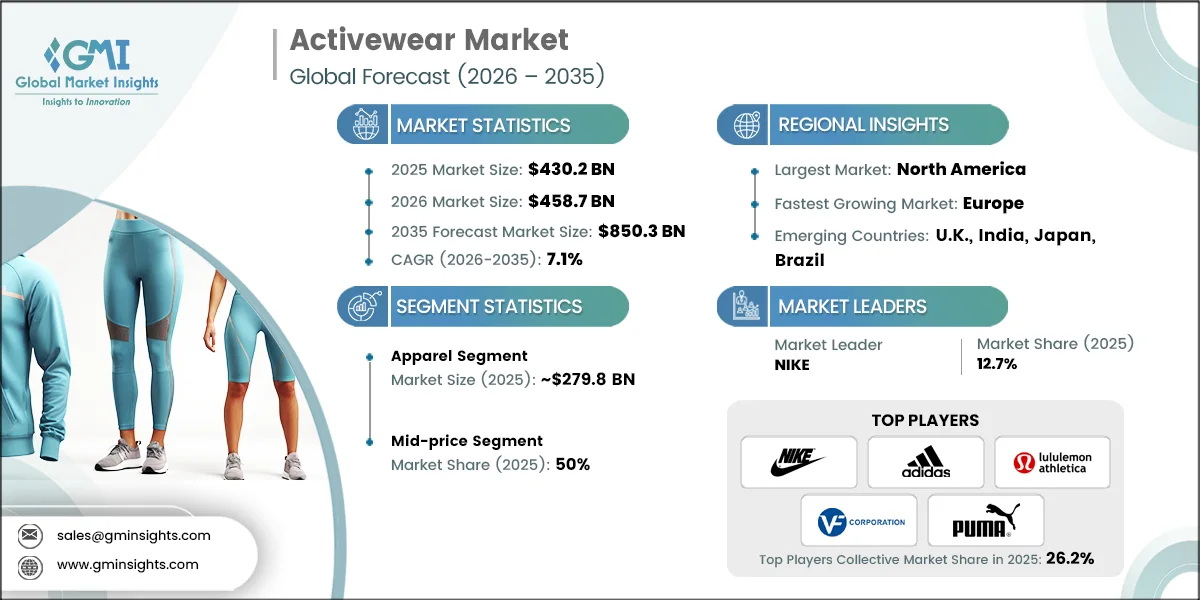
The activewear market was valued at USD 430.2 billion in 2025. The market is expected to grow from USD 458.7 billion in 2026 to USD 850.3 billion in 2035, at a CAGR of 7.1%, according to latest report published by Global Market Insights Inc.
Millennials and Gen Z Fuel Activewear Boom Through Health-Conscious Lifestyles
The activewear industry has been experiencing explosive growth recently due to the increasing priority placed on health and wellness, especially among younger buyers. The two largest groups participating in this trend are Millennials and Generation Z, who are putting a high priority on being fit and healthy. According to the CDC (Centres for Disease Control and Prevention), more than 53% of adults aged 18 through 34 participate in regular physical activity and as a result, they are driving the demand for activewear.
The other contributing factors driving the explosive growth of the activewear market are the Government's various physical fitness initiatives to encourage people to be active physically on a daily basis, such as, U.S. Department of Health and Human Services - "Move Your Way" campaign, which encourages people to be more physically active on a daily basis by making physical activity a part of their daily routines.
Initiatives and programs like this have created an awareness around being physically fit and have directly impacted the growth of the market, further contributing factor to the growth of the activewear market is the rise in the number of individuals participating in fitness programs, such as fitness classes and membership in gyms and health clubs.
According to IHRSA (International Health, Racquet and Sports club Association), over the past year there has been an increase in the number of individuals with gym memberships in the U.S. at approximately 3.6%. Approximately 64 million U.S. residents use fitness facilities, and this trend has led to an increased demand for activewear that is geared toward performance.
Athleisure and Smart Fabric Innovation Broaden the Activewear Consumer Base
In addition, athleisure's increasing popularity- the merging of function and fashion has created an expanded target audience within the activewear industry. Nike and Lululemon are using this trend by producing versatile items that can be worn to work out or for daily casual wear, market opportunities will continue to grow with the introduction of technologies such as moisture-wicking fabric and smart devices and their integration into daily lives.
Activewear Market Trends
Changing innovation and technology transformation are important for the growth of the activewear industry.
The changes in the market are becoming more evident and numerous, with many factors contributing to the overall transformation of this industry. Some of these include consumer demand for things such as inclusiveness and comfort, as well as the introduction of new technologies that enhance the consumer's experience with fitness products.
According to reports from both Nike and Lululemon, as members of Generation Z continue to dominate the market, which is very different than when millennial dominated the market, they much prefer to wear clothes that do not hug their bodies tightly; instead, loose fitting clothing is getting more and more popular. Both companies have launched campaigns focused on creating products for all body types with many options available.
Another trend in activewear is the integration of technology into products. Many companies are creating “smart” activewear, for example, leggings with built in fitness tracking devices. The U.S. Department of Commerce shows that the growth of the wearable technology segment, which includes smart activewear, increased by 20% in 2023 is a good indicator of future growth of smart activewear products.
A growing emphasis on sustainability is being seen across businesses, with many manufacturers such as Adidas and Patagonia incorporating more recycled materials into product lines. The European Union's Circular Economy Action Plan has encouraged more companies to use eco-friendly business practices which match consumers’ desires for sustainable goods.
Customization has become increasingly popular in various ways, such as Under Armour enabling customers to create their custom-designed shoes, demonstrating how quickly the activewear industry responds to new ideas and trends associated with what consumers want.
Activewear Market Analysis
Based on product type, the industry is segmented into apparel, footwear, and accessories. The apparel segment accounts for revenue of around USD 279.8 billion in the year 2025 and is expected to reach USD 554.4 billion by 2035.
The activewear market has grown tremendously, with apparel leading the way in terms of product type. This is mainly because of the flexibility of apparel, frequent replenishment cycles and large numbers of consumers who buy these kinds of products. In fact, according to the U.S. Census Bureau, the total amount spent on retail clothing and accessories in the U.S. was USD 268 billion in 2022, which supports the ongoing strong demand for apparel products in general, and more specifically, for activewear products.
Activewear apparel includes many types of products, such as leggings, joggers, sports bras and compression clothing, and is also a frequent part of the daily custom of consumers. The addition of a major shift towards athleisure is further increasing this trend, as consumers continue to seek clothing that can easily transition between workout sessions, social outings and even work.
Promoting fitness through government programs has also helped support the recent increase in the demand for activewear apparel. For example, the U.S. Department of Health and Human Services launched the "Move Your Way" campaign to help promote the adoption of physical activity into their everyday lives, therefore indirectly increasing the demand for activewear apparel.
The affordability and accessibility of activewear are more attractive relative to other product categories like shoes and accessories. There are many options available for different price points and styles within activewear and as a result, it is considered appealing to a much wider group of consumers.
Thus, combination of versatility, supportive government programs designed to increase physical fitness, and changing consumer preferences have firmly established apparel as the dominant product type in the marketplace. This trend is anticipated to carry forward into the future due to continued innovation and increasing popularity of athleisure.
Based on the price range, the activewear market is bifurcated into low, mid, and high. The mid-price segments held the largest share, accounting for 50% of the market in 2025.
The market's mid-price segment leads the price type category due to its balance of affordability and quality, appealing to a broad consumer base. According to the U.S. Bureau of Economic Analysis, middle-income households accounted for over 40% of consumer spending in 2022, driving demand for products that offer value without compromising on performance.
Mid-price brand activewear targets the consumer that is looking for both durability and style at an affordable price. These brands generally use a high-quality material construction combined with innovative manufacturing techniques which not only appeal to those who participate in sports and activities but also attract non-participants.
For instance, Adidas’ mid-range legging and tops are recognized for their functionality and comfort. This market segment has received additional support through government-sponsored fitness and wellness programs. Such is the case through the European Union’s “Healthy Lifestyle for All” campaign which promotes fitness and exercise for all age groups, creating increased demand for low priced activewear that fits a broad range of needs.
Products located in several different retail channels both online, through e-commerce sites, and offline at traditional brick-and-mortar retailers – means that consumers from all over the world can access mid-priced products easily.
The mid-price range represents the largest portion of the overall marketplace, due to the combination of price point, quality, and wide-ranging availability. This trend will likely continue as more and more consumers are looking to purchase based on value.
North America Activewear Market
In 2025, the U.S. dominated the activewear industry growth in North America, accounting for 75.3% of the share in the region.
The U.S. leads growth with its strong fitness culture, widespread gym memberships, and rapidly rising participation in outdoor and boutique fitness activities. High consumer spending power supports premium and performance‑focused apparel adoption. Digital fitness ecosystems- from smart wearables to app‑integrated training, further stimulate activewear demand.
In addition, strong brand penetration, celebrity‑driven collaborations, and frequent product innovations sustain market momentum. The region’s robust e‑commerce infrastructure expands direct consumer access and personalized shopping experiences. Health‑and‑wellness consciousness accelerated by preventive‑health priorities fuels repeated purchases.
Asia Pacific Activewear Market
Asia Pacific activewear industry is expected to grow at 7.2% during the forecast period.
Asia Pacific’s growth is driven by rising disposable incomes, expanding middle‑class populations, and increasing adoption of Western fitness lifestyles. Governments across the region promote sports participation and wellness initiatives, accelerating demand. A young demographic with high interest in athleisure fuels consistent market expansion.
Europe Activewear Market
Europe activewear industry is expected to grow at 7.4% during the forecast period.
Europe benefits from strong sustainability trends, driving demand for eco‑friendly performance textiles and responsible manufacturing. High participation in running, cycling, and gym activities sustains category momentum across key markets. Premium brands thrive due to fashion‑sports fusion and streetwear‑inspired activewear adoption. Digital fitness adoption and wellness tourism further reinforce steady market growth.
Middle East and Africa Activewear Market
Middle East and Africa activewear industry is expected to grow at 4.5 % during the forecast period.
MEA growth stems from rising health awareness, government‑driven sports investments, and increasing female participation in fitness activities. Expanding retail infrastructure introduces global activewear brands to new consumer segments. Warmer climates boost demand for lightweight, breathable, and UV‑protective fabrics, rapid urbanization and a young population with growing lifestyle aspirations support steady market expansion.
Activewear Market Share
The top companies in the activewear industry include NIKE, Adidas AG, Lululemon Athletica Inc, VF Corporation and PUMA SE and collectively hold a share of 12.7% of the market in 2025. These prominent players are proactively involved in strategic endeavors, such as mergers & acquisitions, facility expansions & collaborations, to expand their product portfolios, extend their reach to a broad customer base, and strengthen their market position.
NIKE operates at scale in the market with performance footwear and apparel anchored by innovation in cushioning, knit construction, and digital ecosystems (Nike App, SNKRS). It leverages athlete endorsements and sport‑specific franchises to drive demand across running, training, basketball, and lifestyle. A vertically integrated DTC strategy enhances margins and consumer data insights while wholesale maintains reach.
Adidas competes through performance and lifestyle crossovers, blending technical apparel with iconic footwear lines and collaborations. The brand invests in materials science (Primeknit, recycled fibers) and sport franchises across running, football, and training to sustain relevance. Omni‑channel retail and strong wholesale partners provide global penetration with fast time‑to‑market drops.
Lululemon leads in premium athleisure with yoga‑led roots expanding into running, training, hike, tennis, and golf. Its product moat rests on proprietary fabrics, fit innovation, and community‑driven retail with experiential stores. A high‑mix DTC model powers strong unit economics and rapid feedback loops for product refresh.
Activewear Market Companies
Major players operating in the activewear industry are:
Adidas AG
ASICS Corporation
ASOS PLC
Champion
Columbia Sportswear Company
Fila Holdings Corporation
Gymshark
Lululemon Athletica Inc.
New Balance
NIKE
Patagonia
PUMA SE
Skechers
Squat Wolf
Under Armour Inc.
VF Corporation
VF Corporation participates via The North Face, Vans, and other brands, focusing on performance outdoor, street‑athletic, and casual active segments. The North Face anchors technical apparel and accessories with innovation in insulation, layering, and weatherproofing. A portfolio approach, global sourcing, and multi‑channel distribution balance growth and risk. Brand elevation, product simplification, and operational discipline underpin activewear competitiveness.
PUMA competes with sport‑style credibility, merging performance footwear and apparel with fashion‑forward design and athlete/creator partnerships. Core categories include running, football, motorsport, and training, supported by accessible pricing and broad retail coverage. Product refresh cadence and color/material updates maintain shelf vitality and trend relevance.
Activewear Industry News
In February 2026, Adidas released the Hellstar x Adidas Superstar “Sandstone”, part of its 2026 collaborative activewear‑lifestyle expansion. The drop reflects Adidas’s ongoing push into cultural and fashion‑driven collaborations that merge streetwear and performance style. This release followed a series of early‑2026 launches including new AE2 models and limited‑edition lifestyle silhouettes.
In October 2025, Lululemon and the NFL launched a co-branded apparel and accessories collection, representing all 32 league teams. This marks Lululemon’s first officially licensed NFL lineup, expanding its presence in performance sportswear. The collection includes men’s and women’s products across popular franchises like Align, Define, and Scuba.
In October 2025, Adidas announced a long-term partnership with GLO Brands B.V. to enter the safety-footwear market. This collaboration aims to integrate adidas’ performance design into professional and industrial footwear applications. The move signifies adidas’ strategic expansion into a new category, leveraging its expertise in performance-driven design.
In October 2025, Nike unveiled its new Innovation Engine, uniting Nike, Jordan, and Converse design teams to accelerate athlete‑focused product creation. The launch introduced major breakthroughs including Aero‑FIT cooling activewear, the Therma‑FIT Air Milano jacket, and Project Amplify powered footwear. These technologies mark Nike’s most advanced airflow and thermal‑regulation systems to date.
In April 2025, Nike unveiled the Air Max DN8, the latest addition to its Air Max series, featuring a bold Hyper Pink colorway. The DN8 incorporates updated Air technology and enhanced cushioning, aligning with Nike’s strategy to strengthen its premium footwear segment for 2025. This launch highlights Nike’s commitment to innovation and design excellence in the competitive footwear market.
The activewear market research report includes in-depth coverage of the industry, with estimates & forecasts in terms of revenue (USD Billion) volume (Million Units) (from 2022 to 2035), for the following segments:
The companies listed in this report are a curated selection - not the full competitive universe.
Our market revenue calculations use a bottom-up methodology that accounts for all players across all regions - including manufacturers, distributors, and specialists not individually profiled. The profiles section spotlights strategically significant players; it does not define the scope of our market sizing.
Your competitive landscape may also include
Regional or domestic-only leaders not in the global top tier
Distributors and channel partners who control market access
Emerging disruptors, startups, or adjacent-industry entrants
Niche players focused on a specific application or end-use
Free customization - up to 20% of report value
Need specific data? Request customization and get the insights tailored to your exact requirements.
Authors: Avinash Singh, Amit Patil
For inquiries regarding discounts, bulk purchases, or customization requests, please contact us at[email protected]
Explore our licensing options:
Starting at: $2,450
Premium Report Details
Base Year: 2025
Companies Profiled: 15
Tables and Figures: 225
Countries covered: 15
Pages: 220
Download Free PDF
Premium Report Details
Base Year: 2025
Companies Profiled: 15
Tables and Figures: 225
Countries covered: 15
Pages: 220
Download Free PDF
Share Content
Add Citations
Avinash Singh. 2026, April. Activewear Market Size - By Product Type, By Usage, By Price, By Consumer Group, By Distribution Channel, Growth Forecast, 2026 – 2035 (Report ID: GMI7357). Global Market Insights Inc. Retrieved August 23, 2026, from https://www.gminsights.com/toc/details/activewear-market
Activewear Market
Get a free sample of this report
Get a free sample of this report Activewear Market
Is your requirement urgent? Please give us your business email for a speedy delivery!



Activewear Market Size
The activewear market was valued at USD 430.2 billion in 2025. The market is expected to grow from USD 458.7 billion in 2026 to USD 850.3 billion in 2035, at a CAGR of 7.1%, according to latest report published by Global Market Insights Inc.
Millennials and Gen Z Fuel Activewear Boom Through Health-Conscious Lifestyles
The activewear industry has been experiencing explosive growth recently due to the increasing priority placed on health and wellness, especially among younger buyers. The two largest groups participating in this trend are Millennials and Generation Z, who are putting a high priority on being fit and healthy. According to the CDC (Centres for Disease Control and Prevention), more than 53% of adults aged 18 through 34 participate in regular physical activity and as a result, they are driving the demand for activewear.
Government-Led Fitness Campaigns Amplify Physical Activity Awareness
The other contributing factors driving the explosive growth of the activewear market are the Government's various physical fitness initiatives to encourage people to be active physically on a daily basis, such as, U.S. Department of Health and Human Services - "Move Your Way" campaign, which encourages people to be more physically active on a daily basis by making physical activity a part of their daily routines.
Initiatives and programs like this have created an awareness around being physically fit and have directly impacted the growth of the market, further contributing factor to the growth of the activewear market is the rise in the number of individuals participating in fitness programs, such as fitness classes and membership in gyms and health clubs.
According to IHRSA (International Health, Racquet and Sports club Association), over the past year there has been an increase in the number of individuals with gym memberships in the U.S. at approximately 3.6%. Approximately 64 million U.S. residents use fitness facilities, and this trend has led to an increased demand for activewear that is geared toward performance.
Athleisure and Smart Fabric Innovation Broaden the Activewear Consumer Base
In addition, athleisure's increasing popularity- the merging of function and fashion has created an expanded target audience within the activewear industry. Nike and Lululemon are using this trend by producing versatile items that can be worn to work out or for daily casual wear, market opportunities will continue to grow with the introduction of technologies such as moisture-wicking fabric and smart devices and their integration into daily lives.
Activewear Market Trends
Changing innovation and technology transformation are important for the growth of the activewear industry.
Activewear Market Analysis
Based on product type, the industry is segmented into apparel, footwear, and accessories. The apparel segment accounts for revenue of around USD 279.8 billion in the year 2025 and is expected to reach USD 554.4 billion by 2035.
Based on the price range, the activewear market is bifurcated into low, mid, and high. The mid-price segments held the largest share, accounting for 50% of the market in 2025.
North America Activewear Market
In 2025, the U.S. dominated the activewear industry growth in North America, accounting for 75.3% of the share in the region.
Asia Pacific Activewear Market
Asia Pacific activewear industry is expected to grow at 7.2% during the forecast period.
Europe Activewear Market
Europe activewear industry is expected to grow at 7.4% during the forecast period.
Middle East and Africa Activewear Market
Middle East and Africa activewear industry is expected to grow at 4.5 % during the forecast period.
Activewear Market Share
The top companies in the activewear industry include NIKE, Adidas AG, Lululemon Athletica Inc, VF Corporation and PUMA SE and collectively hold a share of 12.7% of the market in 2025. These prominent players are proactively involved in strategic endeavors, such as mergers & acquisitions, facility expansions & collaborations, to expand their product portfolios, extend their reach to a broad customer base, and strengthen their market position.
Activewear Market Companies
Major players operating in the activewear industry are:
VF Corporation participates via The North Face, Vans, and other brands, focusing on performance outdoor, street‑athletic, and casual active segments. The North Face anchors technical apparel and accessories with innovation in insulation, layering, and weatherproofing. A portfolio approach, global sourcing, and multi‑channel distribution balance growth and risk. Brand elevation, product simplification, and operational discipline underpin activewear competitiveness.
PUMA competes with sport‑style credibility, merging performance footwear and apparel with fashion‑forward design and athlete/creator partnerships. Core categories include running, football, motorsport, and training, supported by accessible pricing and broad retail coverage. Product refresh cadence and color/material updates maintain shelf vitality and trend relevance.
Activewear Industry News
The activewear market research report includes in-depth coverage of the industry, with estimates & forecasts in terms of revenue (USD Billion) volume (Million Units) (from 2022 to 2035), for the following segments:
Market, By Product Type
Market, By Usage
Market, By Price
Market, By Consumer Group
Market, By Distribution Channel
The above information is provided for the following regions and countries: