Summary
Table of Content

Wool Processing Machinery Market
Get a free sample of this report
Form submitted successfully!
Error submitting form. Please try again.
Thank you!
Your inquiry has been received. Our team will reach out to you with the required details via email. To ensure that you don't miss their response, kindly remember to check your spam folder as well!
Request Sectional Data
Thank you!
Your inquiry has been received. Our team will reach out to you with the required details via email. To ensure that you don't miss their response, kindly remember to check your spam folder as well!
Form submitted successfully!
Error submitting form. Please try again.
Wool Processing Machinery Market Size
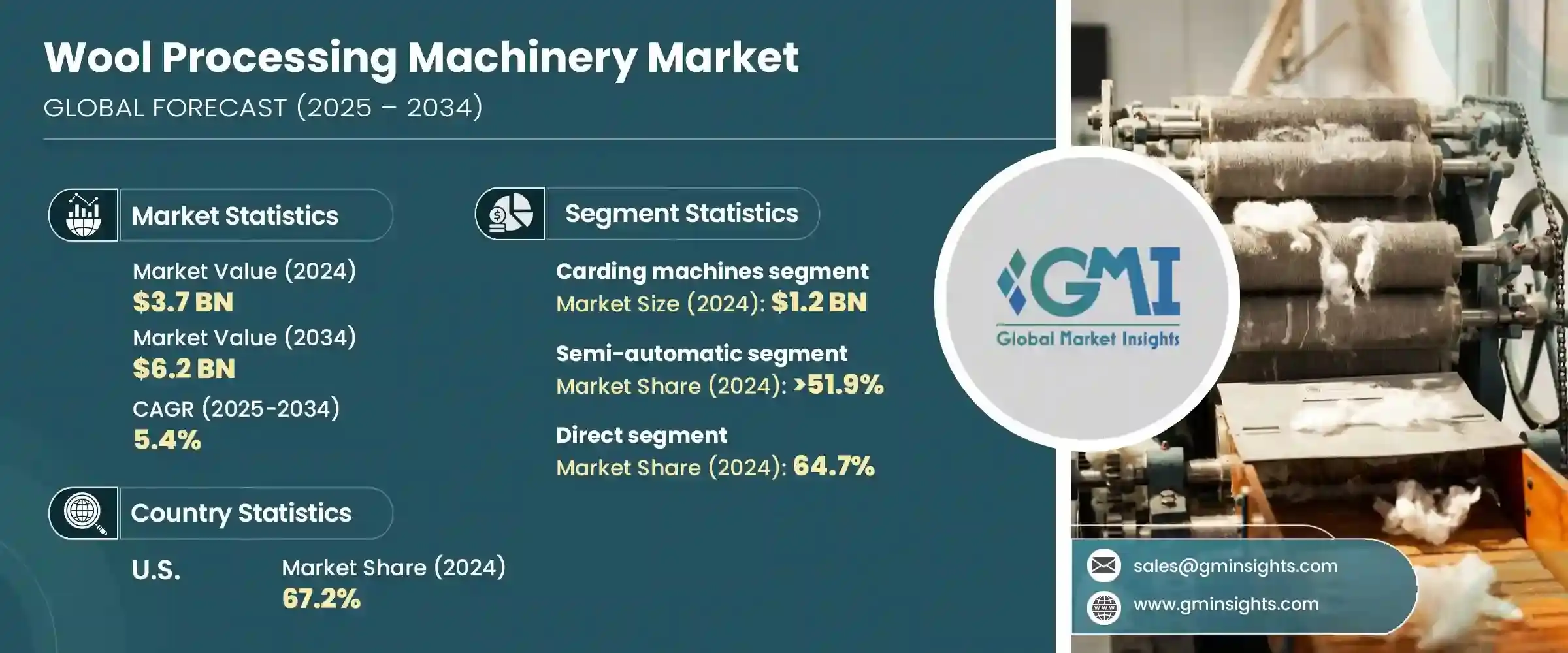
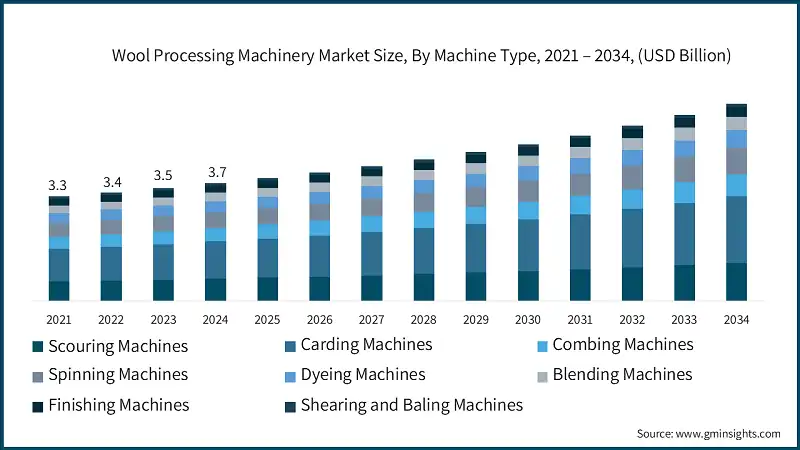
The global wool processing machinery market was estimated at USD 3.7 billion in 2024 and is expected to grow from USD 3.8 billion to USD 6.2 billion in 2034, at a CAGR of 5.4%. The growth is driven by key factors such as rising global demand for wool products, growth of the apparel and textile industry, and technological advancements in machinery.
Wool Processing Machinery Market Key Takeaways
Market Size & Growth
- 2024 Market Size: USD 3.7 Billion
- 2034 Forecast Market Size: USD 6.2 Billion
- CAGR (2025–2034): 5.4%
Key Market Drivers
- Rising global demand for wool.
- Products, growth of the apparel and textile industry.
- Technological advancements in machinery.
Challenges
- High Initial Investment Costs.
- Fluctuating Raw Wool Prices.
Opportunity
- Rising Demand for Sustainable Textiles.
- Expansion in Emerging Markets:.
Get Market Insights & Growth Opportunities
The wool processing machinery market increased by USD 3.3 billion from the year 2021, propelled by the rising demand for natural and sustainable fibers. Wool is increasingly being used to make fashionable apparel and interior decor. The post-pandemic revival of the textile industry, particularly from India, Bangladesh, and Vietnam, has prompted the replacement of existing machinery with new, automated, and energy-efficient equipment. In addition, the application of technical textiles, including felting and insulation, has also contributed to the increased market.
Asia-Pacific (APAC) accounts for the largest market share at 35.2% of the total worth in the market. The reason is that China and India both host numerous textile producers. India and China are also located near big countries that produce wool extensively, such as Australia and New Zealand. Australia contributed 324 million kilograms of production in 2023, the Australian Bureau of Agricultural and Resource Economics and Sciences (ABARES) reported, positioning it as a major supplier. Government subsidies and economies of scale and export promotion, and textile policies are also the causes of the region's highest ranking. Europe accounts for a major share because the region is concentrated on high-quality woolen goods and superior manufacturing technologies, particularly in Germany and Italy. North America is progressively expanding with influence from innovations in recycled wool and environmentally friendly textile projects.
Scouring machines are the largest product segment at 18.6% of the market. Scouring machines are crucial to wash raw wool by stripping off the grease, dirt, and other contaminants. Modern technologies for water-saving and green scouring have increased their demand, especially by those companies that are sustainability-focused. Carding, combing, and spinning machines, and machines for felting and finishing are some of the other important segments used to produce excellent quality wool yarn and are in higher demand for use in industries aside from apparel.
The industry is growing for several important reasons. The power of sustainability is encouraging companies to adopt biodegradable products and invest in machinery for recycling wool. Smart Clothing Equipment is boosting productivity, reducing losses, and offering quality. Australian, South American, and South African wool production is offering extra raw material, and demand for extra machinery encourages the industry. The government is also strong in this sense. For instance, India's Textiles Ministry launched a USD 1.4 billion Production Linked Incentive (PLI) scheme in 2022 to finance the upgradation of the textile industry. All these are going to turn wool processing machinery into a booming and rapidly growing industry.
To get key market trends
Wool Processing Machinery Market Trends
- Wool processing companies are transforming at a fast pace with the implementation of smart and automated machines. The Internet of Things (IoT), artificial intelligence (AI), and machine learning are enabling real-time process monitoring, predictive maintenance needs, and enhanced productivity for manufacturers. These technologies lower labor needs, minimize machine downtime, and deliver quality products daily. For instance, artificial intelligence processing can detect fiber faults at the production stage itself, and a quick response minimizes waste and maximizes output. Efficiency and cost savings are the driving forces for change in light of rising labor costs. Manufacturing worker wages increased 3.8% in 2023, reported the U.S. Bureau of Labor Statistics, and this has encouraged companies to opt for automation. Large and medium-scale wool processors will invest heavily in such technologies in 2024-2030. Smart automation also ensures that the processes are eco-friendly since it tracks energy and water usage, thus ensuring firms remain within environmental compliance. Suppliers with tailor-made smart equipment will most likely gain a competitive advantage because the industry values such technology.
- Sustainability is today the priority in the textile business, and the machinery market for wool processing is readjusting to meet those needs. Governments around the globe are implementing stricter environmental regulations, such as the European Union's Green Deal, which reduces greenhouse gas emissions by 55% by 2030. Retail sales of consumer green products are rising as well. New machinery for wool processing is being created that is less water and chemicals-based, reversing the ecological cost of traditional processes. The innovation comes in the form of waterless scouring technology, chemical-free treatment, and machinery that can process high-quality recycled wool fibers efficiently. All these technologies allow mills to attain their environmental objectives while not sacrificing the laws. The shift, launched in 2023, will persist between 2032 and 2023 because sustainability is an offer that will appeal to regulators and businesses alike. Technology exists on the digital front as well, as smart systems track usage and waste of resources and alert producers so they can act accordingly.
- Fashion is evolving at a rapid rate, and consumers want greater variety when it comes to materials. Wool machinery manufacturers are countering this with the development of multi-fiber machines, which will work on a variety of fibers, i.e., combinations of synthetic and wool fibers, cotton, or vegetable fibers. This multi-fiber capability allows the mills to expand their product range without investing in new machinery, saving time and money. The ability to shift suddenly between different kinds of fibers is of exclusive value in fast fashion, where merchandise has to be made immediately and in different forms. The apparel and textiles sector achieved 4.2% expansion in 2023, the U.S. Census Bureau reported, as part of demand for diversified products. Utilization of multi-fiber equipment is also expected to grow between 2025 and 2030 as textile producers adapt to changing demand in the wool processing machinery market. The machines also facilitate sustainability by making effective use of recycled and substituted fibers to help the mills stay competitive and be sustainable.
- The equipment business for wool processing does not have skilled technicians. Most of the seasoned individuals are retiring, and skilled personnel to run advanced equipment are not on hand. This is higher in developing economies, where the manufacturing of textiles is increasing, but vocational training is extremely poor. This is being overcome by mill owners investing in automated machinery that can be controlled by simple automatic systems. These have simple-to-use interfaces, remote diagnostics, and AI software to make it easy for unskilled laborers to control high-tech machines. The Global manufacturing sector saw its talent pool among existing workers decline by 2.5% in 2023, also showing the way the industry needed automation, as per the International Labor Organization. From 2024 to 2028, manufacturers will need to embrace more digital technology to cope with workforce shortages and enhance efficiency, the International Labor Organization added. Workforce digitization not only addresses labor issues but also modernizes the industry, with guaranteed good quality and dependable output.
Wool Processing Machinery Market Analysis
Learn more about the key segments shaping this market
- Carding machines are the top product segment of the wool processing machinery industry because of their significance, consistent growth, continuous innovation, and reasonable price. As per the International Wool Textile Organization (IWTO), world production of wool in 2023 was around 1.1 million metric tons, and it is not difficult to see why effective processing machinery, such as carding machines, plays such a key role. These carding machines card fibers of wool to unentangle, clean, and align them in a uniform web of fibers necessary for making high-quality yarn or fabric. Substandard carding leads to substandard quality of the end product, hence the necessity for advanced carding technology in investment by textile mills interested in manufacturing premium products.
- Innovation has been the key to carding machine success. Companies are incorporating power-saving design, in-line quality control sensors, and automatic feeders into carding machines in order to lower the cost of operation. The innovations allow for increased production rates, reduce fiber waste, and offer consistent quality. Modular designs also enable carding machines to process complex blends of fibers, offering market solutions to a growing need for customized and flexible offerings.
- In terms of price, carding machines are worth the investment. While they are more costly than spinning and finishing equipment, which are of higher technology specifications, they pay for themselves in full by maximizing downstream processing and quality of product. Hence, they appeal to big textile conglomerates as well as medium-scale mills that wish to eliminate available but obsolete equipment. Their efficiency and their central position in wool processing have placed carding machines at the top of their field. The United Nations Industrial Development Organization reports that investment in sophisticated textile machinery, such as carding machines, has risen by 8% yearly over the past few years, putting them at the top of their field.
Learn more about the key segments shaping this market
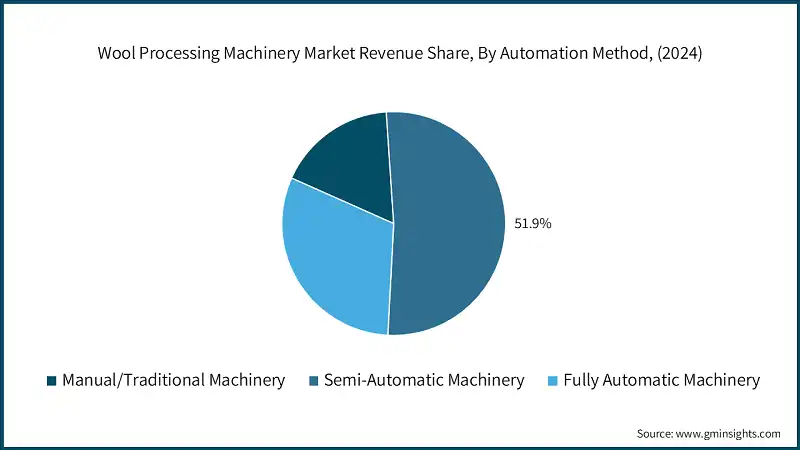
Based on the automation method, the wool processing machinery market is augmented to manual/traditional machinery, semi-automatic machinery, and fully automatic machinery. In 2024, the semi-automatic segment accounted for over 51.9% revenue share and is expected to grow at a rate of 5.3% till 2034.
- Semi-automatic machines are dominating the market for wool processing machinery with their consistent growth, premium features, and cost-competitive price versus fully automatic and manual machines. According to the International Trade Administration (ITA), the textile machinery industry, including wool processing machines, is anticipated to record a compound annual growth rate (CAGR) of 5.2% between the forecast period of 2024-2029. Semi-automatic machines are developing at a more rapid rate in areas where mills require more efficiency but are constrained by budgets or the lack of sufficient workers. Semi-automatic machines also surpass manual machines with better output without the expense of fully automatic machines, and thus, they are the accepted choice in emerging textile markets.
- Some of the recent developments in semi-automatic machines involve simplifying the machine to run, making it more flexible, and with simple digital controls. All of these advancements contribute to accuracy enhancement and the minimization of fatigue without introducing unnecessary complexity. Programmable adjustment, enhanced safety features, and partial mechanization of primary activities enable the mills to deliver continuous, uniform output at a lower cost. These developments make semi-automatic machines suitable for all levels of wool processing, providing an intermediary link between conventional manual processes and advanced automation equipment.
- The cost of semi-automatic machines is another major benefit. They offer a balance between luxury and affordability, which small and medium-sized businesses prefer since they would want to become modernized without excessive spending in the process. Small and medium-sized enterprises (SMEs) represent more than 90% of businesses in the textile industry worldwide, and the majority of them utilize semi-automatic machines due to their affordability. These machines also possess undisputed productivity advantages and are simpler to maintain than automated systems, which ensures them a leading position in the market.
Based on the distribution channel, the wool processing machinery market is segmented into direct and indirect. The direct segment is expected to hold a major share of 64.7% in 2024.
- Direct selling channel is dominating the market for wool processing machinery because it is by far superior to indirect selling channels such as agents or distributors. Manufacturers prefer direct sales because they enable them to get closer to customers. Through this method, they can offer personalized services, personalized solutions, and technical support, which are key in managing intricate wool machines. Through direct contact with customers, the manufacturing companies can discern their needs more clearly in a way that they will easily offer customized products and effective after-sales services.
- Direct sales recent innovations involve remote monitoring tools, online training, and maintenance centers. These enable higher customer satisfaction and lower downtime. Direct sales enable it to be simple for manufacturers to offer new technologies and upgrades by staying in touch with customers.
- Directly from the cost side, direct sales enable producers to have greater control over price and margin because they remove the additional fees intermediaries charge. Customers are also subjected to competitive prices because producers can provide package deals, financing, and bundling services themselves. From the U.S. Census Bureau, the wool processing machinery business, along with other machinery businesses, had an implication of around USD 400 billion on the American economy in the year 2022. This shows the significance of effective sales channels, such as direct selling, in propelling growth and customer satisfaction. The cost-saving synergy, enhanced service, and better support make the direct selling channel the most favored channel of promoting wool processing machinery globally.
Looking for region specific data?
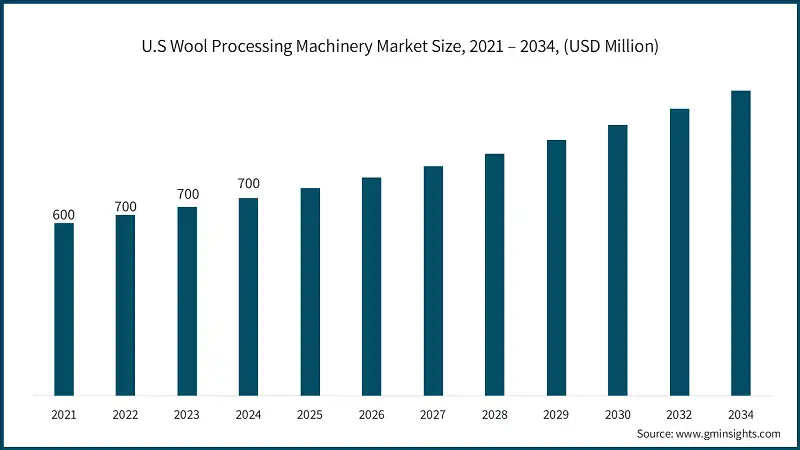
In 2024, the U.S. dominated the wool processing machinery market, accounting for around 67.2% share of the North America and generating around USD 700 million in revenue in the same year.
- North America has a 29.3% market share, which is moderately growing at a CAGR of 5.6%. It is driven by the increasing interest in advanced textile machinery and a growing demand for eco-friendly, recycled wool products. Both Canada and the US are promoting the manufacturing of textiles back home to keep imports to a minimum, and this is driving investment in high-tech wool processing machines in return. A regulatory focus on employee safety and sustainability increases the need for advanced machinery. Big industries such as technical textiles and garment production, where precision is the motto and quality is the ultimate objective, benefit first. The US is directing investments towards computerized and automated machinery in a bid to become more productive and go green.
The European wool processing machinery market in Germany is expected to experience significant and promising growth from 2025 to 2034.
- Europe contributes a market share of 23% with consistent growth at a CAGR of 4.6% through 2034. Advanced textile centers in Italy, Germany, and the UK lead the market with high-end wool products demand and eco-friendly processing innovation. The EU's strict green laws direct investments towards energy-saving and water-saving wool processing equipment. The focus of the region on sustainable lifestyle, circular economic practices, and compliance with laws such as the EU Green Deal also promotes the use of green technology. Italy is unique with its luxury fashion emphasis in the wool industry, and Germany leads with machinery innovation and digitalization.
The APAC wool processing machinery market in China is expected to experience significant and promising growth with a 6.5% CAGR from 2025 to 2034.
- APAC is a leader in the market for wool processing machinery with a 35% share of the global market in 2024 and a strong CAGR of about 6.3% through 2034. This is driven by a strong base of textile production in countries such as China, India, Bangladesh, and Vietnam, where demand for wool has been increasing along with blended fibers. Economic growth, a growing middle class, and state subsidies to upgrade textile mills are also pushing investments. China is APAC's unchallenged champion, supported by its export-driven chains of textiles and strong domestic demand. India, on the other hand, is becoming a large market due to policies such as the Technology Upgradation Fund Scheme (TUFS) that favor the mechanization of machinery. The continent is boosted by low labor and improved raw wool availability, particularly from Australia and New Zealand.
The MEA wool processing machinery market in South Africa is expected to experience significant and promising growth from 2025 to 2034.
- MEA, with a below-average market share of 6.9%, is experiencing a huge growth spurt in terms of a CAGR of 4.9%. This indicates the emergence of emerging markets in the region. The entire South Africa, Egypt, and Morocco regions are experiencing growth within their textile industries through government programs of industrialization and export. The major drivers are increased investment in infrastructure and upgrading wool processing plants. Regional wool products and textile markets are also demonstrating growing demand. South Africa is a regional leader, considering it has a highly advanced infrastructure for wool production and processing. The North African states are, however, emerging as textile production centers.
Wool Processing Machinery Market Share Analysis
Rieter Holding AG, Tritschler Group, Savio Macchine Tessili S.p.A., Marzoli – Camozzi Group, and Lakshmi Machine Works Ltd. lead with 13-15% market share. The top 3 companies collectively hold 12% market share, indicating low market concentration.
- Rieter Holding AG continues to hold its position of leadership by continuing to invest in the latest automation, digitalization, and energy-saving technologies, thus further solidifying its position of leadership as a high-value spinning solution provider. Its focus on providing end-to-end, integrated wool processing lines helps it command a significant market share, particularly in developed nations.
- Marzoli – Camozzi Group puts significant focus on embedding Industry 4.0 features like digital performance monitoring and predictive maintenance to enable the mills to achieve maximum efficiency and minimize downtime. This digital transformation strategy responds to the untapped needs for smart textile machines and makes Marzoli a choice partner to mills looking to modernize.
- Lakshmi Machine Works Ltd. dominates the low-cost machinery solutions for emerging economies through localized production and generous government patronage in India. Its belligerent approach to selling hard, easy-to-maintain machines at cheap prices has enabled it to secure market share in Asia and Africa quickly.
- Combined, the companies utilize tactics of introducing new products, making strategic alliances, and broadening the service offerings to solidify customer relationships and gain new segments of market share. Through the treatments of technological development, requirements of sustainability, and local market demands, they further solidify their leadership within the wool processing machinery industry.
Wool Processing Machinery Market Companies
Major players operating in the wool processing machinery industry are:
- Camozzi
- Fangzheng
- Fong's
- Jingwei
- Lakshmi
- NSC
- Rieter
- Saurer
- Savio
- Shanghai Texmac
- Tatham
- Texpro
- Trutzschler
The machinery business for wool processing equipment has a wide range of specialist equipment from the global leaders anywhere in the world. Rieter and Trützschler particularly lead by providing turnkey spinning systems covering all the processes from blowroom and carding to combing and spinning, typically augmented by high-end automation and sustainability features. These firms, like Camozzi (Marzoli Group) and Saurer, specialize in spinning technology as ring and rotor spinning machines, respectively, and support fiber preparation and winding solutions. The former has high-precision yarn twisting and winding machines owned and run by Savio Macchine Tessili for producing higher-quality wool yarns.
The other companies, such as Fangzheng, Jingwei, Shanghai Texmac, and Texpro, specialize in basic preparatory equipment such as carding, combing, and opening machines for scouring and straightening of wool fibers before spinning. Wool washing and scouring machines, which play a significant role in scoured raw wool cleaning, are provided mainly by companies such as Fong's and Tatham. Apart from that, NSC and Lakshmi Machine Works Ltd. (LMW) provide a broad spectrum of fiber preparation and spinning equipment and cater to the needs of the emerging markets with quality, cost-effective solutions.
The two companies collectively cover the entire value chain of wool processing at varying levels of specialization, innovation, and geographical concentration and provide high-end and mass-market textile manufacturers.
Wool Processing Machinery Market Report Attributes
| Key Takeaway | Details |
|---|---|
| Market Size & Growth | |
| Base Year | 2024 |
| Market Size in 2024 | USD 3.7 Billion |
| Forecast Period 2025 - 2034 CAGR | 5.4% |
| Market Size in 2034 | USD 6.2 Billion |
| Key Market Trends | |
| Drivers | Impact |
| Rising global demand for wool | Consumers increasingly prefer natural, sustainable fibers, boosting wool product demand. |
| Products, growth of the apparel and textile industry | Expanding textile manufacturing, especially in Asia, is driving investments in wool processing. |
| Technological advancements in machinery | Automation and energy-efficient innovations are making modern machines more attractive to mills. |
| Pitfalls & Challenges | Impact |
| High Initial Investment Costs | Modern wool processing machines are expensive, posing a barrier for small and mid-sized manufacturers. |
| Fluctuating Raw Wool Prices | Volatile wool prices affect production planning and deter consistent investment in processing infrastructure. |
| Opportunities: | Impact |
| Rising Demand for Sustainable Textiles | Growing consumer preference for natural and eco-friendly fibers is boosting wool production, driving demand for advanced processing machinery. |
| Expansion in Emerging Markets: | Increasing wool production in countries like China, India, and Australia presents growth opportunities for machinery suppliers. |
| Market Leaders (2024) | |
| Market Leader |
|
| Top Players |
Collective market share in 2024 is 13.7% |
| Competitive Edge |
|
| Regional Insights | |
| Largest Market | Asia Pacific |
| Fastest growing market | Asia Pacific |
| Emerging countries | China, India, Japan |
| Future outlook |
|
What are the growth opportunities in this market?
Wool Processing Machinery Industry News
- In April 2025, Jimmy Beans Wool reported that the company will be acquired by Local Crafts (formerly Premier Needle Arts), an affiliate of Blue Point Capital Partners. Jimmy Beans retails yarn, accessories, and crocheting and knitting kits. No terms were disclosed in the acquisition.
- In March 2025, Universal Fiber Systems purchased FIT (formerly known as Fiber Innovation Technology), which increases its capacity and market penetration.CEO Marc Ammen commended FIT's performance and intends to increase its level of production. The acquisition introduces Universal Fiber Systems with better customer service, industry leadership, and innovation.
- In Oct 2024, Hansae Co. Ltd. (KRX: 105630), an international fashion ODM firm, acquired US textile firm Texollini. This is its Central America vertical integration initiative. The acquisition will strengthen the company's technology in making synthetic fiber and allow it to catch the wave of future nearshoring in the Central American market, the firm believes. Its plant, which employs fully automated production lines, can handle the entire process, from making fabrics to dyeing and printing, day and night.
- In July 2024, Wazir Advisors, in association with Texcoms Worldwide, launched Textile Auction, an e-auctioning portal that can revolutionize the used textile machinery business. The new platform will take the industry to unprecedented heights of transparency and trust. Textile Auction offers a comprehensive range of services to make the auction process convenient and hassle-free. From the first consultation and extensive machine checking to powerful post-auction support, the website provides total end-to-end support, meeting the respective needs of buyers and sellers.
The wool processing machinery market research report includes in-depth coverage of the industry with estimates & forecasts in terms of revenue ($ Mn/Bn) and shipment (Units) from 2021 to 2034, for the following segments:
Market, By Machine Type
- Scouring machines
- Carding machines
- Combing machines
- Spinning machines
- Dyeing machines
- Blending machines
- Finishing machines
- Shearing and baling machines
Market, By Automation Type
- Manual/traditional machinery
- Semi-automatic machinery
- Fully automatic machinery
Market, By Application
- Apparel & garments
- Home textiles (blankets, upholstery)
- Industrial fabrics
- Carpets and rugs
Market, By End Use
- Woolen mills
- Textile manufacturers
- Carpet weaving units
- Export-oriented units
Market, By Distribution Channel
- Direct
- Indirect
The above information is provided for the following regions:
- North America
- U.S.
- Canada
- Europe
- UK
- Germany
- France
- Italy
- Spain
- Russia
- Asia Pacific
- China
- India
- Japan
- Australia
- South Korea
- Latin America
- Brazil
- Mexico
- MEA
- UAE
- South Africa
- Saudi Arabia
Frequently Asked Question(FAQ) :
What is the market size of the wool processing machinery market in 2024?
The market size was USD 3.7 billion in 2024, with a CAGR of 5.4% expected through 2034, proplled by rising global wool demand, textile industry growth, and machinery advancements.
What is the projected value of the wool processing machinery market by 2034?
The global market for wool processing machinery is expected to reach USD 6.2 billion by 2034, fueled by sustainability trends, technological innovations, and growing apparel and home textile production.
How much revenue did the carding machines segment generate in 2024?
The carding machines segment generated USD 1.2 billion in 2024, driven by its essential role in producing high-quality wool yarns.
What was the market share of the semi-automatic machinery segment in 2024?
Semi-automatic machinery accounted for over 51.9% of the market share in 2024, favored for its balance between cost, efficiency, and ease of use.
What is the growth outlook for Asia-Pacific in the wool processing machinery market?
Asia-Pacific led the market with over 35% share in 2024 and is expected to grow at a CAGR of 6.3% from 2025 to 2034, led by strong textile production in China, India, and Vietnam.
Which region leads the wool processing machinery market?
The U.S. led the North America wool processing machinery market in 2024, accounting for 67.2% of the regional share and generating approximately USD 700 million in revenue.
What are the upcoming trends in the wool processing machinery market?
Key trends include smart automation, AI-enabled machinery, eco-friendly processing technologies, multi-fiber machines, and sustainability-driven innovations.
Who are the key players in the wool processing machinery market?
Major players include Rieter, Trützschler, Savio, Marzoli – Camozzi Group, Lakshmi Machine Works Ltd., Camozzi, Fangzheng, Fong's, Jingwei, NSC, Saurer, Shanghai Texmac, Tatham, and Texpro.
Wool Processing Machinery Market Scope
Related Reports