Summary
Table of Content

Wireless Fire Detection System Market
Get a free sample of this report
Form submitted successfully!
Error submitting form. Please try again.
Thank you!
Your inquiry has been received. Our team will reach out to you with the required details via email. To ensure that you don't miss their response, kindly remember to check your spam folder as well!
Request Sectional Data
Thank you!
Your inquiry has been received. Our team will reach out to you with the required details via email. To ensure that you don't miss their response, kindly remember to check your spam folder as well!
Form submitted successfully!
Error submitting form. Please try again.
Wireless Fire Detection System Market Size
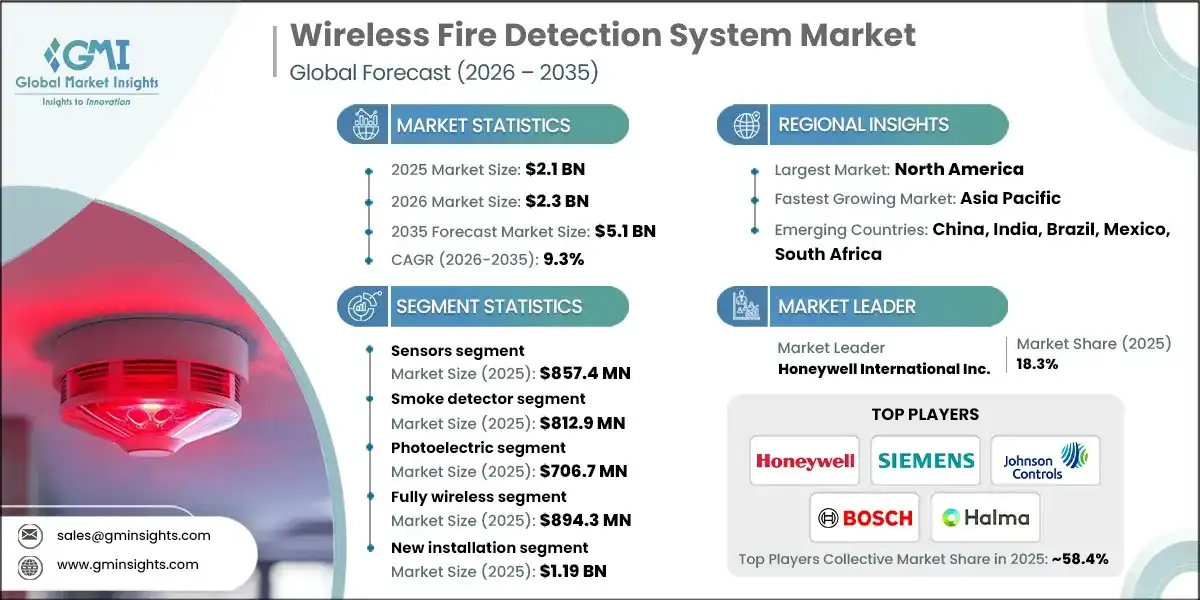
The global wireless fire detection system market was estimated at USD 2.1 billion in 2025. The market is expected to grow from USD 2.3 billion in 2026 to USD 5.1 billion by 2035, at a CAGR of 9.3% during the forecast period of 2026–2035, according to latest report published by Global Market Insights Inc. This growth is driven by the increasing need for enhanced safety & security across residential, commercial, and industrial sectors. Rising adoption of smart building technologies, IoT integration, and wireless communication solutions is enabling real-time monitoring and faster response to fire hazards.
Wireless Fire Detection System Market Key Takeaways
Market Size & Growth
- 2025 Market Size: USD 2.1 Billion
- 2026 Market Size: USD 2.3 Billion
- 2035 Forecast Market Size: USD 5.1 Billion
- CAGR (2026–2035): 9.3%
Key Market Drivers
- Increasing adoption of smart buildings and IoT-enabled fire safety systems..
- Stricter government regulations and building safety standards..
- Rising demand for retrofit low-wiring fire detection solutions..
- Advancements in wireless communication, sensors, and AI-based detection..
- Growing fire-safety awareness across residential, commercial, and industrial sectors..
Challenges
- High initial investment costs.
- Concerns regarding network reliability and potential signal interference in dense urban areas..
Opportunity
- Integration of AI and cloud analytics for predictive fire detection and smart alerts..
- Expansion in emerging markets with growing commercial and industrial infrastructure..
Key Players
- Market Leader: Honeywell International Inc. led with over 18.3% market share in 2025.
- Leading Players: Top 5 players in this market include Honeywell International Inc., Siemens AG, Johnson Controls International plc (Tyco / SimplexGrinnell), Robert Bosch GmbH (Bosch Security Systems), Halma PLC (Apollo, Advanced, etc.), which collectively held a market share of 58.4% in 2025.
Get Market Insights & Growth Opportunities
The adoption of Internet of Things (IoT) technologies is enabling wireless fire detection systems to provide real-time alerts, remote monitoring, and automated emergency responses. Smart building integration allows for predictive maintenance and improved fire safety management, boosting efficiency and reducing human intervention in fire monitoring. For instance, in December 2025, FireAlert Limited launched a next-generation smart fire alarm monitoring system featuring wireless LoRaWAN sensors, cloud-based AI analytics, and mobile notifications.
Wireless fire detection systems detect fire hazards and send notifications wirelessly with no wired infrastructure. Components of these systems include a wireless smoke detector, wireless heat detector, control panel, module for alarms, and a doorway that communicates (gateway). Installation of a wireless fire detection system is quicker than other systems, can be installed in almost any location, and allows for fast and effective management of fire detection systems in a wide variety of settings ranging from residential to commercial and industrial configuration. Wireless fire detection systems work effectively in all types of complicated layouts, such as buildings that maintain important historical properties, large facilities with multiple sections, etc., making them more attractive to many users than traditional wired fire detection systems. Major vendors of the wireless fire detection systems include Honeywell International, Inc., Johnson Controls, Siemens AG, Robert Bosch GmbH, and Hochiki Corporation. These competitors have continued to contribute to expanding the wireless fire detection system marketplace through continued investment in Research and Development, development of innovative and advanced wireless protocols, and development of intelligent and networked fire safety systems. Their endeavours to secure international certification for their products, develop longer-lasting batteries, and improve the accuracy of their sensors further increase the performance of their products and drive global acceptance of wireless fire detection systems. In addition to their continuing investment and efforts in developing new technology, wireless fire detection systems are also changing competitive dynamics in the fire detection systems industry through strategic partnerships with building automation solution providers and implementation of large-scale installations of wireless fire detection systems in commercial buildings.
Between 2022 and 2024, the wireless fire detection system market experienced significant growth, rising from USD 1.7 billion in 2022 to USD 2 billion in 2024. A major trend during this period was the rapid adoption of sensor technologies, including multi-sensor detectors, AI-enabled smoke detection, and wireless connectivity, are improving the reliability and responsiveness of fire detection systems. Enhanced battery life, lower maintenance, and real-time communication features further increase market adoption across diverse applications. For instance, in January 2024, Hikvision partnered with iThermAI to deliver AI-driven fire and smoke detection solutions, combining advanced thermal imaging and intelligent analytics.
The integration of wireless fire detection systems with emergency response networks, including central monitoring centres, alarms, and sprinklers, is becoming more common. Increasingly, these systems are providing real-time alerts and automated notifications to improve response time, to minimize the amount of damage caused by a fire, increase the safety of building occupants, and increase customer interest in using these systems in high-risk urban and industrial environments.
To get key market trends
Wireless Fire Detection System Market Trends
- The growing need for adaptable, cable-free fire safety solutions that provide quicker deployment and excellent dependability is a major trend influencing the wireless fire detection system market. For retrofit projects, temporary locations, and intricate building layouts, wireless detectors, alarms, and control panels simplify installation.
- With the expansion of smart buildings, urban infrastructure, and connected facilities, there is an increase in the adoption of wireless fire detection systems in places where speed, safety and compliance are priority (i.e., offices/hospitals/retail, etc.).
- As systems require greater capabilities, new battery technology, low-power wireless protocols/sensors, and enhanced accuracy of sensory displays are being incorporated within wireless fire detection products. Recent advancements in the field of device miniaturization have improved the longevity, reliability and operation of wireless fire detection systems, especially in difficult or high-density environments.
- Cloud-based platforms have emerged as an integration among solution providers. Cloud Connectivity enables a variety of features to be included with wireless fire detection systems (e.g., remote diagnostics/predictive maintenance/event logging/compliance reporting), ultimately making wireless fire detection systems easier to manage across multiple buildings.
- As the adoption of artificial intelligence and big data analytics continues to increase, an industry's use of these technologies for better decision-making with reduced false alarms from fire detection systems exists. Intelligent algorithms can quickly identify patterns and therefore allow for higher priority to be assigned to alerts, which improves the effectiveness of fire safety and reduces the disruption to the building owner and their occupants.
- Collaborations between fire safety systems manufacturers, wireless technology businesses, as well as regulatory organisations are creating partnerships that stimulate innovative approaches while providing a means for the industry to standardise products. Furthermore, these collaborative efforts will allow for higher rates of interoperability among the various components of the industry and will also enable regulatory organisations to adapt to changing safety standards and subsequently facilitate international acceptance of wireless fire detection systems.
Wireless Fire Detection System Market Analysis
Learn more about the key segments shaping this market
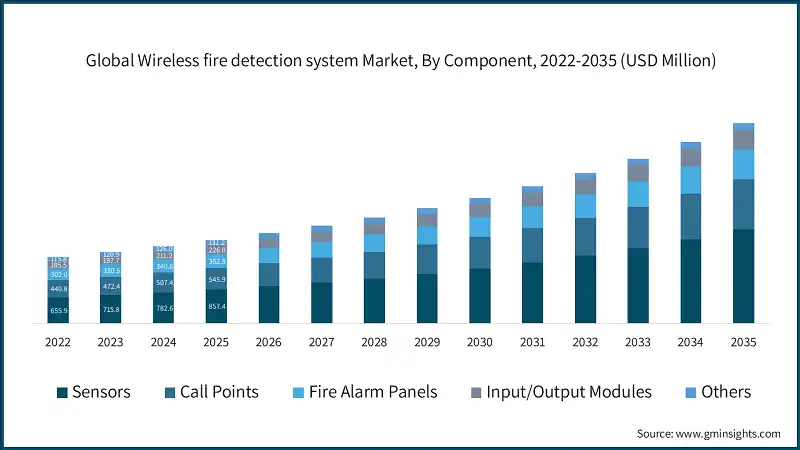
The global market for wireless fire detection system was valued at USD 1.7 billion and USD 1.8 billion in 2022 and 2023, respectively. The market size reached USD 2.1 billion in 2025, growing from USD 2 billion in 2024.
Based on component, the market is segmented into sensors, call points, fire alarm panels, input/output modules, and others. The sensors segment dominated the market in 2025 with a revenue of USD 857.4 million.
- Sensors hold a significant market share in the wireless fire detection system market due to their critical role in detecting fire, smoke, and heat events in real time. They form the backbone of any detection system, ensuring early warning and rapid response across residential, commercial, and industrial infrastructures.
- Wireless sensors, including smoke, heat, and multi-sensor detectors, are preferred for their ease of installation, flexibility, and ability to operate in complex or retrofitted buildings. Their high reliability and low maintenance requirements make them indispensable for modern fire safety systems.
- Additionally, advancements in wireless communication protocols, battery life, and sensor sensitivity have enhanced system accuracy, responsiveness, and scalability. These improvements are expected to further strengthen the dominance of the sensors segment in the market.
- The call points segment is anticipated to witness about 9% CAGR over the forecast period.
- Call points are increasingly adopted due to their ability to provide manual alert capabilities in emergency situations, complementing automated detection systems. They are essential for ensuring compliance with safety regulations and enabling immediate human intervention.
- Integration of wireless call points with advanced fire alarm networks, real-time monitoring systems, and IoT platforms is driving rapidly adoption, making this segment a key contributor to overall market expansion.
Based on sensor type, the wireless fire detection system market is segmented into smoke detectors, heat detectors, gas detectors, and multi-sensor detectors. The smoke detector segment dominated the market in 2025 with a revenue of USD 812.9 million.
- Smoke detectors hold a significant market share due to their critical role in early fire detection, providing timely alerts to prevent property damage and save lives. They are widely deployed across residential, commercial, and industrial infrastructures, forming the core of wireless fire detection systems.
- Advanced smoke detectors with enhanced sensitivity, wireless connectivity, and battery longevity are increasingly preferred for both retrofit and new construction projects. Their ability to detect smoldering and fast-flame fires improves system reliability and response time.
- Continuous innovations in IoT-enabled and smart smoke detection technologies further strengthen the segment’s dominance, supporting large-scale adoption globally.
- The multi-sensor detector segment is anticipated to witness 9.8% CAGR during the forecast period.
- Multi-sensor detectors combine smoke, heat, and sometimes gas detection capabilities, providing higher accuracy and reduced false alarms compared to single-sensor devices.
- The integration of multi-sensor detectors into intelligent, networked fire detection systems is driving rapid adoption, especially in smart buildings and industrial facilities, making this segment a key contributor to overall market growth.
Based on type, the wireless fire detection system market is segmented into photoelectric, ionization, dual sensor, and others. The photoelectric segment dominated the market in 2025 with a revenue of USD 706.7 million.
- Photoelectric detectors hold a significant market share due to their high sensitivity to smoldering fires, early detection capabilities, and wide applicability across residential, commercial, and industrial settings. They are preferred for environments where slow, smoldering fires pose a higher risk.
- Advancements in wireless connectivity, battery life, and integration with smart building systems have further strengthened the adoption of photoelectric detectors. Their reliability and low false-alarm rate enhance overall fire safety performance.
- The segment’s dominance is supported by the growing demand for retrofit and new installations in smart homes, offices, and industrial facilities.
- The dual sensor segment is expected to witness about 10.9% CAGR during the forecast period.
- Dual sensor detectors combine photoelectric and ionization technologies, offering improved detection of both smoldering and fast-flame fires while reducing false alarms.
- Integration of dual sensor detectors into intelligent fire detection networks is driving rapid adoption, particularly in large commercial and industrial infrastructures, making this segment a key contributor to market expansion.
Based on model, the wireless fire detection system market is segmented into fully wireless and hybrid systems. The fully wireless segment holds the market in 2025 with a revenue of USD 894.3 million.
- Fully wireless systems hold a significant market share due to their ease of installation, scalability, and flexibility, eliminating the need for extensive cabling in residential, commercial, and industrial infrastructures. They are especially suitable for retrofitted buildings and complex layouts where wired systems are difficult to implement.
- Advancements in battery technology, wireless communication protocols, and smart monitoring capabilities have further strengthened the adoption of fully wireless systems. These improvements ensure reliable performance, real-time alerts, and seamless integration with building management systems.
- The segment’s dominance is supported by increasing demand for quick deployment, minimal maintenance, and cost-effective fire safety solutions.
- The hybrid segment is expected to witness 9.7% CAGR during the forecast period.
- Hybrid systems combine wireless and wired components, offering the reliability of wired connections with the flexibility of wireless deployment, making them ideal for large-scale commercial and industrial applications.
- Integration of hybrid systems with intelligent fire monitoring platforms is driving rapid adoption, enabling real-time alerts, enhanced system control, and increased market expansion.
Based on installation, the wireless fire detection system market is segmented into new installation and retrofit. The new installation segment dominated the market in 2025 with a revenue of USD 1.19 billion.
- New installations hold a significant market share due to ongoing construction of residential, commercial, and industrial buildings, where fire safety systems are integrated during the initial build phase. These systems benefit from optimized layout planning, ensuring maximum coverage and efficiency.
- Advancements in fully wireless and hybrid technologies, along with smart monitoring integration, further strengthen the adoption of new installations. They provide reliable, scalable, and easy-to-maintain fire detection solutions.
- The segment’s dominance is supported by stringent fire safety regulations and growing awareness among developers and building owners regarding compliance and occupant safety.
- The retrofit segment is expected to witness the fastest growth at a CAGR of 9.6% during the forecast period.
- Retrofit installations are increasingly adopted to upgrade existing buildings with wireless fire detection systems without extensive wiring or structural modifications.
- Rising demand for smart building upgrades, improved safety standards, and IoT-enabled monitoring is driving rapid adoption of retrofit solutions, making this segment a key contributor to market expansion.
Learn more about the key segments shaping this market
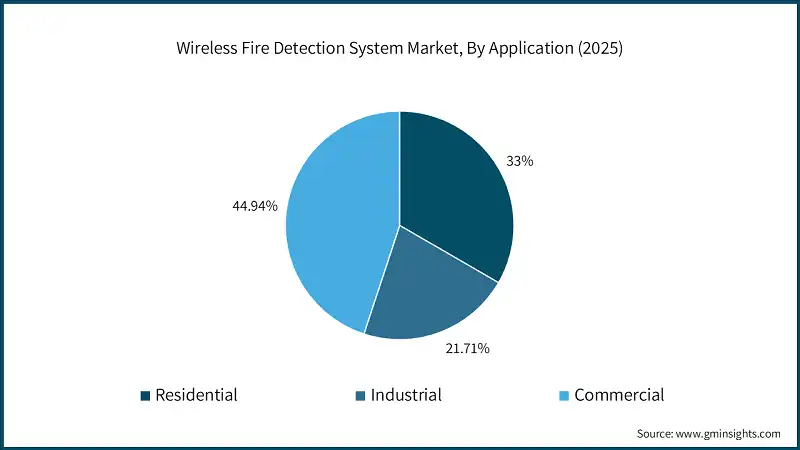
Based on application, the wireless fire detection system market is segmented into residential, industrial, and commercial. The residential segment dominated the market in 2025 with a revenue of USD 708.2 million.
- The residential segment holds a significant market share due to increasing awareness of fire safety among homeowners and the rising adoption of smart home technologies. Wireless fire detection systems offer easy installation, scalability, and real-time alerts, making them ideal for residential applications.
- Advancements in fully wireless and hybrid systems, long-lasting batteries, and smart connectivity further strengthen adoption in homes. These features ensure reliable performance, low maintenance, and seamless integration with home automation platforms.
- The segment’s dominance is supported by growing urbanization, rising disposable incomes, and government initiatives promoting fire safety awareness in residential properties.
- The industrial segment is anticipated to witness the growth at a CAGR of 8.9% during the forecast period.
- Industrial applications are increasingly adopting wireless fire detection systems to protect large-scale manufacturing facilities, warehouses, and chemical plants. Wireless systems provide flexible deployment, real-time monitoring, and integration with industrial safety protocols.
- Rising focus on occupational safety, regulatory compliance, and adoption of IoT-enabled monitoring solutions is driving rapid growth in the industrial segment, making it a key contributor to overall market expansion.
Looking for region specific data?
The North America wireless fire detection system market dominated with the 32.3% market share in 2025, supported by high technology adoption and strong regulatory enforcement.
- A well-defined regulatory framework, stringent fire safety standards, advanced building infrastructure, and strong investments in digital safety technologies are key drivers of market leadership in the region.
- North America, particularly the U.S., hosts leading manufacturers, technology developers, and building automation companies actively advancing wireless fire detection technologies. This ecosystem supports continuous innovation, rapid commercialization of next-generation detectors, and integration of IoT and cloud-based monitoring platforms.
- The region also faces a high incidence of commercial building expansions, industrial facilities, and smart home deployments, generating substantial demand for flexible, reliable, and easily scalable wireless fire detection solutions.
- Additionally, strong insurance requirements and the willingness of enterprises and property owners to invest in advanced fire safety systems further accelerate adoption across residential, commercial, and industrial applications.
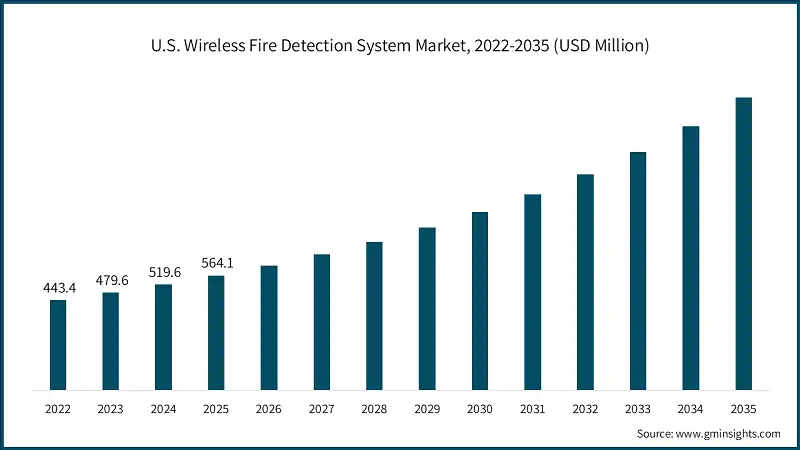
The U.S. market was valued at USD 443.3 million in 2022 and USD 479.6 million in 2023, reaching USD 564.1 million in 2025, up from USD 519.6 million in 2024.
- The U.S. continues to lead the wireless fire detection system market, driven by strict fire safety codes, early adoption of smart building technologies, and strong investments in commercial, industrial, and public infrastructure. High demand for retrofit solutions in aging buildings, growth in data centers and healthcare facilities, and rapid integration of IoT- and cloud-based fire monitoring platforms further support market expansion.
- The presence of major technology providers and rising awareness of advanced fire risk management solutions also reinforce U.S. market leadership.
The Europe market accounted for USD 475.7 million in 2025 and is anticipated to witness strong growth over the forecast period.
- Europe holds a significant share of the wireless fire detection system market, driven by stringent fire safety regulations, widespread adoption of smart building technologies, and increasing investments in commercial, industrial, and public infrastructure.
- Growing demand for retrofit solutions in older buildings, integration of IoT- and cloud-based monitoring platforms, and rising awareness of advanced fire risk management are further fueling market growth. Strong presence of leading technology providers and government initiatives supporting safety standards also contribute to Europe’s robust market position.
Germany dominates the Europe wireless fire detection system market, showcasing strong growth potential.
- Germany holds a substantial share of the market, driven by strict national fire safety regulations, high adoption of smart building technologies, and ongoing investments in commercial, industrial, and public infrastructure. Rising demand for retrofit solutions in older buildings, integration of IoT- and cloud-based monitoring platforms and increasing awareness of advanced fire risk management further support market growth. The presence of leading technology providers and government initiatives promoting safety standards also reinforces Germany’s strong market position.
- Manufacturers should focus on Germany’s wireless fire detection market by emphasizing smart building integration, IoT- and cloud-based monitoring solutions, and retrofit-friendly systems. Compliance with strict fire safety regulations, collaboration with leading technology providers, and addressing growing demand in commercial, industrial, and public infrastructure will drive adoption and strengthen market presence.
The Asia-Pacific market is anticipated to grow at the highest CAGR of 10.4% during the analysis period.
- The Asia-Pacific wireless fire detection system market is experiencing rapid growth, driven by increasing investments in commercial, industrial, and public infrastructure, rising adoption of smart building technologies, and stringent fire safety regulations in key countries.
- Growing urbanization, demand for retrofit solutions in aging structures, integration of IoT- and cloud-based monitoring platforms, and heightened awareness of fire risk management further accelerate market expansion across the region. Technological advancements and the presence of leading solution providers also support robust growth.
The China market is estimated to grow at a significant CAGR of 10.7% from 2026 to 2035.
- China dominates the wireless fire detection system market, driven by rapid urbanization, large-scale commercial and industrial infrastructure projects, and stringent national fire safety regulations. Rising adoption of smart building technologies, integration of IoT- and cloud-based monitoring platforms, and demand for retrofit solutions in older structures further accelerate market growth.
- Government initiatives promoting safety standards, growing awareness of fire risk management, and the presence of leading technology providers also contribute to China’s strong market leadership and sustained expansion.
Brazil leads the Latin American wireless fire detection system market, exhibiting remarkable growth during the analysis period.
- Brazil is emerging as a key growth hub in the Latin America market, driven by expanding commercial and residential infrastructure, increasing urbanization, and rising adoption of advanced fire safety technologies.
- The country’s growing population, coupled with improving awareness of fire safety standards, is generating strong demand for reliable and scalable wireless fire detection solutions.
- Additionally, supportive government regulations, modernization of building codes, and public-private initiatives to enhance fire safety are encouraging widespread deployment of wireless detection systems across commercial, industrial, and residential sectors.
South Africa is expected to experience substantial growth in the Middle East and Africa wireless fire detection system market during the forecast period.
- South Africa demonstrates significant potential in the MEA market, driven by rapid urban development, increasing industrialization, and a rising focus on advanced fire safety infrastructure.
- The country hosts several key technology integrators and is witnessing growing adoption of smart building and IoT-enabled safety solutions across commercial and industrial sectors.
- Government initiatives, stringent fire safety regulations, and collaborations with global technology providers are expected to further accelerate deployment of wireless fire detection systems, supporting market expansion in the region.
Wireless Fire Detection System Market Share
The competitive landscape of the wireless fire detection system industry is characterized by rapid technological innovation and strategic collaboration among leading global players, specialized technology providers, and emerging safety solution firms. Top players such as Honeywell International Inc., Siemens AG, Johnson Controls International plc (Tyco / SimplexGrinnell), Robert Bosch GmbH (Bosch Security Systems), and Halma PLC collectively hold a market share of approximately 58.5%. These companies continuously invest in research and development to enhance system performance, expand product portfolios, and integrate advanced technologies such as IoT connectivity, smart monitoring, and wireless communication protocols.
The market also experiences strategic partnerships, mergers, and acquisitions aimed at accelerating the deployment of next-generation fire safety solutions and expanding presence across residential, commercial, and industrial sectors. Additionally, smaller players and niche technology firms contribute by developing specialized wireless fire detection solutions, advanced sensors, and multi-functional detectors, fostering innovation and differentiation. This dynamic environment drives rapid technological advancements, broader adoption of intelligent fire safety systems, and sustained growth in the global market.
Wireless Fire Detection System Market Companies
Some of the prominent market participants operating in the wireless fire detection system include:
- Apollo Fire Detectors Ltd.
- Electro Detectors Ltd.
- EMS Security Group
- EuroFyre Ltd.
- Gentex Corporation
- Halma PLC (Apollo, Advanced, etc.)
- Hochiki Corporation
- Honeywell International Inc.
- Johnson Controls International plc (Tyco / SimplexGrinnell)
- Kidde Technologies Inc.
- Robert Bosch GmbH (Bosch Security Systems)
- Schneider Electric
- Securiton AG
- Siemens AG
- System Sensor
- Honeywell International Inc.
Honeywell International Inc. is a key player in the wireless fire detection system market with a leading market share of ~18.3%. The company is recognized for its comprehensive portfolio of advanced wireless fire detection solutions, including sensors, call points, and integrated alarm systems. Honeywell’s products provide reliable real-time monitoring, fast response times, and seamless integration with building automation and IoT platforms. Its focus on scalability, energy efficiency, and compliance with global safety standards strengthens its market position and drives innovation across residential, commercial, and industrial applications.
Siemens AG plays a pivotal role in the wireless fire detection system market, holding ~14.2% market share. The company leverages its expertise in smart building technologies and industrial safety systems to deliver high-performance wireless fire detection solutions. Siemens’ products offer accurate detection, low false-alarm rates, and seamless integration with building management and IoT-enabled monitoring platforms. Its emphasis on reliability, advanced analytics, and scalable deployment across commercial and industrial infrastructures enhances system performance and positions Siemens as a trusted provider in intelligent fire safety solutions.
Johnson Controls International plc (Tyco / SimplexGrinnell) holds a significant market share of ~11.3% in the wireless fire detection system market. The company provides a wide range of wireless fire detection products, including sensors, alarm panels, and integrated monitoring solutions for commercial, industrial, and residential applications. Its systems are recognized for high reliability, rapid detection, and seamless integration with building automation and safety networks. Johnson Controls’ focus on scalable solutions, compliance with international safety standards, and service excellence drives adoption and reinforces its leadership in the global market.
Wireless Fire Detection System Market Report Attributes
| Key Takeaway | Details |
|---|---|
| Market Size & Growth | |
| Base Year | 2025 |
| Market Size in 2025 | USD 2.1 Billion |
| Market Size in 2026 | USD 2.3 Billion |
| Forecast Period 2026-2035 CAGR | 9.3% |
| Market Size in 2035 | USD 5.1 Billion |
| Key Market Trends | |
| Drivers | Impact |
| Increasing adoption of smart buildings and IoT-enabled fire safety systems. | Drives demand integrated, intelligent wireless solutions that enhance monitoring, automation, and real-time response. |
| Stricter government regulations and building safety standards. | Accelerates mandatory adoption of compliant wireless detection systems across commercial and industrial facilities. |
| Rising demand for retrofit low-wiring fire detection solutions. | Boosts market uptake as wireless systems reduce installation time, cost, and disruption in existing structures. |
| Advancements in wireless communication, sensors, and AI-based detection. | Improves detection accuracy, minimizes false alarms, and supports scalable, future-ready fire safety networks. |
| Growing fire-safety awareness across residential, commercial, and industrial sectors. | Expands system penetration as stakeholders prioritize proactive risk mitigation and modern safety infrastructure. |
| Pitfalls & Challenges | Impact |
| High initial investment costs | High initial investment costs for wireless fire detection systems hamper market demand, as expenses related to advanced sensors, wireless communication modules, system integration, and professional installation discourage adoption, particularly among small and mid-sized commercial buildings and cost-sensitive residential users. |
| Concerns regarding network reliability and potential signal interference in dense urban areas. | Concerns regarding network reliability and potential signal interference in dense urban areas restrain market growth, as overlapping wireless signals, structural obstructions, and electromagnetic interference can affect alert accuracy, system performance, and user confidence in wireless fire detection solutions. |
| Opportunities: | Impact |
| Integration of AI and cloud analytics for predictive fire detection and smart alerts. | Integration of AI and cloud analytics creates strong opportunities for the wireless fire detection system market by enabling predictive fire detection, real-time risk assessment, and smart alerts. These capabilities improve response times, reduce false alarms, enhance compliance reporting, and support proactive fire safety management across connected commercial and industrial buildings. |
| Expansion in emerging markets with growing commercial and industrial infrastructure. | Expansion in emerging markets presents significant growth opportunities as rapid urbanization and investment in commercial and industrial infrastructure increase demand for modern fire safety solutions. Wireless fire detection systems are well suited for these regions due to easier installation, lower retrofit costs, and scalability across new and existing buildings. |
| Market Leaders (2025) | |
| Market Leaders |
18.3% market share |
| Top Players |
|
| Competitive Edge |
|
| Regional Insights | |
| Largest Market | North America |
| Fastest Growing Market | Asia Pacific |
| Emerging Country | China, India, Brazil, Mexico, South Africa |
| Future Outlook |
|
What are the growth opportunities in this market?
Wireless Fire Detection System Market News
- In November 2025, Hochiki Europe installed a hybrid fire detection system at Villa San Carlo, a 13th-century estate near Vicenza, Italy. The system combined hardwired ESP devices with the Ekho wireless range, controlled via the Latitude panel, to provide full coverage while preserving architectural features. The installation addressed complex constraints, offering reliable fire monitoring for all buildings on site, and demonstrated the flexibility of Hochiki’s solutions for heritage-sensitive hospitality projects.
- In July 2025, Siemens introduced cloud-connected fire safety systems in the UK, enabling silent and remote testing to minimize disruptions in buildings. The ASA detectors with Disturbance Free Testing (DFT) technology allowed automatic checks without on-site staff. Data on system performance, contamination levels, and hazard status were transmitted securely to desktop and mobile apps. The system reduced physical maintenance visits, supported early fault detection, and improved operational efficiency and environmental impact.
- In March 2025, Bosch Building Technologies launched its Wildfire Detection service to enable early detection of vegetation fires. The solution integrates AI-based BME690 gas sensors, cloud connectivity, and automated alerts to emergency services. Solar-powered sensors monitor temperature, humidity, and smoke gases, providing real-time data via a cloud portal. The end-to-end service covers consulting, planning, implementation, and operation, supporting rapid responses, scalable coverage, and protection of forests, infrastructure, and sensitive outdoor areas.
- In February 2023, Halma plc expanded its fire safety sector by acquiring Thermocable (Flexible Elements) Ltd to strengthen Apollo Fire Detectors. Thermocable, based in Bradford, UK, specializes in Linear Heat Detectors for industrial and infrastructure applications. The acquisition, valued at USD 29.3 Million, enhanced Apollo’s ability to serve niche markets including tunnels, factories, car parks, and renewable energy sites, supporting Halma’s strategy of growth through targeted acquisitions and global expansion in safety technologies.
The wireless fire detection system market research report includes in-depth coverage of the industry with estimates and forecasts in terms of revenue in (USD million) from 2022 – 2035 for the following segments:
Market, By Component
- Sensors
- Call Points
- Fire Alarm Panels
- Input/Output Modules
- Others
Market, By Sensor Type
- Smoke Detector
- Heat Detector
- Gas Detector
- Multi-sensor Detector
Market, By Type
- Photoelectric
- Ionization
- Dual Sensor
- Others
Market, By Model
- Fully Wireless
- Hybrid
Market, By Installation
- New Installation
- Retrofit
Market, By Application
- Residential
- Industrial
- Commercial
- BFSI
- Education
- Government
- Healthcare
- Hospitality
- Retail
- Others
The above information is provided for the following regions and countries:
- North America
- U.S.
- Canada
- Europe
- Germany
- UK
- France
- Spain
- Italy
- Netherlands
- Asia Pacific
- China
- India
- Japan
- Australia
- South Korea
- Latin America
- Brazil
- Mexico
- Argentina
- Middle East and Africa
- Saudi Arabia
- South Africa
- UAE
Frequently Asked Question(FAQ) :
What is the market size of the wireless fire detection system in 2025?
The market size was USD 2.1 billion in 2025, with a CAGR of 9.3% expected through 2035 driven by increasing adoption of smart buildings, IoT integration, and enhanced safety requirements across residential, commercial, and industrial sectors.
What is the projected value of the wireless fire detection system market by 2035?
The wireless fire detection system market is expected to reach USD 5.1 billion by 2035, propelled by stricter safety regulations, retrofit demand, and advancements in wireless communication and AI-based detection technologies.
What is the forecasted market size for wireless fire detection systems in 2026?
The market size is projected to reach USD 2.3 billion in 2026.
How much revenue did the sensors segment generate in 2025?
Sensors generated USD 857.4 million in 2025, leading the market due to their critical role in real-time fire, smoke, and heat detection across all infrastructure types.
What was the valuation of the smoke detector segment in 2025?
Smoke detectors held a significant market position and generated USD 812.9 million in 2025, driven by early fire detection capabilities and widespread deployment.
What is the growth outlook for the multi-sensor detector segment from 2026 to 2035?
Multi-sensor detectors are projected to grow at a 9.8% CAGR through 2035, due to higher accuracy, reduced false alarms, and integration into intelligent networked fire detection systems.
Which region leads the wireless fire detection system market?
North America held 32.3% share with USD 564.1 million in 2025. Stringent fire safety codes, smart building adoption, and strong regulatory enforcement fuel the region's dominance.
What are the key trends in the wireless fire detection system market?
Key trends include adoption of cable-free solutions for faster deployment, integration of cloud-based platforms for remote diagnostics, AI and analytics for reduced false alarms, and enhanced battery technology for improved system longevity.
Who are the key players in the wireless fire detection system market?
Key players include Honeywell International Inc., Siemens AG, Johnson Controls International plc (Tyco/SimplexGrinnell), Robert Bosch GmbH (Bosch Security Systems), Halma PLC, Hochiki Corporation, Apollo Fire Detectors Ltd., Schneider Electric, System Sensor, Kidde Technologies Inc., Gentex Corporation, EuroFyre Ltd., EMS Security Group, Electro Detectors Ltd., and Securiton AG.
Wireless Fire Detection System Market Scope
Related Reports