Summary
Table of Content

Wipes Market
Get a free sample of this report
Form submitted successfully!
Error submitting form. Please try again.
Thank you!
Your inquiry has been received. Our team will reach out to you with the required details via email. To ensure that you don't miss their response, kindly remember to check your spam folder as well!
Request Sectional Data
Thank you!
Your inquiry has been received. Our team will reach out to you with the required details via email. To ensure that you don't miss their response, kindly remember to check your spam folder as well!
Form submitted successfully!
Error submitting form. Please try again.
Wipes Market Size
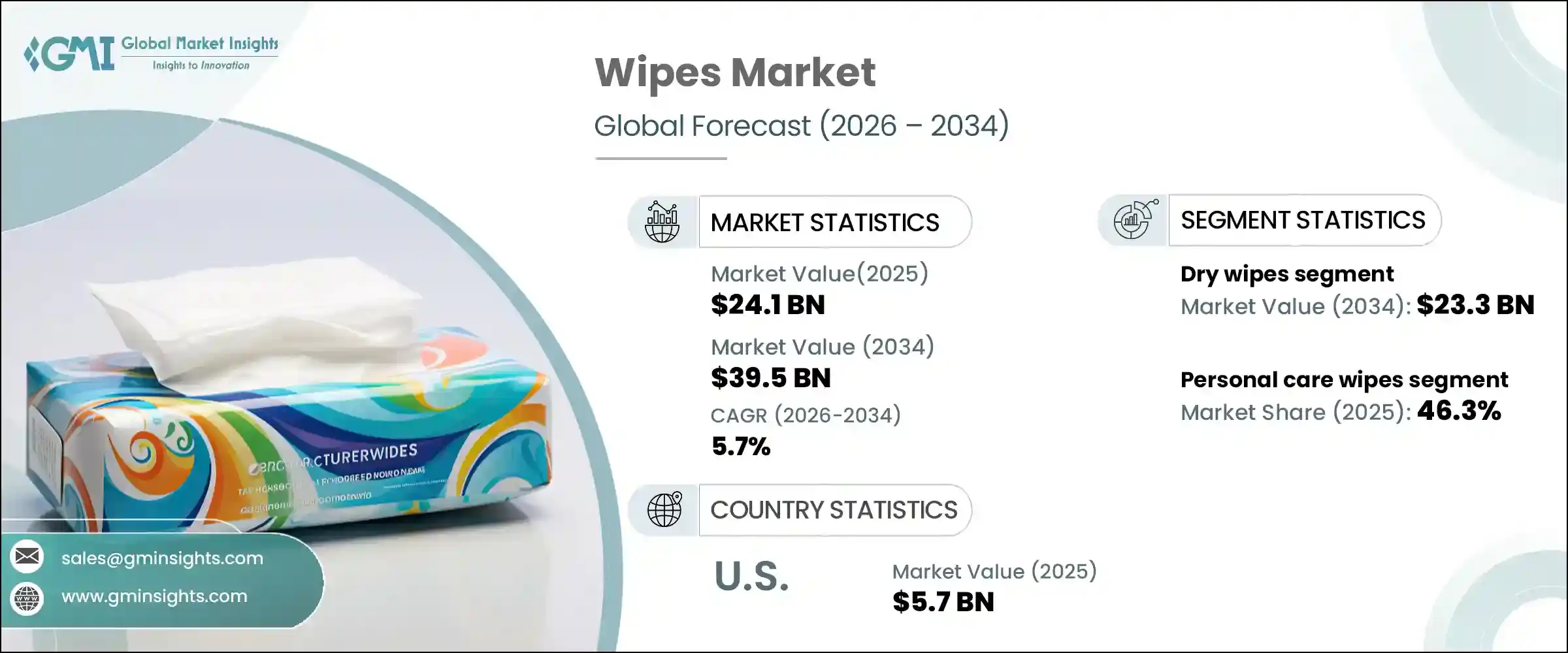
The global wipes market was valued at USD 24.1 billion in 2025. The market is expected to grow from USD 25.3 billion in 2026 to USD 39.5 billion in 2034, at a CAGR of 5.7%, according to latest report published by Global Market Insights Inc.
Wipes Market Key Takeaways
Market Size & Growth
- 2025 Market Size: USD 24.1 Billion
- 2035 Forecast Market Size: USD 39.5 Billion
- CAGR (2026–2035): 5.7%
Key Market Drivers
- Rapid urbanization and lifestyle changes.
- Growing hospitality sector.
- Increasing consumer awareness on hygiene.
- Increasing disposable income.
Challenges
- Market saturation and intense competition.
- Fluctuating raw material prices.
Get Market Insights & Growth Opportunities
The market is experiencing steady growth, driven primarily by rising hygiene awareness and long-term changes in consumer behavior following the COVID-19 pandemic. Heightened emphasis on sanitation across households, healthcare facilities, schools, and public spaces significantly accelerated demand for disinfectant and personal care wipes. During the pandemic, health authorities such as the CDC recommended disinfectant wipes to reduce the spread of infectious diseases, reinforcing their adoption worldwide. This trend aligns with increased healthcare expenditure, which reached USD 9.8 trillion in 2021, accounting for 10.3% of global GDP, directly supporting higher wipes consumption in medical and healthcare settings.
Beyond healthcare, the wipes market growth is strongly supported by consumer preference for convenience-oriented, multifunctional products. Wipes offer portability, ease of use, and versatility across personal hygiene, household cleaning, and baby care applications, making them a practical solution for modern lifestyles. Additionally, rising environmental awareness is reshaping product innovation within the market. Consumers increasingly expect sustainable alternatives, driving demand for organic, biodegradable, and plant-based wipes. In line with this shift, major retailers have announced transitions away from plastic-based wipes toward eco-friendly materials.
Growth in skincare, cosmetics, and personal hygiene segments has further expanded the wipes market value, particularly for facial and cosmetic wipes. These rinse-free, nonwoven wipes meet on-the-go hygiene needs while supporting sustainability goals. As a result, the market forecast remains positive, underpinned by hygiene awareness, sustainability initiatives, and continued product innovation across end-use industries.
Market Dynamics
Drivers
Rapid Urbanization and Lifestyle Changes in the Market
Rapid urbanization and evolving lifestyle patterns are among the most influential wipes market drivers, directly shaping consumption behavior across both developed and emerging economies. As urban populations expand, consumers increasingly seek convenient, time-efficient hygiene solutions that fit fast-paced routines. This shift has significantly increased market demand, particularly for personal care, household and on-the-go hygiene applications.
Increasing Consumer Awareness on Hygiene
Rising consumer awareness around hygiene and sanitation is a primary factor shaping the market growth worldwide. Heightened focus on personal cleanliness, infection prevention, and everyday surface hygiene accelerated by global health events has led to sustained wipes market demand across households, healthcare facilities, workplaces, and public spaces. Consumers now view wipes as an essential hygiene product rather than an occasional convenience, reinforcing their role in daily routines.
Opportunity
Eco-friendly wet wipes fueling online sales expansion
The wipes market analysis indicates that rising demand for eco-friendly wet wipes is emerging as a key growth driver, particularly across online sales channels. Increasing environmental awareness and stricter regulations on single-use plastics are encouraging consumers to shift toward biodegradable, plant-based, and compostable wipe products. This shift is directly influencing market demand, as sustainability has become a critical purchase criterion alongside hygiene and convenience.
Restraint/Challenge
Market saturation and competitive intensity as a key growth driver
The wipes market analysis indicates that market saturation and rising competitive intensity are emerging as influential forces shaping overall industry growth and strategic direction. As the market continues to expand across personal care, household, healthcare, and industrial applications, the growing presence of established brands and new entrants has intensified competition across price, product differentiation, and distribution channels. While saturation in mature markets may limit volume-based expansion, it is simultaneously pushing companies to innovate and unlock new growth avenues.
To get key market trends
Wipes Market Trends
The wipes industry is increasingly shaped by stricter government regulations and industry-led compliance standards focused on product safety and environmental impact. Regulatory frameworks across regions are encouraging manufacturers to adopt sustainable raw materials, cleaner production processes, and responsible disposal practices. This shift is accelerating the adoption of biodegradable wipes across the household, industrial and healthcare-related applications. Compliance with these regulations not only ensures consumer safety but also strengthens brand credibility and improves market acceptance among environmentally conscious buyers.
At the product level, innovation within the disinfectant market and medicated wipes market is advancing rapidly, particularly in the development of flushable and eco-friendly formulations. Manufacturers are prioritizing wipes that deliver effective cleaning and sanitization while minimizing environmental harm. The increasing use of biodegradable and plant-based materials reflects a broader industry alignment with global sustainability goals and wastewater management concerns, making eco-compliant wipes a key growth segment within the overall market forecast.
Simultaneously, the expansion of the personal care sector is driving strong momentum in the facial wipes market. Rising demand for convenient skincare solutions and the introduction of wipes infused with active ingredients have fueled production volumes. Industry data shows that cosmetic wet wipe production in Japan reached 112 million units in FY 2022, marking a decade-high output. Leading consumer goods companies continue to launch facial wipes enriched with botanical extracts, vitamins, and skin-soothing agents, reinforcing long-term wipes market growth across personal, household, and professional-use segments.
Wipes Market Analysis
By Type

Learn more about the key segments shaping this market
Based on type, the market is divided into wet wipes and dry wipes. In 2025, dry wipes held the dominant market of USD 14.3 billion and is expected to reach USD 23.3 billion by 2034.
- The wipes market analysis indicates that rising demand for efficient, time-saving cleaning solutions is a key factor driving growth in the dry wipes segment. Businesses and consumers alike are increasingly seeking multifunctional products that simplify cleaning processes while delivering consistent performance. This shift toward single-solution cleaning products reflects a broader wipes industry analysis, where convenience and operational efficiency are becoming decisive purchase criteria. Product innovations introduced by manufacturers highlight this trend, with newer dry wipes designed to clean both hands and surfaces, reducing the need for multiple cleaning agents.
- Demand from healthcare facilities continues to strengthen the wipes market demand, as dry wipes are widely used for patient care, surface sanitation, and medical equipment cleaning. Their versatility and compatibility with different disinfectants make them suitable for both clinical and household environments. This cross-sector applicability supports a positive market outlook, particularly as hospitals and care centers prioritize hygiene compliance and cost-effective cleaning solutions.
By Application

Learn more about the key segments shaping this market
Based on application, the wipes market is categorized into personal care, household and home cleaning and industrial wipes. In 2025, personal care wipes held the dominant market share of 46.3%.
- The market analysis shows that rapid urbanization and increasingly active lifestyles are driving strong demand for convenient, on-the-go hygiene solutions. Urban consumers prioritize ease of use, portability, and time efficiency, making personal care wipes an essential daily-use product. This trend was further reinforced by the COVID-19 pandemic, which heightened awareness around personal hygiene and cleanliness, strengthening long-term wipes market demand across both developed and emerging economies.
- From an wipes industry analysis perspective, the market covers a broad range of products, including baby wipes, facial and cosmetic wipes, hand and body wipes, and flushable wipes. To meet evolving consumer expectations, manufacturers are increasingly formulating wipes with natural and organic ingredients. These product innovations are designed to appeal to health-conscious buyers who seek safer, gentler hygiene solutions without compromising effectiveness, contributing positively to the overall market outlook.
- Rising awareness of skin health and overall wellness has become one of the most influential wipes market drivers. Consumers are actively shifting toward wipes made with non-irritating, skin-friendly materials, particularly for frequent use and sensitive skin applications. In response, manufacturers are introducing alcohol-free, fragrance-free, and chemical-free formulations, often positioned as hypoallergenic and dermatologist-tested. This emphasis on clean-label ingredients and safety is expected to sustain growth in the personal care wipes segment and support long-term expansion of the market.
By Material
Based on material, the wipes market is categorized into Cotton, Polyester, Viscose, and Others. In 2025, cotton wipes held the dominant market share and is anticipated to maintain its position during the forecast period.
- Cotton is grown on only 2.1% of the world’s Agri-land; however, the U.N. estimates that it fulfills 27% of the world's textile requirements.
- These types of wipes are the most preferred because of their gentleness, absorbency, and softness and are, therefore, ideal for sensitive skin, especially in baby and facial wipes.
- There has been an increase in the demand for cotton wipes with the growing environmentally conscious ideal caused by the shift to sustainable and green products.
Reginal Insights

Looking for region specific data?
The U.S. dominated the North America wipes market with a value of USD 5.7 billion in 2025 and is expected to grow at a CAGR of 6.1% during the forecast period.
- In the U.S., major players are adopting product innovations, sustainable business practices, biodegradable packaging, and use of organic ingredients to remain competitive. For instance, beauty product company Busy Co. launched antibacterial and deodorizing wet wipes in April 2021 that are made in the U.S. using wind energy and 100% clean processes with a zero-waste initiative.
- From a wipes industry analysis standpoint, the Asia-Pacific region is projected to register robust growth, supported by rapid urbanization, rising disposable incomes, and changing lifestyle patterns. China continues to lead regional expansion, as consumers increasingly adopt convenient personal care wipes as part of daily hygiene routines. These structural factors serve as key wipes market drivers, positioning Asia-Pacific as a critical growth engine in the global wipes industry.
- Europe maintains a significant share of the market, with Germany playing a central role due to strong hygiene standards and the presence of established manufacturers. Consistent consumer focus on cleanliness and regulatory compliance is expected to support a stable wipes market outlook across the region. Meanwhile, the Middle East and Africa market is gaining momentum as rising disposable incomes and heightened hygiene awareness encourage a shift toward modern, convenient hygiene products. Countries such as Saudi Arabia are witnessing increased adoption of personal care wipes, contributing to sustained regional growth and reinforcing the overall market trajectory.
Wipes Market Share
The wipes industry competitive landscape remains moderately fragmented, with several multinational companies holding strong brand equity across hygiene, personal care, and household cleaning segments. In 2024, the top five companies Kimberly-Clark Corporation, Procter & Gamble, Johnson & Johnson, Reckitt Benckiser Group plc, and The Clorox Company collectively accounted for approximately 10 - 15% of the market share, highlighting the presence of numerous regional and niche manufacturers alongside established players.
Kimberly-Clark Corporation maintains a differentiated position in the global wipes market through continuous investment in biodegradable and flushable wipe technologies, aligning its product portfolio with evolving sustainability standards. Procter & Gamble leverages its extensive global distribution network and strong brand recognition to sustain a competitive advantage across multiple wipe categories. Johnson & Johnson focuses on personal care wipes, particularly baby and skincare products, supported by higher R&D expenditure that enables consistent product innovation and regulatory compliance.
Reckitt Benckiser Group plc holds a strong foothold in hygiene and disinfection solutions, benefiting from its established presence in both healthcare and household cleaning applications. Meanwhile, The Clorox Company is widely recognized for its disinfecting wipes and continues to expand its portfolio to include environmentally friendly alternatives, strengthening its position in sustainability-driven segments.
Overall, the wipes market share distribution reflects a balance between global brands and emerging players, with competition driven by innovation, sustainability initiatives, and brand trust key factors shaping long-term growth in the global wipes industry.
Wipes Market Companies
Major players operating in the wipes industry are:
- 3M
- BASF SE
- Bayer AG
- Johnson & Johnson
- Kimberly-Clark Corporation
- Procter & Gamble
- Reckitt Benckiser Group plc
- Suominen Corporation
- The Clorox Company
- Unilever
To enhance their market share, participants in the wipes industry are making new product developments, engaging in sustainability initiatives, and forming collaborative partnerships. For example, the Kimberly-Clark corporation has provided the market with biodegradable wipes in response to the increasing need for eco-friendly products.
Likewise, Procter & Gamble directs its efforts toward utilizing its enormous distribution network for a larger consumer base. Another major strategy is product diversification to develop specialty wipes for various purposes. Johnson & Johnson has invested into R&D for functionalized skincare and baby wipes. Reckitt Benckiser Group plc has increased its range of disinfectant wipes to respond to the growing demand for hygienic products in both the medical and domestic fields.
In October 2022, Reckitt’s Lysol Pro Solutions introduced their 800-count bucket and refill pack version of disinfecting wipes. For businesses, this robust offering dramatically reduces operating expense and increases efficiency while lowering packaging waste. The wipes have verified germ defense and kill 99.9% of viruses and bacteria, including the COVID-19 virus.
Wipes Market Report Attributes
| Key Takeaway | Details |
|---|---|
| Market Size & Growth | |
| Base Year | 2025 |
| Market Size in 2025 | USD 24.1 Billion |
| Forecast Period 2026 - 2034 CAGR | 5.7% |
| Market Size in 2034 | USD 39.5 Billion |
| Key Market Trends | |
| Growth Drivers |
|
| Pitfalls & Challenges |
|
What are the growth opportunities in this market?
Wipes Industry News
- Clorox announced the acquisition of GOJO Industries, the maker of PURELL hand hygiene products, for USD 2.25 billion in cash, with expected tax benefits of USD 330 million, bringing the net purchase price to USD 1.92 billion. GOJO generates nearly USD 800 million in annual sales and operates over 20 million installed soap and sanitizer dispensers, significantly strengthening Clorox’s wipes and professional hygiene portfolio.
- Kimberly-Clark reported Q4 2025 net sales of USD 4.08 billion, with organic sales growth of 2.1% and product volume growth of 2.7%, supported by demand for essential hygiene products including wipes. The company achieved adjusted EPS of USD 1.86, exceeding analyst estimates, and announced a strategic focus on margin expansion and efficiency-led growth across personal care and wipes categories in 2026.
The wipes market research report includes in-depth coverage of the industry with estimates & forecast in terms of revenue (USD Billion) (Million Units) from 2021 to 2034, for the following segments:
Market, By Type
- Wet wipes
- Dry wipes
Market, By Application
- Personal care
- Baby wipes
- Cleansing wipes
- Personal hygiene
- Pet care wipes
- Household and home cleaning
- Kitchen wipes
- Bathroom wipes
- Food service wipes
- Industrial wipes
Market, By Material
- Cotton
- Polyester
- Viscose
- Others
Market, By Usability
- Disposable
- Reusable
Market, By Price Range
- Low
- Mid
- High
Market, By Distribution Channel
- Online
- E-commerce websites
- Company-owned websites
- Offline
- Hypermarkets and supermarkets
- Pharmaceutical and drug store
- Other retail stores
The above information is provided for the following regions and countries:
- North America
- U.S.
- Canada
- Europe
- UK
- Germany
- France
- Italy
- Spain
- Russia
- Asia Pacific
- China
- India
- Japan
- South Korea
- Australia
- Latin America
- Brazil
- Mexico
- MEA
- UAE
- Saudi Arabia
- South Africa
Frequently Asked Question(FAQ) :
What was the market size of the wipes in 2025?
The market was valued at USD 24.1 billion in 2025, growing at a CAGR of 5.7% till 2034. The market is driven by rising hygiene awareness and changes in consumer behavior post-COVID-19.
What is the projected value of the wipes market by 2034?
The wipes market is expected to reach USD 39.5 billion by 2034.
What is the expected size of the wipes market in 2026?
The market size is projected to reach USD 25.3 billion in 2026.
How much revenue did the dry wipes segment generate in 2025?
The dry wipes segment generated USD 14.3 billion in 2025 and is expected to reach USD 23.3 billion by 2034.
What was the market share of personal care wipes in 2025?
Personal care wipes held a dominant market share of 46.3% in 2025, led by urbanization and demand for convenient hygiene solutions.
What is the growth outlook for the U.S. wipes sector?
The U.S. dominated the North America market with a valuation of USD 5.7 billion in 2025 and is projected to grow at a CAGR of 6.1% up to 2034.
What are the key trends in the wipes market?
Key trends include the adoption of biodegradable wipes, eco-friendly formulations, and plant-based materials. Innovations in flushable wipes and the expansion of personal care wipes with active ingredients are also driving growth.
Who are the major players in the wipes industry?
Key players include 3M, BASF SE, Bayer AG, Johnson & Johnson, Kimberly-Clark Corporation, Procter & Gamble, Reckitt Benckiser Group plc, Suominen Corporation, The Clorox Company, and Unilever.
Wipes Market Scope
Related Reports