Summary
Table of Content

Window Coverings Market
Get a free sample of this report
Form submitted successfully!
Error submitting form. Please try again.
Thank you!
Your inquiry has been received. Our team will reach out to you with the required details via email. To ensure that you don't miss their response, kindly remember to check your spam folder as well!
Request Sectional Data
Thank you!
Your inquiry has been received. Our team will reach out to you with the required details via email. To ensure that you don't miss their response, kindly remember to check your spam folder as well!
Form submitted successfully!
Error submitting form. Please try again.
Window Coverings Market Size
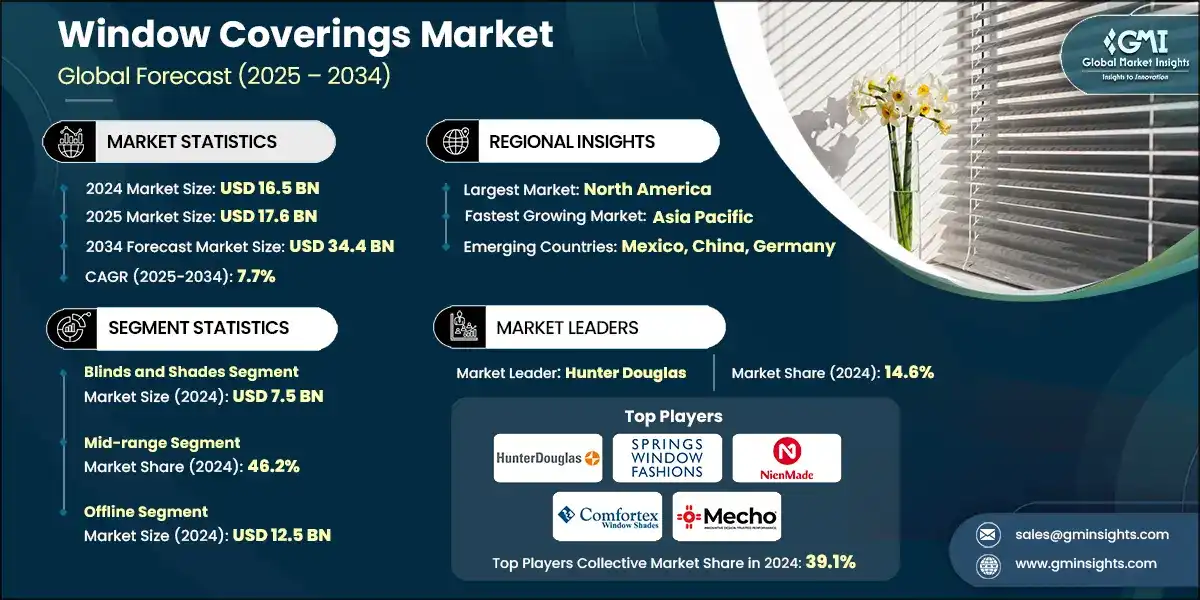
The global window coverings market size was estimated at USD 16.5 billion in 2024. The market is expected to grow from USD 17.6 billion in 2025 to USD 34.4 billion in 2034, at a CAGR of 7.7% according to latest report published by Global Market Insights Inc.
Window Coverings Market Key Takeaways
Market Size & Growth
- 2024 Market Size: USD 16.5 Billion
- 2025 Market Size: USD 17.6 Billion
- 2034 Forecast Market Size: USD 34.4 Billion
- CAGR (2025–2034): 7.7%
Regional Dominance
- Largest Market: North America
- Fastest Growing Region: Asia Pacific
Key Market Drivers
- Rapid integration of smart home ecosystems.
- Resurgence in residential renovation and urbanization.
- Demand for energy-efficient solutions.
Challenges
- Volatility in raw material prices.
- Stringent safety regulations.
Opportunity
- Expansion into eco-friendly and recycled materials.
- Democratization of motorization.
Key Players
- Market Leader: Hunter Douglas led with over 14.6% market share in 2024.
- Leading Players: Top 5 players in this market include Hunter Douglas Inc., Springs Window Fashions, Nien Made Enterprise Co. Ltd., Comfortex Window Fashions, MechoShade Systems, LLC, which collectively held a market share of 39.1% in 2024.
Get Market Insights & Growth Opportunities
The increasing consumer demand for automated and connected home environments continues to present technology as a significant driver in the market. The momentum of smart speakers such as Amazon's Alexa and Google Home and other home automation hubs have made connected home technology mainstream. The Consumer Technology Association (CTA) estimates that about 69% of U.S. households has, more than 80 million households, have at least one smart home device, with this figure expected to grow by 10% each year through 2028. This trend has led to increased demand for window coverings which are compatible with the connected home lifestyle.
Motorized blinds and shades with smartphone app control, and voice command options, are quickly transitioning from a luxury category to more common household items. Motorized window coverings allow users to enjoy the convenience of remote-control capability and programmable schedules, improving user experience and home security (simulating home occupancy). Furthermore, IoT (the Internet of Things) technology, which connects devices, will allow these window coverings to heat and cool a home along with thermostats and lighting, increasing energy efficiency and user convenience.
Since the pandemic, there has been a sustained focus on home improvement, as witnessed by consumers investing heavily in upgrading their living spaces to provide more comfort and aesthetics. According to the Joint Center for Housing Studies of Harvard University, home improvement spending in the United States reached $472 billion in 2022, with an estimated annual growth of 5% through 2025. This directly affected the demand for window treatments as a way of modernizing home interiors. Alongside this trend, rapid urbanization in developing economies-especially across the Asia-Pacific and Africa-is driving new residential construction.
The United Nations estimates that by 2050, about 68% of the world's population will live in urban areas, up from 56% in 2020. All this movement into towns is creating a demand surge for window coverings that suit smaller and denser living spaces. Privacy in these settings is of the essence, therefore driving sales of blinds and shades that boast high opacity without necessarily compromising the natural light. This has seen manufacturers respond with innovative shades designs, including dual-layer shades and blackout blinds, among others, to take care of such emerging trends in consumer needs.
Emerging global trends in energy-efficient window coverings focus on their potential for energy efficiency and functionality rather than solely decorative elements, as the U.S. Department of Energy (DOE) states that windows account for approximately 25-30% of the energy consumption for heating and cooling the home. As a result, trend products such as cellular (or honeycomb) shades are becoming increasingly popular for their ability to insulate by trapping air inside their cells.
In fact, cellular shades can reduce heat gain by roughly 80% in the summer and heat loss by about 40% in the winter, resulting in measurable savings on utility bills. Also, energy-efficient window coverings’ place in the global sustainability agenda can be connected to worldwide sustainability goals such as those outlined in the Paris Agreement on greenhouse gas emissions. Moreover, manufacturers increasingly incorporate recycled polyester and bamboo products to appeal to environmentally minded consumers.
To get key market trends
Window Coverings Market Trends
The integration of IoT sensors, artificial intelligence, is revolutionizing operations, transforming traditional reactive maintenance approaches into predictive, data-driven strategies.
- The global market is undergoing a technological revolution driven by the integration of AI and cutting-edge automation systems. The industry is moving from basic motorization by way of remote control to totally automated and AI-enabled solutions. Smart blinds and shades are increasingly compatible with leading smart home ecosystems such as Amazon Alexa, Google Home, and Control4, thus doing away with proprietary hubs and further improving user convenience. These systems offer "set-it-and-forget-it" functionality whereby sensors automatically adjust the window coverings based on the intensity of sunlight, room temperature, or time of day for optimal energy efficiency and users' comfort.
- Moreover, the manufacturers are integrating machine learning algorithms for further augmentation of the energy management capabilities of such systems. For example, Somfy, one of the leading manufacturers, has introduced AI-powered motorized shades that learn the user's preference over time for a personalized experience. This technological advancement is democratizing smart shades, with more mid-range households finding them increasingly affordable and positioning them as very practical solutions for energy management and home security
- Manufacturers are focusing on using eco-friendly materials such as recycled ocean plastics, biodegradable fabrics, and rapidly renewable resources including bamboo, jute, and hemp. This "Eco-Chic" trend marries sustainability with aesthetics as consumers look for products that help them reinforce their environmental philosophy without repressing their sense of design. The move away from PVC and virgin polyesters is more pronounced, with companies at the forefront being Hunter-Douglas and Springs Window Fashions. Energy efficiency remains another strong factor propelling this trend forward. Cellular shades, also known as honeycomb shades, along with thermal linings designed to reduce heat transfer and the load on HVAC systems, experienced increased demand.
- According to the U.S. Department of Energy, energy-efficient window coverings can reduce heat loss through windows by as much as 25% during colder months while reducing solar heat gain by up to 77% in summer months. This reduces energy bills while contributing to reducing carbon footprints. The European Union's Green Deal, among other similar initiatives taken worldwide, is encouraging manufacturers to adopt sustainable practices in the industry, thereby giving further momentum to this trend.
- Biophilic design, which encourages a greater connection to nature indoors, is gaining popularity in the window covering category. Consumers are increasingly considering organic textures, natural wood grains, and earthy tones instead of a cold, modern look in aluminum or plain white vinyl. Consumers want products like woven wood shades, plantation shutters with natural finishes, and linen-blend drapes to create a calming, sanctuary feel to interior spaces.
- Most recently, a survey by the American Society of Interior Designers (ASID) indicated that 68% of respondents preferred natural materials and finishes in their home decor. This trend to add nature indoors is particularly important to urban dwellers dealing with the strain of city living and constant digital stimulation. In many cases, manufacturers are addressing this changing consumer expectation by adding additional nature-inspired window covering products to their line, such as bamboo blinds and jute-based roller shades, among others.
- The stringent regulations for safety in North America and Europe are propelling a swift move away from corded window covering systems. The regulations remove a strangulation hazard for young children and pets, rendering cordless mechanisms like retractable wands, spring-loaded lifts, and motorized systems the new industry standard. The U.S. Consumer Product Safety Commission's (CPSC) mandatory safety code that was implemented in December 2022 requires all window coverings sold in the United States to meet cordless safety standards.
- Outdoor and exterior living spaces are expanding significantly for the exterior window coverings industry. The "fifth room" concept, extending living space to patios, decks, and balconies, is gaining popularity among homeowners and in the hospitality space. They are increasingly specifying high-durability exterior roller shades, weather-resistant shutters, and zip-track screens, designed specifically for hydronic and UV exposure. These products protect the outdoor furniture, while also minimizing solar heat gain prior to it reaching the window glass, adding energy efficiency for the home.
Window Coverings Market Analysis
Learn more about the key segments shaping this market
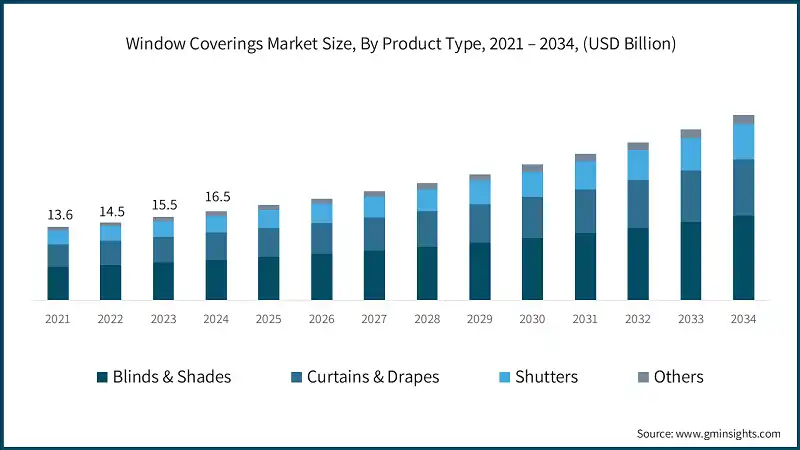
Based on product type, the market is divided into blinds & shades, curtains & drapes, shutters and others. In 2024, blinds and shades held the major market share, generating a revenue of USD 7.5 billion.
- Blinds and shades have emerged as the most dominant category in the global market, driven by their unmatched versatility and aesthetic appeal. These products offer a seamless combination of functionality and style, making them a preferred choice for both residential and commercial applications. According to the Window Covering Manufacturers Association (WCMA), blinds and shades accounted for approximately 45% of the total market share in 2023, showcasing their significant influence in the industry.
- One of the key factors contributing to their dominance is their adaptability to diverse interior design themes. Whether it is modern minimalism or traditional décor, blinds and shades integrate effortlessly, enhancing the overall ambiance of space. Additionally, their ability to provide precise light control and privacy makes them a practical solution for a wide range of consumer needs. The availability of various materials and designs, such as roller shades, Roman shades, and Venetian blinds, further strengthens their appeal. These options cater to different price points, ensuring accessibility for budget-conscious buyers as well as premium customers.
- Ease of installation and maintenance also play a pivotal role in their popularity. Unlike more permanent solutions like curtains or shutters, blinds and shades are relatively simple to install and require minimal upkeep. This convenience has made them a go-to choice for homeowners and businesses alike. Furthermore, advancements in technology, such as motorized and smart blinds, have added a layer of sophistication, attracting tech-savvy consumers. For instance, motorized blinds, which can be controlled via smartphone apps or voice commands.
Learn more about the key segments shaping this market
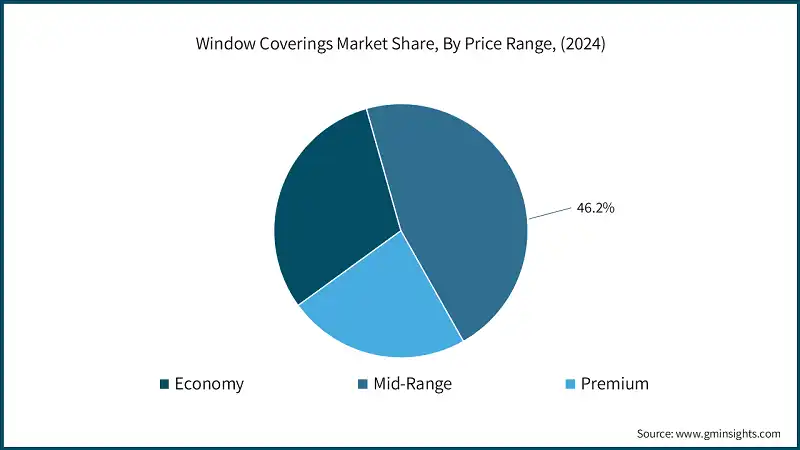
Based on price range, the window coverings market is segmented into economy, mid-range, premium. The mid-range segment held the largest share, accounting for 46.2% of the global market in 2024.
- The mid-range price segment continues to dominate the window-covering market, offering an ideal balance between affordability and quality. This segment caters to consumers who seek durable and aesthetically pleasing products without incurring the high costs associated with premium offerings.
- Mid-range products often incorporate advanced features that were once exclusive to high-end categories. For example, motorization, energy-efficient fabrics, and UV protection are now commonly available in this segment, making it an attractive option for cost-conscious yet discerning buyers.
- The growing middle-class population, particularly in emerging economies, has been a significant driver of this trend. As per the World Bank, the global middle-class population is expected to reach 5.3 billion by 2030, creating a substantial demand for mid-range home improvement products, including window coverings.
- This segment also appeals to aspirational buyers who prioritize design and functionality. Mid-range offerings often feature contemporary designs and customizable options, allowing consumers to personalize their spaces without overspending. The segment's strong presence in both residential and commercial markets underscores its importance in the overall industry landscape.
Based on the distribution channel, the window coverings market is segmented into online and offline. In 2024, offline segment held a major market share, generating a revenue of USD 12.5 billion.
- Despite the rapid growth of e-commerce, offline channels remain the dominant distribution mode in the window covering market. This is largely due to the tactile nature of the products and the need for personalized consultations. According to a report by the National Association of Home Builders (NAHB), over 60% of consumers prefer purchasing window coverings through physical stores, highlighting the enduring relevance of brick-and-mortar retail.
- Offline channels offer a unique advantage by allowing customers to experience the product firsthand. Shoppers can feel fabric textures, evaluate colors, and test mechanisms, which build trust and confidence, especially for high-value or customized products.
- This hands-on approach is particularly important for blinds and shades, where precise measurements and fittings are crucial. Professional guidance and installation services provided by physical retailers further enhance the customer experience, ensuring accuracy and satisfaction.
- Moreover, offline channels cater to a wide demographic, including those who may not be comfortable with online shopping or require immediate support. While e-commerce platforms are gaining traction, particularly among younger, tech-savvy consumers, the offline segment continues to dominate due to its ability to offer assurance, customization, and personalized service.
Looking for region specific data?
North America Window Coverings market
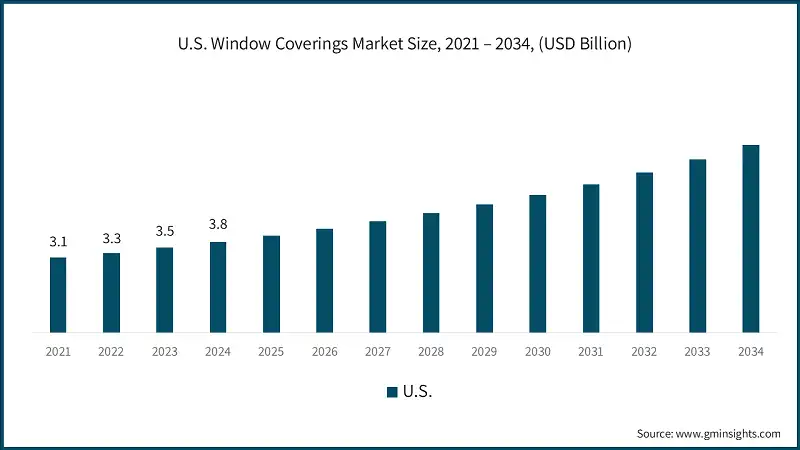
In 2024, the U.S. dominated the North America market, accounting for around 71.2% and generating around USD 3.8 billion revenue in the same year.
- North America continues to dominate the global market, driven by a well-established home improvement industry and a strong consumer preference for premium, technologically advanced products. The region has witnessed a significant adoption of motorized and smart window coverings, supported by the increasing penetration of smart home technologies.
- Additionally, energy-efficient solutions have gained traction, with consumers opting for window coverings that contribute to reduced energy consumption. The presence of leading global brands such as Hunter Douglas, Springs Window Fashions, and Levolor, along with a well-established retail network, ensures easy accessibility and a wide range of customization options.
Europe Window Coverings market
In Europe market, Germany leads the market with 31% share in 2024 and is expected to grow at 7.5% during the forecast period.
- Europe holds a significant share of the global market, underpinned by its strong focus on sustainability and energy efficiency. European consumers prioritize eco-friendly materials, such as recycled fabrics and sustainable wood, which align with the region's stringent environmental regulations. The European Union's Energy Performance of Buildings Directive (EPBD) has further driven demand for window coverings that enhance insulation and reduce energy consumption.
- Countries like Germany, France, and the United Kingdom are at the forefront of adopting automated and motorized solutions, according to the European Commission. The growing popularity of minimalist and modern interior designs has also fueled demand for sleek and functional blinds and shades.
Asia Pacific Window Coverings market
The Asia Pacific with China leads with market share of around 31.1% in 2024 and is anticipated to grow with a CAGR of around 8.2% from 2025 to 2034.
- The Asia-Pacific region is emerging as the fastest-growing market for window coverings, driven by rapid urbanization, rising disposable incomes, and evolving consumer preferences. According to the World Bank, urbanization in the region reached 60% in 2023, with countries like China and India leading the charge.
- The region benefits from a strong manufacturing base, particularly in China. This manufacturing strength enables cost-effective production and supports global exports. While traditional curtains remain popular in many parts of the region, there is a growing shift toward modern blinds and shades, influenced by Western design trends and the increasing adoption of smart home technologies.
Middle East and Africa Window Coverings market
Middle East and Africa market are growing at a CAGR of 5.5% during the forecast period.
- The Middle East & Africa region exhibits unique market dynamics, shaped by its climatic and cultural characteristics. The intense sunlight and high temperatures in the Middle East drive demand for window coverings that offer superior light control and thermal insulation.
- Consumers in the Middle East often prefer luxurious and ornate designs, reflecting the region's cultural affinity for opulence. At the same time, motorized and smart solutions are gaining traction, particularly among affluent households. Offline retail channels dominate the market, as consumers value personalized services and high-end customization.
Window Coverings Market Share
Hunter Douglas Inc. is leading with 14.6% market share. Hunter Douglas Inc., Springs Window Fashions, Nien Made Enterprise Co. Ltd., Comfortex Window Fashions, Mecho Shade Systems, LLC collectively hold around 39.1%, indicating moderately fragmented market concentration. These prominent players are proactively involved in strategic endeavors, such as mergers & acquisitions, facility expansions & collaborations, to expand their product portfolios, extend their reach to a broad customer base, and strengthen their market position.
Hunter Douglas Hunter Douglas has a clear competitive edge as the global leader in window coverings, driven by its innovation in smart and motorized solutions. The company’s strong brand equity and premium positioning allow it to dominate both residential and commercial segments.
Springs Window Fashions stands out for its scale and customization capabilities, particularly in North America. Its competitive edge lies in offering a wide range of mid-range and premium products under well-known brands like Bali and Graber. The company excels in project-based solutions for commercial spaces and provides strong after-sales support, which builds customer trust.
Window Coverings Market Companies
Major players operating in the window coverings industry are:
- Bombay Dyeing & Manufacturing Co Ltd.
- Ching Feng Home Fashions Co.
- Comfortex Window Fashions
- Coulisse B.V.
- Griesser AG
- Hunter Douglas Inc.
- Insolroll Window Shading Systems
- Lafayette Interior Fashions
- MechoShade Systems, LLC
- Nien Made Enterprise Co. Ltd
- Schenker Storen AG
- SKANDIA WINDOW FASHIONS, INC.
- Springs Window Fashions
- TOSO CO. LTD
- Welspun
Nien Made Enterprise Co. Ltd advantage is rooted in its manufacturing scale and cost efficiency, making it one of the largest global suppliers of blinds and shutters. The company benefits from economies of scale and a strong export network, enabling competitive pricing without compromising quality.
Comfortex Window Fashions differentiates itself through innovation in fabrics and energy-efficient shading solutions. Its competitive edge lies in catering to the mid-range segment with customizable options that appeal to homeowners seeking style and functionality without premium pricing. Comfortex also emphasizes sustainability and thermal performance, which resonates with eco-conscious consumers.
MechoShade Systems, LLC strength, is its specialization in commercial automated shading systems, giving it a unique position in the market. The company is a leader in green building compliance, offering solutions that meet LEED and energy efficiency standards. Its competitive edge lies in advanced motorization and integration with building automation systems, making it the preferred choice for large-scale projects like corporate offices, hospitals, and educational institutions.
Window Coverings Market Report Attributes
| Key Takeaway | Details |
|---|---|
| Market Size & Growth | |
| Base Year | 2024 |
| Market Size in 2024 | USD 16.5 Billion |
| Market Size in 2025 | USD 17.6 Billion |
| Forecast Period 2025 - 2034 CAGR | 7.7% |
| Market Size in 2034 | USD 34.4 Billion |
| Key Market Trends | |
| Drivers | Impact |
| Rapid integration of smart home ecosystems | The primary technological driver for the market is the surging consumer demand for automated and connected home environments. As smart speakers (like Alexa and Google Home) and home automation hubs become standard in households, there is a corresponding demand for window coverings that integrate into these ecosystems. |
| Resurgence in residential renovation and urbanization | The post-pandemic focus on home improvement has sustained a strong demand for window treatments, as consumers continue to invest in upgrading their living spaces for comfort and aesthetics. |
| Demand for energy-efficient solutions | With rising global energy costs and a heightened awareness of carbon footprints, consumers are increasingly treating window coverings as functional tools for thermal management rather than just decorative items |
| Pitfalls & Challenges | Impact |
| Volatility in raw material prices | Manufacturers face significant headwinds due to the fluctuating costs of essential raw materials, including aluminum, wood, PVC, and polyester fabrics |
| Stringent safety regulations | The industry is currently undergoing a costly transition due to tightening safety standards aimed at preventing child strangulation hazards. |
| Opportunities: | Impact |
| Expansion into eco-friendly and recycled materials | There is a significant untapped opportunity in the "Green" segment, specifically for products made from recycled ocean plastics, rapidly renewable resources (like bamboo or hemp), and non-toxic, VOC-free fabrics. |
| Democratization of motorization | Currently, automated window coverings are often priced at a premium, restricting them to the upper-mid and luxury tires. A major opportunity exists for manufacturers to develop and distribute entry-level motorized solutions that are affordable for the mass market. |
| Market Leaders (2024) | |
| Market Leaders |
14.6% market share |
| Top Players |
Collective market share in 2024 is 39.1% |
| Competitive Edge |
|
| Regional Insights | |
| Largest market | North America |
| Fastest growing market | Asia Pacific |
| Emerging countries | Mexico, China, Germany |
| Future outlook |
|
What are the growth opportunities in this market?
Window Coverings Market News
- In November 2025, MechoShade Systems, LLC launches Ascend sustainability program, partners with Cisco and Legrand for smart building integration.
- In November 2025, Insolroll Window Shading Systems, nominated in seven categories for Window Fashion Vision’s Readers’ Choice Awards.
- In October 2025, Griesser AG completes switch to green aluminum at Nenzing plant, reducing CO2 footprint by 30%.
- In January 2025, Hunter Douglas Inc. launched Aura Illuminated shades integrating LED lighting and smart home compatibility.
The window coverings market research report includes in-depth coverage of the industry with estimates & forecasts in terms of revenue (USD Billion) and volume (Million Units) from 2021 to 2034, for the following segments:
Market, By Product Type
- Blinds & shades
- Curtains & drapes
- Shutters
- Others
Market, By Material
- Natural
- Synthetic
Market, By Technology
- Manual covers
- Smart covers/automatic covers
Market, By Price Range
- Economy
- Mid-range
- Premium
Market, By Opacity Level
- Blackout
- Room darkening
- Light filtering
- Sheer/transparent
Market, By End Use
- Residential
- Commercial
Market, By Distribution Channel
- Online
- E-commerce
- Company websites
- Offline
- Specialty stores
- Retail stores
- Others
The above information is provided for the following regions and countries:
- North America
- U.S.
- Canada
- Europe
- Germany
- UK
- France
- Italy
- Spain
- Asia Pacific
- China
- India
- Japan
- Australia
- South Korea
- Latin America
- Brazil
- Mexico
- Argentina
- Middle East and Africa
- South Africa
- Saudi Arabia
- UAE
Frequently Asked Question(FAQ) :
What is the market size of the global window coverings market in 2024?
The market size was USD 16.5 billion in 2024, driven by rising home improvement spending, urbanization, and rapid adoption of smart home solutions.
What is the projected value of the window coverings market by 2034?
The market value of window coverings is expected to reach USD 34.4 billion by 2034, reflecting a strong CAGR of 7.7% from 2025 to 2034.
What is the projected market size of the global market in 2025?
The market is projected to reach USD 17.6 billion in 2025, supported by continued home renovation activity and rising adoption of automated and energy-efficient shading solutions.
How much revenue did the blinds & shades segment generate in 2024?
Blinds & shades generated USD 7.5 billion in 2024, making it the largest product category due to its versatility, light control features, and adoption in both residential and commercial spaces.
What was the valuation of the mid-range price segment in 2024?
The mid-range segment held 46.2% share in 2024, driven by strong demand for affordable yet durable window coverings with modern designs and motorization features.
Which region leads the global window coverings market?
North America leads the market, with the U.S. generating USD 3.8 billion and 71.2% share of the region in 2024, driven by high adoption of premium and motorized window treatments.
Who are the key players in the global window coverings market?
Key players include Hunter Douglas Inc., Springs Window Fashions, Nien Made Enterprise Co. Ltd., Comfortex Window Fashions, MechoShade Systems, along with others such as Coulisse B.V., Griesser AG, Lafayette Interior Fashions, TOSO Co. Ltd., Welspun, and Schenker Storen AG. Hunter Douglas leads with 14.6% share.
Window Coverings Market Scope
Related Reports