Summary
Table of Content

Wind Turbine Market
Get a free sample of this report
Form submitted successfully!
Error submitting form. Please try again.
Thank you!
Your inquiry has been received. Our team will reach out to you with the required details via email. To ensure that you don't miss their response, kindly remember to check your spam folder as well!
Request Sectional Data
Thank you!
Your inquiry has been received. Our team will reach out to you with the required details via email. To ensure that you don't miss their response, kindly remember to check your spam folder as well!
Form submitted successfully!
Error submitting form. Please try again.
Wind Turbine Market Size
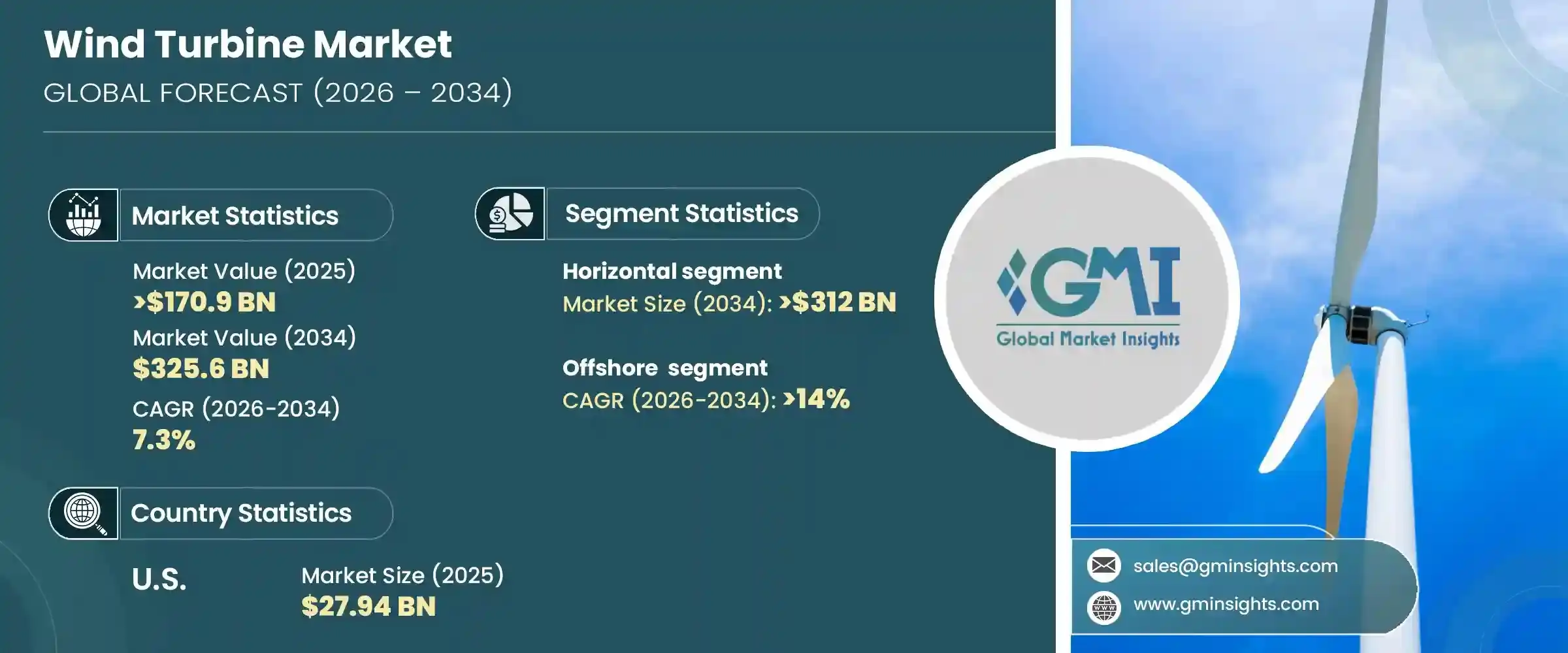
The global wind turbine market was valued at USD 170.9 billion in 2025 and is estimated to grow at a CAGR of 7.3% from 2026 to 2034. Growing adoption of renewable energy across major economies and strong push towards offshore wind energy will drive market growth. Investors are interested in renewable energy projects such as wind farms along with the rise of green bonds that give the available capital for wind energy projects, will improve the business scenario. For instance, Europe installed over 18 GW of wind energy in 2023 and will install 200 GW of new wind capacity from 2024-2030 to meet its climate energy targets.
Wind Turbine Market Key Takeaways
Market Size & Growth
- 2025 Market Size: USD 170.9 Billion
- 2035 Forecast Market Size: USD 325.6 Billion
- CAGR (2026–2035): 7.3%
Key Market Drivers
- Favorable regulatory norms and targets to limit GHG footprints.
- Rising efforts toward clean electricity generation.
- Robust private & public sector investments in the expansion of wind power solutions.
Challenges
- Local demographics & challenges related to turbine installations.
Get Market Insights & Growth Opportunities
Companies are working to mitigate these concerns through environmental assessments, technological solutions, and improved community outreach, supporting wind turbine industry size expansion and driving overall market growth. For citation, in September 2024, consortium of five companies comprising Sumitomo Heavy Industries, Kawasaki Kisen Kaisha, Albatross Technology, Electric Power Development and Tokyo Power to conduct a feasibility study on floating VAWT’s.
Decreasing technology cost, integration of storage solutions with renewable energy along with investments, subsidies and grants for wind energy adoption will augment the business landscape. The Wind Europe states that more than USD 90 billion has been invested in Europe for 2023 which is double the investments made in the year 2022.
To get key market trends
Wind Turbine Market Trends
The wind turbine industry is gaining steady momentum as global decarbonization goals accelerate the adoption of renewable energy wind turbines across utility-scale and commercial applications. Rising integration of wind power with energy storage systems, along with sustained corporate investments in sustainability, continues to strengthen long-term market prospects.
Key wind turbine industry trends include growing interest in environmentally certified wind energy projects. Developers are increasingly pursuing green certifications such as LEED and BREEAM, ensuring that wind farms align with sustainable construction and lifecycle standards. These practices not only reduce environmental impact but also enhance investor confidence and policy support, supporting wider market adoption.
Technological improvements such as higher turbine grades, extended operational lifespans, and reduced maintenance costs are further improving project economics. As a result, both large wind turbines and next-generation models are being deployed to maximize energy output and optimize land use.
The onshore wind turbine market remains a key contributor due to lower installation costs and faster deployment timelines. Meanwhile, the offshore wind turbine is expanding rapidly, driven by higher capacity turbines, favorable coastal wind conditions, and strong government backing. Government initiatives are playing a central role in market expansion. Financial incentives such as tax credits, feed-in tariffs, and long-term power purchase agreements are making wind energy increasingly attractive.
Wind Turbine Market Analysis

Learn more about the key segments shaping this market
The global market for wind turbine continues to expand rapidly, supported by rising wind turbine demand across utility-scale and offshore renewable energy projects. The wind turbine industry analysis highlights strong momentum driven by technological innovation, favorable government policies, and accelerating investments within the broader renewable energy market wind segment.
- The horizontal axis segment is projected to exceed USD 312 billion by 2034, owing to its proven scalability, high efficiency, and adaptability across diverse applications. Continuous improvements in blade materials, nacelle design, and structural components have significantly enhanced performance. HAWTs dominate offshore installations as they efficiently capture stronger and more consistent sea-based winds, reinforcing their long-term role in wind turbine market growth.
- The vertical axis segment is expected to surpass USD 13.43 billion by 2034. Advancements in aerodynamics, lightweight materials, and control systems are improving operational efficiency and expanding use cases. Strategic deployments, such as Vestas’ delivery of high-capacity turbines for Asian markets, signal growing commercialization potential and strengthen the overall forecast.

Learn more about the key segments shaping this market
- Based on installation, the market is segmented into onshore and offshore. The offshore wind turbine market is anticipated to register a CAGR exceeding 14% through 2034, driven by large-scale investments, floating wind projects, and grid-integration advancements in developed economies.
The U.S. wind turbine market reached USD 27.94 billion in 2025, while North America accounted for over 16% market share, supported by advanced manufacturing capabilities, strong supply chains, and innovative project financing models.

Looking for region specific data?
- The U.S. market for wind turbine will cross USD 34 billion by 2034. Growing integration of wind energy with storage solutions along with growing demand for clean energy solutions to combat climate change is driving the need for renewable energy sources like wind. Reduction in the cost of wind energy coupled with policies and incentives like feed-in tariffs, tax credits, renewable energy targets, and even the introduction of new policies will promote clean energy production. These actions will significantly improve the business context.
- The European wind turbine market will grow on account of set ambitious targets, advancing floating wind projects and initiatives boosting the investments in the market. According to the REPowerEU initiative, in 2022, enhanced the wind capacity by 33 GW, ensuring 46% of electricity from the renewables.
- Growing energy demand, commitment to renewable energy goals and increasing adoption for onshore and offshore wind projects in economies including China will augment the product adoption across Asia Pacific. Ongoing development for wind energy infrastructure, especially in coastal areas with optimal wind resources will stimulate the market landscape.
- MEA wind turbine market will reach more than USD 12 billion by 2034. Increasing requirement to diversify the energy sources, reduce dependance on fossil fuels and setting of ambitious renewable energy targets will drive the market growth. For instance, the Dumat al-Jandal, the 400 MW, utility scale wind farm began operations in 2024 in Saudi Arabia, stimulating the product demand.
Wind Turbine Market Share
- In the wind turbine manufacturing sector, Siemens Gamesa holds a noteworthy share in the market owing to a broad range of onshore and offshore wind turbines. The company provides integrated solutions for large scale wind projects and is known for its technological innovation.
- Apart from SGRE, the top 5 companies operating in the wind turbine industry include Nordex, Suzlon Green Energy, Vestas, Goldwind and Senvion. These companies develop large turbines that offer higher efficiency, incorporate AI, IoT and predictive maintenance systems to optimize performance.
- The market structure is dominated by firms whose key strategies involve technology development, cost savings, and venturing into new markets. The industry has a growing number of regional and smaller players. The sector has seen an increase in mergers and acquisitions as companies look to strengthen their positions, enter new markets, or gain access to new technologies.
Wind Turbine Market Companies
- Siemens Gamesa Renewable Energy is amongst the top companies in the wind turbine industry. The company had ana overall revenue of USD 10 billion in 2024. The company innovated and introduced the Recyclable Blade, offering comprehensive solutions for commercial use across onshore and offshore installations.
- Nordex maintains a sizable presence in the market with new order intake of over 1 GW in 2024. The company has a wide manufacturing network with a product portfolio focused on 4 to 6 MW onshore wind turbines. Recently, the company supplied 32% of the new connected onshore wind power in Germany.
- Vestas is the amongst the largest turbine manufacturers and service providers, focusing on technological innovations and sustainable energy solutions. Recently, Vestas received a turbine order for 384 MW Tyligulska project in Ukraine, supplying 64 turbines.
- Goldwind has global installed wind capacity of over 100 GW by 2024. The company provides complete wind power solutions and has formed the Global alliance for Sustainable Energy along with 17 other power companies. Recently, the company inaugurated its wind equipment manufacturing facility in Brazil with anticipated annual capacity of 150 units of medium speed permanent magnet turbines.
Eminent players operating in the wind turbine market are:
- Envision group
- Enercon
- General Electric
- Goldwind
- Mingyang Smart Energy Group Co., Ltd.
- Nordex
- Siemens Gamesa Renewable Energy
- Suzlon Energy
- Senvion
- Vestas
- Zhejiang Windey Co., Ltd.
Wind Turbine Market Report Attributes
| Key Takeaway | Details |
|---|---|
| Market Size & Growth | |
| Base Year | 2025 |
| Market Size in 2025 | USD 170.9 Billion |
| Forecast Period 2026-2034 CAGR | 7.3% |
| Market Size in 2034 | USD 325.6 Billion |
| Key Market Trends | |
| Growth Drivers |
|
| Pitfalls & Challenges |
|
What are the growth opportunities in this market?
Wind Turbine Industry News:
- In January 2025, Nordex received a turbine order for 638 MW including the service contracts from Turkey. This will align with the country goal to achieve the expansion of solar and wind energy to 120,000 MW by 2035. Further, the company has been the market leader with market share of over 30% in the country.
- GE Vernova Forecasts 2026 revenue of $44–45 billion, beating estimates; reported 34% order growth to $59.3 billion backlog; wind segment expected to incur $400 m+ losses in 2026.
- Suzlon Energy acquired 51% stake in Renom Energy for INR 400 cr; will acquire remaining INR 260 cr in next ~18 months; also bagged 370 WTGs orders for Gujarat projects.
This wind turbine market research report includes an in-depth coverage of the industry with estimates & forecast in terms of revenue and volume in “USD Million and MW ” from 2021 to 2034, for the following segments:
Market, By Axis
- Horizontal (HAWTs)
- Up-wind
- Down-wind
- Vertical (VAWTs)
Market, By Installation
- Onshore
- Offshore
Market, By Connectivity
- Grid connected
- Stand alone
Market, By Rating
- 100 kW
- 100 kW to 250 kW
- > 250 kW to 500 kW
- > 500 kW to 1 MW
- 1 MW to 2 MW
- > 2 MW
Market, By Application
- Residential
- Commercial & Industrial
- Utility
The above information has been provided for the following regions and countries:
- North America
- U.S.
- Canada
- Mexico
- Europe
- Germany
- Spain
- UK
- France
- Italy
- Sweden
- Asia Pacific
- China
- Japan
- South Korea
- India
- Australia
- Middle East & Africa
- South Africa
- Egypt
- Latin America
- Brazil
- Chile
- Argentina
Frequently Asked Question(FAQ) :
What is the market size of the wind turbine in 2025?
The market was valued at USD 170.9 billion in 2025, with a CAGR of 7.3% expected through 2034 driven by rising renewable energy adoption and expanding offshore wind projects.
What is the projected value of the wind turbine market by 2034?
The market is expected to reach USD 325.6 billion by 2034.
What is the growth outlook for the horizontal axis segment by 2034?
The horizontal axis segment is projected to exceed USD 312 billion by 2034, driven by proven scalability, high efficiency, and strong offshore deployment.
What is the projected value of the vertical axis segment by 2034?
The vertical axis segment is expected to surpass USD 13.43 billion by 2034, supported by advancements in aerodynamics and lightweight materials.
What is the growth rate for the offshore wind turbine market through 2034?
The offshore wind turbine market is anticipated to register a CAGR exceeding 14% through 2034, driven by large-scale investments and floating wind projects.
What is the projected value of the U.S. wind turbine market by 2034?
The U.S. market is expected to cross USD 34 billion by 2034, supported by integration with storage solutions and favorable clean energy policies.
Which region holds significant market share in the wind turbine market?
North America accounted for over USD 27.94 billion revenue in 2025, driven by advanced manufacturing and innovative financing models.
What are the upcoming trends in the wind turbine market?
Key trends include growing environmentally certified projects with LEED and BREEAM standards, integration with energy storage systems, expansion of offshore installations, and technological improvements in turbine efficiency and lifespan.
Who are the key players in the wind turbine market?
Key players include Siemens Gamesa Renewable Energy, Nordex, Vestas, Goldwind, Suzlon Energy, Senvion, Envision Group, Enercon, General Electric, Mingyang Smart Energy Group, and Zhejiang Windey.
Wind Turbine Market Scope
Related Reports