Summary
Table of Content

Winch Market
Get a free sample of this report
Form submitted successfully!
Error submitting form. Please try again.
Thank you!
Your inquiry has been received. Our team will reach out to you with the required details via email. To ensure that you don't miss their response, kindly remember to check your spam folder as well!
Request Sectional Data
Thank you!
Your inquiry has been received. Our team will reach out to you with the required details via email. To ensure that you don't miss their response, kindly remember to check your spam folder as well!
Form submitted successfully!
Error submitting form. Please try again.
Winch Market Size
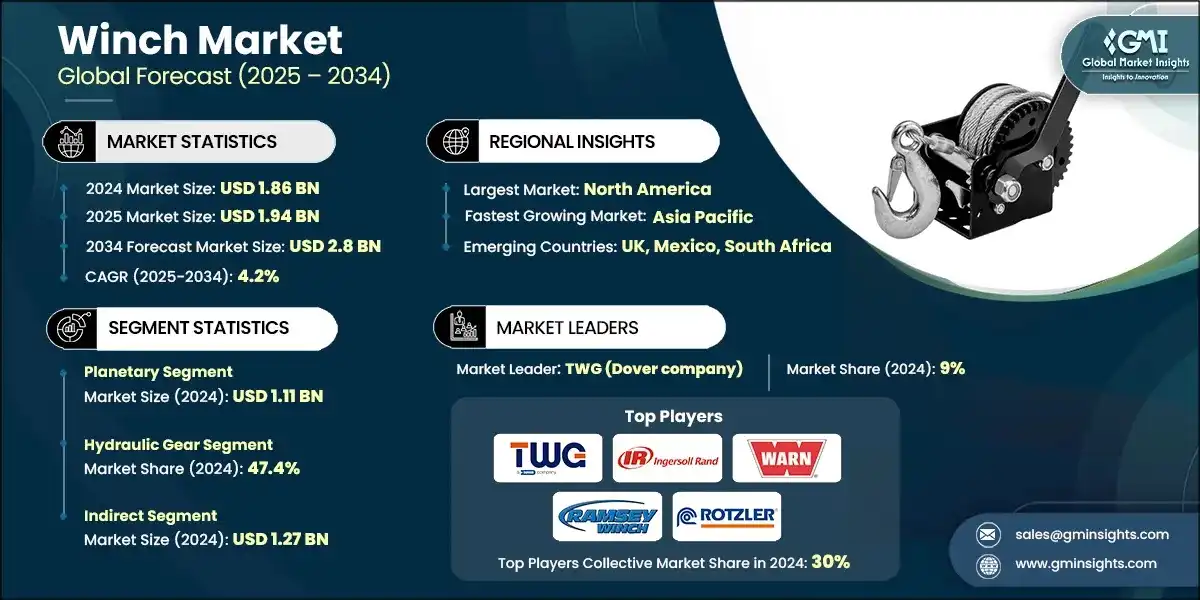
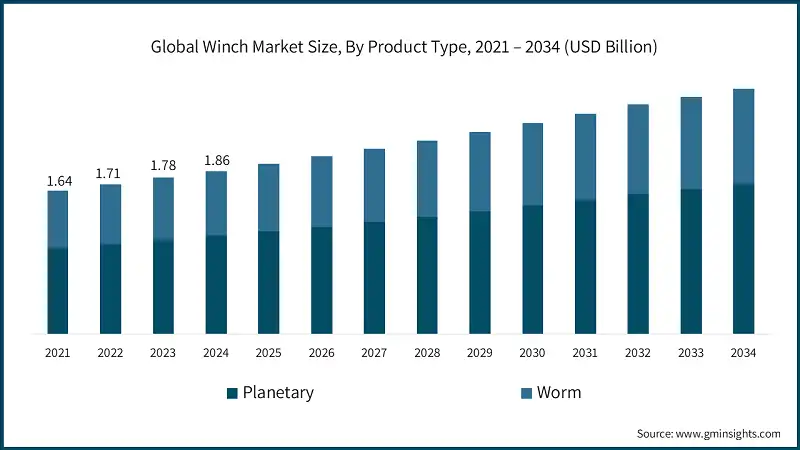
The winch market was estimated at USD 1.86 billion in 2024. The market is expected to grow from 1.94 billion in 2025 to USD 2.8 billion in 2034, at a CAGR of 4.2% according to latest report published by Global Market Insights Inc.
Winch Market Key Takeaways
Market Size & Growth
- 2024 Market Size: USD 1.86 Billion
- 2025 Market Size: USD 1.94 Billion
- 2034 Forecast Market Size: USD 2.8 Billion
- CAGR (2025–2034): 4.2%
Key Market Drivers
- Urbanization and industrialization.
- Rise in oil and gas exploration activities.
- Industrial mechanization and logistics.
Challenges
- High initial cost.
- Regulatory and safety compliance.
Opportunity
- Technological innovation and smart winches.
- Customization and modular design.
Key Players
- Market Leader: TWG (Dover company) led with over 9% market share in 2024.
- Leading Players: Top 5 players in this market include TWG (Dover company), Ingersoll Rand, WARN Industries, Ramsey Winch, Rotzler, which collectively held a market share of 30% in 2024.
Get Market Insights & Growth Opportunities
Urbanization and industrialization are the two major macroeconomic drivers for the winch market. As cities grow, and there are more infrastructure projects, the demand for material handling increases, and winches are an important mechanism in part of the construction activity of lifting heavy weights, moving structural components, and even tunneling underground in construction or installing pipelines underground. The increase in smart cities and large-scale urban development programs, especially in developing economies, will further increase demand for strong and multiple-purpose winch systems that can work in many different environments.
Industrialization is a critical driver creating demand for winches for their respective needs as organizations are striving to be more automated and mechanized in manufacturing plants, warehouses, and logistics movements. Businesses are increasingly adopting winches in place of manual labor focused on safer operations and guaranteeing efficiencies. The introduction of automated systems, integrating winches into assembly lines, cargo movement, or equipment maintenance, is part of a broader industrial efficiency mission. With deliveries from the public and private sector into their respective industrial, logistical, and supply chain infrastructure, sustainable demand for winches can be anticipated in the steel, automotive, chemicals, and heavy machinery sectors.
One of the largest markets for winches is the oil and gas industry mainly because of pressure of exploration and drilling operations. Winches are used in offshore and land-based operations to lift drilling equipment, handle pipes, anchor rigs, and pull supply vessels. As global energy demand increases and countries search for diversified sources of energy, exploration continues to push further into deeper and more remote regions. This has resulted in the launch of dedicated winch systems that can handle pressures, corrosive conditions, and other varying load conditions.
In addition, the resumed specialization and exploration of the Middle East, North America, and certain areas of Africa create new opportunities for winch manufacturers. New technologies for hydraulic winches and electric winches result in safer and more effective operations which are urgently needed in high-risk oil and gas formations. The demand for energy independence and the development of unconventional resources including shale gas and deep-water reserves creates an additional impetus for new winch systems. With all these additional opportunities, winches designed for accuracy, durability, and remote operation will continue to remain in demand as the industry advances.
To get key market trends
Winch Market Trends
The winch industry is evolving in a consistent transition process driven by shifts in industrial needs, technology, and a stronger focus on safety and efficiency. Industries are modernizing and diversifying rapidly, requiring winches that are more multi-dimensional and have multi-functional operational characteristics. The impact is both on product design directly, as well as on product application, as winch products are used in applications across construction, marine, energy, and automotive markets in part because of the newness in environmental and climate regulations.
- Functions such as remote operation of a winch, automated braking, overall load monitoring, and even the addition of a wireless load cell as a common/loading monitoring function are becoming commonplace in industrial uses. These functions both enhance safety, and advances in operator control of processes, particularly when the factors of precision and reliability are critical. Advances in smart technology, adaptability, and robotics are expanding into predictive maintenance capabilities, enabling operators to reduce downtime of systems and extend the usable life of assets as well.
- Electric winches are much easier to install, and easier to maintain, drawing interest in urban construction and other projects sensitive to the environment. This is part of a larger trend toward sustainability in the industrial equipment space, where cutting emissions and reducing noise fully occupies the "to do" list.
- Sectors such as construction and oil & gas are still the largest consumers of winch systems. With the expansion of these sectors into more challenging conditions, the call for tough and high-performing winches is rising and compelling manufacturers to consider more specialized products for unique operational tasks.
- Rise of modular, or customizable winch systems. Businesses are looking for equipment that better suits their unique requirements, whether that is load capacity, control type, or how well a piece of equipment/function of winch system can handle environmental challenges. Manufacturers that can provide unique design options are experiencing success in industries and with customers where operational conditions vary significantly. This trend will create a new wave of innovation in product development and promote collaboration between suppliers and customers.
Winch Market Analysis
Learn more about the key segments shaping this market
Based on product type, the winch market is divided into planetary and worm. The planetary segment generated a revenue of USD 1.11 billion in 2024.
- Planetary gear winches are popular because of their ability to produce high levels of torque for their size and weight, providing productive use in heavy-duty applications like construction, mining, and oil & gas. The gear system of the winch distributes the load over multiple contact points thus allowing for smoother operation and more efficient load bearing while reducing complexity and mass in gear design.
- Planetary gear systems are designed for consistent, well-balanced power transfer, providing smooth performance under changing or uneven loads, making them particularly well suited for applications where accuracy and dependability are essential, such as marine anchoring, industrial hoisting, and vehicle recovery.
- Planetary winches are equally versatile and flexible, with the ability to be integrated into various machinery such as cranes, trucks, and offshore platforms. Their modular design allows manufacturers to create custom gear ratios, motor types, and mounting options to meet operational requirements.
Learn more about the key segments shaping this market
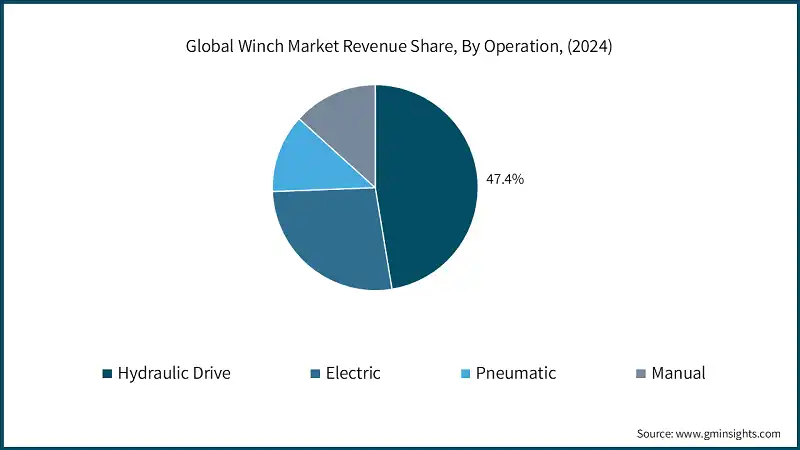
Based on operation, the market is segmented into hydraulic, electric, pneumatic and manual. The hydraulic gear segment held about 47.4% of the global winch market share in 2024.
- Hydraulic winches are favored for their consistent power and torque for long periods of time and can handle demanding industrial and commercial applications. Compared to electric winches, which can overheat and lose efficiency after long periods of use, hydraulic winches perform consistently even under heavy loads.
- Hydraulic winches are designed to work in extreme environments, such as moisture, dirt, heat, and corrosion. They will often have seals and solid construction to assist in working in remote or difficult environments like marine vessels, oil rigs, and desert mining operations.
- Many of the industrial machines and vehicles such as cranes, trucks, and excavators, are already utilizing hydraulic systems hydraulic winches typically fit easily into that existing operational philosophy. This is valuable because it does not require the development of extensive modifications or additional power sources.
Based on the distribution channel, the winch market is segmented into direct and indirect. The indirect distribution channel held a major market share, generating a revenue of USD 1.27 billion in 2024.
- Indirect distribution channels, including dealers, distributors, and third-party retailers, can permit winch manufacturers to expand their reach into new markets without having to establish direct infrastructure in each market. These intermediaries often have knowledge of the local market, existing customers, and logistical capabilities that help reach markets in different geographies. In emerging markets, for instance, the local distributor may be valuable because they know the regulatory environment, culture, and can have established customers.
- Indirect channels provide the producer with opportunities to grow more optimally when compared to direct selling. This is achieved by minimizing significant investments in warehousing, staffing, and customer service operations.
- Distributors will typically manage inventory, provide after-sales support, and perform regional market activities, which minimize the day-to-day operational responsibility of the producer. The opportunity to expand into new geography and/or niche markets using indirect distribution can be a good solution for companies trialing options that require smaller overhead for a venture.
Looking for region specific data?
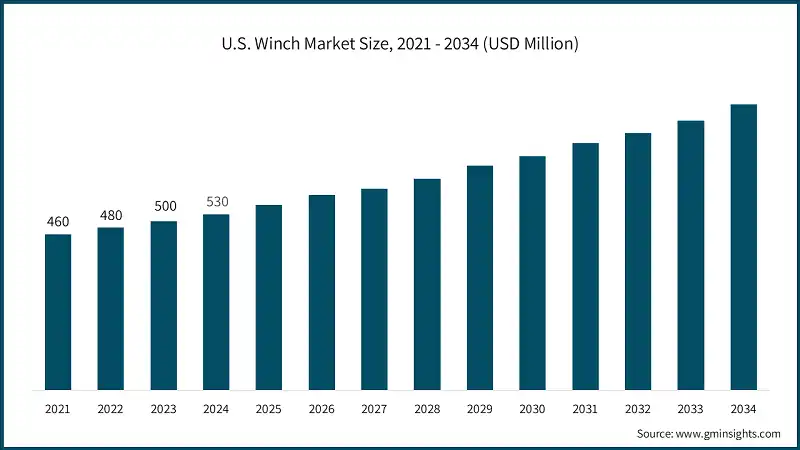
In 2024, the U.S. dominated the North America winch market, accounting for around 75.6% share and generating around USD 530 million revenue in the same year.
- The U.S. remains a crucial contributor to winch industry expansion from its strong industrial base, and ongoing investments in infrastructure upgrades. Winches are a common piece of equipment designed to lift and pull certain weights across its construction, oil & gas, marine, and defense. As the country strives to modernize its transportation systems, infrastructure upgrades related to energy, and real estate urbanization projects, the demand for state-of-the-art winches remains steady. Furthermore, the U.S. has several top manufacturers, and a well-established aftermarket system that stimulate innovation and create a pipeline for supply, which strengthens the country as an important manufacturing and deployment region.
- The winch market across North America benefits from a variety of applications and a high technology adoption rate. Winches serve vital functions in both commercial and recreational contexts from recovering off-road vehicles for Canada’s unpredictable terrains, to supporting oil exploration in the Gulf of Mexico. In addition, the emphasis on safety, automation, and environmental performance, drive the regions embrace of electric and smarter winches and winch technology in general. The established distribution system and aftermarket support also allow for manufacturers to quickly serve large companies and niche markets. This pairing of demand, and innovative marketplace, places North America at the top of the global market.
Europe winch market, Germany leads the market with 19.5% share in 2024 and is expected to grow at 5.8% CAGR during the forecast period.
- The European market is shaped by its stringent safety standards and regulatory frameworks, which dictate the design of products as well as operational practice. Manufacturers in the region focus on conforming to EU directives regarding machinery safety, environmental impact, and ergonomics in the workplace.
- European industries are increasingly adopting electric winch systems in alignment with sustainability goals. Increased pressures to reduce carbon emissions and utilize cleaner technologies are shifting preference from hydraulic to electric; construction, marine, and logistics sectors are implementing electric winch systems. Government incentives and environmental regulations are supporting this change by mandating energy-efficient equipment.
The Asia Pacific leads the winch market; China holds a revenue share of around 37.5% in 2024 and is anticipated to grow with a CAGR of around 5% from 2025 to 2034.
- The APAC region is experiencing rapid industrial advancement and infrastructure development in several of its nations, among them China, India, Indonesia, and Vietnam. This progress leads to an increased demand for winch systems used in construction, mining, and logistics. Trustworthy lifting and pulling systems are needed for large-scale projects such as highways, ports and energy habitats, where winches become paramount. This often coincides with the region's interests in urbanization and connectivity coming together on an ongoing basis; a case for ensuring both standard and bespoke winch solutions based on local circumstances - continues to present manufacturers with real opportunities for supply.
- The region's sizeable coastline and greater investment towards supporting marine transportation, offshore energy and shipbuilding have also led to ongoing demand and opportunities associated with winches in maritime situations. Shipbuilding predominates in countries such as South Korea, China, and Japan, while developing nations of Southeast Asia have increasingly looking toward developing offshore oil and gas exploration activities. Winch systems are found to be competent in delivering anchorage, towing and cargo handling requirements.
Latin America winch market is growing at a CAGR of 4.5% during the forecast period.
- Latin America is experiencing growing urbanization which is stressing existing water and wastewater systems. Countries such as Brazil, Mexico, and Colombia are investing in expansion and modernization of wastewater treatment plants to deal with pollution and public health. Winches are part of these projects due to their reliable aeration and solids handling in biological treatment at municipal and industrial wastewater facilities.
- LATAM is a very long geographic region with a vast coastline, and a robust agricultural economy, which also leads to an increase in the use of winches in marine and agricultural industries. In maritime environments specifically, winches are utilized for anchoring, towing, and cargo handling, particularly during commercial fishing and as part of port operations. In agriculture, winches can be used for installing irrigation systems, recovering stuck equipment, and completing logistics involved in transporting goods.
Winch Market Share
TWG (Dover company), Ingersoll Rand, WARN Industries, Ramsey Winch, Rotzler collectively hold around 30%, indicating moderately fragmented market concentration. These prominent players are proactively involved in strategic endeavors, such as mergers & acquisitions, facility expansions & collaborations, to expand their product portfolios, extend their reach to a broad customer base, and strengthen their market position.
Ingersoll Rand is a large and important company in the industrial machinery space, supplying an array of winch systems, as part of their greater array of air, fluid, and material handling technologies. The company has a reputation for engineering excellence across global markets and services several industries including oil & gas, marine and manufacturing.
WARN Industries manufactures winches for off-road and utility vehicles and is a well-known name in the automotive aftermarket. Its products are used widely for vehicle recovery, towing, and recreational off-roading. WARN, which is a subsidiary of Keystone Automotive Operations, has an exceptional distribution system thanks to the parent company, along with their loyal consumer base. For this reason, they are the leader in the consumer-grade winch industry.
Winch Market Companies
Major players operating in the winch industry are:
- ACE Winches
- Columbus McKinnon
- COMEUP Industries
- Dutton-Lainson Company
- Ingersoll Rand
- Lewmar
- PALFINGER MARINE
- Ramsey Winch
- Rotzler
- Superwinch
- Thern
- Transvictory Winch System
- TWG (Dover company)
- Warn Industries
- WPT Power Corporation
ACE Winches is a UK-based company, which is known for its specialization in marine and offshore winch systems. ACE Winches sells heavy-duty hydraulic winches for oil & gas, subsea, and renewable energy applications. They are also known for providing custom-engineered solutions and assisting with complicated lifting and pulling operations in difficult working conditions. Because of this service, ACE Winches is a notable member of specialized industrial markets.
Columbus McKinnon is a manufacturer of motion control systems based around the globe. Columbus McKinnon makes winches, hoists, and lifting systems used in various applications, mostly related to motion control systems in various sectors such as construction, manufacturing, and logistics. Their winches are included as part of motion control systems emphasis the safety, reliability and automation of hoisting devices.
Winch Market Report Attributes
| Key Takeaway | Details |
|---|---|
| Market Size & Growth | |
| Base Year | 2024 |
| Market Size in 2024 | USD 1.86 Billion |
| Market Size in 2025 | USD 1.94 Billion |
| Forecast Period 2025 - 2034 CAGR | 4.2% |
| Market Size in 2034 | USD 2.8 Billion |
| Key Market Trends | |
| Drivers | Impact |
| Urbanization and industrialization | These shifts are causing a higher demand for winches used in construction, infrastructure, and manufacturing projects where efficient material handling and lifting systems significantly drive productivity and safety. |
| Rise in oil and gas exploration activities | Increased exploration, particularly in offshore and remote regions, has fueled the need for winch systems that can operate properly in extreme conditions while effectively handling heavy equipment. |
| Industrial mechanization and logistics | The evolution of automated and mechanized operations in factories and warehouses is creating a higher use of winches for moving, positioning, and integrating smart automated handling systems. |
| Pitfalls & Challenges | Impact |
| High initial cost | The important initial investment needed for more advanced winch systems can discourage utilization by small and medium enterprises, further inhibiting the uptake of winch in on-demand markets and markets where price plays a key factor in purchasing decisions. |
| Regulatory and safety compliance | Stringent safety and environmental regulations can complicate and increase the cost of manufacturing winches but have also fostered innovations and improvements in the quality of winch design. |
| Opportunities: | Impact |
| Technological innovation and smart winches | The inclusion of materials and inclusions (such as automation, remote control and IoT features) is already being linked to roadside and workplace safety, and operational efficiencies and is always making winches safer and more attractive if used at the right place. |
| Customization and modular design | There is increasing demand for portable solutions or modular winches that are flexible and meet the needs for environment and operational demands. |
| Market Leaders (2024) | |
| Market Leaders |
9% market share |
| Top Players |
The collective market share in 2024 is 30% |
| Competitive Edge |
|
| Regional Insights | |
| Largest Market | North America |
| Fastest Growing Market | Asia Pacific |
| Emerging Country | UK, Mexico, South Africa |
| Future Outlook |
|
What are the growth opportunities in this market?
Winch Market News
- In June of 2025, PALFINGER MARINE introduced its PFM 2100 Crane with integrated winch system, at Nor-Shipping 2025, for aquaculture and offshore support vessel applications. The launch emphasized the company's commitment to providing compact, high-capacity lifting solutions suitably designed for demanding marine environments, with the combination of advanced winch technology and a foldable knuckle boom crane design for flexibility and safety at sea.
- In April 2025, Ramsey Winch introduced its latest lineup hydraulic winches Omega, Hercules, and Helios at the Florida Tow Show. These units are purpose-built heavy-duty winches that provide greater performance, higher durability, and advance functionality on today's tow trucks and recovery vehicles, underscoring Ramsey's rank as a premier manufacturer in the commercial winch industry.
- In January of 2025, Ingersoll Rand introduced its Third Generation™ Air Winch FA5A-24MX1, intended for offshore and mining applications; the latest design features a radial piston motor for greater power and efficiency with auto-disc braking to help control and ensure load safety in demanding applications. The launch demonstrated Ingersoll Rand's commitment to providing durable, reliable heavy-lifting solutions for industrial applications.
- In June 2024, Rotzler launched its TARVOS Pulling winch series along with TREIBMATIC recovery winches in a range designed for defense and heavy-duty recovery operations. Additionally, the debut of the APEX Control System Platform was previously announced at Eurosatory 2024, along with incorporating enhanced communication protocols, such as CAN Bus and Ethernet for added safety, efficiency, and interoperability in the military and industrial domain.
- In January 2024, Columbus McKinnon announced the launch of three new BETA wire rope winches, specifically designed for the slipway in Meppen, Germany. The winches are designed to safely handle vessels with an overall length of up to 36 meters, have webbing and wire rope options. The specifications also include synchronized control systems and emergency operation capabilities. This announcement represented a strategic enhancement to Columbus McKinnon's already robust marine solutions portfolio and was indicative of the continuing commitment to precision, safety, and performance in heavy-duty maritime applications.
The winch market research report includes in-depth coverage of the industry with estimates & forecasts in terms of revenue (USD Billion) and volume (Thousand Units) from 2021 to 2034, for the following segments:
Market, By Product Type
- Planetary
- Worm
Market, By Operation
- Hydraulic
- Electric
- Pneumatic
- Manual
Market, By Pulling Capacity
- Below 2000 lbs.
- 2000 -4000 lbs.
- 4000 -8000 lbs.
- 8000 -12000 lbs.
- 12000 -16000 lbs.
- 16000 -20000 lbs.
- 20000 -40000 lbs.
- 40000 -80000 lbs.
- Above 80000 lbs.
Market, By Application
- Commercial recovery
- Mobile crane
- Military
- Work boat
- Utility
- Others
Market, By End Use Industry
- Oil & gas
- Marine
- Mining
- Aerospace & defense
- Automotive
- Construction
- Metal industry
- Energy power
- Transportation & material handling
- Others
Market, By Distribution Channel
- Direct
- Indirect
The above information is provided for the following regions and countries:
- North America
- U.S.
- Canada
- Europe
- Germany
- UK
- France
- Italy
- Spain
- Asia Pacific
- China
- India
- Japan
- Australia
- South Korea
- Latin America
- Brazil
- Mexico
- Argentina
- Middle East and Africa
- South Africa
- Saudi Arabia
- UAE
Frequently Asked Question(FAQ) :
What is the market size of the winch in 2024?
The market size was USD 1.86 billion in 2024, with a CAGR of 4.2% expected through 2034 driven by rapid urbanization and industrial expansion.
What is the projected value of the winch market by 2034?
The winch market is expected to reach USD 2.8 billion by 2034, propelled by increased oil and gas exploration activities, industrial mechanization, and infrastructure modernization.
What is the current winch market size in 2025?
The market size is projected to reach USD 1.94 billion in 2025.
How much revenue did the planetary segment generate in 2024?
The planetary segment generated USD 1.11 billion in 2024, dominating due to its ability to produce high torque for heavy-duty applications.
What was the market share of hydraulic operation segment in 2024?
Hydraulic operation held 47.4% market share in 2024, favored for consistent power and torque during extended periods under demanding conditions.
What is the growth outlook for Germany from 2025 to 2034?
Germany is expected to grow at 5.8% CAGR during the forecast period, driven by stringent safety standards and increasing adoption of electric winch systems aligned with sustainability goals.
Which region leads the winch market?
The U.S. region dominated with 75.6% share, generating around USD 530 million revenue in 2024, supported by strong industrial base and ongoing infrastructure investments.
What are the upcoming trends in the winch market?
Key trends include adoption of smart technology with remote operation and automated braking, shift toward electric winches for sustainability, integration of IoT features and predictive maintenance, and rise of modular and customizable winch systems.
Who are the key players in the winch market?
Key players include ACE Winches, Columbus McKinnon, COMEUP Industries, Dutton-Lainson Company, Ingersoll Rand, Lewmar, PALFINGER MARINE, Ramsey Winch, Rotzler, Superwinch, Thern, Transvictory Winch System, TWG (Dover company), Warn Industries, and WPT Power Corporation.
Winch Market Scope
Related Reports