Summary
Table of Content

Wetsuits Market
Get a free sample of this report
Form submitted successfully!
Error submitting form. Please try again.
Thank you!
Your inquiry has been received. Our team will reach out to you with the required details via email. To ensure that you don't miss their response, kindly remember to check your spam folder as well!
Request Sectional Data
Thank you!
Your inquiry has been received. Our team will reach out to you with the required details via email. To ensure that you don't miss their response, kindly remember to check your spam folder as well!
Form submitted successfully!
Error submitting form. Please try again.
Wetsuits Market Size
The growing number of people taking part in water sports is driving demand for wetsuits due to increased interest in recreational and adventure sports such as surfing, scuba diving, snorkeling, paddle boarding, wakeboarding, and open-water swimming. Social media, travel influencers, and the rise of adventure tourism are making these types of sports more visible and desirable to younger people and new participants. Several countries are investing in water-activity facilities (surf schools, scuba certification centers, and coastal training facilities), creating greater access to these sports for the beginner and hobbyist market.
Wetsuits Market Key Takeaways
Market Size & Growth
- 2025 Market Size: USD 1.37 Billion
- 2026 Market Size: USD 1.44 Billion
- 2035 Forecast Market Size: USD 2.28 Billion
- CAGR (2026–2035): 5.2%
Regional Dominance
- Largest Market: Asia Pacific
- Fastest Growing Region: Asia Pacific
Key Market Drivers
- Rising participation in water sports.
- Expansion of coastal & marine tourism.
- Growth in fitness-oriented activities.
Challenges
- High material cost & price sensitivity.
- Environmental concerns around neoprene.
Opportunity
- Rising demand for eco-friendly & sustainable wetsuits.
- Customization & 3D body scanning.
Key Players
- Market Leader: O’Neill led with over 11% market share in 2025.
- Leading Players: Top 5 players in this market include O’Neill, Rip Curl, Billabong International, Patagonia, Shieco Group, which collectively held a market share of 35% in 2025.
Get Market Insights & Growth Opportunities
At the same time, endurance sports are becoming popular worldwide, creating an increased need for performance-based wetsuits that provide the best buoyancy, hydrodynamics, and thermal protection. As wetsuits typically wear out quickly from frequent use, amateur athletes, swimming clubs, and health clubs purchase wetsuits repeatedly. Community-based water activity programs, combined with an increased emphasis on health and fitness, are expanding the target market for wetsuit brands.
As ocean, beach and marine biodiversity-based vacations continue to grow, coastal and marine tourism has quickly become one of the fastest growing tourism categories. Thus, governments located in various parts of the world such as Southeast Asia, Southern Europe, Australia and Latin America have made large investments into port development, ocean vacation resorts, salt-water dive facilities and marine conservation areas to lure eco-tourists and adventure travelers. As more people engage in activities such as scuba diving, snorkeling and adventure boat trips, rental and owned rental wetsuits are in high demand, creating a strong volume generating opportunity for the wetsuit rental industry.
The recent rapid growth of interest in nature based and outdoor experiences, which is largely driven by the COVID-19 pandemic, is also contributing to the rapid growth of marine tourism and as a result, more travelers are looking for outdoor activities in nature and environmentally friendly adventure travel. As resorts, cruise lines, dive schools and water sports rental locations seek to meet the seasonal demand of tourists who want to participate in these activities, they will have to purchase large numbers of quality and durable wetsuits, thereby creating consistent business-to-business (B2B) wet suit demand. Additionally, the high volume of international travelers visiting regions will also increase wetsuit product replacement cycles in rental fleets and support the trend toward premium products in tourism-based destinations where consumers value comfort, performance and sustainability attributes over price.
The wetsuits market was estimated at USD 1.37 billion in 2025. The market is expected to grow from USD 1.44 billion in 2026 to USD 2.28 billion in 2035, at a CAGR of 5.2% according to latest report published by Global Market Insights Inc.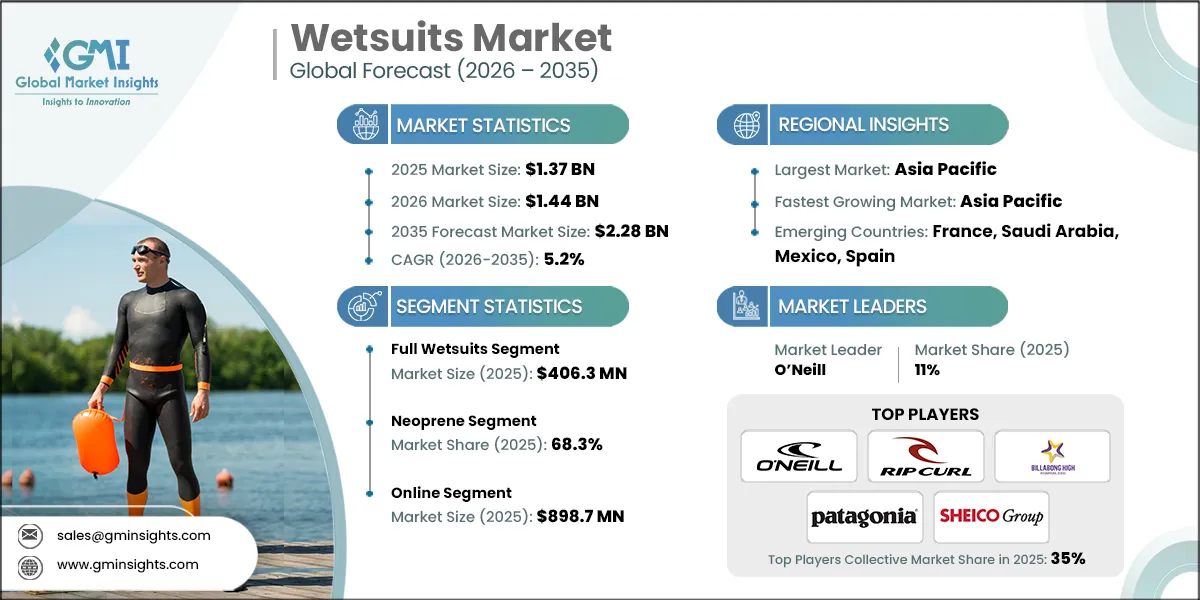
To get key market trends
Wetsuits Market Trends
A global demand for wetsuits is driven by a movement towards high-performance materials, increasing pressure from customers to be more environmentally friendly, and a growing interest in participating in recreational water sports and marine tourism. Customers want to purchase wetsuits that have improved flexibility, reduced weight and increased thermal insulation; on the other hand, brands are looking at how they can incorporate eco-friendly material developments into their products. Additionally, developing satisfactory customer service through an online purchase experience, having custom fit orders and increased participation in endurance/adventure sports has significantly changed both how brands develop their products and how consumers purchase those products.
- Wetsuit manufacturers are moving away from traditional neoprene and towards new material technologies that enhance the comfort, stretchability, and heat retention of wetsuits by utilizing advanced manufacturing methods. New innovations in materials include liners made from graphite, limestone-based neoprene, and engineered foams to reduce the weight of wetsuits while maintaining or improving thermal insulation. These new materials have significant appeal to athletes, surfers, and divers who want maximum mobility and warmth without extra weight or bulk compared to using conventional neoprene. Consequently, there has been an increase in the demand for high-performance wetsuits in both the professional and recreational markets.
- The rise of sustainability as a key trend is impacting product design and brand positioning in the wetsuit market. Companies are turning to alternatives such as Yulex natural rubber, recycled neoprene, and reclaimed textiles to create less impact on the environment than traditional neoprene wetsuits. This trend is a response to increasing consumer concern surrounding ocean pollution, plastic waste, and the negative ecological effects of petrochemical based neoprene. Eco-friendly wetsuits provide brands with a way to stand out and appeal to environmentally minded consumers, particularly the rapidly growing water-sport community around the world.
- Demand for wetsuits is driven by the continued growth of surfing, diving, snorkel, paddle, and open-water swim participants globally. Popular marine adventure tourism destinations (Asia-Pacific, Southern Europe, Latin America) are driving significant purchases of wetsuits for rental fleets, surf schools, and dive centers. Replacement cycles due to seasonal tourist flows are further driving demand for durable wetsuits built for frequent use. This B2B segment represents a significant and recurring source of revenue in the wetsuit market.
- As more water sports consumers make their purchases via the Internet, brands have made substantial investments into creating their online presence while providing tools such as virtual sizing guides, 3D body scanning and custom-fit options to improve fit accuracy. These new developments have reduced return rates, a significant problem associated with purchasing wetsuits because of size variance and have led to increased customer satisfaction. Direct-to-consumer (D2C) web sites have enabled brands to provide wider product assortments and personalized features that appeal to both competitive and recreational users.
Wetsuits Market Analysis

Learn more about the key segments shaping this market
Based on product type, the market is divided into full wetsuits, spring wetsuits, shorty wetsuits, rash guards, long john/jane, short john/jane, wetsuit tops/jackets, wetsuit bottoms, hooded wetsuits and others. In 2025, full wetsuits held the major market share, generating a revenue of USD 406.3 million.
- Steamer suits, often referred to as full wetsuits, are made to protect and keep you warm by completely enrobing your body in insulation for warmth, from the neck down to the ankles. Full wetsuits are ideal for cooler waters, especially to maintain your core body temperature for safety and comfort. The full coverage will help reduce heat loss from your body, as the wetsuit allows for the body heat to heat the small amount of water trapped between your body and the neoprene providing for insulation against the cold.
- Full wetsuits are most used for scuba diving, cold-water surfing, open-water swimming, etc. in cooler marine environments. Not only do full wetsuits provide thermal insulation, but they provide additional protection from elements in the water, such as sharp corals, jellyfish stings, cuts, and UV rays. Full wetsuits vary in construction, and most have varying thicknesses of neoprene (i.e. 3/2mm, 4/3mm, 5/4mm) which are used for different types of motilities and water temperature. There are also many full wetsuits that contain advanced thermal lining technologies (i.e. quick-dry thermal linings, graphene-infused insulation, sealed seams) to increase comfort and reduce the potential of water entering the wetsuit. The flexibility versus warmth ratio is very important, especially for athletes that require range of motion, such as paddling, swimming, or diving.
- The segment dedicated to full wetsuits has continued to be a focus for innovation. Brands have responded to both professional users and recreational users in terms of new product introductions. Environmentally friendly full wetsuits made from either natural rubber or recycled neoprene are among the newest category of full wetsuits, as all brands within the category have begun proactively engaging in a movement towards using more sustainable type materials in their products. In addition, improvements in the ergonomic design of full wetsuits through better panel and stretch zone placement have increased fit and range of motion for full wetsuits allowing them to be used for a greater variety of sports and by more body shapes.
Learn more about the key segments shaping this market
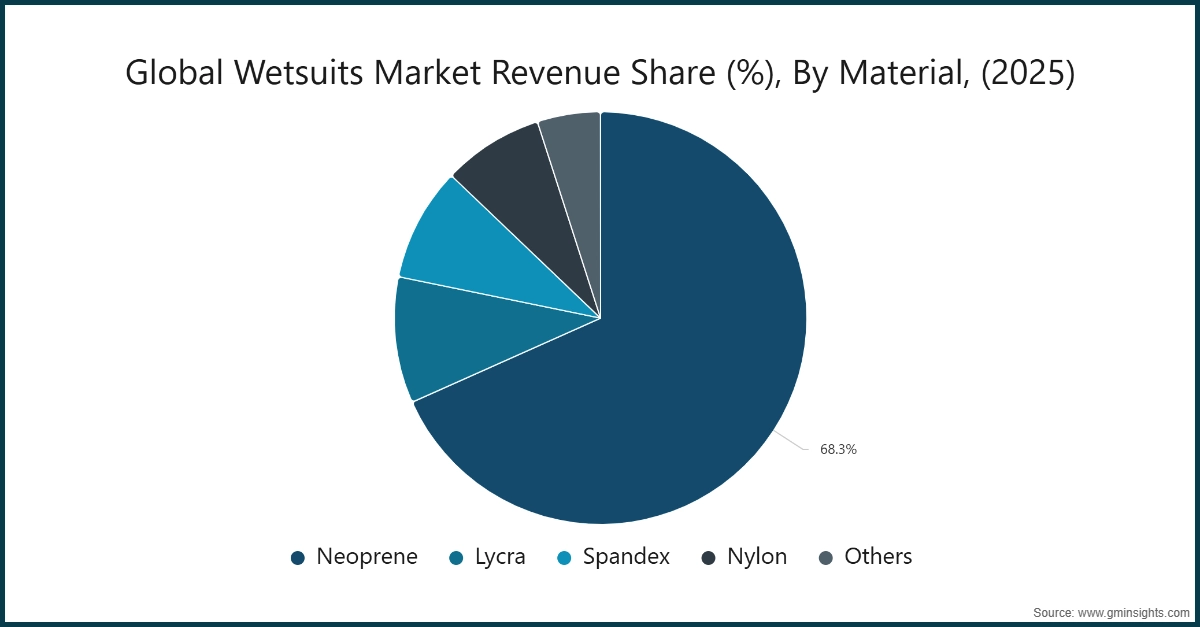
Based on material, the wetsuits market is segmented in neoprene, Lycra, spandex, nylon and others. The neoprene segment held the largest share, accounting for 68.3% of the global market in 2025.
- Polychloroprene, commonly referred to as neoprene, is a synthetic rubber that has many applications across several different industries because of its durability, flexibility, and thermal insulation characteristics. The original purpose for creating neoprene was to provide an alternative developed from petroleum to natural rubber. Neoprene’s popularity skyrocketed due to its resistance to the elements; specifically, water/chemical/UV exposure/and general weathering. Neoprene has a closed-cell foam structure, which traps millions of tiny nitrogen bubbles inside the rubber and creates a buoyancy and insulation effect that makes neoprene ideal for both marine and outdoor applications.
- Neoprene is the most used material in the wetsuit industry because of its ability to maintain body temperature through a minimal amount of water flows between the wetsuit and the person’s body. Wetsuits are made from thick/thin/and super thin neoprene, depending on water and temperature as well as physical requirements of the sport(s). Long gone are the days of simple wetsuit manufacturing as new manufacturing techniques have added significantly to the stretchability, comfort, and strength of neoprene. Because of this, there has been improvement and enhancement to individual’s mobility and fit which is critical to performance-based water sports.
- Due to the increasing awareness of consumers and the tightening of regulations concerning the environment, manufacturers are looking for ways to produce neoprene in an eco-friendly manner. The traditional petroleum-based types of neoprene are being slowly replaced by other alternatives that are considered more environmentally sound. The new types of products being manufactured from limestone, recycled blends of rubber materials, and natural latex (Yulex) use less petroleum or petroleum-derived raw materials. These products will have identical or better performance characteristics than the petroleum-based versions of neoprene. Manufacturers are also offering customers high-quality performance products that are also environmentally friendly in areas such as sportswear, industrial equipment, and other types of safety equipment.
Based on distribution channel, the wetsuits market is segmented into online and offline. In 2025, online segment held the largest market share, generating a revenue of USD 898.7 million.
- As the popularity of shopping online continues to grow among wetsuit consumers, so too does the online distribution channel for wetsuits. Wetsuit buyers can now browse through a much more diverse and extensive selection of wetsuit brands and styles and technical specifications than they would find available in any single retail store. Additionally, the use of product descriptions, user reviews, buying guides, etc., supplements the buyer’s ability to make a more knowledgeable purchasing decision than he/she could otherwise, which, in turn, helps to alleviate the consumer’s uncertainty about purchasing high-performance gear, such as wetsuits.
- In addition to broadening consumers’ access to the available wetsuit selection, online channels help consumers quickly become aware of current sales and brand-new products as they are introduced to the market. Many of the brands manufacturing wetsuits now have developed their own eCommerce websites, which offer custom-fit products, limited edition collections, and hassle-free return policies these conveniences enhance the buyer’s overall purchasing confidence. For many consumers that live outside of coastal areas or that can’t find a local specialty surf shop, online purchases represent the most reliable and convenient option, thereby making digital sales the largest facilitator of growth in the wetsuit industry.
Looking for region specific data?
North America Wetsuits Market
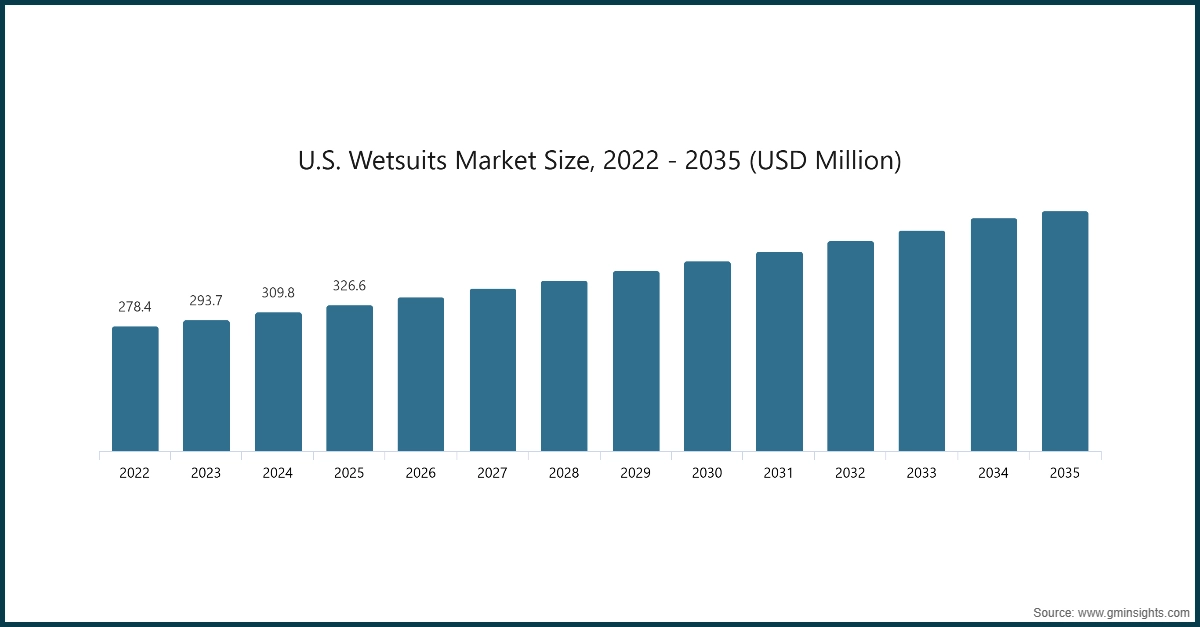
In 2025, the U.S dominated the North America market, accounting for around 78.8% and generating around USD 326.6 million revenue in the same year.
- Due to a very vibrant culture surrounding those who participate in activities such as surfing, scuba diving and triathlons as well as a market full of people who engage in year-round water based recreation, particularly in coastal states, the wetsuit industry will be highly dependent on these factors found in the penetration of similar markets i.e. to establish high quality high performance wetsuits that offer superior flexibility, warmth and insulation characteristics as well as to continue implementing features that extend product life spans. The continued growth of the activities supports an overall strong demand for wetsuits. In addition, the rising popularity of alternative activities such as open water swimming, paddleboarding, use of sustainable equipment also has an added beneficial effect on continuing to drive the types of products made and subsequently result in the way in which customers ultimately make their decision about what types of products they will purchase and use.
- In North America, there are a variety of aquatic environments to enjoy, as well as many recreational users located in the U.S., Canada, and coastal tourism areas. With growing participation in outdoors, adventure based on fitness, research and increasing numbers of people participating in both freshwater and coastal water sports; it is reasonable to expect increased demand for wetsuits. Additionally, the growing popularity of marine tourism will drive increased demand in this region. North America is currently a leader with respect to the adoption of advanced technological wetsuit materials, some made from sustainable materials, and as more consumers become environmentally conscious, there continues to be great growth opportunity for advanced materials. As adventure tourism continues to grow and water sports training programs gain popularity, North America is the premier region for manufacturers of wetsuits to operate in, as it continues to be an innovation-driven area.
Europe Wetsuits Market
Europe market held 27.6% share in 2025 and is expected to grow at 4.9% during the forecast period.
- Europe’s wetsuit sales are fueled by the lush water-sports market which includes surfing in Western European countries, diving in Mediterranean countries, and cold-water sports in the Nordic countries. An overall existing customer base that already participates in various forms of technical equipment consistently produces a high demand for boutique brands that supply premium horizontal and vertical insulations, along with highly engineered very lightweight dried-out materials for wetsuits.
- Environmental responsibility has become a key focus in Europe in all areas of purchasing and developing quality products manufactured from sustainable materials for wetsuits. The continued strong presence of government regulations coupled with increased consumer awareness on ocean conservation provides incentives for brands to focus on delivering eco-friendly products into the market. Lastly, the continued influx of tourism to Europe each summer continues to provide retail outlets selling goods consistently, while continuing to drive the sale of both recreational and performance products throughout Europe.
Asia Pacific Wetsuits Market
The Asia Pacific held the largest market share of 33.9% in 2025 and is anticipated to grow with a CAGR of around 5.7% from 2026 to 2035.
- In APAC, there has been a marked increase in participation in activities such as surfing, snorkeling, and diving within Australia, Indonesia, Japan, Thailand, and the Philippines. This trend can be attributed to the rise of marine tourism, the establishment of surf schools as well as to the increase of international travel to both tropical and temperate coastal locations. Consumption of wetsuits within Australia is primarily seen within the mature, high value market, whereas Southeast Asian destinations are contributing greatly to total wetsuit consumption through wetsuit rental activity and training centers for tourists or beginners.
- Apart from being driven through tourism and visitor arrivals, APAC growth has a solid foundation in a large, young consumer demographic, rising spending on recreational activities and greater connection to water sports via social media and coastal events. eCommerce has enhanced and accelerated the overall access to wetsuits in developing markets, allowing for a more significant number of people to have access to a wider array of premium to mid-range wetsuits. With the continued development of coastal infrastructure and ever-increasing culture around water sports among emerging economies, APAC is one of the world's fastest-growing wetsuit adoption markets.
Latin America Wetsuits Market
Latin America market is growing at a CAGR of 4.5% during the forecast period.
- LATAM’s wetsuit market has benefitted from growing coastal tourism, surf culture and many countries in the region have increasing levels of interest in adventure sports. Several of these countries have world-class surfing conditions, and have vibrant ocean ecosystems, which draw regional participants and international tourists alike. Additionally, as participation in diving, snorkeling, and eco-water tourism increases, the demand for entry-level and mid-range wetsuits continues to grow, particularly through rental shops and local surf schools.
- In LATAM, economic factors have a major influence over consumers’ buying patterns where most seek durable & economic product choices that can endure daily exposure such as being used multiple times through high frequency water use. Premium quality wetsuits are becoming popular among long-time surfing/diving enthusiasts because they are concerned with performance and fit over cost. The continued increase in digital access to online retailers has provided more customers within LATAM with increased opportunity to purchase high quality wetsuit designs and develop the long-term market for these products throughout LATAM.
Wetsuits Market Share
O’Neill is leading with 11% market share. O’Neill, Rip Curl, Billabong International, Patagonia, Shieco Group, collectively hold around 35%, indicating moderately fragmented market concentration. These prominent players are proactively involved in strategic endeavors, such as mergers & acquisitions, facility expansions & collaborations, to expand their product portfolios, extend their reach to a broad customer base, and strengthen their market position.
Billabong International is one of the world's leading surfing/surf-lifestyle brands with a strong surfing heritage. Billabong's wetsuits are known for providing surfers with warmth/flexibility/performance. A loyal customer base has grown due to product development; partnerships with pro surfers; and high-quality neoprene tech for all water temperatures, meaning that Billabong's range of entry level through high performance models provide great options for people participating in a variety of recreational or performance driven water activities.
Rip Curl is recognized as one of the surf industry's leading brands, with a long history of providing technical, high performance surf products through wetsuit engineering. The company is renowned for developing fast drying lining materials and advanced neoprene foams, enabling surf athletes to use their products in various weather and skill level scenarios. In addition to being heavily involved in professional surfing through sponsorships, Rip Curl is known for using quality materials at the time/after being tested by athletes making them one of the industry's leading wetsuit companies worldwide.
Wetsuits Market Companies
Major players operating in the wetsuits indusare:
- Aqualung
- BARE Sports
- Billabong International
- Cressi
- Decathlon
- Hurley International
- O’Neill
- Patagonia
- Quiksilver
- Rip Curl
- Shieco Group
- Sisstrevolution
- Speedo
- Vissla
- Xcel
Speedo manufactures wetsuits made specifically for open water swimming, triathlon, and performance aquatic sport. All the company’s wetsuits are built around the principles of hydrodynamics, buoyancy, and a streamlined construction, which lead to popularity with both competitive swimmers and endurance athletes. The long-term experience that Speedo has with the swimming performance technology area has led them to design wetsuits that offer maximum efficiency, mobility, and comfort in all water conditions.
BARE Sports is a specialized brand in the diving/watersport area that produces a range of products, including high performance wetsuits, drysuits and exposure protection gear. BARE focuses primarily on craftsmanship, fit and warmth, making it an ideal choice among scuba divers, cold water users and multi-sport water user groups who need to have reliable exposure protection in extreme environments. Additionally, BARE is known around the world as an innovative company that uses cutting edge materials and ergonomically designed products to create a brand that is trusted by professional and recreational divers alike.
Wetsuits Market Report Attributes
| Key Takeaway | Details |
|---|---|
| Market Size & Growth | |
| Base Year | 2025 |
| Market Size in 2025 | USD 1.37 Billion |
| Market Size in 2026 | USD 1.44 Billion |
| Forecast Period 2026-2035 CAGR | 5.2% |
| Market Size in 2035 | USD 2.28 Billion |
| Key Market Trends | |
| Drivers | Impact |
| Rising participation in water sports | Rising number of people choosing to do activities requiring some form of thermal protection and performance gear will lead to increased overall demand for wetsuits. |
| Expansion of coastal & marine tourism | Increased bulk and rental wetsuit orders from areas where most tourists are located will increase both retail and B2B sales. |
| Growth in fitness-oriented activities | Growing interest in high-performance wetsuits designed for use in triathlons or long-distance water training will increase demand for performance-oriented designs. |
| Pitfalls & Challenges | Impact |
| High material cost & price sensitivity | Market expansion will be limited due to the cost associated with producing premium-quality wetsuits becoming too high to be offered to consumers who are conscious of their budget. |
| Environmental concerns around neoprene | Quality brands are beginning to transition into using greener materials, creating greater complexity and investment in the design/development and manufacturing process. |
| Opportunities: | Impact |
| Rising demand for eco-friendly & sustainable wetsuits | Brands that go with natural rubber or recycled materials have the potential to create a stronger brand differentiation in their category. |
| Customization & 3D body scanning | More people purchasing online will see greater consumer satisfaction and better fit of their wetsuit will create better conversion rates and lower average return rates. |
| Market Leaders (2025) | |
| Market Leader |
11% market share |
| Top Players |
The collective market share in 2025 is 35% |
| Competitive Edge |
|
| Regional Insights | |
| Largest market | Asia Pacific |
| Fastest growing market | Asia Pacific |
| Emerging countries | France, Saudi Arabia, Mexico, Spain |
| Future Outlook |
|
What are the growth opportunities in this market?
Wetsuits Industry News
- In June 2025 Rip Curl announced the rollout of plant‑based OCENA rubber across E‑Bomb and Dawn Patrol suits beginning July 2025, using water‑based adhesive and dope‑dyed yarns: additionally in 2025 Rip Curl previewed Fall/Winter 2025 with Fusion seam technology, revamped core fits, and more neoprene‑free foams.
- In May 2025 BARE Sports released the Velocity Ultra 2.0 fullsuits in 3 mm/5 mm/7 mm and the 8/7 mm Semi‑Dry 2.0, adding infrared‑responsive thermal lining, a front‑entry dry zipper (semi‑dry), integrated hood, internal bib, Glideskin seals, and reinforced knee panels for cold‑water diving.
- In May 2025 Patagonia continued its neoprene‑free natural‑rubber program across men’s and women’s R‑series suits with temperature‑banded thickness maps (e.g., 3/2.5, 4.5/3.5, 5.5/4), recycled linings, and front‑zip designs for surf performance.
- In February 2025 Aqualung launched the XSCAPE line, a neoprene‑free 4/3 mm warm‑water wetsuit made with natural rubber, water‑based lamination, recycled fleece torso lining, Powertex kneepads, and matching rash guards/leggings for scuba, freediving, snorkeling, and paddle use.
- In August 2024 Xcel launched the Comp+ performance fullsuit and advanced its neoprene‑free rollout to Spring 2025, citing two years of R&D, Channel Flex exterior, infrared thermal interior, taped seams, and an expanded women’s offering.
The wetsuits market research report includes in-depth coverage of the industry with estimates & forecasts in terms of revenue (USD Million) & volume (Thousand Units) from 2022 to 2035, for the following segments:
Market, by Product Type
- Full wetsuits
- Spring wetsuits
- Shorty wetsuits
- Rash guards
- Long john/jane
- Short john/jane
- Wetsuit tops/jackets
- Wetsuit bottoms
- Hooded wetsuits
- Others
Market, by Thickness
- 2mm-3mm (for warmer waters)
- 3mm-5mm (for moderate temperatures)
- 5mm-7mm (for colder waters)
Market, by Material
- Neoprene
- Lycra
- Spandex
- Nylon
- Others
Market, by Application
- Surfing
- Scuba diving
- Windsurfing
- Kayaking
- Snorkeling
- Others
Market, by Consumer Group
- Men
- Women
- Kids
Market, by Price Range
- Low
- Medium
- High
Market, by Distribution Channel
- Online
- E-commerce
- Company website
- Offline
- Supermarkets
- Specialty stores
- Others (Departmental stores, etc.)
The above information is provided for the following regions and countries:
- North America
- U.S.
- Canada
- Europe
- Germany
- UK
- France
- Italy
- Spain
- Asia Pacific
- China
- India
- Japan
- Australia
- South Korea
- Latin America
- Brazil
- Mexico
- Argentina
- Middle East and Africa
- South Africa
- Saudi Arabia
- UAE
Frequently Asked Question(FAQ) :
What is the market size of the wetsuits market in 2025?
The market size for wetsuits was valued at USD 1.37 billion in 2025, driven by rising participation in water sports, marine tourism, and increasing demand for high-performance thermal gear.
What is the projected value of the wetsuits market by 2035?
The market is expected to reach USD 2.28 billion by 2035, growing at a CAGR of 5.2% from 2026 to 2035, supported by growth in adventure tourism.
What will be the wetsuits market size in 2026?
The market is projected to grow to USD 1.44 billion in 2026, reflecting expanding online sales channels, rental fleet demand, and increased consumer spending on recreational water activities.
Which product segment leads the wetsuits industry?
The full wetsuits segment generated USD 406.3 million in 2025, leading the market due to strong demand in cold-water surfing, scuba diving, and open-water swimming applications.
Which distribution channel holds the largest share?
The online segment led the market with USD 898.7 million in revenue in 2025, supported by direct-to-consumer (D2C) platforms, virtual sizing tools, and expanded product accessibility.
How large is the U.S. wetsuits industry?
The U.S. accounted for 78.8% of the North America market, generating approximately USD 326.6 million in 2025, supported by strong surf culture, triathlons, and year-round coastal recreation.
Who are the key players in the wetsuits market?
Leading companies include O’Neill, Rip Curl, Billabong International, Patagonia, Shieco Group, Speedo, BARE Sports, Quiksilver, and Xcel.
Wetsuits Market Scope
Related Reports