Summary
Table of Content

Welded Steel Tanks Market
Get a free sample of this report
Form submitted successfully!
Error submitting form. Please try again.
Thank you!
Your inquiry has been received. Our team will reach out to you with the required details via email. To ensure that you don't miss their response, kindly remember to check your spam folder as well!
Request Sectional Data
Thank you!
Your inquiry has been received. Our team will reach out to you with the required details via email. To ensure that you don't miss their response, kindly remember to check your spam folder as well!
Form submitted successfully!
Error submitting form. Please try again.
Welded Steel Tanks Market Size
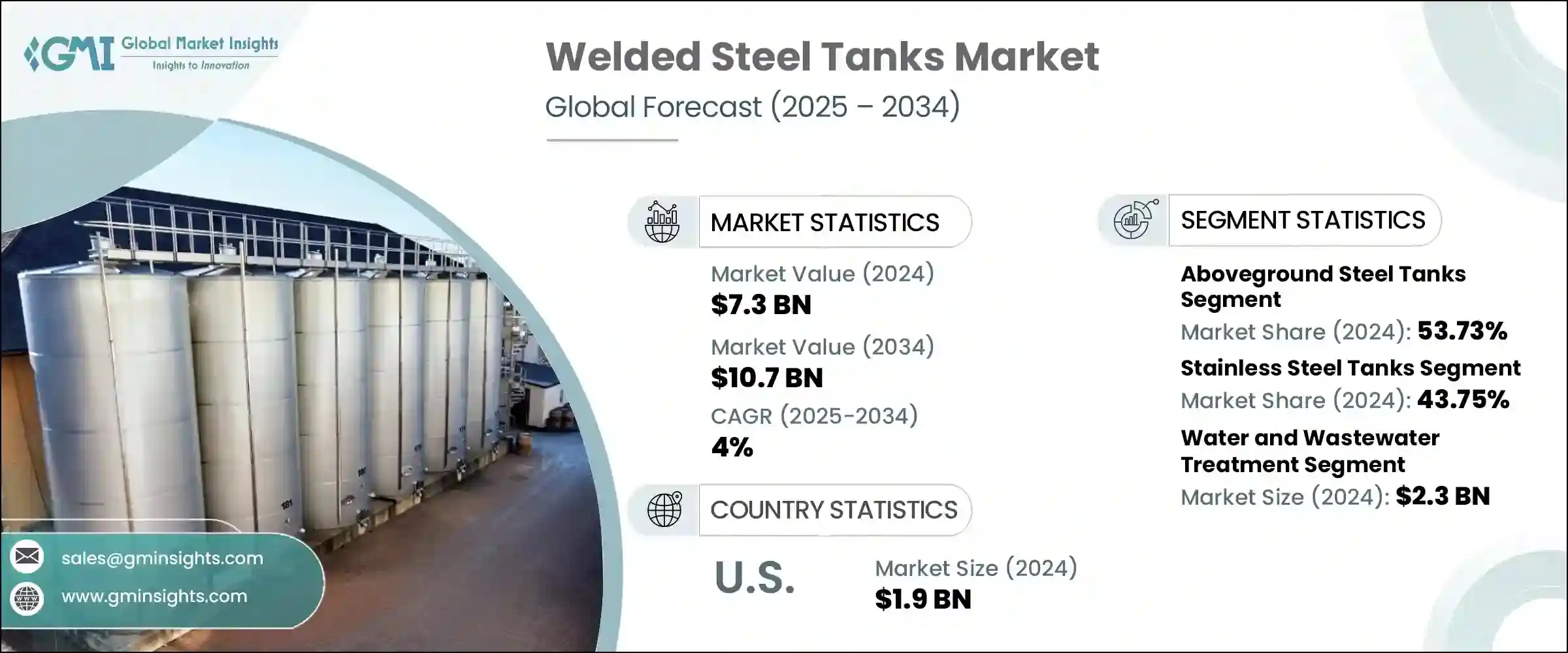
The global welded steel tanks market was estimated at USD 7.3 billion in 2024 and is expected to grow from USD 7.5 billion to USD 10.7 billion in 2034, at a CAGR of 4%. The growth is driven by key factors such as industrial expansion and infrastructure growth, stringent environmental regulations and ESG initiatives, and technological advancements and automation.
To get key market trends
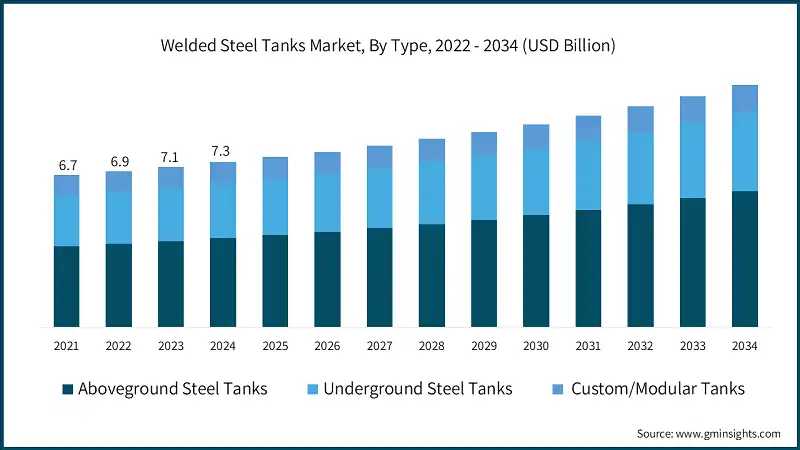
The welded steel tank market in 2021 was USD 6.7 billion and increased continuously over the last couple of years. This is primarily because the demand for secure and larger capacity storage systems in oil & gas, water treatment, chemical processing, and agriculture is increasing. Welded steel tanks are used based on their strength, elastic nature, and long life, thus the most suitable for storing liquids and gases under different conditions. Further, investment in the construction of infrastructure and public utilities, especially in developing nations, is influencing growth in the market.
The Asia-Pacific (APAC) region holds the majority share of the overall welded steel tank market with an aggregate contribution of close to 35% to the world market size. It is being driven by the surge in development of infrastructure, industrialization, and urbanization in countries like China, India, and Southeast Asia. In the case of India's Jal Jeevan Mission, for instance, INR 60,000 crore (equivalent to about USD 7.2 billion) was spent in 2023 on upgrading water supply infrastructure. China spent over USD 100 billion in 2022 alone on petrochemical warehouses and water supply facilities.
The welded steel tank market is witnessing widespread applications in fire water storage, drinking water storage, fuel storage, and the storage of industrial chemicals. Below-ground welded steel tanks are increasingly being utilized for specialized applications such as fuel stops, water treatment plants, and the storage of hazardous waste, driven by factors like space efficiency and enhanced safety. In North America, the market is experiencing significant growth due to the replacement of aging tank infrastructure and rising demand from the chemical and energy industries. Europe is observing moderate growth, supported by stringent environmental regulations and efforts to upgrade energy storage systems.
Above-ground steel tanks have the largest market share and account for almost 54% of the total demand. Ground tanks are employed extensively because they can be easily installed, inspected, and maintained, and because they are less costly compared to underground tanks. The demand is increasing with increased spending on water infrastructure, greater demand for oil and oil storage due to supply shortages and strategic storage, and application of welded steel tanks for alternative fuels such as hydrogen and biofuels. For example, the U.S.
The Department of Energy spent USD 9.5 billion on hydrogen projects in 2023 that will generate demand for specialty tanks. Demand for industrial and commercial building fire protection systems is also generating demand for storage tanks. Increased remote monitoring technology, corrosion-resistant coating, and welding technology are also making such tanks more durable and longer-lasting, and an investment worth making for the government and private companies as well.
Welded Steel Tanks Market Report Attributes
| Key Takeaway | Details |
|---|---|
| Market Size & Growth | |
| Base Year | 2024 |
| Market Size in 2024 | USD 7.3 Billion |
| Forecast Period 2025 - 2034 CAGR | 4% |
| Market Size in 2034 | USD 10.7 Billion |
| Key Market Trends | |
| Drivers | Impact |
| Industrial expansion and infrastructure growth | Rising investments in industrial and utility infrastructure are fuelling demand for welded steel storage tanks. |
| Stringent environmental regulations and ESG initiatives | Environmental compliance and sustainability goals are pushing the adoption of high-quality, durable storage solutions. |
| Technological advancements and automation | Innovations in welding, coatings, and remote monitoring enhance tank performance and reduce maintenance costs. |
| Pitfalls & Challenges | Impact |
| Volatile raw material costs | Fluctuating steel prices can impact production costs and profit margins for manufacturers. |
| Competition of alternative materials | Increasing use of FRP, polyethylene, and concrete tanks poses a threat to steel tank demand in certain applications. |
| Opportunities: | Impact |
| Expansion of Water Infrastructure Projects | With the shift toward renewable fuels like biofuels, ethanol, and green hydrogen, the need for safe, corrosion-resistant, and pressurized storage solutions is growing. |
| Renewable Energy Storage Needs | Countries are building strategic petroleum reserves (SPRs) and expanding existing tank farms, especially in APAC and the Middle East, creating opportunities for large welded tank projects. |
| Market Leaders (2024) | |
| Market Leader |
|
| Top Players |
Collective market share in 2024 is 4.7% |
| Competitive Edge |
|
| Regional Insights | |
| Largest Market | Asia Pacific |
| Fastest growing market | Asia Pacific |
| Emerging countries | China, India, South Korea |
| Future outlook |
|
What are the growth opportunities in this market?
Welded Steel Tanks Market Trends
- Global growth in water infrastructure investment is driving the majority of welded steel tank demand, primarily potable water, fire safety, and wastewater storage. With governments prioritizing secure and sustainable access to water, such as India's Jal Jeevan Mission, China's rural water and sanitation programs, and the U.S. Bipartisan Infrastructure Law, are driving mass deployments. Welded steel tanks are preferred due to their durability, strength against enemy conditions, and capacity to expand to local application. That is going to get even more ferocious from here to 2030 as more cities come up and climate resilience places the world agenda in the limelight. The welded tank industry will benefit greatly from repeat and long-term orders by public and utility utilities. Moreover, as increasing numbers of water networks in developing countries expand, more corrosion-resistant storage on an affordable basis will be required. The same method crosses paths with escalating water scarcity problem, another spur to investment in infrastructure for permanent water storage.
- The transition in energy is creating new possibilities for steel tank producers who weld, focusing on renewable fuel storage. Increased use of biofuels, ethanol, green hydrogen, and ammonia has been fueling demand for ruggedness, safety, and pressurized storage systems. Welded steel tanks, with their ruggedness and acceptability to hazardous or reactive chemicals, are finding increased application in renewable energy processing in pilot and commercial scales. According to industry estimates, the hydrogen storage market alone would account for $20 billion by 2032, and welded tanks will be the enabler for that. With worldwide net-zero action and ESG mandates in place, clean energy firms as well as oil majors are investing in decarbonization enablement infrastructure. That will expand incrementally from 2024 and onwards, with significant deployments from Europe, North America, and APAC. Manufacturers who are capable of producing tanks for cryogenic, high-pressure, or chemical-resistant applications will have a gigantic competitive edge in this new market.
- Growing applications of IoT-based technologies on steel welded tanks are transforming liquid level measurement and storage tank maintenance. As clients in the industrial sector require more efficiency, safety, and real-time insights, smart liquid level sensors, temperature sensors, pressure sensors, and corrosion sensors are the hallmarks of the present day. The market for industrial IoT is growing at over 10% CAGR, and tank-level monitoring is one of the quickest-growing applications. These smart tanks minimize the cost of operations through predictive maintenance that decreases downtime and prevents life-threatening overflows.
- Adoption of advanced smart technology is most common among oil & gas, chemicals, and fire protection applications where regulatory compliance and safety are the prime considerations. During the 2023-2028 period, the trend is expected to gain popularity in new installations as well as retrofit order. Reducing the cost of smart systems leads even small- and medium-size operators to seek for it, leaving a huge market for tank manufacturers with inbuilt automation solutions.
- Maintenance and durability costs become more important to users of welded steel tanks, thus increasing use of corrosion-resistant coatings and materials. Corrosion is a major reason for tank failure and loses the world economy around 3% of GDP each year, based on the World Corrosion Organization. Companies are doing their part by using new coatings like epoxy, glass-fused-to-steel, and zinc linings to enhance tank longevity and reduce maintenance. It is most pronounced in industries like wastewater treatment, chemical storage, and oil & gas, where stored chemicals are corrosive in nature. Environmental regulations safeguarding the environment and water quality are driving environmentally compliant surface storage demand too. From 2022 to 2029, developments in green coatings, UV-resistant, and anti-microbial coatings will ensure the trend persists. Certified or proprietary coating technology will be a market advantage in those markets where saving on material lifecycle cost is mainly a problem.
Welded Steel Tanks Market Analysis
Learn more about the key segments shaping this market
Based on type, the market is divided into aboveground steel tanks, underground steel tanks and custom/modular tanks. In 2024 the aboveground steel tanks segment dominated about 53.73% market share and is expected to grow at a CAGR of 4.46% during 2025 to 2034.
- Steel tanks above ground are the most prevalent welded steel tanks because of the ease of being adjusted, the affordability, and the urgency required to produce them. They do not need excavation, ground proofing, or elaborate anchoring systems like underground tanks. This is cost-effective in initial phases and increases the rate of installation, which is crucial in applications such as fire safety, industrial liquid storage, and municipal water supply. Tanks above ground also ensure easy inspection and maintenance. Leaks and corrosion are visible and easily repaired, thus where environment and safety regulations are of the utmost importance. Above-ground steel tanks are the most typical type of welded steel tanks because they are easy to manufacture, cost-effective, and manufacturing urgency is necessary
- They are exempt from excavation, ground proofing, or elaborate anchoring systems as much as underground storage tanks. This is cost-effective initially and increases the rate of installation, which is necessary in operations such as fire protection, industrial liquid storage, and municipal water supply. Aboveground tanks also have easier maintenance and inspection. Leaks and corrosion are easy to find and replace, thus being the best where environmental and safety standards are a priority.
- Above-ground tanks are available in different sizes and materials and coated with top-notch-quality paints such as epoxy and glass-fused linings, and are weather-resistant, including exterior weather. Above-ground tanks are considered more stylish by the U.S. Environmental Protection Agency (EPA) since they are environmentally friendly and require fewer maintenance works.
- Steel underground tanks are adopted in specific situations, i.e., city tank farms or airport aviation fuel terminals, where the space is limited. They possess advantages like enhanced security, better looks, and a lower risk of fire. They are more costly throughout their life by virtue of the excavation cost, waterproofing, corrosion-proof lining, and monitoring system. They are harder to install, repair, and replace.
- New technologies, like double-walled construction and advanced leak-detection systems, try to mitigate these costs. But these technologies have only kept underground tanks viable for specialty applications and have not affected the market share of above-ground tanks whatsoever. Statistics by the U.S. Department of Energy indicate that underground tanks dominate most of their applications in specialty markets with little growth potential relative to above-ground tanks.
- Custom and modular tanks are a smaller and slower-growing market segment within welded steel tanks. These tanks are typically prefabricated in sections and built on-site, so they are well-suited for difficult or remote locations such as mining ventures, wind farms, or disaster relief sites. They can be shipped with ease and assembled quickly, even in remote locations. They are more costly per unit than a standard welded tank and might not have the same lifespan. Materials such as light metals, bolt-up styles in flat-pack design, and advanced finishes are making them more desirable for customers, requiring flexibility and speed rather than long-term durability. Modular tanks, though, the U.S. Census Bureau describes, are quickly gaining popularity in transitory facilities, but with an infinitesimally minute market share compared to that of above-ground tanks.
- Typically, the market is controlled by steel tanks above-ground because of their tolerable trade-off among performance, cost, regulatory acceptability, and versatility. Although underground and modular tanks are suitable for particular uses, their higher cost and limited shapes render them incapable of challenging above-ground tanks in colossal markets like industrial, municipal, and farm storage.
Learn more about the key segments shaping this market
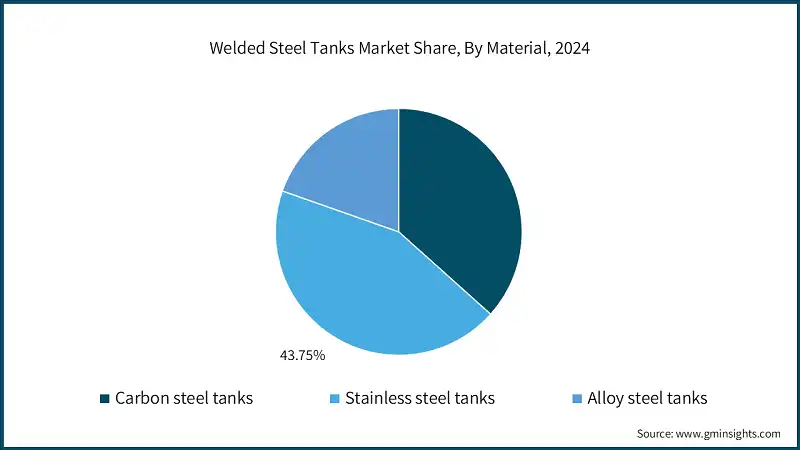
Based on material, the welded steel tank market is segmented into carbon steel tanks, stainless steel tanks, and alloy steel tanks. In 2024, the stainless steel tanks segment held approximately 43.75% revenue share and is expected to grow at a CAGR of 4.6% from 2025 to 2034.
- Stainless steel is the most common material used on all types of welded steel tanks in all industries. It is resistant to corrosion, sanitary, and has a long lifespan, and companies use it due to this. Companies that use stainless steel are pharmaceutical, drinking water, chemicals, wastewater, and food processing because it is not filthy and can handle poor conditions. The stainless steel chromium oxide coating on stainless steel provides it with chemical and corrosion resistance, without the application of coatings and frequent repair. The non-reactive, smooth stainless steel surface also meets the stringent industrialized countries' rules. While stainless steel is higher in cost than carbon steel in the initial price, it is cost-effective in the long run with minimal repair costs, shorter downtime, and longevity. U.S. stainless steel manufacturing in America increased to 2.8 million metric tons during 2022, reflecting growing usage. New technologies like automated welding, robot finishing, and modular manufacturing are speeding up production to be quicker and of higher quality, and stainless steel vessels have been used in other industries.
- Carbon steel is also extensively utilized today on welded tanks, especially where there are less stringent applications like agriculture, storage of fuels, and fire protection. It is significantly less costly and can be easily produced, a suitable option if there is little cash or fewer restrictions to work with. Carbon steel is durable and significantly cost-effective in large production quantities. It has the disadvantage of rusting, though, especially when in wet or external environments. To prevent this, protection like epoxy, rubber, or glass-fused coatings is used by manufacturers, which are incorporated into production and maintenance costs. Government policies, particularly in Europe and North America, are leading the industry to use stainless steel for added strength and safety of water. The European Union's Water Framework Directive, for example, emphasizes the use of materials that guarantee water cleanliness. While carbon steel remains an option for cost-effective projects, it no longer serves its purpose where reliability and durability take center stage.
- Alloy steel tanks, manufactured from metals like chrome-molybdenum or nickel-base alloys, function under extreme conditions. They are adequate for high-pressure chemical processing, mining, nuclear power, and aerospace fuel storage. These are heavier, corrosion-resistant, and heat-resistant than carbon or stainless steel. They are more expensive to produce, and they are not as versatile as they are used in general use. Alloy steel tanks require accurate welding, heat treatment, and stringent quality inspection, which is costly and time-consuming. Though superior, high-performance alloy steel tanks are used only in specialty applications where breakdown is unacceptable. World production of alloy steels increased by 4.2% in 2022, the International Stainless Steel Forum says, echoing their role in critical uses.
Based on end user, the welded steel tank market is segmented as the oil & gas industry, chemical industry, water and wastewater treatment, food & beverage industry, pharmaceutical industry, power generation, pulp & paper, construction, agriculture, and others. In 2024, the water and wastewater treatment segment generated a revenue of USD 2.3 billion and is expected to grow at a CAGR of 5% till 2034.
- Welded steel tank industry serves a wide variety of end users, with water and wastewater treatment being the dominant industry due to ongoing investment triggered by urbanization, aging infrastructure, and stringent environmental regulations. Tanks in this industry are commonly used for drinking water storage, aeration, sludge treatment, and effluent equalization, and coated carbon steel and stainless steel are widely used due to corrosion resistance. Technologies such as new paint, real-time monitoring, and modular tank design enhance performance and life but present challenges in low spending developing countries. In petroleum & gas applications, crude oil, fuel, and water storage are produced welded tanks with strict design codes such as API 650 and usually include cathodic protection as well as fire-resistant paint. Market demand is energy price change and a global trend towards renewable-sensitive, cyclical. Compliance with safety and regulatory needs is the primary driver for the application of stainless and alloy steel tanks holding volatile and corrosive products in the chemical industry.
- Hybrid linings and smart sensors are examples of innovation, but high commissioning lead times and expense remain deterring. In the food and beverages sector, stainless steel tanks play a vital role in hygiene-critical processes such as blending and fermentation, with characteristics including CIP systems and a polished interior. Demand continues to increase in the face of increasing food production demands, especially in Asia-Pacific, despite high CAPEX and revalidation cycles for GMP, posing a challenge. Traceability-grade and high-purity WFI and API storage tanks are required by the pharma industry, which are usually 316L stainless steel and GMP- and ASME BPE-compliant. Electropolishing and real-time validation drive the innovation driven by biologics and sterilizing production growth. Corrosion-resistant tanks are utilized by the pulp and paper segment for processing chemicals, with little growth from sustainability programs. Construction application is project-driven, with prefabricated low-cost carbon steel tanks employed as the preferred solution for site application, but little innovation exists…
- Power generation is dependent on welded tanks as a water reservoir and chemical dosing, wherein the demand is constant in the thermal power plant but variable in the hydrogen and energy storage departments. There is a price-sensitive, volume-driven market for agriculture in which coated and galvanized carbon steel tanks are used for irrigation and storage of inputs with assistance from intelligent monitoring and governmental support. Finally, there is use in mining, naval, and defense applications involving rugged, alloy-based tanks with fire and blast protection, although such use is reserved for specialty, mission-critical applications.
Looking for region specific data?
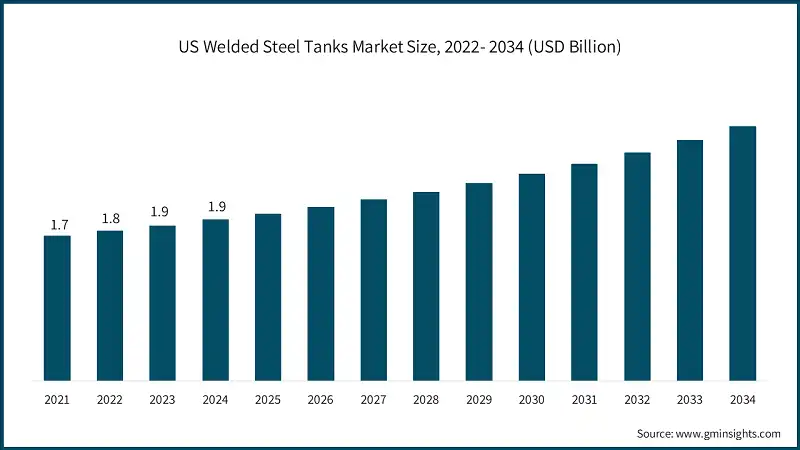
In 2024, the United States dominated the North American welded steel tank market by 86.85% revenue share and generated USD 1.9 billion in revenue.
- The United States is the dominant nation in North America's welded steel tank market due to the existence of its strong industrial economy, advanced infrastructure, and strict environmental regulations. The United States Environmental Protection Agency estimated that over $743 billion would be spent on water infrastructure within the next 20 years to meet demand for welded steel tanks. The United States also has huge investments in water and wastewater treatment, oil and gas, and chemical processing. The regulatory bodies of the government, like the EPA and OSHA, also have strict regulations, which have had the effect of increasing demand for quality equipment for storage, like welded stainless steel tanks. Urbanization and aging municipal infrastructure also call for tank replacement and growth. As growth is speeding up in Mexico and Canada with industrialization and infrastructure development, the U.S. remains the giant due to its enormous manufacturing base and tank technology innovation. Federal government expenditures on water infrastructure and energy development provide opportunities in corrosion-resistant and modular tank systems.
The European welded steel tanks market in Italy is expected to experience significant and promising growth from 2025 to 2034.
- Italy dominates the European welded steel tank market because of its robust manufacturing sector, sophisticated chemical and food processing sectors, and emphasis on sustainability. Italy's industrial production index grew by 1.8% in 2023, reflecting consistent growth in manufacturing, as per Eurostat. Italian businesses specialize in creating high-performance stainless steel tanks for the pharmaceuticals, food & beverages, and specialty chemicals sectors. EU legislation, including the Water Framework Directive, drives investments in long-lasting and compliant tank systems. An aging population and urban regeneration also provide steady demand for infrastructure upgrades. Emerging markets in Poland, Spain, and Eastern Europe are expanding industrial capacity, causing new challenges. Italy is supported by its association with the EU single market, qualified human capital, and innovation emphasis such as modular and intelligent tank styles, favorable to Industry 4.0.
The APAC welded steel tanks market in China is expected to experience significant and promising growth with a 4.9% CAGR from 2025 to 2034.
- China dominates the Asia-Pacific welded steel tanks market due to heavy industrialization, urbanization, and massive infrastructure projects. The industrial production of China in 2023 was 4.5% greater, according to the National Bureau of Statistics of China, which supports welded steel tank consumption by petrochemicals, chemicals, food processing, and municipal water industries. Enhanced pollution and water quality conditions raise demand for anti-corrosive materials, i.e., stainless steel. More efficient and higher production by way of advanced manufacturing and automation is promoted by the "Made in China 2025" initiative. Growth markets for China are India, Southeast Asia, and Australia, which also hold growth potential since they are developing their municipal and industrial infrastructure. China is backed by the massive domestic steel industry, value chain integration, and R&D investment that support cost competitiveness along with innovation for tank solutions.
The MEA welded steel tanks market in Saudi Arabia is expected to experience significant and promising growth from 2025 to 2034.
- Saudi Arabia captures the Middle East and Africa welded steel tank market, spearheaded by its huge oil & gas sector, industrial diversification initiatives, and Vision 2030 infrastructure investments. According to the Saudi Ministry of Energy, the country has allocated $266 billion for energy projects to 2030, including facilities like storage tanks in the form of welded steel tanks. The energy and petrochemical sectors use crude oil, refined products, and chemical tanks. Environmental sustainability requirements and safer storage under reformulated regulations drive demand for fire-protected and corrosion-resistant tanks. Municipal water infrastructure development and population, and urbanization growth, and municipal water infrastructure projects also drive demands. Newly industrializing markets of Egypt, South Africa, and the United Arab Emirates are refitting infrastructure and growing industrially, and thereby further driving demand. The Saudi government is supported by its government-backed industrial ventures, oil wealth, and status as a commercial hub, with these generating avenues for export-based production and sophisticated tank technology.
Welded Steel Tanks Market Share Analysis
CST Industries, Highland Tank, Tarsco, a TF Warren Company, Caldwell Tanks, Inc., and Center Enamel lead with 4.8% market share, indicating low market concentration.
- CST Industries is most recognized as the market leader, particularly in the aboveground bolted and welded tank market, based on global reach, broad application history, and premium production capability. Highland Tank, ZCL | Xerxes (subsidiary of Shawcor), PermianLide, and Tarsco (subsidiary of TF Warren) possess strong regional or market-specific positions.
- These market leaders maintain and build market position through specialization, integrated offerings, and long-term industry relationships, most notably in end-use markets including water and wastewater, oil & gas, and chemicals. One of the most powerful differentiators of market-leading companies is the capability to provide turnkey tank solutions involving engineering design, fabrication, and on-site installation, generally under prescriptive regulatory or performance standards.
- To capture share, companies are investing heavily in intelligent tank monitoring technology, corrosion-resistant solutions (e.g., glass-fused-to-steel or hybrid linings), and modular tank system technologies, leveraging increasing customer needs for lifecycle cost reductions and real-time asset management. Acquisitions and mergers have also taken place, like Shawcor acquiring ZCL to acquire stakes in fiberglass-reinforced tanks and composite solutions in order to gain traction in chemical and wastewater markets.
- Another competitive approach is geographic expansion to specific high-growth emerging regions like Southeast Asia, the Middle East, and Eastern Europe. Domestic joint ventures or regional fabrication centers are being established by firms to reduce lead times and offer more local customization for local needs. Customization and material innovation (like stainless steel and duplex grades for hygiene-critical or corrosive duties) also differentiate players.
- Pricing is cost-sensitive and competitive in construction and agriculture, but value-based differentiation (compliance, quality, lifecycle support) overshadows price in regulated sectors like energy, pharma, and water. Companies that can obtain both compliant tanks at the best cost are the best placed to drive share growth.
- In conclusion, the welded steel tanks market is dominated by a mix of global players and strong regional players driven by innovation, compliance readiness, and engineering depth to sustain competitive advantage. As environmental and infrastructure regulations tighten, those organizations with a focus on R&D, digitalization, and strategic expansion are well placed to increase their market share over the next decade.
Welded Steel Tanks Market Companies
Major players operating in the welded steel tanks industry are:
- BH Tank
- Bulldog Steel Products
- Caldwell Tanks
- CST Industries
- Highland Tank & Manufacturing Company
- Lipp GmbH
- McDermott (formerly CB&I)
- PermianLide
- Pittsburg Tank & Tower Group
- Skinner Tank Company
- Superior Tank Co.
- Tank Connection
- TechFab
- TF Warren Group (Tarsco)
- United Industries Group (UIG Tanks & Domes)
The welded steel tank industry has a number of suppliers that provide different types of tanks to fit different applications. BH Tank supplies field-welded as well as shop-welded steel tanks mainly for agricultural use, fire protection, and drinking water, while the materials are carbon and stainless steel. Bulldog Steel Products specializes in aboveground welded carbon steel tanks, mainly for crude oil and produced water storage. Caldwell Tanks specializes in heavy field-assembled welded water storage tanks, wastewater, and thermal energy applications, stainless steel, and carbon steel. Industry leader CST Industries offers a combination of field- and shop-welded tanks and bolted tanks for water, wastewater, and industrial liquid storage, stainless and carbon steel. In the same manner, Highland Tank also produces horizontal and vertical welded petroleum, chemical, and wastewater tanks in stainless steel and carbon steel. German market leader Lipp GmbH is renowned for its licensed spiral-seamed, field-welded tanks for biogas and wastewater purposes using stainless, galvanized, and duplex steel. In the energy sector, McDermott (ex-CB&I) produces large field-welded tanks for LNG, petrochemical, and oil & gas storage in carbon and low alloy steels. PermianLide upstream oil and gas storage tanks are primarily carbon steel, sold in shop-welded or field-erected forms.
Pittsburg Tank & Tower Group produces field-erected welded tanks, such as elevated tanks for municipal water and fire protection, with carbon and some stainless steel. Skinner Tank Company focuses on API 650 field-welded wastewater, chemical, and petroleum tanks. Superior Tank Co. focuses on field- and shop-welded fire protection and water tanks made of carbon and coated stainless steel. Tank Connection focuses on a wide range of field-welded and hybrid dry bulk, potable water, and wastewater tanks made from carbon and stainless steel, and aluminum dome covers.
TechFab provides specialty welded products and solutions to chemical, oil & gas, and food processing industries with ongoing use of stainless steel, carbon steel, and exotic alloys. TF Warren Group (Tarsco) is a top manufacturer of API-standard large field-welded tanks for oil & gas, chemicals, and biofuels, constructed mainly of carbon and stainless steels with specialty linings. Finally, United Industries Group (UIG Tanks & Domes) offers welded and hybrid tanks for water, wastewater, and fire protection systems made from stainless and carbon steel materials. In all, the aforementioned companies offer a vast majority of welded steel tank types that aim to address particular industry needs and regulatory requirements.
Welded Steel Tanks Industry News
- In February 2025, Center Enamel completed building a massive biogas-storage tank system in Malaysia measuring 23m × 12m. The tank is appropriate for anaerobic digestion as the tank is air-tight and resistant to corrosion. Therefore, the example points out the use of welded steel in clean energy technology
- In January 2025, Afco Steel made a huge stride by introducing IoT-based smart welded steel tanks. Owing to such sensors revealing the present levels, temperature, and pressure, problems can be identified at early stages, and the tanks perform efficiently. Afco Steel also promoted the use of green materials and modular approaches in providing support to sustainability agendas.
- In February 2024, CST Industries Inc. expands its global presence with the acquisition of Ostsee Tank Solutions. Ostsee Tank Solutions helps in enhancing CST’s ability to deliver exceptional value and service to customers globally.
- In 2022, Fisher Tank strategically expanded its presence across the U.S. The company intends to ensure solid growth while continuing to provide storage tanks and related services to address the needs of the ever-growing customer base.
The welded steel tanks market research report includes in-depth coverage of the industry with estimates & forecasts in terms of revenue ($ Mn/Bn) and shipment (Units) from 2021 to 2034, for the following segments:
Market, By Type
- Aboveground steel tanks
- Underground steel tanks
- Custom/modular tanks
Market, By Material
- Carbon steel tanks
- Stainless steel tanks
- 304 stainless steels
- 316 stainless steels
- Alloy steel tanks
Market, By Design
- Open tank
- Closed tank.
Market, By Finishing
- Coated or lined steel tanks
- Uncoated steel tanks
Market, By Capacity
- 0-10,000 gallons
- 10,000-20,000 gallons
- 20,000-40,000 gallons
- 40,000-50,000 gallons
- Above 50,000 gallons
Market, By Tank Shape
- Rectangular
- Cylindrical
Market, By End Use
- Oil & gas industry.
- Chemical industry
- Water and wastewater treatment
- Food & beverage industry
- Pharmaceutical industry
- Power generation
- Pulp & Paper
- Construction
- Agriculture
- Others (Mining, Marine, etc.)
Market, By Distribution Channel
- Direct
- Indirect
The above information is provided for the following regions:
- North America
- U.S.
- Canada
- Europe
- UK
- Germany
- France
- Italy
- Spain
- Russia
- Asia Pacific
- China
- India
- Japan
- Australia
- South Korea
- Latin America
- Brazil
- Mexico
- MEA
- UAE
- South Africa
- Saudi Arabia
Frequently Asked Question(FAQ) :
What is the growth outlook for stainless steel tanks from 2025 to 2034?
The stainless steel tanks segment held 43.75% of the revenue share in 2024 and is projected to grow at a CAGR of 4.6% till 2034, driven by demand from pharmaceutical, food, and water sectors.
Which region leads the welded steel tanks market?
Asia-Pacific led the market in 2024, contributing approximately 35% of the global share, led by industrial growth in China, India, and Southeast Asia.
What are the upcoming trends in the welded steel tanks market?
Key trends include smart IoT-enabled monitoring, corrosion-resistant coatings, renewable energy storage applications, and modular tank designs for flexible deployment.
Who are the key players in the welded steel tanks market?
Major players include CST Industries, Highland Tank, Tarsco (TF Warren Group), Caldwell Tanks, Inc., Center Enamel, BH Tank, Bulldog Steel Products, Lipp GmbH, McDermott, and PermianLide.
What was the market share of aboveground steel tanks in 2024?
Aboveground steel tanks accounted for about 53.73% of the market in 2024, favored for their ease of installation, inspection, and maintenance.
How much revenue did the water and wastewater treatment segment generate in 2024?
The water and wastewater treatment segment generated approximately USD 2.3 billion in 2024, leading the market due to ongoing investments in urbanization and infrastructure.
What is the projected value of the welded steel tanks market by 2034?
The global market for welded steel tanks is expected to reach USD 10.7 billion by 2034, supported by water infrastructure investments, renewable energy storage, and technological advancements.
What is the market size of the welded steel tanks market in 2024?
The market size was USD 7.3 billion in 2024, with a CAGR of 4% expected through 2034, proplled by industrial expansion, infrastructure growth, and environmental regulations.
Welded Steel Tanks Market Scope
Related Reports