Summary
Table of Content

Wave Energy Converter Market
Get a free sample of this report
Form submitted successfully!
Error submitting form. Please try again.
Thank you!
Your inquiry has been received. Our team will reach out to you with the required details via email. To ensure that you don't miss their response, kindly remember to check your spam folder as well!
Request Sectional Data
Thank you!
Your inquiry has been received. Our team will reach out to you with the required details via email. To ensure that you don't miss their response, kindly remember to check your spam folder as well!
Form submitted successfully!
Error submitting form. Please try again.
Wave Energy Converter Market Size
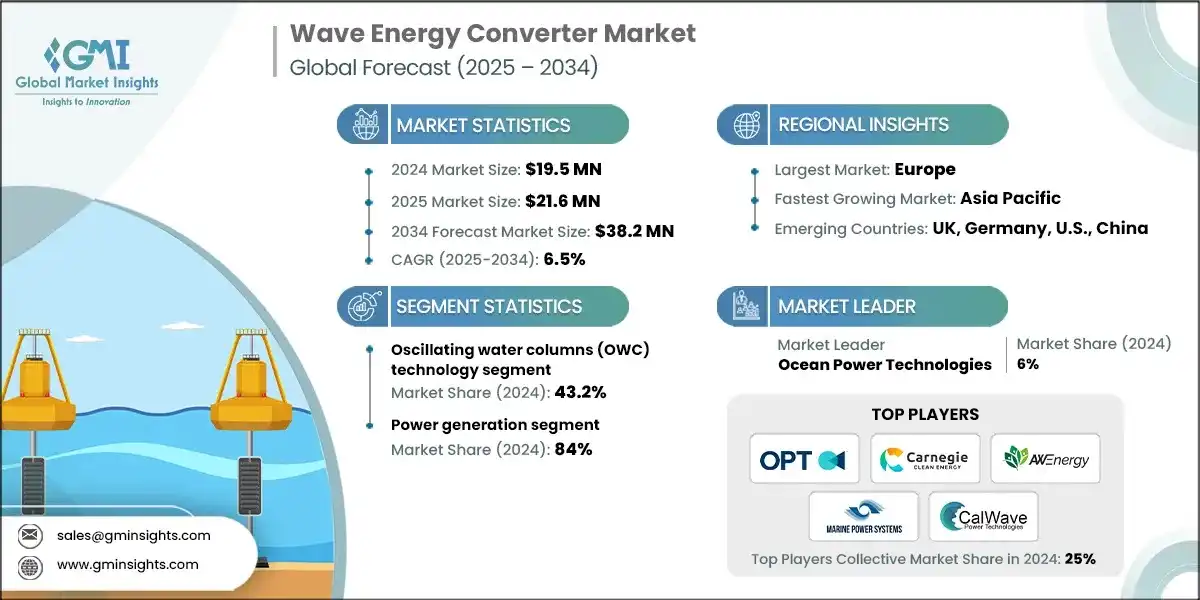
The global wave energy converter market was estimated at USD 19.5 million in 2024. The market is expected to grow from USD 21.6 million in 2025 to USD 38.2 million in 2034, at a CAGR of 6.5%, according to a recent study by Global Market Insights Inc.
Wave Energy Converter Market Key Takeaways
Market Size & Growth
- 2024 Market Size: USD 19.5 Million
- 2025 Market Size: USD 21.6 Million
- 2034 Forecast Market Size: USD 38.2 Million
- CAGR (2025–2034): 6.5%
Regional Dominance
- Largest Market: Europe
- Fastest Growing Region: Asia Pacific
Key Market Drivers
- Government funding & policy support.
- Technological advancements in durability & efficiency.
- Rising demand for decentralized coastal power.
Challenges
- High capital costs & long ROI cycles.
Opportunity
- Blue economy integration.
- Coastal infrastructure synergy.
Key Players
- Market Leader: Ocean Power Technologies led with over 6% market share in 2024.
- Leading Players: Top 5 players in this market include Ocean Power Technologies, Carnegie Clean Energy, AW-Energy Oy, Marine Power Systems, CalWave Power Technologies, which collectively held a market share of 25% in 2024.
Get Market Insights & Growth Opportunities
- Support from national innovation programs towards ocean energy harvesting along with product’s resilience across extreme conditions is augmenting the industry landscape. Government-backed innovation programs are accelerating WEC development by funding prototypes and pilot projects.
- For instance, in March 2024, The U.S. Department of Energy’s Small Business Innovation Research (SBIR) program funded Triton Systems’ wave energy harvesting project, enabling full-scale deployment and testing in open waters. In addition, wave energy technologies are increasingly proving their durability in harsh marine environments. This resilience is critical for long-term deployment and investor confidence.
- For instance, In August 2023, Triton Systems successfully tested its WEC prototype during Hurricane Lee in Buzzards Bay, Massachusetts. Despite waves exceeding eight feet, the system operated continuously and was safely retrieved, validating its robustness for real-world applications.
- Technological advancements in design & efficiency of the product coupled with its integration with local energy infrastructure is swaying the business outlook across the globe. Wave energy is being integrated into microgrids and local energy systems, reducing reliance on batteries and enhancing energy resilience in remote communities.
- For instance, Chile’s Programa de Energización promotes the use of non-conventional renewable energy including wave energy for isolated and rural communities, improving energy access and quality of life. In addition, innovations in turbine control, structural design, and predictive modeling are improving the efficiency and cost-effectiveness of WECs.
- Support for decentralized & off-grid applications along with strategic national energy planning aiming to boost product deployment in oceans is bolstering the market landscape. Wave energy is increasingly seen as a solution for off-grid and decentralized power needs, especially in coastal and island regions.
- For instance, in August 2025, Canada’s Minister of Energy and Natural Resources, under the Energy Innovation Program (EIP), announced an investment of over USD 13 million for five projects that will contribute to electricity grid modernization in Ontario. This in turn will increase product deployment aiming to enhance energy flexibility over the globe.
- Countries are embedding wave energy into long-term energy strategies, recognizing their role in diversifying energy sources and achieving sustainability goals. For instance, in September 2025, Germany is aiming for renewables to supply 80% of electricity by 2030 and for climate neutrality by 2045, which in turn will aid to the industry development down the line.
To get key market trends
Wave Energy Converter Market Trends
- Favorable policy & regulatory support for permitting along with increasing focus on energy equity & rural electrification will strengthen the business outlook, especially across developing countries. Streamlined permitting processes and regulatory frameworks are being introduced to accelerate wave energy project approvals and reduce administrative barriers.
- For instance, Ireland’s 2025 Planning and Development Regulations align with the EU Renewable Energy Directive, introducing mandatory timelines and environmental safeguards for renewable energy projects, including wave energy. In addition, wave energy is being leveraged to address energy poverty and improve access in underserved regions, aligning with broader development goals.
- For instance, in July 2025, Brazil power distribution utilities decided to invest over USD 43 billion between 2025 and 2029. The investment is embarked for various expansion projects, including various electrification projects, which in turn will have a positive impact on the overall market growth over the forecast timeline.
- Global commitment to renewable energy transition is further creating growth prospects for the market. Wave energy is part of a broader global push toward renewable energy, with countries committing to ambitious targets and integrating marine energy into their climate action plans.
- Continuous & exponential increase in product commercialization through pre-commercial procurement models is opening new growth avenues for the market. Governments are adopting innovative procurement strategies to fast-track wave energy technologies from concept to commercial readiness. These models reduce risk for developers and ensure public funds are directed toward the most promising solutions.
- For instance, The EuropeWave project, funded by the European Commission and managed by CINEA, uses a pre-commercial procurement approach to support wave energy developers across Europe. In 2024, three projects, ACHIEVE (Ireland), MARMOK Atlantic (Spain), and Blue Horizon 250 (UK) were selected for final-phase prototype deployment at open-water test sites like EMEC in Scotland and BiMEP in Spain.
- The establishment of accredited, grid-connected wave energy test sites is enabling real-world validation of WEC technologies, which is essential for scaling and investor confidence. For instance, the PacWave South test site off the Oregon coast, developed by the U.S. Department of Energy in partnership with Oregon State University, is the first accredited open-water wave energy test facility in the U.S. As of 2025, eight projects have been selected for testing, including CalWave and Columbia Power Technologies, with combined funding of USD 25 million.
- Wave energy is increasingly being designed for multi-use applications, such as powering aquaculture farms, offshore research stations, and military operations. This versatility enhances its value proposition and supports coastal economic development. As per the National Renewable Energy Laboratory (NREL), wave energy converters are being tailored to serve offshore seafood farming, marine research, and island-based military operations.
Wave Energy Converter Market Analysis
Learn more about the key segments shaping this market
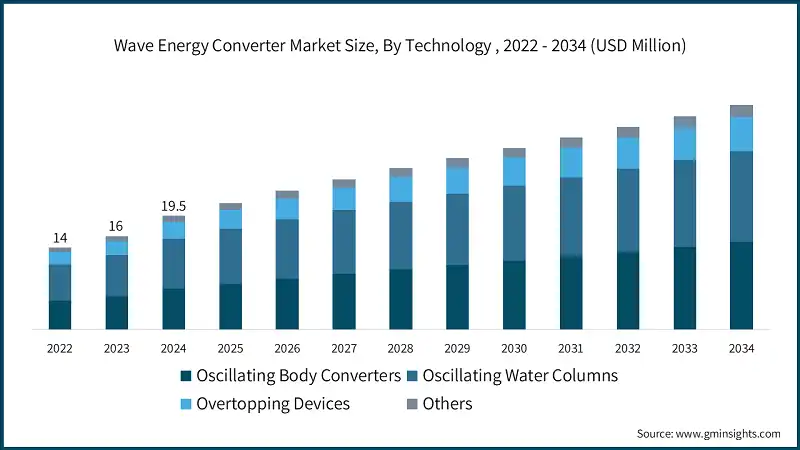
- Based on technology, the wave energy converter market is segmented into oscillating body converters, oscillating water columns, overtopping devices, and others. Oscillating water columns (OWC) technology market dominated by 43.2% of the market share in 2024 and is set to grow at a CAGR of 5.8% by 2034.
- OWCs use trapped air columns above water chambers to drive turbines as waves compress and decompress the air. They are known for their simplicity and durability and with increasing bidirectional turbine innovations coupled with low maintenance designs for remote deployment is adding to the technology adoption across the globe, thereby adding to industry growth.
- Designs emphasize simplicity and robustness, making OWCs suitable for remote or island communities. Passive air valves, corrosion-resistant materials, and simplified turbine assemblies reduce maintenance needs. These features are particularly valuable in regions with limited technical support, enabling long-term autonomous operation.
- The wave energy converter market from oscillating body converter (OBC) technology will grow at a rate of 7.4% through 2034 owing to its ability to harness the kinetic energy of wave-induced motion through floating or submerged structures. In addition, technology advanced control systems for real-time optimization along with its hybrid integration with offshore wind and solar will bolster the industry landscape.
- Oscillating body converters are increasingly being co-located with offshore wind and solar installations. This hybrid approach leverages shared infrastructure such as moorings, transmission lines, and maintenance vessels. It also enables more consistent energy output by balancing the intermittency of different renewable sources.
- For instance, in October 2025, China’s Mingyang Smart Energy has announced plans to invest over USD 1.7 billion in Scotland to build a fully integrated offshore wind turbine manufacturing facility. The facility will be built in phase wise to create an offshore wind hub to serve the UK, European, and other non-Asian markets. This is anticipated to increase the adoption of OBC technology across manufacturing turbines, in turn will add to the overall market growth.
- Growing trend is the shift toward modular architecture that allow for scalable deployment for OBCs. Instead of large, monolithic units, developers are designing smaller, interconnected modules that can be deployed incrementally. This approach reduces upfront capital costs and simplifies maintenance. It also allows operators to tailor installations to specific site conditions and energy demands.
- Overtopping devices technology industry will grow at a CAGR of 6.9% by 2034, driven by improved reservoir geometry and flow control coupled with increasing floating platforms for deep-water deployment, especially across the European countries. Computational fluid dynamics (CFD) simulations are being used to model wave interactions and refine geometries. These improvements lead to higher capture rates and smoother water flow, enhancing turbine performance and reducing turbulence-related losses.
Learn more about the key segments shaping this market
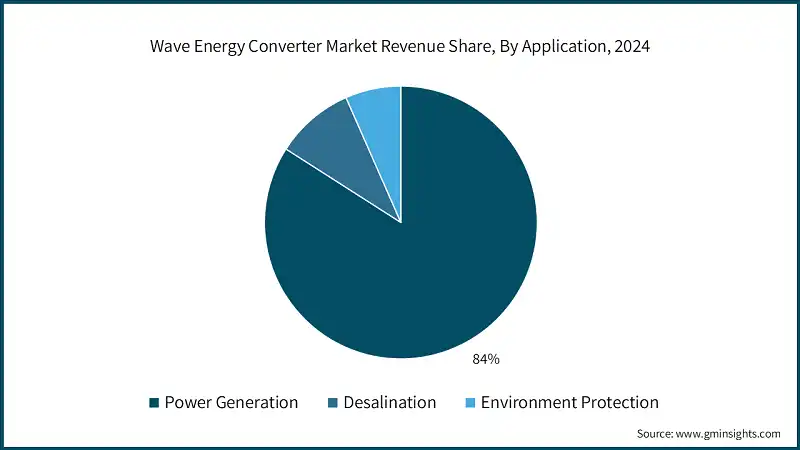
- Based on application, the wave energy converter market is segmented into power generation, desalination, and environment protection. Power generation application industry held a market share of 84% in 2024 and will grow at a CAGR of 6% by 2034. Increasing implementation of grid-connected demonstration projects along with adoption of hybrid energy systems is complementing the application industry.
- A major trend is the deployment of grid-connected WECs at open-water test sites. These projects are essential for validating performance, reliability, and cost-effectiveness under real-world conditions. They also help developers meet regulatory standards and attract commercial investment.
- For instance, in October 2025, the Eco Wave Power's Wave energy project at AltaSea in the Port of Los Angeles has been named to TIME's 2025 Best Inventions list. The project, the first onshore wave energy installation in the U.S is a real-conditions demonstration. The project demonstrates the process of harnessing wave energy through Eco Wave Power's patented floaters attached to existing marine infrastructure.
- The desalination application industry will grow by 7.5% by 2034, driven by increasing concern towards sustainable solutions to global water scarcity, especially in coastal and arid regions. Developers are focusing on small, modular WECs that can be rapidly deployed in disaster zones or remote locations. These systems are designed for quick setup and minimal maintenance, making them ideal for humanitarian and emergency applications.
- For instance, in May 2025, NREL’s HERO WEC, a wave-powered desalination system, underwent major upgrades including the replacement of its wire rope with a polyurethane flat belt. After 30,000 wave cycles in lab testing, the belt showed no wear, indicating a longer lifespan and improved reliability for producing freshwater in ocean deployments.
- The wave energy converter market from environment protection segment will witness a growth rate of 10% by 2034 owing to rising support for marine monitoring and coastal structure integration across the marine renewable energy projects. Wave energy technologies are increasingly being designed to serve dual roles generating energy while protecting coastal ecosystems, thereby adding to industry growth.
- Wave energy converters are being embedded into breakwaters and seawalls. These integrated systems not only generate electricity but also reduce coastal erosion and buffer storm surges. This dual-use design supports climate adaptation strategies. In addition, environmental considerations are driving the development of WECs with minimal ecological footprint. Innovations include noise-reducing turbines, biodegradable materials, and designs that avoid disrupting marine habitats.
Looking for region specific data?
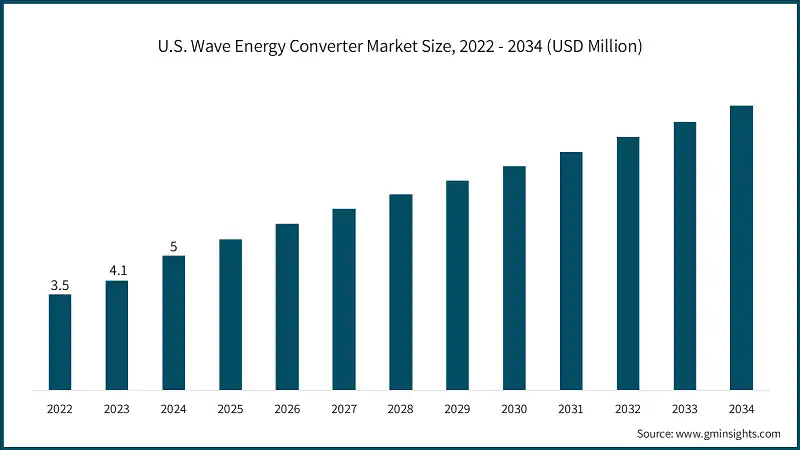
- The U.S. dominated the wave energy converter market in North America with around 85% share in 2024 and generated USD 5 million in revenue. Federal funding & technical support along with shifting focus of product’s application on coastal & offshore application is complementing the business outlook in countries including the U.S. & Canada.
- The U.S. department of energy continues to provide substantial funding and technical assistance through the Water Power Technologies Office and NREL. This support helps developers improve device durability, performance, and cost-effectiveness. For instance, in October 2025, the California Energy Commission decided to invest USD 42.7 million for offshore wind port development.
- Wave energy is being explored for powering offshore aquaculture, military operations, and island communities. These niche applications along with the associated investments are driving innovation in device design and deployment strategies. For instance, in February 2025, the Canada government announced an investment of over USD 125 million through two initiatives under the Ocean’s Protection Plan to strengthen marine safety in 47 communities across the country.
- The Europe wave energy converter market to cross USD 16 million by 2034. This growth is driven by aggressive climate policies, including the EU Emissions Trading System (EU ETS), that are pushing for rapid decarbonization along with increasing innovation, funding and cross-border collaboration. EU programs including Horizon Europe and the Innovation Fund are supporting cross-border wave energy projects.
- For instance, in November 2024, the EU ETS reported a historic 16.5% reduction in emissions from power installations, driven by increased renewable energy adoption, including wave energy integration in coastal infrastructure. Wave energy is being integrated into national energy strategies to meet carbon reduction targets and renewable integration will further enhance the industry scenarios down the line.
- The Asia Pacific wave energy converter market will grow at the fastest rate of 8.4% by 2034, driven by rising focus towards coastal & aquaculture resilience along with government led-innovation programs promoting the technology adoption. Wave energy is being considered for powering aquaculture farms and reinforcing breakwaters. These applications align with regional priorities around food security and climate adaptation.
- For instance, in October 2025, in India, NITI Aayog has launched a comprehensive roadmap to tap the country’s vast but underutilized deep-sea and offshore fisheries potential, estimated at 7.16 million tonnes within its 2 million sq. km Exclusive Economic Zone (EEZ). This is anticipated to increase the product deployment across the country to further utilize the wave energy potential in the country.
- Rest of the world will grow at a rate of 4.7% by 2034. This primarily includes countries such as Saudi Arabia, South Africa, UAE, Brazil, Argentina, among others. Increasing investments in sustainable infrastructure along with strategic energy diversification across various countries will augment the market outlook.
- Countries including the UAE and Saudi Arabia are diversifying their energy portfolios to include renewables. Wave energy is being explored as part of broader strategies to reduce reliance on fossil fuels. For instance, in May 2025, the Abu Dhabi Department of Energy unveiled a strategic framework to transform its energy sector by 2050, including marine energy as part of its sustainability roadmap.
Wave Energy Converter Market Share
- The top 5 companies in the wave energy converter industry including Ocean Power Technologies, Carnegie Clean Energy, AW-Energy Oy, Marine Power Systems, and CalWave Power Technologies held over 25% market share in the year 2024. Ocean Power Technologies focus on autonomous offshore power solutions for defense, oil & gas, and research sectors contributes to its dominant market position.
- CalWave’s xWave system is designed for submerged deployment, minimizing visual and environmental impact. The company has received support from the U.S. Department of Energy and is actively testing at the PacWave South site. Its focus on modularity and autonomous operation positions it well for remote and off-grid applications.
Wave Energy Converter Market Companies
Major players operating in the wave energy converter industry are:
- Aquamarine Power
- AW-Energy
- AWS Ocean Energy
- CalWave
- Carnegie Clean Energy
- CorPower Ocean
- Crestwing
- Eco Wave Power
- Havkraft AS
- INGINE Inc.
- Marine Power Systems
- Mocean Energy
- Novige AB
- Ocean Power Technologies
- Oscilla Power
- Seabased AB
- Wave Swell Energy
- Wavepiston
- Wavex
- Weptos
- Ocean Power Technologies is emerging as a global leader in autonomous marine energy systems, with its flagship PowerBuoy platform integrating AI-enabled maritime domain awareness and unmanned surface vehicles. In fiscal year 2025, the company reported USD 5.9 million in annual revenue, marking a 6.08% year-over-year growth, with a project pipeline valued at USD 137.5 million.
- Carnegie Clean Energy is positioning itself as a pioneer in wave energy innovation, with its CETO technology advancing toward commercial deployment through the EuropeWave ACHIEVE program. The company’s hybrid model combines wave energy with solar microgrids, exemplified by its Garden Island project in Western Australia. For the fiscal year ending June 2024, Carnegie reported USD 220,000, reflecting its early-stage commercialization efforts.
- AW-Energy Oy is known for its patented WaveRoller technology, which harnesses the surge phenomenon in nearshore waters. The company’s strength lies in its fully submerged design, enabling low-visibility, low-impact energy generation suitable for coastal grids. In 2024, the company reported USD 19.1 million in annual revenue, supported by ongoing deployments and technology licensing.
Wave Energy Converter Market Report Attributes
| Key Takeaway | Details |
|---|---|
| Market Size & Growth | |
| Base Year | 2024 |
| Market Size in 2024 | USD 19.5 Million |
| Market Size in 2025 | USD 21.6 Million |
| Forecast Period 2025 - 2034 CAGR | 6.5% |
| Market Size in 2034 | USD 38.2 Million |
| Key Market Trends | |
| Drivers | Impact |
| Government funding & policy support | Public investments and marine energy mandates are accelerating WEC innovation and deployment globally. |
| Technological advancements in durability & efficiency | Improved materials and control systems are making WECs more reliable and cost-effective in harsh marine environments. |
| Rising demand for decentralized coastal power | Remote and island communities are increasingly adopting WECs for off-grid renewable energy solutions. |
| Pitfalls & Challenges | Impact |
| High capital costs & long ROI cycles | WEC projects face financial hurdles due to expensive infrastructure and delayed commercial returns. |
| Opportunities: | Impact |
| Blue economy integration | Wave energy power marine industries like aquaculture and ocean monitoring, expanding their commercial relevance. |
| Coastal infrastructure synergy | Embedding WECs into breakwaters and seawalls offers dual benefits of energy generation and shoreline protection. |
| Market Leaders (2024) | |
| Market Leaders |
6% Market Share |
| Top Players |
Collective market share in 2024 is 25% Market Share |
| Competitive Edge |
|
| Regional Insights | |
| Largest Market | Europe |
| Fastest Growing Market | Asia Pacific |
| Emerging Countries | UK, Germany, U.S., China |
| Future outlook |
|
What are the growth opportunities in this market?
Wave Energy Converter Industry News
- In July 2025, the government of UK and Great British Energy came into a strategic agreement and planned to invest over USD 1 billion in supply chain development for offshore wind across the country. This in anticipated to present a favorable scenario for the product deployment across country’s offshore & nearshore applications.
- In July 2025, the ministry for the ecological transition of Spain decided to invest around USD 182 million in grants to adapt port infrastructure for offshore wind and other marine renewable energy projects. This will include the reinforcement of the country’s logistics and supply chain for manufacturing, assembly, and maintenance of offshore wind turbines and ocean energy devices.
- In February 2025, Bharat Petroleum Corporation Limited (BPCL) has signed a memorandum of understanding with Eco Wave Power Global AB for the development of wave energy in India. The agreement between the two will enable to jointly develop wave energy projects, beginning with a feasibility study.
This wave energy converter market research report includes in-depth coverage of the industry with estimates & forecast in terms of revenue (USD Million) from 2025 to 2034, for the following segments:
Market, By Technology
- Oscillating body converters
- Oscillating water columns
- Overtopping devices
- Others
Market, By Location
- Nearshore
- Shoreline
- Offshore
Market, By Application
- Power generation
- Desalination
- Environment protection
The above information has been provided for the following regions and countries:
- North America
- U.S.
- Canada
- Europe
- Germany
- UK
- Italy
- Netherlands
- Spain
- Asia Pacific
- China
- India
- Japan
- Australia
- South Korea
- Rest of the world
Frequently Asked Question(FAQ) :
What was the market size of the wave energy converter in 2024?
The market size was USD 19.5 million in 2024, with a CAGR of 6.5% expected through 2034. Support from national innovation programs and the product's resilience in extreme conditions are driving market growth.
What is the projected value of the wave energy converter market by 2034?
The market is poised to reach USD 38.2 million by 2034, driven by government-backed innovation programs, streamlined permitting processes, and global renewable energy commitments.
What is the expected size of the wave energy converter industry in 2025?
The market size is projected to reach USD 21.6 million in 2025.
What was the market share of the power generation application segment in 2024?
The power generation application segment held an 84% market share in 2024 and is expected to witness over 6% CAGR till 2034, supported by grid-connected demonstration projects and hybrid energy systems.
What was the valuation of the oscillating water columns (OWC) technology market in 2024?
The oscillating water columns (OWC) technology market accounted for 43.2% of the market share in 2024 and is set to expand at a CAGR of 5.8% up to 2034.
Which region leads the wave energy converter sector?
The U.S. dominated the market in North America with an 85% share in 2024, generating USD 5 million in revenue. Federal funding and a focus on coastal and offshore applications are driving growth in the region.
What are the upcoming trends in the wave energy converter market?
Trends include pre-commercial procurement, multi-use offshore applications, integration of wave energy into renewables, and faster approvals through improved regulations.
Who are the key players in the wave energy converter industry?
Key players include Aquamarine Power, AW-Energy, AWS Ocean Energy, CalWave, Carnegie Clean Energy, CorPower Ocean, Crestwing, Eco Wave Power, Havkraft AS, INGINE Inc., Marine Power Systems, and Mocean Energy.
Wave Energy Converter Market Scope
Related Reports