Summary
Table of Content

Waterborne Acrylic Resin Market
Get a free sample of this report
Form submitted successfully!
Error submitting form. Please try again.
Thank you!
Your inquiry has been received. Our team will reach out to you with the required details via email. To ensure that you don't miss their response, kindly remember to check your spam folder as well!
Request Sectional Data
Thank you!
Your inquiry has been received. Our team will reach out to you with the required details via email. To ensure that you don't miss their response, kindly remember to check your spam folder as well!
Form submitted successfully!
Error submitting form. Please try again.
Waterborne Acrylic Resin Market Size
- Waterborne acrylic resin is water-based polymer which are widely used in the manufacturing process of making coatings, adhesives, and paints. The ability to maintain low volatile organic compound (VOC) emissions makes the product better for both environmental safety and indoor use compared to standard solvent-based resins.
- The process of making this resin type begins with acrylic monomers which undergo emulsion polymerization to create a stable aqueous system. The material delivers strong bonding capabilities together with flexible properties and long-lasting strength which makes it suitable for use in protective coatings and architectural paints and industrial applications that need both performance and environmental compliance.
- Coatings industry experiences a technological transition in the shift from solvent-based systems toward waterborne acrylic resin products. This helps the organizations to meet the environmental compliance while decreasing harmful emissions and thus produce environmentally friendly products which maintain their coating performance capabilities.
- The performance of waterborne acrylic resin systems has improved through advancements in particle size control methods and crosslinking techniques and hybrid combination materials. Technology enables these resins to achieve comparable or superior performance to traditional coatings regarding hardness and chemical resistance and weatherability which results in their increased industrial usage.
- Waterborne acrylic resins deliver functional performance together with sustainable environmental impact through their ability to maintain cost efficiency and safe usage and effective performance. The industry demonstrates its increased dedication to environmentally friendly practices through decorative paints and automotive finishes and protective coatings which maintain product quality and durability.
The global waterborne acrylic resin market was valued at USD 6.7 billion in 2025. The market is expected to grow from USD 7 billion in 2026 to USD 10.6 billion in 2035, at a CAGR of 4.7% according to the latest report published by Global Market Insights Inc.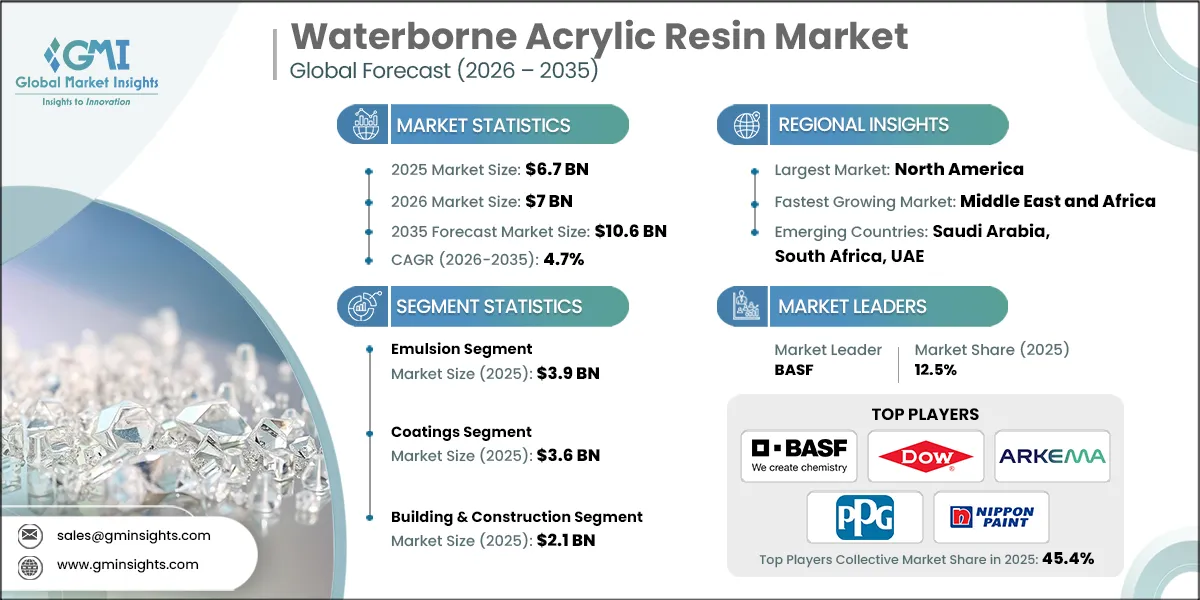
Waterborne Acrylic Resin Market Key Takeaways
Market Size & Growth
- 2025 Market Size: USD 6.7 Billion
- 2026 Market Size: USD 7 Billion
- 2035 Forecast Market Size: USD 10.6 Billion
- CAGR (2026–2035): 4.7%
Regional Dominance
- Largest Market: North America
- Fastest Growing Region: Middle East and Africa
Key Market Drivers
- Strict environmental regulations boosting resin adoption.
- Rising demand in architectural and decorative coatings.
- Technological advancements improving resin performance.
Challenges
- High production costs limiting.
- Performance limitations in extreme conditions.
Opportunity
- Innovation in hybrid and high-performance formulations.
- Expanding applications in adhesives and specialty coatings.
- Strategic collaborations to accelerate market growth.
Key Players
- Market Leader: BASF led with over 12.5% market share in 2025.
- Leading Players: Top 5 players in this market include BASF, Dow Chemical, Arkema, PPG Industries, Nippon Paint, which collectively held a market share of 45.4% in 2025.
Get Market Insights & Growth Opportunities
To get key market trends
Waterborne Acrylic Resin Market Trends
- The waterborne acrylic resin market is expanding because manufacturers develop environmentally safe coatings which contain low VOC emissions and meet environmental standards while providing long-lasting performance and secure adhesion capabilities and protective properties for architectural and automotive and industrial uses.
- Waterborne acrylic resins achieve their superior performance in challenging industrial environments through technological advances which include hybrid formulations and nanoparticle enhancements and advanced crosslinking methods that improve hardness and chemical resistance and weatherability
- The increasing demand for construction and renovation and industrial coatings drives the use of waterborne acrylic resins which provide sustainable high-performance solutions that meet the requirements of paints and protective coatings and all other commercial and consumer applications.
- Waterborne acrylic resins find their way into adhesives and sealants and automotive finishes and specialty coatings because they offer multiple benefits which include environmental compliance and high-performance capabilities while existing applications remain limited to decorative paint.
- The joint efforts of resin producers and coating formulators and research institutions lead to product development acceleration through innovation which supports sustainable high-performance coating adoption in industries that must meet regulatory standards and customer demand.
Waterborne Acrylic Resin Market Analysis
Learn more about the key segments shaping this market
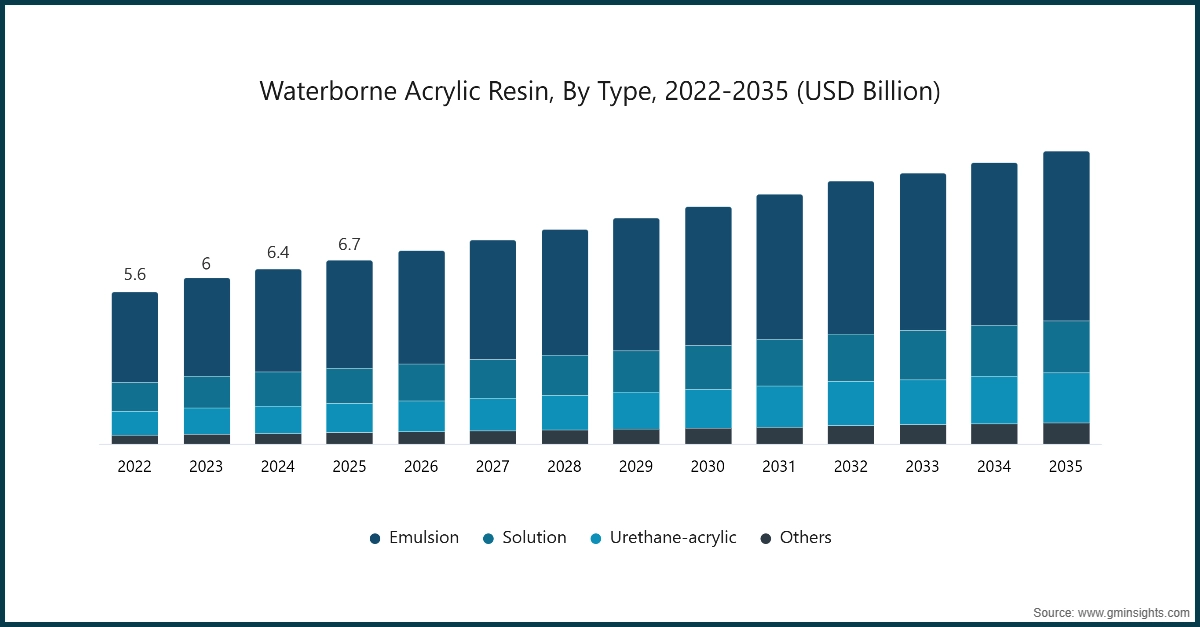
- The emulsion segment continues to grow due to its versatile properties which enable easy formulation for architectural coatings and adhesives and general-purpose applications. The industry advances sustainable development through its ongoing efforts to enhance emulsion resins which now provide better weather protection and quicker drying times and increased material longevity.
- High-performance applications that need clarity, hardness and chemical resistance select solution acrylics. The growing popularity of urethane-acrylic hybrids occurs because they offer toughness and flexibility and waterborne environmental advantages which make them ideal for flooring and wood finishes and industrial coatings. The other segment which includes specialty functionalized or hybrid acrylics serves niche markets through its customized properties which reflect the current trend toward high-performance waterborne acrylic resin formulations that meet sustainable design requirements.
Learn more about the key segments shaping this market
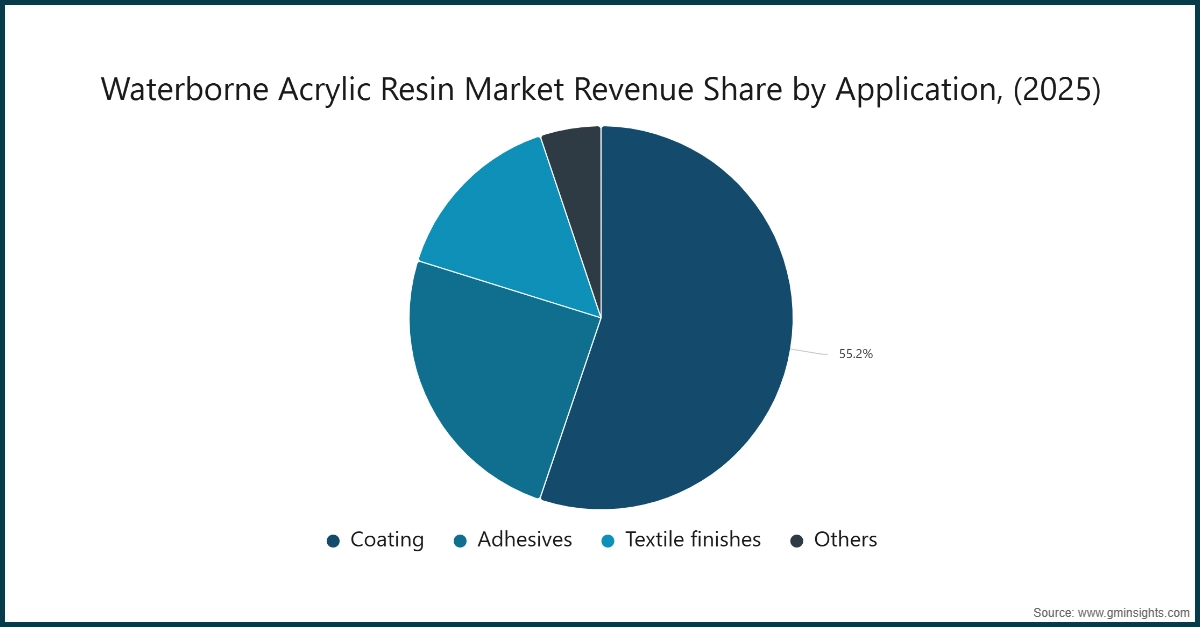
- The coatings segment is expanding because of its increasing demand for low-VOC architectural and industrial coatings which meet environmental standards. The market experiences growth as environmental regulations become stricter and construction activities increase and companies switch from solvent-borne products to waterborne solutions. Manufacturers work on durability and weather resistance and chemical performance improvement to achieve high-performance standards which apply to all decorative and protective and industrial coatings.
- The adhesives segment is growing due to strong demand from packaging, construction, and automotive industries, which require waterborne acrylics because these materials provide excellent bonding strength and flexibility and they enable safer processing. These resins are increasingly used in textile finishes, to enhance fabric durability, softness, and wash resistance while meeting eco-friendly standards in apparel and technical textiles. The others segment maintains steady growth because end-use industries need product customization for their different applications that requires sustainable high-performance material solutions.
The waterborne acrylic resins market by end use is segmented into building & construction, automotive, furniture, packaging, textile, adhesives & sealants and others. Building & construction hold the largest market value of USD 2.1 billion in 2025.
- The building and construction sector demands products because infrastructure development works are increasing while the industry shifts to low-VOC materials for coatings and waterproofing and protective finishes. Environmental regulations and green building standards continue to provide advantages for waterborne technology implementation. To achieve emission limits while preserving durability and gloss retention and corrosion resistance automotive industry increasingly adopts waterborne acrylic resins in OEM and refinishes coatings. The furniture industry uses more waterborne solutions because sustainable wood coatings and better indoor air quality have become popular.
- The packaging market is expanding its use of inks, coatings and laminating materials because food safety regulations require the use of materials that produce low odors and meet environmental standards. Waterborne acrylic resins are used in textiles to create fabric coatings and finishes that provide flexibility and wash resistance and sustainable performance. Industrial demand for adhesives and sealants is experiencing continuous growth because businesses need products that deliver strong adhesion power while maintaining safer chemical compositions. The other category, which includes paper and leather and specialized industrial uses, shows steady market demand because customers want customized products and performance-driven product innovations.
Looking for region specific data?
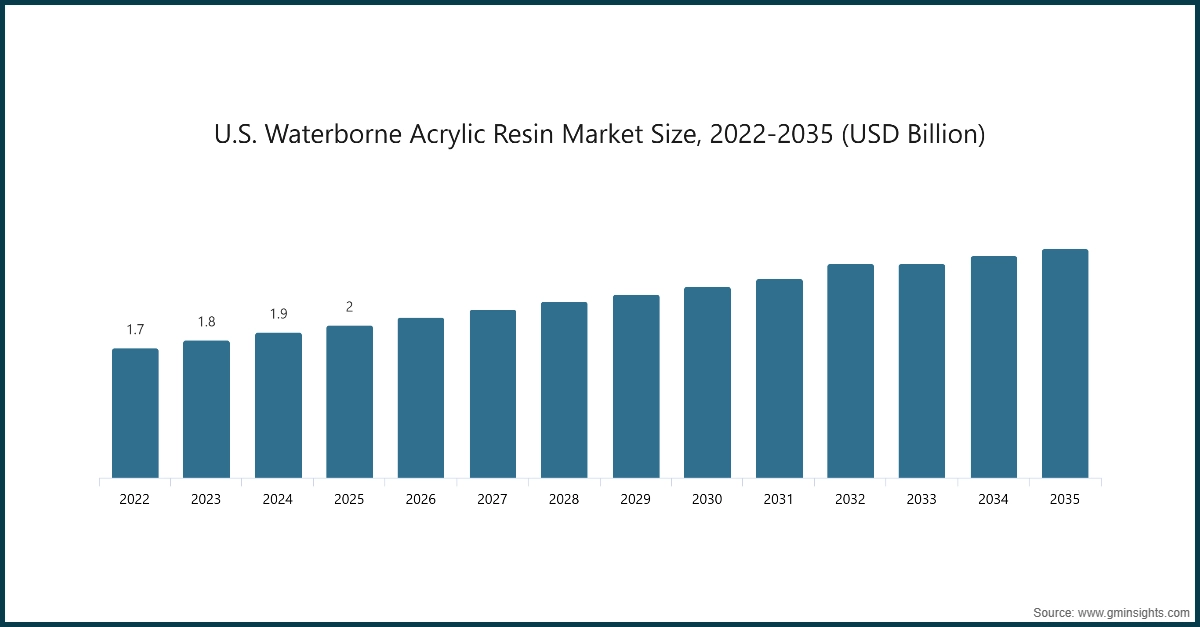
The market in the North America is expected to experience significant and promising growth from USD 2.4 billion in 2025 to USD 3.7 billion in 2035. The U.S. waterborne acrylic resins market accounted for USD 2 billion in 2025.
- The demand for waterborne acrylic resins in North America receives backing from environmental regulations, remodelling activities, and ongoing industrial production which supports the use of low-VOC coatings. The United States maintains its material usage throughout various applications because infrastructure funding and housing improvements and automotive refinish work all drive material requirements.
The market in the Europe is showing a notable and promising growth from USD 2 billion in 2025 to USD 3.1 billion in 2035.
- European market dynamics depends on sustainability objectives, green building codes and the current trend of industrial sectors replacing solvent-based systems with waterborne solutions. The German manufacturing base and automotive industry caters to resin consumption thus companies choose high-performance coatings that meet compliance regulations.
The waterborne acrylic resins market in Asia Pacific is expected to show increasing growth from USD 1.5 billion in 2025 to USD 2.7 billion in 2035.
- The Asia Pacific region shows rising demand because developing countries increase their urbanization rates and build infrastructure and expand their manufacturing operations. China serves as a primary market because its infrastructure development and international trade activities create high demand for sustainable coating and adhesive solutions.
Middle East & Africa market is showing significant and promising growth from USD 238.3 million in 2025 to USD 466.9 million in 2035.
- In the Middle East & Africa region there is a rising demand for sustainable materials because of its ongoing infrastructure developments and efforts to diversify industrial operations. Saudi Arabia contributes in market growth by its national development programs and newly established industrial sites to increase waterborne acrylic system usage in construction and protective coating sectors.
Latin America is showing increasing growth from USD 352.1 million in 2025 to USD 604.3 million in 2035.
- The construction and packaging industries in Latin America are showing signs of recovery while regulatory standards are gradually being improved which creates opportunities for increasing waterborne resin implementation. Brazil demonstrates these trends through its growing furniture production and automotive assembly operations and infrastructure projects that require durable and compliant coating solutions.
Waterborne Acrylic Resin Market Share
- Waterborne acrylic resin industries are moderately consolidated with players BASF SE, Dow Chemical, Arkema, PPG Industries and Nippon Paint holding 45.4% market share and BASF SE. being the market leader holding the market share of 12.5% in 2025.
- Companies maintain their position through research and development activities which they conduct to create better products while they meet changing environmental requirements. Innovation develops durable products which combine strong adhesion properties with chemical protection and low-VOC materials to meet manufacturers' needs for various coating and adhesive and textile and construction applications.
- The companies use product differentiation to develop their strategic approach. They create specialized product lines which include urethane-acrylic hybrid systems and product development for specific customer needs. The company uses customized solutions to build strong customer relationships which decrease market competition based on price.
- Companies need cost-efficient operations and optimized supply chains to keep their businesses running. Producers focus on better manufacturing workflows which enable them to obtain raw materials from stable sources while their regional production sites help them control logistics expenses and guarantee material availability. Businesses gain operational efficiency which allows them to keep their profit margins while they offer lower prices than competitors in markets that focus on cost.
- Sustainability positioning helps companies achieve better results against their competitors. The company uses sustainable raw materials together with bio-based products and energy-efficient manufacturing processes to meet international environmental laws and customer sustainability requirements. Brands establish their market presence through certifications and green building standard compliance which boost their product credibility.
- The companies use strategic partnerships, mergers and geographic expansion to create new market opportunities. They use distributor partnerships and coating formulation partnerships and OEM partnerships to expand its application reach which enables the company to enter emerging markets that offer rapid business growth to achieve revenue growth and build business resilience over time.
Waterborne Acrylic Resin Market Companies
Major players operating in the waterborne acrylic resin industry are:
- AkzoNobel
- Arkema
- BASF
- Dow Chemical
- Eastman Chemical
- Evonik Industries
- Huntsman
- Nippon Paint
- Nippon Shokubai
- PPG Industries
BASF SE produces numerous chemical products which include performance materials, coatings products, and industrial solutions. The company develops waterborne acrylic resin products through its sustainable low-VOC technology research which meets construction and automotive and industrial needs. The company uses its research capabilities and production networks and worldwide distribution system to create personalized resin products which deliver high performance.
Dow Chemical operates as a major materials science company supplying advanced polymers and specialty chemicals worldwide. The company Dow Chemical develops waterborne acrylic resins through its research of eco-friendly coating technologies which also include adhesives and packaging materials. The company's extensive research and development network together with its wide-ranging market reach and global production facilities enable it to compete in the market for sustainable acrylic products.
Arkema produces specialty chemicals which include advanced materials and coating resins. The company develops waterborne acrylic products which meet the specific needs of architectural and industrial and specialty markets. Arkema uses its technological knowledge and worldwide business activities to meet customer needs while implementing sustainable practices and developing high-performance products and specialty additives.
PPG Industries manufacturer paint products and coating solutions and specialty materials to the construction and automotive and industrial sectors. The company PPG develops waterborne acrylic technologies which focus on producing eco-friendly coating systems that deliver performance benefits. The company maintains strong demand for its protective and decorative products through its established brand network and manufacturing knowledge and partnerships with original equipment manufacturers.
Nippon Paint operates as an international paint and coatings producer who serves customers throughout Asia and other international markets. The company uses waterborne acrylic resin materials to manufacture decorative and industrial coating products which provide low-emission technologies together with high-durability features. The company expands its market presence through its local manufacturing facilities, product customization initiatives, and growing distribution network.
Waterborne Acrylic Resin Market Report Attributes
| Key Takeaway | Details |
|---|---|
| Market Size & Growth | |
| Base Year | 2025 |
| Market Size in 2025 | USD 6.7 Billion |
| Market Size in 2026 | USD 7 Billion |
| Forecast Period 2026-2035 CAGR | 4.7% |
| Market Size in 2035 | USD 10.6 Billion |
| Key Market Trends | |
| Drivers | Impact |
| Strict environmental regulations boosting resin adoption | Government policies targeting low VOC emissions and eco-friendly coatings drive adoption of waterborne acrylic resins, especially in construction, automotive, and industrial sectors, supporting sustainable growth and regulatory compliance worldwide. |
| Rising demand in architectural and decorative coatings | Global urbanization and renovation activities increase demand for waterborne acrylic resins, valued for durability, adhesion, and low environmental impact in residential and commercial paints, finishes, and protective coatings. |
| Technological advancements improving resin performance | Innovations in hybrid formulations, nanoparticle integration, and crosslinking technologies enhance waterborne acrylic resin properties, enabling superior hardness, chemical resistance, and broader applications across industrial, automotive, and consumer sectors. |
| Pitfalls & Challenges | Impact |
| High production costs limiting | Manufacturing waterborne acrylic resins involves higher costs and complex processes. These expenses, along with curing and film formation challenges, can hinder adoption despite performance and environmental advantages. |
| Performance limitations in extreme conditions | Certain applications demand high heat, chemical, or abrasion resistance where waterborne acrylic resins may underperform. Addressing these gaps through R&D is crucial to capture more industrial and specialty applications. |
| Opportunities: | Impact |
| Innovation in hybrid and high-performance formulations | Developing advanced waterborne acrylic resins with hybrid technologies, crosslinkers, and additives creates high-durability coatings, automotive finishes, and protective applications, expanding adoption in performance-focused industries. |
| Expanding applications in adhesives and specialty coatings | Waterborne acrylic resins are increasingly used in adhesives, sealants, and specialty coatings, leveraging versatility and environmental compliance, offering new revenue streams beyond traditional decorative paint markets. |
| Strategic collaborations to accelerate market growth | Partnerships between resin manufacturers, chemical companies, and coating formulators enable innovation, improve distribution, and speed adoption, especially in markets emphasizing sustainability and high-performance coatings. |
| Market Leaders (2025) | |
| Market Leader |
Market share 12.5% |
| Top Players |
Collective market share of 45.4 % in 2025 |
| Competitive Edge |
|
| Regional Insights | |
| Largest Market | North America |
| Fastest growing market | Middle East and Africa |
| Emerging countries | Saudi Arabia, South Africa, UAE |
| Future outlook |
|
What are the growth opportunities in this market?
Waterborne Acrylic Resin Industry News
- On November 2025, AkzoNobel and Axalta Coating Systems announced an all-stock merger of equals, creating a global coatings company. The merger unites complementary coatings portfolios, strengthens geographic reach, and integrates R&D platforms.
- On September 2025, PPG Industries showcased its advanced waterborne basecoat during a robotic mural event at the Mesto Galerie Street Art Festival in Mladá Boleslav, Czech Republic.
The waterborne acrylic resins market research report includes an in-depth coverage of the industry with estimates and forecast in terms of revenue in USD Billion and volume in terms of kilo tons from 2022–2035 for the following segments:
Market, By Type
- Emulsion
- Solution
- Urethane-acrylic
- Others
Market, By Application
- Coating
- Adhesives
- Textile finishes
- Others
Market, By End Use
- Building & construction
- Automotive
- Furniture
- Packaging
- Textile
- Adhesives & sealants
- Others
The above information is provided for the following regions and countries:
- North America
- U.S.
- Canada
- Europe
- Germany
- UK
- France
- Spain
- Italy
- Rest of Europe
- Asia Pacific
- China
- India
- Japan
- Australia
- South Korea
- Rest of Asia Pacific
- Latin America
- Brazil
- Mexico
- Argentina
- Rest of Latin America
- Middle East and Africa
- Saudi Arabia
- South Africa
- UAE
- Rest of Middle East & Africa
Frequently Asked Question(FAQ) :
What was the market size of the waterborne acrylic resin in 2025?
The market size was valued at USD 6.7 billion in 2025, with a CAGR of 4.7% expected through 2035. The growth is driven by increasing demand for low-VOC coatings, adhesives, and paints.
What is the projected value of the waterborne acrylic resin market by 2035?
The market is poised to reach USD 10.6 billion by 2035, fueled by advancements in hybrid formulations, nanoparticle enhancements, and regulatory compliance needs.
What is the expected size of the waterborne acrylic resin industry in 2026?
The market size is projected to reach USD 7 billion in 2026.
How much revenue did the emulsion segment generate in 2025?
The emulsion segment generated approximately USD 3.9 billion in 2025, led by its versatile properties for architectural coatings, adhesives, and general-purpose applications.
What was the valuation of the coatings segment in 2025?
The coatings segment accounted for USD 3.6 billion in 2025, supported by rising demand for low-VOC architectural and industrial coatings that meet environmental standards.
What is the growth outlook for the building and construction sector?
The building and construction sector, valued at USD 2.1 billion in 2025, is expected to grow as infrastructure development increases and the industry shifts to low-VOC materials for coatings, waterproofing, and protective finishes.
Which region leads the waterborne acrylic resin sector?
North America leads the market, with significant growth projected from USD 2.4 billion in 2025 to USD 3.7 billion by 2035, propelled by stricter environmental regulations and increased construction activities.
What are the upcoming trends in the waterborne acrylic resin market?
Trends include eco-friendly low-VOC coatings, hybrid and nanoparticle formulation advancements, and growing adoption across automotive, industrial, and specialty applications.
Who are the key players in the waterborne acrylic resin industry?
Key players include AkzoNobel, Arkema, BASF, Dow Chemical, Eastman Chemical, Evonik Industries, Huntsman, Nippon Paint, Nippon Shokubai, and PPG Industries.
Waterborne Acrylic Resin Market Scope
Related Reports