Summary
Table of Content

Water Taxi Market
Get a free sample of this report
Form submitted successfully!
Error submitting form. Please try again.
Thank you!
Your inquiry has been received. Our team will reach out to you with the required details via email. To ensure that you don't miss their response, kindly remember to check your spam folder as well!
Request Sectional Data
Thank you!
Your inquiry has been received. Our team will reach out to you with the required details via email. To ensure that you don't miss their response, kindly remember to check your spam folder as well!
Form submitted successfully!
Error submitting form. Please try again.
Water Taxi Market Size
The global water taxi market was valued at USD 24.6 billion in 2025. The market is expected to grow from USD 25.3 billion in 2026 to USD 34.7 billion in 2035 at a CAGR of 3.6%, according to latest report published by Global Market Insights Inc.
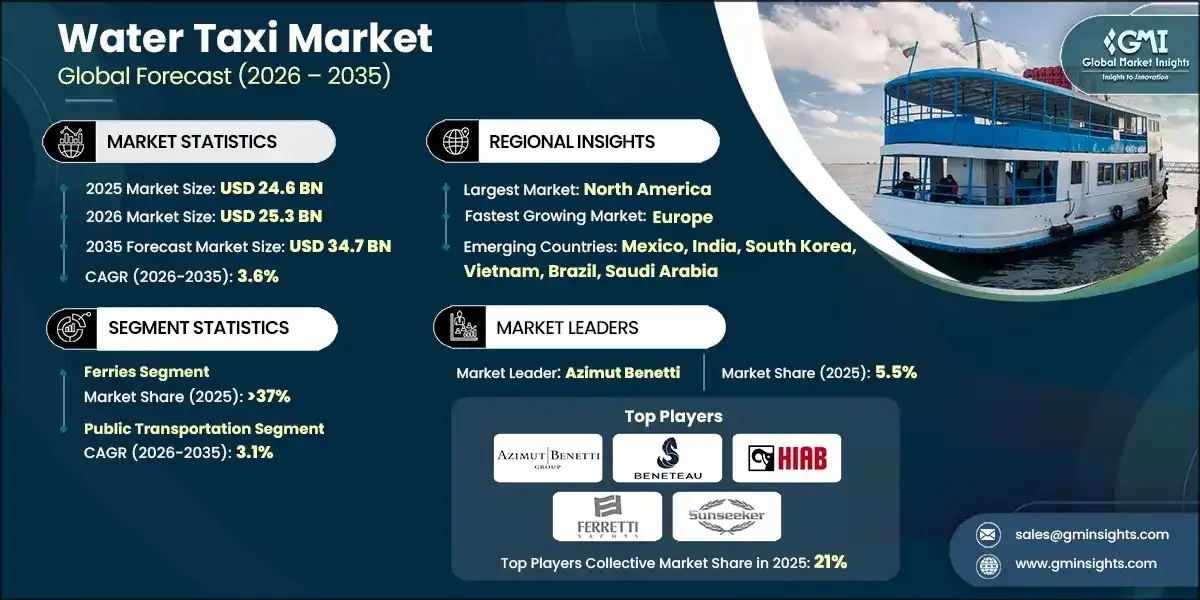
To get key market trends
Water taxis are solving problems of people who are mainly stuck in traffic in urban areas. The waterways are not limited to only big cruise lines, but they are also gaining momentum as a substitute option for travelling in city areas. In many countries, water taxis are in operation for intercity travel as well.
For instance, in June 2025, an intercity water taxi initiative was announced to be launched in India between South Mumbai and Navi Mumbai Airport. The initiative is jointly spearheaded by the City and Industrial Development Corporation (CIDCO) and the Maharashtra Ports Department.
Moreover, urbanization and traffic problems in metro cities are on the rise, which has been the major factor contributing to the growth of the market. With the development of metropolitan cities and road congestion becoming a common occurrence, governments and other transport authorities are looking towards adopting water transportation as a substitute.
Furthermore, in comparison to traditional transportation, water taxis are more affordable and environmentally friendly, using less fuel for maintenance. Building bridges and roads in busy cities is costly and slow, whereas water transport is quicker and more economical.
In regions with natural waterways, water taxis reduce traffic congestion and provide a dependable, low-cost alternative. Water taxis also incur lower maintenance costs over time and are capable of transporting more people with fewer interruptions. Governments and private operators are increasingly using awards and bonuses for water taxis, which boosts their image as a sustainable and economical transport option.
Water Taxi Market Report Attributes
| Key Takeaway | Details |
|---|---|
| Market Size & Growth | |
| Base Year | 2025 |
| Market Size in 2025 | USD 24.6 Billion |
| Market Size in 2026 | USD 25.3 Billion |
| Forecast Period 2026-2035 CAGR | 3.6% |
| Market Size in 2035 | USD 34.7 Billion |
| Key Market Trends | |
| Drivers | Impact |
| Urban Waterfront Congestion Reduction | Water taxis ease road traffic in crowded waterfront cities by shifting commuters to waterways, improving travel time reliability, reducing urban congestion, and encouraging authorities to invest more in water-based public transport solutions. |
| Growth in Coastal and Inland Tourism | Rising tourism increases demand for convenient and scenic water transport, boosting water taxi usage for sightseeing and short-distance travel. |
| Expansion of Smart City Water Transport Initiatives | Smart city programs promote integrated, technology-driven mobility, supporting water taxi adoption through better docks, digital ticketing, and real-time tracking. |
| Rising Demand for Sustainable and Low-Emission Mobility | Growing environmental awareness pushes cities toward cleaner transport, encouraging electric and hybrid water taxis, improving public acceptance. |
| Pitfalls & Challenges | Impact |
| High Initial Capital and Vessel Procurement Costs | High costs for vessels, charging infrastructure, and safety equipment limit new market entry, slow fleet expansion, and discourage small operators. |
| Weather Dependency and Seasonal Operations | Operations depend heavily on weather conditions and water levels, causing service disruptions and seasonal demand fluctuations. |
| Opportunities: | Impact |
| Adoption of Electric and Autonomous Water Taxis | Electric and autonomous technologies reduce fuel and labor costs, improve efficiency, and attract government support. |
| Customized Water Taxi Services for Tourism and Events | Customized water taxis for tourism and events increase demand by offering private charters, sightseeing, and special occasion travel, helping operators generate higher revenues. |
| Expansion in Emerging Coastal and Riverfront Cities | Rapid urbanization in coastal and riverfront cities creates new demand for alternative transport, opening opportunities for water taxi services where road infrastructure is limited or congested. |
| Public-Private Partnerships for Urban Water Mobility | Public-private partnerships reduce financial risks and accelerate service deployment, enabling faster expansion of water taxi networks. |
| Market Leaders (2025) | |
| Market Leaders |
5.5% market share |
| Top Players |
|
| Competitive Edge |
|
| Regional Insights | |
| Largest Market | North America |
| Fastest Growing Market | Europe |
| Emerging Country | Mexico, India, South Korea, Vietnam, Brazil, Saudi Arabia |
| Future Outlook |
|
What are the growth opportunities in this market?
Water Taxi Market Trends
One of the major trends is the government’s support for water taxis. Many countries' governments are openly supporting water taxi players by issuing subsidies to expand their services. This is the major driver that will boost the water taxi market in regions where such government plans have been introduced.
For instance, in November 2025, the European Commission adopted its communication on the Sustainable Transport Investment Plan (STIP) to speed up the shift to cleaner energy in aviation and water transport. The plan focuses on increasing investments and producing more renewable and low-carbon fuels.
Similarly, in June 2025, the European Green Deal provided a subsidy of 1.5 million euros for the development of fast, emission-free water taxis that are expected to be operational by the end of 2026. Watertaxi Rotterdam provides water transport for passengers in Rotterdam and Schiedam, with 50 stops available on demand and several regular ferry services.
On the propulsion side, the market is witnessing high adoption of electric and hybrid propulsion systems. With the growing environmental concerns and presence of stringent emission regulations, many cities are shifting from traditional diesel-powered boats to electric and hybrid models.
Water taxi operators are launching all-electric water taxi services. For instance, in February 2025, E-lixr, which is a water taxi service operator, announced to launch America's first all-electric water taxi service and plans to develop a nationwide network of all-electric operators under one brand name to make it easily accessible.
Water Taxi Market Analysis
Learn more about the key segments shaping this market
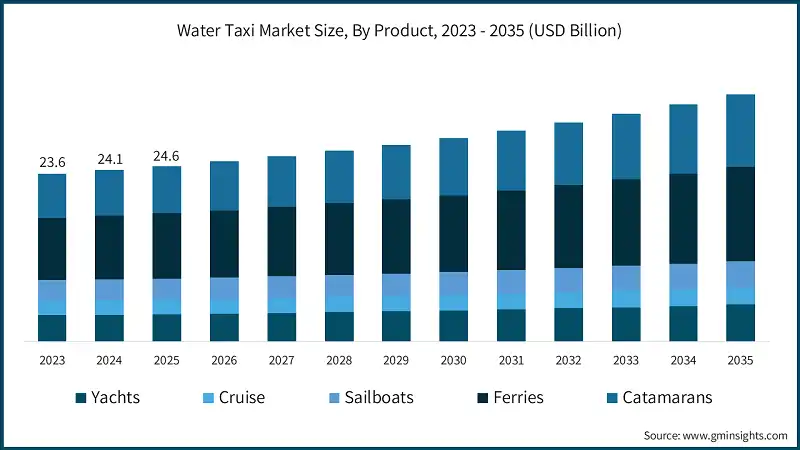
Based on product, the market is segmented into yachts, cruise, sailboats, ferries and catamarans. In 2025, the ferries segment held a market share of over 37% and was valued at around USD 9.1 billion.
- Ferries are becoming an important part of transport systems in coastal cities and islands. They connect buses, trains, and metro systems, making it easier to travel across water. This convenience is increasing the number of passengers using ferries.
- In May 2025, Damen launched the latest Island Class Ferry for BC Ferries. The ferry is a four-battery-equipped diesel-hybrid vessel that will bring the total number of Damen vessels in the BC Ferries fleet to ten. The vessels will transport up to 47 vehicles and 390 passengers, recharging during passenger (dis)embarkation using renewable energy.
- Governments are building ports, terminals, and other ferry service-related infrastructure to upgrade water transport. For example, the 2030 Federal Transport Infrastructure Plan has allocated 9.1% of the fund amount to waterways in Germany. In addition to this, for upgrades and new projects, waterways will receive €0.2 billion per annum on average till 2030.
Learn more about the key segments shaping this market
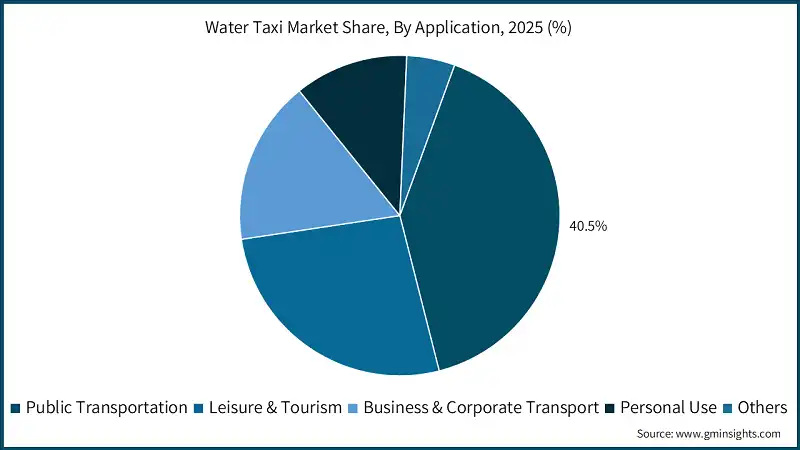
Based on application, the water taxi market is divided into public transportation, leisure & tourism, business & corporate transport, personal use and others. The public transportation segment is expected to grow at a CAGR of 3.1% between 2026 and 2035.
- In 2025, public transportation holds its dominant position in the water taxi industry. The reason behind its dominance is that it is the best-suited offering for daily commuters as well as travelers who come for tourism purposes within the city.
- Travelers who more often opt for such a mode of transportation that takes the least time to reach a desired location will boost the demand for water taxis in emerging tourism nations.
- Governments across the world advocate water-based transportation as an alternative to conventional land modes that will eventually help in the expansion of the water taxi industry. Infrastructure development such as docks and terminals is contributing to the growth of water taxis and ferries as parts of public transport systems. These services reduce road traffic and improve mobility in urban areas, especially those located near rivers and oceans.
Based on propulsion, the water taxi market is divided into diesel, hybrid, electric and others. The diesel segment held a major market share in 2025.
- The efficiency of diesel propulsion puts diesel vessels with high total operations as an immediate low-cost option, while electric and hydrogen-driven vessels are still in the development phase. Like the ferries, water taxis are far more economical to operate with passenger overload and long-distance travel coupled with diesel engines.
- For instance, in December 2025, a fully electric passenger ferry was launched on the River Thames. After being progressively phased into operation, the 150-passenger boat, with capacity for 100 bicycles, will cross the river every 10 minutes from each side on weekdays and every 15 minutes on weekends.
- Despite this, the diesel segment is expected to continue to hold a dominant position in the water taxi market. The strong network of ports and fueling stations makes it convenient for the operators to use diesel vessels without the need for expensive new infrastructure that a shift towards high-speed electric and hydrogen propulsion vessels would demand.
Looking for region specific data?
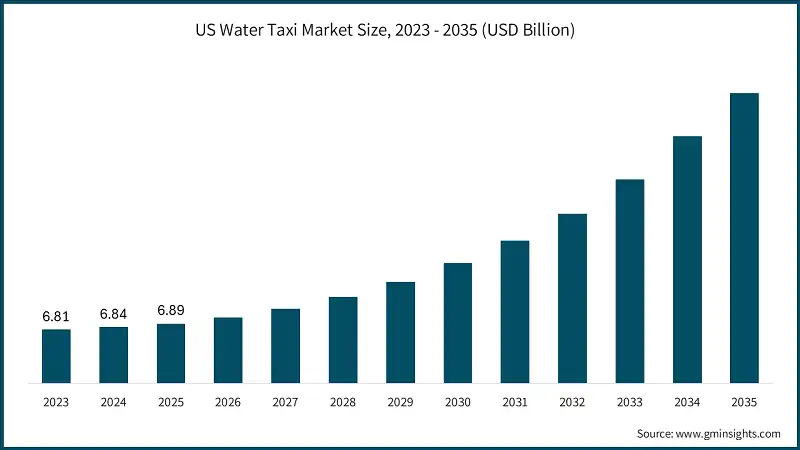
The US water taxi market reached USD 6.89 billion in 2025, growing from USD 6.84 billion in 2024.
- Road congestion continues to be an increasing challenge in the U.S. The INRIX Global Congestion Index states that in 2024, the average driver in the U.S. lost an equivalent of 771 dollars in productivity alongside 43 hours in a yearly traffic jam. In 2024, only congestion resulted in losses of 74 billion dollars for the U.S., reflecting an 5.1% increase from 2023.
- As cities are growing, governments are also introducing water taxis to the total public transport in order to ease the traffic on the roads and effectively cross over rivers and coastal areas.
- The American government, alongside local transit authorities, are enhancing the expansion of ferry terminals, alongside the modernization of the fleet of ships within the docking area to increase the usage of water transport.
The North America water taxi market is estimated to reach USD 9.9 billion by 2035 and expected to grow at a slower CAGR of 2.1% between 2026 and 2035.
- North America, with its large river networks and long coastlines shows potential opportunities for water taxi operators, especially in the United States and Canada. The U.S. has over 3.5 million miles of rivers, providing many waterways for transport and urban water taxi services in inland and coastal areas.
- Moreover, Canada is home to numerous major rivers including the Mackenzie (more than 4,200 km long) and some stretches of the St. Lawrence system that are suitable for both commercial and passenger transportation.
- The vast network of freshwater in Canada is among the largest globally and there are numerous lakes that can act as a pathway for water taxi services to link up urban areas and tourists through the cities and attractions along the lakes.
- The fact that a significant part of the population resides close to rivers and coastlines makes the adoption of water taxis very promising for urban transport and tourism in North America.
The Europe water taxi market accounted for USD 7.2 billion in 2025 and is anticipated to grow at the CAGR of 2.9% between 2026 and 2035.
- In the Europe region, regulatory bodies play a major role in the expansion of the water taxi industry. As the EU has introduced so many subsidies to revolutionize water tourism, it also keeps an eye on water taxi service providers to follow the rules and regulations.
- The new rule, which is currently followed by water taxi service providers, was introduced in February 2022. These new rules to increase ferry safety were put forward by the European Commission. The proposal will help protect passengers from flooding on board after a collision.
- The proposal applies to newly built ships and to those certified to operate in the EU for the first time. For smaller ferries carrying fewer than 1,350 persons and operating in European waters, stricter safety requirements will apply, which go beyond those applied in other world regions.
Germany's water taxi market is growing fast in Europe, with a strong CAGR of 3.4% between 2026 and 2035.
- Germany reveals policies and support to the waterways industry by allocating funds under its 2030 Federal Transport Infrastructure Plan, in which around 9.1% of the fund amount is allocated to waterways.
- Also, the rising number of urban crowds on the road will shift passengers or travelers to opt for water taxis for travelling. The Federal Ministry of Transport and Digital Infrastructure reveals that the number of passenger kilometers travelled in Germany will increase by a total of 12.2% by 2030 compared with 2010 levels. According to the traffic forecast for 2030, this is equivalent to an annual growth rate of 0.6%.
- Such statistics will help the water taxi industry to expand in urban areas where this data may be higher than expected. The current landscape in Germany shows potential opportunities for new entrants with the support of EU subsidies and changing travel preferences.
The Asia Pacific water taxi market is estimated to reach USD 11.1 billion by 2035, by growing at a fastest CAGR of 5.6% during the analysis timeframe.
- The Asia Pacific region has great potential owing to the long coastlines, massive river networks, and numerous island nations. Among the countries are Indonesia, Thailand, Vietnam, the Philippines, and India that have developed metropolitan cities on coastlines and rivers where road congestion and geographical challenges make water transport a viable option for short urban trips.
- Waterfront access and passenger transportation improvements driven by tourism in the region will benefit the visitors travel experience. Iconic destinations like Bangkok, Bali, Phuket, Ha Long Bay, Singapore, and some parts of Japan are already using ferries and boats. It is already enabling the planned water taxi services for sightseeing, city travel, and island hopping.
- Partnerships between the public and private sectors are greatly influencing the water taxi service expansion in the Asia Pacific region. Governments are providing support on the fronts of infrastructure, approvals, and sustainability, while private companies are providing state-of-the-art boats, operational expertise, and digital booking systems.
China is estimated to grow with a CAGR of 4.9% in the projected period between 2026 and 2035, in the Asia Pacific market.
- China is incorporating water taxis into the mass transit systems of its rapidly expanding urban areas such as Shanghai and Guangzhou. These small vessels utilize advanced city concepts known as smart city initiatives to help reduce congestion on the roads and improve mobility.
- China is modernizing its investments into maritime transport by constructing new ferry terminals in addition to updating fleets. Urban transit systems for cities with coastlines and rivers are integrating water taxis into metros and buses for ferry services.
Latin America water taxi market is estimated to reach USD 1.5 billion in 2025 and is anticipated to show lucrative growth over the forecast period.
- Latin America is adopting water taxis as a viable option for enhancing mobility in the congested cities by the sea, river, and with a restricted road network. Brazil, Mexico, Colombia, and Chile are among the countries that have already incorporated water transport in cities and tourist areas, mainly in riverside, island, and coastal cities.
- One of the key factors for the increasing demand for water taxis in the region is tourism, which plays a significant role in this. Places such as Rio de Janeiro, Cartagena, Cancun, and some parts of the Caribbean coast already utilize taxi boats for short hauls, island hopping, and sightseeing.
- In the forecasted period between 2026 and 2035, the region will grow as one of the fastest-growing regions in the water taxi industry. This growth is a result of the region’s strong position in the tourism sector.
Brazil is estimated to grow with a CAGR of 5.1% between 2026 and 2035, in the Latin America water taxi market.
- Brazil intends to use its waterways as a green alternative to transport, thereby boosting tourism and enhancing coastal connectivity. The government is taking water transport services, with small boats and water taxis, as a part of urban and regional travel, especially in those coastal cities and islands where the roads are either very limited or congested.
- Water taxis are extensively used in places like Ilha Grande and the Northeast of Brazil to transport tourists. The operators offer direct transfers between points and also flexible boat services for the locals and travelers.
- Moreover, tourism is a major driving force behind Brazil’s water taxi services expansion and improvement plans. In 2024, Brazil counted more than 6.621 million foreign visitors, the highest recorded number for leisure and business travel. This milestone is an indication of the government’s success in providing better tourism infrastructure and connectivity.
The Middle East and Africa accounted for USD 1.2 billion in 2025 and is anticipated to show lucrative growth over the forecast period.
- In the Gulf nations, particularly the UAE, the marine transport system has turned out to be a significant public transport mode. Residents and tourists alike can choose the fastest or most comfortable way of transport along the major waterfronts in cities like Abu Dhabi, Dubai, and Sharjah, where the public transport system includes water taxis, water buses, ferries, and abras, which are the traditional wooden boats.
- The Gulf authorities in the region are already working on the use of water taxis for the connection between areas of great leisure, culture, and residence. This leads to the creation of more and more businesses such as operators, boat builders, and service providers.
- It brings tourist activities along with other transport connections. In Dubai, the RTA operates water taxis in the waters of Dubai Marina, Dubai Creek, and Al Mamzar. The numerous boarding places facilitate the service and thus make sea transport a common choice for moving from one place to another.
UAE to experience substantial growth in the Middle East and Africa water taxi market in 2025.
- The UAE sees the water taxi industry as an important part of its transport system, focusing on luxury, sustainability, and easy connections across its coastal areas. In Dubai, the Roads and Transport Authority (RTA) manages water taxis as high-end services. These taxis can carry up to 20 passengers and run routes like Dubai Creek to Marina, stopping at key locations such as Al Mamzar. Passengers can use Nol cards for convenient access.
- Abu Dhabi Maritime, created by the Department of Municipalities and Transport (DMT) and AD Ports Group, has been operating water taxis since its inception in November 2022. The Public Water Taxi service was launched in partnership with Miral and connects the Yas Bay and Raha Beach areas.
- There are many opportunities in tourism, better infrastructure, and eco-friendly transport. In Dubai, Marina and Creek networks are adding air-conditioned abras and electric options for places like Burj Khalifa and Bluewaters.
Water Taxi Market Share
- The top 7 companies in the water taxi industry are Azimut Benetti, Beneteau, Hiab, Ferretti, Sunseeker, Bavaria Yachts and Catalina Yachts, contributing 21.7% of the market in 2025.
- Azimut Benetti produces luxury mega yachts and boats for the water taxi market. The company provides high-end boats for premium passenger transport and fleet leasing. Their boats are known for Italian design and advanced technology.
- Beneteau makes many types of sailing and motorboats. Through its Boating Solutions division, it creates boats for water taxi use. The company works with rental companies like Le Boat to invest in fleets, offering river cruisers with air conditioning and fly bridges for charters.
- Hiab makes marine and dock cranes for handling and unloading boats in water taxi operations. These cranes are lightweight, reliable, and suitable for marine environments like fishing and abalone farming.
- Ferretti manufacturers luxury yachts and superyachts. The company builds high-performance boats for passenger transport and tourism. Its shipyards produce motor yachts for coastal and leisure use.
- Sunseeker builds luxury motor yachts, including boats used for water taxi services like Uber Yacht transfers. Models like the Sunseeker 86 offer premium passenger experiences with skippers and catering, especially in places like Ibiza.
- Bavaria Yachts offers versatile boats, such as the Bavaria 41, which are used for taxi boat and water transfer services in coastal areas. The company provides reliable boats for both recreational and operational passenger transport.
- Catalina Yachts makes durable sailboats. The company uses solid fiberglass hulls below the waterline with multiaxial fiberglass laminates and strategic carbon fiber reinforcements.
Water Taxi Market Companies
Major players operating in the water taxi industry are:
- Azimut Benetti
- Beneteau
- Hiab
- Ferretti
- Sunseeker
- Bavaria Yachts
- Catalina Yachts
- Brunswick
- Austal
- Hornblower
- Azimut Benetti focuses on hybrid-electric yachts like the Seadeck 7, allowing owners to cruise quietly at speeds up to 11 knots without using generators. They work with Volvo Penta to ensure smooth switches between diesel and electric modes.
- Beneteau Group makes affordable, mid-range water taxis for both professional and recreational use, often in public-private partnerships in growing markets. They partner with rental companies like Le Boat to provide fleets of cruisers with features like air conditioning and fly bridges.
- Hiab makes marine cranes used for lifting boats and handling docks, which are important for water taxi operations. Their knuckle-boom cranes are designed to handle heavy loads safely, even in rough waters, and are used for fishing and ferry services.
- Ferretti builds luxury yachts and superyachts for passenger transport and tourism in coastal areas. Their shipyards produce high-performance motor yachts for premium water services.
- Sunseeker offers luxury motor yachts like the 86 model for water taxi services, including Uber Yacht sightseeing tours in places like Ibiza. They also provide skipper-led charters with catering for group trips.
- Bavaria Yachts makes motor and sailing yachts that meet water taxi needs, such as their 41 model used in Crete. They focus on reliable passenger transport for both recreational and operational purposes.
- Catalina Yachts produces sailboats that can be used for water taxi services in different marine settings. They are recognized in the market alongside other yacht makers for passenger transport.
Water Taxi Industry News
- In May 2025, Damen launched the new Island Class Ferry for BC Ferries. This is the first of four battery-powered diesel-hybrid ferries. It can carry up to 47 vehicles and 390 passengers. The ferry recharges using renewable energy while passengers get off.
- In August 2024, UrbanLink added Electric Water Taxis to its Multi-Modal Transport system. This move aims to improve urban mobility and reduce environmental impact.
- In December 2024, Uber started its first water transport service in India. Users can book shikara rides on Dal Lake in Srinagar through the Uber app. The service began with seven shikaras, and Uber plans to add more based on demand.
- In November 2024, FlyTahoe partnered with Candela to introduce an electric ferry at Lake Tahoe in California’s Sierra Nevada Mountains. The ferry takes 30 minutes to cross the lake, carries 30 passengers, and has space for sports equipment. It is expected to connect the area’s ski resorts and biking trails.
The water taxi market research report includes in-depth coverage of the industry with estimates & forecasts in terms of revenue ($ Mn/Bn) and volume (Units) from 2022 to 2035, for the following segments:
Market, By Product
- Yachts
- Cruise
- Sailboats
- Ferries
- Catamarans
Market, By Propulsion
- Electric
- Diesel
- Hybrid
- Others
Market, By Service
- Scheduled services
- On-demand services
Market, By Passenger Capacity
- Up to 12 Passengers
- Above 12 Passengers
Market, By Booking Mode
- Online
- Offline
Market, By Operation
- Intercity
- Intracity
Market, By Application
- Public transportation
- Leisure & tourism
- Business & corporate transport
- Personal use
- Others
The above information is provided for the following regions and countries:
- North America
- US
- Canada
- Europe
- Germany
- UK
- France
- Italy
- Spain
- Russia
- Nordics
- Benelux
- Asia Pacific
- China
- India
- Japan
- South Korea
- ANZ
- Singapore
- Malaysia
- Indonesia
- Vietnam
- Thailand
- Latin America
- Brazil
- Mexico
- Argentina
- Colombia
- MEA
- South Africa
- Saudi Arabia
- UAE
Frequently Asked Question(FAQ) :
Who are the key players in the water taxi market?
Key players include Azimut Benetti, Beneteau, Hiab, Ferretti, Sunseeker, Bavaria Yachts, Catalina Yachts, Brunswick, Austal, Hornblower, Candela, Damen Shipyards, Fincantieri, Princess Yachts, American Sail, Cargotec, Thames Clippers, NY Waterway, Artemis, Seastreak, Greenline Yachts, Greenbay Marine, E-lixr, Navier, Callboats, The Water Taxi Company, and Flying Fish.
Which region leads the water taxi market?
The U.S. water taxi market reached USD 6.89 billion in 2025, growing from USD 6.84 billion in 2024.
What are the upcoming trends in the water taxi market?
Key trends include adoption of electric and hybrid propulsion systems to meet emission regulations, government subsidies for sustainable water transport development, integration with multimodal urban transport systems, and deployment of autonomous water taxi technologies for improved efficiency.
What is the growth outlook for the Asia Pacific water taxi market from 2026 to 2035? The
Asia Pacific water taxi market is projected to grow at the fastest CAGR of 5.6% through 2035, driven by long coastlines, massive river networks, tourism growth, and public-private partnerships.
What is the current water taxi market size in 2026?
The market size is projected to reach USD 25.3 billion in 2026.
How much revenue did the ferries segment generate in 2025?
The ferries segment generated USD 9.1 billion in 2025, holding a market share of over 37% as the dominant product category.
What is the market size of the water taxi in 2025?
The market size was USD 24.6 billion in 2025, with a CAGR of 3.6% expected through 2035 driven by rising tourism and demand for convenient, scenic short-distance water transport.
What is the projected value of the water taxi market by 2035?
The water taxi market is expected to reach USD 34.7 billion by 2035, propelled by urban congestion reduction, expansion of smart city water transport initiatives, and rising demand for sustainable low-emission mobility solutions.
Water Taxi Market Scope
Related Reports