Summary
Table of Content

Waste Heat to Power Market
Get a free sample of this report
Form submitted successfully!
Error submitting form. Please try again.
Thank you!
Your inquiry has been received. Our team will reach out to you with the required details via email. To ensure that you don't miss their response, kindly remember to check your spam folder as well!
Request Sectional Data
Thank you!
Your inquiry has been received. Our team will reach out to you with the required details via email. To ensure that you don't miss their response, kindly remember to check your spam folder as well!
Form submitted successfully!
Error submitting form. Please try again.
Waste Heat to Power Market Size
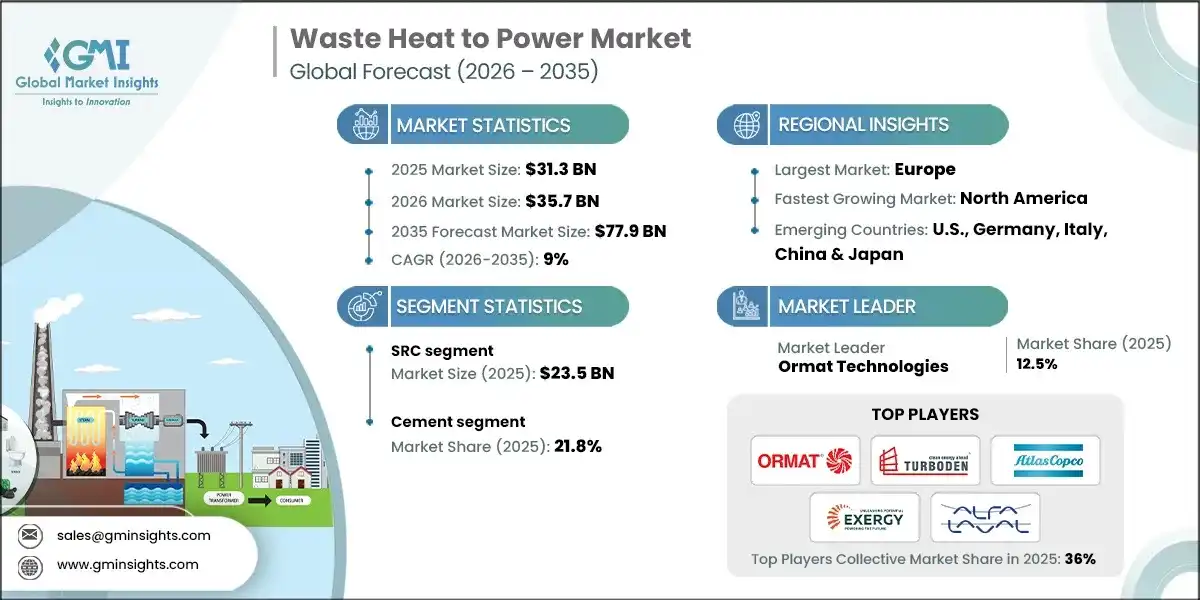
According to a recent study by Global Market Insights Inc., the waste heat to power market was estimated at USD 31.3 billion in 2025. The market is expected to grow from USD 35.7 billion in 2026 to USD 77.9 billion by 2035, at a CAGR of 9%.
Waste Heat to Power Market Key Takeaways
Market Size & Growth
- 2025 Market Size: USD 31.3 Billion
- 2026 Market Size: USD 35.7 Billion
- 2035 Forecast Market Size: USD 77.9 Billion
- CAGR (2026–2035): 9%
Key Market Drivers
- Robust growth in the manufacturing sector.
- Stringent emission norms.
- Increasing clean energy demand.
Challenges
- High initial investment and lack of grid infrastructure.
Opportunity
- Integration with renewable energy systems.
- Adoption in remote industrial sites.
- Technological advancements in working fluids.
Key Players
- Market Leader: Ormat Technologies led with over 12.5% market share in 2025.
- Leading Players: Top 5 players in this market include Ormat Technologies, Turboden, Atlas Copco, Exergy International, ALFA LAVAL, which collectively held a market share of 36% in 2025.
Get Market Insights & Growth Opportunities
- Stricter energy efficiency regulations across heavy industries are a primary growth driver for waste heat to power (WHP). Cement, steel, glass, chemicals, and pulp & paper plants all operate with high-temperature processes that dissipate large thermal losses. WHP systems convert those losses into electricity, reducing site-level energy intensity and supporting compliance with ISO 50001-style programs and corporate efficiency KPIs. As firms benchmark energy performance and face internal carbon budgets, WHP delivers measurable improvements without disrupting core production.
- For instance, in October 2025, Turboden commissioned North America’s first WHP-ORC plant in a steam-assisted gravity drainage (SAGD) facility at Strathcona Resources’ Orion site in Cold Lake, Alberta. The ~19 MW single-shaft ORC recovers low-grade heat (~150°C) previously rejected via aerial coolers and converts it into zero-emission electricity, offsetting a major share of site power while demonstrating WHP’s viability in oil sands operations.
- Corporate net-zero pledges and Scope 1/2 reduction targets are accelerating WHP adoption. Converting waste heat into electricity directly lowers on-site emissions by displacing grid or captive generation. It also complements electrification strategies by producing low-carbon power behind the meter. The technology integrates with other abatement levers, such as fuel switching, process optimization, and electrified equipment, creating a multi-pronged pathway to carbon reduction.
- Energy price uncertainty amplifies the value of self-generation from WHP assets. By harvesting otherwise wasted thermal energy, sites reduce purchased electricity and exposure to peak tariffs. This resilience is particularly important in regions with fuel import dependence or grid constraints. Even when prices soften, WHP contributes predictable, low-marginal-cost power that smooths budget variability. In multi-plant portfolios, standardized WHP deployments create enterprise-wide cost hedges and operational synergies. Over time, avoided energy costs, lower demand charges, and improved power factor can compound savings.
- For instance, in July 2025, Holcim, E.ON, and Orcan Energy launched a 10 MW waste-heat recovery project at Holcim’s Dotternhausen cement plant (Germany), extracting kiln exhaust via a high-temperature thermal-oil loop and producing process heat, district heat, and electricity through Orcan’s eP1000 ORC—delivered under an Energy-as-a-Service model.
- Cement and steel producers are prioritizing WHP as a strategic lever given their energy- and emissions-intensive profiles. In cement, preheater and clinker cooler exhausts present stable, high-grade heat suitable for ORC-based power generation. Steel plants—particularly those with continuous casting, hot rolling, and reheating furnaces—offer multiple waste heat streams. These sectors face increasing regulatory scrutiny and customer demand for low-carbon materials, making WHP valuable for reducing product emissions intensity.
- For instance, in August 2025, that Dotternhausen project was further detailed by trade outlets, emphasizing large-scale ORC for heavy industrial duty and the financing structure that removes upfront capex for the plant—illustrating replicable WHP deployment pathways for cement decarbonization.
- The chemicals and oil & gas value chain features numerous high-temperature processes, crackers, reformers, distillation columns, and flares, that yield substantial waste heat. WHP systems can capture energy from process gas coolers, furnace exhausts, and fluid catalytic cracking units. Integration benefits include improved energy balance, reduced cooling loads, and enhanced heat recovery networks. As refineries pursue energy efficiency and carbon intensity reduction, WHP complements cogeneration and heat exchanger retrofits.
To get key market trends
Waste Heat to Power Market Trends
- Beyond heavy metals and cement, WHP is gaining traction in glass, pulp & paper, ceramics, and food processing. Glass furnaces produce consistent high-temperature exhaust suitable for ORC. Pulp & paper plants can utilize recovery boilers and dryer sections to reclaim heat, improving energy self-sufficiency. Ceramics kilns and continuous ovens generate steady heat profiles amenable to modular WHP units. In food processing, pasteurization and baking lines provide lower-grade heat but still meaningful output with right-sizing.
- Data centers present growing opportunities to repurpose server waste heat. While much of this heat is lower-grade, advancements in heat pumps, optimized heat exchangers, and hybrid systems enable heat-to-power in specific configurations, especially when co-located with industrial loads or district heating networks. As operators adopt liquid cooling and raise return temperatures, the thermodynamic potential increases. Integrating WHP can complement energy reuse effectiveness (ERE) metrics and bolster sustainability reporting.
- For reference, in August 2025, the Chinese Academy of Sciences published an optimized ORC design for recovering low-grade waste heat from the CFETR fusion test reactor, demonstrating improved thermal efficiency and a blueprint to integrate WHP into advanced research facilities.
- Sites with CHP or cogeneration assets benefit from WHP by further cascading thermal energy use. After primary heat delivery to process or heating loads, remaining exhaust can feed WHP systems to generate additional electricity. This multi-stage utilization improves overall system efficiency and reduces emissions per unit of output. WHP also helps balance seasonal demand shifts by converting surplus heat into power when space heating needs are low.
- For citation, in January–July 2025, Exergy International joined the EU Horizon “EMPOWER” project to develop next-generation ORC with two-phase expansion turbines for <150°C waste-heat and geothermal sources, and separately won an EPC revamp for a 5-MWe ORC at Ribeira Grande (Azores)—advancing WHP across steel/cement pilots and geothermal repowering.
- WHP aligns well with district heating/cooling networks and industrial parks that share thermal resources. Captured heat can be converted to power on-site or sold as thermal energy to nearby facilities, with WHP providing flexible electricity when thermal demand dips. Park-level energy management, using shared pipelines, substations, and control systems, reduces capex per participant and supports economies of scale. Anchor tenants with steady waste heat profiles make projects bankable, while co-location de-risks integration.
- Supportive policies, such as energy efficiency credits, tax incentives, carbon pricing, and emissions trading, improve WHP economics. Carbon costs raise the value of avoided emissions, while energy efficiency programs offer grants or certificates for verified performance. Industrial decarbonization funds and green public procurement criteria further encourage projects. In some jurisdictions, WHP qualifies for renewable or low-carbon electricity labels when displacing fossil-based power.
- For illustration, in 2025, multiple market trackers reported rising ORC/WHP order pipelines across North America, Europe, and APAC, driven by industrial decarbonization mandates, volatile power prices, and supportive policies (e.g., IRA in the U.S., EU efficiency programs), with projections of strong growth into the 2030s.
Waste Heat to Power Market Analysis
Learn more about the key segments shaping this market
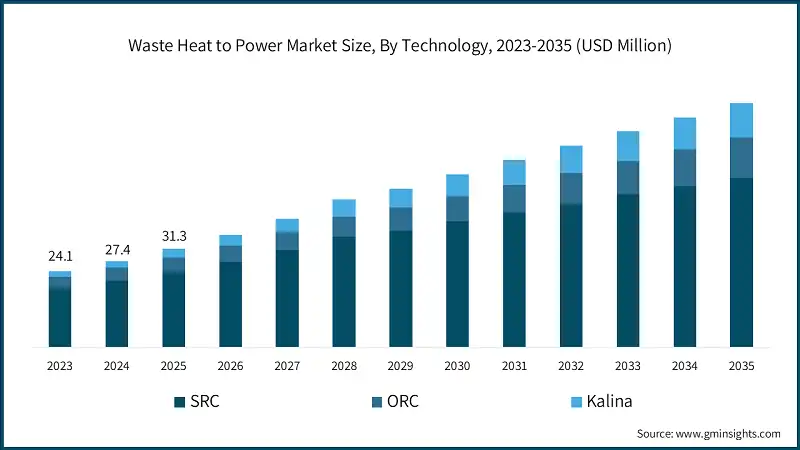
- Based on technology, the industry is segmented into SRC, ORC, and Kalina. The SRC waste heat to power market reached around USD 23.5 billion in 2025 and is projected to grow at a growth rate of over 7.5% through 2035.
- The Steam Rankine Cycle continues to see adoption in waste heat to power applications where high-temperature heat sources are readily available, particularly in cement, steel, petrochemical, and large power generation facilities. Its long-standing operational history, proven turbine technology, and familiarity among plant operators make SRC a preferred option for established heavy industries.
- Growth in SRC adoption is further supported by its suitability for large-scale industrial installations and its compatibility with existing boiler and steam infrastructure. Facilities seeking to retrofit waste heat recovery units often favor SRC systems due to available technical expertise, standardized components, and well-understood performance characteristics. Additionally, regulatory pressure to improve energy efficiency in energy-intensive industries encourages the deployment of SRC-based waste heat recovery where water availability and operational complexity are manageable.
- The Organic Rankine Cycle is experiencing strong growth as industries increasingly target low-to-medium temperature waste heat recovery opportunities that are unsuitable for steam-based systems. ORC technology uses organic working fluids with lower boiling points, enabling efficient power generation from previously unutilized heat sources across manufacturing, oil & gas, chemicals, and biomass applications. Its ability to operate efficiently under fluctuating heat loads makes ORC particularly attractive for industrial processes with variable operating conditions, expanding its relevance across diverse industrial environments.
- For illustration, in October 2025, Turboden successfully deployed a 19 MW Organic Rankine Cycle (ORC) system at Strathcona Resources’ Orion steam-assisted gravity drainage facility in Alberta, Canada. The installation captures low-temperature waste heat generated during SAGD operations and converts it into low-carbon electricity, significantly reducing reliance on grid power.
- Furthermore, growth of ORC systems is driven by their modularity, minimal water requirements, and lower operational complexity compared to steam systems. These characteristics make ORC well-suited for decentralized, off-grid, and brownfield installations, especially in regions with limited grid access or water scarcity. Continuous advances in working fluids, turbine design, and digital system optimization are improving ORC efficiency and economics, strengthening its position as a scalable and flexible solution aligned with industrial decarbonization and energy efficiency objectives.
- The kalina segment is set to exceed USD 11 billion by 2035. The Kalina Cycle is gaining attention in waste heat to power markets where improved thermodynamic efficiency is required across varying temperature profiles. By utilizing an ammonia-water working fluid mixture, Kalina systems can better match heat source temperature gradients, enabling higher energy recovery from medium-temperature industrial waste heat. This flexibility supports its use in specialized applications such as geothermal plants, chemical processing facilities, and combined cycle power plants seeking enhanced performance over conventional Rankine-based technologies.
- In applications where efficiency gains justify higher system complexity, Kalina technology offers a compelling alternative by improving conversion efficiency and reducing thermal losses. Ongoing system optimization efforts, coupled with stricter efficiency expectations in industrial and utility sectors, are supporting selective adoption. While deployment remains niche, these factors are strengthening the Kalina Cycle’s role in advanced waste heat to power applications.
Learn more about the key segments shaping this market
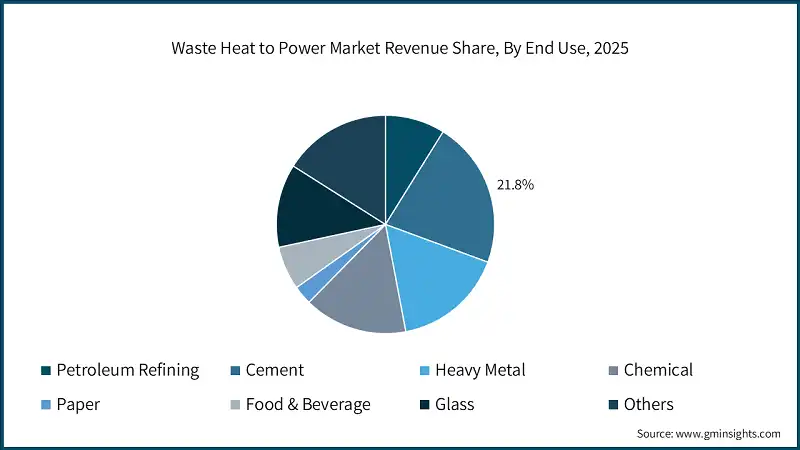
- Based on application, the market is segmented into petroleum refining, cement, paper, glass, chemical, food & beverage, and others. The cement application across the waste heat to power market holds a share of 21.8% in 2025 and is projected to grow at a growth rate of over 8.5% through 2035.
- Refineries operate at elevated temperatures and run continuously, creating stable waste heat profiles suitable for power generation. Rising energy costs and decarbonization pressure are encouraging refiners to convert exhaust heat into electricity to reduce grid dependence and fuel consumption. Additionally, stricter emission regulations and ESG commitments are pushing refineries to improve overall energy efficiency, positioning waste heat to power as a strategic solution for operational optimization.
- Growing regulatory scrutiny on emissions and rising electricity prices are accelerating the adoption of waste heat to power systems in cement plants. These systems enable manufacturers to recover otherwise lost thermal energy and generate on-site electricity, improving energy self-sufficiency. Cement producers are also under pressure to improve sustainability credentials and reduce Scope 2 emissions, making waste heat recovery an increasingly attractive investment to support long-term decarbonization and regulatory compliance strategies.
- Expanding paper production in packaging and hygiene segments is increasing energy demand and heat losses across facilities. Waste heat to power solutions allow paper manufacturers to improve energy utilization by converting low-to-medium temperature heat into electricity. This supports cost reduction objectives while minimizing reliance on external power sources. Additionally, sustainability initiatives and corporate carbon reduction goals are encouraging paper mills to invest in energy recovery technologies that enhance efficiency without disrupting core production processes.
- Glass manufacturing relies on high-temperature furnaces that operate continuously, releasing large amounts of thermal energy through exhaust gases. Rising demand for container, flat, and specialty glass products is increasing energy intensity across the sector. Waste heat to power systems help glass manufacturers recover furnace heat to generate electricity, reducing operational costs and improving overall energy efficiency. Growing pressure to lower carbon emissions and improve environmental performance is further supporting adoption.
- Chemical manufacturing involves diverse energy-intensive processes that generate substantial waste heat across reactors, distillation columns, and thermal separation units. Increasing production of specialty and performance chemicals is resulting in higher energy consumption and heat losses. Waste heat to power solutions enable chemical producers to convert excess thermal energy into usable electricity, improving plant efficiency and resilience. In addition, regulatory pressure to reduce emissions and comply with energy efficiency standards is driving interest in heat recovery technologies.
- Expanding demand for processed foods, beverages, and cold-chain products is increasing energy requirements within the industry. Waste heat to power systems offer food processors an opportunity to improve energy efficiency by converting process heat into electricity, supporting lower operating costs. Sustainability commitments, along with increasing scrutiny on energy use and emissions, are encouraging adoption of recovery technologies that operate reliably within hygiene-sensitive environments, making waste heat to power a valuable efficiency solution.
Looking for region specific data?
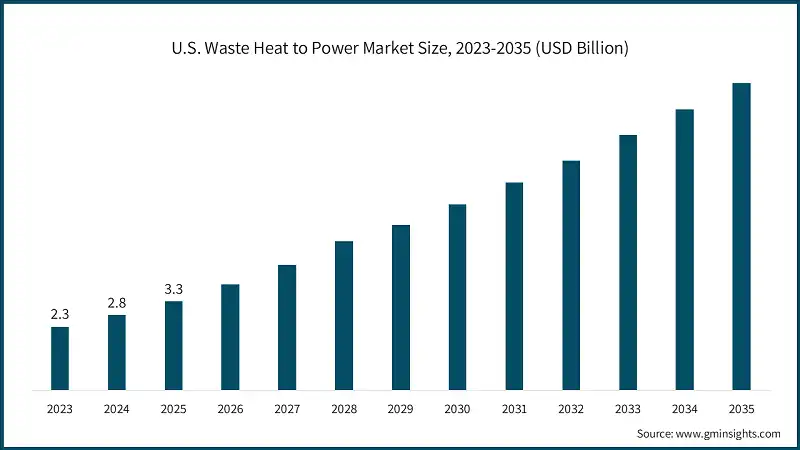
- The U.S. dominated the waste heat to power market in North America with around 70% share in 2025 and generated USD 3.3 billion in revenue. Energy-intensive sectors such as petroleum refining, cement, chemicals, steel, food processing, and oil & gas generate significant waste heat that can be economically converted into on-site electricity, reducing grid dependence. Growing adoption of Organic Rankine Cycle systems reflects their suitability for diverse temperature profiles and retrofitting of existing industrial facilities. Incentives under clean energy and emissions-reduction frameworks, along with rising electricity costs and ESG reporting requirements, are accelerating interest in waste heat recovery as a reliable distributed power generation and sustainability solution.
- The North America waste heat to power market is projected to reach USD 14.8 billion by 2035, driven by rising industrial energy efficiency targets, decarbonization commitments, and supportive policy frameworks. Energy-intensive industries such as oil & gas, refining, chemicals, cement, and manufacturing are under increasing pressure to reduce emissions and operating costs while maintaining productivity. The region’s aging industrial infrastructure provides significant retrofit opportunities for waste heat recovery solutions, particularly ORC systems.
- For reference, in July, 2024, Eldec has designated LINK Induction LLC, headquartered in Bloomfield Hills, Michigan, as its exclusive sales and service representative for the United States, Canada, and Mexico. This appointment enhances Eldec’s commercial reach and customer support capabilities across the North American market.
- Europe represents a mature and regulation-driven market for waste heat to power solutions, supported by stringent emissions standards and ambitious climate neutrality goals. Industrial sectors such as cement, steel, glass, and chemicals are actively pursuing waste heat recovery to meet energy efficiency and carbon reduction mandates. Strong policy support, including energy efficiency directives and funding mechanisms, accelerates deployment of ORC and other waste heat technologies.
- The Asia Pacific waste heat to power market accounts for about 35% of market share in 2025. Asia Pacific is emerging as a high-growth region for waste heat to power systems due to rapid industrialization, expanding manufacturing bases, and increasing electricity demand. Countries across the region are investing heavily in cement, steel, chemicals, and refining capacity, generating substantial volumes of industrial waste heat. Growing awareness of energy efficiency, coupled with government initiatives to reduce industrial emissions, is strengthening demand for waste heat recovery technologies.
- The Middle East & Africa waste heat to power market is set to grow at a rate of over 7.5% by 2035. The Middle East & Africa market is gaining momentum as industries seek to optimize energy use amid rising sustainability expectations and diversification efforts. Energy-intensive sectors such as oil & gas, refining, petrochemicals, cement, and metals generate abundant waste heat suitable for power recovery. Governments in the region are increasingly prioritizing industrial efficiency, emissions reduction, and reduced reliance on primary fuel consumption.
- Latin America’s waste heat to power market growth is supported by expanding industrial activity, rising energy costs, and increasing focus on sustainable development. Cement, food & beverage, mining, refining, and chemicals industries generate continuous waste heat streams that create opportunities for energy recovery. Many countries in the region face grid stability challenges, encouraging industries to invest in on-site power generation solutions.
Waste Heat to Power Market Share
- The waste heat to power industry shows moderate consolidation, with Ormat Technologies, Turboden, Atlas Copco, Exergy International, and Alfa Laval collectively accounting for around 36% market share of industry activity in 2025.
- Ormat Technologies stands out as a prominent player in the waste heat to power landscape, drawing on its long history in geothermal and recovered energy solutions. The company emphasizes the development of high-efficiency ORC systems engineered for industrial waste heat applications. Its modular approach allows flexible deployment across diverse industrial sectors such as oil & gas, cement, and manufacturing, supporting scalable integration and long-term operational reliability.
- Turboden is a specialized provider of waste heat to power technologies, recognized for its strong engineering capabilities and tailored ORC solutions. The company focuses on converting low-and medium-temperature waste heat into electricity across industrial, biomass, and geothermal applications. Turboden’s systems are designed for durability and high performance in demanding industrial settings, reinforcing its position as a preferred partner for heavy-duty waste heat recovery projects.
- Atlas Copco has expanded its industrial energy solutions portfolio to include waste heat to power technologies, leveraging its broad mechanical and process engineering expertise. The company delivers integrated ORC-based solutions that support energy efficiency improvements and emission reduction goals for industrial customers.
- Exergy International is widely recognized for its advanced ORC systems featuring patented radial-outflow turbine technology, which enhances energy conversion efficiency under challenging operating conditions. The company provides customized waste heat to power solutions for sectors such as cement, steel, and glass manufacturing. Exergy’s competitive strength lies in its ability to adapt systems to varying temperature and pressure profiles, supported by strong engineering capabilities and comprehensive project execution expertise.
- Alfa Laval plays a key role in the waste heat to power market by combining its extensive heat transfer expertise with ORC-based energy recovery solutions. The company focuses on maximizing system efficiency through advanced heat exchanger technologies and robust thermal engineering. Alfa Laval’s solutions are applied across industrial and marine environments, helping customers improve energy utilization, reduce emissions, and enhance overall system reliability.
Waste Heat to Power Market Companies
Major players operating in the waste heat to power industry are:
- AC Boiler SpA
- ALFA LAVAL
- Atlas Copco
- Aura GmbH & CO. KG
- Climeon
- Cochran Ltd.
- Dürr Group
- Exergy International Srl
- Forbes Marshall
- General Electric
- IHI Corporation
- Mitsubishi Heavy Industries, Ltd.
- Ormat Technologies
- Rentech Boiler System
- Siemens Energy
- Thermax Ltd
- Turboden
- Walchandnagar Industries Limited (WIL)
- Ormat Technologies reported revenue from operations of USD 249.7 million for the third quarter ended September 30, 2025, reflecting a 17.9% year-over-year increase. During the same period, the company achieved an operating income of USD 40.4 million, representing a 13.3% rise, while net income attributable to stockholders reached USD 24.1 million, up 9.3% year over year. This financial performance highlights Ormat’s sustained growth momentum, supported by expanding product and storage operations and the company’s ability to navigate ongoing market challenges.
- Turboden generated revenue of approximately USD 79 million in 2023, while updated financial figures for 2025 have not been publicly disclosed. The company is widely regarded for its strong engineering capabilities and specialization in delivering customized ORC solutions for industrial waste heat recovery applications. Turboden’s competitive positioning is reinforced by its emphasis on high-efficiency system design and the use of digital monitoring technologies, which improve operational reliability, optimize performance, and help lower long-term operating and maintenance costs.
- Alfa Laval reported revenue of USD 1.67 billion for the third quarter of 2025, indicating continued growth across its thermal management and energy recovery business lines. Within the ORC waste heat to power segment, the company leverages its deep expertise in heat transfer technologies by integrating advanced ORC systems into industrial applications. This approach enables Alfa Laval to deliver reliable, energy-efficient waste heat recovery solutions tailored to the needs of energy-intensive industries.
Waste Heat to Power Market Report Attributes
| Key Takeaway | Details |
|---|---|
| Market Size & Growth | |
| Base Year | 2025 |
| Market Size in 2025 | USD 31.3 Billion |
| Market Size in 2026 | USD 35.7 Billion |
| Forecast Period 2026-2035 CAGR | 9% |
| Market Size in 2035 | USD 77.9 Billion |
| Key Market Trends | |
| Drivers | Impact |
| Robust growth in the manufacturing sector | The continued expansion of global manufacturing activities is resulting in higher levels of industrial process heat losses across energy-intensive sectors. |
| Stringent emission norms | Stricter environmental and emissions regulations across major industrial regions are compelling companies to prioritize waste heat recovery solutions. |
| Increasing clean energy demand | The rising emphasis on renewable energy integration and long-term sustainability is further driving the adoption of ORC systems. |
| Pitfalls & Challenges | Impact |
| High initial investment and lack of grid infrastructure | High upfront capital costs and inadequate grid infrastructure constrain wider waste heat to power adoption, particularly in industrial and remote locations. |
| Opportunities: | Impact |
| Integration with renewable energy systems | Waste heat to power systems can be integrated with solar and geothermal energy systems to provide stable, continuous power output while enhancing overall renewable energy efficiency. |
| Adoption in remote industrial sites | Modular waste heat to power systems deliver dependable electricity for off‑grid sites, lowering diesel reliance and enabling more sustainable industrial operations. |
| Technological advancements in working fluids | Advancements in low‑boiling working fluids and supercritical CO₂ cycles are improving waste heat to power efficiency, enabling viable applications in low‑temperature heat recovery markets. |
| Market Leaders (2025) | |
| Market Leaders |
12.5% market share |
| Top Players |
|
| Competitive Edge |
|
| Regional Insights | |
| Largest Market | Europe |
| Fastest Growing Market | North America |
| Emerging Country | U.S., Germany, Italy, China & Japan |
| Future Outlook |
|
What are the growth opportunities in this market?
Waste Heat to Power Industry News
- In October 2025, Clean Energy Technologies, Inc. announced the successful installation of its Clean Cycle II Organic Rankine Cycle system at an industrial facility in Martin, Tennessee, operated by a Fortune 100 manufacturer. The project represents one of the earliest examples of large-scale industrial waste heat to power deployment within the U.S. manufacturing sector, converting previously unused process heat into clean, on-site electricity.
- In October 2025, Turboden America LLC reported that it had secured contracts to deliver three Generation 2 ORC units with a combined capacity of 180 MW for Phase II of Fervo Energy’s Cape Station geothermal development in Utah. This award builds on Turboden’s earlier involvement in Phase I of the project and highlights the company’s growing role in supporting large scale enhanced geothermal system deployment across North America.
- In September 2022, Mitsubishi Heavy Industries announced the development of a binary power generation system based on organic rankine cycle technology. This system recovers waste heat from the sulphur free fuel burning engines and further converts it into usable energy. The lineup includes three models with rated output ranging from 200 kW to 700 KW, suitable for powering a range of vessel types.
- In September 2021, Dürr Group and Uniper SE collectively developed a waste heat solution that offers customers waste heat utilization solutions. Both companies exhibit immense potential when it comes to reducing energy consumption and driving decarbonization. The processed heat as a result of the decarbonization of the industrial sector is used to effect two-thirds of primary energy consumption.
The waste heat to power market research report includes in-depth coverage of the industry with estimates & forecast in terms of volume & revenue (MW & USD Million) from 2022 to 2035, for the following segments:
Market, By Technology
- SRC
- ORC
- Kalina
Market, By Application
- Petroleum Refining
- Cement
- Heavy Metal
- Chemical
- Paper
- Food & Beverage
- Glass
- Others
The above information has been provided for the following regions & countries:
- North America
- U.S.
- Canada
- Mexico
- Europe
- Germany
- UK
- Italy
- France
- Belgium
- Spain
- Russia
- Asia Pacific
- China
- Australia
- India
- Japan
- South Korea
- Middle East & Africa
- Saudi Arabia
- UAE
- South Africa
- Latin America
- Brazil
- Argentina
Frequently Asked Question(FAQ) :
What is the market size of the waste heat to power in 2025?
The market size was USD 31.3 billion in 2025, with a CAGR of 9% expected through 2035, driven by stricter energy efficiency regulations across heavy industries.
What is the projected value of the waste heat to power market by 2035?
The waste heat to power market is expected to reach USD 77.9 billion by 2035, propelled by advancements in energy recovery technologies and increasing adoption in heavy industries.
What is the current waste heat to power industry size in 2026?
The market size is projected to reach USD 35.7 billion in 2026.
How much revenue did the SRC segment generate in 2025?
The SRC segment generated approximately USD 23.5 billion in 2025, leading the market with its widespread adoption in high-temperature industrial applications.
What was the valuation of the Kalina segment in 2025?
The Kalina segment was valued at USD 11 billion by 2035, driven by its ability to enhance thermodynamic efficiency and energy recovery in medium-temperature industrial waste heat applications.
What is the growth outlook for the cement application from 2026 to 2035?
The cement application is projected to grow at a CAGR of over 8.5% through 2035, supported by increasing adoption of waste heat recovery systems to improve energy efficiency.
Which country leads the North American waste heat to power market?
The United States led the North American market with a 70% share, generating USD 3.3 billion in revenue in 2025. Its dominance is attributed to energy-intensive industries and supportive clean energy policies.
Who are the key players in the waste heat to power market?
Key players include AC Boiler SpA, ALFA LAVAL, Atlas Copco, Aura GmbH & CO. KG, Climeon, Cochran Ltd., Dürr Group, Exergy International Srl, Forbes Marshall, General Electric, IHI Corporation, Mitsubishi Heavy Industries, Ltd., Ormat Technologies, Rentech Boiler System, Siemens Energy, Thermax Ltd, Turboden, and Walchandnagar Industries Limited (WIL).
Waste Heat to Power Market Scope
Related Reports