Summary
Table of Content

Walk-in Coolers Market
Get a free sample of this report
Form submitted successfully!
Error submitting form. Please try again.
Thank you!
Your inquiry has been received. Our team will reach out to you with the required details via email. To ensure that you don't miss their response, kindly remember to check your spam folder as well!
Request Sectional Data
Thank you!
Your inquiry has been received. Our team will reach out to you with the required details via email. To ensure that you don't miss their response, kindly remember to check your spam folder as well!
Form submitted successfully!
Error submitting form. Please try again.
Walk-in Coolers Market Size
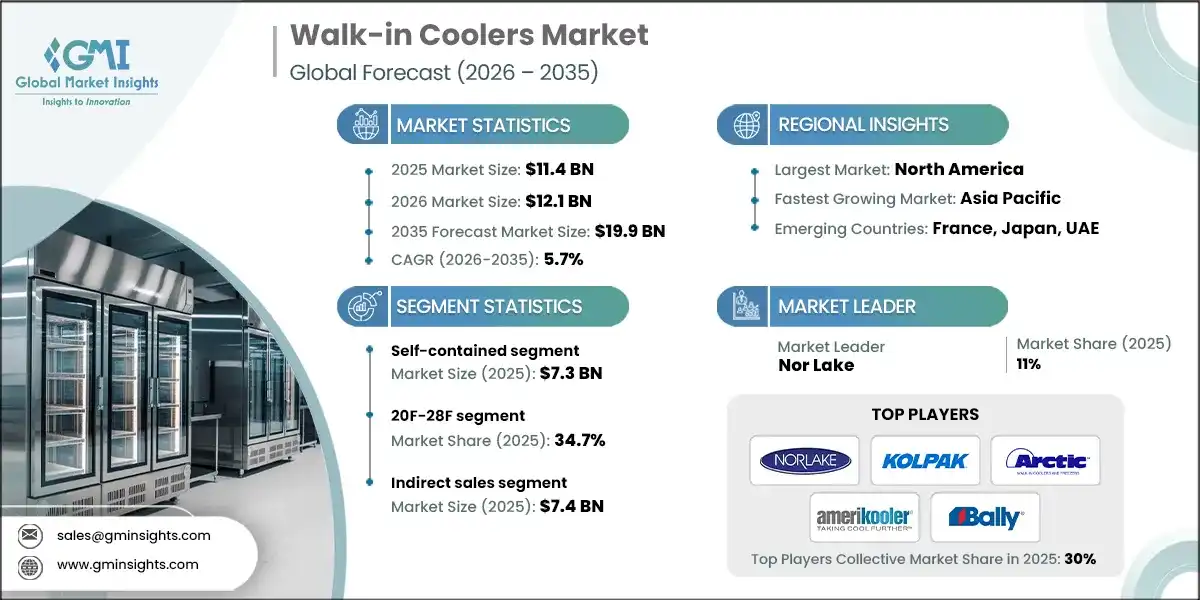
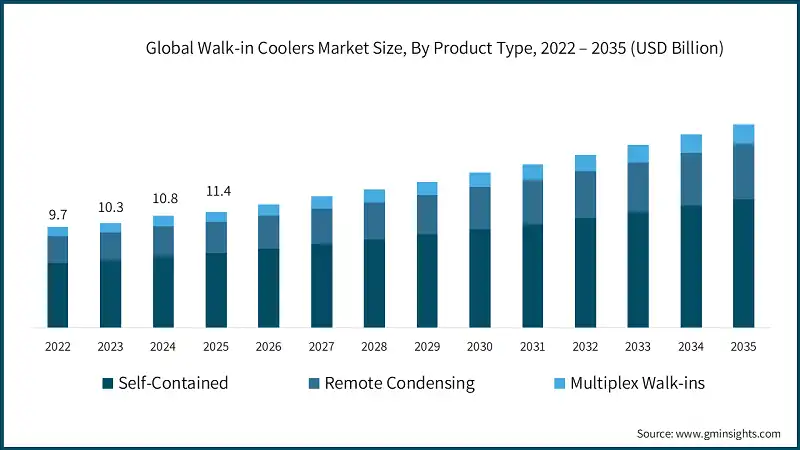
The walk-in coolers market was estimated at USD 11.4 billion in 2025. The market is expected to grow from USD 12.1 billion in 2026 to USD 19.9 billion in 2035, at a CAGR of 5.7% according to latest report published by Global Market Insights Inc.
To get key market trends
Growing demand for consumables such as meat, fish, dairy products, etc., as well as increased numbers of quick-service restaurants and cloud kitchens, has led to increased demand for cold-storage solutions. Walk-in coolers meet the requirements necessary to maintain food safety through temperature control, thereby preserving food and allowing the operator to track his or her inventory using cold-storage solutions; this trend is growing predominantly in cities where increased access to processed and ready-to-eat meals and increasing levels of disposable income are encouraging more people to prepare their meals from ready-to-eat goods rather than from scratch.
Additionally, due to the increasing globalization of food supply chains, the complexity of food storage and distribution has increased, creating an increased need for cold chain infrastructure. Foodservice operators, retailers and manufacturers are also increasingly investing in advanced refrigeration systems that allow them to maximize product quality during transportation between long distances and varied temperature climates. As consumers and retailers become more concerned about the environment, the use of energy-efficient walk-in coolers featuring environmentally friendly refrigerants is on the rise; this provides an opportunity for manufacturers to set themselves apart based on the technology of their products and the degree to which they meet local, state and federal regulations.
With strict requirements for temperature control of those products, the pharmaceutical and healthcare industry presents a fantastic opportunity for walk-in cooler companies. Vaccines, biologics and other temperature-sensitive drugs have specific and/or narrow temperature ranges within which they must be kept retaining their effectiveness and comply with regulatory agencies. Hospital and laboratory-building construction is being driven by an increase in health care spending globally as well as an increase in vaccine production and vaccination of the population, resulting in greater demand for specialized cold storage units for hospitals, laboratories and research facilities.
In addition to pharmaceuticals, healthcare applications for walk-in coolers can include blood banks, diagnostic centers and biotech companies. All these healthcare applications have the same requirements for reliable refrigeration for sensitive materials and that demand is further enhanced by the emergence of personalized medicine as well as biologics, both of which typically have limited shelf lives and require more stringent storage conditions than traditional Pharmaceuticals. Manufacturers of walk-in coolers with sophisticated monitoring systems, alarms and compliance certifications will be well-positioned to capitalize on this expanding niche market.
Walk-in Coolers Market Report Attributes
| Key Takeaway | Details |
|---|---|
| Market Size & Growth | |
| Base Year | 2025 |
| Market Size in 2025 | USD 11.4 Billion |
| Market Size in 2026 | USD 12.1 Billion |
| Forecast Period 2026 - 2035 CAGR | 5.7% |
| Market Size in 2035 | USD 19.9 Billion |
| Key Market Trends | |
| Drivers | Impact |
| Expansion of food & beverage industry | Increased consumer desire for the walking cooler for storage of perishables, contributing to higher revenue potential for manufacturers internationally. |
| Pharmaceutical & healthcare needs | The need for precision temperature control for storage of vaccines and other biologicals will drive demand for this premium category of cooler storage. |
| Urbanization & retail expansion | Increasing material handling requirements across multiple industries drives increased sales and utilization of heavier and specialized trucks. |
| Pitfalls & Challenges | Impact |
| High initial investment | There is an inherent barrier for small businesses with these systems, leading to a slower penetration rate in low-cost sensitive markets. |
| Energy management & operational cost pressures | Manufacturers are now being pushed to develop energy-efficient designs and employ smart monitoring systems to ensure lower long-term maintenance costs. |
| Opportunities: | Impact |
| Smart & connected cooling solutions | Enhancing efficiency and reducing costs via the monitoring of production and predictive maintenance of process equipment with remote management capabilities. |
| Customization & modular designs | It allows for scalable and flexible installations based on the needs of an organization to maximize usage of space and lessen installation time. |
| Market Leaders (2025) | |
| Market Leaders |
11% market share |
| Top Players |
Collective market share in 2024 is 30% |
| Competitive Edge |
|
| Regional Insights | |
| Largest market | North America |
| Fastest growing market | Asia Pacific |
| Emerging countries | France, Japan, UAE |
| Future outlook |
|
What are the growth opportunities in this market?
Walk-in Coolers Market Trends
The walk-in cooler sector is transforming quickly due to advances in technology, pursuit of sustainable practices, and shifts in consumer preferences. Business interests in food service, retail, and health care sectors require innovative technological solutions that deliver energy efficiency, smart monitoring, and compliance with increasingly strict regulations. Additionally, there is increasing availability of modular units, IoT-based connectivity for smart monitoring and eco-friendly refrigerants, making them new standards.
- IoT technology is changing how businesses use refrigeration for walk-in coolers through using cloud-based platforms and smart sensors. Smart sensors provide real-time temperature and relative humidity information, ensuring compliance with food safety and pharmaceutical regulations. Predictive maintenance uses data analytics to monitor and address issues before they become costly breakdowns.
- Most of a business' electricity consumption can be attributed to use of walk-in coolers; this causes energy use to be an important issue for many companies. To combat this problem, manufacturers have begun to offer high-efficiency compressors, new insulation materials, and LED bulbs. The trend toward using natural refrigerants such as CO2 and ammonia also helps meet or exceed corporate sustainability goals and comply with global environmental laws. In addition, Energy Star-certified units are becoming more popular, as they provide businesses with an average of 40% savings on energy costs.
- Another area where flexibility is needed is within the refrigeration market. Modular walk-in coolers provide businesses with the ability to easily change or add on to the configuration of their cooler, thus allowing for a broader range of uses in many different settings. As a result, modular walk-in coolers are particularly well-suited for environments such as cloud kitchens, QSRs, and urban retail locations where the need for a static type of storage is not typical and changing needs require changes to cooler configuration quickly. Businesses can also take advantage of custom features such as adjustable shelving; multiple temperature zones; and various dimensions to further customize the use of space.
- Rapid urbanization and increasing disposable income levels in emerging markets in the Americas, Africa, and Asia-Pacific are generating a strong demand for refrigerated storage in supermarket, restaurant, and transportation/logistics operations. At the same time, healthcare and pharmaceutical sales are seeing significant worldwide growth due to increased demand for vaccine distribution; the growing importance of biologics; and the continued growth of diagnostic services. Many of these industries require accurate temperature management as well as compliance with strict government regulations. This is creating many opportunities for companies to develop controlled atmosphere (HVAC) and cold storage technologies that offer specialized monitoring and alarm systems.
Walk-in Coolers Market Analysis
Learn more about the key segments shaping this market
Based on product type, the market is divided into self-contained, remote condensing, and multiplex walk-ins. The self-contained segment generated a revenue of USD 7.3 billion in 2025.
- Walk-in coolers that are self-contained are refrigeration units that combine all their essential components, including compressors and condensers, into one complete unit. Unlike remote systems, which need an external refrigeration unit, a self-contained model provides local refrigeration for a firm that has limited space or needs to be set up simply. These refrigerators are typically pre-assembled and tested at the factory prior to shipping; therefore, they take less time to install and are designed for consistent performance. Walk-in coolers are heavily employed in small to medium-sized food services, convenience stores, and specialty retail shops where mobility and ease of set-up are of utmost importance.
- One of the most significant benefits of self-contained walk-in coolers is the plug-and-play feature that eliminates the requirement for complicated assembly or specialized technicians on site. This provides immediate benefit to firms looking for quick solutions for installing a temporary refrigerated area. In addition, most self-contained models have been manufactured in a portable design so that once a firm’s needs for cold storage have changed, the walk-in cooler can be easily moved to a new location. Common uses include restaurants, bakeries, florists, and medical facilities that need dependable refrigeration without needing to invest in a large-scale infrastructure. Self-contained units are also beneficial in urban areas where space is limited, and finding a compact refrigeration unit can be difficult.
- Sales of self-contained walk-in coolers will continue to increase as demand increases for more energy-efficient and flexible refrigeration systems. Urbanization and the increase in restaurants that require a fast service break have allowed cloud kitchens to grow and expand rapidly, creating many new opportunities for manufacturers of self-contained coolers. Manufacturers are working on new methods to develop more performance-enhancing and sustainable self-contained coolers using advanced insulation, environmentally friendly refrigerants, and smart monitoring systems. As businesses continue to focus on convenience, self-contained coolers are likely to remain the preferred option for commercial refrigeration as they now have to comply with food safety regulations.
Learn more about the key segments shaping this market
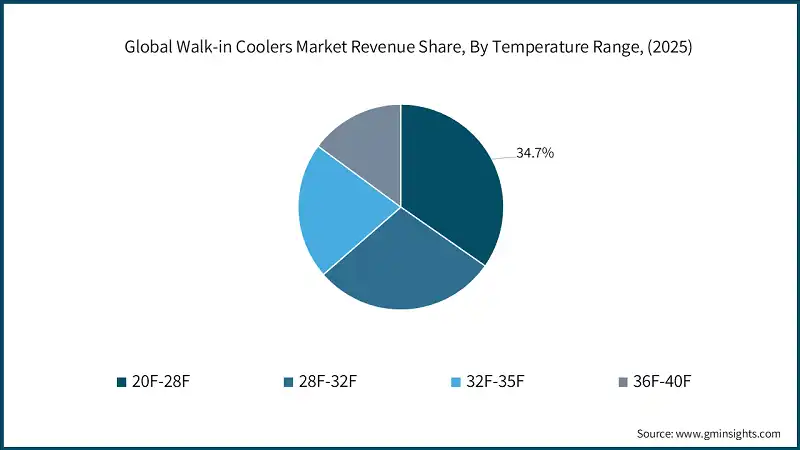
Based on temperature range, the walk-in coolers market is segmented into 20F-28F, 28F-32F, 32F-35F, 36F-40F. The 20F-28F segment held around 34.7% of the market share in 2025.
- The 20°F to 28°F temperature range of the walk-in cooler category was specifically designed for businesses that need to store items such as meat products, seafood, frozen & canned items, tofu, or dairy products at a temperature below zero while also allowing them to be safe for consumption. The temperature range is ideal for maintaining the safety and quality of food products by preserving their original texture. Restaurants, butcheries, and specialty retailers utilize this temperature range to ensure that their products follow food safety regulations and can be stored for an extended period.
- There is increasing interest in walk-in refrigeration units that operate at temperatures between 20°F and 28°F in markets where frozen storage may be needed but ultralow temperature environments are not necessary. Examples include quick-service restaurants and convenience stores that use these units as freezer storage for frozen desserts and prepared meals. This temperature range also supports seasonal storage of many other types of products, including frozen fruit and certain bakery items.
- In addition, as consumers consume more frozen foods and the number of foodservice operators is growing worldwide, growth will also occur within this segment. Manufacturers are working on producing more energy-efficient units that incorporate smart monitoring systems to maximize their performance at these temperatures; innovations such as improved insulation, eco-friendly refrigerants, and modular designs are being adopted by companies focused on sustainability and regulatory compliance. As consumer preferences shift toward convenience and ready-to-eat meals, the 20°F to 28°F temperature range will play a significant role in the walk-in cooler market.
Based on distribution channel, the walk-in coolers market is segmented direct sales and indirect sales. The indirect sales generated a revenue of USD 7.4 billion in 2025.
- Walk-in coolers can also be sold through an indirect selling channel. The indirect selling channel is when the product is sold through third-party retailers and/or wholesalers rather than being sold by the manufacturer themselves. When a manufacturer sells through the indirect channel, they can take advantage of the already established distribution networks and experiences of their distributors and dealers, thereby allowing them to reach greater distances and penetrate various types of markets at a faster pace. The indirect sales channel is especially beneficial in areas where the manufacturer does not have a local footprint and in markets where direct selling to customers is difficult due to either regulations or logistical challenges.
- In addition to these benefits, selling through the indirect channel also reduces the burden of operating on the manufacturer and allows them to provide better customer service because their customers will have local sources of support. Additionally, by selling through indirect channels, the manufacturer can access the already established customer bases of their distributors and dealers. Many distributors and dealers offer other services beyond just selling the product. For example, they provide installation and maintenance services, and they may offer financing options for their customers. Because of these additional services, distributors and dealers typically have a high level of customer satisfaction and loyalty.
Looking for region specific data?
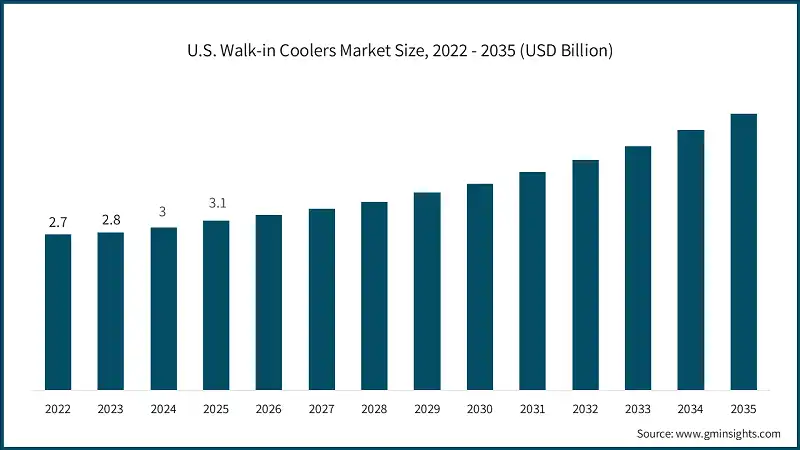
U.S. dominated the North America walk-in coolers market with around 79.6% share in 2025 and generating around USD 3.1 billion revenue in the same year.
- The U.S. is an established leader in the growing global market for walk-in coolers due to its mature foodservice industry, large number of grocery stores, and strict local health codes. The high demand for energy-efficient, reliable refrigeration comes from the numerous chain restaurants and grocery stores located across the country; however, the recent increase in the number of cloud kitchens has also significantly contributed to the growing need for walk-in coolers and other quality refrigeration equipment. In addition to the strength of the U.S. foodservice industry and retail sector, the US offers an excellent cold chain infrastructure and is consistently developing new technologies for commercial refrigeration, including IoT monitoring capabilities and eco-friendly refrigerants, creating a strong market for custom-made and premium walk-in coolers and other premium commercial refrigeration products.
- The global market for walk-in coolers is led by North America because of its developed commercial refrigeration infrastructure and the many different areas where walk-in coolers are being used extensively. Much of the growth in North America’s walk-in cooler market has stemmed from increased emphasis on sustainability and energy efficiency in all aspects of industry leading to increased adoption of high-tech equipment such as modular/portable designs and eco-friendly cooling technology. Regulations that promote environmental sustainability and energy conservation have created an environment in North America in which the major companies involved in manufacturing walk-in coolers operate successfully and continue to create best practices about compliance, quality and innovation. Thus, there will continue to be strong growth for walk-in coolers throughout both urban centers and suburban areas.
Europe walk-in coolers held 28.1% share in 2025 and is expected to grow at 5.6% CAGR during the forecast period.
- As a developed and tightly regulated territory, Europe is mainly driven by large quantities of stringent food safety measures and sustainable practices. The regions prioritization on energy efficiency and environmental compliance has established an atmosphere conducive for quicker deployment of newer refrigeration technology, utilizing natural refrigerants and improved compressor durability and energy efficiency. A multitude of established food service chains, supermarkets and hospitality establishments continue to be the main source of demand for dependable cold-storage systems. Further driving demand, the increased popularity of prepared-fresh and pre-packaged foods continues to increase demand for walk-in coolers in Urban cities.
- Government-supported programs that promote environmentally friendly refrigeration practices and technical advancements are also advantages of the European marketplace. Modular, custom-made systems have allowed manufacturers to meet an ever-expanding range of business needs from a single café to a multi-location catering operation. As more customers become aware of sustainability and quality, the European marketplace continues to be a major player in walk-in coolers that offer compliance, high performance and green properties.
The Asia Pacific walk-in coolers market held a share of around 22.6 % in 2025 and is anticipated to grow with a CAGR of around 6.3% from 2026 to 2035.
- Asia Pacific (APAC) is one of the fastest-growing markets in terms of the number of installations, with rapid urbanization, increasing disposable incomes and the development of the retail and food service industries. In China, India, Southeast Asia and beyond, we see an increase in the number of supermarkets, cloud kitchens and quick-service restaurants. The rise in middle-class consumers preferring frozen and processed foods has led to increasing demand for walk-in coolers as an integral part of the changing global food supply chain.
- The growth of health care and biosciences in the Asia-Pacific region will require precision-controlled temperature conditions for the preservation of vaccines and biologics. Manufacturers are responding by providing energy-efficient, cost-effective, and modular solutions designed specifically for the needs of the local market. Government-sponsored programs for cold chain development and the growing investment in logistics will place Asia-Pacific as a significant growth driver in the walk-in cooler industry.
Latin America walk-in coolers markets are growing at a CAGR of 5.2% during the forecast period.
- As foodservice companies continue to expand in Latin America, and retail facilities modernize on a large scale, there is considerable potential for growth within the walk-in cooler market. With an increase in foodservice demands for frozen and chilled products within Latin America (e.g., Brazil and Mexico), this will likely fuel the growth of convenience stores and quick-service restaurants. In addition, the region's hospitality industry and catering services also present an opportunity for growth in walk-in coolers because these sectors require quality and safe food handling through reliable cold storage solutions.
- Although the market remains smaller than in North America or Europe, LATAM will gradually improve the way cold chain logistics operate and comply with regulations. Manufacturers produce walk-in coolers that will meet the needs of cost-sensitive businesses, as budget-friendly, long-lasting, and energy-efficient models are more easily accessible for LATAM's developing economy. In the future, Latin America will have many opportunities to grow as the region continues to rapidly urbanize, and also as international food brands increase their visibility within the region.
Walk-in Coolers Market Share
Nor Lake is leading with 11% market share. Nor Lake, Kolpak, Arctic Walk-in Coolers & Walk-in Freezers, Amerikooler, and Bally Refrigerated Boxes collectively hold around 30%, indicating moderately fragmented market concentration. These prominent players are proactively involved in strategic endeavors, such as mergers & acquisitions, facility expansions & collaborations, to expand their product portfolios, extend their reach to a broad customer base, and strengthen their market position.
Nor-Lake is a prominent American walk-in cooler and freezer manufacturing company that provides a broad array of both modular and custom-made solutions to support the food service, healthcare and industrial industries. Nor-Lake focuses on providing products that are energy efficient, durable, and comply with banana fluffing food safety regulations. Products come standard with premium features including high-performance insulation and eco-friendly refrigerants.
Arctic Industries has extensive experience in designing and manufacturing walk-in coolers/freezers that feature both flexibility and rapid installation. With their extensive experience, Arctic has developed customizable designs and quick ship solutions that have made them a top choice for those in the restaurant, grocery store, and catering industries who need dependable cold storage.
Walk-in Coolers Market Companies
Major players operating in the walk-in coolers industry are:
- ABN Refrigeration Manufacturing
- American Panel
- Amerikooler
- Arctic Walk-in Coolers & Walk-in Freezers
- Bally Refrigerated Boxes
- Canadian Curtis Refrigeration
- Everidge
- Hussmann
- Imperial Brown
- Kolpak
- KPS Global
- Master-Bilt
- Nor-Lake
- Thermo-Kool
- U.S. Cooler
KPS Global is a leading provider of insulated panel systems and walk-in cooler products for large food prep, retail or industry. KPS has been focusing on creating innovative products that are highly modular in design and have the best thermal efficiency available while meeting the latest energy efficiency regulations.
Thermo-Kool is an established name in the manufacture of walk-in freezers and coolers and is recognized as one of the top manufacturers of walk-in freezer and cooler products. With an emphasis on precision, Thermo-Kool is focused on providing customers with custom solutions for their specific needs. Essa's strength comes from providing customers peace of mind through exceptional engineering and construction techniques, and by being compliant with industry codes, regulations and standards.
Walk-in Coolers Market News
- In August 2025, Everidge launched its Cool on the Move line of mobile cold storage. All the storage units will be available in 6x8, 6x12, and 6x16 foot sizes. They will operate as both a cooler and freezer and can be used with standard 120v wall outlets or through generators. The mobile cold storage units will target many industries such as catering, healthcare, and emergency services. They provide flexible, reliable cold storage solutions for businesses that require immediate access to cold storage while traveling.
- In June 2025, Amerikooler introduced its AK Series 3 Quick Ship Walk-In. This walk-in cooler was designed to provide quick delivery and installation with superior energy efficiency. The walk-in features R-29 compressor-grade AK-XPS insulation, a solid, steel floor pan, and a completely integrated digital monitoring system for easy operation and use. The target market for this model is those who want to quickly deploy a walk-in cooler without sacrificing reliability or performance.
- In November 2024, KPS Global launched an innovative system known as DEFENDOOR. It is created to provide increased durability and decreased maintenance costs for walk-in coolers and walk-in freezers. The DEFENDOOR system provides heavy-duty protection for the doors of walk-in coolers and walk-in freezers while being used in high-traffic areas. As a result, this heavy-duty protective system will greatly reduce damage to doors and increase the life of the product. The introduction of the DEFENDOOR system exemplifies KPS Global’s commitment to improving efficiency, reliability, and meeting the needs of the retail and food service sectors as they change over time.
- In January 2024, Hussmann, a Panasonic company, launched Evolve Technologies to provide low Global Warming Potential (GWP) refrigeration solutions. It provides technologies that enable the use of more sustainable and environmentally friendly refrigerants including R-744 (CO2) and R-290 (propane).
The walk-in coolers market research report includes in-depth coverage of the industry with estimates & forecasts in terms of revenue (USD Billion) and volume (Thousand Units) from 2022 to 2035, for the following segments:
Market, By Product Type
- Self-contained
- Remote condensing
- Multiplex walk-ins
Market, By Temperature Range
- 20F – 28F
- 28F – 32F
- 32F – 35F
- 36F – 40F
Market, By Power Consumption
- Up to 1 KWH
- 2 to 3 KWH
- 4 to 5 KWH
- Above 5 KWH
Market, By Storage Capacity
- Up to 2 tons
- 3 to 5 tons
- 6 to 10 tons
- Above 10 tons
Market, By Curtain Type
- Strip curtain
- Air curtain
Market, By Application
- Food and beverage
- Healthcare & medical facilities
- Pharmaceuticals
- Floral
- Retail
- Others (agriculture, mortuary, etc.)
Market, By Distribution Channel
- Direct sales
- Indirect sales
The above information is provided for the following regions and countries:
- North America
- U.S.
- Canada
- Europe
- Germany
- UK
- France
- Italy
- Spain
- Asia Pacific
- China
- India
- Japan
- Australia
- South Korea
- Latin America
- Brazil
- Mexico
- Argentina
- Middle East and Africa
- South Africa
- Saudi Arabia
- UAE
Frequently Asked Question(FAQ) :
Who are the key players in the walk-in coolers market?
Key players include Nor-Lake, Kolpak, Arctic Walk-in Coolers & Walk-in Freezers, Amerikooler, Bally Refrigerated Boxes, KPS Global, Thermo-Kool, U.S. Cooler, ABN Refrigeration Manufacturing, American Panel, Canadian Curtis Refrigeration, Everidge, Hussmann, Imperial Brown, and Master-Bilt.
What is the growth outlook for Asia Pacific walk-in coolers market from 2026 to 2035?
Asia Pacific walk-in coolers market is projected to grow at approximately 6.3% CAGR till 2035, due to rapid urbanization, increasing disposable incomes, and expansion of retail and food service industries.
Which region leads the walk-in coolers market?
North America held the largest market share, with the U.S. accounting for 79.6% share with generating USD 3.1 billion in 2025. The region's mature foodservice industry and strict health codes fuel its dominance.
What are the upcoming trends in the walk-in coolers market?
Key trends include adoption of IoT-based smart sensors for real-time monitoring, energy-efficient compressors with natural refrigerants like CO2 and ammonia, modular and customizable designs, and predictive maintenance capabilities.
What was the valuation of the 20F-28F temperature range segment in 2025?
The 20F-28F temperature range held approximately 34.7% market share in 2025, driven by demand for storing meat products, seafood, and frozen items.
How much revenue did the self-contained segment generate in 2025?
Self-contained walk-in coolers generated USD 7.3 billion in 2025, leading the market due to plug-and-play features and ease of installation.
What is the current walk-in coolers market size in 2026?
The market size is projected to reach USD 12.1 billion in 2026.
What is the market size of the walk-in coolers in 2025?
The market size was USD 11.4 billion in 2025, with a CAGR of 5.7% expected through 2035 driven by rising demand for perishable consumables and the expanding number of quick-service restaurants and cloud kitchens.
What is the projected value of the walk-in coolers market by 2035?
The walk-in coolers market is expected to reach USD 19.9 billion by 2035, propelled by IoT-enabled monitoring systems, energy-efficient designs, and growing pharmaceutical cold storage requirements.
Walk-in Coolers Market Scope
Related Reports