Summary
Table of Content

Vortex Heat Meters Market
Get a free sample of this report
Form submitted successfully!
Error submitting form. Please try again.
Thank you!
Your inquiry has been received. Our team will reach out to you with the required details via email. To ensure that you don't miss their response, kindly remember to check your spam folder as well!
Request Sectional Data
Thank you!
Your inquiry has been received. Our team will reach out to you with the required details via email. To ensure that you don't miss their response, kindly remember to check your spam folder as well!
Form submitted successfully!
Error submitting form. Please try again.
Vortex Heat Meters Market Size
- Vortex heat meters are used to measure heat energy based on the principle of the vortex shedding effect. This further involves a sensor that detects the vortices or swirling patterns generated by the flow of the fluid. Growing demand for advanced flow measuring technologies along with increasing requirement across applications including power generation, food & beverage and chemicals among other will drive the business scenario.
- Growth of district heating infrastructure, especially in urban areas along with increasing integration of these meters into smart metering and building management systems will stimulate the business landscape. Ongoing technological advancements in sensor technology comprising of improvements in design and materials along with increasing regulatory requirements to enhance energy efficiency and accurate billing is set to complement the market growth.
- Surging investments in infrastructure along with growing emphasis on renewable heating systems will stimulate the product demand. Key factors including precise data measurement coupled with ongoing adoption of sustainable energy systems will sway the industry statistics. In addition, growing emphasis on using efficient heat management systems will bolster the business outlook.
Vortex Heat Meters Market Report Attributes
| Key Takeaway | Details |
|---|---|
| Market Size & Growth | |
| Base Year | 2025 |
| Market Size in 2025 | USD 696.8 Million |
| Market Size in 2026 | USD 737.8 Million |
| Forecast Period 2026-2035 CAGR | 7.2% |
| Market Size in 2035 | USD 1.3 Billion |
| Key Market Trends | |
| Drivers | Impact |
| Regulatory Compliance and Standardization | Government regulations and international standards promoting energy efficiency and carbon reduction will lead to market growth. They enable accurate sub-metering and energy tracking, helping operators comply with these regulations while also reducing operational costs. Further, the regulators increasingly mandate precise energy monitoring in both commercial and residential settings, surging the demand for advanced metering solutions. |
| Increased focus on energy efficiency | Vortex meters are increasingly adopted for their accuracy, reliability, and low maintenance, supporting the companies to achieve operational efficiency while controlling energy costs. These meters provide precise measurement of steam, liquids, and gases, with stricter regulations and corporate sustainability goals pushing the organizations to minimize energy losses, thereby complementing the market growth. |
| Rising Demand for Sustainable Solutions | Shifting focus of industries on renewable energy, district heating and energy recovery systems along with growing requirement for accurate monitoring of thermal energy flow to maximize efficiency and reduce emissions will complement the market growth. These meters provide real-time data for energy optimization and process control, allowing organizations to align with environmental standards, improve resource utilization, and meet sustainability targets, thereby stimulating the business outlook. |
| Pitfalls & Challenges | Impact |
| Privacy Concerns | Vortex heat meters increasingly incorporate IoT connectivity, wireless communication, and cloud-based energy management platforms and collect vast amounts of consumption data. They help utilities optimize energy distribution and enables precise billing, raising significant privacy concerns among consumers. Moreover, as the market shifts toward smart buildings and integrated energy management systems, the volume of data generated grows exponentially, making it increasingly challenging to ensure secure storage, transmission, and processing. |
| Opportunities: | Impact |
| Expansion in industry and utility applications | Surging adoption in steam distribution, district heating, chemical processing, and power generation owing to increasing requirement for accurate energy monitoring and process optimization will lead to market growth. They perform reliably under high temperature and pressure conditions, making them well-suited for these critical applications, stimulating the product penetration. |
| Integration with smart and IoT enabled systems | Ongoing integration of the meters with energy management platforms and automated process control systems, will support provide real-time insights, predictive maintenance capabilities, and improved operational efficiency. Increasing requirement to optimize energy usage and meet sustainability goals will complement the market landscape. |
| Market Leaders (2025) | |
| Market Leader |
18% market share |
| Top Players |
Collective market share in 2025 is 56% |
| Competitive Edge |
|
| Regional Insights | |
| Largest Market | Asia Pacific |
| Fastest growing market | Europe |
| Emerging countries | U.S., Sweden, UK, China, Japan |
| Future outlook |
|
What are the growth opportunities in this market?
The global vortex heat meters market was valued at USD 696.8 Million in 2025. The market is set to grow from USD 737.8 Million in 2026 and is estimated to USD 1.3 Billion by 2035, at a CAGR of 7.2%, according to Global Market Insights, Inc.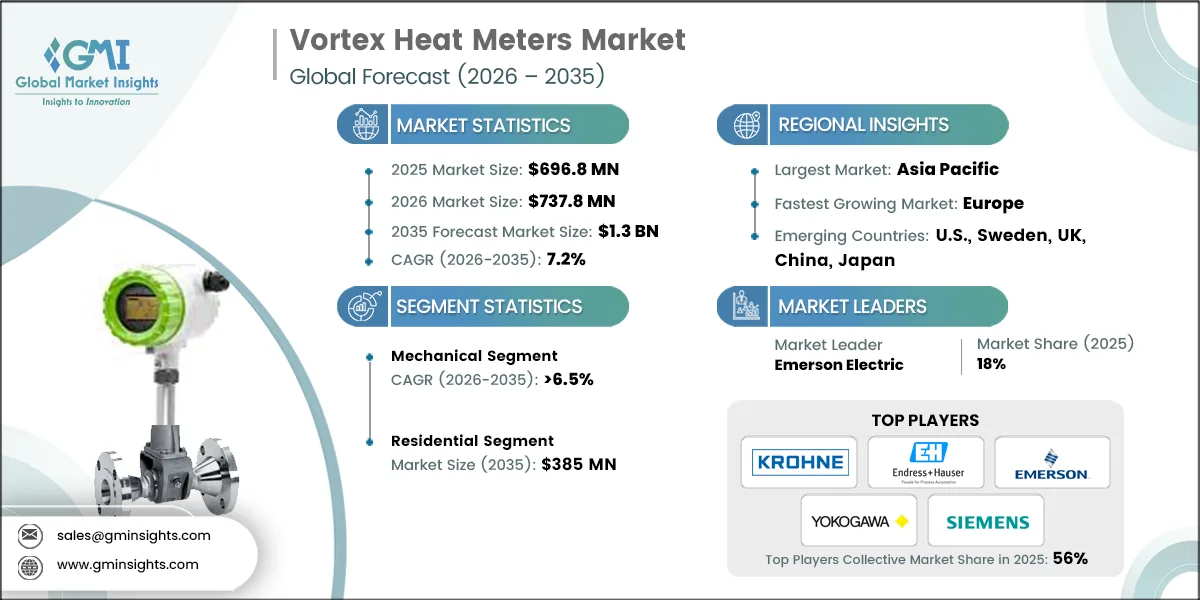
Vortex Heat Meters Market Key Takeaways
Market Size & Growth
- 2025 Market Size: USD 696.8 Million
- 2026 Market Size: USD 737.8 Million
- 2035 Forecast Market Size: USD 1.3 Billion
- CAGR (2026–2035): 7.2%
Regional Dominance
- Largest Market: Asia Pacific
- Fastest Growing Region: Europe
Key Market Drivers
- Regulatory Compliance and Standardization.
- Increased focus on energy efficiency.
- Rising Demand for Sustainable Solutions.
Challenges
- Privacy Concerns.
Opportunity
- Expansion in industry and utility applications.
- Integration with smart and IoT enabled systems.
Key Players
- Market Leader: Emerson Electric led with over 18% market share in 2025.
- Leading Players: Top 5 players in this market include KROHNE, Endress+Hauser, Emerson Electric, Yokogawa, Siemens, which collectively held a market share of 56% in 2025.
Get Market Insights & Growth Opportunities
To get key market trends
Vortex Heat Meters Market Trends
- Businesses and utilities seeking more precise methods to measure and manage energy consumption in conjunction with incentives, subsidies, and regulations encouraging the use of heat meters will boost the market growth. For instance, the EU directives aim to increase the energy efficiency of heat networks. It ensures to mandate the deployment of individual meters by consumers for monitoring energy consumption and providing competitive energy prices. Thereby, key features including accuracy and efficiency in measuring thermal energy consumption will further complement the business growth.
Vortex Heat Meters Market Analysis
Learn more about the key segments shaping this market
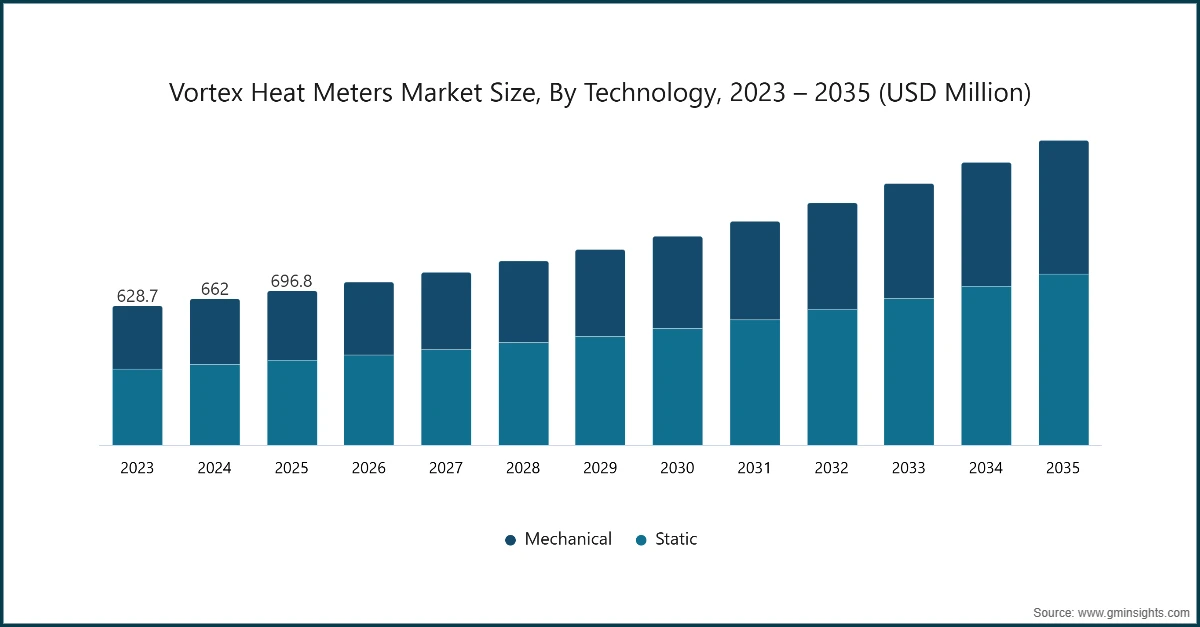
Based on technology, the Vortex heat meters market is segmented into mechanical and static.
- The mechanical segment will grow at a rate of over CAGR 6.5% by 2035, owing to their simple design and low maintenance in line with rising demand for reliable and economical metering solutions will proliferate the business demand. Ongoing advancements in calibration techniques and sensor technologies contribute to improved accuracy. In addition, excellent compatibility of mechanical vortex heat meters with traditional metering aligned with rising efforts of industry players to reduce manufacturing costs will sway the business landscape.
Learn more about the key segments shaping this market
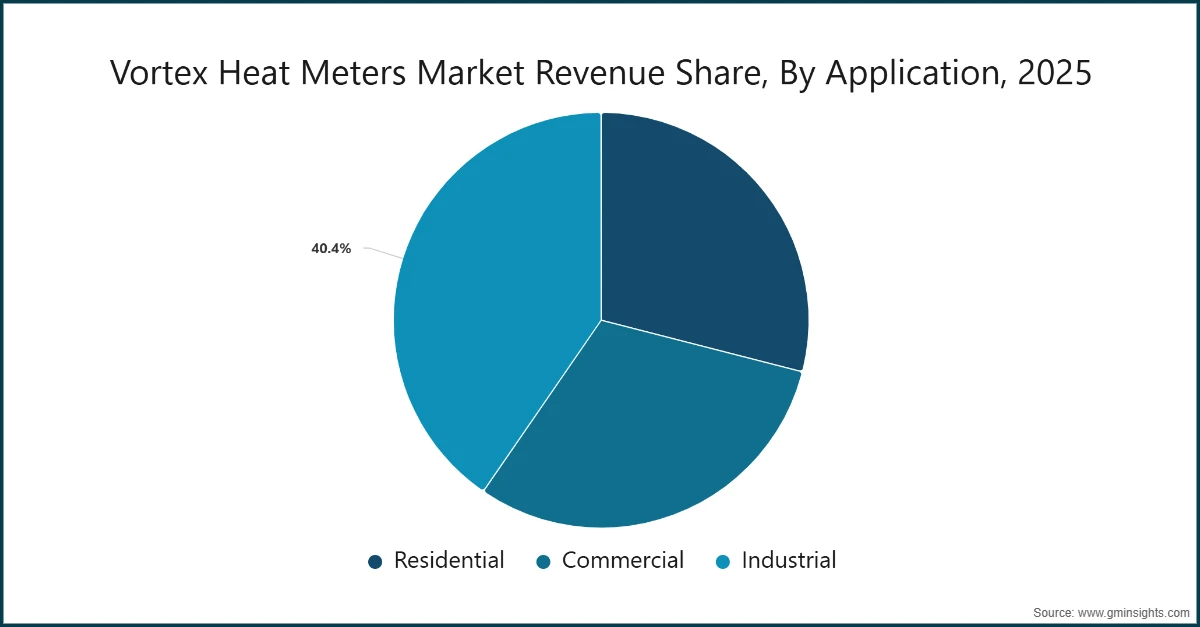
Based on application, the vortex heat meters market is bifurcated into residential, commercial and industrial.
- The residential segment will witness the growth of USD 385 million by 2035. Rising trend of sustainable practices in home construction and operation, incorporation of additional sensors for improved diagnostics and performance monitoring in line with shifting consumer preference for spacious and aesthetically pleasing metering solutions will influence the business outlook. Moreover, shifting consumer focus toward smart metering and the Internet of Things (IoT) involving real-time data collection, remote monitoring, and the ability to integrate with building or industrial control systems will augment the market growth.
Looking for region specific data?
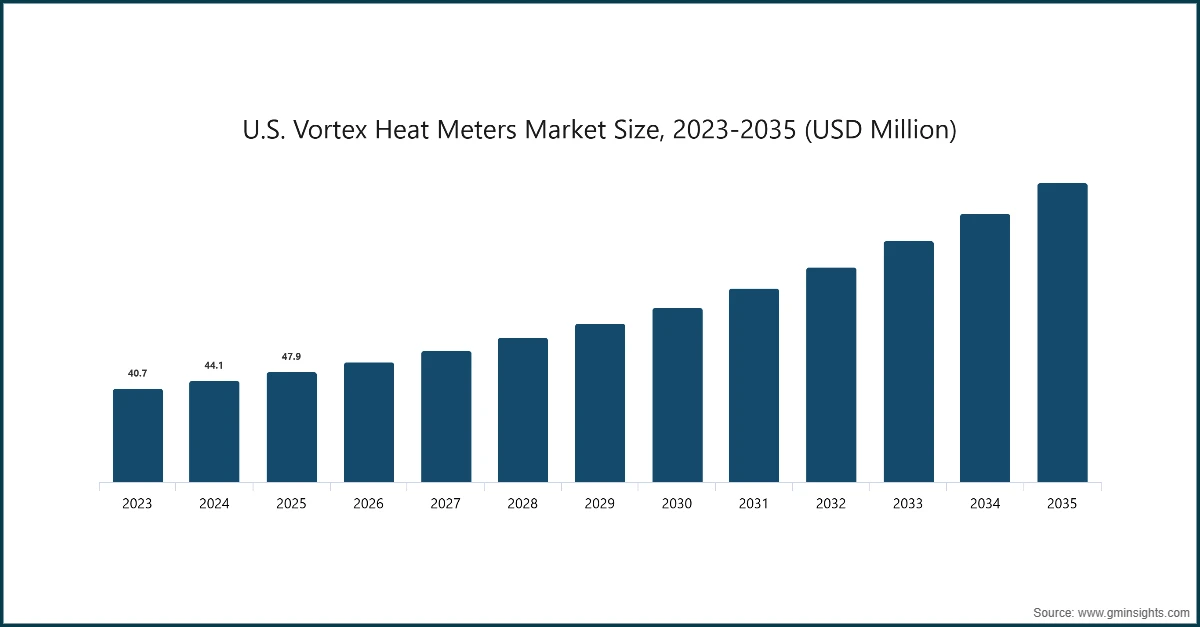
The U.S. vortex heat meters market is anticipated to grow more than USD 130 million by 2035 on account of rising energy prices and varying ownership structures.
- Growing emphasis on industrial automation, energy efficiency, and regulatory compliance for emissions and energy usage will complement the business landscape. Key advantages comprising of low maintenance requirements, high reliability, and ability to perform accurately in high-temperature and pressure environments will augment the product adoption.
- Increasing focus on energy management and cost optimization coupled with technology adoption that support eco-friendly practices will drive the business scenario. Growing investments in renewable energy projects along with rising construction of green and energy-efficient buildings will propel the industry statistics. For instance, the World Green Building Council announced that EU mandated for all new buildings to be Zero Emissions by 2028 and further targeted to upgrade 35 million homes by the end of the decade.
Vortex Heat Meters Market Share
The industry is fragmented with many companies focusing on consulting, service delivery, and better after-sales services. Shared resources, streamlined operations, and reduced duplication of efforts can contribute to overall cost-effectiveness in the development, manufacturing, and distribution of the heat meters. In addition, inorganic growth strategies enable the companies to enhance their product portfolios by incorporating a broader range of offerings.
Vortex Heat Meters Market Companies
Eminent players operating in the vortex heat meters industry are:
- ABB
- Apure
- Arrow Electronics
- Badger Meter
- Emerson Electric
- Endress+Hauser
- Grainger
- Honeywell International
- KROHNE
- KOBOLD Instruments
- Schneider Electric
- Siemens
- Spirax Sarco
- Sino-Inst
- TLV
- WPG Holdings
- Yokogawa Electric Corporation
Vortex Heat Meters Industry News
- In November 2025, Endress+Hauser took over the process measurement division of EMC Industrial Group in New Zealand, thereby introducing the new sales office into the global network. This will enable the company to offer more comprehensive support and additional offerings to its New Zealand customers.
- In March 2025, Endress+Hauser entered in a partnership agreement with SICK, German sensor specialist. The growth venture will offer plant operators extra support in increasing efficiency, reducing carbon footprint and protecting the environment. In addition, the production and development of the gas analyzers and flowmeters was brought together under the umbrella of Endress+Hauser SICK GmbH+Co. KG.
- In September 2022, Axioma Metering invested USD 42.66 million in the construction of a new facility in Kaunas Free Economic Zone (FEZ). The plant will be operational in 2024 with four new production lines, enabling the production of over 4 million smart meters annually. The company aims to stabilize supply chain and interrupted orders of smart heat meters in the market. The company’s strategic investment strengthened its product portfolio across the industry.
The vortex heat meters market research report includes an in-depth coverage of the industry with estimates & forecast in terms of revenue (USD Million) and volume (‘000 Units) from 2022 to 2035, for the following segments:
Market, By Technology, 2022 – 2035 (USD Million & ‘000 Units)
Mechanical
- Static
Market, By Application, 2022 – 2035 (USD Million & ‘000 Units)
- Residential
- Commercial
- College/University
- Office Building
- Government Building
- Others
- Industrial
The above information has been provided for the following regions and countries:
North America
U.S.
- Canada
Europe
- Germany
- Poland
- Sweden
- Denmark
- Finland
- Italy
- UK
- Asia Pacific
- China
- Japan
- South Korea
- Rest of World
Frequently Asked Question(FAQ) :
What was the market size of the Vortex Heat Meters market in 2025?
The global Vortex Heat Meters market was valued at USD 696.8 million in 2025 and is expected to grow at a CAGR of 7.2% through 2035, driven by rising demand for accurate thermal energy measurement and advanced flow metering technologies.
What is the projected value of the Vortex Heat Meters market by 2035?
The market is projected to cross USD 1.3 billion by 2035, supported by increasing adoption of heat meters, energy efficiency regulations, and expanding industrial applications.
What is the expected size of the Vortex Heat Meters industry in 2026?
The Vortex Heat Meters market is expected to reach USD 737.8 million in 2026, driven by growing demand for precise energy monitoring solutions.
How much growth is expected from the mechanical vortex heat meters segment?
The mechanical vortex heat meters segment is projected to grow at a CAGR of over 6.5% through 2035, due to its simple design, reliability, and low maintenance requirements.
What is the growth outlook for the residential vortex heat meters market?
The residential segment is anticipated to witness USD 385 million in growth by 2035, driven by increasing adoption of smart metering technologies and sustainable housing initiatives.
How large will the U.S. vortex heat meters market be by 2035?
The U.S. Vortex Heat Meters market is expected to exceed USD 130 million by 2035, supported by rising energy costs and increasing industrial automation.
What are the upcoming trends in the Vortex Heat Meters market?
Key trends include growing adoption of IoT-enabled smart metering, advancements in sensor technologies, regulatory focus on energy efficiency, and increasing deployment in residential and industrial applications.
Who are the leading companies operating in the Vortex Heat Meters market?
Major players in the market include ABB, Apure, Arrow Electronics, Badger Meter, Emerson Electric, Endress+Hauser, Grainger, Honeywell International, KROHNE, KOBOLD Instruments, Schneider Electric, Siemens, Spirax Sarco, Sino-Inst, TLV, WPG Holdings, and Yokogawa Electric Corporation.
Vortex Heat Meters Market Scope
Related Reports