Summary
Table of Content

Vinyl Acetate Monomer (VAM) Market
Get a free sample of this report
Form submitted successfully!
Error submitting form. Please try again.
Thank you!
Your inquiry has been received. Our team will reach out to you with the required details via email. To ensure that you don't miss their response, kindly remember to check your spam folder as well!
Request Sectional Data
Thank you!
Your inquiry has been received. Our team will reach out to you with the required details via email. To ensure that you don't miss their response, kindly remember to check your spam folder as well!
Form submitted successfully!
Error submitting form. Please try again.
Vinyl Acetate Monomer Market Size
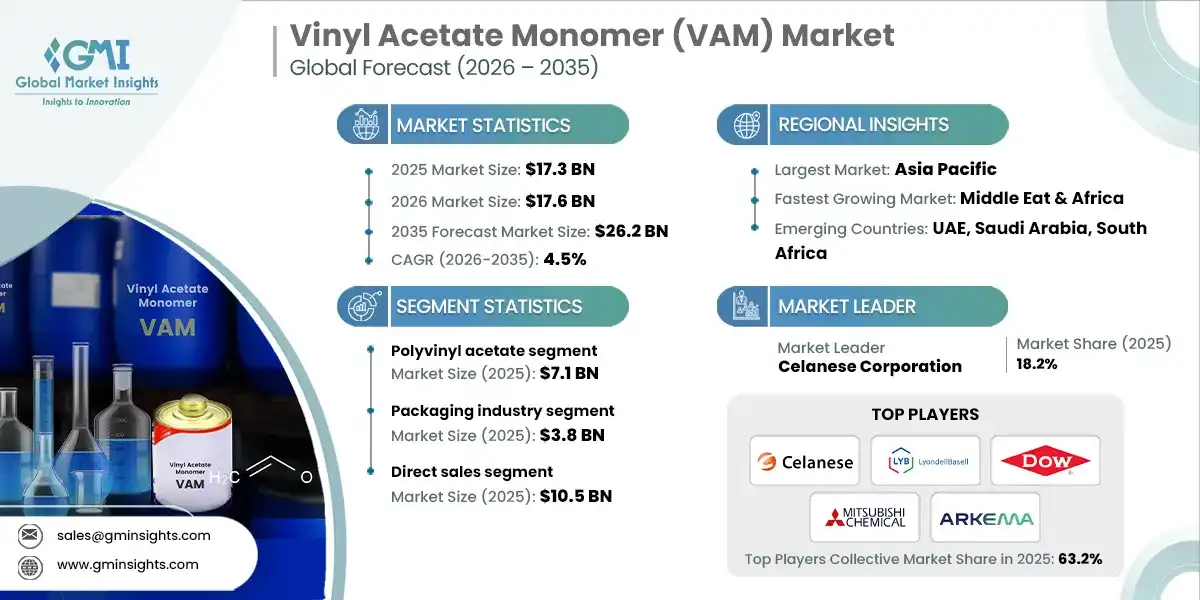
The global vinyl acetate monomer market was estimated at USD 17.3 billion in 2025. It is expected to grow from USD 17.6 billion in 2026 to USD 26.2 billion by 2035, at a CAGR of 4.5%, according to latest report published by Global Market Insights Inc.
Vinyl Acetate Monomer (VAM) Market Key Takeaways
Market Size & Growth
- 2025 Market Size: USD 17.3 Billion
- 2026 Market Size: USD 17.6 Billion
- 2035 Forecast Market Size: USD 26.2 Billion
- CAGR (2026–2035): 4.5%
Regional Dominance
- Largest Market: Asia Pacific
- Fastest Growing Region: Middle Eat & Africa
Key Market Drivers
- Growing demand for waterborne adhesives & coatings.
- Expansion of packaging industry.
- Shift from solvent-based to water-based formulations.
Challenges
- Raw material price volatility.
- Stringent VOC emission regulations.
Opportunity
- High-barrier EVOH films for food packaging.
- Medical-grade EVA for pharmaceutical delivery systems.
Key Players
- Market Leader: Celanese Corporation led with over 18.2% market share in 2025.
- Leading Players: Top 5 players in this market include Celanese Corporation, LyondellBasell Industries, Dow, Mitsubishi Chemical Corporation, Arkema, which collectively held a market share of 63.2% in 2025.
Get Market Insights & Growth Opportunities
- The demand of high-performance and sustainable packaging solutions is increasing, which contributes to the strong growth of the VAM market. Polyvinyl acetate, ethylene- vinyl acetate and polyvinyl alcohol are VAM-derived polymers that are popular in packaging barrier and flexible film due to their excellent bondage, waterproofing and versatility. The central role of VAM in modern production processes is being supported by the growing consumption of consumer goods and industrial packaging.
- Expansion in building, automobiles, and industrial finishes also contributes towards VAM demand. The increased infrastructure, urbanization and renovation works are increasing the consumption of adhesives, sealants, coating and composite materials which are based on VAM-based resins. Simultaneously, low-VOC and water-based formulations, enabled by environmental regulations, are causing the replacement of VAM-derived materials with solvent-based (traditional) materials.
- VAM production is increasing efficiency using technological advancements and optimization of the processes in production ensuring reliability of supplies. Top-notch manufacturing techniques and combined feedstock processes enable manufacturers to target a wider market and area. This guarantees the maintenance of a constant supply and competitive standing in a more demanding international market.
- The growing demand of industry, the pressure of regulation, and the maturation of the technologies keep reinforcing the market of VAM. With a growing use of packaging, coatings, adhesives and specialty polymers in various industries, VAM continues to be an important input which supports the growth of markets and their diversification in the long term.
To get key market trends
Vinyl Acetate Monomer Market Trends
- There is a distinct change in VAM market towards green and sustainable production, and manufacturers are discussing the use of bio-based feedstocks and greener production. This tendency is connected with the increasing pressure of regulations and customer expectations of materials, which would be environmentally friendly, providing a competitive edge to manufacturers that implement technologies of environmentally friendliness and establishing the segments of premium segments of sustainable polymers.
- The use of specialty polymer formulations is broadening the use of VAM to other areas other than adhesives and coatings. High barriers films, water-based emulsions and high-performance laminates are also pushing towards diversification in high-value segments, enabling manufacturers to take higher margins and lessen reliance on the traditional markets.
- Consumers particularly prefer low-VOC and water-based adhesives and coatings, which also represent a trend in governing regulations and health consideration. This shift improves stability in the market of developed regions, and it prefers integrated players that can provide high-quality and compliant VAM-based solutions.
- New applications, such as solar-panel encapsulants, superior packaging and composite materials, are expanding the end use environment of VAM. The diversification to these technology-based sectors will minimize the volatility of demand and make VAM a key contributor in the fast growing industrial and consumer segments.
Vinyl Acetate Monomer Market Analysis
Learn more about the key segments shaping this market
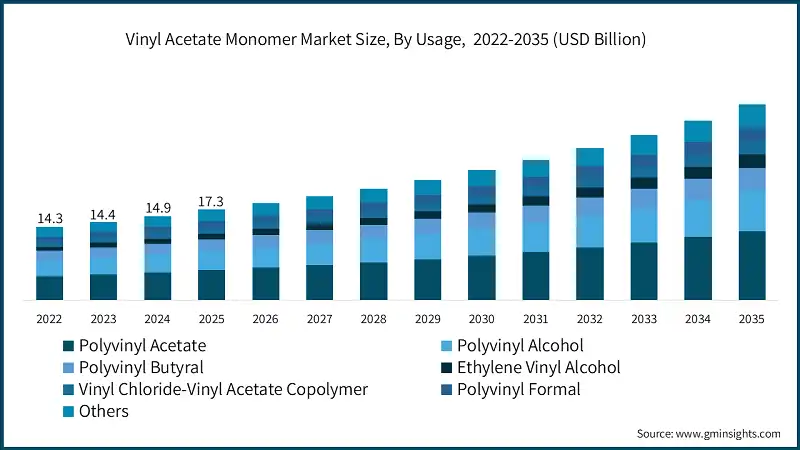
Based on usage, the market is segmented into polyvinyl acetate, polyvinyl alcohol, polyvinyl butyral, ethylene vinyl alcohol, vinyl chloride-vinyl acetate copolymer, polyvinyl formal, and others. Polyvinyl acetate holds a significant share at a valuation of USD 7.1 billion in 2025.
- Polyvinyl Acetate is the largest player in the VAM market because of the large scale adhesives, paints, coatings, and construction materials. Its great bonding performance, simplified formulation and water-based applications win its place as the crucial input in package, woodworking and paper applications. The increasing popularity of low-VOC and environmentally friendly adhesive technologies is expected to keep using Polyvinyl Acetate, as the foundation block in the global picture of VAM applications.
- There is gradual improvement in demand of other downstream polymers such as Polyvinyl Alcohol, Polyvinyl Butyral, Ethylene Vinyl Alcohol, and specialty copolymer due to the incorporation of advanced films and barrier packaging materials, safety glass laminates, and performance coats by industries. Growth in the automotive industry, electronics assembly, and high-value construction solutions promotes the wider use of VAM-based polymers. Such a diversified demand base brings an added stability to the market as Polyvinyl Acetate still enjoys the core market share because of its size, adaptability and steady industrial dependence.
Learn more about the key segments shaping this market
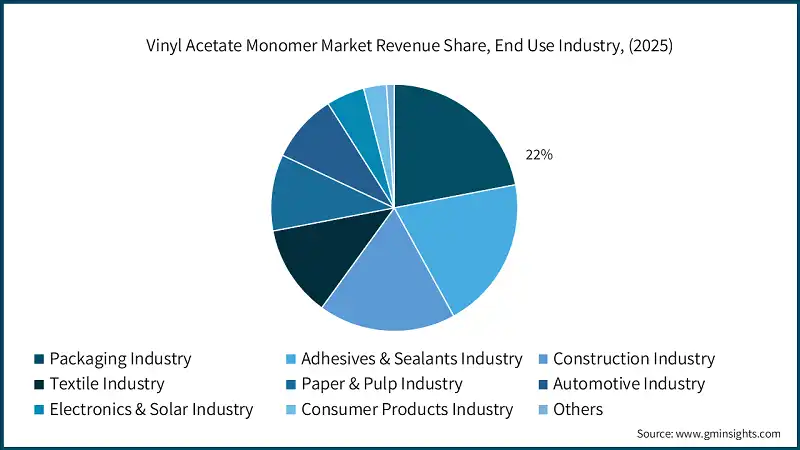
Based on end use industry, the vinyl acetate monomer market is segmented into packaging industry, adhesives & sealants industry, construction industry, textile industry, paper & pulp industry, automotive industry, electronics & solar industry, consumer products industry, and others. Packaging industry holds a significant share at a valuation of USD 3.8 billion in 2025.
- Packaging industry represents the highest percentage in VAM usage because demand in high performance films, laminates and flexible packaging materials is steadily growing in the consumption of food, drinks, healthcare, and consumer goods. Polymers like PVA, PVB, and EVOH are based on VAM, which offers high levels of adhesion, clarity and barrier properties, which are necessary in the production of moisture-resistant oxygen-barrier packaging solutions. The continuous development of e-commerce, the increase in the FMCG distribution networks, and the transition to lightweight, recyclable packaging formats further support its leading role in the end use demand.
- In other industries such as adhesives and sealants, construction, textiles, automotive, electronics, and paper making, the stability to increasing use of VAM-derived materials is observed as they switch to state of art coating, bonding, and laminating processes. These segments use the VAM polymers in enhancing their durability, chemical resilience, thermal stability, and efficiency in processes in a broad spectrum of uses. Although these industries play a large role in the total consumption balance in the market, the magnitude, predictability, and growth in the packaging ecosystem are driven by innovation and will make it the most powerful end use area.
Based on distribution channel, the vinyl acetate monomer market is segmented into direct sales, distributors, merchant traders, and online sales. Direct sales are estimated to grasp a value of USD 10.5 billion in 2025 and are expected to grow at 4.2% of CAGR during the forecast period.
- The distribution channel segment of the VAM market comprises direct sales, which indicates a high level of relationships between producers and large industrial consumers. Major end use, including adhesives, coatings, packaging and construction manufacturers, like direct procurement to provide predictable supply, assure prices and specific contract terms which satisfy their volume and quality needs. This channel also allows the manufacturers to offer technical support, tailored solutions to technical and supply-chain reliability that is fundamental to high-value applications and integrated production processes.
- Although distributors, merchant traders and online platforms are involved in regional and small-scale demand, their portion is insignificant in direct sales. These channels mainly target smaller manufacturers or niche applications that need smaller volumes of their needs or regional availability. On the whole, the significance of customer relations being strategic, bulk contracts, and supply chain insurance to ensure stability in the market and its competitiveness can be highlighted by the dominance of direct sales.
Looking for region specific data?
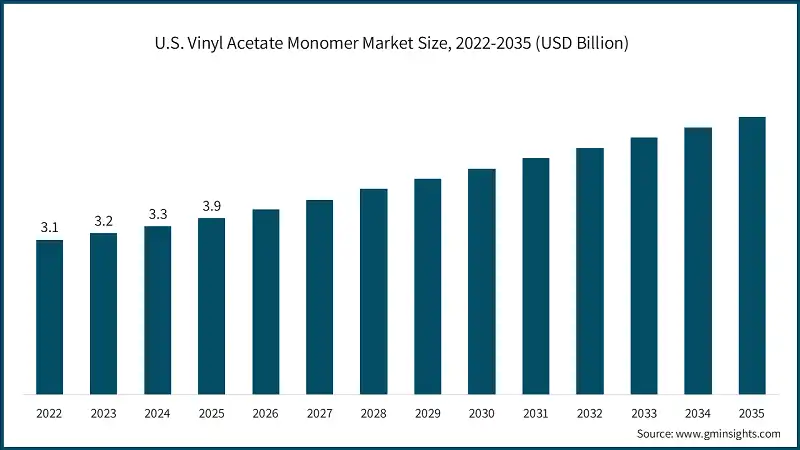
North America accounted for USD 4.5 billion in 2025 and is anticipated to show lucrative growth over the forecast period with US occupying a market of USD 3.9 billion in 2025.
- The market share of VAM of North America is estimated at approximately 26 percent of the global market, and the United States has the highest market share because of its giant and integrated petrochemical environment and good supply of major feedstock sources like ethylene and acetic acid. The area is also in a good position to take advantage of a mature downstream market, especially adhesives, water-based coating, packaging films and construction polymers that would contribute to stable and high-volume use of VAM.
- The market is also booming with the demand of low-VOC and high-performance adhesives and coatings on a tightening environmental regulation. Also, the growth in areas like e-commerce packaging, infrastructure renewals, and EVA-contained materials in applications on solar has been increasing the uptake of VAM. The most recent expansion of capacity by local producers as well as the increasing investment in sustainable polymer solutions also drives the accelerated growth trend of North America in the VAM landscape.
Europe vinyl acetate monomer market accounted for USD 3.5 Billion in 2025 and is anticipated to show lucrative growth over the forecast period.
- Europe holds approximately 20% market share in year 2025, with strong demand in Germany, France, Italy, and UK, where high-technology manufacturing and developed chemical industries will encourage high consumption. The growth of the region is supported by the increasing use of water-based, low-VOC adhesives and coating due to the high demands of the EU environmental regulations and sustainability requirements.
- Growing uses in high-performance packaging films, construction sealants and automotive coating add to the demand of VAM. More so, the transition towards recyclable and environmentally efficient packaging polymers is speeding up the application of VAM-based polymers. Though European growth remains moderate in comparison with the Asian, the strong and stable growth is guaranteed by the strong regulatory system, specialty markets with high prices, and investment in the green chemistry solutions.
Asia Pacific vinyl acetate monomer market accounted for USD 8 billion in 2025 and is anticipated to show lucrative growth over the forecast period.
- Asia-Pacific is the largest segment with a market share of 46% in 2025. China enjoys huge market share in the region because it boasts of a large chemical production base, access to feedstocks and high downstream markets in packaging, adhesives, coatings and textiles. Other countries that are growing at accelerated demand include India, South Korea and Southeast Asian countries by increasing manufacturing, development of infrastructure and increment in consumption of water-based coats and polymer emulsions.
- The area is advantageous due to constant capacity development by the local and international manufacturers, which increases supply security and cost-effectiveness. The accelerated urbanization, the growth of the construction of chemicals, and the increased use of VAM-based materials in automotive, electronics and flexible packaging contribute even more to the market momentum. The trend to the usage of more sustainable and low-VOC formulations is further influencing the use of VAM-based polymers in the industrial environment of APAC.
Latin America market accounted for 5% market share in 2025 and is anticipated to show steady growth over the forecast period.
- The vinyl acetate monomer market in Latin America is experiencing steady and stable growth trajectory due to gradual increase in construction, packaging and industrial manufacturing. The demand in the region is still growing due to the growth of infrastructure investment and the shift towards polymer-based adhesions and coating.
- Market size is still smaller than that in APAC and Europe but with annual demand that is predictable due to continuous consumption by the packaging converters, laminates and paints manufacturers. The area also enjoys relatively competitive cost of production, and this has made it a good place to continue expansion of downstream manufacturing and diversification of supply chains in the long term.
Middle East and Africa vinyl acetate monomer market accounted for 3% market share in 2025 and is anticipated to show steady growth over the forecast period.
- The Middle East & Africa market also shows an equally balanced growth trend due to the current urbanization, industrialization process and the growing use of VAM based products in paints, coatings and flexible packaging. Construction business in the Gulf countries and emerging manufacturing cluster in Africa remain sources of baseline demand.
- The growth is moderate, but the region has opportunities in such areas as building materials, waterproofing membranes, and specialty polymers associated with infrastructure improvements. The strategic emphasis by MEA in the creation of local chemical value chains further places the region at a level to ensure a progressive and consistent increase in VAM consumption.
Vinyl Acetate Monomer Market Share
The market position of Vinyl Acetate Monomer (VAM) is moderately concentrated where the top five players, Celanese Corporation, LyondellBasell Industries, Dow, Mitsubishi Chemical Corporation, and Arkema holds 63.2% market share in the year 2025. These businesses have the advantage of having a high degree of acetyl-chain integration, large production volumes, and diversified downstream portfolios that increase their bargaining power and reliability of supply in large end use markets including adhesives, coating, packaging and polymers.
In a bid to remain competitive, the major producers are increasing regional manufacturing presence, streamlining cost bases and seeking backward integration to achieve availability of feedstock. Sustainability certifications, low-carbon production routes, and production of specialty polymers based on advanced VAM are also in the limelight of companies as a way of meeting customer needs, which are changing. Moreover, to strengthen the market presence, strategic pricing measures, capacity investments in the high-growth regions, and investments in supply-chain resilience are emerging as important strategies to handle the dynamics in the raw material supplies.
Vinyl Acetate Monomer Market Companies
Major players operating in vinyl acetate monomer industry are:
- Celanese Corporation
- LyondellBasell Industries
- Dow
- Mitsubishi Chemical Corporation
- Arkema
- Wacker Chemie AG
- Henan GP Chemicals Co., Ltd.
- Suneco Chem
- Meru Chem Pvt.Ltd.
- Tiankai Chemical
- Gantrade Corporation
- Opes International
- Jubilant Ingrevia
- Vinipul Chemicals
Celanese is a major manufacturer of Vinyl Acetate Monomer in the world and has an integrated acetyls chain that enables production of significant amounts of VAM. VAM supplied by the company is used in downstream applications of PVOH, EVA, adhesives, coatings and films. Its presence on a global level, low cost manufacturing, and regular price manipulations make it an exemplary player in global VAM pricing. Celanese is ever growing acetyls in order to enhance the security of supply in North America, Europe and Asia.
LyondellBasell is engaged in the VAM value chain by its robust acetyl intermediates portfolio as well as combined petrochemical assets. It is backward integrated into ethylene and acetic acid and this assists in stable economics of VAM production. The log markets served by the company include packaging, automotive coating and construction polymers. LondellBasell has an effective presence in the VAM ecosystem in the Americas and Europe with global manufacturing bases.
Dow is a market leader player in VAM market with its all-rounded portfolio in the area of vinyl-acetate derivatives such as adhesives, emulsions and polymer dispersions. Its combined activities enable effective provision of VAM of downstream performance materials in paints, textiles and flexible packaging. The innovation of VAM-based polymer formulations due to the strength of Dow R&D focuses on specialty applications with high value, especially. The wide geographical base of the company increases its capabilities to cater to international VAM customers.
Mitsubishi Chemical is a major Asian manufacture of VAM and its derivatives polymers especially the PVOH and EVOH polymers in the packaging and barrier film. The company has had good integration of acetyls chain to provide competitive VAM. The VAM capacity of MCC serves both domestic and export markets enabling a consistent supply of industrial coats, adhesives and specialty films. The ability to develop high-performance products and materials cement its position in international VAM market.
Arkema participates in the market of VAM by its advanced materials and coating-solutions divisions which operate based on the VAM polymers. The company has a presence in the global market which is strongly based on specialty chemicals and high-value dispersions with a majority being based on vinyl acetate chemistry. Arkema focuses on making sustainable and low-VOC formulations, which pushes innovation in VAM-based coating resins and emulsions. Its niche market orientation in specialty applications provides it with leverage in niche areas of the VAM demand environment.
Vinyl Acetate Monomer (VAM) Market Report Attributes
| Key Takeaway | Details |
|---|---|
| Market Size & Growth | |
| Base Year | 2025 |
| Market Size in 2025 | USD 17.3 Billion |
| Market Size in 2026 | USD 17.6 Billion |
| Forecast Period 2026 - 2035 CAGR | 4.5% |
| Market Size in 2035 | USD 26.2 Billion |
| Key Market Trends | |
| Drivers | Impact |
| Growing demand for waterborne adhesives & coatings | Rising preference for eco-friendly waterborne systems significantly boosts VAM consumption in adhesive and coatings manufacturing. |
| Expansion of packaging industry | Increasing packaging applications in food and consumer goods drives VAM-based adhesive demand for flexible and high-performance solutions. |
| Shift from solvent-based to water-based formulations | Regulatory pressure and sustainability goals accelerate VAM adoption in water-based emulsions for diverse industrial applications. |
| Pitfalls & Challenges | Impact |
| Raw material price volatility | Fluctuating feedstock costs create pricing instability, impacting profitability and strategic planning for VAM producers. |
| Stringent VOC emission regulations | Compliance with evolving VOC norms requires costly innovation and reformulation, increasing operational complexity for manufacturers. |
| Opportunities: | Impact |
| High-barrier EVOH films for food packaging | Growing need for superior oxygen barrier properties expands VAM demand in EVOH film production for packaging. |
| Medical-grade EVA for pharmaceutical delivery systems | Rising healthcare innovation creates niche opportunities for VAM in high-value EVA-based drug delivery applications. |
| Market Leaders (2025) | |
| Market Leaders |
18.2%market share |
| Top Players |
|
| Competitive Edge |
|
| Regional Insights | |
| Largest Market | Asia Pacific |
| Fastest growing market | Middle Eat & Africa |
| Emerging countries | UAE, Saudi Arabia, South Africa |
| Future outlook |
|
What are the growth opportunities in this market?
Vinyl Acetate Monomer Industry News
- In 2025, INEOS LOTTE Chemical declared to increase the VAM production capacity by constructing a third VAM plant in Ulsan. The growth will boost capacity of 450 000 tons per year to about 700,000 tons.
- In January 2025, Haitung Group Limited had added capacity in its VAM manufacturing complex in China. The upgrading ratcheth up throughput and enhances export delivery to the customers in Southeast Asia and Europe.
- In March 2024, a wholly owned subsidiary, Asian Paints (Polymers) Private Limited (APPPL) of Asian Paints Ltd had announced the establishment of a plant to produce Vinyl Acetate, Ethylene Emulsion (VAE), and Vinyl Acetate Monomer (VAM) in Dahej, Gujarat.
The vinyl acetate monomer market research report includes in-depth coverage of the industry with estimates & forecast in terms of revenue (USD Billion) & volume (Kilo Tons) from 2022 to 2035, for the following segments:
Market, By Usage
- Polyvinyl acetate
- Polyvinyl alcohol
- Polyvinyl butyral
- Ethylene vinyl alcohol
- Vinyl chloride-vinyl acetate copolymer
- Polyvinyl formal
- Others
Market, By End Use Industry
- Polyvinyl acetate (PVAc)
- Emulsion polymers
- Adhesives
- Paints & binders
- Ethylene vinyl acetate (EVA)
- Films
- Foams
- Hot-melt adhesives
- Solar encapsulants
- Polyvinyl alcohol (PVOH)
- Fibers
- Paper coatings
- Coatings & paints
- Architectural coatings
- Industrial coatings
- Textile chemicals
- Sizing agents
- Finishing agents
- Paper Chemicals
- Paper binders
- Laminates
- Others
Market, By Distribution Channel
- Direct sales
- Distributors
- Merchant traders
- Online sales
The above information is provided for the following regions and countries:
- North America
- U.S.
- Canada
- Europe
- UK
- Germany
- France
- Italy
- Spain
- Rest of Europe
- Asia Pacific
- China
- India
- Japan
- South Korea
- Australia
- Rest of Asia Pacific
- Latin America
- Brazil
- Mexico
- Argentina
- Rest of Latin America
- MEA
- UAE
- Saudi Arabia
- South Africa
- Rest of Middle East and Africa
Frequently Asked Question(FAQ) :
What is the market size of the vinyl acetate monomer (VAM) market in 2025?
The vinyl acetate monomer market size was valued at USD 17.3 billion in 2025, growing at a CAGR of 4.5% from 2026 to 2035. The market expansion is driven by rising demand for waterborne adhesives & coatings across the chemicals and materials industry.
What is the current VAM market size in 2026?
The VAM market size is projected to reach USD 17.6 billion in 2026. Growth is supported by the increasing adoption of VAM-based polymers in packaging, construction, and industrial applications.
What is the projected value of the vinyl acetate monomer market by 2035?
The vinyl acetate monomer industry is expected to reach USD 26.2 billion by 2035, registering a CAGR of 4.5% during 2026–2035. Rising use of eco-friendly waterborne emulsions and demand for high-performance packaging polymers are boosting long-term market growth.
How much revenue did the polyvinyl acetate (PVAc) usage segment generate in 2025?
Polyvinyl acetate usage accounted for USD 7.1 billion in 2025, holding a significant share of the VAM market. Its dominance stems from extensive adoption in adhesives, paints, coatings, and construction materials.
What was the valuation of the packaging industry segment in 2025?
The packaging industry segment reached USD 3.8 billion in 2025 within the VAM ecosystem. Increasing demand for high-performance films, laminates, and barrier packaging continues to strengthen segment growth.
What is the growth outlook for direct sales distribution from 2026 to 2035?
Direct sales are expected to grow at a 4.2% CAGR during 2026–2035, representing the leading distribution channel. Its strong performance is linked to bulk purchasing by adhesives, packaging, and coatings manufacturers requiring consistent VAM supply.
Which region leads the vinyl acetate monomer market and what is the U.S. contribution?
North America recorded USD 4.5 billion in 2025, with the U.S. contributing USD 3.9 billion to regional VAM consumption. This growth is driven by the country’s integrated petrochemical ecosystem and rising use of low-VOC coatings, adhesives, and solar EVA materials.
What are the upcoming trends in the global VAM market?
Key industry trends include rapid transition to waterborne and low-VOC formulations, rising demand for high-barrier EVOH films, and expanding application in solar encapsulants. Innovation in bio-based feedstocks and advanced polymer technologies is further reshaping the market landscape.
Who are the key players in the vinyl acetate monomer market?
Major companies operating in the VAM industry include Celanese Corporation, LyondellBasell Industries, Dow, Mitsubishi Chemical Corporation, Arkema, Wacker Chemie AG, Henan GP Chemicals, Suneco Chem, Meru Chem Pvt. Ltd., Tiankai Chemical, Gantrade Corporation, Opes International, Jubilant Ingrevia, and Vinipul Chemicals.
Vinyl Acetate Monomer (VAM) Market Scope
Related Reports