Summary
Table of Content

Vibrational Monitoring System for Machinery Market
Get a free sample of this report
Form submitted successfully!
Error submitting form. Please try again.
Thank you!
Your inquiry has been received. Our team will reach out to you with the required details via email. To ensure that you don't miss their response, kindly remember to check your spam folder as well!
Request Sectional Data
Thank you!
Your inquiry has been received. Our team will reach out to you with the required details via email. To ensure that you don't miss their response, kindly remember to check your spam folder as well!
Form submitted successfully!
Error submitting form. Please try again.
Vibrational Monitoring System for Machinery Market Size
Vibrational Monitoring System for Machinery Market Key Takeaways
Market Size & Growth
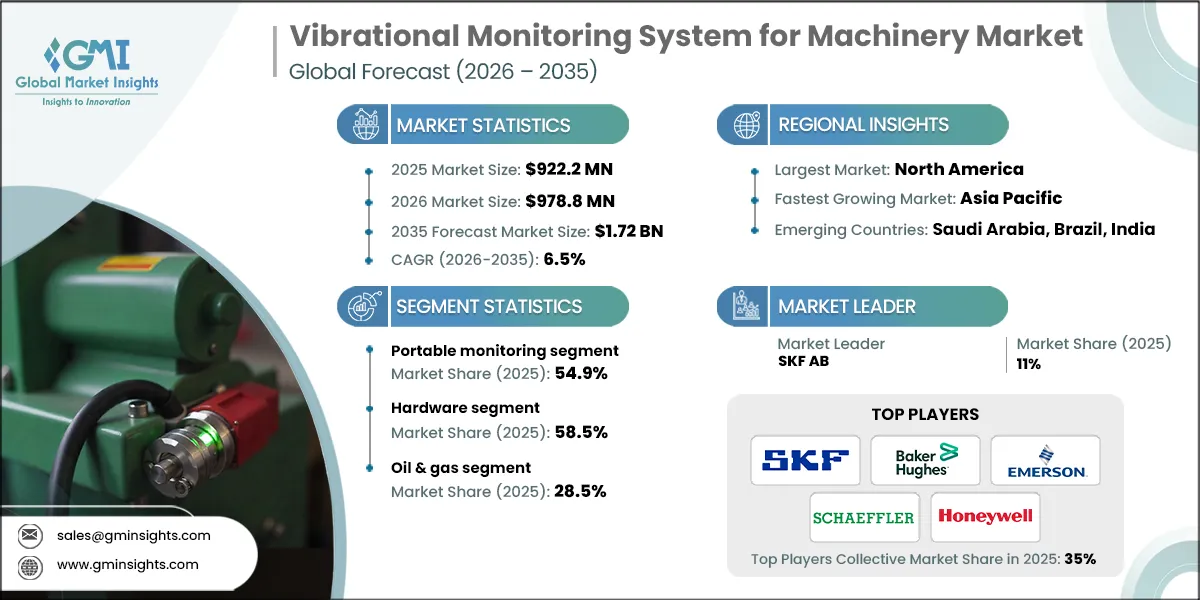
- 2025 Market Size: USD 922.2 Million
- 2026 Market Size: USD 978.8 Million
- 2035 Forecast Market Size: USD 1.72 Billion
- CAGR (2026–2035): 6.5%
Regional Dominance
- Largest Market: North America
- Fastest Growing Region: Asia Pacific
Key Market Drivers
- Shift from preventive to predictive maintenance.
- Proliferation of IIoT & wireless sensing.
- Critical asset protection in energy & power.
Challenges
- High initial installation & hardware costs.
- Shortage of skilled vibration analysts.
Opportunity
- AI-Powered automated diagnostics.
- Subscription-based "Monitoring-as-a-Service".
Key Players
- Market Leader: SKF AB led with over 11% market share in 2025.
- Leading Players: Top 5 players in this market include SKF AB, Baker Hughes, Emerson Electric Co., Schaeffler AG, Honeywell International Inc., which collectively held a market share of 35% in 2025.
Get Market Insights & Growth Opportunities
The global vibrational monitoring system for machinery market was estimated at USD 922.2 million in 2025. The market is expected to grow from USD 978.8 million in 2026 to USD 1.72 billion in 2035, at a CAGR of 6.5% according to latest report published by Global Market Insights Inc.
The increasing awareness about the longevity of industrial assets and operational uptime, which form part of the market trends that have been largely stressed, have contributed to an increasing demand for vibration monitoring systems. The increasing number of strategic partnerships as well as acquisitions of industry leaders is reported to be at the core of this development. The combining of the powers of the key industry giants such as SKF, Emerson Electric, and Baker Hughes (Bently Nevada) has contributed to the increasing innovations, increasing portfolios, as well as an intensification of presence within the heavyweight condition monitoring industry.
On the other hand, traditional practices for machinery inspections such as handheld vibration pens or periodic acoustic checks, which form part of traditional practices, are less effective for critical assets as well as fail to demonstrate economic viability for high-volume production lines running 24/7. The increasing technological developments within the industrial sectors have made vibration monitoring systems increasingly advanced since they incorporate wireless IIoT sensors, AI-based diagnostic algorithms, as well as cloud-integrated analytics that can cut unplanned downtime by as high as 25-40%, thus minimizing industrial waste as well as energy waste.
It is in line with the movement in industries like heavy manufacturing, oil & gas, and power plants embracing Industry 4.0 trends and thus becoming one of the core driving forces responsible for growing this market. The need for automated and real-time tracking of health is rising swiftly in North America, especially for SVC applications in safeguarding high-value rotating assets such as gas and steam turbines and compressors. In addition, increasing investments in smart factory and energy infrastructure have been observed in Europe and Asia-Pacific. Automotive and food & beverage experts and practitioners have been shifting towards efficient and constant vibration analysis for high-throughput assets. They have thus been moving away from outdated and inefficient processes like reactive “run to fail” maintenance and simple visual inspections.
In general, the capacity to monitor vibration online is seen to be more precise and reliable when compared with the traditional methods that involve checking the rotating parts periodically. In most cases, the operators and the third-party providers in the industry are seeking faster methods for assessing the health of the assets. Wireless vibration sensors, therefore, emerge as a preferred option owing to their well-known benefits, such as avoiding costly calculating and lowering the danger associated with work accidents in critical environments. Indeed, this industry is being spurred by a steadily developing understanding of predictive maintenance value and is therefore leading to a comprehensive acceptability for this highly capable diagnosis tool. In other respects, moreover, a continuously advancing trend in MEMS technology for more enhanced sensor designs is bound to help improve their efficacy and user-friendly application quality. The symbiosis factor is thus working.
Vibration monitoring is primarily an industrial machinery market, which is expected to be greatly affected by the substantial manufacturing automation expected in the coming years as a result of the pandemic. In the professional fields, there will be a need for error-free data spaces with high resolution where machine status will have to be visualized.
Apart from that, the creation of insights for data that can be used for predictive modeling purposes is also a very felicitous outcome of this kind of effectiveness, which ensures that time used for repairs is indeed optimized. This kind of effectiveness has been adopted by large power stations as well as chemical companies that require a constant supply of the product line.
Hardware (sensors & transmitters) has been constantly topping in terms of revenue share, thus being the major contributing factor in the total market revenue due to their durability, adaptability, and feasibility to match the need for durability in the modern-day professional. In terms of technology, it is slowly emerging as a highly required component, thus aspects like Edge Analytics & ML provide a highly customized, precise, & in-depth diagnosis procedure. Stainless Steel Encased Sensors & highly designed Hermetic Seals are slowly emerging as the demand in many sectors & services where less invasive & fast approaches for obtaining operational up-time & longevity are required.
Some of the prominent identified advantages of the above-stated product types, which have gained immense popularity in the market, include, for example, the reduction of maintenance risks and the reduction of catastrophic failure risk in sensitive regions. The market for the above-stated products is mostly driven by the awareness of the long-term advantages of preventing machinery degradation, which has resulted in the widespread adoption of this potent device. In addition, the completion of various on-going projects related to the improvement of energy-harvesting sensors and ultra-low power wireless protocols will further improve user safety and ease of use.
To get key market trends
Vibrational Monitoring System for Machinery Market Trends
The vibration analysis industry is during a paradigm shift in trend due to the host of innovative solutions that are being churned out and technological advancements that are being made by the stalwarts of the industrial sector. The best in the business is putting out into the marketplace solutions that are at the bleeding edge of innovation in the form of automatic condition monitoring and heavy-duty diagnostic solutions that come with alluring properties like intelligent MEMS sensors, AI-powered wear prediction algorithms, edge analytics, and high frequency wireless transmitters.
The market's response to these trends is characteristic of the industry's focus on continuous innovation and, thus, the provision of better tools for the users that enhance the level of performance, improve the time required for diagnosis as well as the installation of sensors, and make the process of machine maintenance more productive.
- Technological advancement and product development: Technologically, the machinery monitoring hardware is moving towards being more advanced and effective, which is seen in the incorporation of remote monitoring systems that utilize the Internet of Things technology for greater safety and performance in the bearing life area. Investments are being made in the development of more powerful and energy-saving tri-axial accelerometers, in addition to the development of highly sensitive piezoelectric sensors that will lead to greater system availability.
- Development of smart manufacturing and automated industrial services: The high-value asset industry and the third-party maintenance service industry was healthy, and this had a great influence on the growth of the market. The Manufacturing and Oil and Gas industry combined is an essential part of the market and contributes almost 42% of the total vibration monitoring market share. Hence, there is a constant increase in the requirement for effective sensor-driven data sortation and diagnosis systems due to high-speed fault detection capabilities for complex systems and the optimization of the entire plant reliability.
- Sustainable asset and facility management: Effective machine condition monitoring via vibration analysis is one of the key factors responsible for increased energy savings and the prevention of bottlenecks in operations, mainly due to unwanted machine breakdowns, hence playing a crucial role in sustainable operational environments alongside the implementation of green logistics and factory efficiency projects. This process, alongside the use of wireless sensors to harvest energy and prevent unnecessary battery waste, aligns with the implementation of environmental, social, and governance initiatives, including projects related to carbon neutrality.
- More instances of global disruptions to industry: Global supply chain uncertainty affects global assembly lines that have become a new norm, hence a main focus for localized repair to be centered on resistance and adaptability. There followed an unprecedented rise in instances of reconfiguring modulated wireless monitoring infrastructure. The condition under which manufacturing units perpetually remain reconfigured and rescaled results in higher demands for vibration monitoring systems by automobile manufacturers, chemical processors, and heavy power utilities.
- Greater emphasis on industry 4.0 and smart maintenance: The facility managers and industrial planners show greater interest in the reliability of the automated lines regarding safety and throughput due to proactive maintenance work done to ensure that the machines are healthy enough to prevent expensive down-time due to equipment failure. The regular demand for optimized material flow results in an equal and consistent demand for commercial-grade vibration monitoring solutions throughout the year.
Vibrational Monitoring System for Machinery Market Analysis
Learn more about the key segments shaping this market
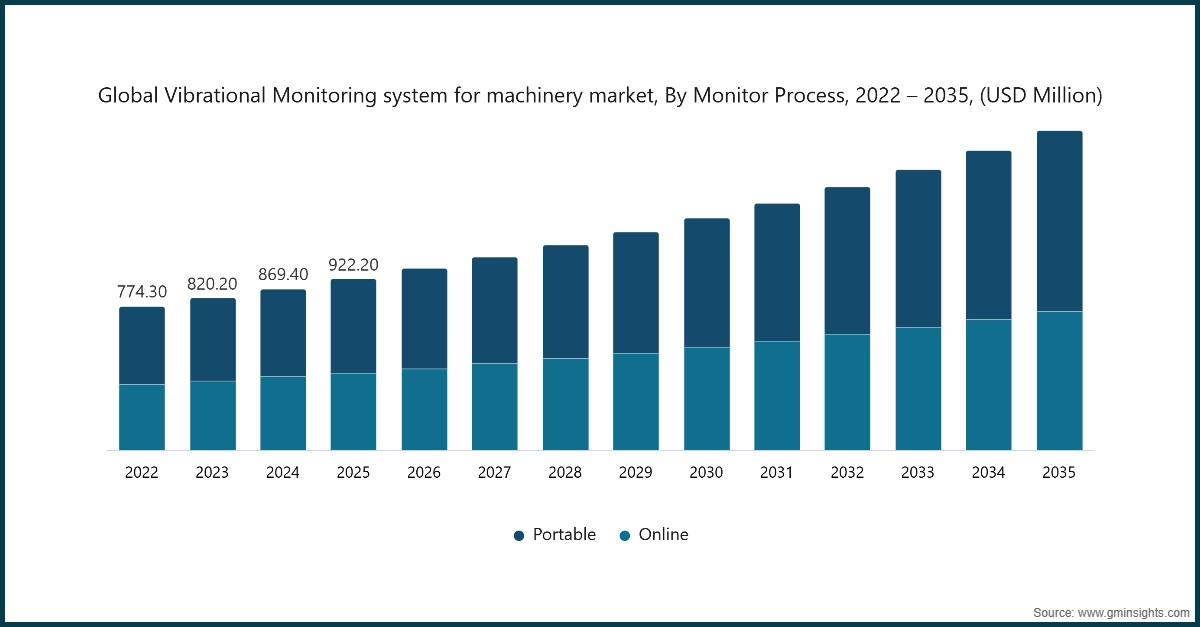
Based on the monitoring process, the vibration monitoring system market is segmented into online and portable monitoring. In 2025, portable monitoring is expected to lead the market with a share of 54.9%, valued at USD 506.7 million.
- Portable monitoring segment's dominance is driven by its cost-effectiveness and flexibility for non-critical or "Balance of Plant" assets where continuous wired sensors may not be financially viable.
- Online monitoring systems accounted for 45.1% of the market in 2025, remaining essential for critical, high-speed rotating machinery in sectors like Power Generation and Oil & Gas where real-time failure prevention is mandatory.
The portable segment is also growing at a strong 6.8% CAGR, reflecting a professional global preference for route-based maintenance tools that integrate seamlessly with handheld diagnostic devices and mobile apps.
Learn more about the key segments shaping this market
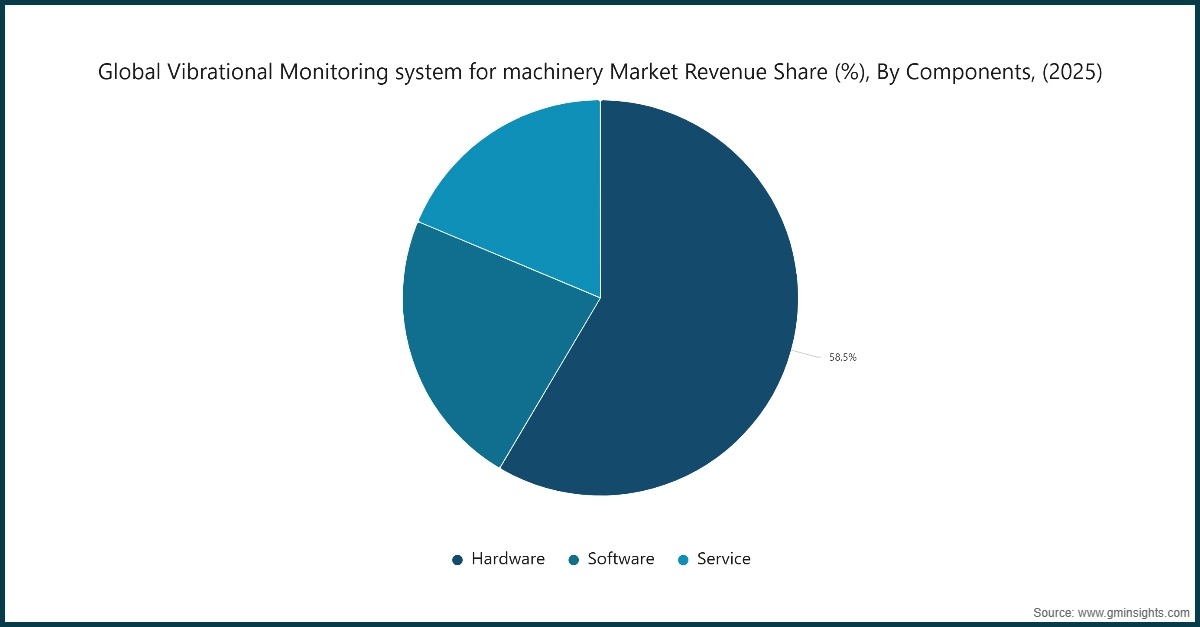
Based on the component, the vibration monitoring system for machinery market is segmented into hardware, software, and services. In 2025, the hardware segment is projected to hold the largest market share of 58.5%, generating a revenue of USD 539.5 million.
- Hardware components like accelerometers, proximity probes, and transmitters offer the foundational data required for asset health. The integration of technologies like MEMS (Micro-Electro-Mechanical Systems) and wireless connectivity further bolsters their efficiency and reliability.
- The hardware segment represents the largest portion of the market, reflecting the industry's critical need for physical sensing infrastructure to enable Industry 4.0 and real-time machine diagnostics.
- Software solutions maintain a consistent market share of approximately 22.8% in 2025, providing the analytical power for facilities to interpret complex vibrational data into actionable maintenance insights.
- The services segment shows a steady growth rate, with a revenue of USD 172.3 million in 2025, as industries increasingly rely on expert consultation and remote monitoring services to supplement their internal maintenance teams
Based on the application, the vibration monitoring system market is segmented into oil & gas, energy & power, metal & mining, chemical, automotive, food & beverages, and others. In 2025, oil & gas held the major market share of 28.5%, reflecting the industry’s heavy reliance on high-value asset protection.
- Oil & gas applications are fueled by the need for localized technical support and the high cost of downtime in offshore and refinery environments. End users in this sector prioritize vibration monitoring for rapid fault detection and on-site maintenance optimization.
- Energy & power generated USD 193.4 million in 2025. This segment is typically utilized for large-scale infrastructure projects such as wind farms and nuclear plants where the longevity of turbines is managed through rigorous vibrational analysis.
- The food & beverages segment shows the highest growth rate at 8.8% CAGR, as more businesses in this sector seek to modernize their existing facilities to prevent contamination and ensure consistent production uptime.
North America Vibrational Monitoring System for Machinery Market
Looking for region specific data?
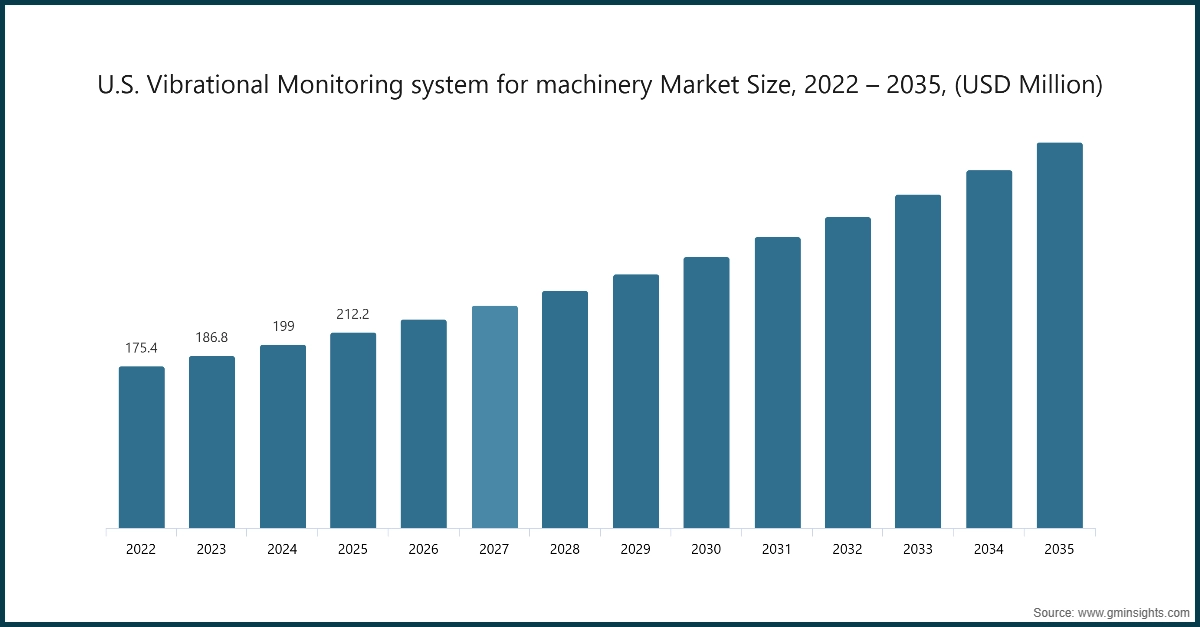
- The U.S. leads the region, holding a staggering 75.6% of the North American market share in 2025. This is driven by massive investments in industrial IoT, predictive maintenance, and the rapid expansion of energy infrastructure.
- The demand in this region is further fueled by a focus on machinery longevity and asset protection, as companies look to reduce unplanned downtime and transition from reactive to proactive maintenance models.
- Canada shows steady growth at a 6.9% CAGR, representing a significant market for specialized oil, gas, and mining vibration monitoring applications
Vibrational Monitoring System for Machinery Market Report Attributes
| Key Takeaway | Details |
|---|---|
| Market Size & Growth | |
| Base Year | 2025 |
| Market Size in 2025 | USD 922.2 Million |
| Market Size in 2026 | USD 978.8 Million |
| Forecast Period 2026-2035 CAGR | 6.5% |
| Market Size in 2035 | USD 1.72 Billion |
| Key Market Trends | |
| Drivers | Impact |
| Shift from preventive to predictive maintenance | Industries are moving away from fixed-schedule repairs to condition-based interventions, reducing maintenance costs by up to 30% and increasing uptime by 20%. |
| Proliferation of IIoT & wireless sensing | The rise of smart factories and "Industry 4.0" necessitates high-density sensor networks that eliminate expensive cabling, boosting the adoption of wireless mesh systems. |
| Critical asset protection in energy & power | Growing investments in renewable energy (wind turbines) and aging power grids drive the need for continuous vibration oversight to prevent catastrophic failures. |
| Pitfalls & Challenges | Impact |
| High initial installation & hardware costs | The upfront CAPEX for high-precision sensors and data acquisition systems remains a barrier for SMEs, leading to phased monitoring rollouts. |
| Shortage of skilled vibration analysts | The complexity of interpreting raw vibration data (FFT, time waveforms) requires specialized expertise, often resulting in a reliance on expensive third-party services. |
| Opportunities: | Impact |
| AI-Powered automated diagnostics | Integrating Machine Learning (ML) to automatically identify faults like bearing wear or misalignment reduces the burden on human analysts and enables real-time alerts. |
| Subscription-based "Monitoring-as-a-Service" | New revenue streams are emerging through SaaS models (Software-as-a-Service), where providers offer hardware and remote cloud analytics for a monthly fee. |
| Market Leaders (2025) | |
| Market Leader |
11% market share |
| Top Players |
Consolidate share of 35% |
| Competitive Edge |
|
| Regional Insights | |
| Largest Market | North America |
| Fastest growing market | Asia Pacific |
| Emerging countries | Saudi Arabia, Brazil, India |
| Future outlook |
|
What are the growth opportunities in this market?
Europe Vibrational Monitoring System for Machinery Market
European growth is increasingly influenced by sustainability initiatives, encouraging the adoption of energy-efficient conveyor drives that align with regional environmental standards.
- Europe is a significant market estimated at USD 180.5 million in 2025 with a projected growth rate of 5.6%. Germany leads the region with a market value of USD 56.6 million in 2025 due to its advanced automotive and high-precision machinery sectors.
- The German market’s strength is attributed to its leadership in Industry 4.0, where heavy-duty rotating assets in manufacturing heavily utilize continuous vibration analysis for quality control.
- The UK follows with a 6.4% CAGR, driven by the modernization of power generation facilities and the adoption of smart sensors in food processing lines.
- European growth is increasingly influenced by sustainability initiatives, encouraging the adoption of vibration monitoring to optimize machine efficiency and reduce the carbon footprint associated with catastrophic mechanical failures.
Asia Pacific Vibrational Monitoring System for Machinery Market
Asia Pacific is the largest and fastest-growing regional market with a projected growth rate of 7.4% from 2022 to 2035.
- China holds the largest market share with a high growth rate of 8.1% driven by massive industrialization, energy demand, and large-scale infrastructure projects.
- India is a key player with a 7.5% CAGR, as manufacturers in the region rapidly shift from manual inspection to automated vibration monitoring platforms to increase production reliability.
- Countries like Japan and South Korea are important for high-tech electronics manufacturing and automotive production, where precision health monitoring of robotic assembly lines is required.
Latin America Vibrational Monitoring System for Machinery Market
Latin America represents a developing segment with a market value of USD 44.1 million in 2025, growing at a rate of 4.6% through 2035.
- Overall growth is steady as increasing industrialization, and a growing mining sector boosts the demand for professional condition monitoring and diagnostic services.
- Mexico shows a steady growth rate of 4.7%, benefiting from its role as a primary manufacturing hub for the North American aerospace and automotive industries.
- While economic variability exists, the long-term trend points toward increased mechanization and the adoption of entry-level vibration sensors to improve regional competitiveness in global heavy industry.
Vibrational Monitoring System for Machinery Market Share
SKF AB is leading with approximately 11% market share. SKF, Baker Hughes, Emerson Electric, Schaeffler AG, and Honeywell International collectively hold around 35%, indicating a moderately fragmented market concentration with a strong tier of dominant global players. These prominent players are proactively involved in strategic endeavors, such as AI-driven software acquisitions, facility expansions, and IIoT collaborations, to expand their product portfolios, extend their reach to a broad customer base, and strengthen their market position
- SKF AB recently enhanced its market footprint by integrating AVEVA’s PI System into its vibration diagnostics portfolio. This strategic move allows for seamless synchronization of vibration and process data, providing a single source of truth for maintenance teams. By integrating sophisticated data-driven tools, SKF reinforces its commitment to reducing unplanned stops and optimizing machine performance through its "Reliable Rotation" initiatives.
- Baker Hughes (Bently Nevada) unveiled an array of new digital monitoring enhancements for its Orbit 60 Series, catering to the oil & gas, power, and heavy manufacturing sectors. The additions include System 1 software updates that feature "Decision Support" capabilities, using real-time vibration data to provide automated diagnostic insights. This technology features high-precision transducers for improved visibility into machinery health even in harsh, high-temperature environments
Vibrational Monitoring System for Machinery Market Companies
Major players operating in the vibrational monitoring system for machinery industry are:
- ABB Ltd.
- Analog Devices, Inc.
- Baker Hughes Company (Bently Nevada)
- Brüel & Kjær (HBK)
- Emerson Electric Co.
- Fluke Corporation
- Honeywell International Inc.
- National Instruments Corp.
- PCB Piezotronics
- Pruftechnik
- Rockwell Automation, Inc.
- Schaeffler AG
- SKF AB
- SPM Instrument AB
- Waites Wireless Sensor Technologies
Fluke Corporation expanded its range of portable vibration tools with the introduction of the Fluke 810 Plus, a system compatible with high-speed production environments. Engineered for optimal productivity, this software-driven handheld tester offers faster on-site diagnostics compared to traditional manual route collection. Unveiled in early 2025, its built-in diagnostic engine identifies mechanical problems by analyzing vibration patterns using specialized logic rather than complex spectrum analysis. The design's advantage lies in providing instant "fault severity" results, eliminating the need for constant analysis by senior engineers during peak production hours
Vibrational Monitoring System for Machinery Market News
- In November 2025, ABB and Samotics announced a significant business integration to strengthen their global market share in high-performance electrical signature and vibration monitoring. Earlier in the year, ABB also expanded its European footprint by acquiring specialized AI diagnostic firms to accelerate the development of "plug-and-play" wireless monitoring systems for the industry 4.0 era.
- In March 2025, Emerson Electric showcased its latest Ovation™ Green asset management systems at the Tech & Innovation Summit, featuring specialized sensors for renewable energy assets. These systems are designed to minimize downtime for wind turbines and battery storage sites. Their new wireless sensor modules allow for high-efficiency monitoring on existing rotating lines, addressing the industry's need for rapid retrofitting without massive infrastructure overhead.
- In April 2025, SKF launched a new manufacturing plant in Tangier, Morocco to meet the rapidly growing demand for magnetic bearings and high-speed motor components in the region. This facility focuses on manufacturing advanced sensors and monitoring hardware for the food, chemical, and energy industries. The plant is a key part of SKF’s strategy to shorten lead times and provide locally engineered diagnostic solutions for the EMEA and global markets.
- In September 2024, Bently Nevada (Baker Hughes) introduced the redesigned Ranger Pro Wireless Sensor, tailored for high-volume industrial logistics. This new iteration boasted robust performance in battery life and range, utilizing high-efficiency data transmission for aggressive monitoring of diverse machine types. Operating with a 10-year battery life, the Ranger Pro addressed the needs of professionals aiming to broaden their monitoring capacity in "dark factories."
- In 2024, Schaeffler AG continued to emphasize its powerful OPTIME wireless series, which uses a high-performance mesh network design to enhance performance in heavy industrial production. This focuses on meeting strict international reliability standards while providing the flexibility required for rapid deployment without the need for complex wiring or constant manual recalibration.
The vibrational monitoring system for machinery market research report includes in-depth coverage of the industry with estimates & forecasts in terms of revenue (USD Million) and volume (Thousand Units) from 2022 to 2035, for the following segments:
Market, By Component
- Hardware
- Software
- Services
Market, By Monitoring Process
- Online
- Portable
Market, By System
- Embedded
- Vibration Analyzers
- Vibration Meter
Market, By Application
- Oil & Gas
- Energy & Power
- Metal & Mining
- Chemical
- Automotive
- Food & Beverages
- Others
The above information is provided for the following regions and countries:
- North America
- U.S.
- Canada
- Europe
- Germany
- UK
- France
- Italy
- Spain
- Asia Pacific
- China
- India
- Japan
- Australia
- South Korea
- Latin America
- Brazil
- Mexico
- Argentina
- Middle East and Africa
- South Africa
- Saudi Arabia
- UAE
Frequently Asked Question(FAQ) :
What is the market size of the vibrational monitoring system for machinery market in 2025?
The market size was USD 922.2 million in 2025, with a CAGR of 6.5% expected through 2035, driven by advancements in IoT-based monitoring systems and increasing demand for predictive maintenance solutions.
What is the projected value of the vibrational monitoring system for machinery market by 2035?
The market is expected to reach USD 1.72 Billion by 2035, fueled by the adoption of smart manufacturing, automated industrial services, and sustainable asset management practices.
What is the projected size of the vibrational monitoring system for machinery market in 2026?
The market is expected to reach USD 978.8 million in 2026.
How much revenue did the portable monitoring segment generate in 2025?
The portable monitoring segment generated USD 506.7 million in 2025, leading the market with a 54.9% share due to its cost-effectiveness and flexibility for non-critical assets.
What was the valuation of the hardware segment in 2025?
The hardware segment held 58.5% market share and generated USD 539.5 million in 2025, driven by the integration of MEMS technology and wireless connectivity.
Which region leads the vibrational monitoring system for machinery market?
North America led the market with a 2025 valuation of USD 280.6 million, accounting for a 7% CAGR through 2035. The U.S. dominated the region with a 75.6% share, driven by investments in industrial IoT and predictive maintenance.
What are the upcoming trends in the vibrational monitoring system for machinery industry?
Key trends include the adoption of AI-powered wear prediction algorithms, edge analytics, energy-efficient sensors, and the increasing focus on Industry 4.0 and sustainable operational environments.
Who are the key players in the vibrational monitoring system for machinery market?
Key players include ABB Ltd., Analog Devices, Inc., Baker Hughes Company (Bently Nevada), Brüel & Kjær (HBK), Emerson Electric Co., Fluke Corporation, Honeywell International Inc., National Instruments Corp., PCB Piezotronics, Pruftechnik, Rockwell Automation, Inc., Schaeffler AG, SKF AB, SPM Instrument AB, and Waites Wireless Sensor Technologies.
Vibrational Monitoring System for Machinery Market Scope
Related Reports