Summary
Table of Content

Vertical Wind Turbine Market
Get a free sample of this report
Form submitted successfully!
Error submitting form. Please try again.
Thank you!
Your inquiry has been received. Our team will reach out to you with the required details via email. To ensure that you don't miss their response, kindly remember to check your spam folder as well!
Request Sectional Data
Thank you!
Your inquiry has been received. Our team will reach out to you with the required details via email. To ensure that you don't miss their response, kindly remember to check your spam folder as well!
Form submitted successfully!
Error submitting form. Please try again.
Vertical Wind Turbine Market Size
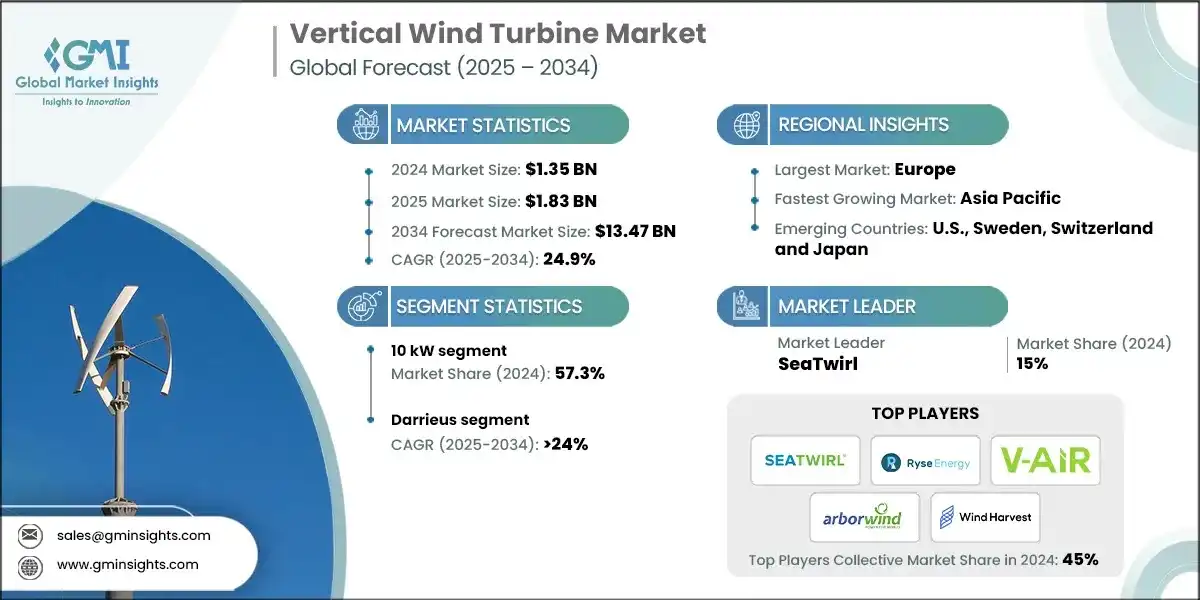
The vertical wind turbine market size was valued at more than USD 1.35 billion in 2024. The market is expected to grow from USD 1.83 billion in 2025 to USD 13.47 billion by 2034, at a CAGR of 24.9%, according to Global Market Insights, Inc.
Vertical Wind Turbine Market Key Takeaways
Market Size & Growth
- 2024 Market Size: USD 1.35 Billion
- 2025 Market Size: USD 1.83 Billion
- 2034 Forecast Market Size: USD 13.47 Billion
- CAGR (2025–2034): 24.9%
Key Market Drivers
- Policy Support and Incentives.
- Urban Integration Requirements.
- Technological Advancements.
Challenges
- Efficiency Gap.
- Higher capital costs.
Opportunity
- Growing turbine efficiencies.
- Adoption across distributed energy generation.
- Integration of smart systems and AI.
Key Players
- Market Leader: SeaTwirl led with over 15% market share in 2024.
- Leading Players: Top 5 players in this market include SeaTwirl, Ryse Energy, V-Air, ArborWind, Wind Harvest International, which collectively held a market share of 45% in 2024.
Get Market Insights & Growth Opportunities
- Adoption of vertical wind turbines (VAWTs) is steadily gaining traction as industries and governments explore decentralized and sustainable wind energy solutions suited for diverse site conditions. They operate efficiently in turbulent and multidirectional wind flows, making them ideal for urban, coastal, and complex terrain environments.
- Rising utilization in distributed energy generation along with increasing demand for small and medium-scale renewable systems, will encourage the installation of VAWTs in residential, commercial, and hybrid microgrid applications. Many emerging economies are also showing interest in compact vertical designs due to lower installation space requirements and reduced noise levels, facilitating adoption near populated or industrial areas.
- Technological innovation including advanced aerodynamic modeling, composite blade materials, and enhanced power electronics will improve the turbine performance and reliability. Introduction of new designs that enhance torque output, durability, and energy capture efficiency, especially under low-wind conditions will augment the vertical wind turbine market landscape.
- Integration with smart monitoring systems and IoT-based predictive maintenance will reduce the operational costs. Ongoing development of hybrid vertical turbine systems, combining Darrieus and Savonius configurations, will widen the operational wind range and improve the start-up capabilities, positioning VAWTs as a viable option for decentralized and hybrid energy systems.
- The turbines are witnessing growing adoption across urban and onshore environments. Their ability to generate power close to demand centers aligns with smart city and sustainable infrastructure initiatives. Urban developers and municipalities are installing vertical turbines on rooftops, building facades, and industrial estates to complement solar PV systems and reduce grid dependence, driving the vertical wind turbine market scenario.
- Onshore deployment is particularly favorable owing to easier installation and maintenance compared to offshore sites. Introduction of hybrid farms integrating small VAWTs to improve the land-use efficiency and power density in constrained or low-wind sites will contribute to the industry momentum.
- Supportive policies for distributed renewable systems across the Europe, North America, and parts of Asia Pacific will enhance the turbine demand. The Middle East and Latin America are showing early-stage interest, especially for remote power and microgrid projects in low-wind zones. In Africa, small-scale VAWTs are being used for rural electrification in off-grid communities, leading to vertical wind turbine market growth.
- Research efforts are focusing on scaling up multi-megawatt VAWTs and hybrid configurations suited for both land and offshore conditions. Key features including silent operation, easier maintenance, and lower visual impact make them particularly attractive for urban and semi-urban applications. The vertical turbines are anticipated to complement in decentralized clean energy systems, especially where land use, aesthetics, or turbulent wind conditions limit conventional turbine deployment.
- Modern VAWT designs have benefited from computational fluid dynamics (CFD) modeling and wind tunnel testing, leading to optimized blade shapes that reduce drag and enhance torque generation. For instance, helical-bladed Darrieus turbines minimize pulsating torque, allowing smoother rotation and better performance in variable wind conditions. Hybrid systems that integrate Darrieus lift-based and Savonius drag-based principles are emerging as a key innovation combining high efficiency with superior low-speed performance. These advancements have improved overall energy capture efficiency by up to 15-25% compared to earlier VAWT generations.
- Ongoing R&D efforts are targeting megawatt-scale vertical turbines for offshore deployment. Companies like SeaTwirl AB are developing floating vertical-axis turbines designed to simplify installation and maintenance at sea by housing all heavy components near the water surface. These designs reduce structural stress and improve stability, offering a potential alternative to horizontal offshore turbines in deep waters. Several EU-funded programs, including H2020 and ETIPWind, are actively supporting prototype development for VAWTs, augmenting the vertical wind turbine market growth.
- Modern VAWTs are designed with low tip-speed ratios, significantly reducing aerodynamic noise an important factor for urban and residential applications. Furthermore, compact vertical designs and aesthetic customization, makes them more acceptable in city landscapes and architectural integrations such as building-mounted or canopy-based systems stimulating the product penetration.
To get key market trends
Vertical Wind Turbine Market Trends
- Introduction of net metering policies and utility interconnection standards that facilitate renewable energy integration will lead to market growth. These systems benefit from simplified installation procedures, standardized interconnection requirements, and revenue generation through excess power sales. Moreover, grid-connected vertical turbines serve both residential and commercial markets, providing energy cost reduction and grid support services. The segment's growth is supported by smart grid infrastructure development and distributed energy resource integration programs.
- Ongoing utility-scale distributed generation programs and corporate renewable energy procurement initiatives coupled with advanced control systems and grid-tie inverters enable seamless integration with existing electrical infrastructure, will support the growing demand for distributed energy resources. Furthermore, the implementation of artificial intelligence and machine learning technologies in vertical wind turbine control systems represents an emerging trend with significant growth potential.
- The integration of IoT connectivity enables remote monitoring and control capabilities, reducing operational costs and improving system availability. This trend is particularly important for distributed installations where manual monitoring and maintenance would be cost-prohibitive, contributing to the overall business statistics. Moreover, integration of artificial intelligence will fundamentally transform Vertical Wind Turbine efficiency and economics, leading to product penetration.
Vertical Wind Turbine Market Analysis
Learn more about the key segments shaping this market
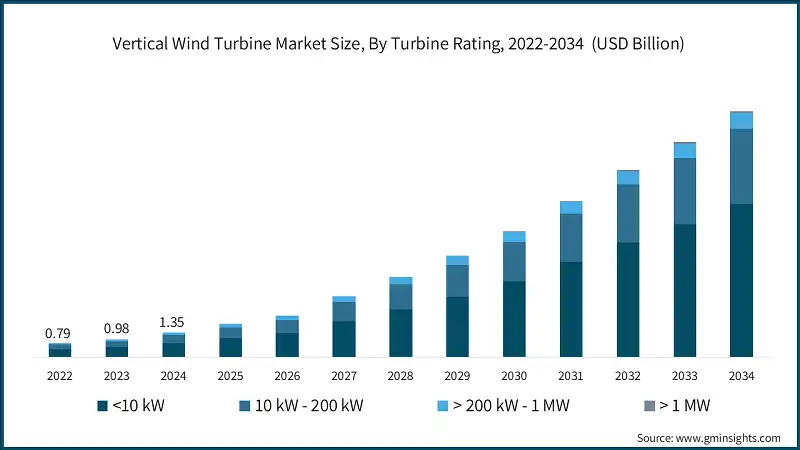
- Based on turbine rating, the market is segmented into <10 kW, 10 kW to 200 kW, > 200 kW to 1 MW and > 1 MW. The 10 kW segment dominated the market with 57.3% share in 2024, with a CAGR of 25.5% expected through 2034 serving residential and small commercial applications where space constraints and noise considerations favor vertical designs.
- <10 kW vertical turbines benefit from simplified installation requirements, reduced permitting complexity, and lower infrastructure costs, augmenting the business landscape. The segment's growth is supported by declining manufacturing costs, improved efficiency ratings, and expanding residential renewable energy adoption driven by net metering policies and environmental consciousness. Additionally, technology improvements in permanent magnet generators and power electronics have enhanced the viability of turbines, driving the vertical wind turbine market scenario.
- 10 kW - 200 kW segment will grow more than 24% CAGR by 2034 on account of the advantages offered in distributed generation applications, providing grid support and reducing peak demand charges for commercial users. Policy incentives including accelerated depreciation and production tax credits enhance the economic attractiveness of medium-scale installations, leading to product penetration.
- The >200 kW to 1 MW market hold 18.6% market share in 2024 driven primarily by offering advantages in turbulent wind conditions and reduced land use requirements. Ongoing incorporation of advanced materials and sophisticated control systems to optimize performance across varying wind conditions will contribute to the turbine demand. The segment's growth is further supported by utility-scale distributed generation programs and corporate renewable energy procurement initiatives, will augment the vertical wind turbine market growth.
- The > 1 MW segment will cross more than USD 115 million by 2034, on account of emerging opportunities in large-scale renewable energy projects. Technological improvements and specific site requirements create niche applications for utility-scale vertical systems, leading to market growth. This segment additionally benefits from economies of scale and advanced manufacturing techniques that reduce the per-unit costs.
Learn more about the key segments shaping this market
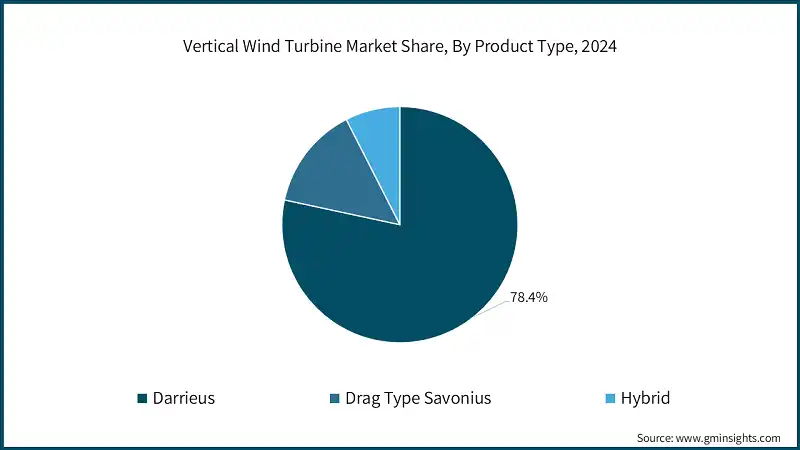
- Based on product type, the vertical wind turbine market is segmented into Darrieus, Drag type Savonius and Hybrid. The darrieus segment dominates with 78.4% market share and is anticipated to register over 24% CAGR till 2034. Key factors comprising of better conversion efficiency in many operating regimes, ability to operate effectively at a wider range of wind speeds and increasing utilization in urban, rooftop, and distributed energy will lead to the process adoption.
- The drag type savonius turbines holds 14.1% market share and is anticipated to grow over 25.5% CAGR through 2034, driven by their used in low-wind-speed, urban or rooftop, and off-grid/rural applications. Further, the turbines don’t need large foundations or high wind sites, thereby augmenting the market growth. These turbines are being re-engineered with multi-stage rotors and twisted blades for higher start-up torque and improved self-starting ability, enhancing the turbine installation.
- Hybrid wind turbines include the self-starting capability of Savonius rotors with the higher efficiency of darrieus rotors and will grow more than USD 1.4 billion by 2034. These are often targeted at urbans, rooftops, microgrids, telecom towers, where the wind speeds are variable and self-starting is important. They further allow more reliable energy capture in challenging wind conditions which will drive the industry scenario. Moreover, growing adoption of building-integrated renewables and hybrid renewable power systems will institute a favorable business momentum.
Looking for region specific data?
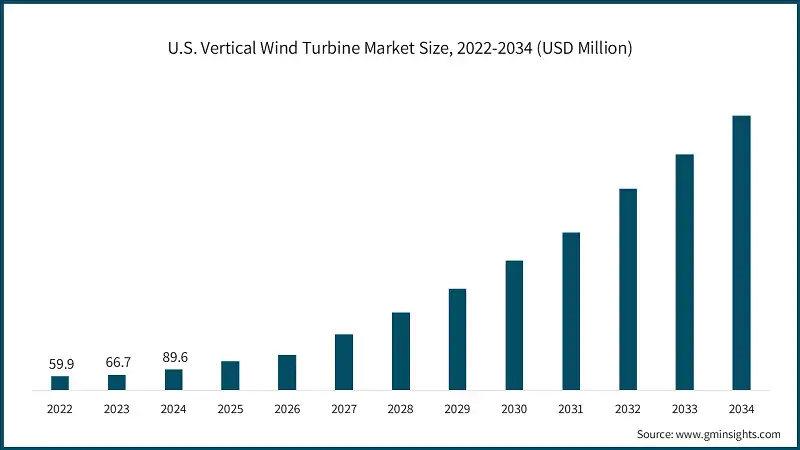
- The U.S. vertical wind turbine market recorded a valuation of USD 59.9 million in 2022, reached USD 66.7 million in 2023 and will reach USD 89.6 million by 2024. North America accounted for 9.3% of the global market share in 2024 supported by supportive policy frameworks and established distributed wind programs.
- The United States dominates the regional growth through the Inflation Reduction Act incentives, DOE-USDA rural energy programs, and state-level renewable energy standards. The region benefits from mature wind energy infrastructure, experienced installation networks, and favorable financing mechanisms that support vertical turbine adoption. Canada further contributes significant growth through provincial renewable energy programs and remote community electrification initiatives.
- Europe maintains 57.7% market share in 2024 and is anticipated to grow to 20.5% CAGR expected through 2034, supported by EU renewable energy directives and carbon reduction commitments. The region's focus is on distributed energy resources and grid modernization creates favorable conditions for vertical turbine adoption. Key countries including Germany, United Kingdom, and Nordic countries lead regional development through technology innovation and supportive regulatory frameworks, leading to market growth.
- Asia Pacific represents the fastest-growing region with 28.5% CAGR anticipated by 2034 led by China, India, and Southeast Asian markets. The region's growth is driven by rapid urbanization, energy security concerns, and government commitments to renewable energy expansion. China's manufacturing capabilities and domestic market development create cost advantages and technology innovation that benefit global market expansion. India's distributed generation policies and rural electrification programs provide substantial growth opportunities for vertical wind turbine deployment.
- The Middle East and Africa region has a steady increase in the turbine adoption, especially in off-grid and hybrid systems. Growing interest in Africa for wind turbines particularly in rural, off-grid communities along with urban/building-integrated installations in the cities will complement the business landscape. In addition, increasing renewable energy goals and policy support for diversified technologies will contribute to the business momentum.
Vertical Wind Turbine Market Share
- The top five players operating in the industry include SeaTwirl, V-Air, Ryse Energy, V-Air, and ArborWind. Major players operating in the global vertical wind turbine industry include a diverse range of companies spanning from established wind energy manufacturers to specialized vertical turbine developers, each contributing unique technologies and market approaches that collectively drive industry innovation and growth.
- The industry has experienced moderate M&A activity with strategic acquisitions focused on technology integration, market expansion, and manufacturing consolidation. Recent transactions include component supplier acquisitions, technology licensing agreements, and joint ventures for market development in emerging regions. The trend toward vertical integration among leading players aims to control critical technologies, reduce supply chain risks, and capture additional value across the manufacturing and installation process.
- Future consolidation is expected to accelerate as the market matures and competition intensifies, with larger players seeking to acquire innovative technologies, expand geographic presence, and achieve manufacturing economies of scale. Private equity and strategic investors are showing increased interest in the sector, providing capital for growth initiatives and technology development that will influence competitive dynamics through the forecast period.
- Leading companies are pursuing differentiated strategies to maintain competitive positions and capture growth opportunities. Technology leaders focus on efficiency improvements, advanced materials, and smart control systems to justify premium pricing and expand market applications. Cost leaders emphasize manufacturing scale, supply chain optimization, and standardized product offerings to compete in price-sensitive segments. Market specialists target specific applications or geographic regions where vertical turbines offer distinct advantages over alternative technologies.
- SeaTwirl focuses on developing floating vertical-axis wind turbines (VAWTs) that are designed for deep-water offshore installations. The company generated an overall revenue of USD 0.68 million in the year 2024. In September 2025, the Verti-Go project secured USD 17.2 million from Horizon Europe to demonstrate the company’s floating wind technology with a 2 MW turbine, including the design, fabrication, installation and operation.
Vertical Wind Turbine Market Companies
Eminent players operating in the vertical wind turbine industry are:
- ArborWind
- Aeolos Wind Energy
- Hi-VAWT Technology
- Flower Turbines
- Ryse Energy
- SeaTwirl
- Mariah Power
- Urban Green Energy
- Whirlwind Wind Turbines
- WindHarvest International
- Windside Production
- Windspire Energy
- V-Air
- Vertogen
- V-Air leads the market through comprehensive vertical wind turbine solutions designed for urban and distributed applications. Its proprietary helical blade design optimizes performance in turbulent wind conditions common in urban environments, while their manufacturing facilities in multiple countries provide global supply chain capabilities. In late 2016, the wind energy division was renamed V-AIR, and acquired by UGE’s Chinese shareholders, who continued to operate the factory and expand the Beijing presence.
- ArborWind specializes in small-scale vertical turbines designed for residential and remote applications, with particular emphasis on off-grid and hybrid renewable energy systems. The company's products incorporate advanced power electronics and battery integration capabilities that optimize energy storage and utilization. The company’s market strategy targets rural and remote locations where grid connection costs make distributed generation economically attractive.
- Aeolos Wind Energy operates as a comprehensive wind energy solutions provider with vertical turbine offerings spanning small residential units to larger commercial installations. The company's global manufacturing network includes facilities in China and North America, providing cost advantages and regional market access. It further emphasizes standardized product designs and manufacturing efficiency to compete effectively in price-sensitive market segments while maintaining quality standards through ISO certification processes.
- Windspire Energy focuses on innovative vertical axis designs that optimize performance through advanced blade profiles and magnetic levitation bearing systems that reduce maintenance requirements. The company's technology portfolio includes patented designs for improved starting torque and enhanced performance in low wind speed conditions. The market approach further emphasizes distributed generation applications and grid-tie systems that provide energy cost reduction for commercial and industrial customers.
Vertical Wind Turbine Market Report Attributes
| Key Takeaway | Details |
|---|---|
| Market Size & Growth | |
| Base Year | 2024 |
| Market Size in 2024 | USD 1.35 Billion |
| Market Size in 2025 | USD 1.83 Billion |
| Forecast Period 2025 - 2034 CAGR | 24.9% |
| Market Size in 2034 | USD 13.47 Billion |
| Key Market Trends | |
| Drivers | Impact |
| Policy Support and Incentives | Government initiatives including the Inflation Reduction Act and DOE-USDA distributed wind programs are accelerating the market adoption. |
| Urban Integration Requirements | Space limitations and aesthetic considerations in urban environments favor vertical designs over traditional horizontal turbines. |
| Technological Advancements | Improvements in blade design, materials, and control systems enhancing efficiency and reducing maintenance costs |
| Pitfalls & Challenges | Impact |
| Efficiency Gap | Lower power coefficients compared to horizontal axis wind turbines limiting large-scale commercial adoption. |
| Higher capital costs | Initial investment costs remain 15-25% higher than conventional wind systems affecting market penetration. |
| Opportunities: | Impact |
| Growing turbine efficiencies | Integration of advanced blade design technologies and aerodynamic optimization techniques are significantly improving vertical wind turbine efficiency by 20-90% across various configurations. |
| Adoption across distributed energy generation | Growing adoption in urban and distributed energy applications driven by space constraints and noise reduction requirements in densely populated areas. |
| Integration of smart systems and AI | Implementation of machine learning and AI-based control systems enabling real-time performance optimization and predictive maintenance capabilities. |
| Market Leaders (2024) | |
| Market Leaders |
15% market share |
| Top Players |
Collective market share in 2024 is 45% |
| Competitive Edge |
|
| Regional Insights | |
| Largest Market | Europe |
| Fastest Growing Market | Asia Pacific |
| Emerging Country | U.S., Sweden, Switzerland and Japan |
| Future Outlook |
|
What are the growth opportunities in this market?
Vertical Wind Turbine Industry News
- In October 2024, the U.S. Department of Energy announced expanded funding for distributed wind research and development programs, allocating USD 25 million specifically for vertical axis wind turbine technology advancement and demonstration projects. The initiative focuses on improving efficiency ratings, reducing manufacturing costs, and validating performance in diverse operating environments. This funding supports collaborative research between national laboratories, universities, and private companies to accelerate technology commercialization and market adoption.
- In September 2024, UGE International completed installation of its largest vertical wind turbine project to date, deploying 150 units across multiple commercial sites in California. The project demonstrates the scalability of vertical turbine technology for distributed generation applications and provides valuable performance data for future installations. The successful deployment validates the company's manufacturing capabilities and installation expertise while generating significant revenue and market visibility.
- In July 2024, Windstalk announced breakthrough efficiency improvements in its helical blade design, achieving 35% higher power output compared to previous generation products. The advancement results from advanced computational fluid dynamics modeling and extensive wind tunnel testing that optimized blade geometry and pitch angles. This technological progress addresses the primary limitation of vertical turbines compared to horizontal axis systems and enhances commercial competitiveness.
This vertical wind turbine market research report includes an in-depth coverage of the industry with estimates & forecast in terms of revenue and volume in “USD Million and MW” from 2021 to 2034, for the following segments:
Market, By Turbine Rating
- <10 kW
- 10 kW - 200 kW
- > 200 kW - 1 MW
- > 1 MW
Market, By Connectivity
- Grid connected
- Standalone
- Hybrid
Market, By Installation
- Onshore
- Offshore
Market, By Product Type
- Darrieus
- Drag Type Savonius
- Hybrid
Market, By Application
- Residential
- Commercial & Industrial
- Utility
The above information has been provided for the following regions and countries:
- North America
- U.S.
- Canada
- Mexico
- Europe
- Switzerland
- Sweden
- France
- UK
- Finland
- Asia Pacific
- China
- India
- Japan
- Australia
- Middle East & Africa
- UAE
- South Africa
- Latin America
- Brazil
Frequently Asked Question(FAQ) :
What is the market size of the vertical wind turbine in 2024?
The market size was USD 1.35 billion in 2024, with a CAGR of 24.9% expected through 2034 driven by rising adoption of VAWTs for decentralized and site-flexible wind energy solutions.
What is the projected value of the vertical wind turbine market by 2034?
The vertical wind turbine market is expected to reach USD 13.47 billion by 2034, propelled by technological advancements, urban integration requirements, and growing distributed energy generation.
What is the current vertical wind turbine market size in 2025?
The market size is projected to reach USD 1.83 billion in 2025.
How much market share did the Darrieus segment hold in 2024?
Darrieus turbines dominated with 78.4% market share in 2024, led by better conversion efficiency and ability to operate effectively at wider range of wind speeds.
What was the valuation of the <10 kW turbine rating segment in 2024?
The <10 kW segment held 57.3% market share in 2024, serving residential and small commercial applications where space constraints and noise considerations favor vertical designs.
What is the growth outlook for the Asia Pacific region from 2025 to 2034?
Asia Pacific represents the fastest-growing region with 28.5% CAGR anticipated by 2034, led by China, India, and Southeast Asian markets driven by rapid urbanization and energy security concerns.
Which region leads the vertical wind turbine market?
North America accounted for 9.3% of the market share in 2024, supported by supportive policy frameworks and established distributed wind programs.
What are the upcoming trends in the vertical wind turbine market?
Key trends include integration of AI and machine learning in control systems, IoT-based predictive maintenance, hybrid turbine configurations combining Darrieus and Savonius designs, and floating offshore VAWT development.
Who are the key players in the vertical wind turbine market?
Key players include SeaTwirl, Ryse Energy, V-Air, ArborWind, Wind Harvest International, Aeolos Wind Energy, Hi-VAWT Technology, Flower Turbines, Mariah Power, Urban Green Energy, Whirlwind Wind Turbines, Windside Production, Windspire Energy, and Vertogen.
Vertical Wind Turbine Market Scope
Related Reports