Summary
Table of Content

Vertical Farming Automation System Market
Get a free sample of this report
Form submitted successfully!
Error submitting form. Please try again.
Thank you!
Your inquiry has been received. Our team will reach out to you with the required details via email. To ensure that you don't miss their response, kindly remember to check your spam folder as well!
Request Sectional Data
Thank you!
Your inquiry has been received. Our team will reach out to you with the required details via email. To ensure that you don't miss their response, kindly remember to check your spam folder as well!
Form submitted successfully!
Error submitting form. Please try again.
Vertical Farming Automation System Market Size
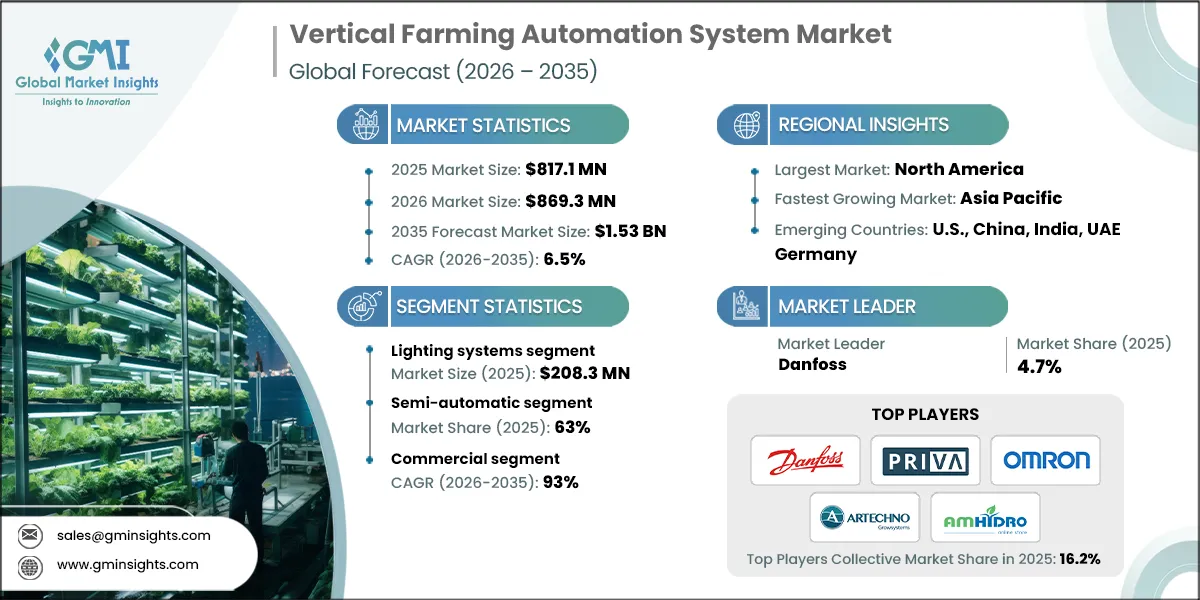
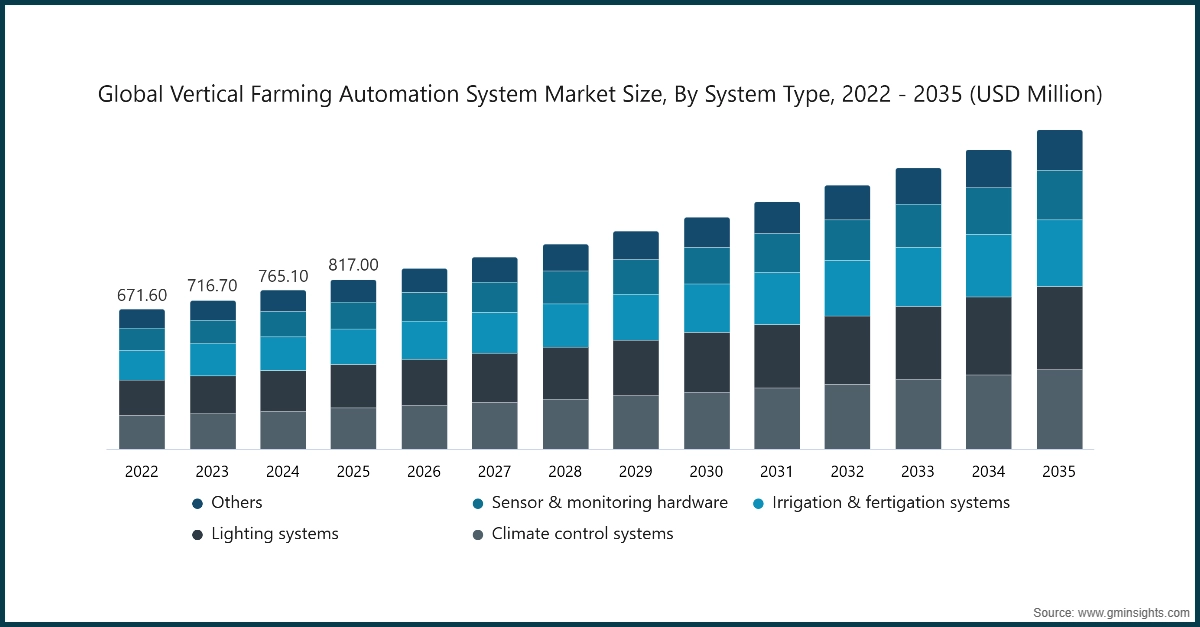
The global vertical farming automation system market was estimated at USD 817.1 million in 2025. The market is expected to grow from USD 869.3 million in 2026 to USD 1.53 billion in 2035, at a CAGR of 6.5% according to latest report published by Global Market Insights Inc.
Vertical Farming Automation System Market Key Takeaways
Market Size & Growth
- 2025 Market Size: USD 817.1 Million
- 2026 Market Size: USD 869.3 Million
- 2035 Forecast Market Size: USD 1.53 Billion
- CAGR (2026–2035): 6.5%
Regional Dominance
- Largest Market: North America
- Fastest Growing Region: Asia Pacific
Key Market Drivers
- Increasing demand for sustainable agricultural practices.
- Rising adoption of automation technologies.
Challenges
- High initial investment costs.
- Technical complexities and maintenance requirements.
Opportunity
- Advancements in IoT and AI technologies.
- Expansion into emerging markets.
Key Players
- Market Leader: Danfoss led with over 4.7% market share in 2025.
- Leading Players: Top 5 players in this market include Danfoss, Priva, OMRON, Artechno Growsystems, American Hydroponics, which collectively held a market share of 16.2% in 2025.
Get Market Insights & Growth Opportunities
The market for vertical farming automation systems is growing because of the increasing requirement for sustainable agricultural practices and the need to optimize crop production in a limited area.
Vertical farming, which entails the growth of crops in vertically stacked layers, has been on the rise owing to its efficiency in yielding higher produce while consuming lower resources. Automation systems are integral to the optimization of these farming processes.
The market is also benefiting from government support and subsidies to promote sustainable agricultural practices. The increasing awareness about the environmental advantages of vertical farming, including water conservation and the avoidance of pesticides, is also contributing to the growth of the market.
According to the World Economic Forum, the indoor vertical farming industry raised significant funding of USD 2.4 billion in the year 2022. In the United States, regions differ from others regarding the ability to support vertical farming in most cities.
For instance, Realty Income and Plenty Unlimited entered into a partnership to facilitate the growth of indoor vertical farms by Plenty. This partnership requires Realty Income to purchase and develop facilities that will house indoor Plenty farms. This partnership offers up to a maximum of USD 1 billion development capacity, of which Realty Income is to invest an initial amount of USD 42 million in the first indoor vertical farm of Plenty.
Technologies such as the use of artificial intelligence (AI), Internet of Things (IoT), and robotics, as well as technological improvements, are also contributing to the increased use of automation systems in vertical farming. This technology allows for the control and regulation of environmental factors such as temperature, humidity, and light.
Rising urban population and the need for food security are factors that promote the use of vertical farming technology, thus increasing the demand for automation systems.
To get key market trends
Vertical Farming Automation System Market Trends
- Vertical farming has also seen the increasing use of artificial lighting, with advanced LED technology being an important part of the process that mimics ideal lighting conditions necessary for different plants.
- By the year 2025, the market for LED lighting in vertical farming is projected to grow because of the high energy efficiency and low operating costs of LEDs. Additionally, LEDs provide the ability to customize the spectrum of the light depending on the stage of the plants.
- The minimal heat emission of LEDs makes it possible to install lighting close to crops, utilizing available space to the full. New developments in dynamic full-spectrum lighting make it possible to vary the emission spectrum and intensity during growth stages to speed up growth, boost yields, and improve nutrient content.
- The use of modular and containerized farming systems is an important innovation that has been introduced to the world of vertical farming because of the speed and scalability that they provide to the farming process. These farming systems can be erected in areas where space is limited, including disaster zones. These farming systems find use across various sectors.
- The use of renewable resources, like solar panels and windmills, makes the carbon footprint of vertical farming lower. The use of energy recovery systems and HVAC systems also makes farming sustainable. The internet of things (IoT) devices and data analysis tools help in the monitoring and control of growing. This makes the farming practices precise.
- Due to the increasing rate of urbanization, cities are turning into centers for vertical farm construction. Vertical farms minimize the need to transport farm products, and as a result, the produce remains fresh and there are fewer carbon emissions. Venture capital and government support are fueling the growth of vertical farm startups.
- Vertical farms, which started off as a means of growing leafy greens and herbs, have begun to test the feasibility of growing a variety of produce, such as strawberries, tomatoes, wheat, and even rice.
Vertical Farming Automation System Market Analysis
Learn more about the key segments shaping this market
Based on the system type, the vertical farming automation system market is divided into climate control systems, lighting systems, irrigation & fertigation systems, sensor & monitoring hardware and others. In 2025, lighting systems dominated the market generating revenue of USD 208.3 million and expected to grow at a CAGR of 6.7% during the forecast period.
- The demand for climate control systems in vertical farming is increasing because of the need to manage the climate in a precise manner. Climate control systems allow the temperature, humidity, and CO2 levels to be optimized, resulting in uniform crop production. Technological innovations, including AI-based climate control systems, are improving efficiency and cutting down on operational costs.
- Lighting systems constitute an essential part of vertical farming, as lighting has a direct impact on plant growth and production. The trend towards the use of energy-saving LED lighting technology is also prominent due to their ability to offer customized light spectrums depending on the type of plant being grown.
- The sensor and monitoring hardware component is emerging due to the growing importance of data-driven agriculture. This technology enables farmers to monitor the key parameters such as the moisture content of the soil, nutrient levels, and health of the crops.
Learn more about the key segments shaping this market
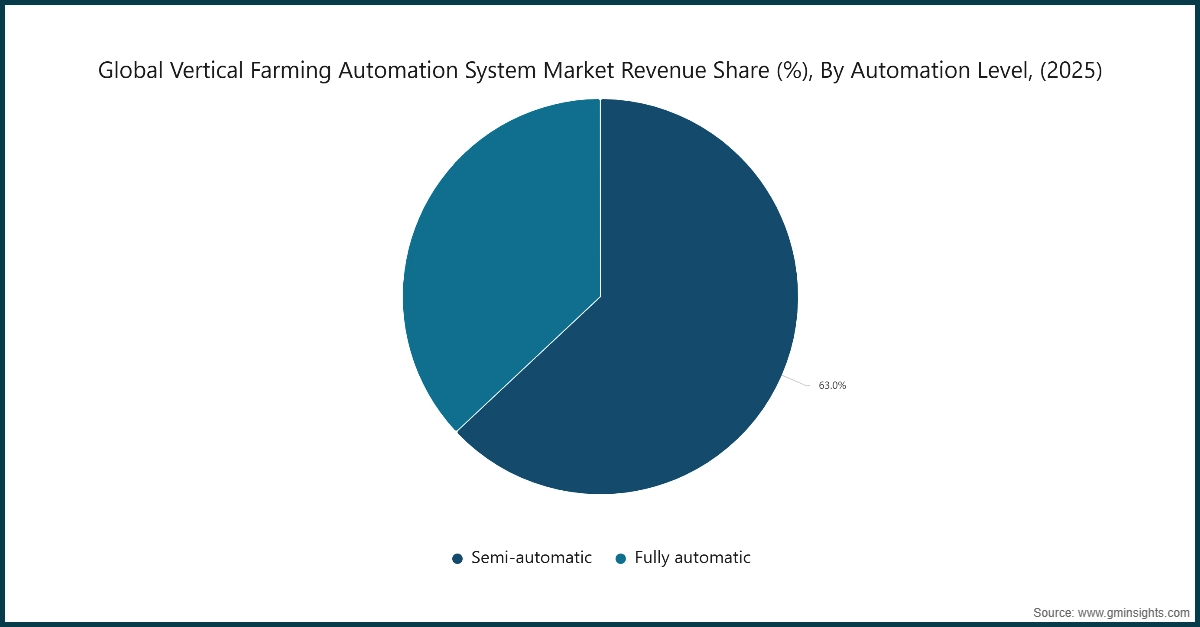
Based on automation level, the vertical farming automation system market is segmented into semi-automatic and fully automatic. In 2025, semi-automatic segment dominates the market with 63% market share, and the segment is expected to grow at a CAGR of 6.2% from 2026 to 2035.
The semi-automatic segment is witnessing steady growth as it offers a balance between cost and efficiency. These systems are particularly popular among mid-sized vertical farming operations that aim to enhance productivity without incurring the high costs associated with fully automated systems.
- The fully automatic segment is experiencing significant growth, fueled by the rising demand for high-efficiency farming solutions and the need to optimize resource utilization. These systems leverage advanced technologies, including artificial intelligence, IoT, and robotics, to automate processes such as planting, monitoring, and harvesting.
- Fully automated systems are particularly favored by large-scale vertical farming operations and urban farming initiatives aiming to maximize yield and minimize labor costs.
Based on end users, the vertical farming automation system market is segmented into individual/residential and commercial. In 2025, the commercial segment dominates the market and is expected to grow at a CAGR of 93% from 2026 to 2035.
- The residential/individual segment in the vertical farming automation system market is witnessing steady growth due to increasing consumer interest in sustainable and self-reliant food production. Urban households are adopting vertical farming systems to grow fresh produce in limited spaces, driven by rising awareness of food security and the benefits of pesticide-free crops.
- The commercial segment dominates the vertical farming automation system market, fueled by the rising demand for large-scale, efficient food production to meet urban population needs. Commercial vertical farms are leveraging automation technologies, including robotics, AI, and IoT, to optimize crop yield, reduce labor costs, and ensure consistent quality.
Looking for region specific data?
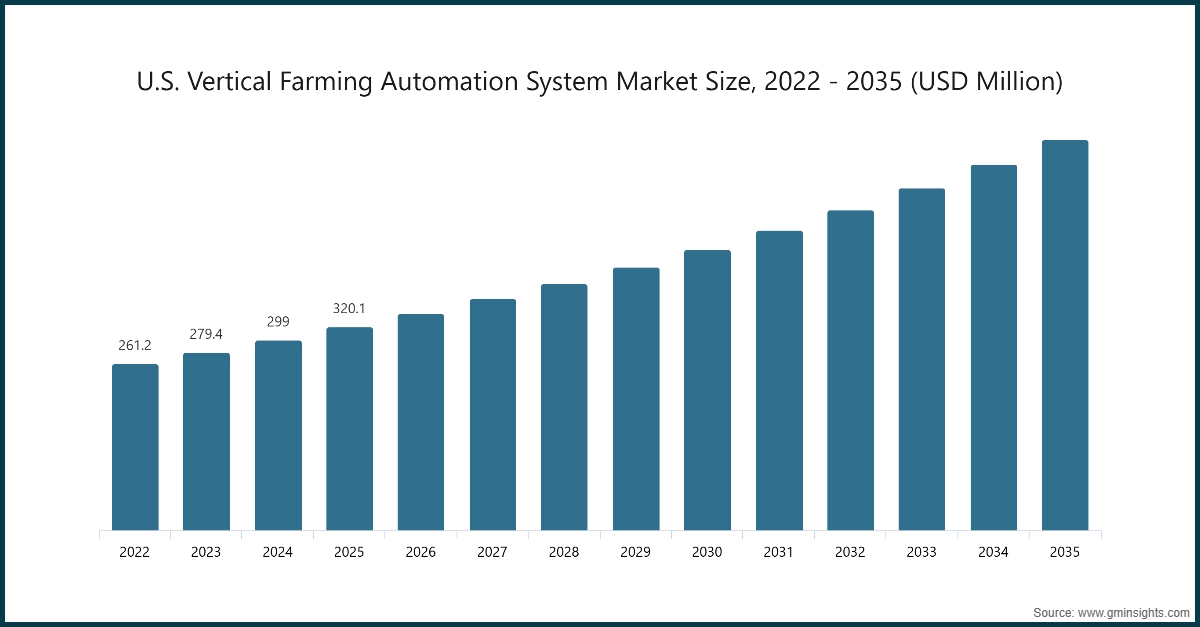
In terms of country, the United States led the vertical farming automation system market with 77% of the North American market share and estimated USD 320.1 million in revenue during 2025.
- The growth of the US vertical farming automation market is led by the increasing demand for sustainable agriculture, urbanization, and the demand to increase the efficiency of food production.
- Large cities like New York, Chicago, Los Angeles, and San Francisco have also witnessed the emergence of commercial and research-based vertical farming, aimed at both high-end youth and underserved populations.
- Urban farming solutions are being increasingly implemented inside the city boundaries, from the top of buildings to warehouses and even ex-office buildings, bringing the farm right inside the heart of the city, thereby cutting the distance that the food travels from the farm to the plate.
- Vertical farming in the USA has been contributing to fulfilling the global environmental objective of cutting down on emissions, minimizing waste, and assisting carbon foot-printing projects that monitor, report, and reduce emissions from agriculture.
- Research grants and infrastructural incentives are being provided by the federal and local governments, and this has encouraged investors and entrepreneurs who are interested in benefiting from the developing vertical farm solution market.
The Europe vertical farming automation system market was valued at USD 240.4 million in 2025 and is projected to grow at a CAGR of 6.2% between 2026 and 2035.
- Rise in the use of advanced technologies like robotics, IoT, and AI is propelling the use of automation systems in vertical farming in the Europe market.
- Germany, the Netherlands, and the UK are among the key players driving the market due to their intense focus and development in sustainable agriculture and technology.
- The increasing need for effective food production systems, owing to the rising population and urbanization, is adding to the market’s momentum.
The Asia Pacific vertical farming automation system market was valued at USD 139.2 million in 2025 and is projected to grow at a CAGR of 7.1% between 2026 and 2035.
- The driving factors for the growth of the region of Asia-Pacific include urbanization, the need for sustainable agriculture, and automation technology.
- Countries like China, Japan, and India are at the forefront in adopting vertical farming systems because they lack arable land and need increased crop production.
- Government initiatives regarding smart farming and new innovations in technology are also boosting the growth of this market.
The Middle East and Africa vertical farming automation system market was valued at USD 10.8 million in 2025 and is projected to grow at a CAGR of 6.1% between 2026 and 2035.
- The Middle East & Africa market for the automation system in vertical farming is growing, driven by the rising demand for sustainable agricultural practices. The United Arab Emirates continues its investment in the technologies of indoor farms as two contracts have been awarded as per the Abu Dhabi Agriculture and Food Safety Authority (ADAFSA), the first (valued at USD 71 million) being awarded to Emirates Hydroponics Farms for the establishment of a hydroponic farm for the production of vegetables, fruits, and mushrooms.
- The second contract was signed with the Emirates International Agricultural Advanced Company for the establishment of the Aquaponic farm that would cost approximately USD 13.6 million and would measure 750,000 square meters.
Vertical Farming Automation System Market Share
- The top 5 companies in the vertical farming automation system industry are Danfoss, Priva, OMRON, Artechno Growsystems, American Hydroponics collectively hold a share of 16.2% in the market.
- These companies continue to acquire and merge with others, expand facilities, and make various collaborations to increase their product offerings, access customer bases, and secure their market positions.
- Danfoss is able to tap into the vertical farming automation system market by utilizing its advanced climate control solutions. The company offers sustainable solutions that optimize temperature, humidity, and CO2 concentration, thus providing ideal conditions for plant growth. Danfoss has been able to partner with vertical farming companies to integrate their automation systems with ease.
- Priva is increasing its market presence by providing the latest automation technology for vertical farming. The company focuses on climate, water, and energy management solutions, which provide efficiency for growers. Priva invests heavily in R&D, which ensures that the company's technology is always up-to-date and the latest in the market.
- OMRON is acquiring a market share because of its expertise in the field of industrial automation and robotics. The company offers sophisticated sensors, controllers, and robotics solutions for vertical farms. This is because the company is concentrating on the incorporation of AI and IoT technologies in its products.
- Artechno Growsystems is emerging as a prominent player in the automation of vertical farming by providing complete turnkey solutions, which simplify the entire process of farming. The company provides modular systems that are easy to install, operate, and suitable for small-scale as well as large-scale farmers.
Vertical Farming Automation System Market Companies
Major players operating in the vertical farming automation system industry are:
- American Hydroponics
- Arianetech
- Artechno Growsystems
- AutoStore
- Danfoss
- Green Automation
- Heliospectra
- Jungheinrich
- Logiqs
- Modula USA
- OMRON Corporation
- Priva
- Signify Holding
- Swisslog
- TTA
To improve the product and market share key players are constantly investing in technological activities and are also entering into partnerships to provide improved and better solutions for the customers. These investments are benefiting both companies and customers as they help develop and offer solutions as per the changing technological trends and thus the customer requirements.
American Hydroponics is known to be a company that designs and manufactures hydroponics systems specific to vertical farming. The company offers innovative approaches to improve crop yield, conserve water, and optimize space usage. American Hydroponics, with sustainability in mind, incorporates automation technologies to optimize farming processes.
American Hydroponics systems are designed to meet the needs of small-scale and commercial growers alike.
AutoStore is a key player in the provision of automated storage and retrieval systems. This is because the company’s solutions allow for the effective storage and retrieval of the inputs as well as the produce in the vertical farms. Additionally, the systems provided by AutoStore can be scaled depending on the expansion of the vertical farms.
Heliospectra is one of the top companies that offer smart lighting solutions for vertical farming. The company’s smart LED lighting solutions are developed to maximize plant growth by providing customized light spectrums depending on the type of crops that need to be grown. Heliospectra’s smart lighting solutions allow farmers to optimize crop quality, minimize energy usage, and promote consistent crop production on a year-round basis.
Modula USA is known for their automated storage solutions that are tailored to suit the requirements of vertical farming. The vertical lift modules developed by Modula are designed in such a way that they provide maximum storage space with minimal space occupied. The storage solutions developed by Modula are equipped with sophisticated software that helps with proper management and retrieval of farming goods. The solutions developed by the company are highly customizable.
Vertical Farming Automation System Market Report Attributes
| Key Takeaway | Details |
|---|---|
| Market Size & Growth | |
| Base Year | 2025 |
| Market Size in 2025 | USD 817.1 Million |
| Market Size in 2026 | USD 869.3 Million |
| Forecast Period 2026-2035 CAGR | 6.5% |
| Market Size in 2035 | USD 1.53 Billion |
| Key Market Trends | |
| Drivers | Impact |
| Increasing demand for sustainable agricultural practices | The growing need to address food security concerns is driving the adoption of vertical farming automation systems, positively impacting market growth |
| Rising adoption of automation technologies | Automation enhances efficiency and reduces labor costs, which is accelerating the adoption of automated vertical farming systems, thereby boosting market expansion |
| Pitfalls & Challenges | Impact |
| High initial investment costs | The significant capital required to establish automated vertical farming systems is a barrier for many potential adopters, which could slow market growth, particularly among small-scale farmers |
| Technical complexities and maintenance requirements | The advanced nature of automation systems necessitates skilled labor and regular maintenance, which may hinder adoption and impact market growth negatively |
| Opportunities: | Impact |
| Advancements in IoT and AI technologies | Innovations in IoT and AI are enabling optimization of vertical farming operations, creating significant growth opportunities for the market |
| Expansion into emerging markets | Increasing focus on sustainable agriculture in emerging markets presents untapped potential for market players to expand their presence and drive growth |
| Market Leaders (2025) | |
| Market Leader |
4.7% market share |
| Top Players |
Collective market share in 2025 is 16.2% |
| Competitive Edge |
|
| Regional Insights | |
| Largest Market | North America |
| Fastest growing market | Asia Pacific |
| Emerging countries | U.S., China, India, UAE, Germany |
| Future outlook |
|
What are the growth opportunities in this market?
Vertical Farming Automation System Industry News
- In June 2025, Modula announced the expansion of its manufacturing facility in Franklin, Ohio. The 170,000-square-foot addition to the existing 242,000-square-foot building will enable Modula to double its production capacity and consolidate its off-site warehouse and distribution operations. This move reinforces Modula’s long-term commitment to the U.S. market and its strategy to provide faster, more flexible support to North American customers.
- In May 2025, AutoStore and OnePointOne launch an innovative vertical farming system supplying Whole Foods with fresh greens grown faster, smarter, and closer to customers. Robots move crops through a precision-controlled environment, adjusting their position to deliver the perfect balance of water and nutrients.
- In December 2024, Heliospectra announces the launch of its Dynamic MITRA X multi-channel LED solutions. Featuring advanced 3-channel and 4-channel configurations, the new lighting systems bring unmatched precision and customization in combination with the new Spectrum Design Tool and Dynamic Zoning, allowing growers to optimize crop growth, quality, and operational efficiency.
- In October 2024, FutureProp announced the partnership between Gold Leaf Technologies and Artechno Growsystems that aims to revolutionize plant propagation. By leveraging Artechno's advanced AVF+ vertical farming technology, FutureProp will deliver an innovative multi-layer precision propagation system to growers across North America.
The vertical farming automation system research report includes in-depth coverage of the industry with estimates & forecasts in terms of revenue (USD Million) and volume (Thousand Units) from 2022 to 2035, for the following segments:
Market, By System Type
- Climate control systems
- HVAC systems
- Dehumidifiers
- Humidification systems
- Ventilation systems
- Others (Co2 injection/enrichment systems etc.)
- Lighting systems
- LED grow light systems
- Fluorescent light systems
- Others (light distribution hardware etc.)
- Irrigation & fertigation systems
- Drip irrigation systems
- Automated dosing equipment
- Water filtration & treatment systems
- Others (nutrient film technique systems etc.)
- Sensor & monitoring hardware
- Environmental sensors
- Light measurement sensors
- Gas sensors
- Others (water quality sensors etc.)
- Others (robotic automation systems etc.)
Market, By Technology Type
- Hydroponics
- Aeroponics
- Aquaponics
Market, By Automation Level
- Semi-automatic
- Fully automatic
Market, By Crop Type
- Leafy greens & herbs
- Fruiting vegetables
- Flowers & ornamentals
- Others (medicinal plants etc.)
Market, By End Users
- Individual/residential
- Commercial
- Retail & Hospitality
- Restaurants
- Grocery stores
- Others (research & educational institutions etc.)
Market, By Distribution Channel
- Direct sales
- Indirect sales
The above information is provided for the following regions and countries:
- North America
- U.S.
- Canada
- Europe
- UK
- Germany
- France
- Italy
- Spain
- Netherlands
- Asia Pacific
- China
- India
- Japan
- South Korea
- Australia
- Latin America
- Brazil
- Mexico
- Argentina
- MEA
- South Africa
- Saudi Arabia
- UAE
Frequently Asked Question(FAQ) :
What was the market size of the vertical farming automation system in 2025?
The market size was USD 817.1 million in 2025, with a CAGR of 6.5% expected through 2035. The growth is driven by the increasing demand for sustainable agricultural practices and the need to optimize crop production in limited spaces.
What is the projected value of the vertical farming automation system market by 2035?
The market is poised to reach USD 1.53 billion by 2035, fueled by advancements in LED lighting, modular farming systems, and IoT-based precision farming technologies.
What is the expected size of the vertical farming automation system industry in 2026?
The market size is projected to reach USD 869.3 million in 2026.
How much revenue did the lighting systems segment generate in 2025?
The lighting systems segment generated approximately USD 208.3 million in 2025, dominating the market and expected to grow at a CAGR of 6.7% during the forecast period.
What was the market share of the semi-automatic segment in 2025?
The semi-automatic segment held a 63% market share in 2025 and is set to expand at a CAGR of 6.2% till 2035.
What is the growth outlook for the commercial segment from 2026 to 2035?
The commercial segment is anticipated to observe around 93% CAGR up to 2035, led by the increasing adoption of vertical farming systems in urban areas.
Which country leads the vertical farming automation system sector?
The United States leads the market, accounting for 77% of the North American market share and generating an estimated USD 320.1 million in revenue in 2025, supported by urbanization and government initiatives.
What are the upcoming trends in the vertical farming automation system market?
Key trends include advanced LED lighting, modular and containerized farms, renewable energy use, IoT-based precision farming, and expanding crops beyond leafy greens to fruits and grains.
Who are the key players in the vertical farming automation system industry?
Key players include American Hydroponics, Arianetech, Artechno Growsystems, AutoStore, Danfoss, Green Automation, Heliospectra, Jungheinrich, Logiqs, Modula USA, OMRON Corporation, Priva, Signify Holding, Swisslog, and TTA.
Vertical Farming Automation System Market Scope
Related Reports