Summary
Table of Content

Ventilated Rainscreen Façade Market
Get a free sample of this report
Form submitted successfully!
Error submitting form. Please try again.
Thank you!
Your inquiry has been received. Our team will reach out to you with the required details via email. To ensure that you don't miss their response, kindly remember to check your spam folder as well!
Request Sectional Data
Thank you!
Your inquiry has been received. Our team will reach out to you with the required details via email. To ensure that you don't miss their response, kindly remember to check your spam folder as well!
Form submitted successfully!
Error submitting form. Please try again.
Ventilated Rainscreen Façade Market Size
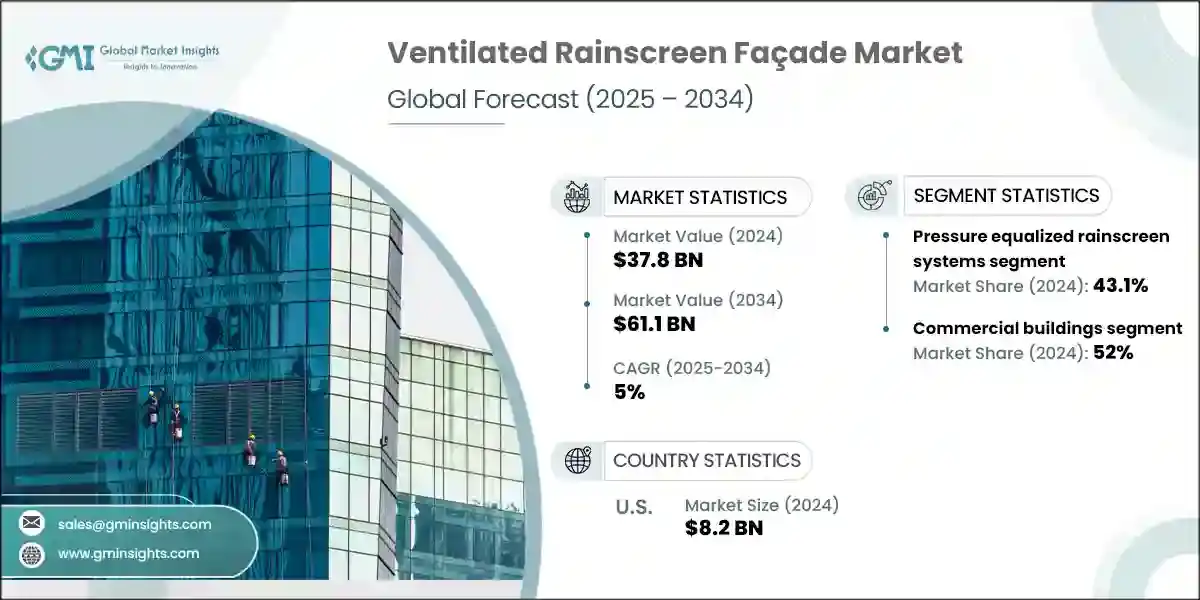
The global ventilated rainscreen façade market was estimated at USD 37.8 billion in 2024, and the market is expected to grow from USD 39.3 billion in 2025 to USD 61.1 billion in 2034 with a CAGR of 5% from 2025 to 2034.
Ventilated Rainscreen Façade Market Key Takeaways
Market Size & Growth
- 2024 Market Size: USD 37.8 Billion
- 2034 Forecast Market Size: USD 61.1 Billion
- CAGR (2025–2034): 5%
Regional Dominance
- Largest Market: Europe
- Fastest Growing Region: Asia Pacific
Key Market Drivers
- Demand for energy-efficient building solutions.
- Preference for modern architectural aesthetics.
- Supportive green building regulations.
Challenges
- High installation and material costs.
- Low awareness in developing regions.
Opportunity
- Retrofit demand in aging buildings.
- Expansion in emerging economies.
Key Players
- Market Leader: Permasteelisa North America led with over 2.5% market share in 2024.
- Leading Players: Top 5 players in this market include Kingspan Group, Trespa International, James Hardie Industries, Centria International, Permasteelisa North America, which collectively held a market share of 5.7% in 2024.
Get Market Insights & Growth Opportunities
The ventilated rainscreen facade market is recording a significant increase due to the growing concern of energy-efficient building systems, and contemporary architectural approaches. With the expansion of cities together with the development of commercial infrastructure, one will find an increasing focus on sustainable construction. A smart solution is to install ventilated façade systems, which not only offer thermal insulation, moisture control, and prolong the life of the building. Important industries such as commercial property, hospitality, and education are implementing such systems in order to conform to the requirements of the green building certification and regulations. Moreover, the demand has been boosted by the fact that more consumers favor attractive and useful cladding materials. The demand of the market for high performance of a building envelope is thriving in this area at a considerable rate.
To achieve the flexibility of different designs, manufacturers are investing in new materials that include fiber cement, high-pressure laminates, and aluminum composites among other new materials to ensure durability. Besides, these facades are passive cooling aids, hence, contributing to lowering HVAC loads and thereby reducing operational energy cost in both hot and cold climates. There is a strong trend to pre-engineered panels of the facade minimizing on-site workforce and time of construction. There is also an attempt by governments in various regions to promote façade retrofits on existing buildings to increase their energy performance and safety. The trend in the market will continue to be positive, as the aesthetic value is combined with the environmental responsibility, and smart construction plus climate-sensitive design will continue to influence this trend.
To get key market trends
Ventilated Rainscreen Façade Market Trends
The market of ventilated rainscreen facade is becoming more and more exposed to smart technologies. Implementation of digital solutions like BIM (Building Information Modeling), performance monitoring equivalent to a sensor, and automated installations are making projects more accurate and effective. The attached technologies help to maintain temperature control in real time and anticipate maintenance of the facade, which improves facade functionality. Prefabrication and modular properties services are also becoming popular for the construction of façade components, aiming to shorten the construction period. The flexibility of digital design is facilitating the achievement of performance parameters as well as the aesthetic objectives amongst architects.
The power of sustainability in the market remains strong, and it is more concentrated on materials that are easily recyclable, coatings that are low in emissions, and cladding systems that are energy efficient. Environmental certification systems such as LEED and BREEAM are making their way into the mind and the criteria of institutional buyers through the selection of materials. The need to have façades which enhance passive ventilation and help cut down power consumption of buildings is increasingly becoming high. Manufacturers are countering with product innovations hitting the ESG standards and the aims of circular economies. In the contemporary structures, sustainability is not an option, but rather, it is gradually becoming part of the procurement schemes.
Ventilated Rainscreen Façade Market Analysis
Learn more about the key segments shaping this market
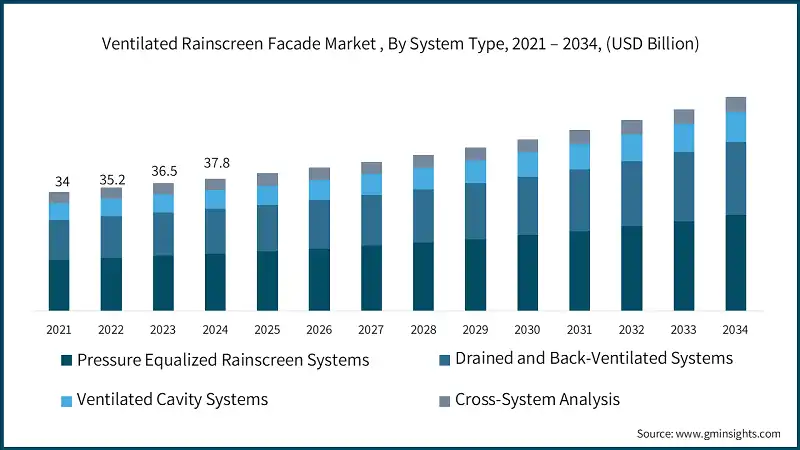
Based on system type, the market is segmented as pressure equalized rainscreen systems, drained and back-ventilated systems, ventilated cavity systems, and cross-system analysis. In 2024, the pressure equalized rainscreen systems segment dominated the global market, accounting for 43.1% share and expected to grow at a CAGR of 5.4% during 2025 to 2034.
- Pressure-equalized rainscreen systems are dominating the ventilated rainscreen façade market because of their better control of moisture and air infiltration. The systems are based on a compartmentalized cavity which balances the air pressures both externally and internally to avoid water sealing through the building envelope. This strength of performance is peculiarly pertinent in high-rise, coastal, and high-wind areas where durability of facades is of importance. Their capability of safeguarding interior insulation increases thermal efficiency, which saves energy expenditure in the long run. With the increase in standards of infrastructure, these systems are becoming mandatory in the present-day construction theories.
- Besides reliability in the performance, the pressure-equalized systems are also widely used due to their versatile design using materials like metal composites, fiber cement, and terracotta. These facades facilitate long-term structural health and satisfy the needs of appearance and performance. They also complement prefabrication elements because they cut down on the demands of labor and time of the construction on-site, enhancing efficient projects. The systems also find themselves in a sustainable position by adhering to international green building certifications. Pressure-equalized rainscreens remain top of this market niche with their characteristics of durability, performance, and versatility.
Learn more about the key segments shaping this market
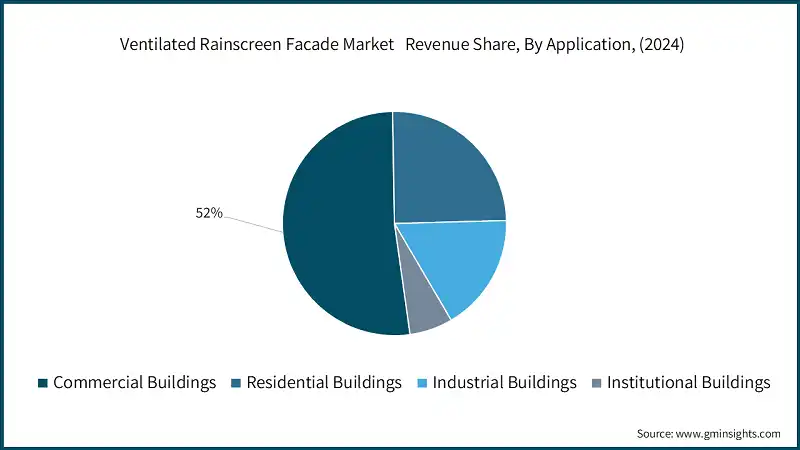
Based on applications, the ventilated rainscreen façade market is divided into commercial buildings, residential buildings, industrial buildings, and institutional buildings. In 2024, the commercial buildings segment held about 52% market share and is expected to grow at a CAGR of 5.4% through 2034.
- The commercial buildings market is taking over the ventilated rainscreen facade industry because of the increasing need for energy-efficient, attractive, and long-lasting external solutions. Increased insolation and other efforts to make buildings sustainable incorporate the use of façade systems in office complexes, malls, and mixed-use developments. Ventilated façades allow the control of internal temperature and decrease HVAC loads; thus, they are the perfect option to apply in high-occupancy commercial settings. Moreover, the flexibility of their design promotes architectural beauty and individuality, making brand image and popularity among tenants. With the growth of urban business centers, the performance of facade is a major factor in the long-term value of assets.
- A vast variety of façade materials provides commercial developers with a possibility of striking the right balance between performance and affordability. Green building standards, such as LEED and WELL ratings and certifications, are also encouraged with ventilated system integration because they are increasingly prevalent among commercial buildings. The benefit of pressure-equalized applications on high-rise buildings is being able to give high resistance to weather and pollution. The business community is also investing in facades that make maintenance less and enhance the life of the structures. The prevalence of commercial buildings in this market is cemented by the continuous urbanization and the need to have a sustainable infrastructure by the corporations that require commercial buildings.
Looking for region specific data?
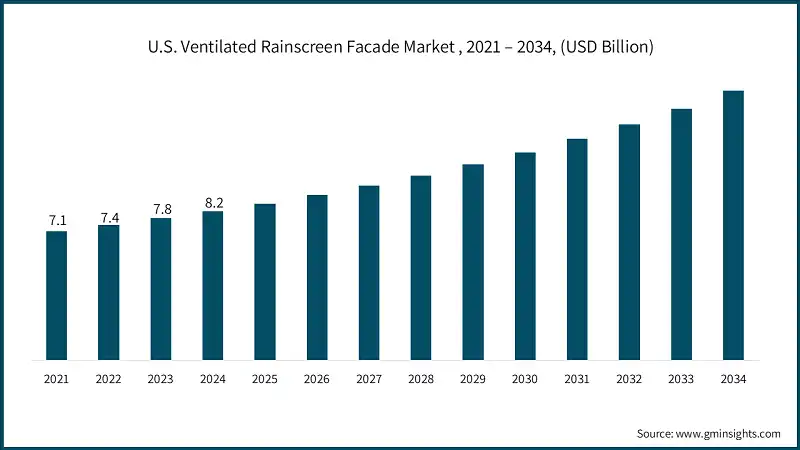
U.S. dominated the 76% share of the North America ventilated rainscreen façade market and generated USD 8.2 billion revenue in 2024.
- North America is leading the ventilated rainscreen panel business owing to their highly developed construction techniques, extensive focus on energy efficiency and their stringent building regulations. High-performance façade systems are well implemented in the region, at both regulatory and sustainability expectations, in commerce, and institutional infrastructure. The increase in investments in green buildings, retrofitting initiatives, and corporate campuses has also fueled demand. The availability of important manufacturers and a well-developed supply chain guarantees stable innovations and product supply. The strongest adoption of pressure-equalized systems is because of resilience needs in a changing climate with benefits later in maintenance.
- One of the advantages of the regional market is also the early adoption of the most modern technologies in construction, including prefabricated panels and BIM-based façade design. Materials that correspond to LEED and EnergyStar are preferred by developers, furthering the effort to create green building envelopes based on environmental responsibilities. The growing interest in the façade performance in urban high-rise buildings, airports, and schools provides steady growth. The location uses procurement strategies that focus on life cost savings; thus, ventilated systems are a major choice. This policy, innovation, and demands to meet high performance standards substantially prove North America a world leader in the segment.
Asia Pacific ventilated rainscreen façade market is set to grow at a CAGR of 5.7% from 2025 to 2034.
- China is dominating the market due to the massive scale of production, low-cost production line, and domestic supply systems. Rayon materials and the capacity to fabricate them are locally available, and production can be done with ease and delivery schedules. Urbanization levels are soaring high, and the construction of mega infrastructure projects by the government also serves to stimulate domestic demand both in residential and non-residential markets. Economies of scale and good trade policies support the country to remain a global exporter. Due to constant growth in construction and real estate, China is still a major supply/demand border.
- Research, automation, and material innovation are also improved investment that makes China a leader of the façade segment. The development of fire-retardant boards, light-weight composite and modular facade is associated with the growing international quality demands. Sustainable market development comes as governments are supported by their energy-efficient building and green urban development efforts. The shift to smart city initiatives and green constructions standards increases the drive to employ adapted high-tech facades. China remains at the forefront of the world when it comes to the production and innovation of façade systems with its healthy export ecosystem.
Europe is growing rapidly in the ventilated rainscreen façade market with 5.1% CAGR till 2034.
- Germany dominates the ventilated rainscreen facade market because of the high level of engineering standards, strong interest in the building energy efficiency, and well-developed construction industry. The use of rigorous building codes and environmental rules leads to the popularization of high-performance envelopes. The focus on passive design of buildings and thermal insulation are in line with the objectives of national energy transition. The demand is further boosted by a well-established infrastructure environment, particularly on commercial and institutional structures. The strengths of Germany are also based on well-trained labor, good manufacturing, and an established expertise.
- German manufacturers have high research and development capabilities to bring on board functionality in façade systems with an element of sustainable design. Fire resistance, acoustic insulation material, and recyclable resources are all innovations that comply with the performance and environmental standards. The level of demand is backed by programs suggested by the government with respect to green renovation and retrofitting existing buildings. Collaborations among technology-based companies, façade engineers, and building contractors improve the efficiency of project delivery. The merging of precision manufacturing, regulatory alignment as well and design innovation enables Germany to remain the leader in the worldwide market.
In the MEA region, South Africa is leading and expected to grow at a positive CAGR in the forecast year 2025-2034
- South Africa is currently dominating the ventilated rainscreen facade market with the growing infrastructural cities, commercial activity, and increased awareness of energy-efficient strategies in construction processes. To counter the increasing energy cost, high-rise office buildings, shopping complexes, and institutional structures are gradually using advanced façade system to enhance the insulation process and minimize the use of energy. The trend is facilitated by the government-led green building initiatives and noting the building standards of green building. The local construction industry is focusing more on materials that can be durable and react to climatic conditions. These aspects make South Africa a leader in terms of façade innovation and implementation in the region.
- The nation enjoys an already existing network of developers, architects and building materials suppliers that are keen on upgrading the city facades to involve high performance building envelopes. The idea of rainscreen systems attracts users because of their flexibility in adapting to various climatic conditions, particularly in urban cities such as Johannesburg and Cape Town. Local and international manufacturers are also joining forces to bring to the market fire-rated, lightweight, and recyclable facade materials. Commercial real estate and investment in the public infrastructure also boost the growth of the market. The country is leading in the MEA façade market because of its mix of technical implementations, green objectives, and urbanization.
Ventilated Rainscreen Façade Market Share
- Kingspan Group, Trespa International, James Hardie Industries, Centria International, and Permasteelisa North America are the major players accounting for market share. These firms serve major industries including commercial real estate, education as well and healthcare, in which high-performance building systems play a crucial part. The competition in the market is driven by the existence of global manufacturers and local participants, which provide customized solutions in terms of facades to its clients. Co-strategic partnerships with architects, contractors, and building companies facilitate market penetration and brand reaffirmation. System durability, adherence to green certification, and flexibility in the design of the systems are some of the factors that determine brand preference of the projects.
- Among the best competitors, innovation and sustainability continue as the main differentiators. Companies specializing in recycling material, thermal insulation improvement, and a quick fixing system are gaining a competitive advantage. The increasing focus on smart construction technologies is manifested in integration of digital tools, including BIM compatibility and sensor-based survey of the facade. The R&D segment of the architectural companies can better address the changing building policies and energy-saving requirements. With a change in the expectations of the market to focus on long-term, aesthetically flexible, and environmentally friendly solutions, the firms that rely on innovation remain in commanding leadership.
Ventilated Rainscreen Façade Market Companies
Major players operating in ventilated rainscreen façade industry:
- Benson Industries
- Central International
- Cladding Corp
- Enclos Corp
- Hilti Corporation
- ITW Construction Products
- James Hardie Industries
- Kingspan Group
- Permasteelisa North America
- Powers Fasteners
- SFS Group (NV 1 Systems)
- Simpson Strong -Tie
- Trespa International
- Walters & Wolf
- Zahner
Kingspan Group, Trespa International, James Hardie Industries, Centria International, and Permasteelisa North America are the major players dominating the market. Such businesses are identified with the provision of high-performance façade systems that integrate durability, thermal performance, as well as design adaptability. Their systems are also largely employed in commercial, healthcare, education, and institutional applications where performance of the facade is a dominant issue. Its product portfolios are fire-rated panels, cladding flowers, and modular installation systems, which are customized according to the complex building requirements. These firms can keep up with the latest trends in the construction industry because they have a presence across the globe and they also have a steady pipeline that pumps up innovations.
Other key competitors, including Zahner, Benson Industries, SFS Group, Enclos Corp, and Hilti Corporation, continue to establish presence by diversifying into facades engineering and niche skills in markets. These corporations specialize in precision manufacturing, anchoring systems of facades, and combination with digital construction technologies. There must be a priority on lending sustainable material use, as well as energy efficiency and long-term performance of the building. They have strategic partnerships with developers, architects, and permanent infrastructure projects in the public sector to widen their scope and reliability. In collaboration, mature leaders and innovative challengers are building a competitive environment that is performance driven, customer customized, and environmentally accountable.
Ventilated Rainscreen Façade Market Report Attributes
| Key Takeaway | Details |
|---|---|
| Market Size & Growth | |
| Base Year | 2024 |
| Market Size in 2024 | USD 37.8 Billion |
| Forecast Period 2025 – 2034 CAGR | 5% |
| Market Size in 2034 | USD 61.1 Billion |
| Key Market Trends | |
| Drivers | Impact |
| Demand for energy-efficient building solutions | Rainscreen façades improve thermal insulation and reduce energy consumption. |
| Preference for modern architectural aesthetics | These systems offer sleek, customizable designs that appeal to contemporary architecture. |
| Supportive green building regulations | Incentives and standards like LEED promote the use of energy-efficient façade systems. |
| Pitfalls & Challenges | Impact |
| High installation and material costs | The systems are expensive due to complex installation and premium materials. |
| Low awareness in developing regions | Limited knowledge and expertise restrict adoption in emerging markets. |
| Opportunities: | Impact |
| Retrofit demand in aging buildings | Growing needs to upgrade old buildings for energy efficiency and aesthetics create strong demand for rainscreen retrofit solutions. |
| Expansion in emerging economies | Urbanization and rising construction in Asia, Africa, and Latin America offer untapped potential for market growth as awareness improves. |
| Market Leaders (2024) | |
| Market Leaders |
Market Share 2.5% |
| Top Players |
Collective market share in 2024 is Collective market share 5.7% |
| Competitive Edge |
|
| Regional Insights | |
| Largest Market | Europe |
| Fastest Growing Market | Asia Pacific |
| Emerging Countries | China, Japan, India |
| Future outlook |
|
What are the growth opportunities in this market?
Ventilated Rainscreen Façade Market News
- In March 2025, Fischer presented a series of high-tech rear-ventilated rainscreen facade systems, such as solar facade adaptors and passive fire protection products. Its solutions are focused on energy efficiency, structural quality, and thermal decoupling and used with German-engineered stainless steel and aluminum subframes as well as a Passive House-certified option.
- In April 2024, Laminators Inc. launched AdaptaClad, the RS wall system, which has Omega-Lite FR ACM panels. On-site workman and time are minimized using this shop-fabricated rainscreen. Its mechanical system of open joints complies with important standards which are NFPA 285, AAMA 509, ASTM E283/E331/E330, and provides performance as well as efficiency.
- In March 2024, Knauf Insulation published its Rainscreen Cavity Systems, more precisely the Rocksilk 26 rainscreen cavity systems. Rainscreen The fully tested solution contains gateway-ready features to streamline the specification of the architecture, as well as simplify the installation into the buildings of those rainscreen façades.
The ventilated rainscreen façade market research report includes in-depth coverage of the industry with estimates & forecasts in terms of revenue ($ Mn/Bn) and Volume in Thousand Units from 2021 to 2034, for the following segments.
Market, By System Type
- Pressure equalized rainscreen systems.
- Drained and back ventilated systems
- Ventilated cavity systems
- Cross-system analysis
Market, By Material Type
- Metal composite materials
- Fiber cement panels
- Natural stone panels
- Ceramic and terracotta panels
- High-pressure laminate panels
Market, By Application
- Commercial buildings
- Residential buildings
- Industrial buildings
- Institutional buildings
The above information is provided for the following regions:
- North America
- U.S.
- Canada
- Europe
- UK
- Germany
- France
- Italy
- Spain
- Russia
- Asia Pacific
- China
- India
- Japan
- South Korea
- Australia
- Latin America
- Brazil
- Mexico
- MEA
- UAE
- Saudi Arabia
- South Africa
Frequently Asked Question(FAQ) :
What is the market size of the ventilated rainscreen façade in 2024?
The market size was USD 37.8 billion in 2024, with a CAGR of 5% expected through 2034 led by demand for energy-efficient buildings, modern architecture, urbanization, and sustainable construction practices.
What is the projected value of the ventilated rainscreen façade market by 2034?
The ventilated rainscreen façade market is expected to reach USD 61.1 billion by 2034, propelled by green building regulations, retrofit demand, and expansion in emerging economies.
How much market share did the pressure equalized rainscreen systems segment hold in 2024?
Pressure equalized rainscreen systems dominated with 43.1% market share in 2024 and are expected to grow at a CAGR of 5.4% during the forecast period.
What was the market share of commercial buildings segment in 2024?
Commercial buildings held 52% market share in 2024 and are projected to grow at a CAGR of 5.4% through 2034.
What is the growth outlook for the Asia-Pacific region from 2025 to 2034?
Asia-Pacific is the fastest growing region with a CAGR of 5.7% from 2025-2034, driven by massive urbanization, infrastructure projects, and government support for energy-efficient buildings.
Which region leads the ventilated rainscreen façade market?
United States dominating at 76% share of the North America and generating USD 8.2 billion revenue in 2024.
What are the upcoming trends in the ventilated rainscreen façade market?
Key trends include integration of smart technologies like BIM and sensor-based monitoring, prefabrication and modular systems, sustainable materials focus, and digital design flexibility for enhanced performance.
Who are the key players in the ventilated rainscreen façade market?
Key players include Benson Industries, Central International, Cladding Corp, Enclos Corp, Hilti Corporation, ITW Construction Products, James Hardie Industries, Kingspan Group, Permasteelisa North America, Powers Fasteners.
Ventilated Rainscreen Façade Market Scope
Related Reports