Summary
Table of Content

Vehicle-to-everything (V2X) Security Chips Market
Get a free sample of this report
Form submitted successfully!
Error submitting form. Please try again.
Thank you!
Your inquiry has been received. Our team will reach out to you with the required details via email. To ensure that you don't miss their response, kindly remember to check your spam folder as well!
Request Sectional Data
Thank you!
Your inquiry has been received. Our team will reach out to you with the required details via email. To ensure that you don't miss their response, kindly remember to check your spam folder as well!
Form submitted successfully!
Error submitting form. Please try again.
Vehicle-to-everything Security Chips Market Size
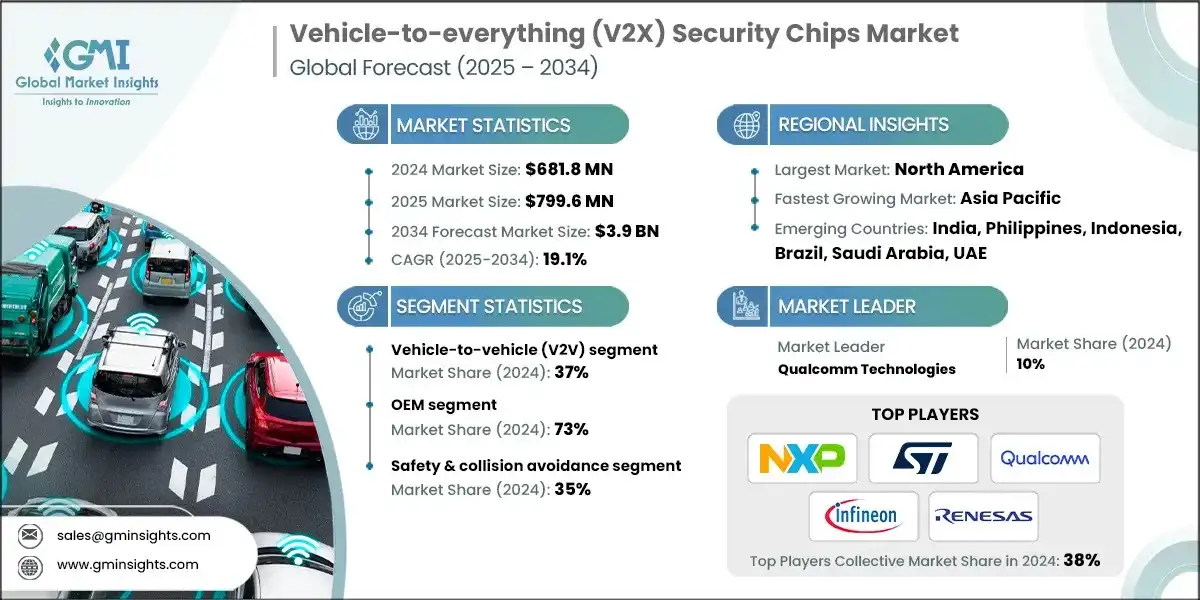
The global vehicle-to-everything (V2X) security chips market size was estimated at USD 681.8 million in 2024. The market is expected to grow from USD 799.6 million in 2025 to USD 3.9 billion in 2034, at a CAGR of 19.1%, according to latest report published by Global Market Insights Inc.
Vehicle-to-everything (V2X) Security Chips Market Key Takeaways
Market Size & Growth
- 2024 Market Size: USD 681.8 Million
- 2025 Market Size: USD 799.6 Million
- 2034 Forecast Market Size: USD 3.9 Billion
- CAGR (2025–2034): 19.1%
Key Market Drivers
- Rising need to protect data in connected vehicles is fueling demand for V2X security chips.
- Increasing government mandates for automotive cybersecurity are accelerating market growth.
- Growth of 5G networks and edge computing is enabling faster, more secure V2X communications.
- Expansion of smart city initiatives is driving adoption of secure vehicular communication systems.
Challenges
- High costs associated with implementing V2X security chips are limiting adoption among manufacturers.
- Lack of standardized security protocols across vehicles and infrastructure is creating deployment challenges.
Opportunity
- Growing autonomous vehicle adoption is creating new requirements for advanced security solutions.
- Surge in electric vehicle usage is boosting demand for secure charging and communication systems.
- Proliferation of 5G-enabled vehicles is opening avenues for innovative security chip designs.
- Integration of V2X technology with smart infrastructure is creating potential for new service offerings.
Key Players
- Market Leader: Qualcomm Technologies led with over 10% market share in 2024.
- Leading Players: Top 5 players in this market include NXP, ST Microelectronics, Qualcomm Technologies, Infineon Technologies, Renesas Electronics, which collectively held a market share of 38% in 2024.
Get Market Insights & Growth Opportunities
The vehicle-to-everything (V2X) security chips market is evolving at a very high pace around the world because of the existence of stricter safety regulations, increased demand for automated driving capabilities and increased adoption of the advanced driver-assistance systems. Car manufacturers are incorporating such elements as high-performance microcontrollers, image signal processors, radar chips, lidar interface ICs, and AI accelerators to enhance real-time decision-making and perception and actuation, as well as energy efficiency and reliability.
In September 2025, Qualcomm Technologies and BMW Group developed the Snapdragon Ride Pilot, an automated driving system, jointly. The platform is a synthesis of Qualcomm AI and machine learning with the BMW car experience to facilitate safety, performance, and scalability of autonomous driving solutions.
Tier-1 suppliers and OEMs are enhancing the protection of vehicle cybersecurity by means of secure firmware validation, multi-layered encryption, and real-time anomaly detection. Such technologies ensure that the software used is authentic, information transfer is secure and that irregularity in the system is detected early enough. These measures can assist automotive firms to meet rigorous international rules, such as ISO/SAE 21434, UNECE WP.29, and NHTSA regulations, and protect connected and autonomous vehicles against new cyber threats without jeopardizing the system reliability and safety.
The COVID-19 pandemic revealed vulnerabilities in global semiconductor sourcing and security requirements but triggered businesses to invest into regional manufacture, dependable supply chains and automotive-grade certification of a chip. New smart mobility ecosystems, electric vehicles, and autonomous fleets have increased the need for secure communication processors, which have increased after the pandemic. Some of the business models that are helping manufacturers to offer manufacturers scalable and long-lasting cyber defenses include secured-as-a-Service (SECaAS), co-designs of hardware and software and update of cryptography on a subscription basis.
The use of the cameras, radar, and lidar integrated chips is on the increase because vehicle-to-vehicle (V2V), the vehicle-to-infrastructure (V2I), and vehicle-to-network (V2N) communication is becoming part of connected mobility. Anomaly detection via AI, V2X connectivity, and Telematics are also on priority lists of OEMs and technology providers to develop the next level of connected vehicles that are secure and safe.
In North America and Europe, the market is mature, and compliance, chip reliability, and partnership with OEMs to conform to standards such as UNECE WP.29 and ISO/SAE 21434 are the areas of competition between companies. The vendors are focusing on encryption with low latency, secure OTA updates, and hardware root-of-trust architectures to achieve performance and safety standards.
Moreover, the Asia-Pacific region is becoming the most rapidly developing market, which is facilitated by the rapid deployment of 5G networks, smart cities, and vehicle electrification programs. China, Japan and South Korea are showing high large scale V2X pilot programs whereas India and Southeast Asia are witnessing growing use of security chips with cost-effective mid-range vehicles. The current trend towards connected mobility, autonomous fleets and security-as-a-service (SECaaS) models continues to transform the world competitive landscape.
To get key market trends
Vehicle-to-everything Security Chips Market Trends
Automakers are increasingly adopting hybrid computing platforms and AI-enabled V2X security chips to strengthen vehicle communication networks. These solutions enhance real-time authentication, encryption, and deviation of data, assuring safe interactions of V2X and minimizing the complexity of the system, energy usage, and compliance expenses of international safety and cybersecurity standards.
In April 2025, NXP Semiconductors introduced a V2X security SoC that combines hardware root-of-trust, multi-layer encryption, and AI-based threat detection. This platform assists OEMs to secure vehicles against cyberattacks, streamline system architecture, and anticipate future autonomous and connected mobility applications. The collaboration of semiconductor companies and auto companies is facilitating unified security platform adoption and eliminating redundancy of hardware.
The market is being transformed with the introduction of telematics, V2X connectivity, and IoT-enabled chips which enable real-time monitoring, predictive threat detection, and secure vehicle-to-infrastructure communication. The effects of these developments are greater sensor integration, minimized latency, and reliability of the system that facilitates safer connected mobility and decreases the operational expenses of the fleet operators.
Secure-as-a-service (SECaaS), subscription-based security patches, and scaled chipset architectures are allowing Tier-1 suppliers and OEMs to deploy enhanced V2X security solutions without heavy upfront investment. These models can enable manufacturers to whether fine tune security solutions to the demand, meet regional norms and effectively implement secure V2X systems in various types of vehicles across different markets.
Vehicle-to-everything Security Chips Market Analysis
Learn more about the key segments shaping this market
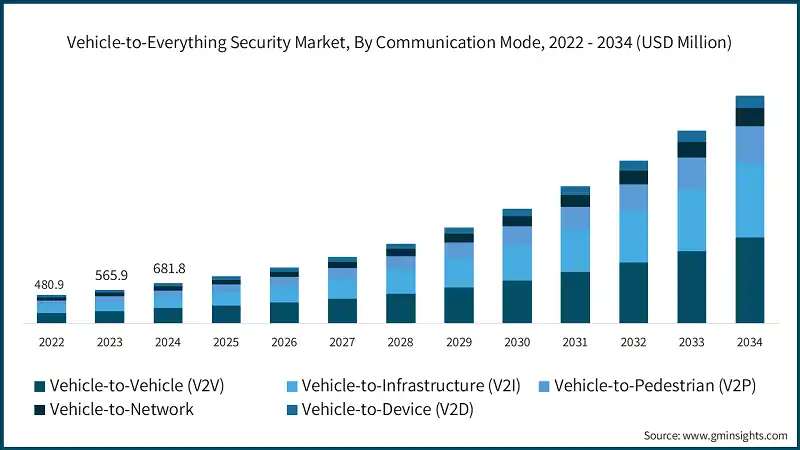
Based on communication mode, the vehicle-to-everything security chips market is divided into vehicle-to-vehicle (V2V), vehicle-to-infrastructure (V2I), vehicle-to-pedestrian (V2P), vehicle-to-network (V2N), and vehicle-to-device (V2D). The vehicle-to-vehicle (V2V) segment dominated the market, accounting for around 37% in 2024 and is expected to grow at a CAGR of over 19% through 2034.
- The vehicle-to-vehicle (V2V) segment dominates the V2X security chips market because it is critical for ensuring real-time communication between vehicles on the road, which helps prevent accidents, improve traffic flow, and enhance overall road safety. V2V systems rely on rapid data exchange to alert drivers about potential collisions, sudden braking, or lane changes. Security chips are essential in protecting this sensitive data from cyberattacks, message spoofing, or unauthorized access, ensuring reliability and trust in connected vehicle networks.
- Moreover, regulatory mandates in regions like the U.S. and Europe increasingly require secure V2V communications in modern vehicles. Automakers are integrating V2V security solutions as standard in advanced driver-assistance systems (ADAS) and autonomous vehicles, further driving market adoption.
- For example, in April 2024, Autotalks announced a partnership with Secure-IC to integrate its Securyzr HSM into the Autotalks TEKTON3 V2X chipset, enhancing cryptographic security.
- The vehicle-to-infrastructure (V2I) segment is projected to grow at a CAGR of more than 20% because it enables vehicles to communicate with roadside infrastructure, traffic signals, and smart city systems. This communication improves traffic management, reduces congestion, and enhances overall road safety. V2I relies on secure and low-latency data transmission, making V2X security chips essential for protecting information from cyber threats, unauthorized access, and data tampering.
Learn more about the key segments shaping this market
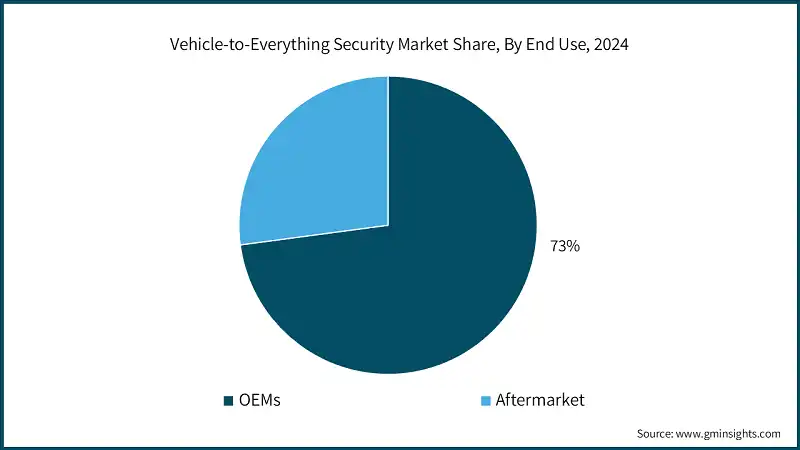
Based on end use, the vehicle-to-everything security chips market is segmented into OEMs, and Aftermarket. The OEM segment dominates the market accounting for around 73% share in 2024, and the segment is expected to grow at a CAGR of over 18.1% between 2025 and 2034.
- The OEM segment holds the largest share in the Vehicle-to-everything (V2X) security chips market due to the increasing integration of connected and autonomous technologies directly during vehicle manufacturing. Automakers are embedding V2X security chips at the design stage to ensure compliance with cybersecurity standards such as ISO/SAE 21434 and UNECE WP.29, which mandate in-built protection against hacking, spoofing, and data theft. This proactive approach enhances consumer safety and brand reliability.
- Moreover, OEMs are collaborating with semiconductor leaders such as NXP Semiconductors, Infineon Technologies, and Qualcomm to co-develop secure communication systems for next-generation vehicles. The rapid expansion of electric and connected vehicle production lines, along with government-backed mandates for intelligent transportation systems, continues to strengthen the OEM segment’s market dominance.
- For example, in April 2025, BMW introduced its new 5 Series in China equipped with JOYNEXT’s V2X technology, illustrating OEM adoption of V2X security and connectivity integration.
- The Aftermarket segment will possess a CAGR of approximately 21.4% owing due to increasing demand for existing vehicles with V2X security solutions, rising awareness of vehicle cybersecurity, and the need for system upgrades in older fleets, particularly in regions with evolving safety regulations and connected mobility adoption.
Based on security chip, the vehicle-to-everything security chips market is segmented into discrete security chips, integrated security solutions, software-defined security, hybrid security architectures, and quantum-ready security chips. Integrated security solutions segment is expected to dominate the market with around 41% share, driven by the rising adoption of embedded security modules in connected vehicles, integration with telematics control units, and OEM preference for scalable, cost-efficient, and hardware-rooted security frameworks ensuring end-to-end data protection.
- The integrated security solutions segment dominates the Vehicle-to-everything (V2X) security chips market because automakers are increasingly embedding comprehensive security functions directly into chipsets to enable real-time authentication, encryption, and data integrity within vehicle communication systems. These integrated solutions combine hardware-based security elements like secure enclaves and cryptographic processors with software-based firewalls and key management systems, offering a unified defense layer against evolving cyber threats.
- Furthermore, the increasing interconnectivity of modern vehicles requires a holistic approach to cybersecurity that balances performance, cost, and compliance. Integrated security solutions offer seamless coordination between hardware and software layers, improving response times to cyber incidents while minimizing power consumption and component redundancy. These chips are also easier to update over-the-air, ensuring long-term adaptability to new threats. Their compatibility with multiple communication protocols such as DSRC and C-V2X enhances secure data exchange between vehicles and infrastructure. As a result, integrated security architectures provide automakers with a future-ready, efficient, and standardized platform that supports secure mobility ecosystems and accelerates the adoption of intelligent transportation systems worldwide.
- For example, in August 2024, LG Electronics achieved a significant milestone by receiving the world's first Common Criteria (CC) certification for a Vehicle-to-Everything (V2X) device. This certification was awarded to LG’s Transceiver Module developed for Volkswagen’s MQB platform, confirming its compliance with stringent security standards.
- Hybrid security architectures segment will register the highest CAGR of approximately 23.2% due to increasing demand for flexible security solutions that combine hardware- and software-based protections, enabling scalable, adaptive, and cost-efficient defense against evolving cyber threats in connected vehicles.
Based on application, the vehicle-to-everything (V2X) security chips market is divided into safety & collision avoidance, traffic management, infotainment, navigation & routing, remote diagnostics, and fleet management. The safety & collision avoidance segment dominated the market, accounting for around 35% revenue share in 2024.
- The safety and collision avoidance segment holds the largest market share in the V2X security chips market because modern connected vehicles are highly dependent on real-time communication as the means of avoiding accidents. V2X security chips are designed in such a way that messages that are related to safety, like emergency braking messages, lane change messages, and pedestrian detection messages are sent safely and without interference. This will avoid malicious attacks or data corruption to interfere with vehicle safety, and such chips will be necessary for autonomous and semi-autonomous driving systems.
- Also, the regulatory requirements and the OEM safety concerns are accelerating the use of effective security systems in collision avoidance systems. Healing vehicle-to-vehicle (V2V) and vehicle-to-infrastructure (V2I) communications, these chips ensure greater confidence in connected mobility, minimize risk of accidents and facilitate the implementation of advanced driver-assistance systems in the world.
- For example, in May 2024, AUTOCRYPT entered a Memorandum of Understanding (MoU) with Cohda Wireless to provide them with a secure full-stack V2X solution. This project integrates the security library and PKI platform (AUTOCRYPT) with V2X software stack (Cohda) to promote safety and security in connected cars.
- Moreover, the remote diagnostics market will expand quickly because of the rising use of connected vehicle technologies, as they allow real-time monitoring and predictive maintenance, as well as over-the-air updates. V2X security chip guarantees safe data transfer, safer vehicle information, and remote diagnostics are provided efficiently, safely, and at a reasonable cost.
Looking for region specific data?
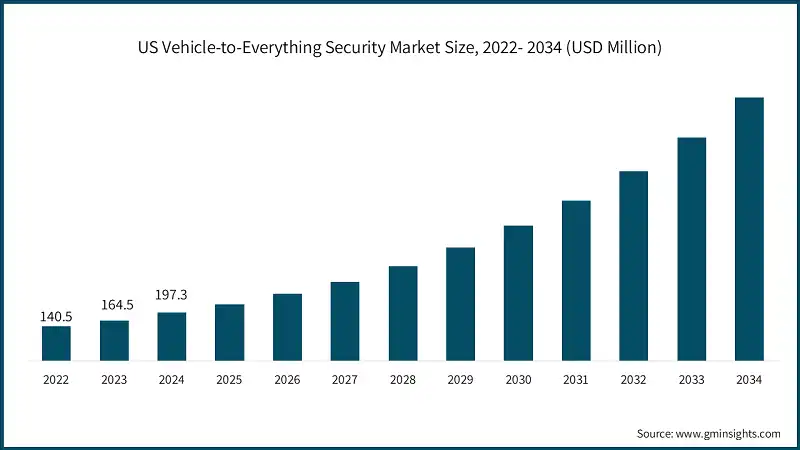
US dominated the Vehicle-to-everything (V2X) security chips market in North America with around 86% share and generated USD 197.3 million in revenue in 2024.
- The U.S. vehicle-to-everything (V2X) security chips industry is witnessing rapid growth driven by strong government initiatives toward road safety, connected infrastructure, and autonomous vehicle deployment. The National Highway Traffic Safety Administration (NHTSA) and the Federal Communications Commission (FCC) are promoting V2X communication standards to enhance vehicle connectivity and reduce traffic fatalities. Major automakers and Tier-1 suppliers in the U.S. are integrating secure microcontrollers, encryption engines, and hardware root-of-trust solutions to comply with cybersecurity frameworks such as ISO/SAE 21434 and UNECE WP.29.
- Moreover, growing collaborations among tech giants, automotive OEMs, and semiconductor companies are accelerating the adoption of AI-driven V2X chips for real-time authentication and secure data exchange. The presence of key players like Qualcomm, Intel, and NXP Semiconductors strengthens the U.S. ecosystem for V2X infrastructure and chip manufacturing. With expanding 5G networks, smart city initiatives, and pilot programs for autonomous mobility, the U.S. remains one of the most advanced and strategically significant markets for V2X security chip development.
- For examples, in June 2025, Qualcomm Technologies expanded its collaboration with ECARX to develop a broader range of intelligent vehicle solutions, including V2X communication technologies, aiming to improve vehicle safety and efficiency.
- Canada is emerging as one of the fastest-growing markets for V2X Security Chips due to the increasing adoption of connected and autonomous vehicles, expansion of smart city initiatives, and government support for secure mobility infrastructure. The country’s focus on vehicle electrification and intelligent transport systems is driving investments in V2X communication networks and cybersecurity solutions.
The Vehicle-to-everything security chips market in Germany is expected to experience robust growth between 2025 and 2034.
- Europe accounts for around 29% of the Vehicle-to-everything (V2X) security chips market in 2025 and is expected to grow at a CAGR of over 19.5% due to rising adoption of connected vehicles, stringent safety regulations, and increasing investments in smart mobility infrastructure.
- Germany is experiencing a substantial expansion in the V2X Security Chips market, due to its developed automotive industry, increasing use of connected vehicles, and government-based efforts in favor of promoting smart mobility and road safety. Tier-1 suppliers and automakers are moving towards having trusted platform modules (TPMs), multi-layer encrypted communication or secure microcontrollers to ensure safe and reliable vehicle-to-vehicle (V2V) and vehicle-to-infrastructure (V2I) communication. The need to comply with regulatory requirements under UNECE WP.29, ISO/SAE 21434, and other European standards on cybersecurity leads to investments in secure hardware and software to serve passengers and commercial vehicles.
- German manufacturers such as BMW, Daimler and Volkswagen are collaborating with semiconductor companies such as Infineon Technologies and NXP Semiconductors to design AI-powered V2X chipsets that can accurately detect threat, perform secure OTA updates and encrypted data communications in real-time. As the 5G networks grow with connected highways and smart city infrastructure, Germany is becoming a strategic location of innovation of V2X security chip in Europe, serving autonomous mobility and connected vehicle ecosystems.
- For examples, in July 2022, Bosch stated that it would invest USD 3.2 billion in semiconductor chip manufacturing and research over the next four years. This investment entails the establishment of additional manufacturing plants in the development of computer chip in Dresden and Reutlingen in a bid to improve their V2X and ADAS technologies.
- Moreover, the progress of AI-based perception processors, edge computing cards, and over-the-air software updates are also improving real-time decision-making in cars, reducing faults, and allowing them to be safer. All these factors coupled with the automotive innovation ecosystem in Germany affirm its dominance in the European market of Vehicle-to-everything (V2X) security chips.
- The UK is becoming a major growing market of V2X Security Chips due to the growing use of electric cars (EVs) and autonomous vehicle pilots. Connected mobility infrastructure, AI-based perception systems, and advanced driver-assistance systems (ADAS) investments are improving the safety of vehicles, real-time decision-making, and communication capabilities. The implementation of V2X technologies is further facilitated by government efforts to encourage smart city development and intelligent transport networks.
The Vehicle-to-everything security chips market in China is expected to experience rapid growth between 2025 and 2034.
- Asia-Pacific accounts for more than 24% of the vehicle-to-everything (V2X) security chips market in 2025 and is the fastest-growing region with a CAGR of around 20.1%. This expansion is fueled by major investments in intelligent delivery infrastructure, the creation of urban micro-hubs, and the use of novel delivery vehicles, like electric vans, cargo bikes, and three-wheelers.
- China is one of the fastest-growing markets for V2X Security Chips, driven by rapid adoption of connected and electric vehicles, government-backed smart mobility initiatives, and extensive 5G network deployment. Chinese automakers and Tier-1 suppliers are increasingly integrating secure microcontrollers, trusted platform modules (TPMs), and cryptographic processors to ensure real-time, low-latency V2X communication for vehicle-to-vehicle (V2V) and vehicle-to-infrastructure (V2I) applications. Regulations and cybersecurity guidelines from authorities like the Ministry of Industry and Information Technology (MIIT) further support investment in secure V2X systems.
- Leading companies such as Huawei, NXP Semiconductors, and Infineon Technologies are collaborating with local OEMs to develop AI-powered, energy-efficient V2X chips capable of handling high data loads for autonomous driving and advanced driver-assistance systems (ADAS). With urban smart infrastructure, large-scale pilot projects, and growing EV penetration, China is poised to dominate the Asia-Pacific V2X Security Chips market, shaping global trends in connected mobility and vehicle cybersecurity.
- For example, in May 2025, Huawei introduced the MH5000 5G C-V2X module, designed to support high-speed, low-latency vehicle-to-everything communications. This module aims to facilitate the development of intelligent transportation systems and autonomous vehicles by enabling real-time data exchange between vehicles and infrastructure.
- Moreover, India is experiencing the fastest growth in the APAC Vehicle-to-everything (V2X) security chips market due to rapid adoption of connected vehicles, expanding electric vehicle (EV) penetration, and government-backed smart mobility initiatives. OEMs and Tier-1 suppliers are increasingly investing in AI-enabled V2X chips, secure communication modules, and cost-efficient ADAS platforms to enhance road safety, reduce traffic incidents, and support future autonomous vehicle deployments. This growth is further fueled by urban infrastructure modernization and rising consumer demand for advanced automotive cybersecurity features.
The Vehicle-to-everything security chips market in Brazil is expected to experience significant and promising growth from 2025 to 2034.
- Latin America holds approximately 8% of the market in 2025 and is growing at a CAGR of approximately 18% driven by increasing adoption of connected vehicles, rising investments in smart transportation infrastructure, and growing focus on automotive cybersecurity.
- Brazil leads the Latin American Vehicle-to-everything (V2X) security chips market due to increasing investments in connected vehicle technologies and a rising focus on road safety. Automotive manufacturers in Brazil are actively integrating V2X-enabled security chips in both commercial and passenger vehicles to enhance communication between vehicles, infrastructure, and pedestrians. The government is promoting intelligent transportation systems through regulatory support, smart city projects, and incentives for electric and connected vehicles, which drives demand for secure V2X solutions.
- OEMs and Tier-1 suppliers in Brazil are collaborating with global semiconductor companies to deploy AI-powered and low-latency V2X chips that meet functional safety standards. These initiatives ensure reliable data exchange, real-time threat detection, and enhanced cybersecurity in vehicles, further strengthening Brazil’s position as the regional leader.
- Mexico is the fastest-growing market for Vehicle-to-everything (V2X) security chips in Latin America, driven by increasing adoption of connected and autonomous vehicle technologies, expanding electric vehicle (EV) sales, and government-backed smart mobility programs. Automotive OEMs and Tier-1 suppliers are investing in secure V2X chipsets, AI-based processors, and low-latency communication modules to enhance real-time vehicle-to-vehicle and vehicle-to-infrastructure interactions.
The Vehicle-to-everything security chips market in UAE is expected to experience significant and promising growth from 2025 to 2034.
- Middle East and Africa constitute approximately 5% of the market in 2024 and is growing steadily driven by increasing investments in smart city projects, connected vehicle initiatives, and road safety programs.
- The UAE is the market leader in the MEA Vehicle-to-everything (V2X) security chips market because of significant government initiatives supporting smart mobility, autonomous vehicles, and connected infrastructure. The country has invested heavily in intelligent transportation systems, smart city projects, and 5G-enabled V2X networks, creating a conducive environment for the deployment of advanced V2X security chips. Automotive OEMs and Tier-1 suppliers are actively integrating secure communication modules and AI-enabled processors into vehicles to enhance real-time data exchange, collision avoidance, and cybersecurity.
- Additionally, strategic collaborations between local automotive players and global semiconductor manufacturers have accelerated the adoption of next-generation V2X solutions. The UAE’s regulatory support for vehicle safety standards and cybersecurity compliance further strengthens market growth, positioning it as the regional leader in V2X security technology.
- In September 2025, UAE unveiled its first Sovereign Mobility Cloud at the Dubai World Congress for Self-Driving Transport. This initiative aims to enhance the country's autonomous transport capabilities by integrating secure V2X communication systems, ensuring safe and efficient vehicle-to-vehicle and vehicle-to-infrastructure interactions.
- The Vehicle-to-everything (V2X) security chips market in Saudi Arabia is experiencing tremendous growth due to the nation's strategic investments in smart mobility and autonomous vehicle technologies. As part of its Vision 2030 initiative, Saudi Arabia is focusing on transforming its transportation sector by integrating advanced technologies that enhance road safety and traffic management. This includes the adoption of V2X communication systems that enable vehicles to communicate with each other and with infrastructure, improving situational awareness and reducing the likelihood of accidents.
Vehicle-to-everything Security Chips Market Share
- The top 7 companies in the Vehicle-to-everything (V2X) security chips industry are Autotalks, NXP, STMicroelectronics, Qualcomm Technologies, Infineon Technologies, Renesas Electronics, Continental, contributed around 47% of the market in 2024.
- Autotalks focuses on providing dedicated V2X communication chips with integrated security modules. Their strategy emphasizes low-latency, reliable vehicle-to-everything connectivity, supporting autonomous and connected vehicles. They actively collaborate with automotive OEMs and Tier-1 suppliers to integrate secure V2X solutions into scalable, future-ready smart mobility platforms.
- NXP leverages its expertise in secure automotive semiconductors to develop V2X chips with embedded cryptography. Their strategy revolves around supporting standardized security protocols, integrating hardware-based safety features, and collaborating with automotive and infrastructure partners to enable secure, real-time vehicle communications globally.
- STMicroelectronics emphasizes hybrid and integrated security solutions for V2X applications. They focus on combining SoCs with embedded security, supporting software-defined encryption, and offering scalable solutions for connected cars. Strategic partnerships with automakers and smart city initiatives enhance adoption and interoperability across ecosystems.
- Qualcomm invests in V2X modems and security processors that integrate AI, low-latency connectivity, and 5G capabilities. Their strategy centers on enabling secure, high-speed vehicle communications for autonomous driving, collaborating with automotive OEMs, and supporting global security standards and software-defined updates for future-proof solutions.
- Infineon develops hardware-based security chips and Trusted Platform Modules (TPMs) for V2X networks. Their strategy emphasizes robust cryptographic protection, compliance with automotive cybersecurity standards, and integration into safety-critical vehicle systems. They collaborate closely with Tier-1 suppliers to scale adoption in smart transportation.
- Renesas focuses on integrated SoC solutions with V2X security features, targeting automotive and industrial applications. Their strategy includes leveraging AI-based encryption, hybrid hardware-software security, and partnerships with automotive OEMs and mobility platforms to ensure secure real-time communication in connected vehicles.
- Continental strategy revolves around providing end-to-end V2X solutions, including secure chips, software, and connectivity platforms. They focus on cybersecurity compliance, vehicle-to-infrastructure integration, and collaborative programs with automakers and cities to support safe autonomous driving and intelligent transportation systems.
Vehicle-to-everything Security Chips Market Companies
Major players operating in the Vehicle-to-everything (V2X) security chips industry are:
- Autotalks
- Bosch
- Continental
- Denso
- Huawei Technologies
- Infineon Technologies
- NXP Semiconductors
- Qualcomm Technologies
- Renesas Electronics
- ST Microelectronics
- Companies in the V2X security chips market are focusing on developing integrated and discrete security solutions with advanced cryptographic capabilities. Emphasis is placed on hardware-software co-design, low-latency processing, and secure key management to ensure compliance with automotive cybersecurity standards and enhance vehicle-to-everything communication safety.
- Vendors are investing in AI-enabled and software-defined security platforms that support real-time threat detection, post-quantum cryptography readiness, and adaptable security protocols. This allows scalable deployment across connected vehicles, smart infrastructure, and autonomous mobility ecosystems while reducing operational risks and ensuring interoperability with legacy and emerging automotive networks.
- Strategic collaborations, standardization efforts, and regional compliance alignment are central to market strategies. Companies prioritize partnerships with automotive OEMs, Tier-1 suppliers, and regulatory bodies to accelerate adoption, ensure certification, and facilitate cross-industry technology integration while addressing emerging threats, supply chain vulnerabilities, and evolving cybersecurity requirements globally.
Vehicle-to-everything (V2X) Security Chips Market Report Attributes
| Key Takeaway | Details |
|---|---|
| Market Size & Growth | |
| Base Year | 2024 |
| Market Size in 2024 | USD 681.8 Million |
| Market Size in 2025 | USD 799.6 Million |
| Forecast Period 2025 - 2034 CAGR | 19.1% |
| Market Size in 2034 | USD 3.9 Billion |
| Key Market Trends | |
| Drivers | Impact |
| Rising need to protect data in connected vehicles is fueling demand for V2X security chips | With more vehicles connected to networks, vast amounts of sensitive data are exchanged in real-time. This drives demand for V2X security chips to prevent cyberattacks, ensure passenger safety, and maintain trust in connected vehicle systems. |
| Increasing government mandates for automotive cybersecurity are accelerating market growth | Governments worldwide are introducing strict regulations requiring vehicle manufacturers to implement cybersecurity measures. Compliance with these standards boosts the adoption of V2X security chips, ensuring vehicles meet safety and privacy requirements while avoiding regulatory penalties. |
| Growth of 5G networks and edge computing is enabling faster, more secure V2X communications | The rollout of 5G and edge computing enables faster and more reliable V2X communications. This technological advancement creates a need for advanced security chips capable of safeguarding high-speed data transmission and protecting against sophisticated cyber threats. |
| Expansion of smart city initiatives is driving adoption of secure vehicular communication systems | As cities implement intelligent traffic systems, connected infrastructure, and vehicle-to-infrastructure communication, the integration of V2X security chips becomes crucial. These chips help secure communication between vehicles and urban systems, improving traffic efficiency and urban safety. |
| Pitfalls & Challenges | Impact |
| High costs associated with implementing V2X security chips are limiting adoption among manufacturers | The deployment of security chips in vehicles requires significant investment in hardware and software integration. These high costs can deter manufacturers, particularly in mid-range or budget vehicle segments, limiting market penetration. |
| Lack of standardized security protocols across vehicles and infrastructure is creating deployment challenges | Different manufacturers and regions follow varying standards for V2X security. This lack of universal protocols creates interoperability challenges, complicates system integration, and slows widespread adoption of security solutions in connected vehicles. |
| Opportunities: | Impact |
| Growing autonomous vehicle adoption is creating new requirements for advanced security solutions | Autonomous vehicles rely heavily on secure communication for navigation and decision-making. The increasing presence of self-driving cars opens opportunities for V2X security chip manufacturers to develop advanced, tamper-proof solutions for safe vehicle operation. |
| Surge in electric vehicle usage is boosting demand for secure charging and communication systems | As electric vehicles become more common, secure charging stations and communication systems are essential. V2X security chips can safeguard energy transactions, prevent unauthorized access, and ensure safe operation within the EV ecosystem. |
| Proliferation of 5G-enabled vehicles is opening avenues for innovative security chip designs | With 5G connectivity, vehicles exchange large volumes of data in real-time. This drives demand for sophisticated security chips that can handle high-speed encryption, authenticate devices, and prevent cyberattacks, creating a growing market opportunity. |
| Integration of V2X technology with smart infrastructure is creating potential for new service offerings | Smart traffic lights, toll systems, and urban mobility networks require secure communication with vehicles. Integrating V2X security chips in these environments ensures data integrity, enhances traffic efficiency, and enables innovative smart city solutions. |
| Market Leaders (2024) | |
| Market Leaders |
10% market share |
| Top Players |
Collective Market Share in 2024 is 38% |
| Competitive Edge |
|
| Regional Insights | |
| Largest Market | North America |
| Fastest Growing Market | Asia Pacific |
| Emerging Country | India, Philippines, Indonesia, Brazil, Saudi Arabia, UAE |
| Future Outlook |
|
What are the growth opportunities in this market?
Vehicle-to-everything Security Chips Industry News
- In September 2025, NXP Semiconductors entered a multi-year agreement with a major North American fleet operator to provide DSRC and C-V2X chips. The contract focuses on deploying V2X-enabled traffic management and collision avoidance systems across urban and highway fleets.
- In August 2025, Qualcomm announced a strategic collaboration with a leading European automotive OEM to supply C-V2X chipsets for next-generation connected vehicles. The partnership aims to integrate low-latency, 5G-enabled V2X communication modules into both passenger and commercial vehicle platforms.
- In July 2024, Infineon Technologies launched a new series of automotive-grade V2X chipsets designed for ADAS, emergency vehicle notification, and autonomous driving applications. The modules are optimized for low power, high reliability, and integration with both DSRC and C-V2X standards.
- In April 2024, Autotalks partnered with Secure-IC to develop a V2X communication chipset. Autotalks strategically licensed Secure-IC’s Securyzr IP and integrated it into its chipsets. This integration was further enhanced by Autotalks' V2X Security firmware, leveraging the hardware to create a state-of-the-art, certifiable V2X Hardware Security Module.
- In April 2024, DENSO unveiled its MobiQ brand at the ITS America Conference & Expo 2024, offering advanced aftermarket solutions in smart mobility and V2X technologies. The portfolio includes a roadside unit that optimizes traffic flow by integrating with existing infrastructure and an onboard unit enabling seamless communication between connected vehicles and smart systems, promoting safer, more efficient, and environmentally friendly transportation.
- In September 2023, Qualcomm Technologies, Inc. partnered with JLR to integrate 5G capabilities into selecting next-generation JLR vehicles, including the Range Rover, Defender, Discovery, and Jaguar brands. Utilizing Qualcomm's Snapdragon Auto 5G Modem-RF, JLR aims to deliver modern luxury in-vehicle experiences through efficient and seamless connectivity.
The vehicle-to-everything (V2X) security chips market research report includes in-depth coverage of the industry with estimates & forecasts in terms of revenue ($Bn) and shipment (Units) from 2021 to 2034, for the following segments:
Market, By Vehicle Autonomy Integration
- Hardware Security Module (HSM)
- Trusted Platform Module (TPM)
- Crypto accelerators (on-chip)
- Root of Trust
- Secure microcontrollers or secure SoCs
Market, By Security Chip
- Discrete security chips
- Integrated security solutions
- Software-defined security
- Hybrid security architectures
- Quantum-ready security chips
Market, By Communication Mode
- Vehicle-to-Vehicle (V2V)
- Vehicle-to-Infrastructure (V2I)
- Vehicle-to-Pedestrian (V2P)
- Vehicle-to-Network (V2N)
- Vehicle-to-Device (V2D)
Market, By Vehicle
- Passenger cars
- Hatchbacks
- Sedans
- SUVs
- MPVs
- Commercial vehicles
- Light commercial vehicles (LCVs)
- Medium commercial vehicles (MCVs)
- Heavy commercial vehicles (HCVs)
Market, By Application
- Safety & Collision Avoidance
- Traffic Management
- Infotainment
- Navigation & Routing
- Remote Diagnostics
- Fleet Management
Market, By End Use
- OEM
- Aftermarket
The above information is provided for the following regions and countries:
- North America
- US
- Canada
- Europe
- Germany
- UK
- France
- Italy
- Spain
- Russia
- Nordics
- Asia Pacific
- China
- India
- Japan
- Australia
- South Korea
- Philippines
- Indonesia
- Latin America
- Brazil
- Mexico
- Argentina
- MEA
- South Africa
- Saudi Arabia
- UAE
Frequently Asked Question(FAQ) :
What is the market size of the vehicle-to-everything (V2X) security chips in 2024?
The market size was estimated at USD 681.8 million in 2024, growing at a CAGR of 19.1% through 2034. The market growth is driven by stringent safety regulations, increased demand for automated driving.
What is the projected value of the V2X security chips market by 2034?
The market is projected to reach USD 3.9 billion by 2034, fueled by advancements in hybrid computing platforms, AI-enabled chips, and secure communication networks.
What is the expected size of the vehicle-to-everything security chips market in 2025?
The market size is expected to reach USD 799.6 million in 2025.
How much revenue did the vehicle-to-vehicle (V2V) segment generate in 2024?
The vehicle-to-vehicle (V2V) segment accounted for approximately 37% of the market in 2024 and is expected to witness over 19% CAGR through 2034.
What was the valuation of the OEM segment in 2024?
The OEM segment dominated the market with a 73% share in 2024 and is set to expand at a CAGR of over 18.1% between 2025 and 2034.
What is the growth outlook for the safety & collision avoidance segment?
The safety & collision avoidance segment held a 35% revenue share in 2024, led by the reliance of modern connected vehicles on real-time communication to prevent accidents.
Which region leads the vehicle-to-everything (V2X) security chips sector?
The U.S. leads the North American market with an 86% share, generating USD 197.3 million in revenue in 2024.
What are the upcoming trends in the vehicle-to-everything security chips market?
Trends include telematics, IoT chips, AI threat detection, SECaaS models, and subscription-based security updates.
Who are the key players in the V2X security chips industry?
Key players include Autotalks, Bosch, Continental, Denso, Huawei Technologies, Infineon Technologies, NXP Semiconductors, Qualcomm Technologies, Renesas Electronics, and ST Microelectronics.
Vehicle-to-everything (V2X) Security Chips Market Scope
Related Reports