Summary
Table of Content

Vehicle Subscription Services Market
Get a free sample of this report
Form submitted successfully!
Error submitting form. Please try again.
Thank you!
Your inquiry has been received. Our team will reach out to you with the required details via email. To ensure that you don't miss their response, kindly remember to check your spam folder as well!
Request Sectional Data
Thank you!
Your inquiry has been received. Our team will reach out to you with the required details via email. To ensure that you don't miss their response, kindly remember to check your spam folder as well!
Form submitted successfully!
Error submitting form. Please try again.
Vehicle Subscription Services Market Size
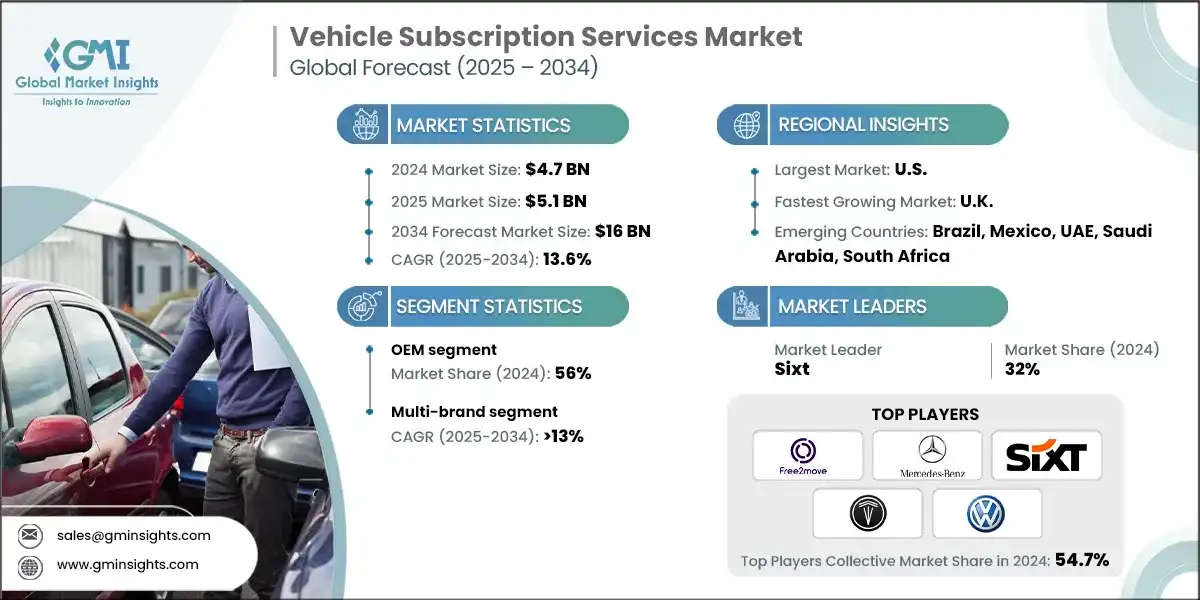
The global vehicle subscription services market was valued at USD 4.7 billion in 2024. The market is expected to grow from USD 5.1 billion in 2025 to USD 16 billion in 2034 at a CAGR of 13.6%, according to latest report published by Global Market Insights Inc.
Vehicle Subscription Services Market Key Takeaways
Market Size & Growth
- 2024 Market Size: USD 4.7 Billion
- 2025 Market Size: USD 5.1 Billion
- 2034 Forecast Market Size: USD 16 Billion
- CAGR (2025–2034): 13.6%
Regional Dominance
- Largest Market: US
- Fastest Growing Region: UK
Key Market Drivers
- Shift from ownership to access-based mobility.
- Rising EV adoption supported by subscription platforms.
- Increasing digitalization & app-based mobility ecosystems.
- Flexible contracts for personal & commercial users.
- Sustainability and circular economic trends.
Challenges
- High subscription costs vs. leasing/financing.
- Limited availability of vehicle models in some regions.
- Complex insurance & liability issues.
- Competition with ride-hailing, leasing, and car rental.
Opportunity
- Integration of multi-brand and EV fleets.
- Partnerships with OEMs, dealers, and fleet operators.
- Growing adoption by SMEs and logistics players.
- Emerging markets in APAC & LATAM.
- AI-enabled fleet management & predictive maintenance.
Key Players
- Market Leader: Sixt led with over 32% market share in 2024.
- Leading Players: Top 5 players in this market include Free2move, Mercedes Benz, Sixt, TeslaRents, Volkswagen, which collectively held a market share of 54.7% in 2024.
Get Market Insights & Growth Opportunities
- The increased insecurity of long-term ownership is pushing the demand of subscription service. The desire of consumers to switch between ownership and more flexibility is growing, especially among younger generations, and is driving adoption. This shift is driven by lifestyle transformations, urban commuting patterns as well as digital platforms that make access-based models "frictionless," which poses a great potential in positioning subscription-based services as a better substitute for traditional leasing.
- The market is growing due to the attractiveness of a monthly payment with insurance, maintenance and servicing all-in-one. Such bundling minimizes the hidden expenses and wastes on ownership hassles. The increased desire by consumers to simplify mobility solutions is driving uptake in the ease of vehicle subscriptions, becoming an increasingly attractive alternative to the ever-varying costs of owning a car.
- Companies operating in vehicle subscription services market are engaged in various inorganic growth strategies such as mergers and acquisitions, partnerships, and new product launch to stay competitive in the market. For instance, PEUGEOT Middle East in June 2025, joined forces with Invygo and Yelo to trial the first vehicle subscription program in the region, where UAE customers will have access to the latest models through an easy and convenient digital experience. PEUGEOT has taken a further step regarding regional mobility with this strategic partnership in line with the goal of transforming the experiences of its drivers.
- The development of technology and app-based mobility ecosystems are enhancing the growth of subscription-based services. Digital-first gives immediate sign-up, vehicle switching, and simple subscriptions control, resulting in an effortless process. The emergence of fintech integration, telematics, and AI-based personalization is creating additional consumer engagement pressure and subscription-based services are becoming an appealing option to the generation of young, technology-savvy consumers who are looking for modern, on-demand mobility options.
- Increased demand by enterprises to have flexible fleet management strength is driving the market. Subscriptions are also becoming common with companies doing so to manage costs and to be more operationally flexible, especially in logistics and last-mile delivery. This has also been driven by the increase in e-commerce and the requirement to have flexible vehicle fleets which makes subscription a strategic option that can help companies manage mobility costs.
- The turning point is to eco-friendly transportation, driving the ambitions of subscription-based mobility where customers can use EVs without a substantial upfront investment. This is being pushed by environmental laws, governmental incentives, and consumer awareness of the possible impact they have on the environment. Subscriptions will provide an easy mode to demo the electric vehicles, gas-powered vehicle penetration, and establish subscription companies as an important part of the transition to green transportation systems.
- North America accounts as the leading shareholder in the vehicle subscription market due to high consumer willingness of flexible mobility services, good digital service, and accessibility of cheap vehicle prices. Established OEMs and third-party providers have ramped up subscription models, and soaring urban congestion and changing ownership behavior are further driving further subscriptions, strengthening the region as a leader in subscription-based mobility.
- The fastest-growing marketplace is Asia Pacific with an increase in urban population, the expansion of the middle-income group and digital first consumer behavior. The call to shift to electric mobility and shared mobility by governments is driving the demand of subscription as well. Access over ownership is also a preference of younger consumers in markets like India and China, making them the hotspot of subscription services growth.
To get key market trends
Vehicle Subscription Services Market Trends
- With the ever-increasing cost of vehicle insurance, service and spare parts, customers are getting attracted to subscription-based services. As the products combine insurance, maintenance, and roadside assistance into a single fixed fee, they become progressively perceived as economical and convenient and are used in both developed and emerging markets.
- Several consumers are increasingly interested in cars suited to lifestyle events, the season or travel choice. Vehicle subscriptions make it possible to alternate SUV, sedans, or EVs depending on occasion. This flexibility is an evolution of lifestyle, and it is establishing market growth mainly due to the customer experience in their desire to have a greater degree of personalization of mobility solutions that cannot be accomplished with conventional leasing or ownership.
- Corporates are increasingly finding subscription services to offer benefits to employees or mobility means to salespeople and field workforces. Being tax efficient, flexible and minimizing on the asset management load, has made it an appealing choice to entrepreneurs, creating a new and rapidly expanding demand band of subscribers globally.
- The affordability and accessibility of certified pre-owned (CPO) and refurbished vehicles are widening because many of them are being introduced into subscription fleets. Providers use the advantages of used cars to reduce the costs and satisfy sustainability targets. Both these strengths of low cost and environmentally friendly are influencing growth among price-sensitive yet environmentally responsible consumers, boosting market growth in price-sensitive markets.
- The rise in business travel, tourism and temporary relocations are creating demand for short-term subscriptions. Subscription services allow longer access periods and include other benefits such as maintenance and insurance in comparison to rentals.
- The subscriptions services are integrating AI and telematics to deliver customized vehicle packages, maintenance forecasts, and up-gradation plans. Such data-centered personalization promotes customer fulfillment and loyalty in the long-term. The emergence of networked services and intelligent analytics is driving the shift toward subscription-based platforms on top of which a wide diversification of mobility ecosystems can be built instead of single car access services.
Vehicle Subscription Services Market Analysis
Learn more about the key segments shaping this market
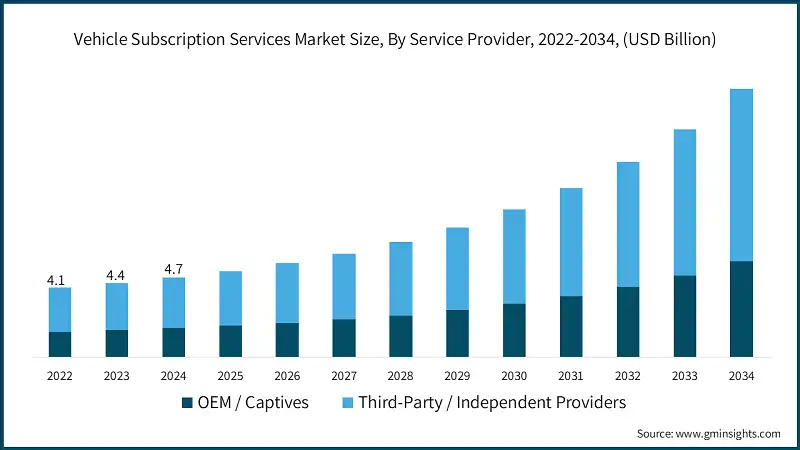
Based on service providers, the vehicle subscription services market is divided into OEM / captives, third-party / independent providers. The OEM segment dominated the market accounting for around 56% in 2024 and is expected to grow at a CAGR of over 13% from 2025 to 2034.
- OEMs are using subscription models to build long-term brand loyalty and establish customer accessibility to its new line-ups. This direct-to-consumer strategy is also leading to an increase in growth as those drivers who have explored multiple designs within the brand family are more likely to stay with the producer, leading to recurring revenue and lifetime value.
- Automakers are using remaining, unused stock, demonstrators and returned leases into subscription plans. This strategy lower the consequences of depreciation, also generates recurring revenues. By converting surplus vehicles to yielding fleets, OEMs are generating profitability whilst at the same time they increase accessibility of premium vehicles at leading creator costs.
- The subscription services are where OEMs are running tests with their electric vehicle portfolios. They are lending comfort to consumers and boosting EV adoption by making consumers gain risk-free trial access to EVs. The practice will drive the demand of the EV line-up by OEMs in the future and establish a competitive edge on the fast-changing sustainable mobility environment.
- OEM subscriptions offer after-sales services (i.e. maintaining, insurance, and upgrading) wrapped together with a single predictable subscription. Such bundling is contributing to customer adoption by removing pain points in ownership. In the meantime, OEMs capture repeat service income, close the relationship with the customer and achieve a competitive advantage against independent third-party subscription providers.
- OEMs are increasingly leveraging telematics and connected car data to deliver personalized subscriptions with an emphasis on vehicle selection, upgrade, and pay-per-use based pricing. This targeted consumer personalization is witnessing a rising adoption, with the consumer believing that there is greater value in having targeted solutions. At the same time, OEMs receive in-depth insights into driver behavioral patterns, allowing them to continue to innovate and improve consumer retention efforts.
- The growth has contributed to the existence of the third-party subscription providers that enable the customers to subscribe to a variety of multi-brand fleets. This gets rid of the obligation to one OEM and accommodates different lifestyle needs. Into this we have the third parties facilitating mass-market penetration by providing a one-stop experience with an extended vehicle selection, thus lowering consumer barriers through increased access.
Learn more about the key segments shaping this market
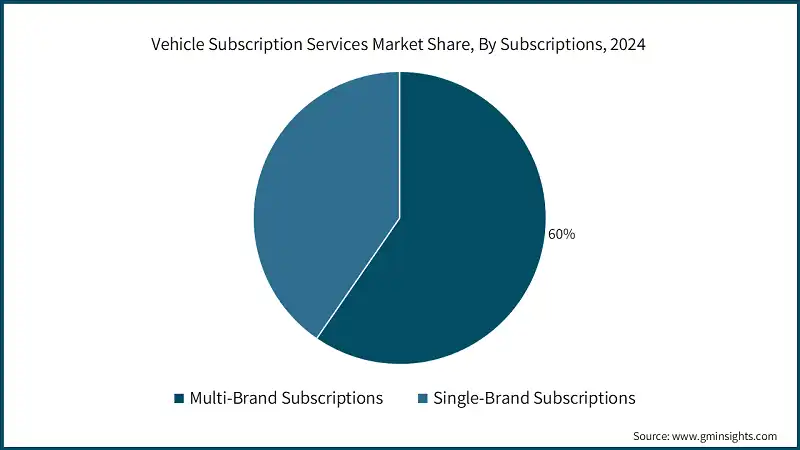
Based on subscriptions, the vehicle subscription services market is segmented into multi-brand, and single-brand. The multi-brand segment dominates the market with 60% share in 2024, and the segment is expected to grow at a CAGR of over 13% from 2025 to 2034.
- The increasing use of multi-brand subscription and providing solutions to a dynamic lifestyle of the consumers are contributing to the growth. A customer can need both a small car to go to work every day and an SUV to spend the weekend. The ability to gain access to multiple brands in a single subscription package is becoming an increasingly desired value, which is driving market uptake across cities, amongst both urban professionals and families.
- The existence of several brands under the same subscription program also contributes to competitive pressures, which leads to low prices. Consumers get convenience based on the flexibility of monthly subscription between brands and segments to drive mass-market carrier penetration. This competitive advantage is driving the need towards multi-brand subscriptions especially in territories where cost-dominant buying habits and consumer choice are the most influential buying elements.
- Multi-brand BM systems appeal to consumers with flexibility, who do not make the commitment to a particular brand, which increases the popularity of such services among the younger generations. This customer neutrality is contributing to customer acquisition across different demographics and encouraging growth in subscription in both mature and emerging automotive markets worldwide.
- The partnership between subscription providers, OEMs and leasing companies is increasing the supply of the available fleet regarding a multi-brand platform. Such a wide spectrum of available vehicles is exciting the interest of consumers because they can shift between luxurious, utility, and green vehicles. Strategic relationships are thus propelling scalability, consumer confidence and the realization of multi-brand subscription services on a global scale.
- Subscriptions to multi-brands offering bundled services in cross-model or cross-segment pack patterns are becoming new sources of impetus. This is a one solution that is driving adoption, particularly in the urban denizens who want convenience. This freedom of choice of brands without hidden costs is pushing the satisfaction of the customers and increasing the appeal of multi-brand subscription ecosystems.
- Single brand subscription services are becoming a source of growth by providing consumers with the opportunity of experiencing an upper end brand. Customers have the benefit of variety whereby they have a choice of models under the same source. This is the strategy that is contributing to the repeat purchases, as customers scale up the scale of the brand-level- entry-level model to the premium cars- within a single ecosystem.
Based on subscription period, the vehicle subscription services market is segmented 1-6 months, 6-12 months, and more than 12 months. The 6–12-month subscription segment is propelling market growth by offering the right balance between short-term trials and long-term commitments. It fuels adoption among customers seeking flexibility during relocation, work assignments, or lifestyle changes, making this duration increasingly attractive for both individual users and corporate clients adapting to evolving mobility needs.
- Six- and 12- month subscription plans are driving the uptake since they offer improved value over monthly rentals. Customers save on average monthly expenses and side-step heavy ownership outlay. The affordability of this mass transit-friendly halfway house is aiding that transition, especially amongst working professionals and young families who care about budget which require a reliable means of transport.
- The 6-12 months’ time is on the increase as users look to relate vehicle use with their life changes e.g. academic semester completion, project-based employment or seasonal residencies. By aligning the life cycle with subscription cycles, providers are stoking the user appetite and increasing penetration among groups that find basic access to a vehicle on a somewhat-temporary basis more important than ownership.
- The 6-to-12-month subscription business is growing as businesses look to subscription to act as an alternative to corporate leasing. This model offers flexibility to the staff, consultants, or expatriates who are project-oriented but not came into multi-year terms. Mid-term adjustment ability to fleets is driving use among both SMEs and MNCs.
- The adoption is being driven by the 6–12-month period which provides the consumer with the best time to explore electric cars without the risk of full ownership. A realistic time frame allows the customers to check the convenience of charging, driving range, and economic benefits. This variable subscription business model is spurring growth in electric vehicles and is instilling confidence in consumers of sustainable mobility.
- Since a year subscriptions are increasing as they provide predictable recurring revenue base to the providers. Those customers who choose to commit to a longer-term contract pay less monthly but have greater loyalty benefits, and providers have more stability and better fleet utilization rates. This is a long-term alignment that is driving maturity in the market and the sustainable source of revenues to the operators.
Based on vehicle, the vehicle subscription services market is segmented into luxury cars, executive cars, economy cars, and others. Executive cars are fueling market growth as corporations increasingly adopt vehicle subscription services for senior staff and travel executives. This model provides flexibility, cost efficiency, and access to a premium fleet without the burden of long-term leasing contracts. Such corporate mobility initiatives are driving recurring demand for executive car subscriptions across global business hubs.
- The increasing middle-class employment is driving subscription services of executive vehicles as their professionals need prestigious vehicles without acquisition liability. The ability to freely access sedans and premium models allows users to align their lifestyle aspirations and can put this within their budget. Such a socio-economic change is promoting the adoption of subscriptions in developed and fast-growing cash urbanizing emerging economies.
- Executive car subscriptions have been fueling their expansion as they provide businesses with cost effectiveness over owning fleets. The subscription models minimize balance-sheet liabilities, accelerate upgrades and incorporate service bundling, such as insurance and maintenance. This mobility tax-friendly and cost-predictable solution is driving demand among companies rationalizing their mobility approaches to their executive workforce.
- As city dwellers need time-efficient and status-rewarding convenience with seamless mobility, executive vehicles are increasingly being subscribed to in virtual auto-leasing. Maintenance, insurance and simple upgrades are bundled items that offer hassle free experiences to the executives.
- Executives with high travel rates are driving the subscription-based executive cars since they can upgrade based on the trip, such as city commute, intracity or client facing meetings. The freedom of choice to exchange vehicles and continue to have a quality experience that is unified across vehicles is what is driving consumers to adopt this type of subscription service and subscription services as a trend will be a focal point in the future.
- Luxury cars subscriptions are on the rise as wealthy customers are demanding unique transportation experiences without the burden of ownership. Getting to experience the new brands of cars, test drives all the latest models and receives services are some of the reasons behind the spread. Lifestyle along with the increased acceptance of access over ownership concept is fueling the luxury car subscription business.
Looking for region specific data?
North America region dominates the global vehicle subscription services market with a share of 37.7% in 2024.
- The automakers and dealerships in North America are launching or associating with subscriptions in a bid to generate alternative revenue streams as well as retain clients. By combining financing, servicing, and access to vehicles in a single subscription, OEMs can serve to keep their customers loyal to them and decrease their dependency on conventional sales, therefore, leading to a significant rise in the use and exposure of subscription services in the region.
- Concerns about increased congestion in cities, shortage of parking spaces and steeper prices in owning vehicles are all turning consumer preferences toward flexible mobility. Vehicle subscription services enable residents in metropolitan areas to gain access to personal mobility without the burden of vehicle ownerships by enabling them to only have access to vehicles when they need to, thereby facilitating efficient urban living and growth across the North American Metropolitan areas.
- Vehicle subscription is an emerging trend among North American businesses in vehicle mobility requirements in the fleet and to their employees. These programs minimize capital outlay, maximize fleet utilization and generate flexible fleet sizes to fit the demand. The subscriptions also align with the sustainability objectives and help to achieve cleaner fleets, establishing a growth trajectory in the corporate mobility and business transportation market.
- Demand for subscriptions is gaining speed due to the high-growth of electric vehicles in North America driven by government incentives and expansion of charging infrastructure. Subscriptions help increase the number of consumers willing to purchase EVs by offering them a low-cost way to test-drive EVs to understand how they suit their lifestyles better than conventional cars do, in addition to it being an effective way to introduce them to sustainable mobility.
- The most powerful force of growth is the comprehensive character of subscription models that include insurance, servicing, and roadside assistance bundles. This can enhance transparency and predictability of the monthly costs, which is attractive to the cost sensitive customers due to the lack of hidden costs with ownership. The ease of the packaged services improves customer satisfaction leading to further market trajectory towards adaptability of subscriptions in the North America market.
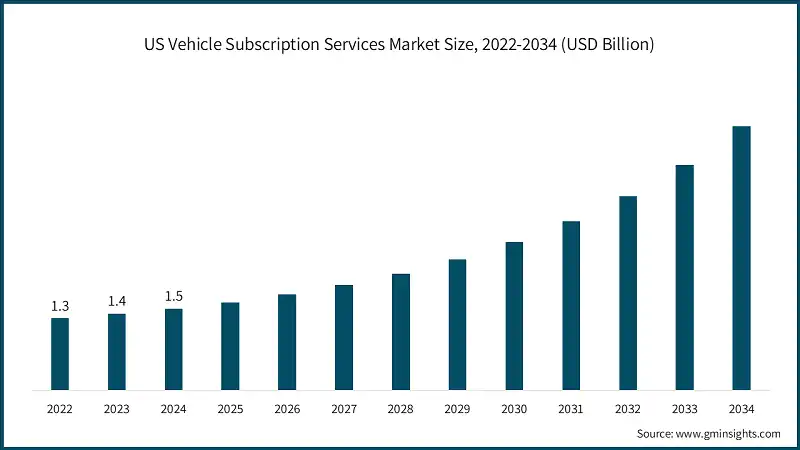
US dominated the vehicle subscription services market in North America with around 85% share in 2024 and generated USD 1.5 billion in revenue.
- The US market is driven by the presence of a highly technical savvy consumer base who will quickly adopt mobility solutions that are digital first. As personalization through AI and high app penetration becomes the norm, automotive subscription services are on the increase as a logical extension of the shared economy. This is a flawless digital integration that is driving growth trends and transforming mobility preferences in the country.
- A growing urban population and the changing consumer behavior in big US cities is contributing to increased demand for flexible mobility. Younger audiences are less interested in ownership than access, and older citizens want to avoid long-term leasing. The substitution of the old vehicle ownership patterns with the subscriptions based on short-term to medium-term subscriptions is helping in having a steady growth in areas such as New York, Los Angeles, and Chicago.
- Global automakers, most of which are based in the USA, are pushing the subscription services market forward by testing pilot programs and widening the offering in major cities. Other companies, such as Ford, GM, and foreign brands, are using subscriptions as a testbed to EV adoption, loyalty driving, and flexible ownership options. The credibility and the accelerating consumer are being attributed to this OEM backed expansion.
- The current US trend toward sustainability and electrification is serving as a booster of vehicle subscription. Although consumers are not yet willing to fully commit to EV ownership because of charging infrastructure or depreciation concerns, this group is choosing subscriptions. Risk-free EV experience and support of green mobility efforts translate into the expansion of the consumer base in urban areas and suburbs.
- Subscriptions are gaining momentum on the American continent as bundled packages involving insurance, maintenance, roadside support and straightforward upgrades. The single-bill with one-month payment simplicity is appealing to customers of both the high-tier and the mid-range market segments. This is a value-based approach that is driving growth and differentiating subscriptions with traditional leasing models.
Europe vehicle subscription services accounted for USD 1.4 billion in 2024 and is anticipated to show lucrative growth over the forecast period.
- The European Union Green Deal and ambitious CO2 emission limits, combined with low-emission zones at the level of cities, are increasing the urgency of alternative mobility to models. The subscription service has both above in that the subscription-based vehicle service is largely environmentally friendly since it discourages long-term possession of vehicles, which fit with Europe policies to promote sustainable use of vehicles and subscription-based services without long-term ownership are a major solution to environment conscientious European consumers.
- Share mobility culture in Europe is well established with great use of carsharing and ride-hailing. Vehicle subscription services can perfectly fit with this ecosystem as they provide a third option between the two extremes--having your own vehicle and using it the whole time, or having a vehicle on a short-term basis. This social preparedness to the non-ownership mobility models is leading to a fast growth in subscriptions across the cities of Europe.
- European automakers such as BMW, Volvo and Mercedes-Benz are leading the way with subscription services to upper-end clients. People who value variety, status, and convenience look to have the luxury vehicles by means of subscription services, which OEMs embrace. The OEM-led impetus boosts trustworthiness, good-quality fleets and briskens the enthusiasm of consumers to subscription models in the mature auto market of Europe.
- The current inflationary environment and increasing ownership cost of cars (insurance, parking, taxes and depreciation) in Europe is leading to an increasing preference among consumers in the region switching to subscriptions as more predictable ownership. The low risk features it has are fixed monthly payments that are made alongside the bundling of services no matter what uncertainty there is, they are controlled by fixed monthly payments. This makes affordability element a very strong market growth determinant in the area.
- In Europe, digital mobility ecosystems are evolving in the ellipse of the Mobility-as-a-Service where subscriptions can merge with fare-free trips to buses, bike-sharing, and ride-hailing. Tech-enabled platforms are changing consumer experience by providing a multi-modal access and digital onboarding, making subscription services a part of the European smart mobility strategy and transportation transformation in the long run.
The vehicle subscription services market of Germany is steadily growing. Germany’s strong automotive heritage, with global OEMs like BMW, Mercedes-Benz, and Audi, is propelling subscription adoption. Consumers trust established brands to deliver high-quality subscription offerings. This brand loyalty combined with innovative models from OEMs is fueling growth, as customers increasingly shift from ownership to flexible mobility backed by Germany’s premium engineering excellence.
- New government incentives to use electric vehicles and environmentally friendly emission standards are increasing EV use in Germany and extending demand in subscription services. Most people would like to have a trial before buying an EV by using short-term usage. Subscriptions reflect this trial phase, as in line with the country that aims to decarbonize by 2045, and consumers take interest in eco-friendly transport options.
- Dense cities such as Berlin, Munich, and Hamburg are opening up vehicle subscriptions as people look away to ownership of vehicles. Shortage of parking places, small taxation of vehicles and congestion are driving toward flexible and access-based systems. This is a key mobility trend that is fueling the subscription economy in the country in the metropolitan areas of Germany.
- German OEMs are experimenting with subscription-based models aggressively in an attempt to maintain customer affinities in a changing consumer landscape. The availability of programs that provide multi-brand fleet is driving growth through the ability to provide consumers with a range of vehicle choices. The high support of established manufacturers is promoting credibility and the blistering expansion of subscription services in the premium and economy classes of cars in the German market.
- This is because Germany is increasingly on a mission to move toward Industry 4.0 and digitalization, leading to the adoption of subscription models that can fit into a digital platform. Customer engagement is driven by app-based booking, artificial intelligence-based vehicle recommendations and real-time fleet management. This convenience offered by such technology is increasing the use of the same, especially among the younger, digital-native consumers who want transport services to suit their hectic lifestyles.
- German companies are turning to subscription arrangements of corporate fleet management to maximize the number of vehicles at minimal cost and flexibility. The growth is driven by the inclining demand by both the SME segment and the large enterprise (Vehicle accessibility requirements). Subscriptions give companies the ability to interchange between EVs, premium sedans, or utility vehicles according to the needs of the project and are the reason for high corporate take-up in the German market.
The Asia Pacific vehicle subscription services market is anticipated to grow at the highest CAGR of over 15% during the analysis timeframe.
- The growing middle class in Asia Pacific is experiencing an ever scarce taste of the drain ownership costs on the pocket and desires low cost and flexible mobility options in the form of car subscriptions. Subscriptions in vehicles are more practical options in high-growth economies like India, China, and Southeast Asia, which have larger target markets with a cross-section of consumers with limited budgets and high levels of insensitivity to costs-hence accelerating subscription use.
- The preference of consumers against owning cars permanently, as megacities in Asia Pacific struggle with congestion, pollution and lack of parking, is changing. Subsect yon services alleviate all these issues, as flexible short-term access to vehicles on only an as-needed basis reduce the reliance on personal ownership, and instead, provide greater convenience and flexibility to accommodate younger and mobile lifestyles.
- Asia Pacific is an example of markets that have strong two-wheeler dominance unlike Western markets. There is a growing trend of subscription providers offering scooters, motorcycles, and electric two-wheelers, to satisfy the needs of urban mobility. Together with the increasing EV incentives in China, India, and Southeast Asia, this spread of subscription models also makes the model a driver of multimodal and sustainable transport.
- Asia Pacific has great super-apps such as Grab, Gojek and Ola who are moving towards vehicle subscription services on their mobility platforms. This digital-first strategy makes onboarding, payment, and access to a fleet simple to consumers. The incorporation into the daily lifestyle applications will enhance consumer adoption and the presence of subscription-based services in the digital economy in the region.
- Asia Pacific is home to one of the youngest populations in the entire world and millennials and Gen Z value flexibility as well as digital convenience. Subscriptions create opportunities to switch vehicles and upgrade, which resonates with their more preference of access-based models of consumption. Such generational change is establishing a long-term demand base with youth adoption being an important growth factor.
The vehicle subscription services market in China is projected to witness strong and sustained growth throughout the forecast period from 2025 to 2034.
- The high numbers of electric vehicle (EV) production, and rapid charging interconnection are driving subscription riddance in China. Consumers are seeking trials of the emerging brands of EVs such as NIO, XPeng, and BYD before making a commitment purchase. The subscription model is facilitating an EV trial and adherence due to flexibility as well as aligning with the government vision of transforming mobility into green mobility.
- This is attributed to the younger population in China and especially in megacities where people appreciate a subscription to services more than the physical products. Growth is driven by rising aspirations and low long-term commitment in regard to premium cars. The subscription models are not lost to consumers who are digital natives and who prefer the agility, the convenience, the technological-driven mobility experiences compared to the angst of ownership.
- Rigid government regulations like the limitation of license plates in such cities as Beijing and Shanghai are also contributing to the use of subscription services. Flexibility in mobility subscriptions allows consumers to forgo ownership challenges such as license lottery and high charges of vehicle registration. The effects of these regulatory dynamics are driving the growth that is calculated to make subscriptions a viable substitute to car ownership.
- China OEMs and new-energy vehicle manufacturers have been strongly testing subscription services in their quest to attract younger customers. Advancement, such as integrations in battery swapping, bundled charging, and mobility-as-a-service platforms, are driving uptake. This wave of OEM experimentation is emerging with subscription models being aligned with the ultra-competitive and fast cycle of automotive innovation in China.
- China digital ecosystem subscription is being driven by super-apps like WeChat, Alipay, and ride-hailing companies like Didi that have very strong digital ecosystems. Smart affiliate marketing is driven by seamless integration of payment, booking, and customer engagement on existing platforms. This driving force of integration between automotive and technological eco-systems is fueling the luxury and convenience of its consumers and stimulating the subscription market on a premium and economy level.
Latin America vehicle subscription services accounted for over USD 900 million in 2034 and is anticipated to show lucrative growth over the forecast period.
- Latin America faces high purchase costs as a result of strict tariffs on imports, near currency-devastation, and an exorbitant rate of car financing. Instead of buying the cost of a car and paying up-front prices, vehicle subscription services offer predictable monthly rates and bundle costs to the consumer, creating affordable offerings on the mobility market. This cost saving is making subscriptions an attractive option instead of ownership in countries such as Brazil, Mexico and Argentina.
- Large populations in major cities like San Paulo, Mexico and Bogota also experience serious traffic delays and a poorly developed transport system. Vehicle subscription services provide freedom to drive without the commitments of owning a car, extensive flexibility and personal mobility on an as-needed basis. Subscriptions can supplement the current mobility choices by providing a possibility of regular and reliable access to vehicles on demand to urban residents.
- One of the key factors that have prompted the adoption of pay-per-use/non-ownership modes of mobility in Latin America is the popularity of ride-hailing giants like Uber, 99 and Cabify. The subscription models of vehicles are the next step of this as they will facilitate more extended amounts of flexibility, integrated as a part of the shared mobility environment and will appeal to city professionals who enjoy convenience and being able to make choices.
- In Latin America, automakers and leasing firms are sweating out subscription models with a view to having a new stream of earnings. By packaging financing, servicing and insurance, OEMs make ownership less complex to the consumer. Pilot programs in Brazil, Chile and Mexico provide a highlight of successful market potential since established automotive brands have the trust and credibility in inflating subscription solutions.
The vehicle subscription services market in Brazil is projected to witness a notable increase in market share from 2025 to 2034.
- Increasing urbanization in large cities in Brazil such as the Rio de Janeiro and Sao Paulo is boosting the need to have flexible mobility options. Customers are becoming more attracted to subscription services that diminish the inconveniences of ownership and allow them to lend a wide range of vehicles. High congestion in this urban setting is driving the subscriptions as a flexible solution that helps lower the cost as well as the expenses of owning a car due to parking deficiency and limited resources.
- High interest rates and auto financing in Brazil are fueling away the consumers towards the traditional car ownership. Subscription services - where there are steadily recurring payments and no long-term debt - are driving adoption. This monetary fluidity is driving the expansion of new markets as middle-income consumers want relatively inexpensive entry into mobility without the risks and burdens of bank fundings or depreciation.
- The developing corporate markets in Brazil, especially in the logistics, tech, and services sector are driving the interest in flexible access to vehicles. B2B adoption is becoming introduced as new approaches to fleet management are implementing subscription models instead of longer commitments. This increased demand of the scalable mobility solutions is driving subscription services as a superior alternative to leasing, and the traditional corporate fleet ownership.
- The convenience of subscriptions is being fueled by Brazilian thriving digital ecosystems that are facilitated by fintech solutions and Super-app integration. The increased penetration of smartphones and consumer familiarity with app-enabled services are also the factors behind the rising subscription platforms. The online transition is driving the emergence of new mobility experiences whereby users are increasingly willing to use cars on-demand based on new patterns of consumption.
MEA vehicle subscription services accounted for over USD 120 million in 2024 and is anticipated to show lucrative growth over the forecast period
- In the Gulf nations, there are masses of expatriates and migrant labor. Vehicle subscription services satisfy their requirement of flexible and short-term mobility, without a long-term ownership obligation. The segment is appreciative of bundled services and the concept of predictability in costs, which makes subscriptions an effective option to consider in the region and drives market growth.
- Cities such as Dubai, Riyadh, and Doha are centers of luxury life and high-tech mobility. Vehicle subscription companies are capitalizing on this need by leasing top-tier fleets, such as luxury cars and SUVs, on a subscription basis. In high-income markets in the MEA region, the demand of prestigious and flexible mobility options is also high.
- Several MEA governments are betting on smart cities and economic diversification beyond oil. The idea of subscription-based mobility gives in to these strategies because it encourages asset-light mobility and minimizes car ownership dependency. The national plans like Saudi Vision 2030 and UAE Smart Mobility plans are developing promising policy environments in which subscription models may expand.
- The MEA region presents one of the youngest populations in the world, and its interest in digital-first and access-over-ownership lifestyles is increasing. They specifically address this shift by offering vehicle subscriptions through apps that can be onboarded seamlessly. Youth motivated consumption is an essential growth booster in the MEA rapidly changing automotive environment, as younger buyers favor practical mobility as opposed to traditional ownership.
- With MEA countries slowly shifting towards incentivizing EV adoption and enhancing the infrastructure, vehicle subscription models will transform into a low-stakes method of experimenting with e-mobility. With low initial vehicle costs, subscription providers can enable EV adoption faster and establish themselves at the epicenter of the regional shift toward more sustainable transport.
The vehicle subscription services market in Saudi Arabia is anticipated to capture a growing share of the regional market between 2025 and 2034.
- The high expatriate labor force in Saudi Arabia is driving the flexibility in mobility. A large number of expats have short-term contracts, so long-term automobile ownership is not appealing. The subscription services are gaining ground by quickly providing short-term to medium-temporal access without ownership obligations, which fits well into the needs of the transient workforce and encourages more corporations and individuals to make use of subscriptions and subscription-based services in general.
- The Saudi Arabia Vision 2030 reforms focus on new, green, and diversified transportation means. This is fueling the move to subscribing to owning or leasing vehicles. Supported by the urban development and smart city projects driven by the government, the subscription services are booming as they move in accordance with national initiatives of changing consumer transport patterns.
- This is driven by the need among the younger population in Saudi, who are getting increasingly influenced by the style of living seen in other parts of the world that include easy access to cars through an approach that is therapeutic and seems to have the lack of hassle of ownership. Digitization is a trend, and an increasing number are choosing digital over ownership of assets, which is creating a shift toward vehicle subscription. The corresponding cultural change is driving the uptake in the form of millennials and Gen Z that value convenience and flexibility as opposed to binding contracts.
- Saudi customers have ambitious tastes on luxury cars, but the cost-of-entry is rather steep and depreciation factors fearful. Monthly subscription plans of premium brands such as BMW, Mercedes, Lexus are among the growth drivers due to affordability. This growing interest on prestige mobility is driving subscriptions as access to dreamy lifestyles but without economic burdens.
- The oil & gas, logistics, and business services are the areas of the Saudi Arabian corporate sector that are currently stimulating the demand of flexibility of fleet. Vehicle subscription services are driving organic growth, which allows all corporates to easily access fleets with no long-term commitments. The increased appetite towards operational efficiency and mobility-as-a-service is driving subscription models as a cost-efficient fleet management strategy.
Vehicle Subscription Services Market Share
- The top 7 companies in the vehicle subscription services industry are Sixt, Free2move, Mercedes-Benz, Carvolution, TeslaRents, Volkswagen, and Myles, contributing around 55% of the market in 2024.
- Sixt
Sixt leads the vehicle subscription services market with a share of over 32% in 2024. Sixt is[SJ1] [SJ2] fortifying its competitive advantage by widening its flexible subscription programs that include high-quality cars and short-term / long-term plans. The company has its comprehensive rental and leasing network that helps it to connect subscription models more efficiently, covering more market places both in the urban and corporate regions. Sixt is pursuing these investments, including digital platforms, app-based access, and EV integration, in order to pursue customer convenience and become a one-stop mobility service provider in Europe and beyond.
Mercedes-Benz is keeping up with the competition by leveraging its luxury brand appeal in order to appeal to high-value subscription customers. The company specializes in single-brand subscriptions that are curated and concentrate on premium models with flexible swaps, and digital services incorporated. Betting on connected car technology and EV growth, Mercedes-Benz will tie its subscription model to the shifting taste of the high-affluent customers that want both prestige and flexibility in terms of vehicle ownership options.
Volkswagen is powering competitiveness with its scaled-up subscription programs based on affordability and accessibility. The company utilizes its wide-ranging model line that suits individual customers in all classes including compact cars, EVs, and so forth. Alliances with mobility platforms and local operators are supporting reach and a digital-first subscription management coupled with flexible terms of tenure enable Volkswagen to cut-throat among third-party mobility, as well as OEMs product offerings.
Vehicle Subscription Services Market Companies
Major players operating in the vehicle subscription services industry are:
- Carvolution
- FINN
- Free2move
- Hyundai
- Mercedes Benz
- Myles
- Sixt
- Tata Motors
- TeslaRents
- Volkswagen
- The competitive environment of the vehicle subscription services market is characterized by competitive forces comprising OEM-led initiatives and third-party platforms that are aspiring to achieve scale and customer loyalty. Venerable automakers like Mercedes, Volkswagen, and BMW are using their brand equity and the variety of products they produce to create single-brand subscription-based programs, frequently complemented by digital-service packages and EV adoption plans.
- On the one hand, the movement of mobility experts such as Sixt, Free2move, and Carvolution is promoting multi-brand subscriptions, focusing on flexibility, affordability, and complete digitalization of registration. Such a dual structure is opening possibilities of competitive overlaps in various end segments globally across premium, executive and economy car segments.
- The competition is getting stiffer as businesses are choosing to diverge based on technology incorporation in their operations, flexibility of tenures, and the ability to electrify their fleets. OEMs are focusing on unique customer experiences, premium upgrades, and connected services, versus third party providers taking the higher entry cost, wider model base, and ease of usability via app-based strategy.
- The focus on integrating EVs and hybrid vehicles into the subscription fleets is an emerging trend that adds more competition between incumbents and new entrants. The ability to form strategic partnerships, the optimization of fleet, and expansion of operating capacity in regions remain primary avenues of competitiveness as the market transpires into a variety of ecosystem where versatility and customer-focused market inventions are the vibrant dimensions of long-term success.
Vehicle Subscription Services Market Report Attributes
| Key Takeaway | Details |
|---|---|
| Market Size & Growth | |
| Base Year | 2024 |
| Market Size in 2024 | USD 4.7 Billion |
| Market Size in 2025 | USD 5.1 Billion |
| Forecast Period 2025 – 2034 CAGR | 13.6% |
| Market Size in 2034 | USD 16 Billion |
| Key Market Trends | |
| Drivers | Impact |
| Shift from ownership to access-based mobility | Driving adoption of flexible subscription models among urban populations |
| Rising EV adoption supported by subscription platforms | Fuels consumer willingness to trial electric cars without full ownership risk |
| Increasing digitalization & app-based mobility ecosystems | Enables seamless onboarding, payments, and multi-vehicle access |
| Flexible contracts for personal & commercial users | Expands adoption across corporates, gig economy, and fleet operators |
| Sustainability and circular economic trends | Supports car reuse, optimized fleet utilization, and reduced carbon footprint |
| Pitfalls & Challenges | Impact |
| High subscription costs vs. leasing/financing | Restricts penetration in price-sensitive markets |
| Limited availability of vehicle models in some regions | Constrains consumer choice and slows adoption |
| Complex insurance & liability issues | Creating operational and regulatory hurdles |
| Competition with ride-hailing, leasing, and car rental | Erodes market share and blurs consumer preference |
| Opportunities: | Impact |
| Integration of multi-brand and EV fleets | Expands consumer appeal and accelerates EV penetration |
| Partnerships with OEMs, dealers, and fleet operators | Creates new mobility revenue streams and broader reach |
| Growing adoption by SMEs and logistics players | Unlocks commercial subscription demand, especially in urban freight |
| Emerging markets in APAC & LATAM | Provide large untapped customer base for subscription providers |
| AI-enabled fleet management & predictive maintenance | Enhances efficiency, lowers operational cost, and improves customer retention |
| Market Leaders (2024) | |
| Market Leaders |
32% market share |
| Top Players |
Collective market share in 2024 is Collective Market Share is 54.7% |
| Competitive Edge |
|
| Regional Insights | |
| Largest Market | US |
| Fastest Growing Market | UK |
| Emerging Countries | Brazil, Mexico, UAE, Saudi Arabia, South Africa |
| Future outlook |
|
What are the growth opportunities in this market?
Vehicle Subscription Services Industry News
- In November of 2024, Casi, announced that it is extending its collaboration with Hyundai Connected Mobility, supplying the technology to launch its MOCEAN Subscription service in Germany. MOCEAN is now able to provide the business and the consumer in the European largest automobi market, with flexible, all-inclusive vehicle subscriptions.
- In October 2024, Volkswagen Group of America collaborated with Volkswagen Financial Services (VWFS aka Volkswagen Credit Inc.) to introduce VW Flex, a car subscription plan for Volkswagen cars in Atlanta metro region. The subscription is an all-new, monthly subscription, providing maintenance, insurance and roadside assistance 24/7, on a monthly payment plan, which allows consumers a flexible and convenient mobility means on some of the select Volkswagen models.
- In February 2023, Eden Motor Group announced the launch of car subscription service in the Karzoom partnership. The AM100 retail group will be able to access vehicles with franchised partners Mazda, Hyundai, Peugeot, Suzuki and MG on a one- to three-month short term basis as part of the offering.
- In October 2022, Maruti Suzuki India announced the implementation of its car subscription service that was launched in 5 new cities Maruti Suzuki Subscribe. Through this, the subscription program of the company has become available in 25 cities in the country. With additional partnerships and growth to new cities, the company are excited to offer convenience to our customers in more locations.
The vehicle subscription services market research report includes in-depth coverage of the industry with estimates & forecasts in terms of revenue ($ Mn/Bn) and shipment (Fleet Size) from 2021 to 2034, for the following segments:
Market, By Service Provider
- OEM / Captives
- Third-Party / Independent Providers
Market, By Subscription
- Multi-Brand Subscriptions
- Single-Brand Subscriptions
Market, By Subscription Period
- 1-6 months
- 6-12 months
- More than 12 months
Market, By Vehicle
- Luxury car
- Executive car
- Economy car
- Others
Market, By End Use
- Personal
- Commercial
Market, By Fuel
- ICE
- BEV
- PHEV
- HEV
The above information is provided for the following regions and countries:
- North America
- US
- Canada
- Europe
- UK
- Germany
- France
- Italy
- Spain
- Russia
- Nordics
- Asia Pacific
- China
- India
- Japan
- South Korea
- ANZ
- Southeast Asia
- Latin America
- Brazil
- Mexico
- Argentina
- MEA
- South Africa
- Saudi Arabia
- UAE
Frequently Asked Question(FAQ) :
What is the market size of the vehicle subscription services in 2024?
The market size was USD 4.7 billion in 2024, with a CAGR of 13.6% expected through 2034. The growing demand for flexible ownership models and the integration of digital platforms are driving market growth.
What is the projected value of the vehicle subscription services market by 2034?
The market is poised to reach USD 16 billion by 2034, driven by lifestyle changes, urban commuting patterns, and the adoption of AI and telematics in subscription services.
What is the expected size of the vehicle subscription services market in 2025?
The market size is projected to reach USD 5.1 billion in 2025.
How much revenue did the OEM segment generate in 2024?
The OEM segment generated approximately 56% of the market share in 2024 and is set to expand at a CAGR of over 13% from 2025 to 2034.
What was the valuation of the multi-brand segment in 2024?
The multi-brand segment accounted for 60% of the market share in 2024. This segment's growth is led by the flexibility it offers consumers to choose from a variety of brands and vehicle types.
Which region leads the vehicle subscription services sector?
North America leads the market, with the US accounting for 85% of the regional revenue and generating USD 1.5 billion in 2024.
What are the upcoming trends in the vehicle subscription services market?
Trends include AI-telematics, certified pre-owned fleets, and growth of short-term subscriptions.
Who are the key players in the vehicle subscription services industry?
Key players include Carvolution, FINN, Free2move, Hyundai, Mercedes Benz, Myles, Sixt, Tata Motors, TeslaRents, and Volkswagen.
Vehicle Subscription Services Market Scope
Related Reports