Summary
Table of Content

Vehicle Scanner Market
Get a free sample of this report
Form submitted successfully!
Error submitting form. Please try again.
Thank you!
Your inquiry has been received. Our team will reach out to you with the required details via email. To ensure that you don't miss their response, kindly remember to check your spam folder as well!
Request Sectional Data
Thank you!
Your inquiry has been received. Our team will reach out to you with the required details via email. To ensure that you don't miss their response, kindly remember to check your spam folder as well!
Form submitted successfully!
Error submitting form. Please try again.
Vehicle Scanner Market Size
The vehicle scanner market is projected to witness strong growth in the coming years, driven by rising global security concerns, increasing cross-border trade, expanding logistics infrastructure, and growing threats related to smuggling, terrorism, and vehicle-borne explosives. Governments, defense agencies, critical infrastructure operators, and private enterprises are increasingly investing in advanced vehicle inspection technologies to enhance safety, ensure regulatory compliance, and streamline checkpoint operations. The rapid expansion of smart cities, urban transportation networks, and high-security commercial facilities is further accelerating demand for automated and AI-enabled vehicle scanning systems.
Vehicle Scanner Market Key Takeaways
Market Size & Growth
- 2025 Market Size: USD 3.1 Billion
- 2026 Market Size: USD 3.3 Billion
- 2035 Forecast Market Size: USD 6.1 Billion
- CAGR (2026–2035): 7.2%
Regional Dominance
- Largest Market: Europe
- Fastest Growing Region: Asia Pacific
Key Market Drivers
- Rising Border Security & Anti-Smuggling Measures.
- Growth in Critical Infrastructure Protection.
- Expansion of Global Trade & Logistics Networks.
- Technological Advancements in AI & Imaging.
Challenges
- High Installation & Maintenance Costs.
- Regulatory & Radiation Compliance Concerns.
Opportunity
- Rapid Adoption of Mobile & Portable Scanners.
- Smart City & AI-Based Integrated Security Platforms.
Key Players
- Market Leader: Leidos led with over 10.9% market share in 2025.
- Leading Players: Top 5 players in this market include Leidos, Scanlab, SecureOne, SecuScan, Snap On, which collectively held a market share of 18% in 2025.
Get Market Insights & Growth Opportunities
Growing pressure on border control authorities, homeland security agencies, airport operators, logistics companies, and event organizers to improve threat detection accuracy, reduce inspection time, and minimize operational disruptions is driving the adoption of next-generation scanning technologies. Modern vehicle scanners enable non-intrusive inspection, real-time analytics, automated license plate recognition (ALPR), and under-vehicle threat detection, supporting faster vehicle throughput while maintaining high-security standards.
Technological advancements such as high-energy X-ray imaging, under-vehicle scanning systems (UVSS), 3D imaging platforms, AI-powered anomaly detection, cloud-connected monitoring, and integrated command-and-control software are transforming traditional vehicle inspection processes. For instance, in January 2025, Smiths Detection launched an upgraded drive-through X-ray vehicle scanner integrated with AI-based threat recognition software for border security agencies across Europe and North America.
Major industry participants including Leidos Holdings, Rapiscan Systems, Smiths Detection, UVeye, and Gatekeeper Security. are actively strengthening their product portfolios through investments in high-resolution imaging systems, AI-enabled analytics software, mobile vehicle scanners, and integrated surveillance solutions. These companies are focusing on scalable platforms that address diverse applications, including security & border control, critical infrastructure protection, commercial facilities, logistics hubs, parking facilities, and event management.
The vehicle scanner ecosystem continues to evolve as digitalization, automation, and data-driven security strategies reshape inspection and threat detection priorities. Industry participants are increasingly prioritizing modular, interoperable, and cloud-enabled vehicle scanning platforms that offer faster deployment, improved detection rates, and lower total cost of ownership. These developments are redefining the market, enabling enhanced security intelligence, streamlined vehicle inspection processes, operational efficiency, and long-term value creation across government, transportation, logistics, and high-security commercial sectors worldwide.
The global vehicle scanner market was valued at USD 3.1 billion in 2025. The market is expected to grow from USD 3.3 billion in 2026 to USD 6.1 billion in 2035, at a CAGR of 7.2%, according to latest report published by Global Market Insights Inc.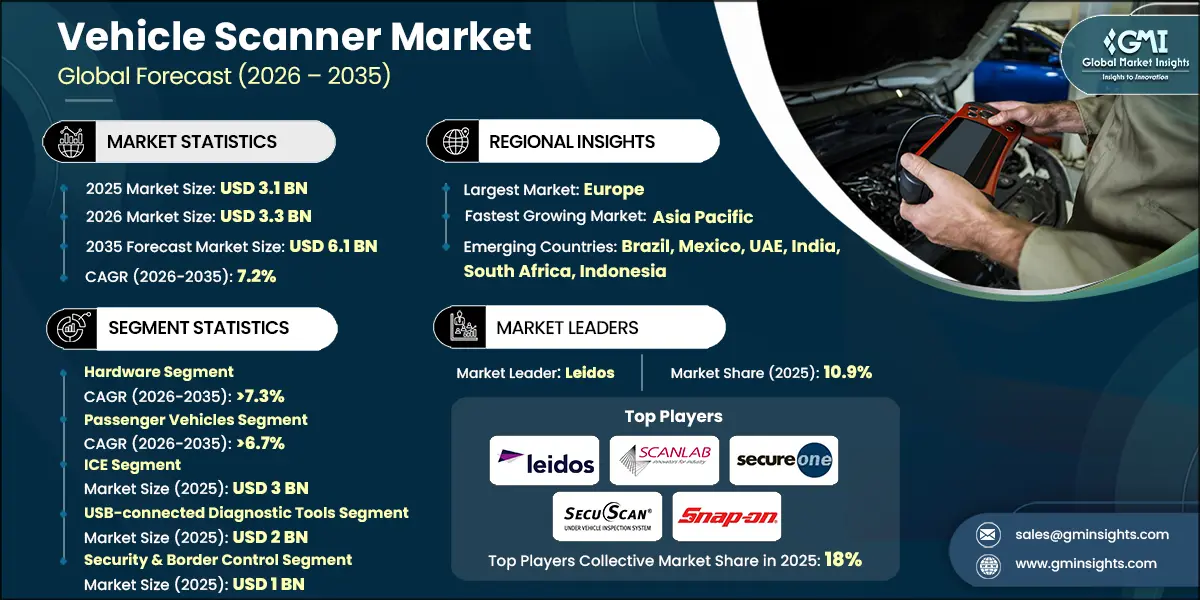
To get key market trends
Vehicle Scanner Market Trends
The demand for advanced vehicle scanner solutions is steadily increasing, driven by growing collaboration among government agencies, border security authorities, logistics operators, critical infrastructure managers, and technology providers. These partnerships aim to enhance threat detection accuracy, improve inspection speed, enable non-intrusive vehicle screening, and comply with increasingly stringent security and regulatory standards across airports, ports, borders, and high-security commercial facilities.
For instance, in 2025, leading vehicle scanner manufacturers strengthened strategic collaborations with government and commercial operators to deploy AI-driven drive-through scanners, portable inspection units, and integrated under-vehicle imaging systems for border security, logistics hubs, and event security applications. These initiatives improved detection accuracy, reduced inspection time, enhanced operational throughput, and ensured compliance with international security protocols across high-traffic checkpoints and critical infrastructure sites worldwide.
Regional customization of vehicle scanner solutions has emerged as a key trend. Major suppliers are developing region-specific imaging calibrations, multi-sensor integration, and AI-based detection algorithms tailored for North America, Europe, Asia Pacific, Latin America, and the Middle East & Africa. These solutions address local regulatory requirements, security protocols, environmental conditions, and facility-specific operational needs across airports, ports, corporate campuses, logistics centers, and temporary event sites.
The rise of specialized vehicle scanning technology providers and AI-enabled inspection platform developers is reshaping the competitive landscape. Companies focusing on modular drive-through scanners, mobile inspection units, high-resolution imaging systems, and integrated cloud-based analytics platforms are enabling scalable and cost-effective adoption of advanced vehicle scanning technologies. These innovations empower both government agencies and private operators to enhance security intelligence, improve throughput efficiency, reduce operational costs, and support multi-site deployment strategies.
The development of standardized, interoperable, and modular vehicle scanner architectures is transforming the market. Leading players are deploying platforms that integrate seamlessly with license plate recognition systems, CCTV networks, perimeter access control, and centralized command-and-control frameworks. These platforms support real-time monitoring, predictive maintenance, multi-location compatibility, and global security compliance, enabling agencies and enterprises to deliver efficient, high-throughput, and threat-compliant vehicle inspection solutions across global security and commercial applications.
Vehicle Scanner Market Analysis
Learn more about the key segments shaping this market
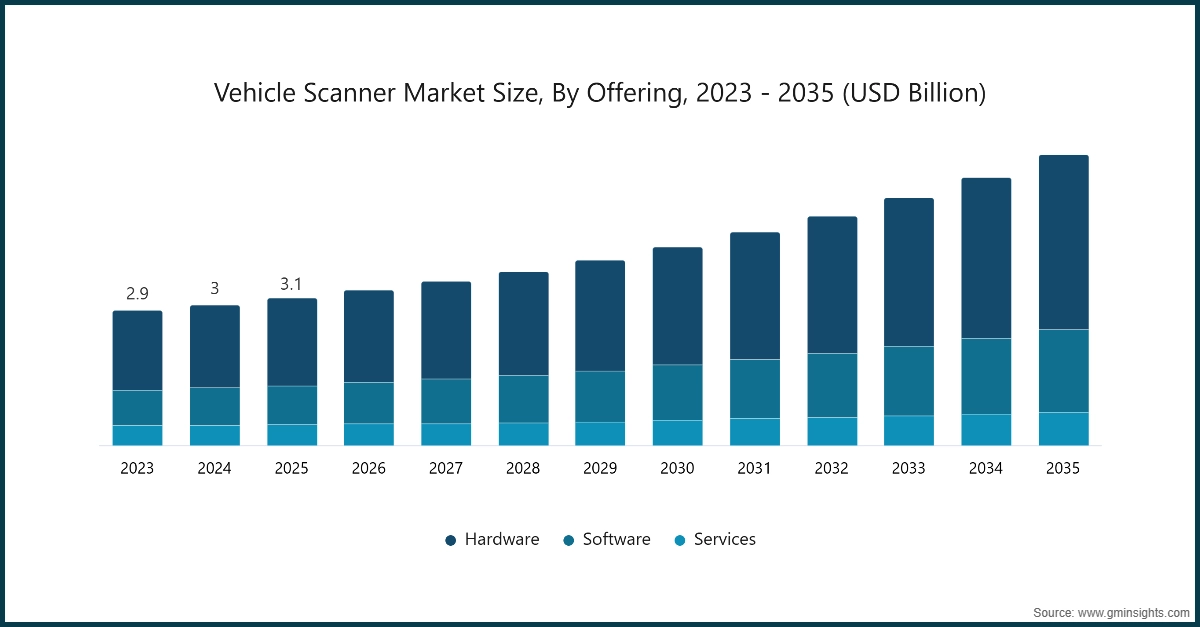
Based on offering, the market is divide into hardware, software and services. The hardware segment dominated the market, accounting for around 59% share in 2025 and is expected to grow at a CAGR of over 7.3% from 2026 to 2035.
- The hardware segment dominates the vehicle scanner market, primarily due to its critical role in enabling accurate vehicle inspection, high-resolution imaging, and real-time threat detection. With the widespread adoption of fixed, mobile, and drive-through scanning systems across borders, ports, logistics hubs, and critical infrastructure, hardware components such as X-ray scanners, under-vehicle scanning systems (UVSS), multi-sensor imaging units, and drive-through platforms have become essential for ensuring operational efficiency, security compliance, and high throughput. Their extensive integration across government, commercial, and industrial applications ensures consistent demand in both new deployments and aftermarket service channels globally.
- Other offerings, including software and services, play complementary roles within the vehicle scanner ecosystem. Software solutions, including AI-powered anomaly detection, automated license plate recognition (ALPR), and cloud-connected monitoring, enhance system intelligence and operational efficiency, while services such as installation, maintenance, and technical support ensure reliability and longevity. However, these segments hold comparatively smaller revenue shares than hardware.
Learn more about the key segments shaping this market
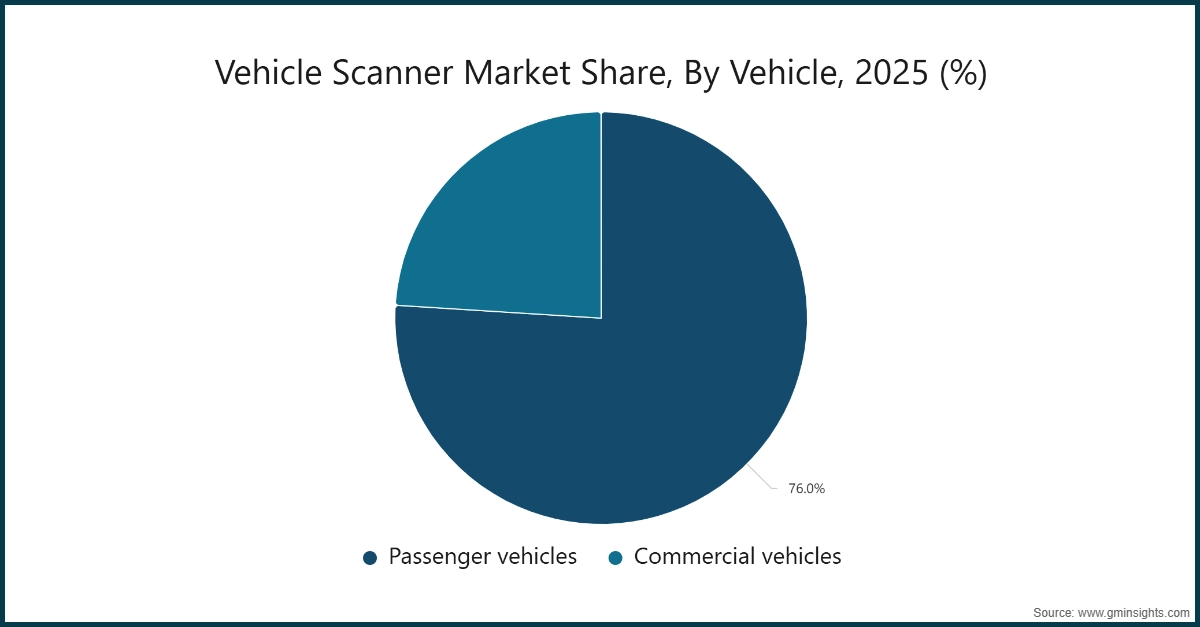
Based on vehicle, the market is divided into passenger vehicles and commercial vehicles. The passenger vehicles segment dominates the market, accounting for around 76% share in 2025, and the segment is expected to grow at a CAGR of over 6.7% from 2026 to 2035.
- The passenger vehicles segment dominates the vehicle scanner market due to the high global deployment of security and inspection systems across personal cars, SUVs, and hybrid vehicles. Growing concerns around border security, non-intrusive inspection requirements, and threat detection at high-traffic checkpoints have accelerated the adoption of advanced vehicle scanner technologies, including fixed X-ray scanners, under-vehicle scanning systems (UVSS), and drive-through inspection platforms. Standardization of scanning protocols and AI-enabled analytics across passenger vehicle inspection applications further reinforces this segment’s market leadership across North America, Europe, and Asia Pacific.
| - The commercial vehicles segment is also witnessing steady adoption, particularly in light commercial vehicles (LCVs) and fleet operations requiring regular vehicle inspection for security and regulatory compliance. Logistics operators and corporate fleets increasingly prioritize reliable scanning performance, faster inspection throughput, and automated reporting to improve operational efficiency. However, the comparatively lower number of commercial vehicles undergoing high-frequency security inspections, especially in heavy-duty and diesel truck segments, limits the overall share of this segment. As a result, the passenger vehicles segment continues to maintain its dominant position in the vehicle scanner market.
Based on propulsion, the market is divided into ICE, hybrid vehicles and electric vehicles (EVs). The ICE segment dominated the market and was valued at USD 3 billion in 2025.
- The ICE (Internal Combustion Engine) segment dominates the vehicle scanner market due to the large global base of gasoline- and diesel-powered passenger cars, SUVs, and commercial vehicles. Vehicle scanners for ICE vehicles are widely deployed at borders, ports, logistics hubs, and critical infrastructure, benefiting from standardized inspection protocols and compatibility with existing security systems. The widespread adoption of ICE vehicles ensures consistent demand for stationery, mobile, and drive-through scanning solutions across both OEM and aftermarket channels worldwide.
- The hybrid and electric vehicle (EV) segments are growing steadily as governments and fleets adopt cleaner propulsion technologies. Hybrid vehicle scanners require specialized integration for combined ICE and electric powertrains, while EV scanners must account for high-voltage components and battery safety during inspections. Despite this growth, the comparatively smaller global fleet of hybrid and EVs limits their current market share, ensuring that ICE vehicles maintain a clear dominant position in the vehicle scanner market.
Based on connectivity, the market is divided into USB-connected diagnostic tools, Bluetooth-enabled diagnostic tools and wi-fi-enabled diagnostic tools. The USB-connected diagnostic tools segment dominated the market and was valued at USD 2 billion in 2025.
- The USB-connected diagnostic tools segment dominates the vehicle scanner market due to its widespread adoption in service centers, fleet operations, and OEM inspection protocols. USB-connected tools offer reliable, high-speed data transfer, stable connectivity with vehicle onboard systems, and compatibility with a wide range of passenger and commercial vehicles, making them the preferred choice for professional-grade vehicle scanning and diagnostics.
- The Bluetooth-enabled and Wi-Fi-enabled diagnostic tools segments are growing steadily, driven by demand for mobile diagnostics, remote monitoring, and cloud-based analytics. However, the relatively smaller adoption in professional and high-throughput inspection environments limits their market share compared with USB-connected tools. As a result, USB-connected diagnostic tools continue to maintain a clear dominant position in the vehicle scanner market.
Based on application, the market is divided into security & border control, critical infrastructure protection, commercial and event management. The security & border control segment dominated the market and was valued at USD 1 billion in 2025.
- The security & border control segment dominates the vehicle scanner market due to the high global demand for vehicle inspection systems at borders, ports, airports, and other high-security checkpoints. Scanners deployed for this application include stationery, mobile, and drive-through systems equipped with X-ray imaging, under-vehicle scanning (UVSS), AI-powered anomaly detection, and automated license plate recognition. Governments and border security agencies prioritize rapid, accurate, and non-intrusive vehicle inspection to prevent smuggling, terrorism, and illegal cross-border activities, driving consistent adoption and high revenue generation in this segment.
- The critical infrastructure protection, commercial, and event management segments are witnessing steady growth as airports, power plants, corporate campuses, logistics hubs, and event venues adopt vehicle scanners for enhanced security. However, the relatively smaller scale of deployments and lower regulatory mandates compared with border security limit their market share. As a result, security & border control continues to maintain a clear dominant position in the vehicle scanner market.
Looking for region specific data?
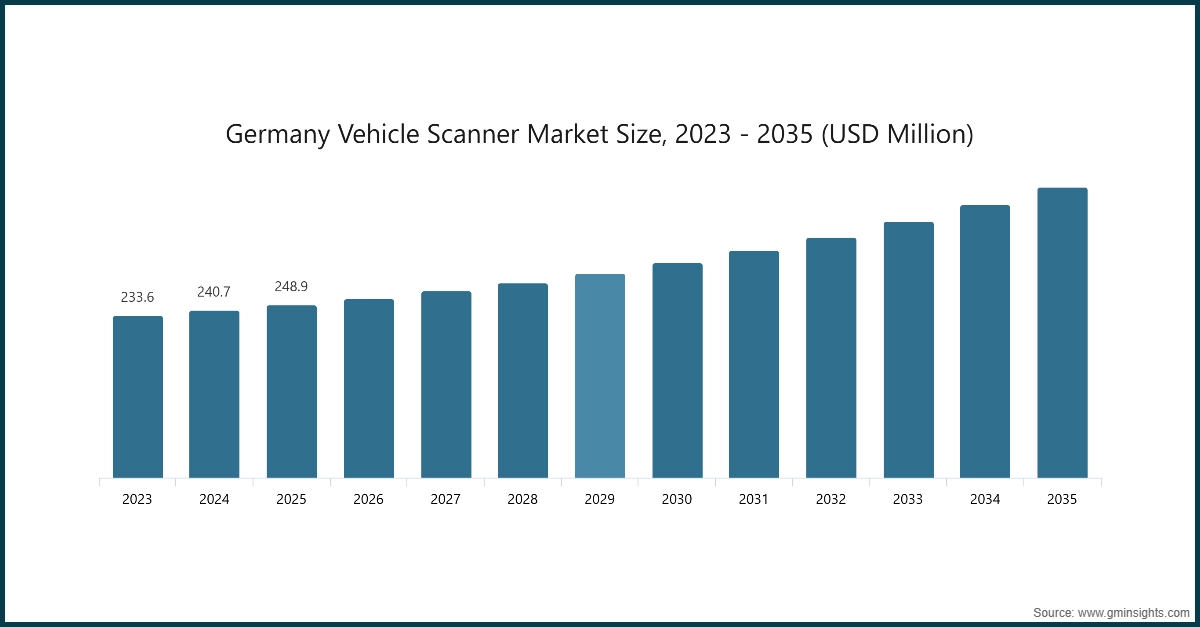
In 2025, Germany dominated the Europe vehicle scanner market with around 21% market share and generated approximately USD 248.9 million in revenue.
- Europe dominates the vehicle scanner market, supported by a mature security infrastructure, advanced logistics networks, and widespread adoption of stationery, mobile, and drive-through vehicle scanning systems. Governments, border security agencies, and critical infrastructure operators across the region focus on threat detection accuracy, operational efficiency, regulatory compliance, and integration with AI-enabled analytics and automated monitoring platforms. Well-established security regulations, advanced R&D capabilities, and rising demand for standardized vehicle scanning solutions reinforce Europe’s position as a key regional market.
- Germany dominates the European vehicle scanner market, driven by its strong automotive and security technology industries, concentration of advanced OEMs, and strict regulatory enforcement. German manufacturers and suppliers lead in deploying high-resolution X-ray scanners, under-vehicle scanning systems (UVSS), drive-through platforms, and AI-powered anomaly detection solutions. Investments in precision imaging, multi-sensor integration, and modular scanning architectures have strengthened reliability, improved inspection throughput, and accelerated market adoption, positioning Germany as the regional leader.
- Other major European countries, including the United Kingdom, France, and the Netherlands, are contributing to regional growth through adoption of advanced vehicle scanning technologies. The UK emphasizes integration with multi-site monitoring and fleet security, France focuses on high-throughput border and checkpoint inspections, and the Netherlands prioritizes mobile scanning solutions and AI-based threat detection. Despite these developments, Germany maintains its leading role in scale, technological innovation, and comprehensive deployment of high-performance vehicle scanning solutions across Europe.
China holds a major share of 51% in Asia Pacific vehicle scanner market in 2025 and it will grow tremendously between 2026 and 2035.
- China holds a major share of the Asia-Pacific vehicle scanner market, driven by the country’s large-scale deployment of stationary, mobile, and drive-through vehicle scanning systems across borders, ports, logistics hubs, and critical infrastructure. China’s robust security infrastructure, rapidly expanding urban transportation networks, and high vehicle volume contribute to strong demand for high-resolution X-ray scanners, under-vehicle scanning systems (UVSS), AI-enabled anomaly detection, and automated inspection platforms across passenger cars, SUVs, and commercial vehicles.
- Major security hubs such as Shanghai, Beijing, Guangzhou, and Shenzhen are witnessing widespread adoption of advanced vehicle scanning technologies, including multi-sensor integration, cloud-connected monitoring, portable and drive-through inspection systems, and automated license plate recognition (ALPR). Government agencies, OEMs, and technology providers collaborate to ensure accurate threat detection, faster inspection throughput, operational efficiency, and compliance with national security and safety regulations.
- Other Asia-Pacific markets, including India, Japan, and South Korea, are emerging as high-growth regions, supported by increasing adoption of mobile and AI-enabled vehicle scanners, expansion of regional security networks, and investments in advanced scanning solutions. India focuses on cost-effective and portable inspection systems for high-traffic checkpoints, Japan emphasizes precision-engineered stationery and drive-through scanners with AI integration, while South Korea prioritizes modular and multi-sensor platforms for commercial and critical infrastructure applications. Despite these developments, China maintains its leading role in scale, technological adoption, and comprehensive deployment of high-performance vehicle scanning solutions across Asia Pacific.
US holds share of 83% in North America vehicle scanner market in 2025 and it will grow tremendously between 2026 and 2035.
- The United States dominates the North American vehicle scanner market, supported by a mature security ecosystem, advanced border and critical infrastructure operations, widespread deployment of vehicle scanning technologies, and sophisticated inspection and service networks. The region benefits from large-scale checkpoint and port operations, strict regulatory standards for security and safety, and advanced integration of AI-powered imaging, under-vehicle scanning systems (UVSS), and automated vehicle inspection platforms, positioning it as a leader in high-quality, technologically advanced vehicle scanner solutions.
- Within the U.S., widespread adoption of stationary, mobile, and drive-through vehicle scanners, high-resolution X-ray imaging systems, and AI-enabled anomaly detection platforms across passenger cars, SUVs, and commercial vehicles drives market growth. Major security and automotive hubs such as Detroit, Chicago, Los Angeles, and Austin serve as key centers for scanner deployment, modular platform integration, sensor-enabled systems, and operational excellence.
- Leading U.S. vehicle scanner providers continue to expand portfolios of portable inspection units, multi-sensor platforms, and cloud-connected monitoring solutions. Ongoing investments in high-throughput scanning, predictive analytics, and modular deployment consolidate the U.S.’s dominant position in the North American market.
Vehicle scanner market in Brazil will experience significant growth between 2026 and 2035.
- Latin America holds a smaller share but is steadily expanding its presence in the global market, driven by growing deployment of stationery, mobile, and drive-through vehicle scanning systems across borders, ports, logistics hubs, and critical infrastructure. Governments, commercial operators, and fleet managers are gradually implementing standardized scanning protocols, AI-powered inspection platforms, and modular vehicle scanner solutions to ensure faster throughput, accurate threat detection, and compliance with regional security regulations.
- Brazil dominates the Latin American vehicle scanner market, supported by its large automotive and security technology sectors, expanding passenger and commercial vehicle operations, and increasing adoption of advanced scanning systems. Major hubs such as São Paulo, Rio de Janeiro, and Brasília host extensive deployment of high-resolution X-ray scanners, under-vehicle scanning systems (UVSS), drive-through platforms, and AI-enabled anomaly detection tools. Leading vehicle scanner providers continue to offer integrated, modular, and portable inspection solutions, consolidating Brazil’s dominant position in the regional market.
- Mexico represents the second largest and rapidly growing market, driven by increasing adoption of mobile, AI-enabled, and drive-through scanning systems across passenger cars, SUVs, and commercial vehicles. Key industrial and logistics centers such as Mexico City, Monterrey, and Guadalajara are witnessing higher deployment of multi-sensor platforms, portable inspection units, and cloud-connected monitoring solutions, contributing to the overall modernization of Latin America’s vehicle scanner ecosystem, while Brazil maintains its leading role.
Vehicle scanner market in UAE will experience significant growth between 2026 and 2035.
- Middle East & Africa (MEA) holds a smaller share but is gradually expanding its presence in thevehicle scanner industry , driven by increasing deployment of stationery, mobile, and drive-through vehicle scanning systems across borders, ports, commercial facilities, and critical infrastructure. Governments, fleet operators, and private security providers across the region are gradually implementing standardized inspection protocols, high-resolution imaging platforms, and AI-enabled anomaly detection systems to ensure faster throughput, accurate threat detection, and compliance with regional security regulations.
- UAE dominates the MEA vehicle scanner market, supported by its rapidly developing security infrastructure, advanced OEM and technology networks, and adoption of predictive, modular, and integrated vehicle scanning solutions. Major hubs such as Dubai, Abu Dhabi, and Sharjah host extensive deployment of high-resolution X-ray scanners, under-vehicle scanning systems (UVSS), drive-through inspection platforms, and AI-enabled monitoring tools. Leading vehicle scanner providers actively offer integrated, portable, and multi-sensor platforms, reinforcing the UAE’s dominant position in the MEA market.
- Other MEA countries, including Saudi Arabia, South Africa, and Egypt, are emerging as high-growth markets, driven by increasing adoption of mobile, AI-enabled, and high-throughput scanning systems for passenger cars, SUVs, and commercial vehicles. Saudi Arabia emphasizes fleet and commercial checkpoint applications, South Africa focuses on passenger and light commercial vehicle inspections, and Egypt prioritizes modular and drive-through scanning platforms. Despite growth in these countries, the UAE continues to maintain its leading role in MEA due to its service network scale, technological adoption, and strong government and enterprise support.
Vehicle Scanner Market Share
The top 7 companies in the market are Leidos, Snap On, Scanlab, Gatekeeper Security, Omnitec, SecureOne and SecuScan. These companies hold around 20% of the market share in 2025.
- Leidos is a leading provider of vehicle scanner solutions, offering stationary, mobile, and drive-through scanning systems, under-vehicle inspection platforms (UVSS), and AI-enabled anomaly detection technologies for passenger cars, SUVs, and commercial vehicles. Leidos leverages advanced imaging, modular system design, and cloud-connected monitoring to deliver high-accuracy, reliable, and fast vehicle inspection solutions. Its strong government and enterprise collaborations, combined with global deployment experience, reinforce its leadership in the market.
- Snap-On delivers premium vehicle scanning and diagnostic solutions, including portable inspection units, multi-sensor platforms, and software-enabled vehicle analysis tools. Snap-On leverages precision engineering, mobile platform integration, and fleet-focused design to enhance operational efficiency, detection accuracy, and inspection throughput. Its global service network and aftermarket support strengthen its competitive position in the market.
- Scanlab provides advanced scanning technologies, including high-resolution X-ray scanners, under-vehicle imaging systems, and automated anomaly detection platforms for border security, logistics hubs, and critical infrastructure. Scanlab leverages modular designs, AI-enabled analytics, and integration with existing security networks to improve inspection accuracy, operational speed, and compliance. Its focus on scalable, multi-location deployment reinforces its market presence.
- Gatekeeper Security offers comprehensive vehicle scanning solutions, including drive-through scanners, stationary UVSS systems, and AI-assisted detection platforms. Gatekeeper Security leverages advanced imaging technologies, modular system architecture, and real-time monitoring capabilities to enhance security at high-traffic checkpoints and critical infrastructure. Its government and enterprise partnerships support its leading role in the market.
- Omnitec delivers intelligent vehicle scanner technologies, including portable and fixed scanners, automated under-vehicle imaging systems, and integrated analytics platforms. Omnitec leverages sensor fusion, AI-based anomaly detection, and modular platform designs to improve inspection throughput, detection accuracy, and operational efficiency. Its strong OEM and security agency collaborations reinforce its competitive position.
- SecureOne specializes in vehicle inspection and scanning systems for commercial, industrial, and government applications, including drive-through, mobile, and stationary platforms. SecureOne leverages high-resolution imaging, cloud-connected monitoring, and AI-driven analytics to enhance threat detection, reliability, and operational scalability. Its modular platform strategy and regional deployment expertise strengthen its market presence.
- SecuScan provides advanced vehicle scanner solutions, including under-vehicle inspection systems, portable scanners, and AI-integrated detection platforms for passenger and commercial vehicles. SecuScan leverages precision imaging, real-time analytics, and modular architecture to ensure fast, accurate, and reliable vehicle inspections. Its global deployment experience and partnerships with security agencies consolidate its competitive position in the market.
Vehicle Scanner Market Companies
Major players operating in the vehicle scanner industry include:
- BorgWarner
- Denso Corporation
- Gatekeeper Security
- Leidos
- Omnitec
- Robert Bosch
- Scanlab
- SecureOne
- SecuScan
- Snap-On
- The vehicle scanner market is highly competitive, with leading solution providers such as Leidos, Snap-On, Scanlab, Gatekeeper Security, Omnitec, SecureOne, SecuScan, Robert Bosch, Denso Corporation, and BorgWarner occupying key segments across stationary, mobile, and drive-through scanners, under-vehicle inspection systems (UVSS), AI-enabled anomaly detection, and multi-sensor platforms, as well as OEM, commercial, and government deployment channels.
- Leidos, Snap-On, Scanlab, Gatekeeper Security, Omnitec, SecureOne, and SecuScan lead the market with comprehensive vehicle scanning solutions, integrating high-resolution imaging, modular platforms, cloud-connected monitoring, and AI-powered inspection capabilities. These companies focus on enhancing detection accuracy, operational efficiency, throughput, and reliability, while maintaining strong collaborations with government agencies, commercial operators, and fleet networks.
- Robert Bosch, Denso Corporation, and BorgWarner specialize in integrated vehicle scanning and diagnostic solutions, emphasizing portable and fixed scanner platforms, AI-enabled detection, modular architectures, and predictive analytics. Their products enable faster, reliable inspections, seamless integration with fleet and border management systems, and support for passengers, SUV, and commercial vehicle applications across global markets.
Vehicle Scanner Market Report Attributes
| Key Takeaway | Details |
|---|---|
| Market Size & Growth | |
| Base Year | 2025 |
| Market Size in 2025 | USD 3.1 Billion |
| Market Size in 2026 | USD 3.3 Billion |
| Forecast Period 2026-2035 CAGR | 7.2% |
| Market Size in 2035 | USD 6.1 Billion |
| Key Market Trends | |
| Drivers | Impact |
| Rising Border Security & Anti-Smuggling Measures | Increasing geopolitical tensions, terrorism threats, and illegal cross-border activities are driving governments to deploy advanced non-intrusive inspection systems at borders, ports, and checkpoints. |
| Growth in Critical Infrastructure Protection | Airports, power plants, data centers, defense facilities, and government buildings are strengthening vehicle entry screening protocols, boosting demand for under-vehicle and drive-through scanning systems. |
| Expansion of Global Trade & Logistics Networks | The rapid growth of international trade, e-commerce warehouses, and high-throughput logistics hubs requires automated vehicle inspection systems to maintain security without slowing operations. |
| Technological Advancements in AI & Imaging | Integration of AI-powered analytics, 3D imaging, multi-sensor fusion and cloud-based monitoring enhance detection accuracy and reduce false alarms, increasing adoption. |
| Pitfalls & Challenges | Impact |
| High Installation & Maintenance Costs | Vehicle scanner systems, especially fixed and high-energy X-ray models, require significant capital investment, infrastructure setup, and ongoing maintenance, limiting adoption in developing regions. |
| Regulatory & Radiation Compliance Concerns | Strict safety regulations related to radiation exposure, data privacy, and security compliance can slow down deployment and increase certification complexity. |
| Opportunities: | Impact |
| Rapid Adoption of Mobile & Portable Scanners | Demand for deployable, truck-mounted, and portable scanning systems is rising for temporary checkpoints, public events, and military use, opening new revenue channels. |
| Smart City & AI-Based Integrated Security Platforms | Integration of vehicle scanners with smart surveillance networks, automatic license plate recognition (ALPR), and centralized command-and-control systems presents strong growth opportunities in smart city projects worldwide. |
| Market Leaders (2025) | |
| Market Leader |
10.9% market share |
| Top Players |
Collective market share in 2025 is 18% |
| Competitive Edge |
|
| Regional Insights | |
| Largest Market | Europe |
| Fastest growing market | Asia Pacific |
| Emerging countries | Brazil, Mexico, UAE, India, South Africa, Indonesia |
| Future outlook |
|
What are the growth opportunities in this market?
Vehicle Scanner Industry News
- In March 2025, Leidos launched a next-generation vehicle scanner platform featuring AI-enabled anomaly detection, under-vehicle inspection systems (UVSS), and modular drive-through scanner architectures. The initiative aims to enhance threat detection accuracy, operational throughput, and deployment across passenger cars, SUVs, and commercial vehicles at borders, ports, and critical infrastructure.
- In February 2025, Snap-On expanded its vehicle scanning portfolio, introducing portable inspection units, multi-sensor imaging platforms, and cloud-connected monitoring solutions. The rollout focuses on improving mobile diagnostics, fleet monitoring, and real-time inspection reliability across commercial and passenger vehicle applications worldwide.
- In January 2025, Scanlab upgraded its vehicle scanner offerings with high-resolution X-ray imaging systems, AI-integrated anomaly detection, and modular platform designs for stationery and drive-through scanners. The initiative targets large-scale deployment, enhanced inspection accuracy, and faster operational efficiency across global checkpoints.
- In December 2024, Gatekeeper Security introduced an advanced scanning platform combining multi-sensor imaging, automated license plate recognition, and AI-enabled predictive analytics. The deployment aims to improve checkpoint efficiency, threat detection, and operational reliability for passenger, SUV, and commercial vehicle applications.
- In October 2024, Omnitec, SecureOne, and SecuScan launched integrated vehicle scanning solutions for borders, logistics hubs, and commercial facilities, combining portable and stationary scanners, sensor-enabled imaging modules, and cloud-connected analytics. The initiative emphasizes reliability, operational efficiency, AI-enabled detection, and seamless integration with government and enterprise security systems globally.
The vehicle scanner market research report includes in-depth coverage of the industry with estimates & forecasts in terms of revenue ($ Bn) and volume (units) from 2022 to 2035, for the following segments:
Market, By Offering
- Hardware
- Scanners
- Code Readers
- TPMS Tools
- Battery Analyzers
- Digital Pressure Testers
- Multimeters & Electrical Testers
- Others
- Software
- ECU Diagnosis & Programming Software
- Vehicle Tracking & Fleet Management Software
- Emission Analysis Software
- Vehicle System Testing & Calibration Software
- Cloud-Based Diagnostic Platforms
- Services
- Vehicle Maintenance & Repair Services
- Custom Training & Technician Certification
- Technical Support & Integration Services
- Subscription-Based Software Update Services
Market, By Vehicle
- Passenger vehicles
- Hatchbacks
- Sedans
- SUV
- Commercial vehicles
- Light commercial vehicles (LCV)
- Medium commercial vehicles (MCV)
- Heavy commercial vehicles (HCV)
Market, By Connectivity
- USB-Connected Diagnostic Tools
- Bluetooth-Enabled Diagnostic Tools
- Wi-Fi-Enabled Diagnostic Tools
Market, By Propulsion
- ICE
- Hybrid Vehicles
- Electric Vehicles (EVs)
Market, By Application
- Security & border control
- Critical infrastructure protection
- Commercial
- Parking facilities
- Logistics hubs
- Entertainment centers
- Others
- Event management
The above information is provided for the following regions and countries:
- North America
- US
- Canada
- Europe
- UK
- Germany
- France
- Italy
- Spain
- Belgium
- Netherlands
- Sweden
- Asia Pacific
- China
- India
- Japan
- Australia
- Singapore
- South Korea
- Vietnam
- Indonesia
- Latin America
- Brazil
- Mexico
- Argentina
- MEA
- South Africa
- Saudi Arabia
- UAE
Frequently Asked Question(FAQ) :
What is the market size of the vehicle ccanner in 2025?
The market size was USD 3.1 billion in 2025, with a CAGR of 7.2% expected through 2035, driven by increasing cross-border trade, and growing adoption of AI-enabled, non-intrusive vehicle inspection technologies across borders, ports, and critical infrastructure.
What is the projected value of the vehicle ccanner industry by 2035?
The vehicle ccanner market is expected to reach USD 6.1 billion by 2035, propelled by advancing AI and 3D imaging technologies, rising demand for mobile and portable scanning systems, and increasing integration of ALPR and cloud-connected monitoring platforms globally.
What is the current vehicle ccanner industry size in 2026?
The vehicle ccanner market size is projected to reach USD 3.3 billion in 2026, supported by deployment of under-vehicle scanning systems (UVSS), and growing demand for automated, high-throughput inspection solutions across logistics hubs and government facilities.
How much market share did the hardware segment hold in 2025?
The hardware segment dominated the vehicle ccanner market with approximately 59% share in 2025, growing at a CAGR of over 7.3% through 2035, driven by widespread deployment of X-ray scanners
What was the market share of the passenger vehicles segment in 2025?
The passenger vehicles segment dominated the vehicle ccanner market with approximately 76% share in 2025, growing at a CAGR of over 6.7% through 2035, driven by AI-enabled inspection platforms at high-traffic security checkpoints.
What is the growth outlook for the security & border control application segment?
The security & border control segment was valued at USD 1 billion in 2025 and maintains market dominance, driven by high global demand for stationary, mobile, and drive-through vehicle inspection systems equipped with X-ray imaging.
Which region leads the vehicle ccanner market?
Germany dominated the Europe vehicle scanner market with around 21% revenue share and generated approximately USD 248.9 million in revenue, driven by its mature security infrastructure, advanced logistics networks, and widespread adoption of stationary, mobile, and drive-through vehicle scanning systems.
What are the key trends shaping the vehicle ccanner market?
Key trends in vehicle scanning systems include rising adoption of IoT-enabled and AI-powered connected systems, growing demand for mobile and portable scanners at temporary checkpoints, and integration with ALPR for smart city projects.
Who are the key players in the vehicle ccanner market?
Key players include Leidos, Snap-On, Scanlab, Gatekeeper Security, Omnitec, SecureOne, SecuScan, Robert Bosch, Denso Corporation, and BorgWarner.
Vehicle Scanner Market Scope
Related Reports