Summary
Table of Content

Vehicle Roadside Assistance Market
Get a free sample of this report
Form submitted successfully!
Error submitting form. Please try again.
Thank you!
Your inquiry has been received. Our team will reach out to you with the required details via email. To ensure that you don't miss their response, kindly remember to check your spam folder as well!
Request Sectional Data
Thank you!
Your inquiry has been received. Our team will reach out to you with the required details via email. To ensure that you don't miss their response, kindly remember to check your spam folder as well!
Form submitted successfully!
Error submitting form. Please try again.
Vehicle Roadside Assistance Market Size
The global expansion of vehicle ownership, rising traffic density, and increasing vehicle complexity are driving significant transformation in the Vehicle Roadside Assistance (VRA) market. Roadside assistance has evolved from a basic emergency towing service into an integrated mobility support ecosystem that ensures vehicle uptime, driver safety, and service continuity. As consumers and fleet operators prioritize reliability and convenience, roadside assistance has become a critical value-added component of insurance policies, OEM warranties, fleet management programs, and mobility subscriptions.
Vehicle Roadside Assistance Market Key Takeaways
Market Size & Growth
- 2025 Market Size: USD 40.9 Billion
- 2026 Market Size: USD 42.9 Billion
- 2035 Forecast Market Size: USD 68.7 Billion
- CAGR (2026–2035): 5.4%
Regional Dominance
- Largest Market: North America
- Fastest Growing Region: Asia Pacific
Key Market Drivers
- Rise in global vehicle ownership.
- Increase in insurance-bundled roadside assistance.
- Surge in connected cars and OEM programs.
- Growth in urbanization and road safety awareness.
Challenges
- Low penetration in emerging markets.
- Overlap in coverage reducing incremental revenue.
Opportunity
- Rise in electric vehicle (EV) specific services.
- Growth in commercial fleets and shared mobility.
- Expansion of digital and aggregator platforms.
- Increase in vehicle ownership in emerging markets.
Key Players
- Market Leader: American Automobile Association led with over 12.51 % market share in 2025.
- Leading Players: Top 5 players in this market include ADAC, Allstate, American Automobile Association, Automobile Association (AA), Progressive, which collectively held a market share of 25.49% in 2025.
Get Market Insights & Growth Opportunities
Unlike traditional breakdown services that focused primarily on towing, modern roadside assistance operates as a technology-enabled, multi-service platform. Core services—including towing, battery support, tire replacement, fuel delivery, lockout assistance, and minor mechanical repairs are increasingly supported by GPS-enabled dispatch systems, predictive diagnostics, telematics integration, and mobile application interfaces. Service providers are now optimizing response times, digital claim processing, and real-time vehicle tracking to enhance customer experience and operational efficiency.
In August 2025, Audi India launched a comprehensive 10‑year extended warranty paired with a 15‑year roadside assistance programme across its product lineup, reflecting OEM priorities on long‑term customer support and value‑added services to boost ownership confidence.
The market is also witnessing strong collaboration across insurers, OEMs, independent service providers, telematics companies, and digital mobility platforms. Subscription-based coverage models, bundled insurance add-ons, pay-per-use services, and app-based on-demand assistance platforms are reshaping how roadside services are delivered and monetized. Digital aggregators enable price transparency, instant service booking, and dynamic dispatch allocation, increasing competition while improving service accessibility.
Electric vehicle (EV) adoption is further redefining roadside assistance requirements. In addition to conventional services, providers are developing capabilities such as mobile EV charging, high-voltage battery diagnostics, and EV-safe towing procedures. Investments in technician training, insulated equipment, and specialized response vehicles are strengthening service readiness for next-generation vehicles. As vehicles incorporate advanced driver assistance systems (ADAS) and connected car technologies, remote diagnostics and predictive maintenance alerts are reducing breakdown frequency while increasing the sophistication of service interventions.
Fleet operators represent a high-growth segment within the market. Logistics providers, ride-sharing platforms, rental companies, and corporate fleet managers increasingly demand contract-based roadside assistance agreements that guarantee uptime, priority dispatch, and centralized billing. Integrated fleet management systems now combine telematics, breakdown analytics, and service performance metrics to minimize operational disruptions and total cost of ownership.
Post-pandemic mobility normalization, rising used-vehicle sales, and aging vehicle fleets have further stimulated demand for roadside assistance services. Governments and regulatory authorities are also emphasizing highway safety standards, emergency response coordination, and consumer protection frameworks, indirectly supporting structured roadside assistance networks. The expansion of electric mobility incentives and connected vehicle regulations is accelerating digital transformation across service providers.
From a regional perspective, North America and Europe represent high-value markets driven by mature insurance penetration, strong automotive club memberships, and established OEM warranty programs. In these regions, demand is increasingly focused on rapid response time, EV-compatible services, subscription flexibility, and integrated digital platforms.
Asia-Pacific represents the fastest-growing market, supported by rising vehicle parc, expanding middle-class vehicle ownership, and rapid digital platform adoption. Emerging economies are witnessing growth in app-based assistance providers and insurer-OEM partnerships. Large-scale urbanization and infrastructure expansion further increase demand for reliable roadside support networks.
The global vehicle roadside assistance market was estimated at USD 40.9 billion in 2025. The market is expected to grow from USD 42.9 billion in 2026 to USD 68.7 billion in 2035, at a CAGR of 5.4%, according to latest report published by Global Market Insights Inc.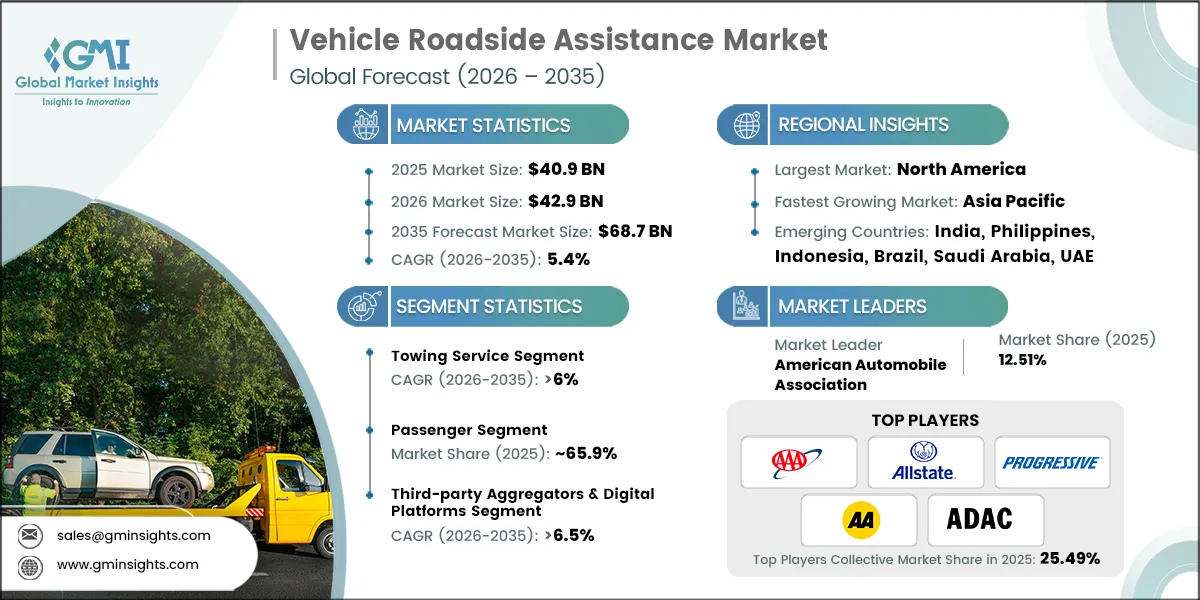
To get key market trends
Vehicle Roadside Assistance Market Trends
The roadside assistance market is increasingly embracing digital transformation, with telematics, connected car data, and mobile applications enabling real-time vehicle monitoring, predictive maintenance alerts, and automated dispatch. These advancements reduce response times, improve operational efficiency, and enhance customer experience. Fleet operators and individual vehicle owners benefit from instant service notifications, GPS-based tracking, and digital claims processing, transforming traditional breakdown support into a proactive, technology-enabled service ecosystem.
With the rapid adoption of electric vehicles, roadside assistance providers are expanding services tailored to EVs, such as mobile EV charging, battery diagnostics, and EV-safe towing procedures. Specialized training for technicians, insulated towing equipment, and advanced monitoring systems ensure safe and efficient service. These offerings address unique challenges posed by EV breakdowns, enhance customer confidence, and support the growing need for reliable emergency assistance in electrified vehicle fleets and individual EV ownership.
For example, in September 2024, AUTO i CARE expanded its roadside assistance coverage across India to include electric two‑wheelers from all manufacturers, adding battery management, emergency repairs, and 24/7 support tailored for EV owners a sign of growing demand for EV‑specific roadside services.
Consumers increasingly prefer flexible roadside assistance through subscription-based or on-demand services, replacing traditional insurance-bundled packages. Mobile apps allow real-time booking, dynamic pricing, and instant dispatch of service vehicles. Pay-per-use models and tiered subscriptions provide personalized solutions for both individual and fleet operators. This trend aligns with the digital-first expectations of modern vehicle owners, improving convenience, transparency, and accessibility, while enabling providers to expand revenue streams and attract tech-savvy customers.
Commercial fleets, including logistics companies, ride-sharing platforms, and rental services, are adopting integrated roadside assistance programs to ensure minimal downtime and operational efficiency. These solutions include centralized dispatch, priority response, telematics-based predictive alerts, and performance analytics. By combining breakdown support with fleet management systems, operators can maintain high vehicle utilization, reduce maintenance costs, and streamline service delivery, making roadside assistance an essential component of modern fleet operations and total cost-of-ownership optimization.
Collaboration between insurers, OEMs, and service providers is reshaping the roadside assistance landscape. Insurers bundle emergency services into premium plans, while OEMs integrate assistance programs into vehicle warranties, offering brand-specific, high-quality support. These partnerships expand service networks, improve response reliability, and enhance customer trust. Regional coverage and specialized service offerings, including EV and fleet support, ensure consistent service delivery, strengthen stakeholder ecosystems, and create competitive differentiation in mature and emerging markets.
Vehicle Roadside Assistance Market Analysis
 Learn more about the key segments shaping this market
Learn more about the key segments shaping this market
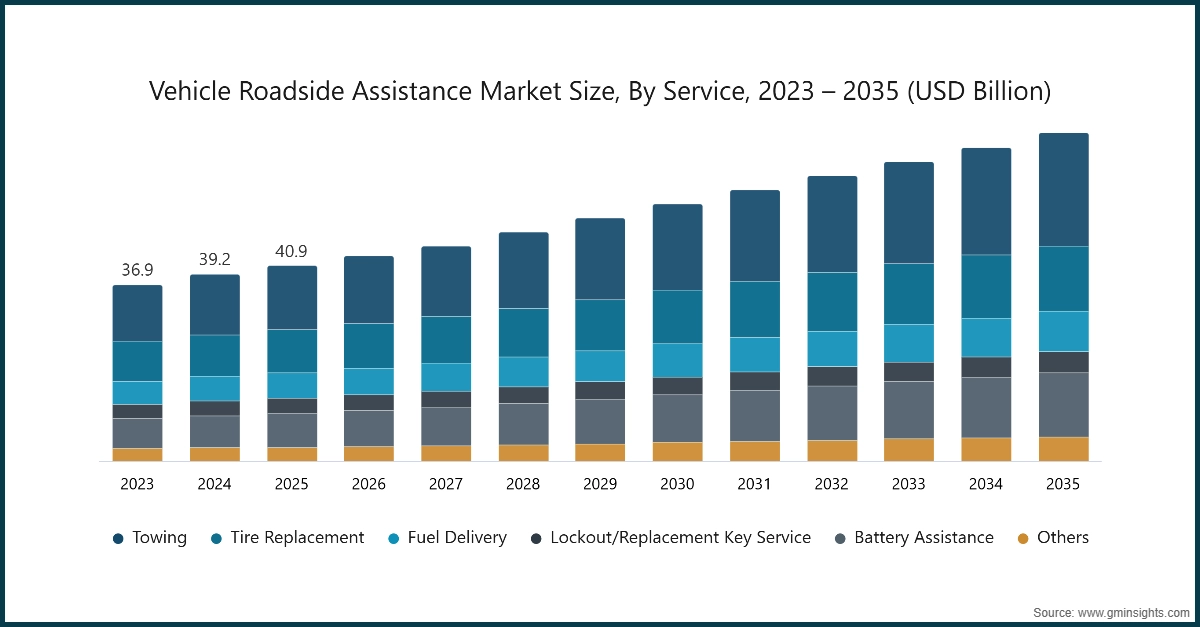
Based on service, the market is divided into towing services, tire replacement services, battery assistance services, fuel delivery services, lockout & replacement key services, winching & extraction services, and others. Towing service segment dominated the vehicle roadside assistance industry, accounting for around 33% in 2025 and is expected to grow at a CAGR of more than 6% through 2035.
- The vehicle roadside assistance market is primarily driven by the adoption of towing services, which remain the most frequently requested emergency support by vehicle owners and fleet operators. Towing services cover light-duty passenger vehicles, heavy-duty commercial vehicles, long-distance breakdowns, and accident recovery, addressing both urban and intercity mobility challenges.
- In addition, the market is fueled by the increasing demand for battery assistance, tire replacement, fuel delivery, and lockout services. The rise of app-based, on-demand, and subscription models, along with the growing adoption of EVs, connected vehicles, and fleet-integrated programs, further accelerates the adoption of comprehensive roadside assistance services, ensuring minimal downtime, operational efficiency, and enhanced customer satisfaction across passenger and commercial vehicle segments.
- For example, in December 2024, Motive launched “Motive Roadside Assistance,” an AI‑powered 24/7 roadside support service for commercial drivers in the U.S. and Canada, providing access to more than 75,000 service providers including heavy‑duty towing and emergency repair partners highlighting the integration of advanced tech with traditional on‑road support to reduce downtime and improve fleet safety.
- The battery assistance segment is expected to experience a faster growth of more than 6.5% over the forecast period, due to increasing adoption of electric vehicles (EVs), hybrid vehicles, and connected cars that require specialized support for battery failures, jump-starts, and diagnostics. Rising awareness of battery maintenance, coupled with technological advancements such as mobile battery testing and app-based emergency assistance, is driving demand among private vehicle owners and fleet operators.
Learn more about the key segments shaping this market
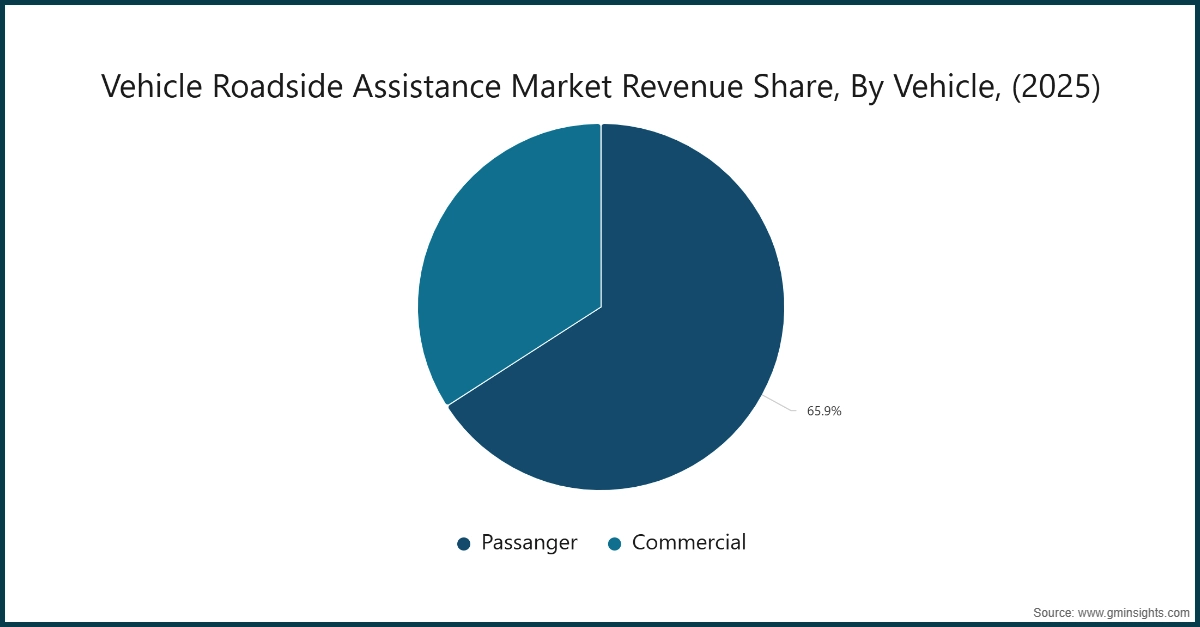
Based on vehicle, the market is segmented into passenger and commercial. The passenger segment dominates the market accounting for around 65.9% share in 2025, and the segment is expected to grow at a CAGR of over 4.2% from 2026-2035.
- The vehicle roadside assistance market is dominated by the passenger vehicle segment due to high private vehicle ownership, increasing urbanization, and growing reliance on convenient, reliable, and fast emergency services. Passenger cars including sedans, SUVs, hatchbacks, and luxury vehicles represent many service requests for towing, battery assistance, tire replacement, lockout support, and minor mechanical repairs. Digital platforms, mobile apps, and connected telematics systems allow service providers to respond quickly to breakdowns, enhancing convenience and customer satisfaction for individual vehicle owners.
- Additionally, the rise of electric passenger vehicles is contributing to segment growth. OEMs, insurers, and independent service providers are offering EV-ready roadside programs with mobile charging, battery diagnostics, and EV-safe towing solutions. Subscription-based and on-demand models further reinforce market dominance by catering to passenger vehicles, ensuring minimal downtime and reliable support across urban and suburban regions worldwide.
- For example, in April 2025, AAA reported responding to over 27 million emergency roadside service calls across the United States, with the majority involving passenger vehicles needing towing, battery assistance, and other roadside services, illustrating how high passenger car usage drives demand for comprehensive roadside assistance across personal transportation networks.
- The commercial vehicle segment is expected to experience a faster growth of more than 7.4% over the forecast period, driven by the rapid expansion of logistics, transportation, and delivery services across urban and intercity routes. Growing demand for fleet efficiency, reduced downtime, and operational reliability is encouraging companies to adopt comprehensive roadside assistance programs covering towing, battery support, tire replacement, and emergency repairs for trucks, vans, and buses.
Based on service channel, the vehicle roadside assistance market is divided into OEM networks, insurance company networks, independent service providers, and third-party aggregators & digital platforms. The insurance company networks segment held the major market share in 2025.
- The insurance company networks segment is the largest market segment in the vehicle roadside assistance industry because it represents the standard configuration for urban and suburban public transport systems worldwide. Buses in this seating range are widely used on high-frequency city routes, offering an optimal balance between passenger capacity, vehicle size, and route flexibility. Their compatibility with existing road infrastructure, depots, and charging setups makes it easier to integrate into current transit networks compared to smaller minibuses or larger articulated buses.
- The insurance company networks segment is the largest market segment in the vehicle roadside assistance market because insurers often bundle emergency support services with auto insurance policies, making them highly accessible to a wide customer base. These networks provide coverage for towing, battery assistance, tire replacement, fuel delivery, and lockout services, ensuring reliable support for both private and commercial vehicle owners. Integration with claims processes, mobile apps, and telematics-enabled platforms enhances convenience and responsiveness, increasing service utilization and customer satisfaction.
- Additionally, insurance companies collaborate with OEMs, independent service providers, and digital platforms to expand service reach and reduce operational costs. Subscription-based and tiered roadside assistance models further drive market dominance, as policyholders gain access to comprehensive, 24/7 support, making insurance-backed networks the most widely adopted and dependable solution in the roadside assistance ecosystem.
- For example, in December 2024, Allianz Partners and Mazda Motor Europe extended their long‑standing roadside assistance partnership across multiple European markets, providing brand‑specific roadside repair and towing services as part of insurance‑linked customer support and integrating digital service requests into the MyMazda app to streamline breakdown assistance.
- The third-party aggregators & digital platforms segment is expected to grow with a CAGR of more than 6.5% due to the increasing demand for app-based, on-demand, and subscription-driven roadside assistance services. Consumers and fleet operators prefer platforms that provide real-time service requests, GPS-based tracking, transparent pricing, and rapid response for towing, battery support, tire replacement, and minor repairs.
Based on end use, the vehicle roadside assistance market is divided into individual/retail customers, commercial fleet operators, automotive dealerships, rental & leasing companies, and others. The individual/retail customers segment dominated the market.
- The individual/retail customers segment dominates the vehicle roadside assistance industry due to the high number of privately owned vehicles and increasing dependence on convenient, reliable emergency support services. Passenger cars, SUVs, hatchbacks, and luxury vehicles frequently require towing, battery assistance, tire replacement, lockout support, and minor repairs, making individual vehicle owners the largest user base. Mobile apps connected to vehicle technology, and subscription-based services enhance convenience, enabling real-time service requests and faster response times, which further strengthens adoption among retail customers.
- Additionally, growing awareness of safety, convenience, and cost-saving benefits drives demand in this segment. Insurance-backed roadside assistance, digital platform integration, and fleet service offerings tailored to individual users provide accessible, round-the-clock coverage. This ensures minimal downtime, reliable support, and improved overall customer experience, solidifying the dominance of individual/retail customers in the vehicle roadside assistance market.
- For example, in 2025, GEICO promoted its Emergency Roadside Service in the U.S. through its mobile app, allowing individual policyholders to request 24/7 towing, battery jump‑starts, tire changes, lockout services, and fuel delivery with just a few taps, underscoring the convenience driving adoption among private vehicle owners.
- The Commercial Fleet Operators segment is expected to grow with a CAGR of more than 6.3% due to the increasing demand for reliable and efficient roadside assistance across logistics, delivery, ride-hailing, and corporate transport fleets. Fleet operators require services such as towing, battery assistance, tire replacement, fuel delivery, and minor repairs to ensure minimal downtime and uninterrupted operations.
Looking for region specific data?
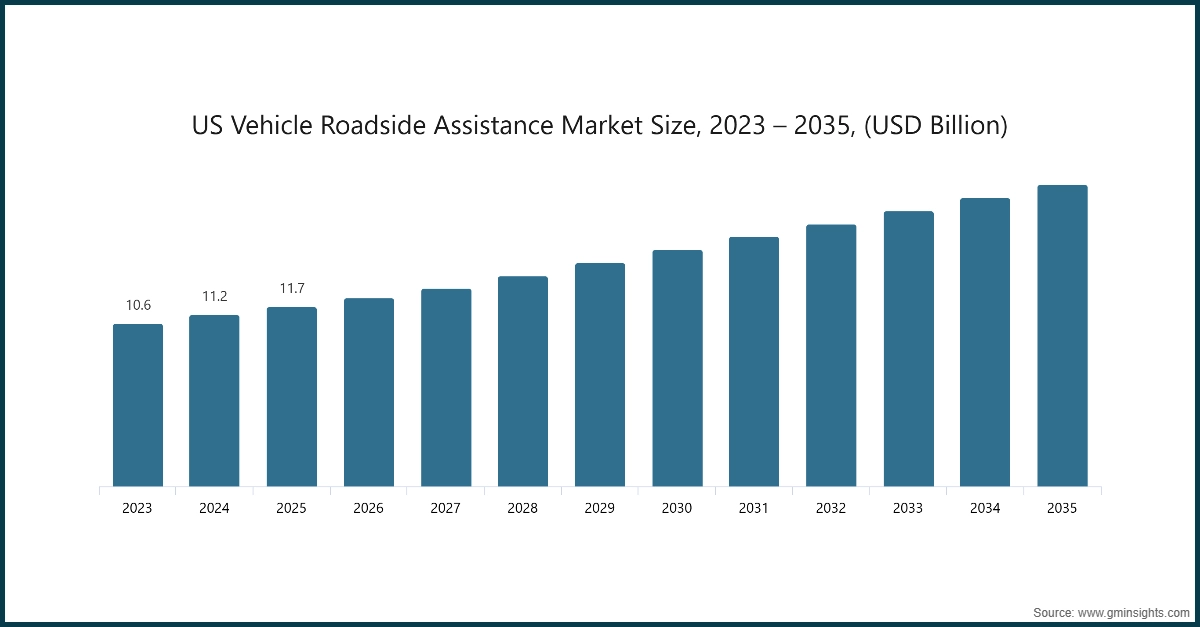
The vehicle roadside assistance market in US is expected to experience significant and promising growth from 2026-2035.
- North America accounts for over 33.5% of the market in 2025 and is expected to grow at a CAGR of around 5.7% due to high vehicle ownership, widespread insurance coverage, and strong adoption of connected and electric vehicles. The presence of established automotive clubs, OEM-backed assistance programs, and app-based on-demand services enhances service availability and customer convenience. Additionally, fleet operators and logistics companies increasingly rely on integrated roadside solutions to minimize downtime, further supporting market expansion across the region.
- US has established itself as a leader in the vehicle roadside assistance industry, driven by high vehicle ownership, advanced insurance penetration, and a mature automotive services ecosystem. Consumers increasingly rely on digital and connected platforms that enable real-time dispatch, predictive diagnostics, and mobile app-based service requests. Automotive clubs like AAA, OEM-backed roadside programs, and independent service providers offer comprehensive coverage including towing, battery support, tire replacement, and minor mechanical repairs, ensuring reliability and convenience for both personal and commercial vehicle owners.
- The US market is also propelled by growing adoption of electric vehicles and fleet integration solutions. Providers are expanding EV-ready services, such as mobile charging, battery diagnostics, and EV-safe towing. Fleet operators, including logistics, rental, and ride-sharing companies, are increasingly subscribing to integrated roadside assistance programs to minimize downtime and improve operational efficiency. Government regulations, urban infrastructure development, and strong OEM-insurer collaborations further reinforce the country’s leading position in this market.
- For example, in January 2025, Agero introduced a new mobile app feature for real‑time tracking of roadside assistance services across the United States, enabling customers to see technician ETAs, live service status, and transparent pricing, reflecting strong digital transformation and higher consumer expectations for convenience and connected support in the US roadside assistance market.
- The Canada is emerging as a strong growth market for vehicle roadside assistance due to rising vehicle ownership, increasing adoption of electric and connected vehicles, and growing consumer preference for subscription-based and on-demand services. The market is further supported by insurer-OEM collaborations, fleet integration programs, and the expansion of digital platforms enabling real-time dispatch, predictive diagnostics, and mobile app-based support. Government incentives for EV adoption, fleet modernization, and urban mobility projects are also driving demand, positioning Canada as a high-growth, technology-enabled market within the North American vehicle roadside assistance ecosystem.
The vehicle roadside assistance market in Germany is expected to experience significant and promising growth from 2026 to 2035.
- The market in Germany is witnessing significant growth, driven by increasing vehicle ownership, rising traffic density, and the adoption of advanced automotive technologies. Consumers and fleet operators are demanding faster, more reliable, and digitally enabled services, including towing, battery assistance, tire replacement, and minor mechanical repairs. Integration of telematics, GPS-based dispatch, and predictive diagnostics allows service providers to reduce response times, improve operational efficiency, and enhance customer experience. Growing awareness of convenience and safety further encourages vehicle owners to subscribe to premium roadside assistance packages, creating new revenue opportunities for insurers, OEMs, and independent service providers.
- Additionally, the shift toward electric mobility in Germany is boosting demand for EV-specific roadside services. Providers are deploying mobile EV charging units, EV-safe towing, and battery diagnostics to support high adoption of electric vehicles. Collaborations between insurers, OEMs, and fleet operators enable bundled services for both private and commercial vehicles, ensuring minimal downtime and seamless assistance. Government incentives for electrification, stringent safety standards, and urban mobility modernization projects further reinforce the market, positioning Germany as a high-growth, technology-driven region within the roadside assistance industry.
- For example, in February 2026, L‑Charge launched a Mobile EV Charging & Roadside Assistance Vehicle equipped with integrated 60 kW DC fast charging and service support for stranded EVs, demonstrating the market’s shift toward specialized EV‑ready roadside solutions that combine emergency charging with traditional breakdown services.
- UK is emerging as a strong growth market for vehicle roadside assistance due to rising vehicle ownership, increasing adoption of connected and electric vehicles, and growing consumer preference for subscription-based and on-demand services. The market is further supported by partnerships between insurers, OEMs, and independent service providers, enabling faster response times, digital claims processing, and EV-ready support. Government incentives for low-emission vehicles and fleet modernization programs are also driving demand across both private and commercial vehicles.
The vehicle roadside assistance market in China is expected to experience significant and promising growth from 2026-2035.
- Asia Pacific accounts for over 29.5% of the market in 2025 and is expected to grow at a CAGR of around 6.1% between 2026 and 2035 owing to rapid urbanization, increasing vehicle ownership, and the rising adoption of connected and electric vehicles. Emerging economies in the region are witnessing growing demand for app-based on-demand services, subscription models, and EV-ready roadside assistance. Expansion of fleet operations, insurance-linked assistance programs, and government initiatives supporting low-emission vehicles further accelerate market growth across both passenger and commercial segments.
- The China vehicle roadside assistance market is experiencing robust growth due to rapid expansion of vehicle ownership, increasing urbanization, and rising demand for digital and connected services. Consumers and fleet operators are increasingly relying on app-based platforms, telematics integration, and GPS-enabled dispatch systems to ensure timely assistance for breakdowns, battery issues, tire replacements, and minor mechanical repairs. The proliferation of subscription-based and on-demand roadside assistance services is also enhancing convenience and reliability for both private and commercial vehicle owners, driving strong adoption in major urban centers.
- Additionally, the growth of electric vehicles in China is boosting demand for specialized EV roadside support. Service providers are deploying mobile charging units, EV-safe towing equipment, and trained technicians to handle high-voltage systems safely. Collaborations between OEMs, insurers, and digital service platforms enable comprehensive coverage for passenger cars and commercial fleets, ensuring minimized downtime and operational efficiency. Government policies promoting green mobility, fleet modernization, and urban transportation infrastructure further reinforce China’s position as a high-growth, technology-driven market in the roadside assistance ecosystem.
- For instance, in February–March 2026, Xiaomi Auto announced that it would offer 24/7 free roadside assistance including on‑site tire repairs, cross‑region vehicle delivery, reimbursement for high‑speed rail or flight travel, and ride‑hailing coupons—during the Lunar New Year travel period, demonstrating Chinese OEMs’ efforts to expand emergency support services and enhance customer experience in China’s growing vehicle roadside assistance ecosystem.
- India is projected to grow at a significant CAGR for the vehicle roadside assistance market due to to rising vehicle ownership, increasing adoption of digital and app-based services, and growing awareness of convenience and safety among consumers. The market is further supported by fleet expansion in logistics, ride-hailing, and commercial transportation sectors, along with collaborations between insurers, OEMs, and independent service providers. Additionally, the surge in electric vehicles and government incentives for EV adoption are driving demand for EV-ready roadside assistance solutions, positioning India as a high-growth, technology-driven market within the vehicle roadside assistance ecosystem.
The vehicle roadside assistance market in Brazil is expected to experience significant and promising growth from 2026 to 2035.
- Latin America holds around 8.58% of the vehicle roadside assistance industry in 2025 and is growing steadily at a CAGR of around 4.1% between 2026 and 2035 due to increasing vehicle ownership, urbanization, and rising consumer preference for subscription-based and app-enabled emergency services. The market growth is further supported by fleet expansion in logistics, delivery, and ride-hailing services, as well as collaborations between insurers, OEMs, and independent service providers.
- Brazil dominates the market in Latin America due to its large vehicle population, high urbanization, and well-established automotive ecosystem. The country has a growing demand for reliable roadside services, including towing, battery assistance, tire replacement, and minor repairs, driven by increasing consumer expectations and rising traffic congestion in major cities. Insurance companies, OEMs, and independent service providers offer comprehensive coverage, leveraging digital platforms and mobile apps to provide real-time service dispatch, route tracking, and predictive maintenance support.
- Additionally, Brazil’s commercial vehicle and fleet sector contribute significantly to market growth. Logistics, ride-hailing, and delivery operators increasingly subscribe to fleet-integrated roadside assistance programs to minimize downtime and ensure operational efficiency. Government initiatives promoting road safety, urban mobility modernization, and fleet electrification further reinforce Brazil’s leading position in the Latin American roadside assistance market, making it a high-growth and strategically important region for service providers.
- For example, in March 2026, Brazilian insurance industry commentary noted that 24‑hour automotive assistance has become a strategic component of auto insurance offerings in the country, particularly during high‑traffic holiday periods, reflecting growing consumer reliance on emergency roadside services as part of broader coverage plans.
- The market in Mexico is experiencing high growth due to increasing vehicle ownership, urbanization, and rising consumer demand for convenient, reliable, and digital-enabled services. App-based and on-demand roadside assistance solutions, including towing, battery support, tire replacement, and minor repairs, are gaining traction among private vehicle owners and commercial fleets.
The vehicle roadside assistance market in UAE is expected to experience significant and promising growth from 2026-2035.
- MEA holds around 2.2% of the vehicle roadside assistance industry in 2025 and is growing steadily at a CAGR of around 3.3% between 2026 and 2035 due to increasing vehicle ownership, urbanization, and rising demand for reliable emergency support services across passenger and commercial vehicles. The market is further supported by expansion of fleet operations in logistics, delivery, and ride-hailing sectors, along with growing adoption of digital, app-based, and subscription-driven roadside assistance solutions.
- The UAE dominates the MEA market due to its high vehicle ownership, advanced road infrastructure, and strong adoption of digital and connected vehicle services. The country has a mature automotive ecosystem supported by insurers, OEMs, and independent service providers offering comprehensive roadside coverage including towing, battery assistance, tire replacement, and minor repairs. App-based service requests, GPS-enabled dispatch, and real-time tracking enhance convenience and reliability, catering to both private and commercial vehicle owners across urban and intercity regions.
- Additionally, the UAE’s growing fleet and EV sectors contribute significantly to market leadership. Logistics, corporate fleets, and ride-hailing services increasingly rely on integrated roadside assistance programs to minimize downtime and maintain operational efficiency. Government initiatives promoting smart mobility, EV adoption, and road safety further reinforce the country’s leading position, making the UAE a high-growth and technologically advanced hub for vehicle roadside assistance within the MEA region.
- For example, in March 2025, OMODA & JAECOO partnered with the International Motoring Club (IMC) to launch a comprehensive 24/7 AI‑powered roadside assistance program across the UAE, offering real‑time support for towing, flat tires, battery issues, and emergency fuel delivery via a mobile app, demonstrating how UAE‑based initiatives are advancing digital and customer‑centric roadside services.
- Saudi Arabia is expected to grow at the fastest CAGR in the MEA vehicle roadside assistance market due to rapid urbanization, rising vehicle ownership, and increasing adoption of digital and app-based emergency support services. Consumers and commercial fleet operators are demanding reliable roadside coverage, including towing, battery support, tire replacement, and minor mechanical repairs, which is driving market expansion.
Vehicle Roadside Assistance Market Share
The top 7 companies in the vehicle roadside assistance industry American Automobile Association, ADAC, Automobile Association, Allstate, Progressive, Allianz, and GEICO contributed around 31% of the market in 2025.
AAA focuses on a membership-driven model, offering comprehensive roadside assistance including towing, battery, tire, and lockout services. Their strategy emphasizes rapid response infrastructure, bundled travel and insurance services, and loyalty programs. They are increasingly integrating digital platforms and mobile apps to streamline service requests, track dispatch, and enhance member experience, while expanding partnerships with insurance companies and fleet operators.
- ADAC leverages its position as Europe’s largest automotive club to offer wide coverage, emergency services, and premium roadside assistance packages. Strategies include rapid response networks, membership engagement, tiered service offerings, and integration with travel insurance. ADAC also invests in digital service requests, real-time assistance tracking, and partnerships with fleet operators, ensuring high customer satisfaction and retention across Germany and neighboring European markets.
- Automobile Association (AA) focuses on multi-channel roadside assistance, combining insurance-bundled services with direct membership offerings. Their strategies include fast-response emergency services, vehicle recovery, premium memberships, and fleet contracts. AA is increasingly leveraging digital platforms and mobile apps for service request management and tracking. Strategic partnerships with insurance providers and automotive OEMs ensure broad coverage and sustained growth in the UK and European markets.
- Allstate’s strategy revolves around insurance-integrated roadside assistance, offering bundled RA services with auto policies. They emphasize customer convenience, digital claims processing, and nationwide service coverage. Strategic initiatives include partnering with tow operators and service providers, integrating mobile apps for instant dispatch, and promoting premium tiers and add-on services to increase penetration and enhance policyholder satisfaction across the U.S.
- Progressivev differentiation via digital-first roadside assistance integrated with insurance policies. Their strategy focuses on app-based service requests, real-time tracking, and predictive analytics to optimize dispatch. They emphasize cost-effective coverage, fleet partnerships, and bundling RA with auto insurance, targeting tech-savvy drivers seeking seamless and fast emergency support. Expansion into EV-specific roadside services is also emerging as a strategic priority.
- Allianz leverages its global insurance network to provide roadside assistance bundled with auto policies. Strategic priorities include high service quality, emergency coverage in multiple countries, digital service platforms, and predictive dispatch. Allianz also targets fleet operators and premium vehicle owners, offering tiered packages, partnerships with local service providers, and integration with connected car technologies for optimized response and customer satisfaction.
- GEICO focuses on insurance-bundled roadside assistance, offering towing, tire replacement, fuel delivery, and lockout services. Their strategies include leveraging a large agent and contractor network, mobile app-based service requests, and partnerships with local towing companies. GEICO emphasizes convenience, rapid response, and cost efficiency, integrating RA as a value-added benefit to enhance auto insurance policyholder retention.
Vehicle Roadside Assistance Market Companies
Major players operating in the vehicle roadside assistance industry are:
ADAC
- Allianz
- Allstate
- American Automobile Association
- Automobile Association
- Better World Club
- GEICO
- Japan Automobile Federation (JAF)
- Progressive
- RACE
- Global vehicle roadside assistance providers are increasingly adopting Industry 4.0 technologies, including AI-driven dispatch systems, predictive maintenance for fleet vehicles, and digital twin simulations of service operations. Advanced modeling tools optimize service routing, technician allocation, and response time efficiency. Machine-learning algorithms predict peak service demand, optimize fleet deployment, and improve resource utilization, ensuring faster response, reduced operational costs, and enhanced customer satisfaction. Digital twins of roadside service fleets and operations allow virtual testing of route efficiency, service coverage, and operational KPIs, reducing trial-and-error costs, accelerating service scaling, and ensuring compliance with safety and quality standards.
- Leading VRA companies are forming strategic partnerships with insurance providers, OEMs, digital aggregators, fleet operators, and telematics platform providers to accelerate adoption and improve service delivery. These collaborations integrate connected vehicle data, predictive maintenance solutions, and digital dispatch platforms, enabling faster mobilization of service fleets, optimized coverage in urban and rural areas, and enhanced subscription-based roadside assistance offerings. Joint agreements and partnerships improve service reliability, reduce operational risk, enhance scalability, and support expansion into EV-specific roadside assistance, premium service tiers, and digital-first platforms, ensuring cost-effective, high-quality, and technologically advanced emergency vehicle support for individual and commercial customers globally.
Vehicle Roadside Assistance Market Report Attributes
| Key Takeaway | Details |
|---|---|
| Market Size & Growth | |
| Base Year | 2025 |
| Market Size in 2025 | USD 40.9 Billion |
| Market Size in 2026 | USD 42.9 Billion |
| Forecast Period 2026-2035 CAGR | 5.4% |
| Market Size in 2035 | USD 68.7 Billion |
| Key Market Trends | |
| Drivers | Impact |
| Rise in global vehicle ownership | Increasing vehicle sales worldwide, especially in Asia-Pacific and Latin America, are driving the demand for roadside assistance services. Higher vehicle density increases the likelihood of breakdowns, prompting both individual owners and commercial fleet operators to subscribe to RA services for safety and convenience. |
| Increase in insurance-bundled roadside assistance | Auto insurance providers increasingly include roadside assistance coverage in their policies. This bundling strategy boosts penetration, particularly in mature markets like the USA and Europe, ensuring broader customer coverage while creating a recurring revenue stream for insurers and expanding the overall market size. |
| Surge in connected cars and OEM programs | OEMs integrate roadside assistance into connected car systems and warranty programs, offering services like automatic towing, remote diagnostics, and emergency support. This increases adoption rates in developed markets and provides a premium, technology-driven growth channel for the roadside assistance industry. |
| Growth in urbanization and road safety awareness | Rapid urbanization increases traffic density, vehicle usage, and risk of breakdowns. Rising awareness of road safety and emergency preparedness encourages individuals and fleet operators to adopt roadside assistance services, driving market growth globally. |
| Pitfalls & Challenges | Impact |
| Low penetration in emerging markets | Many emerging markets, including India, Africa, and Southeast Asia, have low roadside assistance adoption due to limited awareness, cost sensitivity, and inadequate infrastructure. This limits revenue potential despite rising vehicle ownership, restraining overall market growth in these regions. |
| Overlap in coverage reducing incremental revenue | Vehicles often have multiple RA coverages insurance, OEM, or club memberships. This overlap can reduce incremental revenue, as multiple providers may service the same vehicle, inflating theoretical market size but limiting actual cash flow from unique users. |
| Opportunities: | Impact |
| Rise in electric vehicle (EV) specific services | The growing EV market presents opportunities for specialized roadside assistance, including battery-related breakdowns, towing to charging stations, and EV-specific support. These services can generate higher ARPU and attract early EV adopters seeking reliable emergency solutions. |
| Growth in commercial fleets and shared mobility | Expanding logistics, ride-sharing, and rental fleets require reliable roadside assistance to minimize downtime. Large-scale contracts with fleet operators provide recurring revenue, increasing market stability and opening opportunities in fleet-focused service offerings. |
| Expansion of digital and aggregator platforms | Digital RA platforms are rapidly expanding, offering app-based on-demand services, real-time tracking, and instant assistance. This trend enhances user convenience, boosts adoption, and provides opportunities for innovative monetization models. |
| Increase in vehicle ownership in emerging markets | Rising middle-class income and growing vehicle ownership in Asia-Pacific, Latin America, and Africa present untapped opportunities for RA services. Affordable, region-specific solutions can help capture this expanding customer base. |
| Market Leaders (2025) | |
| Market Leader |
12.51 % market share |
| Top Players |
Collective Market Share in 2025 is 25.49% |
| Competitive Edge |
|
| Regional Insights | |
| Largest Market | North America |
| Fastest growing market | Asia Pacific |
| Emerging countries | India, Philippines, Indonesia, Brazil, Saudi Arabia, UAE |
| Future outlook |
|
What are the growth opportunities in this market?
Vehicle Roadside Assistance Industry News
•In January 2026, AAA expanded its mobile EV charging service to 45 metropolitan markets across the U.S., deploying 350 additional mobile charging units capable of Level 2 and DC fast charging, delivering 15–50 miles of range within 30–45 minutes of arrival. The USD 42 million initiative includes EV-specific service infrastructure, technician training, and partnerships with Tesla, Ford, GM, and Rivian, bringing AAA’s nationwide mobile EV fleet to over 520 units as the U.S. EV population nears 8 million.
In December 2025, HONK Technologies secured USD 85 million Series D funding to expand its roadside assistance marketplace, enhance technology platforms, and enter international markets including the UK and Australia beginning Q2 2026. The funding supports network growth beyond 45,000 service providers, AI-powered dispatch optimization, predictive service capabilities, and partnerships with insurance carriers and OEMs. HONK processed 2.7 million service requests in 2025, up 42% year-over-year.
- In November 2025, Agero announced a strategic partnership with a major telematics platform provider to integrate roadside assistance dispatch into connected vehicle systems, enabling automatic breakdown detection, remote diagnostics, and proactive service dispatch without driver intervention. Initial deployment covers 2.8 million connected vehicles from January 2026, expanding to over 12 million vehicles by year-end 2027.
- In October 2025, Allstate Insurance enhanced roadside assistance benefits for policyholders, offering unlimited service calls, towing up to 100 miles, and improved digital service request capabilities via mobile application integration. The upgraded program adds approximately USD 8 to average annual premiums while expanding coverage, addressing competitive pressure from digital platforms and OEM programs.
- In September 2025, ADAC deployed 50 hydrogen fuel cell electric patrol vehicles (Mercedes-Benz eSprinter) for EV and conventional vehicle service, advancing fleet electrification and sustainability commitments. Phase two of ADAC’s program targets 500 zero-emission patrol vehicles by 2028, with fuel cell technology supporting longer range and faster refueling. Initial pilot program performance from 30 vehicles in 2024 was successful.
- In August 2025, Progressive Insurance integrated roadside assistance requests into its Snapshot telematics mobile application, enabling one-touch service access, GPS location sharing, ETA visibility, and service history tracking. Integration eliminates separate apps or phone numbers, enhancing customer experience and providing data to inform underwriting and retention strategies.
- In July 2025, RAC Limited launched RAC Patrol Elite, a premium service tier with guaranteed 30-minute urban response times, comprehensive breakdown coverage, 500-mile European towing, mobile vehicle health checks, and concierge travel services at GBP 180 annually. The tier targets affluent customers seeking lifestyle-oriented vehicle services, improving average revenue per member.
The vehicle roadside assistance market research report includes in-depth coverage of the industry with estimates & forecasts in terms of revenue ($Bn), from 2022 to 2035, for the following segments:
Market By Service
Towing Services
- Tire Replacement Services
- Battery Assistance Services
- Fuel Delivery Services
- Lockout & Replacement Key Services
- Winching & Extraction Services
- Others
Market, By Vehicle
- Passenger Cars
- Sedans
- SUVs & Crossovers
- Hatchbacks
- Commercial Vehicles
- Light Commercial Vehicles (LCVs)
- Medium Commercial Vehicles (MCVs)
- Heavy Commercial Vehicles (HCVs)
Market, By Service Channel
- OEM Networks
- Insurance Company Networks
- Independent Service Providers
- Third-Party Aggregators & Digital Platforms
Market, By End Use
- Individual/Retail Customers
- Commercial Fleet Operators
- Automotive Dealerships
- Rental & Leasing Companies
- Others
The above information is provided for the following regions and countries:
- North America
- US
- Canada
- Europe
- Germany
- UK
- France
- Italy
- Spain
- Russia
- Belgium
- Netherlands
- Sweden
- Asia Pacific
- China
- India
- Japan
- Australia
- South Korea
- Philippines
- Indonesia
- Singapore
- Latin America
- Brazil
- Mexico
- Argentina
- MEA
- South Africa
- Saudi Arabia
- UAE
Frequently Asked Question(FAQ) :
What is the vehicle roadside assistance market size in 2025?
The market size for vehicle roadside assistance is valued at USD 40.9 billion in 2025. Increasing vehicle ownership, insurance-bundled services, and connected car programs are driving market growth.
What is the market size of the vehicle roadside assistance industry in 2026?
The market size for vehicle roadside assistance is projected to reach USD 42.9 billion in 2026, reflecting steady growth supported by rising urbanization and road safety awareness.
What is the projected value of the vehicle roadside assistance market by 2035?
The market size for vehicle roadside assistance is expected to reach USD 68.7 billion by 2035, growing at a CAGR of 5.4%. This growth is driven by the expansion of connected car systems, EV-specific services, and digital roadside assistance platforms.
What was the market share of the towing services segment in 2025?
The towing services segment accounted for approximately 33% of the market in 2025, making it the largest service category. Its dominance is attributed to the high frequency of towing needs and the integration of advanced vehicle diagnostics.
What is the growth outlook for the passenger vehicle segment from 2026 to 2035?
The passenger vehicle segment is projected to grow at a CAGR of over 4.2% from 2026 to 2035. Rising adoption of connected car technologies and insurance-bundled roadside assistance services are fueling sustained growth.
Which region leads the vehicle roadside assistance market?
North America leads the market, accounting for over 33.5% of the global share in 2025. High vehicle ownership, widespread insurance coverage, and strong adoption of connected and electric vehicles drive the region's dominance.
What are the upcoming trends in the vehicle roadside assistance industry?
Key trends include the rise of EV-specific roadside assistance services, expansion of app-based digital platforms, integration of connected car systems, and increasing adoption of OEM-backed assistance programs. Growth in shared mobility and fleet-focused solutions is also shaping the market.
Who are the key players in the vehicle roadside assistance market?
Key players include ADAC, Allianz, Allstate, American Automobile Association, Automobile Association, Better World Club, and GEICO. These companies are focusing on expanding their service portfolios, digital platforms, and partnerships with OEMs and insurers.
Vehicle Roadside Assistance Market Scope
Related Reports