Summary
Table of Content

Vehicle as a Service Market
Get a free sample of this report
Form submitted successfully!
Error submitting form. Please try again.
Thank you!
Your inquiry has been received. Our team will reach out to you with the required details via email. To ensure that you don't miss their response, kindly remember to check your spam folder as well!
Request Sectional Data
Thank you!
Your inquiry has been received. Our team will reach out to you with the required details via email. To ensure that you don't miss their response, kindly remember to check your spam folder as well!
Form submitted successfully!
Error submitting form. Please try again.
Vehicle as a Service Market Size
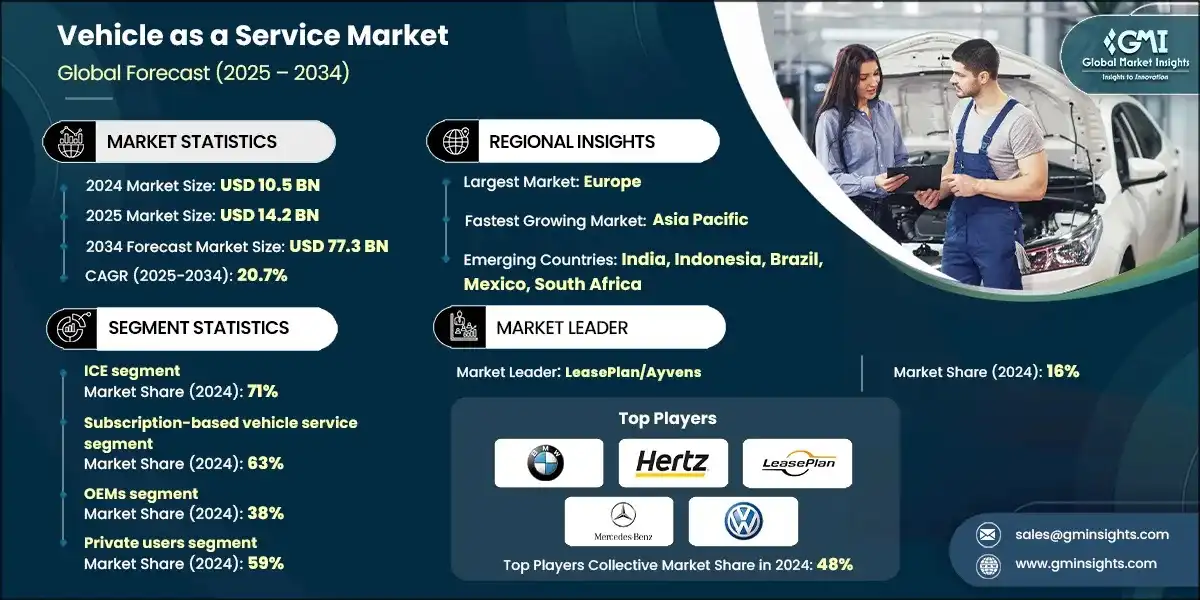
The global vehicle as a service market size was valued at USD 10.5 billion in 2024. The market is expected to grow from USD 14.2 billion in 2025 to USD 77.3 billion in 2034 at a CAGR of 20.7%, according to latest report published by Global Market Insights Inc.
Vehicle as a Service Market Key Takeaways
Market Size & Growth
- 2024 Market Size: USD 10.5 Billion
- 2025 Market Size: USD 14.2 Billion
- 2034 Forecast Market Size: USD 77.3 Billion
- CAGR (2025–2034): 20.7%
Key Market Drivers
- Preference for flexible mobility over ownership.
- Growing EV adoption and fleet electrification.
- Rising corporate fleet demand.
Challenges
- High capital investment.
- Regulatory and insurance challenges.
Opportunity
- Expansion in emerging urban markets.
- Integration with smart cities and MaaS platform.
- Bundled services with insurance and maintenance.
- Specialized EV and commercial vehicle solutions.
Key Players
- Market Leader: LeasePlan/Ayvens led with over 16% market share in 2024.
- Leading Players: Top 5 players in this market include LeasePlan/Ayvens, BMW, Hertz, Mercedes-Benz, Volkswagen, which collectively held a market share of 48% in 2024.
Get Market Insights & Growth Opportunities
Consumers and businesses are increasingly seeking access to vehicles without ownership, with an emphasis on flexibility to change vehicles, no long-term commitment, and lower costs related to vehicle ownership (purchase price, insurance, maintenance). Subscription and pay-per-use service models enable consumers and businesses to meet these needs; combined with urbanization and tech-savvy users, these factors are contributing to more widespread adoption of Vehicle-as-a-Service (VaaS) in cities and on-demand access to mobility.
The worldwide push toward electric vehicles (EVs) will be a strong driver for VaaS providers to convert their fleets to include electrified vehicles. EVs offer a lower operating cost than gasoline or diesel vehicles, provide environmental gains, and, in many cases, even offer fleets government incentives. As a result, electrified VaaS solutions will continue to gain popularity, especially in cities and governments that are investing heavily in EV infrastructure and sustainability programs.
Organizations will increasingly be interested in VaaS to alleviate fleet management pain points as part of an effort to reduce operational complexities. Fleet-as-a-Service allows organizations to access vehicles without paying for the capital costs, relieving the organization of paying or arranging for maintenance, insurance requirements, and replacements. Organizations will continue to evaluate VaaS given its attractiveness as a solution when increases in planning and delivery present themselves, as well as new employee mobility and transportation needs. VaaS is attractive for organizations as a low-cost mobility solution.
Advances in connected vehicles, telematics, and IoT allow users to track vehicles in real-time, gain predictive maintenance and service alerts, and receive optimized routing. These enhancements provide efficiencies to VaaS providers and improve the user experience through seamless (including automatic) booking, tracking, and service management, which encourages subscription and pay-per-use vehicle options more broadly.
To get key market trends
Vehicle as a Service Market Trends
Consumers and businesses are valuing flexibility over ownership, resulting in sourcing vehicles and using subscriptions and pay-per-use type services. This provides lower upfront costs, tailored plans, and convenience for consumers and businesses. This allows users to adjust vehicle usage anywhere in the world according to demand, and for providers to have a predictable revenue stream and better use of the fleet.
There is a move away from selling vehicles by the automakers into providing end-to-end mobility solutions consisting of apps for bookings, management of fleets, and customer services. Mobility solutions offered by OEMs can enhance brand loyalty, provide one-stop multi-service experiences for customers, and elevate manufacturers from selling vehicles to being mobility providers capturing more value along the value of ecosystems.
AI and IoT technologies allow for real-time tracking of fleet vehicles, predictive maintenance, and route optimization providing better efficiency and reducing operational costs. Using data analytics and insights can also drive vehicle utilization up and reduce down-time while enabling dynamic pricing for the users' costs. Further, advanced predictive analytics enable service providers to predict demand in service levels while providing higher customer satisfaction.
Fleet-as-a-Service providers are increasingly offering bigger fleets in more electric and hybrid vehicles to their customer base, with increased emission reductions and incentives from the government. All sustainable offers can include a green fleet, EV charging stations, and greener routes. The addition of sustainability in the mobility services offering will also appeal to consumers who seek environmentally friendly alternatives. Sustainable services also appeal to smart cities more than revenues and will bring them advocates for regulatory compliance. Sustainable VaaS providers will position themselves with the public as the leader of the transition to cleaner, and sustainable mobility.
Vehicle as a Service Market Analysis
Learn more about the key segments shaping this market
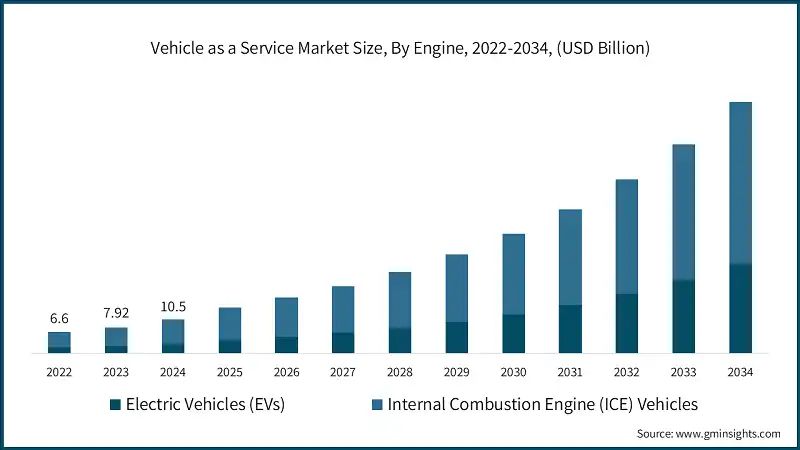
Based on engine, the vehicle as a service market is divided into EVs and ICE vehicles. The ICE segment dominated the market, accounting for 71% share in 2024 and is expected to grow at a CAGR of over 19% through 2025 to 2034.
- As ICE vehicles dominate lower cost acquisition, existing fuel distribution network and mainstream suitability in rural and long-range commercial application, it is possible future growth of EV may face existing modes slower growth relative to electrification and regulations. By 2034, EVs segment is expected to reach 35.7% of total VaaS value, so we can expect to see effective growth of electric mobility.
- EV-as-a-service is rapidly evolving, measuring over 17 million global EV sales for 2024, and fleet electrification increasing at 25% per annum. VaaS providers take on the high initial costs of EV ownership and spread them with subscription and pay-per-drive models, making EV flexibility more accessible to consumers and lowering financial barriers to entering the EV ecosystem.
- VaaS services credibly and sustainably lower operational cost; offer managed charging infrastructure; and allow consumers a short-term way to access EVs without ownership costs. VaaS providers will centralize charging optimization to reduce operational costs for the consumer, while government incentives to encourage electric mobility via subsidies, charging grants, preferential parking, and low-emission zone incentives in higher EV use cities would also support accelerating growth of VaaS providers focused on EV in urban environments.
Learn more about the key segments shaping this market
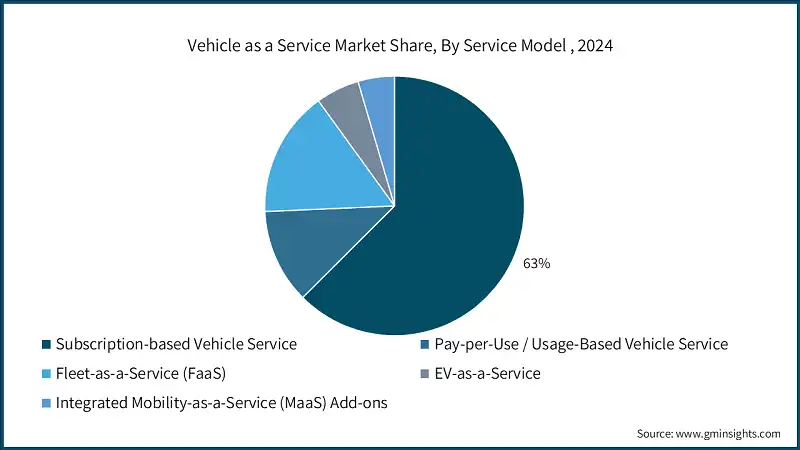
Based on service model, the vehicle as a service market is segmented into subscription-based vehicle service, pay-per-use / usage-based vehicle service, fleet-as-a-service (FaaS), EV-as-a-service and integrated mobility-as-a-service (MaaS). Subscription-based vehicle service segment dominates the market with 63% share in 2024, and the segment is expected to grow at a CAGR of 20.2% from 2025 to 2034.
- Subscription-based vehicle-as-a-service (VaaS) offers flexibility, bundling, and a commitment-free way to access a vehicle, making it the leading option in the market. Pay-per-use models offer occasional users’ prices that are based on the demand algorithms optimized for cost-per-trip pricing. Mobility-as-a-service (MaaS) platforms now incorporate VaaS into integrated platforms with transit and micromobility, allowing for unified payment and multimodal planning, especially in a public transport-rich area.
- Fleet-as-a-service (FaaS) enables businesses and public organizations to outsource the acquisition of fleets, along with insurance, maintenance, and management. It allows for the conversion of capital costs to operating expenses, allowing for scalability and access to the newest technologies in vehicles. FaaS has received investment worldwide into urban mobility and is in widespread use for commercial businesses, governments, logistics, and public transport organizations.
- Electric vehicles as a service is the fastest growing model and addresses barriers to adoption by providing vehicles, charging options, managed energy use and range-assurance programs while managing charging and fleet optimization to provide an economic transition to electrification. The current rapid pace for EV-as-a service reflects the rapid pace of EV sales growth around the globe and the rapid pace of fleet electrification, driven by regulatory incentives and sustainability needs.
Based on service provider, the vehicle as a service market is segmented into automotive OEMs, auto dealerships / dealer groups, auto-tech startups & mobility companies, car subscription software providers / platform providers and leasing & financial services companies. The automotive OEMs segment dominates the market with 38% share in 2024, and the segment is expected to grow at a CAGR of 20.1% from 2025 to 2034.
- OEMs are expanding into mobility services by taking advantage of brand trust, dealer networks, and vehicle supply. Automakers like VW, BMW, Mercedes-Benz, and Volvo are beginning subscription programs made possible by dealerships offering subscription and rental programs at a local level, allowing for a stream of revenue while maintaining the relationship with the customer beyond the sale of the vehicle.
- Auto-tech players like Turo, Getaround, FINN, Autonomy and Zipcar are inducing growth with their digital-first platforms that use VaaS. With Their superior technology, rapid innovation and flexibility in business models drive a 23.3% CAGR in this segment. FINN received €1 billion funding in 2025 and got strong investor confidence in tech-related mobility solutions.
- B2B software providers are helping VaaS operators with white-label subscription platforms, vehicle telematics integration, and automation tools that enable rental companies and dealerships to go to market and deploy solutions quickly. Leasing companies, like LeasePlan/Ayvens and ALD Automotive, bring fleet management applications and expertise to VaaS offering fleet-as-a-service models in the enterprise space that bundle vehicles, maintenance, insurance and management.
Based on end use, the vehicle as a service market is segmented into enterprise users and private users. Private users segment dominated the market with a share of 59% in 2024, driven by rising preference for flexible, cost-effective mobility solutions without ownership commitments.
- Private users see VaaS initiatives as an easy, flexible and low-cost way to avoid traditional vehicle ownership. The subscription and pay-per-use use case options are especially attractive to urban millennials and Z users as they don't own a vehicle, especially those individuals who prefer to use public alternatives for commuting, utilizing vehicle access models for leisure, spontaneity, or occur far less frequently than daily.
- There are many pay-per-use options that benefit the convenience of a mobile first platform to create less friction in switching vehicles, whether it's a transition to an alternative vehicle type from their use case, or a unique market for VaaS on special occasions or for leisure.
- Enterprise acceptance of VaaS is propelled by converting capital expenditures to operating expenses, increasing fleet size dynamically, and outsourcing ownership responsibilities relating to acquisition, maintenance, insurance, and compliance. It integrates renewable energy strategies and minimizes the administrative burden while reserving capital to invest in core operations. Various public and semi-public transportation projects also utilize funding to leverage mobility strategy options to VaaS.
- Enterprises are the catalysts for the use of electric vehicles to support the goals of sustainability, lowering emissions, and meeting ESG requirements while taking advantage of local/state/federal incentives in the VaaS model. The VaaS platform company can take responsibility for managing charging infrastructure and ensures optimal scheduling, including renewable charging strategies, to help corporations mitigate matters related to fleet electrification in the enterprise revenue model, while complying ultimately with low total cost of ownership for vehicles that experience higher-than-average utilization and rarely sit idle.
Looking for region specific data?
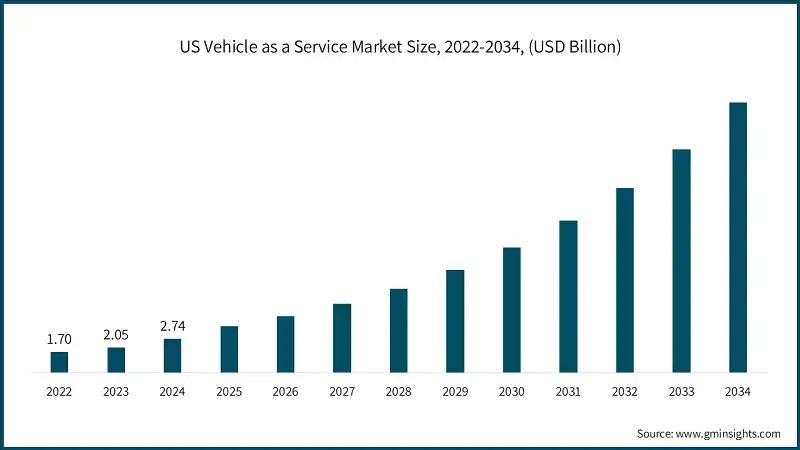
The US vehicle as a service market reached USD 2.74 billion in 2024, growing from USD 2.05 billion in 2023.
- In US, the trend among consumers and businesses is increasing to have a mobility option without vehicle ownership. This consumer trend is driving the growth of subscription and pay-per-use VaaS solutions. Subscription or pay-per-use options lower the barrier to entry for the ownership of a new vehicle, allow the consumer to have access to a variety of vehicle types, and allow all of this flexibility for the consumer to scale vehicle usage based on demand. Recurring revenue, optimized fleet utilization and increased driver engagement are just some of the positive benefits to the provider.
- In US, companies are incorporating VaaS into their corporate fleet solutions within their telematics, AI-based route and optimization solutions, predictive maintenance, which is improving their operational efficiency, decreasing costs and improving driver safety. VaaS solutions are following the same pattern, companies want to align their mobility solutions in a way that is aligned as their business grows or wants to position with sustainability objectives.
- As consumer and regulatory environmental concerns increase, this promotes a push by VaaS providers to integrate electric and hybrid vehicles. By using gas/electric hybrid vehicles or even fully electric vehicles, the impact on operations would lower emissions, operational costs, and allow for greener fleets and therefore will attract consumers who want to be environmentally conscious. As VaaS providers continue to invest in charging infrastructure, eco-routing and solutions, and some even bundle a green mobility option; it places VaaS providers in a stronger position in the ongoing evolution of the US mobility market.
North America dominated the vehicle as a service market with a market size of USD 3.16 billion in 2024.
- Canada and Mexico are implementing shared mobility and vehicle as a service (VaaS) solutions to solve congestion in roads and maximize urban transportation efficiencies. This subscription service provides users with on-demand access to a vehicle, which reduces reliance on personal vehicle ownership, which supports the growing strategic planning of smart cities.
- By aligning telemetry, IoT, and AI-based analytics allows connected fleet management to plan optimized routes, service vehicles efficiently, and work with operational efficiency for corporate and commercial fleets. Providers are prioritizing using this data to maximize utilization rates of their fleet while servicing vehicles faster and increasing customer satisfaction.
- The government incentives and increasing public awareness regarding environmental issues are increasing EV adoption in fleets. VaaS systems are implementing electric vehicle models to increase sustainability measures, decrease carbon footprint and attract environmentally friendly users in North America.
Europe vehicle as a service market accounted for a share of 42.1% and generated revenue of USD 4.42 billion in 2024.
- European cities are focused on developing and expanding car-sharing and subscription-based VaaS models to curb congestion and emissions. More access to vehicles that utilize flexible, shared usage can satisfy a need for urban mobility while reducing the number of private vehicles on the road.
- Strong environmentally conscious regulation is forcing an increase in fleet EV and hybrid vehicles in urban spaces. VaaS providers are adding electric vehicles to their fleets to serve urban mobility in the urban commuter market and corporate clients as well.
- Telematics and connected vehicle technologies allow fleets to satisfy internal safety and emissions regulatory requirements as well as support advanced predictive analytics to optimize maintenance schedules, operational efficiency of the fleet, and customer service across competitive European markets.
Germany dominates the vehicle as a services market, highlighting robust growth potential, with a CAGR of 18.3% from 2025 to 2034.
- Automakers are scaling digital mobility platforms that merge vehicle subscriptions, lease, and shared services into seamless customer journeys. This move not only increases OEM control over the mobility ecosystem but typically drives brand loyalty, as they leverage an opportunity to migrate from car sales to recurring mobility revenue. Germany's heavy automotive industry will speed up the adoption of more advanced, integrated VaaS solutions.
- The electrification of mobility fleets (of considerable significance) is being driven by environmental regulations and government incentives. Providers move to electric and hybrid vehicles, not just on the implementation of and compliance to a stringent emission standard, but to attract environmentally conscious users and enterprises. This shift lowers operational costs in the long term and is coherent with Germany's aggressive climate goals.
- AI-powered fleet optimization and IoT-enabled telematics are ubiquitous for fleet performance, fleet maintenance planning, and route efficiency. Doing so provides assurance of reliable service, reduces fleet downtime, and unlocks scalability for mobility operations. German mobility providers increasingly rely on corresponding (or correlated) data to provide a high quality and affordable drive and mobility service to both commercial and consumer markets and make them environmentally responsible.
The Asia Pacific vehicle as a service market is anticipated to grow at the highest CAGR of 23.2% from 2025 to 2034.
- With rapid urbanization and increasing population density in APAC is leading to a need for flexible models of mobility. VaaS solutions are becoming favorable and convenient, low-cost transport system without the burden of ownership - particularly for younger, urban demographics.
- Strong policy support for electrification drives VaaS providers to look to establish EV and hybrid fleets in markets like China, India, Japan, and Southeast Asia. Governments look at electric mobility as a process to mitigate emissions; reduce the cost of operations for the long-term; and support initiatives towards sustainability in nation-state agendas. Charging infrastructure is improving in terms of quality for consumers, leading to an increase in mobility services.
- In APAC, IoT-enabled vehicles and AI-based fleet optimization tools are changing the way Mobility operations are executed. Providers are using improved data insights to better utilize vehicles, support predictive maintenance, and better manage surges in demand. These changes help in scalability in improved mobility ecosystems that are robust and low-cost solutions.
China vehicle as a service market is estimated to grow with a CAGR of 23.6% from 2025 to 2034.
- The incorporation of mobility services into smart city ecosystems is driving the growth of the VaaS market in China. Mobility-as-a-service platforms connect vehicles to traffic systems, public transportation, and digital applications, providing highly efficient and flexible access to mobility. These developments are contributing to China's goals in urban planning, while also improving the overall experience of mobility.
- The ubiquity of electric vehicles in mobility services is supported by significant government incentives and the fast-paced improvements in electric vehicle manufacture. Mobility providers deploy large fleets of electric vehicles to reduce emissions, reduce fuel costs, and to fulfill their responsibilities to national goals in sustainability. The advanced capabilities of Chinese manufacturers in battery technology allows for accelerated electrification of fleets.
- The extensive utilization of artificial intelligence, the internet of things, and telematics allows for enhanced fleet tracking and monitoring, predictive maintenance, and dynamic routing. These digital capabilities are beneficial to mobility operators in improving efficiency, reducing costs, and providing a high-quality service in China's fast-paced transportation transition.
Latin America vehicle as a service market shows lucrative growth over the forecast period.
- Rising population density and transportation costs are main reasons for use of shared mobility and Vehicle-as-a-Service (VaaS) models in major Latin America cities. Vehicle access options that offer flexibility led to more affordability among consumers who may not want to or cannot buy a vehicle. Partnerships with government contribute further to adoption.
- Electric and hybrid vehicles are being integrated into fleets as municipalities in Latin America aim for reduced emissions and improved air quality. VaaS providers contain sustainable vehicles which include initiatives necessary to meet regulatory expectations and through plans to build greener mobility systems, although charging infrastructure is limited thus far.
- Telematics and AI based digital fleet management solutions are increasingly being adopted to improve route planning, ensure a timely maintenance approach, and provide greater monitoring of vehicles. This technology is needed to support private business in improving operational efficiencies in logistics and mobility services.
Brazil vehicle as a service market is estimated to grow with a CAGR of 17.1% from 2025 to 2034 and reach USD 1.07 billion in 2034.
- Sao Paulo and Rio de Janeiro are typical examples of the increasing congestion that is speeding up the adoption of VaaS products. Increasingly, individuals are subscribing, ridesharing, and using pay-per-use programs to access mobility. These VaaS solutions offer an attractive alternative to personal vehicles, especially for younger population groups without an established transit model.
- Corporate fleets are embracing significant digitization and adopting connected fleet tools to track services and improve areas such as fuel management and driver safety. Ensuring digitization or transformation supports innovative companies to manage and contain costs, develop more sustainable operations, optimize routes, and modify service areas from Brazil's diverse geography.
- There is also increasing availability of pilot programs for electric and hybrid fleets as Brazil moves toward sustainable and greener transportation tools. Increased availability and testing of EVs are typical of VaaS providers, who are also supported by additional government subsidies and grants as well as growing environmental awareness among businesses and their cities.
The Middle East and Africa vehicle as a service market accounted for USD 220.5 million in 2024 and is anticipated to show lucrative growth over the forecast period.
- The rise of urbanization and the need for corporate fleets are leading to more VaaS offerings to expand throughout MEA region. Flexible leasing and mobility services provide an affordable approach to traditional ownership and tend to be best suited for rapidly growing cities.
- More specifically, governments and private operators are piloting electric mobility programs to decrease emissions and makes transportation more sustainable. While adoption remains gradual, VaaS providers are experimenting with sustainable fleet services with the anticipation that different regulatory and sustainable fleet models will emerge in the years to come.
- Implementing telematics and fleet monitoring systems based on IoT applications is more efficient, decreases fuel consumption, and enhances maintenance planning for fleets across MEA. These digital capabilities will support VaaS providers to address operational reality situated in highly diverse and constantly evolving transportation environments.
UAE market is expected to experience substantial growth in the Middle East and Africa vehicle as a service market, with a CAGR of 15.7% from 2025 to 2034.
- A growing appetite for premium, flexible mobility options, fueled by consumer desire for convenience, variety, and status appeal, is contributing to the growing acceptance of vehicle subscription and leasing services focused on luxury vehicles. These services resonate with the highly affluent, urban lifestyle typical of the UAE.
- Smart mobility initiatives are intended to connect vehicles to digital frameworks to facilitate increased traffic throughput, real-time fleet monitoring and improvements to urban mobility efficiency. This also fits into national visions of developing technologically advanced urban areas.
- Ambitiously rising sustainability and corporate social responsibility goals are prompting commitments toward electric and hybrid fleets in urban mobility services. New entrants in urban mobility are bringing electric vehicle solutions as a strategy to support green mobility, drive emissions reductions, and align with the UAE’s ambition to achieve environmental sustainability.
Vehicle as a Service Market Share
- The top 7 companies in the vehicle as a service industry are LeasePlan/Ayvens, Volkswagen, BMW, Mercedes-Benz, Hertz, Sixt and Care by Volvo contributing 57% of the market in 2024.
- Ayvens (previously referred to as LeasePlan) is a well-established worldwide mobility service and vehicle leasing solution that specializes in long-term leasing, fleet management, and electrification solutions. The firm has committed to digital mobility platforms, sustainability, and EV fleet growth while assisting corporate customers shift away from ownership-based solutions. Its scale, multi-national coverage, and defined EV strategy make Ayvens a formidable enabler of vehicle as a service (VaaS).
- Volkswagen, in addition to its vehicles business, is also expanding towards mobility services via subscription programs, shared mobility platforms, and resourcing companies with new service models oriented towards EVs. With a solid interest in electrification and digital mobility ecosystems, Volkswagen is supporting the emergence of integration and vehicle as a service (VaaS) solutions across global markets. With great brand recognition and diverse vehicle inventory, Volkswagen is expanding upon more flexible access models that are aligned with a long-term mobility transformation strategy.
- BMW is augmenting its position in VaaS with premium subscription services, corporate leasing solutions, and digital mobility services. The company is integrating connected vehicle technologies, while exploring sustainability initiatives, with i-Series focused on electric and electrified fleets. BMW is focused on delivering flexible and elevated mobility experiences with its premium and sporty approach, that includes performance, technology, and convenience for both consumer mobility and enterprise mobility service.
- Hertz is moving towards subscription model from traditional car rental services and providing long-term mobility offerings and its EV fleet is growing rapidly. Hertz has announced partnerships with automotive companies offering EVs and investing in flexible access options for consumers and businesses. With its large network, fleet and global presence Hertz is well tapped for EVs and is becoming a key player in everyday mobility offerings.
- Sixt has broad mobility solution offerings including subscriptions, long-term rentals, corporate leasing and integrated digital solutions. Sixt is also known for its technology-supported operating model, which integrates connected fleet solutions to improve consumer experience and the overall efficiency of operations. Sixt, like its competitors, is expanding the integration of EVs and is focused on offering flexible mobility solutions in continual development in Europe, North America, and global markets.
- Care by Volvo is an all-inclusive, subscription-based mobility service allowing customers access to a Volvo vehicle for a monthly fee. Care by Volvo emphasizes simplicity, safety, and sustainability by offering insurance, maintenance, and service in one package and with flexible terms. With strong emphasis on electrified vehicles, Care by Volvo represents Volvo's overall sustainable growth mindset, and fully embraces the upper end of hassle-free, premium VaaS offerings
Vehicle as a Service Market Companies
Major players operating in the vehicle as a service industry are:
- BMW
- Care by Volvo
- Hertz
- Hyundai
- LeasePlan/Ayvens
- Mercedes-Benz
- Sixt
- Volkswagen
- BMW builds its (VaaS) portfolio with premium subscription offerings, corporate leasing and connected digital mobility solutions, combining a heightened emphasis on electric vehicle adoption with its i-Series. Care by Volvo provides an all-inclusive subscription model that bundles insurance and maintenance into a single payment while centering on easy, convenient, and flexible access to electrified vehicles. Both services serve to push the market toward a new generation of premium, technology-based, convenience-oriented mobility services.
- Hertz rotates its business model from traditional rentals toward long-term access and subscription-style mobility, expanding its EV offerings in partnership with major automotive manufacturers. Hyundai is assisting in the evolution of the VaaS market by providing innovative mobility platforms, flexible leasing options and integration of EV offerings via its IONIQ brand in the VaaS landscape. Both companies depict trends toward electrified mobility solutions that leverage flexible, digitally managed solutions into the daily user experience across global markets.
- Ayvens (formally known as LeasePlan) is a global leader in leasing and the electrification of fleets with digital fleet management solutions and long-term mobility solutions for corporates in general. Mercedes-Benz contributes to evolution of the VaaS with premium subscription services, connected vehicle ecosystems, and a growing fleet of EVs via its EQ brand. Both brands focus on sustainability, digitalization, and flexible access for both corporate clients and high-end consumers.
- Sixt enhances the VaaS model via digital-first subscriptions, long-term rentals and connected corporate fleet services, with an eye towards rapid integration of EVs. Volkswagen is innovating mobility services past manufacturing to mobility services, as evidenced by its enabling of flexible subscriptions, shared mobility platforms and services focused on EVs that are related to its electrification strategy. Together, they enable mass-scale, flexible, digitally enabled access to mobility across Europe and its global markets.
Vehicle as a Service Market Report Attributes
| Key Takeaway | Details |
|---|---|
| Market Size & Growth | |
| Base Year | 2024 |
| Market Size in 2024 | USD 10.5 Billion |
| Market Size in 2025 | USD 14.2 Billion |
| Forecast Period 2025 - 2034 CAGR | 20.7% |
| Market Size in 2034 | USD 77.3 Billion |
| Key Market Trends | |
| Drivers | Impact |
| Preference for flexible mobility over ownership | Reduces personal vehicle purchases, boosting subscription and shared mobility adoption |
| Growing EV adoption and fleet electrification | Accelerates demand for sustainable VaaS solutions and lowers fleet emissions. |
| Rising corporate fleet demand | Increases recurring revenue and drives large-scale fleet management services. |
| Pitfalls & Challenges | Impact |
| High capital investment | Limits entry for smaller providers and slows fleet expansion. |
| Regulatory and insurance challenges | Creates compliance hurdles, slowing adoption and increasing operational costs. |
| Opportunities: | Impact |
| Expansion in emerging urban markets | Unlocks new customer bases and growth potential. |
| Integration with smart cities and MaaS platform | Enables seamless mobility solutions and ecosystem partnerships. |
| Bundled services with insurance and maintenance | Increases customer stickiness and lifetime value. |
| Specialized EV and commercial vehicle solutions | Opens niche markets and strengthens differentiation in sustainable mobility. |
| Market Leaders (2024) | |
| Market Leaders |
16% market share |
| Top Players |
Collective market share in 2024 is 48% |
| Competitive Edge |
|
| Regional Insights | |
| Largest Market | Europe |
| Fastest Growing Market | Asia Pacific |
| Emerging Country | India, Indonesia, Brazil, Mexico, South Africa |
| Future Outlook |
|
What are the growth opportunities in this market?
Vehicle as a Service Industry News
- In November 2024, Volkswagen began offering a new service called VW Flex in Atlanta, which provides month-to-month access to a vehicle, inclusive of insurance, maintenance and roadside assistance. VW Flex specifically targets urban customers searching for flexible means of mobility using vehicles. This service builds upon their more recent work in car sharing with WeShare, and ridesharing with MOIA; VW Flex also serves as a U.S. test market for the advancement of subscriptions in VaaS.
- In November 2024, Zoomcar moved to offering long-term subscriptions (the minimum of seven days) in urban cities of India. This service is more than hourly or daily-based rentals, and includes better insurance, maintenance and 24/7 roadside assistance. The service is designed to meet expanding urban consumer demand to use their vehicles without ownership for both professionals and families.
- In August 2024, Kia India launched Kia Subscribe in 14 cities including New Delhi, Mumbai and Bangalore. This service was developed to offer a subscription-based vehicle ownership model on a monthly basis for the Seltos, Sonet and Carens models; this subscription includes insurance, maintenance, roadside assistance and vehicle replacement as necessary. Kia Subscribe is also a sign of the expanding VaaS offerings, specifically subscription services, in the Indian market.
- In August 2024, California-based Autonomy switched from consumer EV subscriptions to a Software- as-a-Service for Autonomous Driving Systems (ADS). The switch focused on building and licensing software for autonomous vehicles to OEMs and mobility service providers. The switch also improved their business scalability and capital efficiency, which demonstrates further evolution in VaaS.
The vehicle as a service market research report includes in-depth coverage of the industry with estimates & forecasts in terms of revenue ($ Mn/Bn) from 2021 to 2034, for the following segments:
Market, By Engine
- Electric vehicles (EVs)
- Battery electric vehicles (BEVs)
- Plug-in hybrid electric vehicles (PHEVs)
- Internal combustion engine (ICE) vehicles
- Gasoline
- Diesel
Market, By Service Model
- Subscription-based vehicle service
- Pay-per-use / usage-based vehicle service
- Fleet-as-a-service (FaaS)
- EV-as-a-service
- Integrated mobility-as-a-service (MaaS) add-ons
Market, By Service Provider
- Automotive OEMs
- Auto dealerships / dealer groups
- Auto-tech startups & mobility companies
- Car subscription software providers / platform providers
- Leasing & financial services companies
Market, By End Use
- Enterprise users
- Private users
Market, By Vehicle
- Passenger cars
- Hatchback
- Sedan
- SUV
- Commercial vehicles
- LCV
- MCV
- HCV
- Two-wheelers
- Specialty & utility vehicles
The above information is provided for the following regions and countries:
- North America
- US
- Canada
- Europe
- Germany
- UK
- France
- Italy
- Spain
- Russia
- Nordics
- Asia Pacific
- China
- India
- Japan
- South Korea
- ANZ
- Vietnam
- Indonesia
- Latin America
- Brazil
- Mexico
- Argentina
- MEA
- South Africa
- Saudi Arabia
- UAE
Frequently Asked Question(FAQ) :
What is the market size of the vehicle-as-a-service in 2024?
The market size was USD 10.5 billion in 2024, with a CAGR of 20.7% expected through 2034. Increasing demand for flexible vehicle access without ownership and the adoption of subscription and pay-per-use models are driving market growth.
What is the projected value of the vehicle-as-a-service market by 2034?
The market is poised to reach USD 77.3 billion by 2034, driven by urbanization, technological advancements, and the growing preference for on-demand mobility solutions.
What is the expected size of the vehicle-as-a-service industry in 2025?
The market size is projected to reach USD 14.2 billion in 2025.
What was the market share of the ICE segment in 2024?
The ICE segment dominated the market with a 71% share in 2024 and is expected to grow at a CAGR of over 19% from 2025 to 2034.
What was the market share of the subscription-based vehicle service segment in 2024?
The subscription-based vehicle service segment held a 63% market share in 2024 and is set to expand at a CAGR of 20.2% till 2034.
What was the market share of the automotive OEMs segment in 2024?
The automotive OEMs segment accounted for 38% of the market in 2024 and is anticipated to showcase around 20.1% CAGR up to 2034.
What was the valuation of the US vehicle-as-a-service sector?
The US vehicle-as-a-service market reached USD 2.74 billion in 2024, led by increasing consumer and business demand for mobility solutions without ownership.
What are the upcoming trends in the vehicle-as-a-service market?
Trends include a shift to flexible access models, AI- and IoT-driven fleet optimization, increased electric and hybrid adoption, and sustainability through green fleets and eco-friendly routing.
Who are the key players in the vehicle-as-a-service industry?
Key players include BMW, Care by Volvo, Hertz, Hyundai, LeasePlan/Ayvens, Mercedes-Benz, Sixt, and Volkswagen.
Vehicle as a Service Market Scope
Related Reports