Summary
Table of Content

Utility Communication Market
Get a free sample of this report
Form submitted successfully!
Error submitting form. Please try again.
Thank you!
Your inquiry has been received. Our team will reach out to you with the required details via email. To ensure that you don't miss their response, kindly remember to check your spam folder as well!
Request Sectional Data
Thank you!
Your inquiry has been received. Our team will reach out to you with the required details via email. To ensure that you don't miss their response, kindly remember to check your spam folder as well!
Form submitted successfully!
Error submitting form. Please try again.
Utility Communication Market Size
The global utility communication market size was valued at USD 18.1 billion in 2024. The market is expected to grow from USD 18.8 billion in 2025 to USD 27.4 billion in 2034, at a CAGR of 4.2%, according to Global Market Insights Inc.
Utility Communication Market Key Takeaways
Market Size & Growth
- 2024 Market Size: USD 18.1 Billion
- 2025 Market Size: USD 18.8 Billion
- 2034 Forecast Market Size: USD 27.4 Billion
- CAGR (2025–2034): 4.2%
Regional Dominance
- Largest Market: Asia Pacific
- Fastest Growing Region: Middle East & Africa
Key Market Drivers
- Modernization of Power Grids.
- Integration of Renewable Energy Sources.
Challenges
- Issues related to interoperability.
Opportunity
- adoption of 5G and private LTE networks.
Key Players
- Market Leader: Siemens led with over 12.5% market share in 2024.
- Leading Players: Top 5 players in this market include Hitachi Energy, Schneider Electric, Siemens, Itron, Inc., Honeywell International, which collectively held a market share of 30% in 2024.
Get Market Insights & Growth Opportunities
- Governments worldwide are allocating substantial investment to modernize utility infrastructure, boosting utility communication markets. In the U.S., the Department of Energy (DOE) reported a USD 2billion investment in 2024 aimed at 38 projects to enhance grid capacity and deploy modern communication technologies for real-time data and responsiveness. These investments underscore the central role of communication systems integrating sensors, meters, and control nodes in enabling smart grid functionality.
- The proliferation of distributed energy resources (DERs) solar panels, battery storage, electric vehicles necessitates advanced utility communications capable of bi-directional data flows and low latency. The 2024 Smart Grid System Report by DOE forecasts that DER deployment will increase by 262GW between 2023–2027, nearly matching conventional bulk generation additions. This surge underlines the need for robust communication infrastructure utility meters, IoT networks, and SCADA systems to coordinate intermittently generated power and manage demand response across the grid.
- Regulatory frameworks also support utility communications growth on a significant scale. Under the Infrastructure Investment and Jobs Act, the U.S. DOE allocated USD 13billion for grid resilience and smart grid deployment programs. In addition, the Federal Energy Regulatory Commission (FERC) reported over 32,400MW of demandresponse resources in ISO/RTO markets in 2021, accounting for 6.6% of peak load with annual growth of 6%, spotlighting enhanced grid communication capabilities. Demand-response systems rely heavily on secure, reliable messaging between utilities and end-users, reinforcing investment in communication infrastructure.
- Government agencies are championing advanced communication technologies such as private LTE/5G, fiber optics, RF mesh, and IoT-based telemetry. The DOE highlights demonstration programs like Stem’s VPP (50MW/340MWh) and Baltimore Gas & Electric’s EV telematics pilot, both reliant on secure, scalable communications. With grid electrification goals and renewable deployment increasing under policies like the U.S. green-energy agenda and the EU Green Deal, utility communication systems are positioned for sustained, long-term growth.
- The International Energy Agency estimateed that annual global investment in grid technologies must more than double from approximately USD 330billion in 2024 to around USD 750billion by 2030 if the world is to meet net-zero energy goals. Crucially, about 75% of these investments which roughly around USD 560billion annually will flow into the modernization and digitalization of distribution networks where communications systems are essential to integrate distributed renewables, EV charging infrastructure, and demand-side management.
- Government policies across regions from EU digitalization plans to U.S. federal and state grants are actively directing funds toward communications-enabled smart grid initiatives. These include advanced meter rollouts, substation automation upgrades, and private LTE/5G deployments for utility telemetry. The result is a globally synchronized acceleration in utility communication infrastructure, spearheaded by policy commitments and backed by multibillion-dollar funding streams.

To get key market trends
Utility Communication Market Trends
- The DOE’s 2023 white paper highlights a major move away from centralized grid communications toward a distributed, two-way system embedded with sensors, DERs, and load-responsive devices. This evolving network demands not just increased bandwidth and low latency, but robust cyber-physical security. Initiatives like DOE’s SPaRC program further launch secure communications testbeds and architecture designs tailored to utility needs, underlining security as a core trend.
- The IEA reports that global investment in transmission and distribution digital infrastructures (including networking and communications systems) increased from below USD 20billion in 2015 to nearly USD 60billion in 2022. Notably, approximately 75% of recent digital grids spend targets distribution, where communication infrastructure supports DER integration, fault detection, and grid resilience. This surge reflects governments accelerating grid digitalization as a foundation for clean energy transitions.
- DOE’s 2024 Smart Grid System Report forecasts 262GW of DER growth from 2023 to 2027, nearly matching utility-scale generation capacity. This acceleration demands low-latency, two-way communications to manage VPPs, EV charging (e.g. Baltimore Gas & Electric’s EV telematics pilot), and gridedge devices. In early 2025, DOE invested USD 32million in “Connected Communities” pilots, including EV smart-charging and DER coordination, highlighting real-world use cases of modern grid communications.
- Federal and international bodies are codifying utility communication needs. The DOE’s SPaRC initiative develops secure communications frameworks and provides this research to regulators. FERC, under EPAct 2005 Section 1252, publishes annual assessments on metering and demand-response and recently expanded DR participation windows to 24/7 service through PJM, optimizing grid flexibility. Additionally, NIST’s Smart Grid Interoperability Framework underscores interoperability and standards for communications across grid devices.
- The utility communication market is undergoing a transformative shift driven by the increasing complexity of modern power grids. As utilities transition from traditional centralized systems to decentralized networks, communication technologies are becoming essential for managing distributed energy resources, electric vehicles, and smart appliances.
- One major trend is the integration of real-time, two-way communication systems that enable dynamic grid balancing and faster fault detection. Utilities are also adopting advanced technologies like private LTE, 5G, and fiber optics to support high-speed, low-latency data exchange across grid components. Cybersecurity is gaining prominence, with utilities investing in secure protocols to protect critical infrastructure.
- Additionally, regulatory bodies are encouraging interoperability and standardization to ensure seamless communication across diverse devices and platforms. These trends reflect a broader push toward digitalization, resilience, and sustainability, positioning communication infrastructure as a cornerstone of future-ready utility operations.
Utility Communication Market Analysis
Learn more about the key segments shaping this market
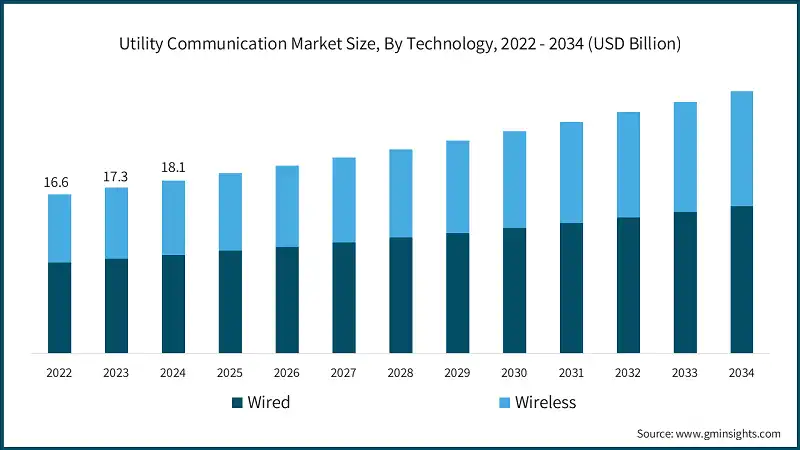
- The utility communication market was valued at USD 16.6 billion, USD 17.3 billion and USD 18.1 billion in 2022, 2023 and 2024 respectively. This increase is primarily driven by the rising adoption of smart grid technologies, which require robust, real-time communication systems to monitor, control, and optimize energy distribution. Utilities are increasingly deploying smart meters, automated substations, and distributed energy resources, all of which depend on secure and efficient communication infrastructure.
- Based on technology, the wired segment is anticipated to cross USD 15 billion by 2034 due to multiple advantages of such systems. Wired systems including fiber optics, Ethernet, and power line communication serve as the mission-critical infrastructure for power transmission and distribution. They deliver high bandwidth, ultra-low latency, and exceptional resilience against interference, which is indispensable for applications like substation automation, SCADA, and wide-area grid control.
- According to the EIA, transmission spending nearly tripled between 2003 and 2023 reaching USD 27.7billion underscoring investment in robust wire-based backbone systems. Similarly, distribution capital investment increased by 160% during the same period as utilities integrated smart-grid communications within wired networks. These investments reflect government priorities in reinforcing wired infrastructure to enable real-time control, enhance security, and improve operational reliability.
- Wireless technologies including RF mesh, cellular (4G/5G), WiFi, and satellite are vital for nimble, last-mile connectivity. They are key enablers for smart meters, DERs, remote sensors, and EV charging stations. The DOE's 2024 Smart Grid System Report highlights that DER deployments requiring decentralized communications are projected to grow by 262GW between 2023 and 2027.
- In these edge scenarios, wireless communication allows swift deployment and broad reach, especially in rural and hard-to-wire areas. Wireless enables utilities to rapidly expand services, adapt to evolving field conditions, and support modernization programs without extensive infrastructural investment.
- Wireless technologies including RF mesh, cellular (4G/5G), WiFi, and satellite—enable scalable and flexible deployments across wide geographic spans. Utilities increasingly rely on these solutions for smart meter installations, DER networks, EV charging communications, and remote sensing.
- DOE-funded surveys, such as the PNNL report on wireless communications, highlight the suitability of technologies like 3G/4G/LTE and IEEE 802.15.4 (e.g., Zigbee) for rapidly connecting thousands of devices in field deployments. Wireless networks reduce infrastructure costs and accelerate rollouts, especially in rural and hard-to-reach terrains, making them essential for distributed grid modernization efforts.
- Utilities increasingly adopt hybrid communication architectures that combine wired and wireless systems. Wired networks provide a high-capacity, secure central backbone, while wireless extensions support flexible edge connectivity. DOE whitepapers focus on this convergence, emphasizing hybrid architectures that link fiber backhaul with wireless last-mile connections for sensors and smart meters. These configurations stress reliability and cost efficiency, aligning with governmental objectives to amplify grid resilience and expand coverage in remote areas.
- Emerging technologies such as private LTE/5G networks and advanced optical fiber are expanding the capabilities of both segments. Wired infrastructure is being enhanced to support high-speed analytics and DER management. Wireless networks, leveraging 5G and IoT protocols, enabling distributed connectivity on a wider scale. These developments align with DOE and EIA investments, driving a consistent shift toward interconnected, intelligent grid systems that rely on both wired backbone and flexible wireless edge connectivity.
Learn more about the key segments shaping this market
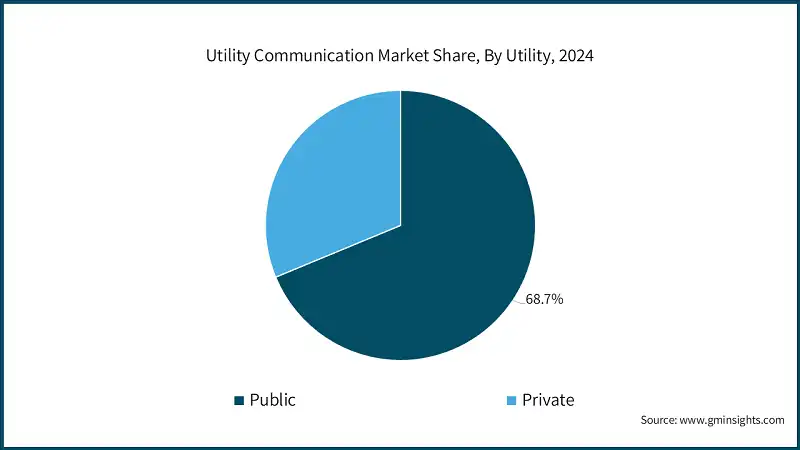
- Based on utility, public segment in utility communication market is expected to grow with CAGR of more than 5.5% by 2034. Public utilities play a foundational role in the utility communication market due to their responsibility for large-scale infrastructure and service delivery. These entities typically manage vast transmission and distribution networks, which require robust communication systems to ensure operational efficiency, safety, and reliability.
- Public utilities are often tasked with implementing wide-reaching smart grid technologies, including automated substations, advanced metering systems, and centralized control platforms. Their communication networks must support real-time data exchange, fault detection, and grid stability across diverse geographic regions.
- Because of their scale and public accountability, these utilities prioritize secure, standardized, and interoperable communication systems that align with private utilities, often operating in more focused or specialized markets, contribute significantly to innovation within the utility communication space. These organizations tend to be more agile, allowing them to adopt emerging technologies such as wireless IoT networks, private LTE/5G systems, and cloud-based analytics platforms.
- Their communication strategies are often tailored to specific customer needs, enabling more responsive and flexible service models. Private utilities are instrumental in piloting new approaches to distributed energy resource management, smart home integration, and predictive maintenance. Their ability to quickly implement and implement communication technologies makes them valuable contributors to the evolution of utility infrastructure.
- While public and private utilities differ in structure and approach, their roles in the communication market are complementary. Public utilities provide the foundational infrastructure and ensure broad service coverage, while private utilities bring innovation and responsiveness to the table.
- Together, they create a balanced ecosystem where stability and experimentation coexist. This collaboration enables the development of hybrid communication architectures that combine wired and wireless technologies, centralized and decentralized control systems, and legacy and next-generation platforms.
Looking for region specific data?
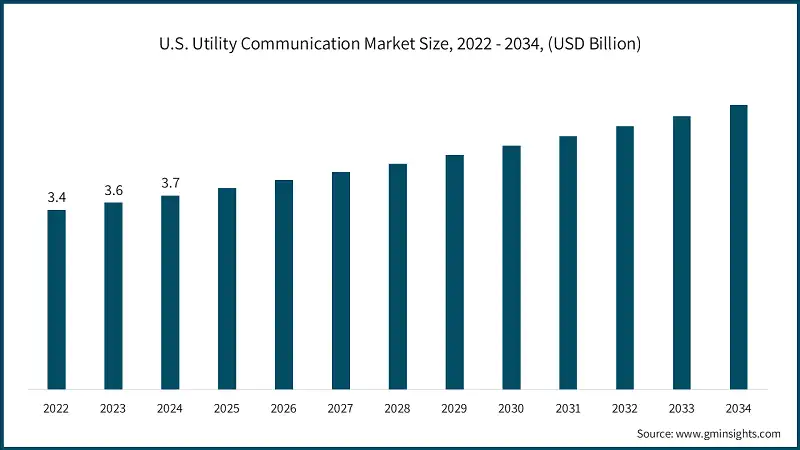
- The U.S. utility communication market in 2022, 2023 and 2024 was valued at USD 3.4 billion, USD 3.6 billion and USD 3.7 billion respectively U.S. holds a particularly influential position in the market. It has been a pioneer in deploying smart grid technologies, supported by federal and state initiatives aimed at enhancing grid reliability, resilience, and efficiency.
- U.S. utilities are actively investing in both wired and wireless communication systems to support advanced metering, demand response, and distributed energy integration. The country’s regulatory environment encourages innovation while maintaining high standards for security and performance. As a result, the U.S. often sets benchmarks that influence utility communication strategies worldwide.
- North America plays a pivotal role in the utility communication market due to its advanced infrastructure and strong regulatory frameworks. The region has been at the forefront of smart grid development, with utilities actively deploying communication technologies to support grid modernization, demand response, and distributed energy resource integration.
- The presence of well-established utility companies and government support for digital transformation has enabled widespread adoption of both wired and wireless communication systems. North America also benefits from a mature technology ecosystem, allowing utilities to experiment with emerging solutions such as private LTE networks, edge computing, and AI-driven grid analytics.
- Europe’s importance in the utility communication market stems from its strong emphasis on sustainability, energy efficiency, and regulatory harmonization. European utilities are deeply engaged in transitioning to low-carbon energy systems, which requires robust communication networks to manage renewable integration, electric vehicle infrastructure, and smart metering.
- Asia Pacific is one of the fastest-growing regions in the utility communication market, driven by rapid urbanization, population growth, and increasing energy demand. Many countries in the region are investing heavily in infrastructure upgrades to support smart cities, rural electrification, and industrial expansion. Utility companies are adopting scalable communication technologies to manage complex and diverse energy networks, often combining traditional grid systems with modern digital platforms.
- The region’s dynamic economic landscape encourages innovation and flexible deployment models, especially in areas where conventional infrastructure is limited. Asia Pacific’s diverse utility environment from highly developed markets to emerging economies makes it a key area for communication technology adaptation and growth.
Utility Communication Market Share
Top 5 companies including Hitachi Energy, Schneider Electric, Siemens, Honeywell International, Itron, Inc. hold more than 30% of the market around the world. The major companies consistently work on new products and solutions which makes them a crucial part of the industry globally. These companies place a high focus on investment, especially on research and development. Besides, these companies apply different methods of market development in order to obtain considerable shares in the industry.
Utility Communication Market Companies
Major players operating in the utility communication industry are:
- Cisco System
- Doxim
- Hexagon
- Hexaware Technologies
- Hitachi Energy
- Honeywell
- Itron, Inc.
- Kontron
- Morcom International
- Motorola Solutions
- Ribbon Communications
- Schneider Electric
- Siemens
- Utility Communications Inc.
- Zenner International
- Hitachi Energy: HitachiEnergy provides missioncritical communications for utilities spanning wired networks, wireless and hybrid architectures, powerline carrier, and 5G-enabled systems. They support substation automation, teleprotection, DER integration, and cybersecurity with IEC61850 compliance, ensuring grid modernization, resilience, and scalable, reliable OTgrade connectivity.
- Schneider Electric: SchneiderElectric offers comprehensive utility communication via its EcoStruxure platform and Energy Management business. Solutions include medium- and low-voltage distribution, RTUs, relays, SCADA integration, DERMS, and demand-response systems. Their suite digitizes grid operations, supports renewable integration, and enhances operational efficiency, sustainability, and grid resilience.
Utility Communication Market Report Attributes
| Key Takeaway | Details |
|---|---|
| Market Size & Growth | |
| Base Year | 2024 |
| Market Size in 2024 | USD 18.1 Billion |
| Market Size in 2025 | USD 18.8 Billion |
| Forecast Period 2025 - 2034 CAGR | 4.2% |
| Market Size in 2034 | USD 27.4 Billion |
| Key Market Trends | |
| Drivers | Impact |
| Modernization of Power Grids | As utilities shift to smart grids, they require robust, real-time communication networks to manage distributed energy resources, enhance reliability, and support automation—driving demand for advanced communication technologies across transmission and distribution systems. |
| Integration of Renewable Energy Sources | As solar, wind, and other renewables are added to the grid, utilities need advanced communication systems to monitor, control, and balance variable energy inputs, ensuring grid stability and efficient energy distribution. |
| Pitfalls & Challenges | Impact |
| Issues related to interoperability | Utilities often use equipment from multiple vendors, and lack of standardized communication protocols can lead to integration challenges, increased costs, and system inefficiencies hindering the seamless operation of smart grid technologies and slowing down modernization efforts. |
| Opportunities: | Impact |
| adoption of 5G and private LTE networks | An important opportunity in the utility communication market is the adoption of 5G and private LTE networks. These technologies offer ultra-low latency, high bandwidth, and enhanced reliability enabling real-time monitoring, automation, and control of grid operations, which supports the transition to smarter, more resilient energy infrastructure. |
| Market Leaders (2024) | |
| Market Leaders |
12.5% |
| Top Players |
Collective market share in 2024 is 30% |
| Competitive Edge |
|
| Regional Insights | |
| Largest Market | Asia Pacific |
| Fastest Growing Market | Middle East & Africa |
| Emerging Region | Latin America |
| Future outlook |
|
What are the growth opportunities in this market?
Utility Communication Industry News
- In June 2025, ZENNER, in partnership with EchoStar and Semtech, introduced what it describes as the first utility meter system capable of direct communication with satellites. Revealed as a collaboration between members of the LoRa Alliance, this system aims to reshape how consumption data from utility meters covering water, gas, and electricity is collected and managed across vast geographies.
The utility communication market research report includes in-depth coverage of the industry with estimates & forecast in terms of “USD Million” from 2021 to 2034, for the following segments:
Market, By Technology
- Wired
- Wireless
Market, By Utility
- Private
- Public
Market, By Component
- Hardware
- Software
Market, By Application
- Transmission & distribution
- Oil & gas utilities
- Others
The above information has been provided for the following regions and countries:
- North America
- U.S.
- Canada
- Mexico
- Europe
- UK
- France
- Germany
- Italy
- Russia
- Spain
- Asia Pacific
- China
- Australia
- India
- Japan
- South Korea
- Middle East & Africa
- Saudi Arabia
- UAE
- Turkey
- South Africa
- Egypt
- Latin America
- Brazil
- Argentina
Frequently Asked Question(FAQ) :
What is the market size of the utility communication in 2024?
The market size was valued at USD 18.1 billion in 2024, with a CAGR of 4.2% expected through 2034. Government investments in modernizing utility infrastructure and the adoption of smart grid technologies are driving market growth.
What is the projected value of the utility communication market by 2034?
The market is poised to reach USD 27.4 billion by 2034, driven by advancements in communication technologies, increased adoption of distributed energy resources (DERs), and grid digitalization initiatives.
What is the expected size of the utility communication industry in 2025?
The market size is projected to reach USD 18.8 billion in 2025.
What is the growth outlook for the public utilities segment by 2034?
The public utilities segment is expected to grow at a CAGR of 5.5% till 2034, led by the need for robust communication systems to manage large-scale infrastructure and ensure operational efficiency.
What was the valuation of the wired segment in 2024?
The wired segment is anticipated to surpass USD 15 billion by 2034, due to its high bandwidth, ultra-low latency, and resilience against interference.
Which region leads the utility communication sector?
The U.S. market was valued at USD 3.7 billion in 2024, supported by federal and state initiatives aimed at enhancing grid reliability and efficiency.
What are the key trends in the utility communication market?
Trends include real-time two-way communication, integration of 5G, LTE, and fiber optics, stronger cybersecurity focus, and regulatory push for interoperability.
Who are the key players in the utility communication industry?
Key players include Cisco System, Doxim, Hexagon, Hexaware Technologies, Hitachi Energy, Honeywell, Itron, Inc., Kontron, and Morcom International.
Utility Communication Market Scope
Related Reports