Summary
Table of Content

Used Trucks Market
Get a free sample of this report
Form submitted successfully!
Error submitting form. Please try again.
Thank you!
Your inquiry has been received. Our team will reach out to you with the required details via email. To ensure that you don't miss their response, kindly remember to check your spam folder as well!
Request Sectional Data
Thank you!
Your inquiry has been received. Our team will reach out to you with the required details via email. To ensure that you don't miss their response, kindly remember to check your spam folder as well!
Form submitted successfully!
Error submitting form. Please try again.
Used Trucks Market Size
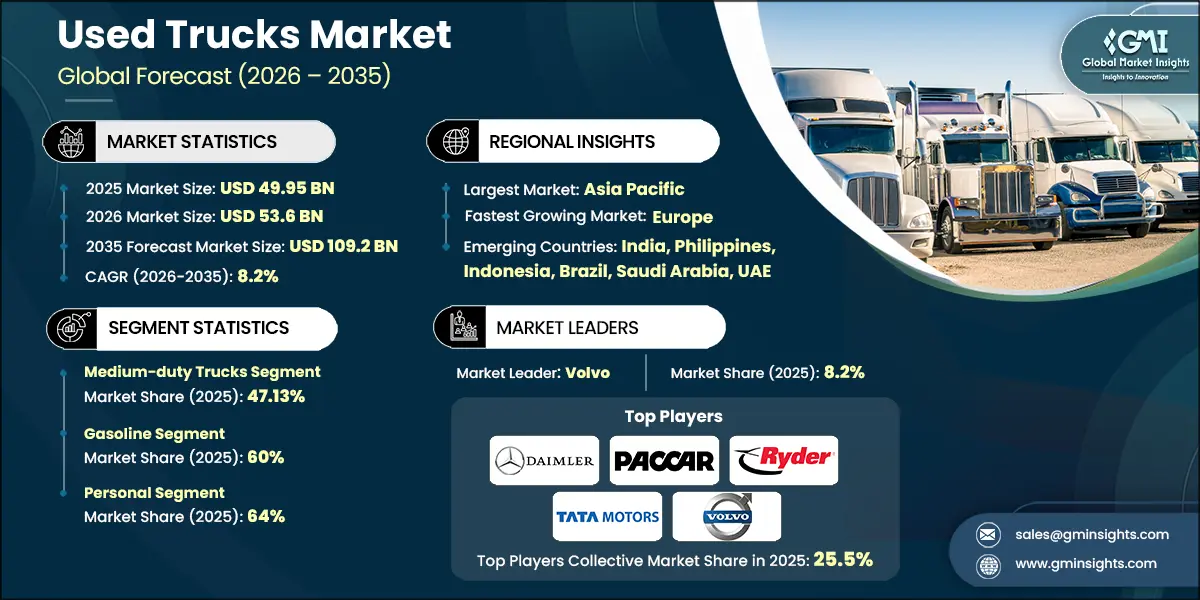
The global used trucks market size was estimated at USD 49.95 billion in 2025. The market is expected to grow from USD 53.6 billion in 2026 to USD 109.2 billion in 2035, at a CAGR of 8.2%, according to latest report published by Global Market Insights Inc.
Used Trucks Market Key Takeaways
Market Size & Growth
- 2025 Market Size: USD 49.95 Billion
- 2026 Market Size: USD 53.6 Billion
- 2035 Forecast Market Size: USD 109.2 Billion
- CAGR (2026–2035): 8.2%
Regional Dominance
- Largest Market: Asia Pacific
- Fastest Growing Region: Europe
Key Market Drivers
- Increasing demand for electric & hybrid heavy-duty trucks across the globe.
- Growing freight transportation activities across North America.
- The rising number of small and medium-sized businesses.
- Rising investments in infrastructure development activities in Asia Pacific.
Challenges
- Economic downturns and low economic growth.
- Regulatory Compliance and Government Regulations.
Opportunity
- Expansion of certified pre-owned (CPO) and OEM-backed used truck programs.
- Growing demand for cost-effective fleet solutions among SMEs and owner-operators.
- Rising cross-border trade of used trucks from developed to emerging markets.
- Increasing adoption of digital remarketing, online auctions, and data-driven pricing.
Key Players
- Leading Players: Top 5 players in this market include Daimler, PACCAR, Ryder System, TATA Motors, Volvo, which collectively held a market share of 25.5% in 2025.
Get Market Insights & Growth Opportunities
Once considered as residual trucks, used trucks have become part of fleet right-sizing, cost-efficiency, and speedy capacity delivery in logistics, construction, municipal, mining, agriculture, and utility. The escalating vehicle prices, lengthy delivery timelines of OEMs and capital preservation measures are forcing fleet operators to the secondary market in a bid to maintain operational continuity and maintaining profit margin.
Light, medium, and heavy-duty used trucks are being used more in urban and regional freight distribution, last- and mid-mile logistics, construction support, infrastructure development, municipal service and cross-border trade corridors. Fleet purchasers are increasingly focusing on vehicles that have proven service records, that meet their emission standards and that can be retrofitted with digital features, and this is evidence of a shift in the lifecycle-based approach to asset use, not first-ownership economics.
Used trucks are also experiencing a significant value addition with the incorporation of telematics, fleet analytics, ADAS retrofits and powertrain monitoring systems. Fleet operators are using data resources to do predictive maintenance, real time utilization monitoring, fuel efficiency optimization, driver performance rating, and redeploying assets, which increases the life of vehicles and reduces the total cost of ownership (TCO). This operational device is turning used trucks into digitally empowered productivity resources and has become especially appealing to small and medium-sized enterprise (SME) that need to achieve fleet efficiencies at the enterprise tier without initiating significant capital investments.
The used truck ecosystem is also being impacted by the adoption of alternative fuel. Due to the transition of the fleet owners to electric, hybrid, LNG, and hydrogen trucks, the resale market is flooded with more and more diesel and CNG used trucks. At the same time, first-generation electric and hybrid trucks are also starting to enter the secondary market, especially in municipal and urban delivery trucks, and this is forming an emerging, yet expanding used zero-emission truck market.
The used truck value chain is being redefined quickly with flexible ownership and service-based model. Truck-as-a-Service (TaaS), subscription leasing, short-term rentals, fleet pooling and pay-per-use models are on the rise, with a particular focus on construction, seasonal logistics, infrastructure projects, and municipal work. These models have the benefit of minimizing initial capital needs, and transferring risk of maintenance to services providers, and can scale fleets quickly, which can make used trucks very successful in unpredictable demand conditions.
The used truck market has strengthened its structural significance, as part of the post-pandemic recovery. The e-commerce boom, the decentralized warehousing, regional distribution centers and the infrastructure stimulus programs have heightened the demand of vehicles that can be deployed instantly. Trucks that are faster and less capital intensive of the form of used trucks have become the crucial solution to the problem of capacity shortage in the developed and developing markets.
In China, China is the largest volume market in the region, which is facilitated by huge investment in infrastructure, the high demand of domestic freight, vertically integrated production systems, and well-developed second-tier trading networks. The constant presence of used trucks in the local and export markets is sustained by government-driven infrastructure projects, logistics expansion in the urban areas, and modernization of fleet.
The high-value markets are still in North America and Europe, with technologically advanced fleets, high compliance with the regulations, and well-developed certified used programs supported by OEMs. In these markets, fleet purchasers are more focused on safety systems, emission compliance, connectivity and TCO optimization which are pushing up the premium prices of used trucks in good conditions.
The Asia-Pacific region has the most promising long-term growth opportunities based on the accelerated urbanization, increased logistic infrastructure, urban infrastructures and the increased use of medium and heavy-duty trucks in urban logistics and regional trucking. India, Indonesia, Vietnam, Japan and South Korea have become the major users of modern and fuel efficient and low emission used trucks to facilitate the growth of e-commerce, expansion of government fleets as well as industry.
To get key market trends
Used Trucks Market Trends
The used trucks industry is rapidly shifting toward digital platforms, including online auctions, e-commerce marketplaces, and peer-to-peer sales channels. These platforms offer high-resolution vehicle images, detailed service histories, diagnostic reports, and telematics-based performance data, significantly improving transparency and buyer confidence. Digital tools enable remote inspection, price comparison, and cross-border transactions, expanding market reach beyond traditional dealer networks. The adoption of AI-driven valuation models and data-enabled remarketing is further accelerating digital transformation, positioning online channels as a core growth driver in the used trucks ecosystem.
Rising online shopping and last-mile delivery needs are boosting demand for used light and medium-duty trucks. These vehicles suit urban routes, parcel delivery, and small business logistics due to their maneuverability and lower operating costs. Fleets and independent operators prefer affordable used options to expand quickly without high new-vehicle expenses. This trend reflects the ongoing expansion of e-commerce and the growing need for efficient, city-friendly transportation solutions.
Early electric and hybrid trucks from initial fleet deployments are now appearing in the used market. As companies upgrade to newer models, these greener vehicles become available to cost-conscious buyers. Improved charging networks and environmental pressures encourage adoption. Though still a small portion of total inventory, their presence signals a gradual shift toward sustainable options, offering lower fuel and maintenance costs for operators open to alternative powertrains.
For example, in June 2024, Ryder System expanded its fleet operations by ordering additional BrightDrop Zevo electric vans, targeting e-commerce and retail clients who require sustainable, maneuverable light-duty vehicles for efficient last-mile and urban parcel delivery services.
Buyers increasingly seek reassurance through certified pre-owned programs that include thorough inspections, warranties, and documented service histories. Telematics systems provide real-time data on vehicle health, usage, and maintenance needs. Trucks with verified records and digital tracking build greater trust, reduce unexpected repairs, and appeal to operators prioritizing reliability and long-term cost control. This emphasis on quality and transparency is reshaping buyer preferences in the used market.
Used Trucks Market Analysis
Learn more about the key segments shaping this market
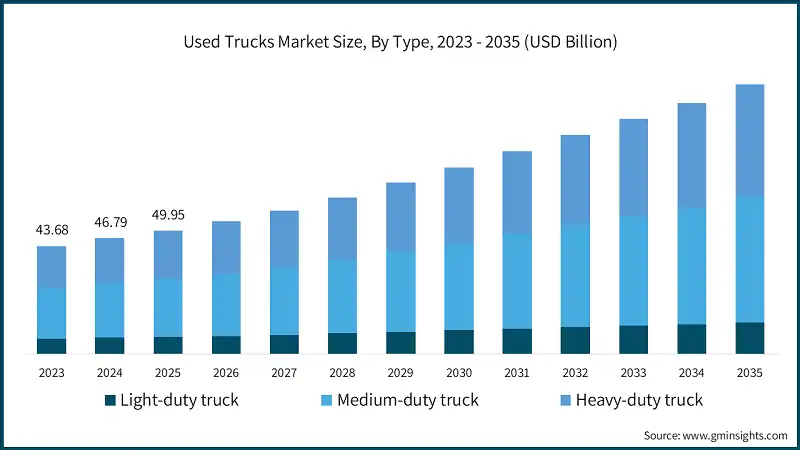
Based on type, the used trucks market is divided into light-duty trucks, medium-duty trucks, and heavy-duty trucks. The medium-duty trucks segment dominated the market, accounting for around 47.13% in 2025 and is expected to grow at a CAGR of 8.1% through 2035.
- The used trucks industry is largely dominated by the medium-duty segment (GVWR 10,001–26,000 lbs), driven by its versatility and cost-effectiveness. Medium-duty trucks are widely used in urban logistics, last-mile deliveries, construction, and municipal services, making them highly sought after in the secondary market. Fleet operators and small-to-medium businesses prefer these vehicles because they offer a balance of payload capacity, fuel efficiency, and lower acquisition costs compared to heavy-duty trucks.
- Additionally, the rise of e-commerce, infrastructure development, and expanding urban transportation networks is boosting demand for medium duty used trucks globally. Manufacturers and dealers are also supporting the market through certified pre-owned programs, telematics integration, and flexible financing, further enhancing market growth and buyer confidence.
- For example, in February 2025, VE Commercial Vehicles (VECV) recorded sales of 8,092 commercial vehicles, driven by strong Eicher truck demand in both domestic and export markets, indicating healthy new truck flows that will feed future used truck inventories globally.
- The heavy-duty truck segment is expected to witness a CAGR of over 9% during the forecast period, driven by growing demand for long-haul logistics, infrastructure projects, and industrial transportation. These trucks, typically with GVWR above 26,000 lbs, are crucial for transporting large volumes over long distances, making them essential assets for fleet operators. As companies look to optimize costs, many turn to the used heavy-duty truck market, where well-maintained vehicles provide reliable performance at lower capital investment than new trucks.
Learn more about the key segments shaping this market
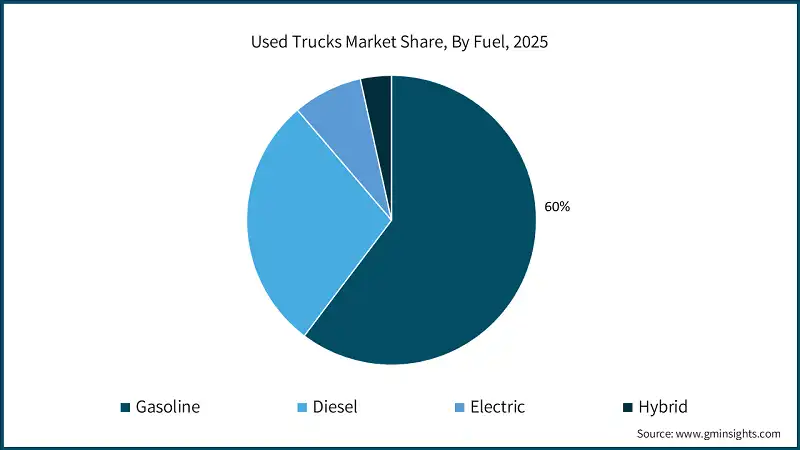
Based on fuel, the used trucks market is segmented into gasoline, diesel, electric, and hybrid. The gasoline segment dominates the market accounting for around 60% share in 2025, and the segment is expected to grow at a CAGR of over 8.3% from 2026 to 2035.
- The market is dominated by the gasoline segment due to its widespread availability, lower initial cost, and ease of maintenance compared to alternative fuel or diesel trucks. Gasoline trucks are popular among small-to-medium businesses, local delivery operators, and fleet owners who require reliable vehicles for short- to medium-distance operations. The broad service network for gasoline engines and abundant spare parts make these trucks a practical choice in emerging and developing markets alike.
- Additionally, gasoline trucks often have lower purchase prices than diesel equivalents, making them attractive in the pre-owned market. As a result, fleet operators seeking cost-effective solutions for urban logistics, last-mile delivery, and regional transport frequently opt for gasoline-powered used trucks, sustaining strong demand in this segment worldwide.
- For example, in May 2025, Volvo reported that its gas-powered truck sales increased by over 25 % globally, with more than 8,000 gas-powered units sold across Europe and other regions, outpacing its growing electric truck deliveries highlighting continued real-world demand for engine-powered trucks that will later enter the used truck market.
- The electric truck segment is expected to experience a faster growth of more than 10.1% over the forecast period, driven by rising environmental regulations, corporate sustainability initiatives, and growing adoption of clean energy solutions in logistics. Electric trucks offer lower operational costs, reduced emissions, and compliance with urban emission restrictions, making them increasingly attractive to fleet operators in developed and emerging markets. As OEMs expand production of electric trucks, a larger pool of EVs will gradually enter the secondary market, supporting rapid growth in used electric truck sales.
Based on application, the used truck market is divided into personal and commercial. The personal segment held the major market share of 64% in 2025.
- The personal segment is the largest market segment in the used trucks market because pickup trucks are widely preferred for private use, including family transport, recreational activities, and personal utility. Consumers often favor pre-owned pickups for their cost-effectiveness, reliability, and versatility, allowing them to own capable vehicles at lower prices compared to new models. Additionally, strong brand loyalty, popular models with long lifespans, and extensive service networks make used pickups an attractive option for personal buyers.
- Moreover, growing interest in outdoor lifestyles, adventure tourism, and urban-to-rural commuting contributes to consistent demand for personal pickup trucks. Flexible financing options, certified pre-owned programs, and online marketplaces further enhance accessibility and trust, reinforcing the personal segment as the dominant category in the used truck market.
- For example, in August 2025, Ford announced the launch of its Certified Pre-Owned F-150 Lightning program in the U.S., offering fully inspected and warranty-backed used electric pickups for personal buyers. This initiative highlights OEM focus on supporting the growing demand for reliable, cost-effective pre-owned pickups for personal use, including urban commuting, recreational activities, and family transport.
- The commercial segment is expected to grow with a CAGR of more than 8.8% due to increasing demand from logistics, construction, utility services, and regional transportation industries. Medium- and heavy-duty trucks are essential for last-mile delivery, long-haul freight, and industrial operations, making pre-owned vehicles a cost-effective choice for businesses seeking operational efficiency while managing capital expenditures. Rising fuel costs and high new truck prices also encourage companies to invest in used trucks rather than new units, fueling the secondary market.
Based on drive, the used trucks market is divided into two-wheel drive, and four-wheel drive. The two-wheel drive segment dominated the market.
- The two-wheel drive (2WD) segment dominates the market due to its lower purchase price, reduced maintenance costs, and higher fuel efficiency compared to four-wheel drive (4WD) trucks. 2WD trucks are widely used in urban, regional, and light-duty applications, making them a popular choice for small businesses, last-mile delivery, and personal utility purposes. Their simpler drivetrain and easier handling also make them more accessible to a broader range of buyers in the secondary market.
- Moreover, the availability of spare parts, extensive service networks, and long lifespan of 2WD trucks enhance their resale value and reliability. These factors, combined with cost-effectiveness and suitability for most road conditions, ensure that the two-wheel drive segment remains the dominant category in the used trucks market.
- For example, in September 2025, Toyota launched a Certified Pre-Owned Hilux 2WD program in Australia and Southeast Asia, offering inspected, warranty-backed used 2WD pickups for commercial and personal buyers. This initiative highlights OEM support for the growing demand for reliable, cost-effective 2WD trucks widely used in urban logistics, small business fleets, and regional transport.
- The four-wheel drive segment is expected to grow with a CAGR of more than 9% due to increasing demand from logistics, construction, utility services, and regional transportation industries. Medium- and heavy-duty trucks are essential for last-mile delivery, long-haul freight, and industrial operations, making pre-owned vehicles a cost-effective choice for businesses seeking operational efficiency while managing capital expenditures. Rising fuel costs and high new truck prices also encourage companies to invest in used trucks rather than new units, fueling the secondary market.
Looking for region specific data?
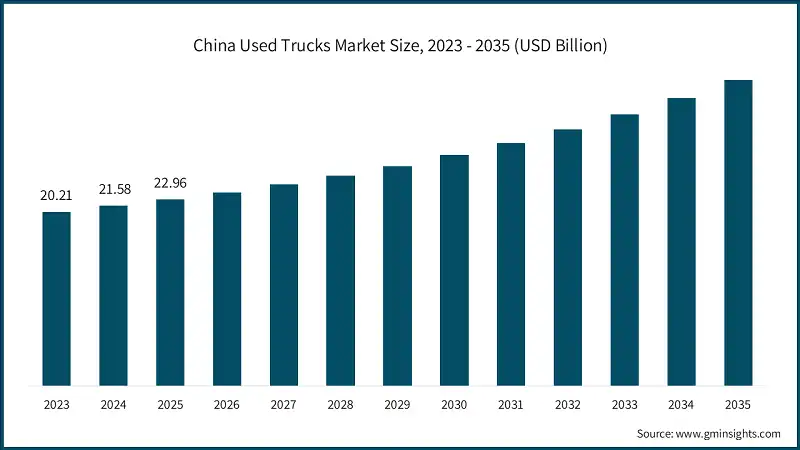
China dominated the used trucks market in Asia Pacific with around 65.5% share and generated USD 22.96 billion in revenue in 2025.
- China’s market is experiencing robust growth due to rapid expansion in e-commerce, logistics, and infrastructure development. The increasing need for last-mile delivery, regional transportation, and construction support has boosted demand for medium- and heavy-duty used trucks. Additionally, rising new truck prices have made cost-effective pre-owned options more attractive to small- and medium-sized fleet operators, further driving market activity.
- Government policies promoting fleet modernization and stricter emissions regulations are also accelerating turnover in the commercial vehicle sector, creating a steady supply of relatively new used trucks. OEM-certified pre-owned programs, along with digital sales platforms, have improved transparency and trust, making it easier for buyers to acquire reliable vehicles. These factors collectively contribute to China’s strong growth in the used trucks market.
- Government incentives for new energy vehicles, stricter emission regulations, and pilot programs for electric and alternative-fuel medium-duty trucks are encouraging fleet replacement. These factors collectively support the large-scale deployment of technologically advanced, fuel-efficient, and electric Used trucks across China.
- For instance, in July 2025, China’s Sinotruk launched its H2 light-duty truck and H3 medium-duty truck models in Kenya in partnership with CFAO Mobility, expanding product availability internationally and strengthening the pipeline of trucks that will eventually enter local and export used market.
- India is projected to grow at a significant CAGR in the used trucks market due to rapid expansion in e-commerce, logistics, and infrastructure projects across the country. Small and medium enterprises (SMEs), last-mile delivery operators, and construction companies increasingly prefer cost-effective pre-owned trucks to manage capital expenditure while meeting rising transportation demand. Medium-duty trucks dominate urban and regional transport, while heavy-duty trucks are in demand for long-haul and construction operations, creating a steady pipeline for used truck turnover.
The used trucks market in Germany is expected to experience significant and promising growth from 2026 to 2035.
- Europe accounts for over 12.59% of the market in 2025 and is expected to grow at a CAGR of around 10.9% due to strong demand from logistics, construction, and industrial transport sectors. The region has a mature commercial vehicle market, where fleet operators frequently replace older trucks to comply with strict EU emissions regulations and operational efficiency requirements.
- Germany is a strong used trucks market leader due to its mature logistics sector, high industrial output, and well-developed transportation infrastructure. The country’s stringent environmental and emission regulations, such as Euro VI standards, encourage fleet operators to regularly replace older trucks with newer or certified pre-owned models, creating a vibrant secondary market. Medium- and heavy-duty trucks dominate regional and long-haul transport, further reinforcing the demand for reliable used trucks.
- Moreover, Germany hosts major OEMs like Daimler, MAN, and Iveco, which offer certified pre-owned programs, telematics services, and flexible financing for used trucks. The combination of strong domestic demand, regulatory compliance, and manufacturer support positions Germany as a leading market for high-quality used trucks in Europe and globally.
- For instance, in December 2025, Mercedes-Benz Trucks began series production of the new eActros-400 electric trucks at its Wörth plant, broadening its product lineup in Germany with more electrified heavy-duty options poised to enter both primary and secondary markets. This supports the used truck market’s future growth as EV supply increases.
- The UK is emerging as a strong growth market for used trucks due to increasing demand from logistics, e-commerce, and construction sectors. Rising operational costs, including high fuel prices and new truck acquisition costs, are encouraging fleet operators to turn to cost-effective used trucks for last-mile delivery, regional transport, and industrial applications. Medium- and heavy-duty trucks dominate this market, creating a steady supply of reliable pre-owned vehicles for businesses seeking efficiency and affordability.
The used trucks market in US is expected to experience significant and promising growth from 2026-2035.
- North America accounts for over 11.98% of the market in 2025 and is expected to grow at a CAGR of around 9.8% between 2026 and 2035 owing to strong demand from logistics, construction, and long-haul transportation sectors. The region’s mature fleet market and high commercial vehicle turnover rates contribute to a substantial supply of medium- and heavy-duty used trucks.
- The US is the market leader in the used trucks segment due to its large and mature commercial vehicle fleet, high fleet replacement cycles, and well-established logistics and e-commerce sectors. Medium- and heavy-duty trucks dominate regional and long-haul operations, driving strong demand for reliable pre-owned vehicles. Fleet operators prefer used trucks to optimize costs, maintain operational efficiency, and manage high capital expenditures, making the US a dominant secondary market globally.
- Additionally, supportive infrastructure, extensive dealer networks, and OEM-backed certified pre-owned programs enhance transparency and vehicle reliability. Advanced financing options, telematics integration, and regulatory compliance further encourage the adoption of used trucks. Combined, these factors position the US as the largest and most dynamic market for medium- and heavy-duty used trucks worldwide.
- For instance, in August-2025, Samsara launched a Pre-Delivery Installation Program in partnership with Daimler Truck and Fontaine Modification to equip new trucks with telematics systems before delivery, reflecting growing integration of modern fleet tech in the U.S. market that enhances used truck value.
- Canada is becoming one of the fastest-growing markets in the used trucks sector due to rising demand from logistics, construction, and regional transportation industries. The need for cost-effective and reliable medium- and heavy-duty trucks drives fleet operators to turn to pre-owned vehicles as an affordable alternative to new trucks. Expanding e-commerce, infrastructure development, and natural resource transport further fuel the adoption of used trucks in urban, regional, and long-haul applications.
The used trucks market in Brazil is expected to experience significant and promising growth from 2026 to 2035.
- Latin America holds around 2.81% of the market in 2025 and is growing steadily at a CAGR of around 6.6% between 2026 and 2035 due to increasing demand from logistics, construction, mining, and agricultural sectors. Medium- and heavy-duty trucks are widely used for regional transportation, long-haul operations, and industrial activities, creating a strong secondary market.
- Brazil dominates the used trucks market in Latin America due to its large commercial vehicle fleet, extensive logistics network, and high demand in sectors such as construction, mining, agriculture, and regional transportation. Medium- and heavy-duty trucks are widely utilized for long-haul operations and industrial transport, creating a robust secondary market. Fleet operators increasingly rely on used trucks to manage costs while maintaining operational efficiency, making Brazil the leading market in the region.
- Additionally, government policies promoting infrastructure development and fleet modernization, combined with rising new truck prices, encourage turnover in the commercial vehicle sector. OEM-certified pre-owned programs, financing solutions, and digital platforms enhance trust and accessibility for buyers, further strengthening Brazil’s position as the dominant market in Latin America.
- The used trucks market in Mexico is experiencing high growth due to increasing demand from logistics, construction, and regional transportation sectors. Medium- and heavy-duty trucks are widely used for last-mile delivery, long-haul freight, and industrial operations, making pre-owned trucks a cost-effective solution for fleet operators. Rising new truck prices and limited financing options drive businesses to choose used vehicles, sustaining strong market activity across the country.
The used trucks market in UAE is expected to experience significant and promising growth from 2026-2035.
- MEA holds around 2.47% of the market in 2025 and is growing steadily at a CAGR of around 8.2% between 2026 and 2035 due to rising demand from construction, mining, and urban logistics sectors. Expanding industrialization, infrastructure projects, and increased freight movement are driving the need for medium-duty trucks capable of handling regional distribution and municipal services.
- The UAE dominates the MEA used trucks market due to its strategic position as a logistics and trade hub, well-developed infrastructure, and high demand from construction, transportation, and industrial sectors. Medium- and heavy-duty trucks are extensively used for regional and long-haul operations, making pre-owned vehicles a cost-effective solution for fleet operators. Rising new truck prices, coupled with rapid urbanization and expanding industrial activity, further drive the adoption of used trucks in the UAE.
- Additionally, government initiatives supporting infrastructure development, fleet modernization, and low-emission zones encourage frequent replacement of older trucks, expanding the availability of quality pre-owned vehicles. OEM-certified used truck programs, digital marketplaces, and financing solutions enhance transparency and reliability, positioning the UAE as the leading market for used trucks in the MEA region.
- Saudi Arabia is expected to grow at the fastest CAGR in the MEA used trucks market due to rapid infrastructure expansion, industrial development, and increasing demand for logistics and construction transport solutions. Medium- and heavy-duty trucks are widely used for long-haul freight, mining, and industrial operations, making pre-owned trucks a cost-effective alternative for fleet operators seeking to optimize capital expenditure. Rising new truck prices and expanding commercial activity further support the adoption of used trucks in the country.
Used trucks Market Share
- The top 7 companies in the used trucks industry are PACCAR, Schneider National, Ryder System, TATA Motors, Ritchie Bros, Volvo, and Daimler Trucks, contributed around 27.7% of the market in 2025.
- PACCAR leverages its DAF, Kenworth, and Peterbilt brands to operate certified pre-owned programs, focusing on inspected and warranty-backed used trucks. The company emphasizes dealer-supported resale, financing options, and telematics integration for performance monitoring. PACCAR also targets fleet operators with trade-in programs and value-added services, ensuring residual value retention and fostering loyalty in the secondary market.
- Schneider National optimizes its fleet renewal cycles to refresh assets and sells well-maintained retired trucks through auctions and dealer partnerships. They emphasize high-quality, low-mileage vehicles for resale, supported by fleet management data and maintenance history. Schneider also collaborates with logistics partners to ensure pre-owned trucks meet operational standards, enhancing confidence in the used truck market.
- Ryder operates a structured used truck resale program leveraging its rental and leasing fleet. It offers certified pre-owned vehicles with full maintenance and service history, along with financing support. The company targets both small fleet operators and individual buyers, using digital platforms and auction partnerships to maximize reach and streamline secondary-market sales.
- TATA Motors promotes its used truck segment through certified pre-owned programs and dealer-supported resale, focusing on medium- and heavy-duty trucks in India and other emerging markets. It provides warranty-backed vehicles, financing solutions, and service support to ensure reliability. Strategic partnerships with logistics and fleet operators allow TATA to maintain a steady pipeline of pre-owned trucks.
- Ritchie Bros operates one of the largest used truck marketplaces through live and online auctions. They focus on transparency, verified inspection reports, and a wide range of trucks to attract commercial buyers. Their digital platform and global reach allow seamless cross-border sales, enhancing liquidity and confidence in the secondary truck market.
- Volvo uses certified pre-owned programs, emphasizing inspected, low-mileage trucks with warranties and telematics support. The company collaborates with dealers to provide trade-in options, financing, and fleet consulting, targeting both commercial operators and personal buyers. Volvo’s strategy includes integrating electrified trucks and sustainable solutions to future-proof the secondary market.
- Daimler leverages its Mercedes-Benz, Freightliner, and Western Star brands for certified pre-owned truck programs, offering warranty-backed, inspected vehicles. The company provides financing, telematics, and dealer network support to fleet operators. Daimler also promotes trade-in programs and digital marketplaces to optimize residual values and facilitate reliable resale across regions.
Used Trucks Market Companies
Major players operating in the used trucks industry are:
- Daimler
- Enterprise Truck Rental
- PACCAR
- Penske Used Trucks
- Ritchie Bros. Auctioneers
- Ryder System
- Schneider National
- TATA Motors
- Volvo Trucks
- Werner Enterprises
- Used trucks players are increasingly adopting digital fleet management, telematics, and IoT solutions to enhance uptime, safety, and operational efficiency. AI-powered predictive maintenance, GPS tracking, and real-time diagnostics enable monitoring of vehicle performance, driver behavior, and fuel optimization, reducing downtime and providing actionable insights for cost management and regulatory compliance.
- Strategic partnerships between OEMs, telematics providers, and logistics companies are driving innovation in the used trucks ecosystem. These collaborations support connected platforms, predictive analytics, and autonomous-capable systems, enabling seamless data exchange, improved vehicle utilization, lower operational costs, and compliance with emission standards, accelerating adoption of a connected, intelligent, and highly efficient used truck market.
Used Trucks Market Report Attributes
| Key Takeaway | Details |
|---|---|
| Market Size & Growth | |
| Base Year | 2025 |
| Market Size in 2025 | USD 49.95 Billion |
| Market Size in 2026 | USD 53.6 Billion |
| Forecast Period 2026 - 2035 CAGR | 8.2% |
| Market Size in 2035 | USD 109.2 Billion |
| Key Market Trends | |
| Drivers | Impact |
| Increasing demand for electric & hybrid heavy-duty trucks across the globe | The rising adoption of electric and hybrid heavy-duty trucks is reshaping the used trucks market by creating future availability of low-emission pre-owned vehicles. As fleets upgrade to cleaner technologies, their retired vehicles enter the secondary market, expanding supply while supporting sustainability and emission-compliance goals worldwide. |
| Growing freight transportation activities across North America | Expanding e-commerce, manufacturing output, and cross-border trade are driving freight transportation growth in North America. This increases fleet utilization and accelerates replacement cycles, generating steady demand for cost-efficient used trucks among logistics operators, regional carriers, and last-mile delivery companies. |
| The rising number of small and medium-sized businesses | Expanding e-commerce, manufacturing output, and cross-border trade are driving freight transportation growth in North America. This increases fleet utilization and accelerates replacement cycles, generating steady demand for cost-efficient used trucks among logistics operators, regional carriers, and last-mile delivery companies. |
| Rising investments in infrastructure development activities in Asia Pacific | Large-scale investments in roads, ports, industrial zones, and urban infrastructure across Asia Pacific are increasing demand for medium- and heavy-duty trucks. Contractors and logistics providers prefer used trucks to control costs, supporting strong growth in the regional secondary commercial vehicle market. |
| Pitfalls & Challenges | Impact |
| Economic downturns and low economic growth | Economic slowdowns reduce freight volumes, infrastructure spending, and business expansion, directly impacting used truck demand. Uncertain economic conditions delay fleet replacement decisions, reduce financing availability, and weaken resale values, creating volatility and slower growth across the used trucks market. |
| Regulatory Compliance and Government Regulations | Stringent emission standards, safety regulations, and vehicle age restrictions limit the circulation of older used trucks. Compliance costs and regulatory uncertainty increase operational risks for buyers and sellers, particularly in regions implementing low-emission zones and stricter commercial vehicle norms. |
| Opportunities: | Impact |
| Expansion of certified pre-owned (CPO) and OEM-backed used truck programs | OEM-backed CPO programs enhance buyer confidence through inspections, warranties, and service support. These programs improve residual values, increase transparency, and attract fleet operators and SMEs, driving structured growth and professionalism in the used trucks ecosystem. |
| Growing demand for cost-effective fleet solutions among SMEs and owner-operators | SMEs and independent operators increasingly favor used trucks to reduce upfront investment while maintaining operational capability. This demand supports sustained market growth, especially in logistics, construction, and regional transport segments where affordability and reliability are critical. |
| Rising cross-border trade of used trucks from developed to emerging markets | Used trucks are increasingly exported from developed regions to emerging economies due to cost advantages and strong demand. This cross-border trade improves asset utilization, balances supply-demand gaps and supports fleet modernization in price-sensitive markets. |
| Increasing adoption of digital remarketing, online auctions, and data-driven pricing | Digital platforms, online auctions, and analytics-based pricing tools are transforming used truck sales. These technologies improve transparency, expand buyer reach, optimize pricing accuracy, and accelerate transaction speed, supporting higher liquidity and efficiency in the used trucks market. |
| Market Leaders (2025) | |
| Market Leaders |
8.2 % market share |
| Top Players |
|
| Competitive Edge |
|
| Regional Insights | |
| Largest Market | Asia Pacific |
| Fastest growing market | Europe |
| Emerging countries | India, Philippines, Indonesia, Brazil, Saudi Arabia, UAE |
| Future outlook |
|
What are the growth opportunities in this market?
Used Trucks Industry News
- In December 2025, Volvo Trucks expanded its Certified Pre-Owned program to include used electric trucks, reflecting growing confidence in electric commercial vehicles. The initiative introduces EV-specific inspections, battery health guarantees, and extended powertrain warranties, addressing buyer concerns around degradation and supporting wider adoption of used electric trucks.
- In November 2025, Daimler Truck launched an AI-powered used truck valuation platform, enabling real-time pricing based on vehicle condition, telematics data, and market demand. The solution improves transparency and pricing accuracy, helping dealers and fleet operators optimize resale decisions and maximize residual value recovery.
- In October 2025, PACCAR Financial Services introduced specialized financing for used zero-emission trucks, offering longer loan tenures, reduced interest rates, and buyback guarantees. This strategy mitigates residual value risks and encourages fleet operators to adopt used electric and hydrogen trucks across key global markets.
- In September 2025, Penske Used Trucks reported record annual sales exceeding 40,000 units, driven by strong demand for late-model commercial vehicles. Growth was supported by digital sales platforms, expanded dealer networks, and transparent maintenance histories, reinforcing Penske’s leadership in structured used truck remarketing.
- In August 2025, Ritchie Bros. Auctioneers completed the acquisition of a leading European truck auction platform, strengthening its presence in Europe. The move enhances cross-border auction capabilities, increases listing volumes, and improves pricing efficiency within the used trucks marketplace.
- In July 2025, Ryder System launched a blockchain-based vehicle history platform, providing tamper-proof records for maintenance, ownership, and mileage. This initiative improves buyer trust, reduces fraud risk, and accelerates transaction timelines in the used truck resale ecosystem.
The used trucks market research report includes in-depth coverage of the industry with estimates & forecasts in terms of revenue ($Bn), and shipment (Units) from 2022 to 2035, for the following segments:
Market, By Size
- Compact
- Mid-size
- Full-size
Market, By Type
- Light-duty truck
- Medium-duty truck
- Heavy-duty truck
Market, By Age
- Up to 3 years
- 5-10 years
- Above 10 years
Market, By Fuel
- Gasoline
- Diesel
- Electric
- Hybrid
Market, By Application
- Personal
- Commercial
- Construction and heavy equipment
- Agriculture and farming
- Landscaping and outdoor services
- Utility and municipal use
Market, By Drive
- Two-wheel drive
- Four-wheel drive
Market, By Sales Channel
- Franchise Dealers
- Independent Dealers
- Peer-to-peer
The above information is provided for the following regions and countries:
- North America
- US
- Canada
- Europe
- Germany
- UK
- France
- Italy
- Spain
- Russia
- Nordics
- Asia Pacific
- China
- India
- Japan
- Australia
- South Korea
- Philippines
- Indonesia
- Latin America
- Brazil
- Mexico
- Argentina
- MEA
- South Africa
- Saudi Arabia
- UAE
Frequently Asked Question(FAQ) :
What was the market size of the used trucks in 2025?
The market size was estimated at USD 49.95 billion in 2025, growing at a CAGR of 8.2% till 2035, driven by increasing demand for cost-efficient fleet operations and secondary market adoption.
What is the projected value of the used trucks market by 2035?
The market is expected to reach USD 109.2 billion by 2035, fueled by rising vehicle prices, extended OEM delivery timelines, and capital preservation measures.
What is the expected size of the used trucks industry in 2026?
The market size is projected to reach USD 53.6 billion in 2026.
What percentage of the market did medium-duty trucks account for in 2025?
Medium-duty trucks accounted for approximately 47.13% of the market in 2025 and is expected to grow at a CAGR of 8.1% through 2035.
What was the market share of the gasoline segment in 2025?
The gasoline segment dominated the market with a 60% share in 2025 and is set to expand at a CAGR of over 8.3% up to 2035.
What was the market share of the personal segment in 2025?
The personal segment held a major market share of 64% in 2025, led by the popularity of pickup trucks for private use, including family transport, recreational activities, and personal utility.
Which region dominated the used trucks sector in Asia Pacific in 2025?
China dominated the Asia Pacific market with a 65.5% share, generating USD 22.96 billion in revenue in 2025. The market is supported by growth in e-commerce, logistics, and infrastructure development.
What are the key trends in the used trucks market?
Shift to digital sales platforms, higher demand for light and medium-duty trucks, growth of electric and hybrid used trucks, and rising popularity of certified pre-owned programs with telematics tracking.
Who are the major players in the used trucks industry?
Major players include Daimler, Enterprise Truck Rental, PACCAR, Penske Used Trucks, Ritchie Bros. Auctioneers, Ryder System, Schneider National, TATA Motors, Volvo Trucks, and Werner Enterprises.
Used Trucks Market Scope
Related Reports