Summary
Table of Content

USB Car Charger Market
Get a free sample of this report
Form submitted successfully!
Error submitting form. Please try again.
Thank you!
Your inquiry has been received. Our team will reach out to you with the required details via email. To ensure that you don't miss their response, kindly remember to check your spam folder as well!
Request Sectional Data
Thank you!
Your inquiry has been received. Our team will reach out to you with the required details via email. To ensure that you don't miss their response, kindly remember to check your spam folder as well!
Form submitted successfully!
Error submitting form. Please try again.
USB Car Chargers Market Size
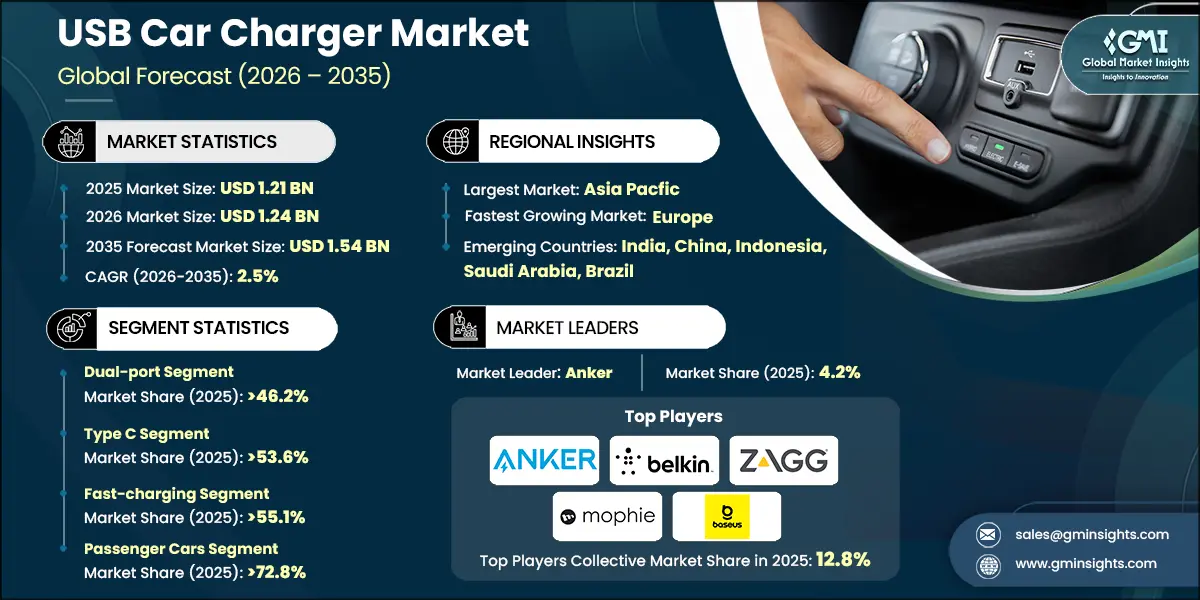
The global USB car charger market was estimated at USD 1.21 billion in 2025. The market is expected to grow from USD 1.24 billion in 2026 to USD 1.54 billion in 2035, at a CAGR of 2.5% according to latest report published by Global Market Insights Inc.
USB Car Charger Market Key Takeaways
Market Size & Growth
- 2025 Market Size: USD 1.21 Billion
- 2026 Market Size: USD 1.24 Billion
- 2035 Forecast Market Size: USD 1.54 Billion
- CAGR (2026–2035): 2.5%
Regional Dominance
- Largest Market: Asia Pacific
- Fastest Growing Region: Europe
Key Market Drivers
- Rising Vehicle Electrification and Connectivity.
- Increasing Smartphone and Device Usage.
- Advancements in Fast and Smart Charging Technologies.
- Growth of Aftermarket and E-Commerce Channels.
Challenges
- Price Sensitivity and Product Commoditization.
- Compatibility and Standardization Issues.
Opportunity
- Vehicle Growth in Emerging Markets.
- Expansion of Commercial and Fleet Vehicles.
- Wireless Charging Adoption.
- Integration with Electric and Autonomous Vehicles.
Key Players
- Market Leader: Anker led with over 4.2% market share in 2025.
- Leading Players: Top 5 players in this market include Anker, Belkin, ZAGG, Mophie, Baseus, which collectively held a market share of 12.8% in 2025.
Get Market Insights & Growth Opportunities
USB-C is rapidly replacing traditional USB-A ports in car chargers. Its ability to deliver higher power, faster data transfer, and universal compatibility across smartphones, tablets, and laptops makes it the preferred standard for both consumers and manufacturers.
The increasing reliance on smartphones, the growth of electric vehicles, and the rising adoption of in-car connectivity are fueling demand for efficient charging solutions. Consumers seek fast-charging, multi-port, and wireless technology to accommodate multiple devices in their vehicles. Additionally, the expansion of ride-sharing and fleet services, where multiple users require simultaneous device charging, further boosts the market.
For instance, in January 2026, Clean energy company BLUETTI introduced Charger 2, a new smart charging system aimed at people who live and travel on the road. The launch targets overlanders, RV owners, 4WD drivers, and off-grid travelers who depend on reliable power while moving between camps, highways, and remote locations.
The growing number of global automobile manufacturers, in association with the increasing use of commercial vehicles in logistics, taxi services and public transport, is thereby propelling the market for USB car chargers. Commercial vehicles need multiple charging ports for their usage purposes.
Also, the rising preference for faster and more efficient charging technology is leading to the increasing adoption of fast charging USB car chargers. Owing to this faster charging technology, such as the USB-C Power Delivery and Quick Charge technology, is helping to charge devices faster.
The availability of relatively inexpensive USB car chargers has become a market-expanding factor with the help of e-commerce websites and aftermarket sellers. Ease of installation, product diversity and reasonable pricing have led to wider consumer acceptance, especially in the developing world.
Furthermore, the growing demand for multi-port chargers is driven by consumers' need to charge multiple devices simultaneously in vehicles. With more passengers relying on smartphones, tablets, and other electronic devices during travel, multi-port chargers provide an efficient solution. Additionally, the rise of connected cars and smart technologies, which often require multiple devices to stay powered, further boosts this demand.
To get key market trends
USB Car Chargers Market Trends
Shift toward fast charging as consumers increasingly prefer USB car chargers that support fast-changing technologies such as USB-C Power Delivery and Quick Charge. This trend is driven by larger smartphone batteries, increased device usage during travel, and the need for shorter charging times in daily commuting.
The adoption of USB Type-C connectors is rapidly increasing in vehicles, driven by their faster data transfer speeds and higher power output. This growth is particularly evident in newer charger models, where Type-C ports are becoming the standard for charging devices like smartphones, laptops, and tablets. As more electronic devices adopt Type-C, consumer demand for compatible chargers in vehicles grows. Hence, the market players are focusing on collaboration.
For instance, in January 2026, Japanese automaker Honda and battery materials manufacturer Princeton NuEnergy have signed a memorandum of understanding (MOU) to collaborate on the development of lithium-ion battery recycling technologies. The strategic partnership will focus on collaborative validation projects and the potential for future commercial-scale applications that align Honda’s global electrification strategy and Princeton NuEnergy’s goal to expand cost-efficient production of battery-grade cathode active materials through a closed-loop platform.
Rising competition from low-cost local manufacturers poses a significant challenge, as these players often offer cheaper alternatives with fewer features, which can drive prices down and reduce profitability for established brands. Additionally, the shift to integrated charging solutions in newer vehicles, where manufacturers embed charging ports directly into vehicle systems, could reduce the need for aftermarket USB chargers. This trend could limit growth opportunities for standalone charger producers, as consumers may prefer built-in solutions, making it harder for external suppliers to maintain market share.
Automotive manufacturers are increasingly offering USB charging ports as standard or optional features in new vehicles. OEM-integrated chargers enhance user experience, reduce reliance on aftermarket products, and support the growing demand for connected and smart in-vehicle systems.
For instance, in July 2024, Anker introduced its 167.5W 3-Port Charger, priced at USD 39.99. This compact charger, about the size of a key-fob, comes with two USB-C ports (100W and 45W) and one USB-A port (22.5W), enabling users to charge multiple devices at once, including laptops and smartphones.
USB Car Chargers Market Analysis
Learn more about the key segments shaping this market
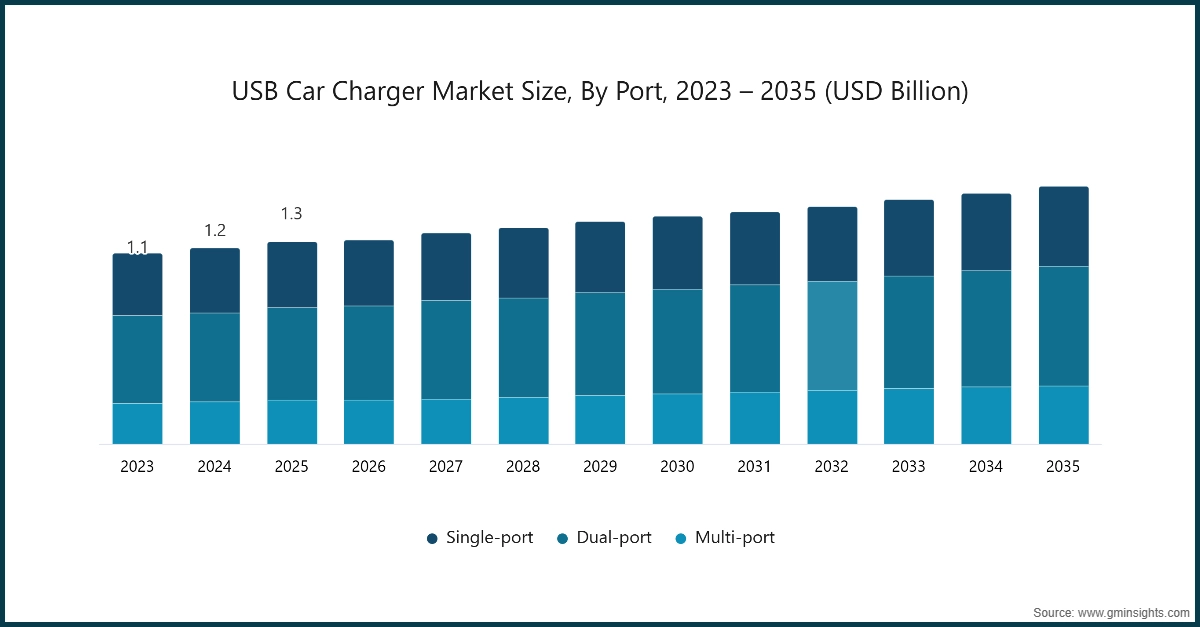
Based on port, the market is divided into single-port, dual-port and multi-port. In 2025, the dual-port segment accounted for over 46.2% of the market share and is expected to reach USD 717.8 million by 2035.
- Dual-port USB car chargers are becoming increasingly popular due to their ability to charge multiple devices simultaneously. This feature addresses consumer demand for convenience and efficiency, particularly in passenger and commercial vehicles where users often require simultaneous charging of smartphones, tablets, and other mobile devices. The integration of fast-charging technology further enhances the utility of dual-port chargers, making them a preferred choice for modern drivers.
- The dual-port USB car charger growth is further driven by the increasing number of connected devices in vehicles, from smartphones to wearables. As consumers prioritize charging efficiency, dual-port chargers that support fast-charging standards like USB Power Delivery or Qualcomm Quick Charge are gaining traction. This demand is especially noticeable in family cars and ride-sharing services, where multiple users need to charge simultaneously.
- Single-port USB car chargers are experiencing moderate growth, mainly driven by budget-conscious users and traditional cars. Single-port USB charging is mainly common in entry-level cars. However, the growth rate for single-port charging is gradually reducing with most people preferring the option to charge multiple devices at the same time.
- The multi-port USB car chargers category is one of the fastest-growing segments in the market, growing due to the increasing need for simultaneous charging of multiple devices. The growth in the market is driven by family cars, commercial vehicles, and the ride-sharing industry. Improved power management, fast charging, and multi-device compatibility are some factors that boost growth in the market.
- For instance, in October 2025, Anker officially launched its Nano 75W Car Charger, priced at USD 29.99. This innovative charger is designed to offer enhanced convenience while keeping your vehicle’s interior neat and organized. It delivers a total output of 75W, featuring a built-in retractable USB-C cable with 45W charging capability, along with an additional 30W USB-C port for charging multiple devices at the same time.
Based on connectors, the market is divided into USB 2.0, USB 3.0 and Type C. In 2025, the Type C segment accounted for over 53.6% of the market share and is expected to exceed USD 649.4 million by 2035.
- USB 2.0 connectors are experiencing slow but stable growth, supported mainly by legacy vehicles and low-cost charger models. While adoption is declining in premium segments, USB 2.0 remains relevant in emerging markets where affordability is prioritized over fast charging and high-power output.
- USB 3.0 connectors show moderate growth as they provide improved power delivery compared to USB 2.0. They are commonly used in mid-range chargers and vehicles transitioning toward newer standards. However, their growth pace is gradually constrained by the rapid adoption of USB Type-C connectors.
- Type-C connectors account for the fastest-growing connectors, due to universal compatibility, enhanced power, and fast charging capabilities. The growing usage in smartphones, electric cars, as well as OEM-based car chargers, is driving the growth of these connectors, which will also be the major connector type during the forecast period.
- For instance, in November 2024, Mophie introduced its new Qi2 Car Charger, designed to improve charging experience for Apple device users and other Qi-compatible gadgets. Supporting the latest Qi2 standard, it ensures optimal charging efficiency for compatible devices. With the ability to deliver up to 15W of power, it provides fast charging for smartphones. The charger is designed to fit most car cup holders, making it a versatile option for a wide range of vehicles.
Based on technology, the market is categorized into standard charging, fast charging and wireless charging. In 2025, the fast-charging segment held a market share of over 55.1% and was valued at around USD 669.2 million.
- Standard charging solutions steadily progress as established, popular alternatives. These chargers remain dominant in basic cars and low-cost aftermarket chargers. Although the rate of adoption is slower compared to advanced solutions, standard charging still has significant market presence based on its reliability and cross-device support.
- Fast Charging is one of the major drivers in the USB car charger industry, aided by the demand for shorter charging time and higher power output. There is an accelerated adoption of USB-C Power Delivery or Quick Charging in the automotive industry, specifically for passenger cars, EVs, or commercial vehicles.
- Wireless charging is seeing rapid growth, particularly in higher-end and medium cars. The ease of wireless charging and its ability to add visual appeal to the car’s interior are the driving factors for increased adoption in the market. Although the penetration rate of wireless charging solutions in the market is lower compared to wired solutions, convenience and efficiency in car charging are expected to push the growth of wireless charging solutions in the future.
Learn more about the key segments shaping this market
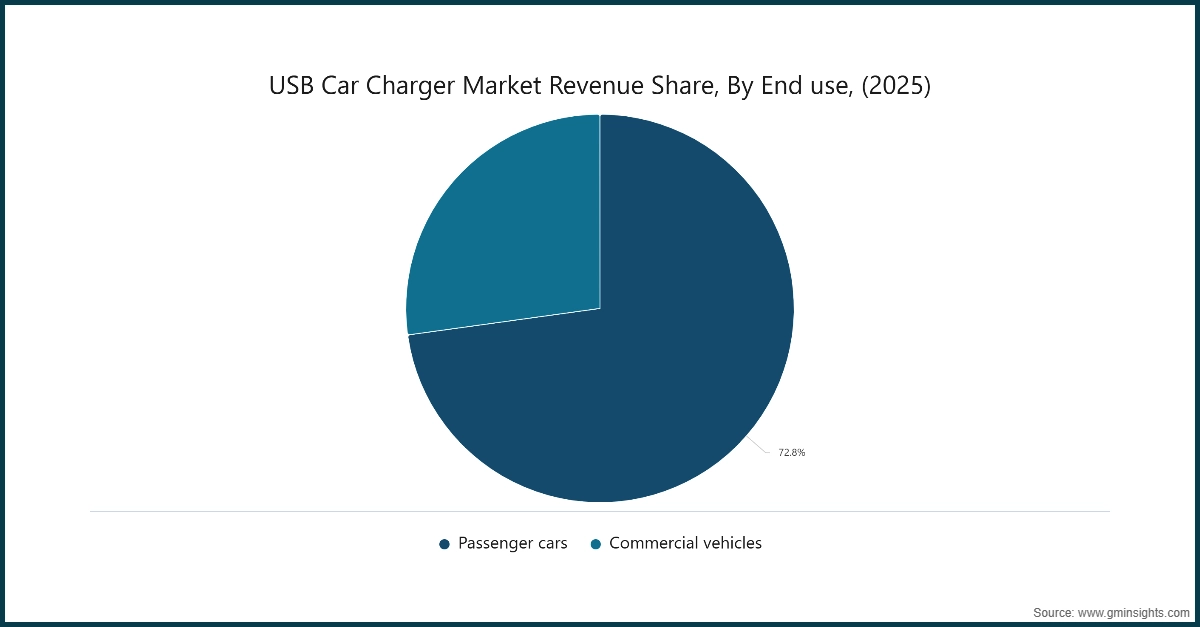
Based on end use, the market is divided into passenger cars and commercial vehicles. In 2025, the passenger cars segment held a market share of over 72.8% and was valued at around USD 883.8 million.
- Passenger cars dominate the USB car charger market, with steady growth driven by rising vehicle ownership and increasing use of personal electronic devices. Demand is supported by family travel, infotainment usage, and OEM integration of advanced charging solutions such as fast and wireless chargers.
- In passenger cars, the growing reliance on mobile devices and in-car technology is driving demand for efficient USB car chargers. Consumers prefer fast-charging, multi-port solutions to support multiple devices simultaneously. The rise of electric vehicles is also pushing for advanced charging solutions like USB-C and wireless charging. Convenience and integration with vehicle infotainment systems further fuel this demand.
- As consumer expectations for connectivity rise, passenger vehicles are increasingly equipped with advanced infotainment systems that integrate with smartphones and other devices. This drives the need for versatile USB car chargers that offer fast charging and multiple ports. Furthermore, the adoption of electric vehicles accelerates the demand for sustainable, high-performance charging solutions, boosting interest in wireless and USB-C technology.
- Commercial vehicles are witnessing strong growth as fleets increasingly rely on smartphones, tablets, GPS systems, and communication devices. Logistics, ride-hailing, and delivery services are key contributors. Demand for durable, multi-port, and fast-charging USB car chargers is particularly high in this segment.
Looking for region specific data?
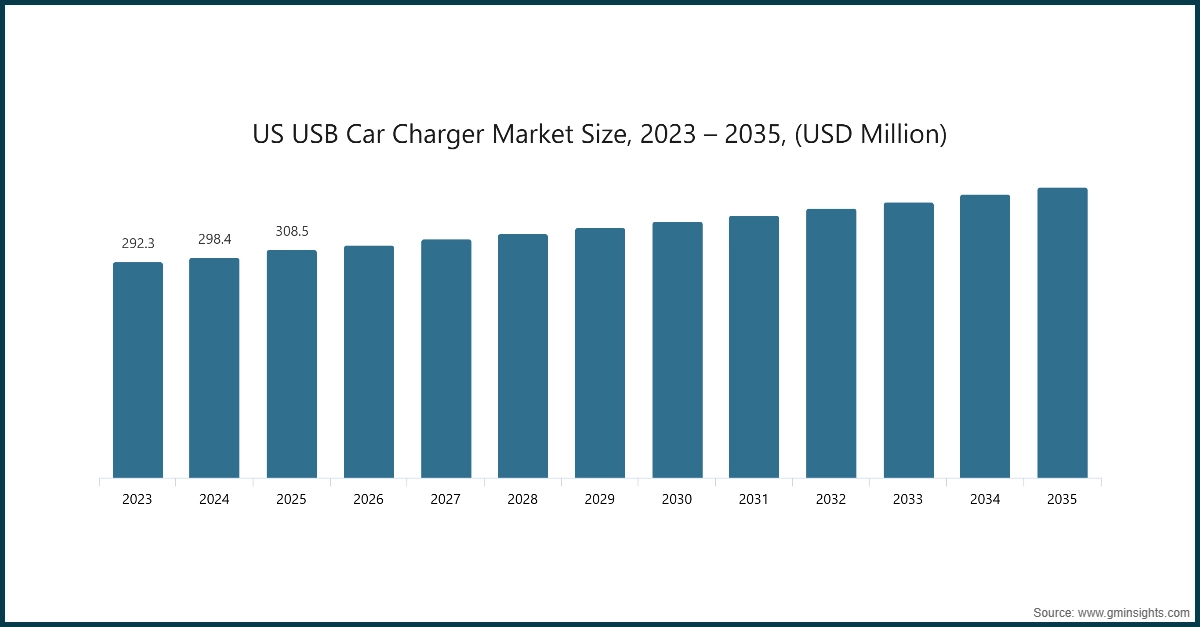
The USB car charger market in the US was valued at USD 308.5 million in 2025 and is expected to experience significant and promising growth from 2026 to 2035.
- This market is seeing a steady rise in the US owing to an increasing number of people using smartphones, tablets, GPS devices and wearable electronics that have to be constantly charged while traveling. Both private and commercial cars are increasingly using USB charging solutions for connected lifestyles as well as for professional mobility.
- The focus of the automobile industry on the safety of automobiles, convenience of the driver, and standardization of infotainment has also played an indirect role in the integration of USB charging ports into automobiles.
- Car manufacturers are integrating USB-C ports as well as fast-charging ports into their vehicles to cater to consumers’ requirements for fast charging capabilities compatible with contemporary electronics.
- Technological innovation remains a contributing factor in market growth, as firms bring out smart chargers which incorporate power management, over-voltage protection, as well as support for charging multiple devices at once.
- Increased use of electric vehicles (EVs) and connected cars is further accelerating the demand for sophisticated USB car chargers with seamless integration capabilities with digital dashboards.
North America USB car chargers market exceeded USD 351.3 million in 2025 and is anticipated to grow at a CAGR of 12% between 2026 and 2035.
- Factors that drive the growth of the North American aftermarket industry include high vehicle penetration, aftermarket demand, and rising expenditures by North American consumers on vehicle accessories.
- The logistics, ride-sharing, and delivery segments of the commercial vehicle market are also adopting USB car chargers in order to facilitate communication devices, GPS solutions, and mobile office solutions for drivers.
- The shift towards USB type-C ports as well as fast charging is gaining impetus due to a shorter charging time.OEM integration of USB charging ports is increasingly making new cars less reliant on traditional charging solutions while offering easier user access.
- Technological developments in smart charging, such as intelligent distribution of power and security solutions, are adding value for the product in the region.
Europe USB car chargers market accounted for USD 275.9 million in 2025 and is anticipated to show growth of 9% CAGR over the forecast period from 2026 to 2035.
- The driving force in the market is the promotion of standardization by the European Union regarding the use of the USB Type-C port, which accelerates the adoption of compatible charging solutions in both vehicles and other devices.
- Rising penetration of premium and mid-segment vehicles with advanced infotainment systems has driven demand for multi-port and fast USB car chargers.
- A major emphasis on sustainable solutions and energy efficiency in the European market is stimulating the development of chargers that are optimized for power consumption as well as intelligent charging functionality.
- Auto manufacturers are increasingly incorporating wireless charging pads into their vehicles to increase consumer convenience. Moreover, the rising use of electric and hybrid cars reinforces the demand for innovative charging options within cars.
Germany dominates the Europe USB car chargers market, showcasing strong growth potential, and held a revenue share of 33% in 2025.
- Highly developed automotive production infrastructure, as well as the presence of foreign OEMs focused on digitalized vehicles, helps the German government. As a hub for transnational travel and logistics, there is a great demand for a standardized car charger that is compatible with a variety of devices.
- The automobile and parts industry in Germany leads the world in the development of technologies for USB-C, fast charging, and wireless charging. Car industry innovation that advocates sustainability continues to promote the use of energy-efficient charging solutions that meet the environmental vision of the German government.
- Vehicle innovation in Germany with a focus on sustainability encourages the application of energy-efficient USB chargers with smart power management. These solutions support environmentally responsible mobility and advanced automotive engineering, important values for the country.
Asia Pacific USB car chargers market exhibiting remarkable growth with a CAGR of 7.8% during the forecast period of 2026 to 2035.
- Factors such as rapid urbanization, increased disposable income, and the growing number of vehicles are driving the market in the Asia-Pacific region, including China, India, Japan, and the ASEAN nations.
- Ride-sharing services, delivery cars, and commutes have led to an expanded need for in-car charging systems. The governments and car manufacturers are encouraging smart mobility solutions and connected car technologies, thereby encouraging the use of USB chargers.
- Adoption of technology in the region is accelerating with increased adoption of USB Type-C, fast charging, and wireless solutions. Many new vehicle platforms are being designed to support advanced charging technologies from launch.
- The region witnesses high volume production of vehicles. This promotes a large-scale integration of USB charging ports by OEMs in low-end and mid-segment vehicles.
China to experience substantial growth in the Asia Pacific USB car chargers market in 2025. The market in China is expected to reach USD 348 million by 2035.
- The rapid expansion of electric vehicles, ride-hailing fleets, and long-distance travel has increased demand for efficient car charging solutions. USB chargers are now considered a standard feature in both personal and shared mobility vehicles.
- Also, the Chinese are leading in adopting AI, cloud connectivity, and smart electronics that, in turn, are allowing for advanced USB chargers with adaptive power output and safety monitoring. Those technologies enhance efficiency in charging and are in tune with the country's initiative of smart mobility.
- Strong growth in e-commerce and aftermarket automotive accessories is further supporting USB car charger sales in China. Online platforms offer a wide range of technologically advanced and affordable chargers, enabling quick adoption across private vehicles and commercial fleets.
Latin America USB car chargers market was valued at USD 97.2 million in 2025 and is expected to experience substantial growth during the forecast period from 2026 to 2035.
- Brazil, Mexico, and Argentina are leading contributors, supported by growing urbanization and increased demand for affordable automotive accessories. USB car chargers are gaining popularity as cost-effective upgrades for older vehicle fleets.
- Freight and commercial vehicle operators are increasingly adopting USB chargers to support navigation devices and driver connectivity. Expansion of urban mobility and public transportation systems further supports demand for onboard charging solutions.
- The growing penetration of ride-hailing and shared mobility services in major Latin American cities is increasing demand for reliable in-vehicle charging solutions. Drivers rely heavily on mobile devices for navigation and communication, making USB car chargers a critical accessory.
- Rising smartphone usage and increasing adoption of digital payment and navigation apps are also driving demand for USB car chargers. As connectivity becomes essential for drivers and passengers, USB chargers are increasingly viewed as a standard vehicle feature.
MEA USB car chargers market was valued at USD 57.9 million in 2025 and is expected to experience substantial growth during the forecast period from 2026 to 2035.
- Middle Eastern countries such as the UAE and Saudi Arabia are witnessing increased adoption of premium vehicles, supporting demand for fast and wireless USB charging solutions. Consumer preference for advanced in-car features is accelerating market growth.
- Growth in tourism and long-distance travel across Middle Eastern countries is increasing the need for dependable in-car charging solutions. USB car chargers are becoming essential accessories for rental vehicles, taxis, and private cars supporting multiple devices.
- In Africa, growth is supported by gradual expansion of vehicle fleets and increasing affordability of automotive accessories. Government-backed transportation development initiatives are improving vehicle penetration, thereby increasing demand for USB car chargers.
- Also, improving road infrastructure and gradual expansion of commercial vehicle fleets are supporting USB car charger adoption. Increasing reliance on mobile connectivity for navigation, logistics, and communication is driving steady demand for affordable and durable charging solutions.
USB Car Chargers Market Share
The top 7 companies in the USB car chargers’ industry are Anker, Aukey, Belkin, ZAGG, Ugreen, Mophie, Baseus contributed around 14% of the market in 2025.
- Anker Innovations: Anker is a global leader in the USB car charger market, known for its advanced fast-charging technologies, including PowerIQ and USB-C Power Delivery. The company’s strong R&D focus, premium build quality, and broad distribution network enable reliable, high-performance charging solutions across passenger and commercial vehicles worldwide.
- Aukey: Aukey offers a wide range of cost-effective USB car chargers featuring intelligent charging and advanced circuit protection. The company leverages strong manufacturing capabilities and online sales channels to deliver competitively priced fast-charging solutions, particularly appealing to price-sensitive consumers and emerging automotive markets.
- Belkin International: Belkin differentiates itself through premium design, certified charging standards, and strong compatibility across major smartphone ecosystems. Its USB car chargers emphasize reliability, durability, and safety, supported by established retail partnerships and strong brand recognition in North America and Europe.
- ZAGG: ZAGG, through its mophie brand, focuses on premium USB car chargers and wireless charging solutions designed for high-end vehicles. Its competitive edge lies in sleek design, certified fast-charging performance, and strong alignment with premium smartphone ecosystems, especially Apple devices.
- Mophie: Mophie, a subsidiary of ZAGG, is known for premium charging accessories, including wireless and fast USB car chargers. The company emphasizes certified charging, elegant design, and seamless integration with modern smartphones, positioning itself strongly within premium and lifestyle-oriented vehicle segments.
- Baseus: Baseus leverages innovative design, advanced fast-charging technology, and cost efficiency to compete globally in the USB car charger market. Its products often feature smart power management, digital displays, and multi-port configurations, appealing to tech-savvy consumers and fast-growing emerging markets.
USB Car Chargers Market Companies
Major players operating in the USB car charger market are:
Anker
- RAVPower
- Aukey
- Belkin
- ZAGG
- Scosche Industries
- Ugreen
- Mophie
- Baseus
- Anker, Belkin, and Mophie collectively held a substantial market share of 8% in the USB car charger market in 2025. Anker, Belkin, and Mophie lead the market with strong brand recognition in the accessory space. Anker focuses on performance, offering products with fast-charging capabilities, while Belkin excels in integrating technology like USB Power Delivery. Mophie distinguishes itself with wireless charging solutions, catering to a tech-savvy, convenience-driven consumer base.
- Anker, Belkin, and Mophie dominate the sector with innovative product offerings. Anker leads with affordable, high-quality chargers, while Belkin offers premium, sleek designs with fast charging. Mophie, known for wireless solutions, caters to users seeking seamless integration into their connected lifestyles. Each brand's focus on user experience fuels their competitive edge.
USB Car Charger Market Report Attributes
| Key Takeaway | Details |
|---|---|
| Market Size & Growth | |
| Base Year | 2025 |
| Market Size in 2025 | USD 1.21 Billion |
| Market Size in 2026 | USD 1.24 Billion |
| Forecast Period 2026-2035 CAGR | 2.5% |
| Market Size in 2035 | USD 1.54 Billion |
| Key Market Trends | |
| Drivers | Impact |
| Rising Vehicle Electrification and Connectivity | Growing adoption of connected vehicles and electric cars is increasing demand for reliable in-vehicle charging solutions to support smartphones, infotainment systems, and connected devices. |
| Increasing Smartphone and Device Usage | Higher dependency on mobile devices for navigation, communication, and entertainment is driving widespread adoption of USB car chargers across passenger and commercial vehicles. |
| Advancements in Fast and Smart Charging Technologies | Innovations such as USB Type-C, Power Delivery, intelligent power management, and overheating protection are improving charging efficiency and user experience. |
| Growth of Aftermarket and E-Commerce Channels | Online retail platforms and aftermarket distribution are expanding product availability, affordability, and consumer adoption, especially in developing markets. |
| Pitfalls & Challenges | Impact |
| Price Sensitivity and Product Commoditization | Intense competition and availability of low-cost alternatives put pressure on pricing and profit margins, particularly in emerging economies. |
| Compatibility and Standardization Issues | Variations in charging standards, power output requirements, and connector types can limit universal compatibility across devices and vehicle models. |
| Opportunities: | Impact |
| Vehicle Growth in Emerging Markets | Rising vehicle ownership in Asia Pacific, Latin America, and the Middle East is creating strong demand for affordable and reliable USB car charging solutions. |
| Expansion of Commercial and Fleet Vehicles | Growth in logistics, ride-hailing, and shared mobility services increases demand for durable, multi-device USB chargers in commercial vehicles. |
| Wireless Charging Adoption | Increasing consumer preference for convenience is driving adoption of wireless USB car chargers, particularly in mid-range and premium vehicles. |
| Integration with Electric and Autonomous Vehicles | Next-generation vehicles require advanced charging solutions, creating opportunities for high-power, smart USB chargers integrated into digital dashboards. |
| Market Leaders (2025) | |
| Market Leader |
Held 4.2% Market Share in 2025 |
| Top Players |
Collectively held market share of 12.8% in 2025 |
| Competitive Edge |
|
| Regional Insights | |
| Largest Market | Asia Pacific |
| Fastest growing market | Europe |
| Emerging countries | India, China, Indonesia, Saudi Arabia, Brazil |
| Future outlook |
|
What are the growth opportunities in this market?
USB Car Chargers Industry News
In December 2025, CUKTECH launched two products in the Philippine market: the 10 Car Charger with retractable cable and the CP24 Power Bank with built-in cables. The 10 Car Charger represents a new product category for CUKTECH beyond its existing power banks, chargers, and cables, marking significant expansion of its product lineup. The CP24 Power Bank comes in two versions: single built-in Type-C cable and dual Type-C plus Lightning cables, catering to different users' charging requirements.
- In July 2025, Baseus confirmed that the PrimeTrip VR2 Max Car Charger is launching in Europe. The new charging accessory was unveiled at CES earlier in 2025 and then released in the US.
- In June 2024, Satechi officially launched its Qi2 Wireless Car Charger, a new accessory aimed at improving the charging experience for drivers. Supporting the latest Qi2 standard, the charger offers fast charging capabilities of up to 15W, which is twice as fast as traditional Qi chargers, typically limited to 7.5W.
- In May 2024, Portronics launched the Car Power 65, a dual-port car charger designed for efficient charging of multiple devices on the go. The Car Power 65 enables users to charge two devices at once, making it a versatile option for gadgets like smartphones, laptops, and tablets. It includes a 100W Type-C cable, 2 meters in length, providing convenient charging from any seat in the vehicle.
The USB car chargers market research report includes in-depth coverage of the industry with estimates & forecasts in terms of revenue (USD Mn) and volume (units) from 2022 to 2035, for the following segments:
Market, By Port
- Single-port
- Dual-port
- Multi-port
Market, By Connector
- USB 2.0
- USB 3.0
- Type C
Market, By Technology
- Standard charging
- Fast charging
- Wireless charging
By Sales Channel
- OEM
- Aftermarket
By Vehicle
- Passenger cars
- Commercial vehicles
The above information is provided for the following regions and countries:
- North America
- US
- Canada
- Europe
- Germany
- UK
- France
- Italy
- Spain
- Russia
- Nordics
- Portugal
- Croatia
- Benelux
- Asia Pacific
- China
- India
- Japan
- Australia
- South Korea
- Singapore
- Thailand
- Indonesia
- Vietnam
- Latin America
- Brazil
- Mexico
- Argentina
- Colombia
- MEA
- South Africa
- Saudi Arabia
- UAE
- Turkey
Frequently Asked Question(FAQ) :
What is the market size of the USB car chargers in 2025?
The market size was USD 1.21 billion in 2025, with a CAGR of 2.5% expected through 2035 driven by increasing reliance on smartphones, growth of electric vehicles, and rising adoption of in-car connectivity solutions.
What is the projected value of the USB car chargers market by 2035?
The USB car chargers market is expected to reach USD 1.54 billion by 2035, propelled by the shift toward USB-C connectors, expansion of ride-sharing and fleet services, and growing demand for fast-charging and multi-port solutions.
What is the current USB car chargers market size in 2026?
The market size is projected to reach USD 1.24 billion in 2026.
What was the market share of the dual-port segment in 2025?
The dual-port segment held 46.2% market share in 2025 and is expected to reach USD 717.8 million by 2035, driven by consumer demand for simultaneous charging of multiple devices.
What was the market share of the Type-C connector segment in 2025?
The Type-C connector segment held 53.6% market share in 2025 and is expected to exceed USD 649.4 million by 2035, representing the fastest-growing connector type due to universal compatibility and enhanced power delivery.
What was the market share of the fast-charging segment in 2025?
The fast-charging segment held 55.1% market share in 2025 and was valued at USD 669.2 million, driven by demand for shorter charging times and higher power output.
Which region leads the USB car chargers market?
North America USB car chargers market exceeded USD 351.3 million in 2025 and is anticipated to grow at a CAGR of 12% between 2026 and 2035.
What are the upcoming trends in the USB car chargers market?
Key trends include rapid shift toward USB Type-C connectors for faster data transfer and higher power output, increasing adoption of fast-charging technologies like USB-C Power Delivery and Quick Charge.
Who are the key players in the USB car chargers market?
Key players includeAnker, RAVPower, Aukey, Belkin, ZAGG, Scosche Industries, Ugreen, Mophie, Baseus.
USB Car Charger Market Scope
Related Reports