Summary
Table of Content

Usage-based Insurance (UBI) Market
Get a free sample of this report
Form submitted successfully!
Error submitting form. Please try again.
Thank you!
Your inquiry has been received. Our team will reach out to you with the required details via email. To ensure that you don't miss their response, kindly remember to check your spam folder as well!
Request Sectional Data
Thank you!
Your inquiry has been received. Our team will reach out to you with the required details via email. To ensure that you don't miss their response, kindly remember to check your spam folder as well!
Form submitted successfully!
Error submitting form. Please try again.
Usage-based Insurance Market Size
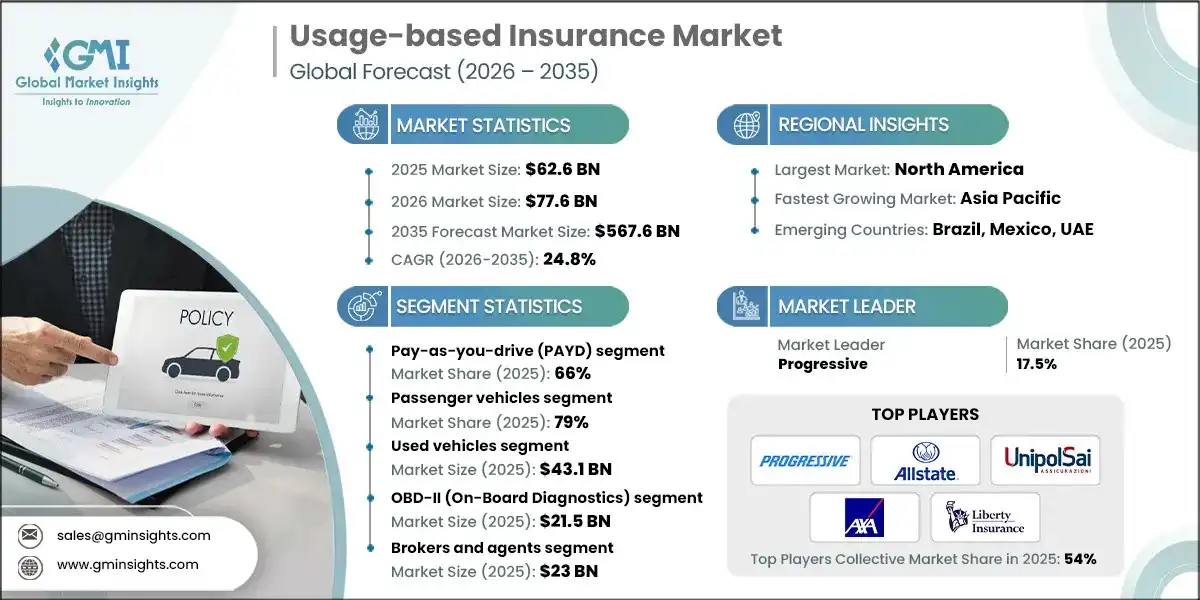
The global usage-based insurance (UBI) market size was valued at USD 62.6 billion in 2025. The market is expected to grow from USD 77.6 billion in 2026 to USD 567.6 billion in 2035, at a CAGR of 24.8%, according to latest report published by Global Market Insights Inc.
Usage-based Insurance (UBI) Market Key Takeaways
Market Size & Growth
- 2025 Market Size: USD 62.6 Billion
- 2026 Market Size: USD 77.6 Billion
- 2035 Forecast Market Size: USD 567.6 Billion
- CAGR (2026–2035): 24.8%
Regional Dominance
- Largest Market: North America
- Fastest Growing Region: Asia Pacific
Key Market Drivers
- Rapid growth of connected vehicles and telematics infrastructure.
- Rising demand for personalized and usage-linked insurance pricing.
- Advancements in AI, ML, and data analytics.
- Insurance sector digital transformation and regulatory acceptance.
Challenges
- Data privacy and cybersecurity concerns.
- Customer resistance to behavioral monitoring.
Opportunity
- High deployment and integration costs.
- Implementing UBI requires investment in telematics hardware, analytics platforms, and integration with legacy insurance systems, increasing complexity for traditional insurers.
Key Players
- Leading Players: Top 5 players in this market include Progressive, Allstate, UNIPOLSAI ASSICURAZIONI, AXA, Liberty Mutual Insurance, which collectively held a market share of 54% in 2025.
Get Market Insights & Growth Opportunities
The usage-based insurance (UBI) market is projected to witness strong growth in the coming years, driven by the increasing penetration of connected vehicles, rising demand for personalized insurance pricing, and the growing emphasis on data-driven risk assessment models. As insurers seek to improve underwriting accuracy, reduce loss ratios, and enhance customer satisfaction, UBI solutions are becoming essential to enable fair, transparent, and behavior-based premium structures aligned with individual driving patterns.
Technological advancements such as telematics devices, smartphone-based tracking, embedded vehicle sensors, AI and ML powered driving behavior analytics, GPS-based mileage monitoring, and real-time data processing platforms are transforming traditional auto insurance models. These innovations enable continuous monitoring of driving parameters such as speed, braking, acceleration, mileage, and time of use, while providing insurers with end-to-end visibility across policy lifecycle stages from enrollment and risk scoring to dynamic pricing, claims management, and renewal optimization.
Market growth is further supported by the expansion of connected and electric vehicles, increasing adoption of pay-as-you-drive (PAYD) and pay-how-you-drive (PHYD) models, rising regulatory acceptance of telematics-based pricing, and growing consumer awareness of cost-saving and usage-linked insurance products. Core UBI functions such as real-time driving data collection, behavioral risk scoring, dynamic premium calculation, driver feedback and coaching, fraud detection, and claims optimization have become critical to insurer competitiveness and profitability. Associated services including telematics device deployment, platform integration, data analytics, consulting, customer support, and compliance management ensure seamless implementation and scalability across diverse insurance portfolios.
In 2024, leading UBI ecosystem participants such as Progressive, Allstate, AXA, Liberty Mutual, UNIPOLSAI Assicurazioni, Metromile, and Octo expanded their usage-based insurance capabilities. These players invested significantly in AI-driven telematics analytics, cloud-based insurance platforms, mobile-enabled customer engagement tools, and deeper integration with policy administration, claims, and customer relationship management systems to improve risk selection, enhance customer retention, and optimize underwriting performance.
The usage-based insurance ecosystem continues to evolve as advanced analytics, real-time telematics, automation, and personalized insurance models reshape the global auto insurance landscape. Insurers and technology providers are increasingly prioritizing integrated, data-driven UBI platforms that deliver holistic insights into driving behavior, enable dynamic pricing, reduce manual intervention, and support long-term profitability. These advancements are redefining the UBI market, enabling more transparent, customer-centric, and risk-optimized insurance solutions across global markets.
To get key market trends
Usage-based Insurance Market Trends
The demand for advanced usage-based insurance (UBI) solutions is rapidly increasing, driven by growing collaboration among insurers, telematics technology providers, automotive OEMs, mobility platforms, and data analytics firms. These partnerships aim to enhance driving behaviour monitoring, real-time risk assessment, personalized premium pricing, claims optimization, and compliance with evolving data privacy and insurance regulations. Industry stakeholders are working together to develop integrated, modular, and data-driven UBI platforms incorporating AI- and ML-powered driving analytics, real-time telematics data collection, cloud-enabled data management, predictive risk modelling, and mobile-first customer engagement applications.
For instance, in 2024, leading UBI ecosystem participants such as Progressive, Allstate, AXA, Liberty Mutual, UNIPOLSAI Assicurazioni, and Octo expanded strategic collaborations with telematics providers, automotive OEMs, and insurtech partners to deploy unified UBI platforms, real-time driving analytics, AI-driven underwriting insights, and automated policy and claims workflows. These initiatives improved underwriting accuracy, reduced loss ratios, enhanced customer transparency, and increased operational efficiency across personal and commercial auto insurance portfolios.
Regional customization of UBI solutions is emerging as a key market trend. Leading insurers are developing localized telematics configurations, region-specific pricing models, regulatory compliance frameworks, and data privacy modules across North America, Europe, Asia Pacific, Latin America, and the Middle East & Africa. These solutions address country-specific insurance regulations, driving behaviors, vehicle usage patterns, and consumer expectations, tailored for diverse segments such as personal auto insurance, fleet insurance, mobility-as-a-service providers, and electric vehicle users.
The rise of specialized insurtech and telematics startups offering AI-powered driving analytics, smartphone-based tracking, predictive risk scoring, and cloud-based UBI platforms is reshaping the competitive landscape. Companies focusing on PAYD and PHYD models, real-time driver feedback, fraud detection, and automated claims processing are enabling scalable and cost-effective deployment of UBI programs. These innovations empower both established insurers and emerging players to accelerate digital transformation, improve customer engagement, and expand UBI adoption across global markets.
The development of standardized, modular, and interoperable UBI platforms is transforming the market. Leading players such as AXA, Progressive, Allstate, Liberty Mutual, UNIPOLSAI, and Octo Group are deploying unified telematics and insurance architectures that integrate seamlessly with policy administration, underwriting, claims, customer relationship management, and automotive data ecosystems. These platforms support customizable pricing models, real-time risk monitoring, enterprise-scale deployment, and compliance with global data protection regulations, enabling insurers to deliver transparent, flexible, and customer-centric usage-based insurance solutions across the full policy lifecycle.
Usage-based Insurance Market Analysis
Learn more about the key segments shaping this market
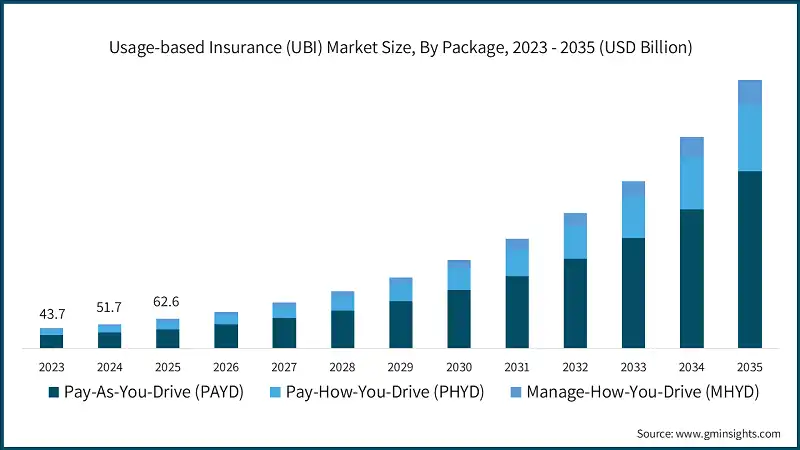
Based on package, the usage-based insurance market is divided into pay-as-you-drive (PAYD), pay-how-you-drive (PHYD) and manage-how-you-drive (MHYD). The pay-as-you-drive (PAYD) segment dominated the market, accounting for around 66% share in 2025 and is expected to grow at a CAGR of over 24.7% from 2026 to 2035.
- The pay-as-you-drive (PAYD) segment dominates the usage-based insurance (UBI) market due to its simplicity, cost-effectiveness, and widespread adoption. By linking insurance premiums primarily to mileage or distance travel, PAYD enables insurers to accurately price risk for low-mileage and safe drivers while providing transparent and affordable insurance solutions. Its ease of implementation and measurable savings make it highly attractive for both insurers and policyholders across global markets.
- The pay-how-you-drive (PHYD) segment focuses on driver behavior, using telematics to monitor parameters such as speed, acceleration, and braking. While PHYD provides more granular risk assessment and encourages safer driving, its adoption is limited compared to PAYD due to higher technological complexity, device requirements, and customer hesitation regarding behavioral monitoring.
- The manage-how-you-drive (MHYD) segment emphasizes driver engagement, coaching, and long-term behavior improvement, often used in fleet management or corporate programs. Despite its advanced features and potential to reduce risk, MHYD represents a smaller portion of the market. Ongoing innovations in AI-powered analytics, mobile telematics, and real-time feedback are gradually increasing the relevance of PHYD and MHYD, but PAYD continues to maintain clear dominance in terms of market share and large-scale deployment.
Learn more about the key segments shaping this market
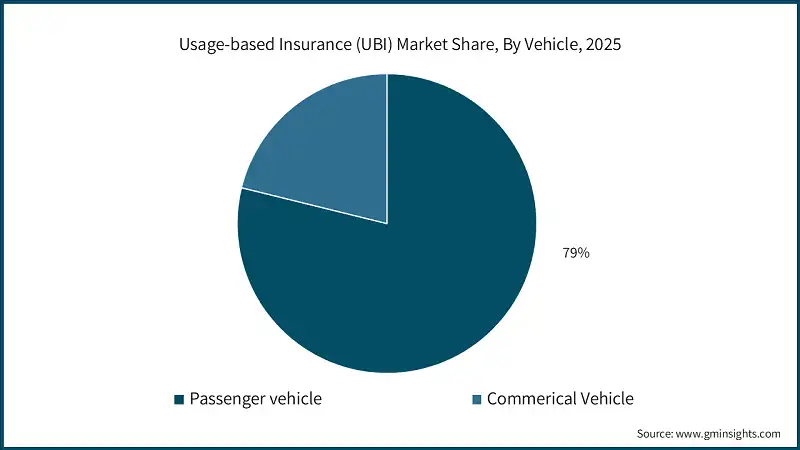
Based on vehicle, the market is divided into passenger vehicles and commercial vehicles. The passenger vehicles segment dominates the market, accounting for around 79% share in 2025, and the segment is expected to grow at a CAGR of over 25.1% from 2026 to 2035.
- The passenger vehicles segment dominates the usage-based insurance market due to its extensive customer base, high penetration of personal auto insurance, and strong alignment with widely adopted UBI models such as Pay-As-You-Drive (PAYD) and Pay-How-You-Drive (PHYD). Individual vehicle owners are increasingly seeking personalized insurance solutions that reflect their actual driving patterns, mileage, and behavior, allowing them to benefit from cost-effective and transparent premium calculations.
- The proliferation of connected cars, telematics devices, smartphone-based tracking, and embedded vehicle sensors has further facilitated the widespread adoption of UBI solutions among passenger vehicle owners, making this segment the primary contributor to overall market growth.
- The commercial vehicles segment, while smaller in comparison, also contributes significantly to the market through fleet telematics, driver monitoring, and operational efficiency programs. UBI adoption in commercial fleets helps insurers and fleet operators optimize risk assessment, reduce accident-related costs, and improve driver safety.
- However, the segment faces relatively higher implementation challenges due to the scale of fleets, regulatory compliance requirements, and the complexity of integrating telematics across diverse vehicle types. Despite these challenges, commercial vehicles continue to show steady growth, but the passenger vehicles segment maintains its clear dominance globally, driven by higher individual adoption rates, easier implementation, and the growing consumer preference for usage-based, behavior-driven insurance solutions.
Based on vehicle age, the market is divided into used vehicles and new vehicles. The used vehicles segment dominated the market and was valued at USD 43.1 billion in 2025.
- The used vehicles segment dominates the usage-based insurance market, driven by strong demand for cost-effective, flexible, and easily implementable telematics-based insurance solutions. UBI programs for used vehicles allow insurers to offer personalized premiums based on actual driving behavior and mileage, making insurance more affordable for cost-conscious consumers. These solutions leverage OBD-II devices, smartphone-based tracking, and cloud-enabled telematics platforms to monitor driving patterns, provide real-time feedback, and optimize risk assessment, making the used vehicles segment the preferred choice for widespread UBI adoption.
- The new vehicles segment also contributes to the market, particularly among owners of connected cars and vehicles with embedded telematics systems. However, adoption in new vehicles is comparatively lower than used vehicles due to higher upfront costs, limited consumer awareness, and slower integration of UBI programs at the point of sale. Despite this, advancements in embedded telematics, mobile applications, and AI-driven analytics are gradually increasing the relevance of new vehicles in the market, but the used vehicles segment continues to maintain its dominant position globally.
Based on technology, the market is divided into OBD-II (On-Board Diagnostics), smartphone-based telematics, embedded telematics and black boxes. The OBD-II (On-Board Diagnostics) segment dominated the market and was valued at USD 21.5 billion in 2025.
- The OBD-II (On-Board Diagnostics) segment dominates the UBI market, driven by its widespread adoption, ease of installation, and reliable data collection for mileage and driving behavior monitoring. OBD-II devices provide insurers with accurate, real-time insights into vehicle usage, acceleration, braking, and overall driving patterns, enabling precise risk assessment and personalized premium pricing. Their compatibility with most passenger vehicles and low implementation complexity makes OBD-II the preferred technology for large-scale UBI deployment across global markets.
- Smartphone-based telematics, embedded telematics, and black box technologies also contribute to market growth by offering additional options for driver monitoring, behavior analysis, and fleet management. Smartphone-based solutions are gaining popularity due to low cost and ease of use, while embedded telematics offer high accuracy in connected and new vehicles. Black boxes, though historically significant, are gradually being phased out in favor of more flexible and integrated telematics solutions. Despite these alternatives, the OBD-II segment continues to maintain its dominant position globally, owing to its scalability, cost-effectiveness, and broad applicability across vehicle types.
Based on distribution channel, the market is divided into brokers and agents, direct sales, online platforms and bancassurance. The brokers and agents segment dominated the market and was valued at USD 23 billion in 2025.
- The brokers and agents segment dominates the usage-based insurance market due to its extensive customer reach, trust, and ability to guide policyholders through the complexities of telematics-based insurance. Brokers and agents play a critical role in explaining PAYD and PHYD models, assisting with device installation, and ensuring customers understand how driving behavior impacts premiums. Their long-standing relationships with clients and expertise in risk assessment make them a preferred channel for insurers deploying UBI solutions on a scale.
- Direct sales, online platforms, and bancassurance also contribute to market growth by providing alternative distribution options. Direct sales allow insurers to engage customers via company websites, mobile apps, or call centers, while online platforms enable telematics-based policy management, real-time data tracking, and customer engagement. Bancassurance channels, though less prevalent, leverage bank-insurer partnerships to reach targeted customer segments in specific regions.
- Despite the increasing adoption of digital and self-service channels, the brokers and agents segment maintains its dominant position globally. Its ability to build trust, provide personalized guidance, and facilitate the deployment of telematics devices ensures that brokers and agents remain the most effective channel for expanding UBI penetration and supporting large-scale adoption across diverse markets.
Looking for region specific data?
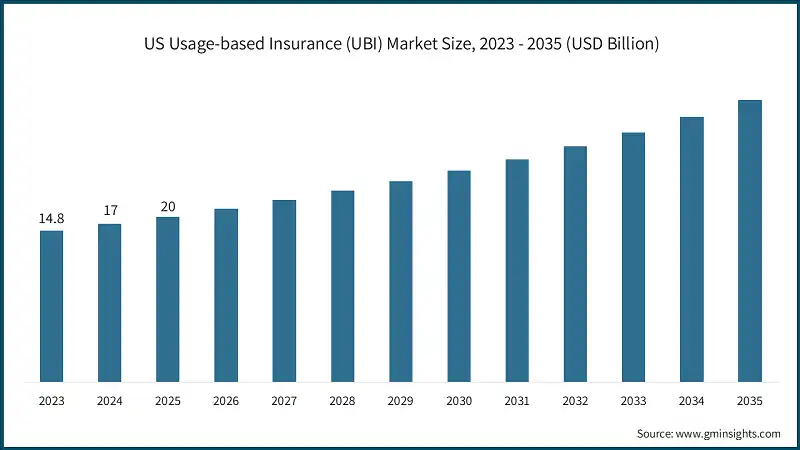
In 2025, US dominated the North America usage-based insurance market with around 78% market share and generated approximately USD 20 billion in revenue.
- The North America region dominates the market, supported by a mature auto insurance ecosystem, high penetration of connected vehicles, and widespread adoption of telematics technologies. The region benefits from advanced implementation of PAYD and PHYD insurance models, OBD-II and smartphone-based telematics, AI- and ML-powered driving analytics, and cloud-based insurance platforms, positioning it as a global leader in UBI solutions and services.
- Within North America, the United States accounted for the largest share, driven by a high concentration of passenger vehicles, large insurer presence, advanced digital infrastructure, and strong focus on personalized, usage-linked insurance pricing. Widespread adoption of telematics-enabled policies, predictive risk analytics, and real-time driving behavior monitoring, combined with extensive collaboration among insurers, technology providers, and automotive OEMs, fuels market growth. States with major automotive and insurance hubs, such as California, New York, and Texas, serve as primary centers for UBI deployment, innovation, and best-practice implementation.
- Key U.S. players, including Progressive, Allstate, AXA, Liberty Mutual Insurance, UNIPOLSAI Assicurazioni, and Octo, continue to expand their UBI portfolios, enhance telematics analytics capabilities, and strengthen strategic partnerships. Ongoing investments in AI-driven risk modeling, cloud-based insurance platforms, mobile engagement tools, and integrated policy and claims systems consolidate the U.S.’s dominant position in the North American market.
Germany holds share of 21% in Europe Usage-based insurance market in 2025 and it will grow tremendously between 2026 and 2035.
- Europe accounted for a significant share of the market, supported by a mature insurance ecosystem, increasing adoption of telematics technologies, and growing implementation of AI-driven risk analytics, cloud-based insurance platforms, and real-time driving behavior monitoring. Insurers across the region are increasingly deploying UBI solutions, while technology providers, automotive OEMs, and insurtech firms focus on personalized premiums, risk optimization, claims management, and data-driven underwriting. Well-established regulatory frameworks, advanced digital infrastructure, and rising demand for cost-effective and usage-linked insurance reinforce Europe’s position as a key regional market.
- Germany dominated the Europe UBI market, supported by its strong automotive industry, high vehicle ownership, and advanced digital and telematics infrastructure. German insurers and technology providers are leading large-scale deployment of PAYD and PHYD programs, AI-powered driving analytics, predictive risk modeling, and telematics-based premium pricing. Investments in OBD-II and embedded telematics systems, real-time monitoring platforms, and integrated policy and claims management solutions have strengthened operational efficiency, expanded solution portfolios, and accelerated market growth, positioning Germany as the regional leader.
- Other major European countries, including the United Kingdom, France, and Italy, are contributing to regional UBI market expansion through adoption of connected car technologies, mobile telematics solutions, and AI-driven risk assessment. The UK emphasizes fleet telematics and digital insurance adoption, France focuses on usage-based pricing for passenger vehicles, and Italy prioritizes personalized driver engagement programs. Despite varying levels of adoption, Germany maintains its leading role in scale, technological innovation, and comprehensive UBI deployment across Europe.
China holds share of 42% in Asia Pacific Usage-based insurance (UBI) market in 2025 and it is expected to grow tremendously between 2026 and 2035.
- Asia-Pacific holds a major share of the market, supported by rapid digital transformation in the insurance sector, growing adoption of telematics technologies, and increasing focus on personalized, usage-linked insurance pricing. The region is witnessing steady growth as insurers, telematics providers, and automotive OEMs invest in AI-powered driving analytics, predictive risk modeling, cloud-enabled insurance platforms, and mobile-first customer engagement solutions. Strong digital infrastructure, large vehicle populations, and evolving regulatory frameworks continue to strengthen Asia-Pacific’s position in the UBI market.
- China represents the largest market in Asia-Pacific, driven by widespread adoption of OBD-II, smartphone-based, and embedded telematics technologies, PAYD and PHYD insurance models, AI- and ML-powered risk analytics, and integrated policy and claims management systems. Major automotive and insurance hubs such as Beijing, Shanghai, Shenzhen, and Guangzhou are experiencing high demand for real-time driving monitoring, predictive premium pricing, and personalized insurance solutions. Regulatory support, digital maturity, and strong insurer–technology partnerships further accelerate the deployment of advanced UBI solutions across passenger vehicles, fleets, and emerging mobility services.
- Other Asia-Pacific markets, including India, Japan, and Singapore, are emerging as high-growth regions, supported by increasing adoption of telematics-enabled policies, smartphone-based tracking, and AI-driven risk assessment. India emphasizes fleet telematics and cost-effective insurance solutions, Japan focuses on connected vehicles and predictive analytics, and Singapore prioritizes usage-based pricing and customer engagement. Despite growing adoption in these countries, China remains the dominant market in Asia-Pacific, driven by scale, technological innovation, and strong enterprise and regulatory support.
Usage-based insurance market in Brazil will experience significant growth between 2026 and 2035.
- Latin America holds a smaller share but is steadily expanding its presence in the market, driven by growing digitalization in the insurance sector, increasing adoption of telematics technologies, and rising focus on personalized, usage-linked insurance models. Insurers across the region are gradually deploying AI-powered driving analytics, predictive risk scoring, real-time mileage and behavior monitoring, and cloud-enabled insurance platforms. Strengthening insurer networks, expanding vehicle ownership, and improving regulatory frameworks continue to support Latin America’s growing role in the market.
- Brazil dominates the Latin American UBI market, supported by its large vehicle population, growing insurance adoption, and focus on cost-effective, telematics-based insurance solutions. Major urban hubs such as São Paulo, Rio de Janeiro, and Brasília host numerous insurers, telematics providers, and automotive OEMs implementing PAYD and PHYD programs, AI- and ML-powered driving analytics, and integrated policy and claims management systems. Leading insurers, including Progressive, Allstate, AXA, Liberty Mutual, UNIPOLSAI Assicurazioni, and Octo, actively offer scalable, cloud-enabled, and data-driven UBI solutions, reinforcing Brazil’s dominant position in the regional market.
- Mexico represents the second largest and rapidly growing market, driven by increasing adoption of telematics-enabled policies, fleet and passenger vehicle insurance, and smartphone-based tracking solutions. Key cities such as Mexico City, Monterrey, and Guadalajara are witnessing higher deployment of real-time driving behavior monitoring, predictive risk analytics, and mobile-first insurance platforms, contributing to the overall growth and modernization of Latin America’s market.
Usage-based insurance market in UAE will experience significant growth between 2026 and 2035.
- The Middle East & Africa (MEA) region accounted for a modest share of the market in 2025, supported by gradual adoption of telematics technologies, expansion of vehicle ownership, and increasing focus on personalized, usage-linked insurance models. Countries across the region are progressively implementing AI-powered driving analytics, predictive risk scoring, cloud-enabled insurance platforms, and mobile-first telematics solutions. Growth of insurer networks, emerging digital infrastructure, and regulatory initiatives further support MEA’s integration into the market.
- The UAE dominates the MEA UBI market, driven by high adoption of telematics-based insurance solutions among passenger vehicles, connected cars, and corporate fleets. Key hubs such as Dubai and Abu Dhabi host major insurance companies, automotive OEMs, and telematics service providers that implement PAYD and PHYD programs, AI- and ML-powered driving analytics, predictive premium pricing, and integrated policy and claims management systems to enhance risk assessment, customer engagement, and cost optimization.
- Leading insurers and telematics providers, including Progressive, Allstate, AXA, Liberty Mutual, UNIPOLSAI Assicurazioni, and Octo, are actively deploying cloud-enabled, AI-driven, and mobile-accessible UBI platforms to strengthen the UAE’s position as the regional leader in usage-based insurance. The adoption of advanced technologies and data-driven insurance practices in the UAE is expected to drive further growth and set benchmarks for neighboring MEA markets.
Usage-based Insurance Market Share
- The top 7 companies in the market are Progressive, Allstate, UNIPOLSAI ASSICURAZIONI, AXA, Liberty Mutual Insurance, Metromile and Octo. These companies hold around 55% of the market share in 2025.
- Progressive is a global leader in usage-based insurance (UBI), offering telematics-driven auto insurance solutions such as its Snapshot program. Progressive emphasizes OBD-II and smartphone-based telematics, AI- and ML-powered driving analytics, real-time risk assessment, and predictive premium pricing. Its extensive U.S. presence, scalable digital platforms, and integration with policy administration and claims management systems reinforce its strong market share in the UBI sector.
- Allstate provides comprehensive UBI solutions through its Drivewise platform, enabling continuous driving behavior monitoring, personalized premium calculation, and real-time feedback. Allstate focuses on cloud-enabled platforms, AI-driven risk analytics, mobile telematics applications, and customer engagement tools, supporting its competitive position and significant market share in North America.
- UNIPOLSAI ASSICURAZIONI is a leading European UBI provider with strong adoption of telematics-based insurance across Italy and neighboring markets. The company integrates in-vehicle telematics, behavior-based pricing models, and predictive analytics to improve underwriting precision. UNIPOLSAI’s cloud-enabled platforms, robust analytics capabilities, and partnerships with telematics providers strengthen its market presence in Europe.
- AXA delivers UBI solutions across multiple global markets, leveraging embedded and smartphone-based telematics, AI-driven driving analytics, and connected-vehicle data to offer PAYD and PHYD models. AXA emphasizes cloud-native deployment, regulatory compliance, and seamless integration with policy and claims systems, maintaining a strong competitive position and market share worldwide.
- Liberty Mutual Insurance offers telematics-based insurance programs that analyze driver behavior, mileage, and usage patterns to provide customized premiums. The company focuses on AI-powered risk modeling, mobile telematics applications, and cloud-enabled insurance platforms, reinforcing its market presence and adoption across passenger vehicles and fleet programs.
- Metromile specializes in UBI for low-mileage and urban drivers, using smartphone-based telematics and AI-driven analytics to calculate pay-per-mile premiums. Metromile leverages cloud platforms, predictive risk assessment, and mobile engagement tools, supporting its niche market share and rapid adoption in the U.S. personal auto insurance sector.
- Octo provides telematics-enabled UBI solutions, focusing on driving behavior monitoring, PAYD and PHYD models, and AI-driven risk analytics. Octo Group emphasizes cloud-based insurance platforms, mobile telematics applications, and integration with policy and claims management systems, reinforcing its competitive presence and market share in Europe and other global markets.
Usage-based Insurance Market Companies
Major players operating in the usage-based insurance (UBI) industry include:
- Allianz
- Allstate
- AXA
- Liberty Mutual Insurance
- Metromile
- Octo Group
- Progressive
- State Farm Mutual Automobile Insurance Company
- UNIPOLSAI ASSICURAZIONI
- Zurich Insurance
- The usage-based insurance (UBI) market is highly competitive, with leading solution providers such as Progressive, Allstate, AXA, Liberty Mutual Insurance, UNIPOLSAI ASSICURAZIONI, Metromile, Octo, State Farm, Zurich Insurance, and Allianz occupying key segments across PAYD/PHYD models, telematics technologies, AI- and ML-powered driving analytics, real-time risk monitoring, predictive premium pricing, and cloud-based insurance platforms.
- Progressive, Allstate, AXA, Liberty Mutual, and UNIPOLSAI lead the market with comprehensive, end-to-end UBI solutions, integrating OBD-II, smartphone-based, and embedded telematics, AI-driven driving analytics, predictive risk assessment, and policy/claims management systems. These companies focus on enhancing underwriting accuracy, reducing loss ratios, improving customer engagement, and expanding telematics adoption across passenger vehicles, fleets, and connected car programs globally.
- Metromile, Octo, State Farm, Zurich, and Allianz specialize in scalable, flexible, and technology-driven UBI platforms, emphasizing real-time driving insights, mobile telematics applications, usage-based pricing, workflow automation, and seamless integration with insurer operations. Their solutions enable precise risk evaluation, personalized premium calculation, fraud detection, claims optimization, and operational efficiency. Overall, the market is characterized by rapid technological adoption, with companies continuously developing AI-enabled, cloud-based, and mobile-accessible UBI platforms to improve customer satisfaction, increase adoption, and strengthen competitive positioning across global markets.
Usage-based Insurance (UBI) Market Report Attributes
| Key Takeaway | Details |
|---|---|
| Market Size & Growth | |
| Base Year | 2025 |
| Market Size in 2025 | USD 62.6 Billion |
| Market Size in 2026 | USD 77.6 Billion |
| Forecast Period 2026-2035 CAGR | 24.8% |
| Market Size in 2035 | USD 567.6 Billion |
| Key Market Trends | |
| Drivers | Impact |
| Rapid growth of connected vehicles and telematics infrastructure | The increasing integration of telematics systems, OBD-II devices, smartphone tracking, and embedded vehicle sensors is enabling insurers to collect real-time driving and usage data. |
| Rising demand for personalized and usage-linked insurance pricing | Consumers are increasingly favoring insurance models that reflect actual mileage and driving behavior rather than traditional demographic-based pricing. |
| Advancements in AI, ML, and data analytics | AI- and ML-driven analytics improve driver risk scoring, underwriting accuracy, fraud detection, and claims optimization. |
| Insurance sector digital transformation and regulatory acceptance | Insurers are modernizing legacy systems and adopting cloud-based platforms to improve efficiency and decision-making. |
| Pitfalls & Challenges | Impact |
| Data privacy and cybersecurity concerns | Continuous collection of driving and location data raises concerns around data security, regulatory compliance, and customer trust, potentially limiting adoption if not managed transparently. |
| Customer resistance to behavioral monitoring | Some drivers remain hesitant to adopt UBI due to perceptions of constant surveillance or uncertainty around how driving behavior impacts premiums. |
| Opportunities: | Impact |
| High deployment and integration costs | Implementing UBI requires investment in telematics hardware, analytics platforms, and integration with legacy insurance systems, increasing complexity for traditional insurers |
| Implementing UBI requires investment in telematics hardware, analytics platforms, and integration with legacy insurance systems, increasing complexity for traditional insurers | Variability in data quality across devices, vehicles, and regions can affect pricing accuracy and scalability, making standardization a critical challenge. |
| Market Leaders (2025) | |
| Market Leaders |
Progressive |
| Top Players |
|
| Competitive Edge |
|
| Regional Insights | |
| Largest Market | North America |
| Fastest growing market | Asia Pacific |
| Emerging countries | Brazil, Mexico, UAE |
| Future outlook |
|
What are the growth opportunities in this market?
Usage-based Insurance Industry News
- In March 2025, Progressive launched an upgraded UBI platform integrating AI- and ML-powered driving analytics, real-time risk monitoring, and cloud-enabled predictive premium pricing. The initiative aims to improve underwriting accuracy, reduce loss ratios, and enhance customer engagement across passenger vehicles and fleet programs in the U.S. and international markets.
- In February 2025, Allstate introduced a new telematics module within its Drivewise platform, featuring real-time driving behavior analysis, continuous mileage tracking, and AI-driven risk scoring. The rollout focuses on optimizing usage-based premiums, enhancing policyholder insights, and supporting large-scale deployment across diverse vehicle segments.
- In January 2025, AXA unveiled an AI-driven UBI solution for European and global markets, incorporating OBD-II and smartphone-based telematics, predictive risk modeling, and automated claims integration. The initiative targets passenger and commercial vehicles, enabling more accurate premium calculation and improved driver safety.
- In December 2024, Liberty Mutual Insurance expanded its telematics-based insurance offerings, adding AI-powered driving analytics, mobile engagement tools, and cloud-enabled risk assessment dashboards. The deployment aims to support insurers and policyholders with enhanced monitoring, personalized premiums, and fraud prevention capabilities.
- In October 2024, Metromile, Octo, and UNIPOLSAI ASSICURAZIONI launched integrated UBI platforms combining real-time driver feedback, predictive risk analytics, and cloud-native telematics solutions. The move emphasizes scalable deployment, data-driven premium calculation, and improved operational efficiency across personal and fleet insurance programs globally.
The usage-based insurance (UBI) market research report includes in-depth coverage of the industry with estimates & forecasts in terms of revenue ($ Bn) from 2022 to 2035, for the following segments:
Market, By Package
- Pay-How-You-Drive (PHYD)
- Pay-As-You-Drive (PAYD)
- Device- based
- Telematics-based
- Manage-How-You-Drive (MHYD)
Market, By Vehicle
- Passenger vehicle
- OBD-II
- Black box
- Smartphone
- Embedded telematics
- Commercial vehicle
- Light commercial vehicles (LCVs)
- OBD-II
- Black box
- Smartphone
- Embedded telematics
- Medium commercial vehicles (MCVs)
- OBD-II
- Black box
- Smartphone
- Embedded telematics
- Heavy commercial vehicles (HCVs)
- OBD-II
- Black Box
- Smartphone
- Embedded telematics
- Light commercial vehicles (LCVs)
Market, By Technology
- OBD-II
- Black box
- Smartphone
- Embedded telematics
Market, By Vehicle Age
- New vehicles
- Used vehicles
Market, By Distribution channel
- Brokers and agents
- Direct sales
- Online platforms
- Bancassurance
The above information is provided for the following regions and countries:
- North America
- US
- Canada
- Europe
- UK
- Germany
- France
- Italy
- Spain
- Belgium
- Netherlands
- Sweden
- Asia Pacific
- China
- India
- Japan
- Australia
- Singapore
- South Korea
- Vietnam
- Indonesia
- Latin America
- Brazil
- Mexico
- Argentina
- MEA
- South Africa
- Saudi Arabia
- UAE
Frequently Asked Question(FAQ) :
What was the market size of the usage-based insurance (UBI) in 2025?
The market size was valued at USD 62.6 billion in 2025, with a CAGR of 24.8% expected through 2035. Increasing penetration of connected vehicles, demand for personalized insurance pricing, and data-driven risk assessment models are driving market growth.
What is the projected value of the usage-based insurance (UBI) market by 2035?
The market is poised to reach USD 567.6 billion by 2035, driven by advancements in telematics, AI-powered analytics, and behavior-based premium models.
What is the expected size of the usage-based insurance industry in 2026?
The market size is projected to reach USD 77.6 billion in 2026.
What was the market share of the pay-as-you-drive (PAYD) segment in 2025?
The PAYD segment accounted for approximately 66% of the market share in 2025 and is expected to grow at a CAGR of over 24.7% from 2026 to 2035.
What was the market share of the pay-as-you-drive (PAYD) segment in 2025?
The PAYD segment accounted for approximately 66% of the market share in 2025 and is expected to grow at a CAGR of over 24.7% from 2026 to 2035.
What was the valuation of the passenger vehicles segment in 2025?
The passenger vehicles segment dominated the market with a 79% share in 2025 and is set to expand at a CAGR of over 25.1% till 2035.
What was the valuation of the OBD-II (On-Board Diagnostics) segment in 2025?
The OBD-II segment was valued at USD 21.5 billion in 2025, led by its widespread adoption, ease of installation, and reliable data collection for monitoring driving behavior.
Which region leads the usage-based insurance (UBI) sector?
North America leads the market, with the U.S. accounting for 78% of the regional revenue, generating approximately USD 20 billion in 2025.
What are the upcoming trends in the usage-based insurance market?
Trends include AI- and ML-powered driving analytics, cloud-based insurance platforms, smartphone-based telematics, real-time risk assessment, and the integration of PAYD and PHYD models.
Who are the key players in the usage-based insurance (UBI) industry?
Key players include Allianz, Allstate, AXA, Liberty Mutual Insurance, Metromile, Octo Group, Progressive, State Farm Mutual Automobile Insurance Company, UNIPOLSAI ASSICURAZIONI, and Zurich Insurance.
Usage-based Insurance (UBI) Market Scope
Related Reports