Summary
Table of Content

U.S. Ultra-Luxury Home Automation Market
Get a free sample of this report
Form submitted successfully!
Error submitting form. Please try again.
Thank you!
Your inquiry has been received. Our team will reach out to you with the required details via email. To ensure that you don't miss their response, kindly remember to check your spam folder as well!
Request Sectional Data
Thank you!
Your inquiry has been received. Our team will reach out to you with the required details via email. To ensure that you don't miss their response, kindly remember to check your spam folder as well!
Form submitted successfully!
Error submitting form. Please try again.
U.S. Ultra-Luxury Home Automation Market Size
- Ultra-luxury residential development is a large and increasingly important factor in supporting growth in the U.S. market. The increase in high-value residential projects creates a demand for smart home systems that are sophisticated and completely integrated. Ultra-luxury properties provide residents with premium living experiences through intelligent automation infrastructure. More developers are now incorporating automation into their developments during the construction phase to satisfy the high expectations of ultra-luxury buyers. Large homes typically require centrally located devices and equipment for the efficient control of lighting, climate, and security because of their size. The use of home automation significantly enhances the ability of ultra-luxury properties to differentiate themselves from other ultra-luxury properties in a competitive real estate market.
- As buyers associate high-end automation with exclusivity, convenience, and increased long-term value, there is a direct correlation between the increase in the inventory of luxury villas, as well as custom design/build homes and the number of home automation installations. Furthermore, most of the ultra-luxury real estate projects develop seamless integration of technology through large living spaces. Automation systems provide efficient control over the management of the often-complex layouts of ultra-luxury homes, which typically consist of multiple distinct zones.
- High incomes and luxury lifestyle expenditures are driving growth in the ultra-luxury home automation market in the United States. Affluent consumers have strong buying power to spend on premium residential technologies. The increased income level of wealthy homeowners is creating demand for customized home automation systems that are beyond the traditional smart home category. The expenditures associated with a luxury lifestyle mean that consumers are seeking comfort, exclusivity, and seamless control of their living environments. Home automation solutions meet these expectations by providing consumers with custom control of their lighting, temperature, safety, and entertainment in their homes. More than ever before, wealthy homeowners view cutting-edge home automation technology as a continuation of their luxury living standards.
- Higher disposable income enables the purchase of professionally designed and fully integrated home automation systems, which enhance convenience and improve the overall experience of living in a luxury residence. Consumers who focus on luxury value home automation technologies that enhance the appearance of the home’s architecture and complement the home’s interior design. As demand for premium features within a home increases, the demand for advanced control platforms and services increases too. Financial confidence encourages homeowners to upgrade to the latest home automation technologies within the product lifecycle.
- The ultra-luxury home automation area of the U.S. market, which includes centralized systems, is a significant component. Centralized solutions provide a single platform from which all the homeowner's lighting, climate, security, and entertainment systems are controlled within one large luxury home. Homeowners who desire highly customized automation solutions that meet their unique needs tend to favor the use of centralized solutions. When combined, the various sub-systems in a complete and integrated system create a high degree of reliability with minimal compatibility concerns.
- Use of a sophisticated interface that enables easy and intuitive control of each subsystem via mobile devices and touch screens has become commonplace. Professional design and installation provides for optimization of system performance. Continuous growth within this segment of the luxury home market is driven primarily by an increase in demand for "smart", interconnected luxury homes.
The U.S. ultra-luxury home automation market was estimated at USD 3.3 billion in 2025. The market is expected to grow from USD 3.5 billion in 2026 to USD 6.7 billion in 2035, at a CAGR of 7.4%, according to latest report published by Global Market Insights Inc.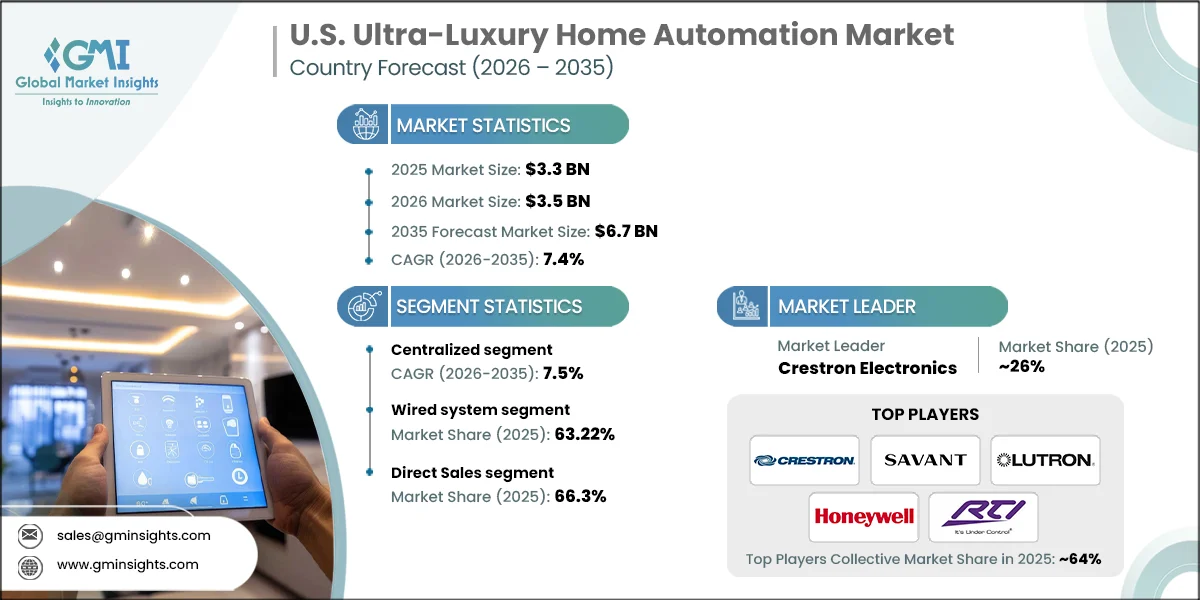
U.S. Ultra-Luxury Home Automation Market Key Takeaways
Market Size & Growth
- 2025 Market Size: USD 3.3 Billion
- 2026 Market Size: USD 3.5 Billion
- 2035 Forecast Market Size: USD 6.7 Billion
- CAGR (2026–2035): 7.4%
Key Market Drivers
- Large and growing ultra-luxury real estate segment.
- High disposable incomes and luxury lifestyle spending.
- Technological innovation in IoT, AI, and integrated ecosystems.
Challenges
- High upfront costs and installation complexity.
- Cybersecurity and data privacy concerns.
Opportunity
- AI-powered predictive automation and personalization.
- Partnerships with luxury real estate developers and architects.
Key Players
- Market Leader: Crestron Electronics led with over 26% market share in 2025.
- Leading Players: Top 5 players in this market include Crestron Electronics, Savant Systems, Lutron Electronics, Honeywell International, Remote Technologies Inc., which collectively held a market share of 64% in 2025.
Get Market Insights & Growth Opportunities
To get key market trends
U.S. Ultra-Luxury Home Automation Market Trends
- Ultra-luxury home automation adoption in the U.S. is growing alongside robust sales of high-end residences. Wealthy buyers are investing more in upscale estates that include advanced home technologies as part of the overall property appeal. This trend reflects affluent consumers’ desire to merge premium living spaces with state-of-the-art automation systems. Growth in luxury property transactions reinforces long-term demand for sophisticated smart home solutions.
- The U.S. accounts for a predominant share of the ultra-luxury home automation market, supported by strong technology ecosystems. American homeowners benefit from extensive networks of manufacturers, integrators, and technology partners specializing in premium automation systems. This established infrastructure ensures seamless delivery and servicing of complex smart home installations. High consumer awareness and available innovation contribute to widespread adoption in the luxury segment.
- U.S. ultra-luxury systems increasingly incorporate artificial intelligence and predictive features for more intuitive control. Smart environments now adapt automatically to resident behavior and preferences without manual input. These intelligent capabilities extend across lighting, climate, security, and entertainment systems throughout the home. Advanced programming enhances convenience and creates a deeply personalized living experience for affluent buyers.
- Centralized automation platforms remain the preferred choice in U.S. ultra-luxury residences due to their unified control of multiple systems. Homeowners often demand one cohesive interface to manage lighting, audio-visual equipment, climate settings, and security features. This centralized design simplifies use while ensuring consistency across connected technologies. Such systems enhance reliability and responsiveness in large, complex properties.
- Luxury home automation buyers in the U.S. increasingly seek bespoke systems tailored to specific architectural and lifestyle needs. Direct engagement with manufacturers and integrators allows affluent clients to shape highly personalized technology experiences. Customized installations often include high-end materials, voice control, biometric security, and energy management tools. This emphasis on bespoke design reinforces exclusivity and long-term client satisfaction.
U.S. Ultra-Luxury Home Automation Market Analysis
Learn more about the key segments shaping this market
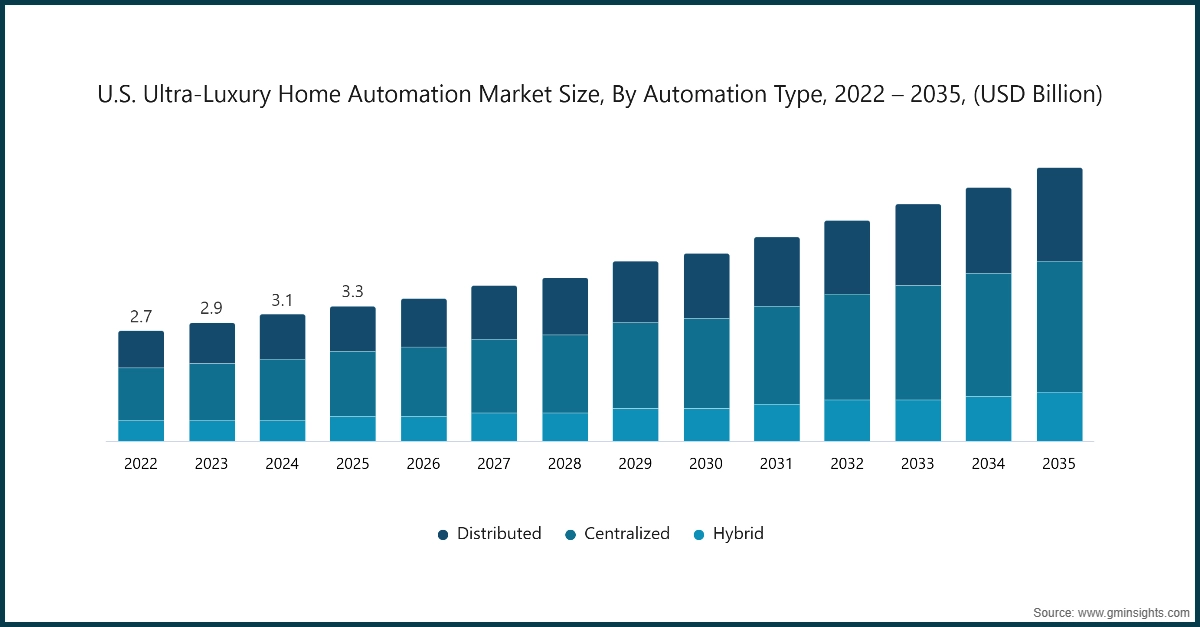
Based on automation type, the U.S. ultra-luxury home automation market is categorized into distributed, centralized, and hybrid. The centralized segment accounted for revenue of around USD 1.6 billion in 2025 and is anticipated to grow at a CAGR of 7.5% from 2026 to 2035.
- Centralized automation dominates the U.S. ultra-luxury home automation market due to advanced system integration capabilities. Unified control platforms enable seamless operation of lighting, security, climate, and entertainment systems. Large luxury residences benefit from centralized architecture supporting consistent performance across multiple zones. High-net-worth homeowners prioritize reliability and tailored automation experiences.
- Integrated systems reduce compatibility challenges and enhance operational stability. Advanced user interfaces improve convenience through intuitive control methods. Professional installation ensures optimized functionality and long-term system efficiency. Growing demand for smart luxury residences reinforces centralized automation dominance.
Based on technology type, of U.S. ultra-luxury home automation market consists of wired system and wireless system. The wired system emerged as leader and held 63.22% of the total market share in 2025 and is anticipated to grow at a CAGR of 6.8% from 2026 to 2035.
- Wired systems dominate the U.S. market due to superior system stability. Physical cabling ensures consistent connectivity across large and architecturally complex residences. High data transmission capacity supports advanced automation functions without performance interruptions. Luxury homeowners prefer wired infrastructure for enhanced security and reduced signal interference.
- Seamless integration with centralized automation platforms improves overall system responsiveness. Long operational lifespan lowers maintenance and replacement requirements. Professional installation aligns wired systems with premium construction and design standards.
Learn more about the key segments shaping this market
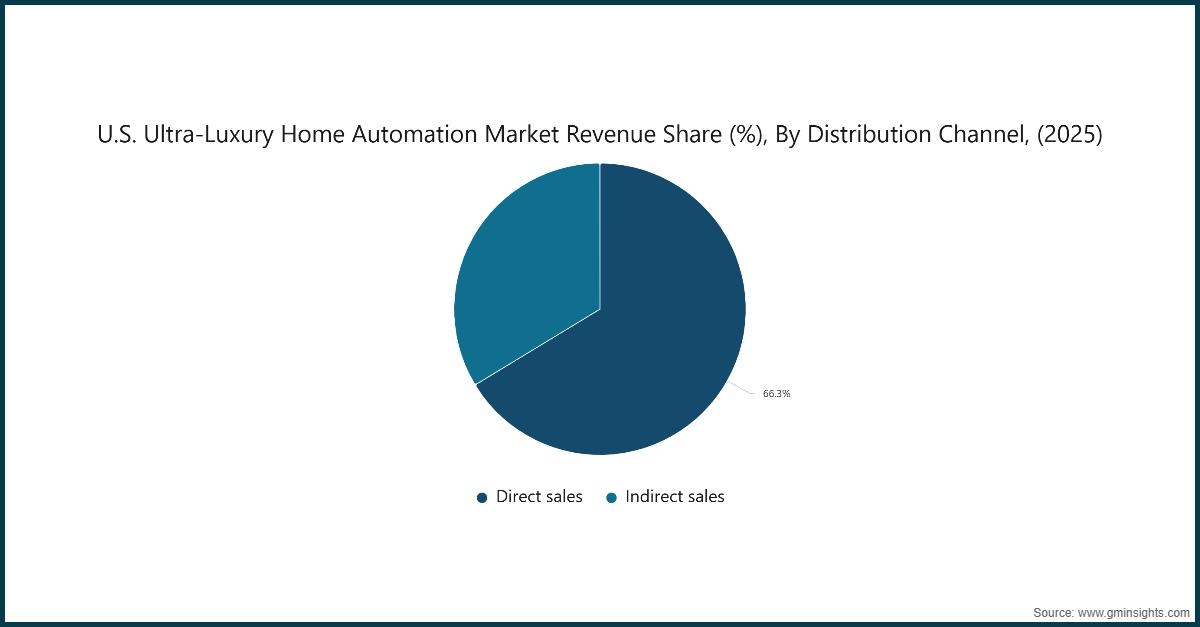
Based on distribution channel, U.S. ultra-luxury home automation market consists of conventional and smart. The direct sales emerged as leader and held 66.3% of the total market share in 2025 and is anticipated to grow at a CAGR of 7.1% from 2026 to 2035.
- Direct sales lead market share in the U.S. market due to personalized service delivery. Manufacturers collaborate directly with homeowners, architects, and luxury developers during planning phases. Tailored automation solutions address unique design and lifestyle requirements of premium residences.
- Direct engagement enhances transparency across system specifications and pricing structures. High-value projects require detailed technical consultation and customization. Streamlined communication reduces installation errors and project delays. Post-installation support strengthens long-term customer relationships and system reliability.
U.S. Ultra-Luxury Home Automation Market Share
- In 2025, the prominent manufacturers in U.S. market are Crestron Electronics, Savant Systems, Lutron Electronics, Honeywell International, and Remote Technologies Inc. collectively held the market share of ~64%.
- Crestron Electronics leads the U.S. ultra-luxury home automation market through fully customized and highly integrated control systems. The company enables centralized management of lighting, audio-visual, climate, shading, and security systems. Crestron focuses on bespoke programming, long-term system reliability, and flexibility for large and complex residences. Its extensive network of certified integrators and strong relationships with luxury architects and developers support sustained market leadership.
- Savant Systems holds a strong position in the U.S. ultra-luxury segment by delivering premium automation solutions with a focus on simplicity and design consistency. The company emphasizes intuitive user interfaces, strong Apple ecosystem integration, and sleek hardware aesthetics. Savant systems are widely adopted in luxury homes, yachts, and custom estates. Its close collaboration with high-end integrators and focus on user experience support steady adoption among homeowners.
U.S. Ultra-Luxury Home Automation Market Companies
Major players operating in the U.S. ultra-luxury home automation industry include:
- Crestron Electronics
- Savant Systems
- Lutron Electronics
- Vivint Smart Home
- Remote Technologies Inc.
- Honeywell International
- Integrated AV
- Heyo Smart
- Leviton Manufacturing Co.
- Universal Remote Control
- Liaison Technology Group
- Smart Systems of Texas
- The HomeWorks Group
- Digital Interiors
- J.J. Orion
Lutron Electronics is a key player in the U.S. ultra-luxury home automation market, driven primarily by its leadership in lighting and shading control systems. The company is known for precision dimming, system reliability, and elegant design. Lutron products are frequently specified in luxury residences and estates. Its focus on comfort, energy efficiency, and seamless integration with broader automation platforms strengthens its position in high-end residential projects.
Honeywell International participates in the U.S. ultra-luxury home automation market through advanced climate control, security, and connected home technologies. The company emphasizes system stability, energy management, and scalable infrastructure suitable for large luxury residences. Honeywell solutions are often selected for smart estates requiring robust and integrated building systems. Its strong brand reputation and expertise in residential and commercial automation support continued demand in premium home applications.
Remote Technologies Inc. is a recognized provider of control and automation solutions for high-end residential environments in the U.S. The company specializes in user interfaces, control processors, and integration tools designed for custom installations. RTI focuses on flexibility and compatibility with third-party devices. Its strong presence among professional integrators and focus on tailored solutions support its role in complex ultra-luxury home automation projects.
U.S. Ultra-Luxury Home Automation Market Report Attributes
| Key Takeaway | Details |
|---|---|
| Market Size & Growth | |
| Base Year | 2025 |
| Market Size in 2025 | USD 3.3 Billion |
| Market Size in 2026 | USD 3.5 Billion |
| Forecast Period 2026-2035 CAGR | 7.4% |
| Market Size in 2035 | USD 6.7 Billion |
| Key Market Trends | |
| Drivers | Impact |
| Large and growing ultra-luxury real estate segment | Significant increases in high-end home sales signal affluent buyer demand for high-end automation systems tailored to expansive luxury properties, directly elevating market demand. |
| High disposable incomes and luxury lifestyle spending | Affluent U.S. consumers are increasingly willing to spend on premium home automation for comfort, convenience, security, and personalization, expanding the customer base for ultra-luxury solutions. |
| Technological innovation in IoT, AI, and integrated ecosystems | Cutting-edge smart technologies such as AI-driven control, centralized systems, and IoT-enabled device interconnectivity enhance user experiences and fuel consumer preference for ultra-luxury automation systems. |
| Pitfalls & Challenges | Impact |
| High upfront costs and installation complexity | Premium systems require substantial spending for advanced hardware and professional custom installation, which limits adoption slows broader penetration. |
| Cybersecurity and data privacy concerns | Connected ultra-luxury systems collect and transmit sensitive data, raising significant security and privacy risks that may deter adoption without robust protective measures. |
| Opportunities: | Impact |
| AI-powered predictive automation and personalization | Growing integration of advanced AI offers homeowners predictive customization, enhancing convenience and value in ultra-luxury systems |
| Partnerships with luxury real estate developers and architects | Embedding ultra-luxury automation systems at the design and build phase for premier properties provides seamless integrated experiences tailored to elite buyers. |
| Market Leaders (2025) | |
| Market Leader |
Market share of ~26% |
| Top Players |
Collective market share of ~64% |
| Competitive Edge |
|
| Regional Insights | |
| Future outlook |
|
What are the growth opportunities in this market?
U.S. Ultra-Luxury Home Automation Industry News
- In September 2025, Crestron launched the Cevo Mini Remote, a handheld control device developed for smart home applications. The remote supports control of entertainment systems, lighting, and automation scenes and features a compact design intended for use in high-end residential environments.
- In September 2025, Lutron Electronics launched the Native by Design Partner Program. This initiative integrates Lutron’s intelligent lighting and motorized shading technology natively with select luxury smart home brands and products, designed to streamline installation and improve performance in high-end residential automation systems.
- In February 2025, Savant Systems unveiled new smart home solutions including GE Proseo smart lighting and shading products and Savant Smart Power Modules at the 2025 International Builder’s Show. The launch includes GE-branded professional smart lighting and shade solutions along with affordable smart power modules that help homeowners manage energy usage and integrate automation seamlessly.
- In February 2025, Leviton Manufacturing Company opened its Immersive Customer Experience Center in Nashville and announced plans to showcase its lighting, networking, and smart control solutions for homes and small businesses, including its Decora Smart Wi-Fi Dimmer and advanced smart sensors.
The U.S. ultra-luxury home automation market research report includes in-depth coverage of the industry, with estimates & forecast in terms of revenue (USD Billion) and volume (Thousand Units) from 2022 to 2035, for the following segments:
Market, By Product Type
- Lighting devices
- In-wall modules/ smart bulbs
- Smart switches
- Smart plugs
- Others
- Smart security devices
- Motion/arrival sensor
- Door/window sensor
- Alarms
- Smart wireless bells
- Smart door locks
- Others
- Entertainment devices
- Speakers/ audio distribution
- Video distribution
- Others
- Protection sensors
- Flood/fire sensors
- UV sensors
- Others
- Others
Market, By Automation Type
- Distributed
- Centralized
- Hybrid
Market, By Technology
Wired system
- Wireless system
Market, By Distribution Channel
Direct sales
- Indirect sales
Frequently Asked Question(FAQ) :
What was the market size of the U.S. ultra-luxury home automation in 2025?
The market size was USD 3.3 billion in 2025, with a CAGR of 7.4% expected through 2035. Growth is driven by increasing demand for sophisticated, fully integrated smart home systems in high-value residential projects.
What is the projected value of the U.S. ultra-luxury home automation market by 2035?
The market is poised to reach USD 6.7 billion by 2035, fueled by advancements in automation technologies, rising luxury property transactions, and consumer demand for premium living experiences.
What is the expected size of the U.S. ultra-luxury home automation industry in 2026?
The market size is projected to reach USD 3.5 billion in 2026.
How much revenue did the centralized segment generate in 2025?
The centralized segment generated approximately USD 1.6 billion in 2025 and is anticipated to grow at a CAGR of 7.5% till 2035.
What was the market share of the wired system segment in 2025?
The wired system segment held 63.22% of the total market share in 2025 and is expected to witness over 6.8% up to 2035.
What is the growth outlook for the direct sales segment from 2026 to 2035?
The direct sales segment, which held 66.3% of the total market share in 2025, is set to expand at a CAGR of 7.1% through 2035.
What are the upcoming trends in the U.S. ultra-luxury home automation market?
Key trends include AI-driven automation, centralized control platforms, customized smart systems, advanced materials, voice and biometric security, and energy management solutions.
Who are the key players in the U.S. ultra-luxury home automation industry?
Key players include Crestron Electronics, Savant Systems, Lutron Electronics, Vivint Smart Home, Remote Technologies Inc., Honeywell International, Integrated AV, Heyo Smart, Leviton Manufacturing Co., and Universal Remote Control.
U.S. Ultra-Luxury Home Automation Market Scope
Related Reports